

An evaluation of variation in published estimates of schizophrenia prevalence from 1990–2013: A systematic literature review
Open accessThe DOI matches its Crossref record; 115 of the 115 references it cites were found in a registry or an index.
Abstract
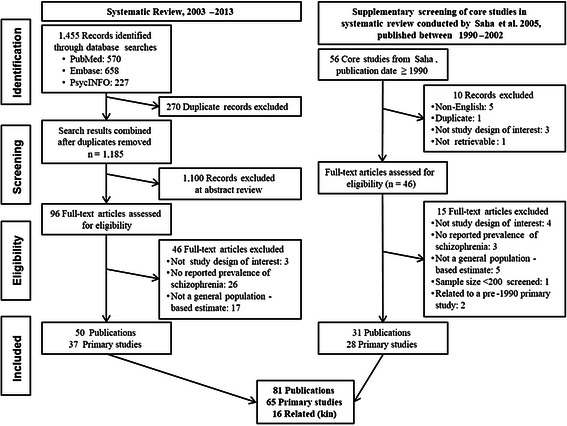
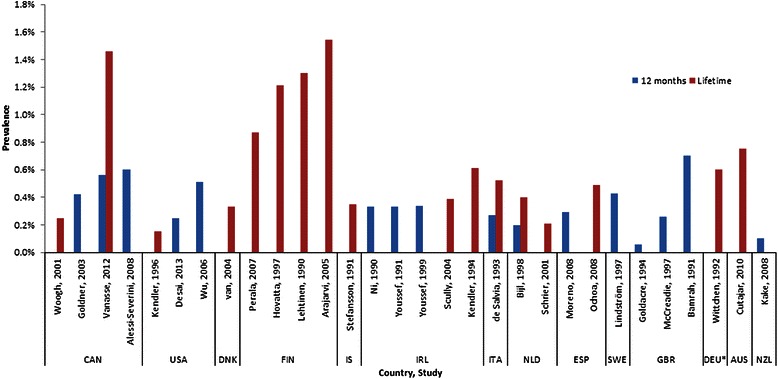
BACKGROUND: There is a lack of consistency in findings across studies on the prevalence of schizophrenia, and no recent systematic review of the literature exists. The purpose of this study is to provide an updated systematic review of population-based prevalence estimates and to understand the factors that could account for this variation in prevalence estimates. METHODS: MEDLINE, Embase, and PsycInfo databases were searched for observational studies describing schizophrenia prevalence in general populations from 2003-2013 and supplemented by studies from a prior review covering 1990-2002. Studies reporting prevalence estimates from specialized populations such as institutionalized, homeless, or incarcerated persons were excluded. Prevalence estimates were compared both across and within studies by factors that might contribute to variability using descriptive statistics. RESULTS: Sixty-five primary studies were included; thirty-one (48 %) were from Europe and 35 (54 %) were conducted in samples of ≥50,000 persons. Among 21 studies reporting 12-month prevalence, the median estimate was 0.33 % with an interquartile range (IQR) of 0.26 %-0.51 %. The median estimate of lifetime prevalence among 29 studies was 0.48 % (IQR: 0.34 %-0.85 %). Prevalence across studies appeared to vary by study design, geographic region, time of assessment, and study quality scores; associations between study sample size and prevalence were not observed. Within studies, age-adjusted estimates were higher than crude estimates by 17 %-138 %, the use of a broader definition of schizophrenia spectrum disorders compared to schizophrenia increased case identification by 18 %-90 %, identification of cases from inpatient-only settings versus any setting decreased prevalence by 60 %, and no consistent trends were noted by differing diagnostic criteria. CONCLUSIONS: This review provides updated information on the epidemiology of schizophrenia in general populations, which is vital information for many stakeholders. Study characteristics appear to play an important role in the variation between estimates. Overall, the evidence is still sparse; for many countries no new studies were identified.
Overview
The claims and statistics of this paper haven’t been checked yet.
Free: it reads the open-access text and checks the first 5 claims that cite a source we can check. Create a free account to check every claim.
Integrity signals
Registry
Cites
Statistics
Figures
Verification
Claims the paper makes
The claims and statistics of this paper haven’t been checked yet.
Free: it reads the open-access text and checks the first 5 claims that cite a source we can check. Create a free account to check every claim.
Claims other papers make about this one
Each is checked against this paper’s own text: does it say what the citing paper says it does?
The source backs part of the claim, not all of it — or backs it for a different population, condition or comparison.
In the citing paper
“Although our search criteria included all DSM-5 schizophrenia-spectrum disorders, all of the SSD studies we located used samples diagnosed with schizophrenia and schizoaffective disorder, the two most common non-substance-related DSM-5 schizophrenia-spectrum disorders (American Psychiatric Association, 2013; Moreno-Küstner et al., 2018; Simeone et al., 2015).”
From Narrative identity in the psychosis spectrum: A systematic review and developmental model (2021) · cites this paper as Simeone et al., 2015
Experimental — accuracy not yet measured
Self-check
Percentages, sums and reported differences re-computed from the paper’s own numbers.
The self-check needs the paper’s full text.
Citations
Cites
Schizophrenia: A Concise Overview of Incidence, Prevalence, and Mortality
McGrath, J., Saha, S., Chant, D., & Welham, J. (2008) · Epidemiologic Reviews · doi:10.1093/epirev/mxn001 · Cited by 2,280 · cited 6×
“2 per 100,000 persons [1] and a pooled lifetime prevalence of 0.”
BackgroundInfluentialSystematic Reviews: Synthesis of Best Evidence for Clinical Decisions
Cook, D. J., Mulrow, C. D., & Haynes, R. B. (1997) · Annals of Internal Medicine · doi:10.7326/0003-4819-126-5-199703010-00006 · Cited by 2,184 · cited 1×
“Methods This systematic review adheres to current best practices for conducting systematic reviews of the literature [12, 13].”
MethodA Systematic Review of the Prevalence of Schizophrenia
Saha, S., Chant, D., Welham, J., & McGrath, J. (2005) · PLoS Medicine · doi:10.1371/journal.pmed.0020141 · Cited by 2,168 · cited 6×
“[2] are less than half the overall estimate reported from the 2003 WHS [56].”
BackgroundMethodInfluentialLifetime Prevalence of Psychotic and Bipolar I Disorders in a General Population
Perälä, J., Suvisaari, J., Saarni, S. I., Kuoppasalmi, K., Isometsä, E., Pirkola, S., Partonen, T., Tuulio-Henriksson, A., Hintikka, J., Kieseppä, T., et al. (2007) · Archives of General Psychiatry · doi:10.1001/archpsyc.64.1.19 · Cited by 1,516 · cited 3×
“Some extreme outliers were observed, especially in studies from countries other than Europe and North America; these may reflect true differences in the prevalence of schizophrenia across some North America Woogh, 2001 Canada 140,000 0.25 % Cohort NR Vanasse, 2012 Canada 5,996,925 1.46 % Cohort 18+ Kendler, 1994 US 8,…”
MethodInfluentialBijl, R. V., Ravelli, A., & van Zessen, G. (1998) · Social Psychiatry and Psychiatric Epidemiology · doi:10.1007/s001270050098 · Cited by 1,216 · cited 2×
“In total, 65 primary studies [14–78] and 16 related publications [79–94] published from 1990–2013 were identified for inclusion in this review.”
BackgroundMcGrath, J., Saha, S., Welham, J., El Saadi, O., MacCauley, C., & Chant, D. (2004) · BMC Medicine · doi:10.1186/1741-7015-2-13 · Cited by 1,072
Serologic Evidence of Prenatal Influenza in the Etiology of Schizophrenia
Brown, A. S., Begg, M. D., Gravenstein, S., Schaefer, C. A., Wyatt, R. J., Bresnahan, M., Babulas, V. P., & Susser, E. S. (2004) · Archives of General Psychiatry · doi:10.1001/archpsyc.61.8.774 · Cited by 1,053 · cited 3×
“5 %) reported prevalence among diagnosed populations, and the age of patients sampled in each study varied widely, from narrow ranges such as 15–38 years [24] to no age restrictions.”
BackgroundSystematic Review of the Literature: Parental Outcomes After Diagnosis of Fetal Anomaly
Wool, C. (2011) · Advances in Neonatal Care · doi:10.1097/anc.0b013e31821bd92d · Cited by 952
Kendler, K. S. (1996) · Archives of General Psychiatry · doi:10.1001/archpsyc.1996.01830110060007 · Cited by 676 · cited 1×
“In total, 65 primary studies [14–78] and 16 related publications [79–94] published from 1990–2013 were identified for inclusion in this review.”
BackgroundPsychosis Screening Questionnaire
Bebbington, P., & Nayani, T. (2014) · PsycTESTS Dataset · doi:10.1037/t30040-000 · Cited by 541 · cited 1×
“Another possible explanation for the higher prevalence estimates reported by the WHS is its use of lay interviewers, who may classify disease differently than psychiatrists, even after the use of standardized reporting forms [96, 97].”
Background
Research works printed but not linked: 1
- Vuylsteek K Hallen M Epidemiology 1994 Amsterdam, Netherlands Ios Press
Cited by
Items 101–200 of 352
Schizophrenia: Epidemiology, Causes, Neurobiology, Pathophysiology, and Treatment
Volkan, K. (2020) · Journal of Health and Medical Sciences · doi:10.31014/aior.1994.03.04.143 · Cited by 28
Chi, J., Liu, N., Tian, T., Jiang, Q., Lu, C., Li, Y., Zhang, X., Ma, Y., Wang, L., & Li, S. (2024) · BMC Psychiatry · doi:10.1186/s12888-024-06333-7 · Cited by 18
Meller, T., Schmitt, S., Ettinger, U., Grant, P., Stein, F., Brosch, K., Grotegerd, D., Dohm, K., Meinert, S., Förster, K., et al. (2020) · Psychological Medicine · doi:10.1017/s0033291720002044 · Cited by 17
Increased peripheral levels of TARC/CCL17 in first episode psychosis patients
Malmqvist, A., Schwieler, L., Orhan, F., Fatouros‐Bergman, H., Bauer, M., Flyckt, L., Červenka, S., Engberg, G., Piehl, F., & Erhardt, S. (2019) · Schizophrenia Research · doi:10.1016/j.schres.2018.12.033 · Cited by 16
Peterson, R. E., Bigdeli, T. B., Ripke, S., Bacanu, S., Gejman, P. V., Levinson, D. F., Li, Q. S., Rujescu, D., Rietschel, M., Weinberger, D. R., et al. (2021) · Journal of Psychiatric Research · doi:10.1016/j.jpsychires.2021.02.027 · Cited by 18
Lang, X., Wang, D., Chen, D., Xiu, M., Zhou, H., Wang, L., Cao, B., & Zhang, X. (2022) · Neurotherapeutics · doi:10.1007/s13311-021-01174-8 · Cited by 18
“Schizophrenia (SCZ) is one of the most common severe psychiatric disorders, with a prevalence rate around 1% worldwide [1].”
BackgroundTsugawa, S., Honda, S., Noda, Y., Wannan, C., Zalesky, A., Tarumi, R., Iwata, Y., Ogyu, K., Plitman, E., Ueno, F., et al. (2023) · Schizophrenia Bulletin · doi:10.1093/schbul/sbad160 · Cited by 15
Sexually dimorphic subcortical brain volumes in emerging psychosis
Egloff, L., Lenz, C., Studerus, E., Harrisberger, F., Smieskova, R., Schmidt, A., Huber, C. G., Simon, A. E., Lang, U. E., Riecher‐Rössler, A., et al. (2018) · Schizophrenia Research · doi:10.1016/j.schres.2018.03.034 · Cited by 17
“Schizophrenic psychoses are potentially severemental disorders, affecting approximately 0.48% of the population worldwide (Simeone et al., 2015) and typically emerging in late adolescence or early adulthood (Häfner et al., 1992; Riecher-Rössler et al., 2007).”
BackgroundInfluentialThe cost-of-illness trend of schizophrenia in South Korea from 2006 to 2016
Jo, M., Kim, H., Rim, S. J., Lee, M. G., Kim, C. E., & Park, S. (2020) · PLoS ONE · doi:10.1371/journal.pone.0235736 · Cited by 17
“According to a systematic literature review [5], the median 12-month and lifetime prevalence rate of schizophrenia is 0.”
BackgroundGicas, K. M., Cheng, A., Panenka, W. J., Kim, D. D., Yau, J. C., Procyshyn, R. M., Stubbs, J. L., Jones, A. A., Bains, S., Thornton, A. E., et al. (2020) · Progress in Neuro-Psychopharmacology and Biological Psychiatry · doi:10.1016/j.pnpbp.2020.110084 · Cited by 15
Fortier, A., Dumais, A., Athanassiou, M., Tikàsz, A., & Potvin, S. (2022) · Psychiatry Research Neuroimaging · doi:10.1016/j.pscychresns.2022.111579 · Cited by 14
Mutation–selection–drift balance models of complex diseases
Berg, J. J., Li, X., Riall, K., Hayward, L. K., & Sella, G. (2025) · Genetics · doi:10.1093/genetics/iyaf220 · Cited by 15
“Schizophrenia, for example, has a prevalence of 0.5% to 1% (Jablensky 2000; Saha et al. 2005; Chan et al. 2015; Simeone et al. 2015), affects several fitness components and has been estimated to reduce fertility by up to 75% (Haukka et al. 2003; Laursen and Munk-Olsen 2010; Power et al. 2013).”
InfluentialStenmark, L., Popiołek, K., Bodén, R., Brus, O., Hammar, Å., Landén, M., Lundberg, J., Nordanskog, P., & Nordenskjöld, A. (2020) · Schizophrenia Bulletin Open · doi:10.1093/schizbullopen/sgaa019 · Cited by 14
Nawa, Y., Kimura, H., Mori, D., Kato, H., Toyama, M., Furuta, S., Yu, Y., Ishizuka, K., Kushima, I., Aleksić, B., et al. (2020) · Human Genome Variation · doi:10.1038/s41439-020-00125-7 · Cited by 14
Correll, C. U., Fusar‐Poli, P., Leucht, S., Karow, A., Marić, N. P., Moreno, C., Nordentoft, M., & Raballo, A. (2022) · Neuropsychiatric Disease and Treatment · doi:10.2147/ndt.s345066 · Cited by 14
Hudak, R., & Rasmussen, A. (2022) · Journal of Cognitive Psychotherapy · doi:10.1891/jcp-2021-0008 · Cited by 42
Neurodevelopment: Inflammation Matters
Davis, R. L. (2018) · Advances in neurotoxicology · doi:10.1016/bs.ant.2018.03.002 · Cited by 17
Dey, M., Marti, L., & Jorm, A. F. (2019) · The European Journal of Psychiatry · doi:10.1016/j.ejpsy.2018.12.001 · Cited by 14
Chen, J., Chen, X., LEUNG, S. S. M., & Tsang, H. W. H. (2020) · Children and Youth Services Review · doi:10.1016/j.childyouth.2020.105751 · Cited by 14
Metaphor Production by Patients with Schizophrenia – A Case Analysis
Despot, K. Š., Sović, M. S., Vilibić, M., & Mimica, N. (2021) · Metaphor and Symbol · doi:10.1080/10926488.2021.1893606 · Cited by 15
Otte, M., Schmitgen, M. M., Wolf, N. D., Kubera, K. M., Calhoun, V. D., Fritze, S., Geiger, L. S., Tost, H., Seidl, U., Meyer‐Lindenberg, A., et al. (2023) · European Archives of Psychiatry and Clinical Neuroscience · doi:10.1007/s00406-023-01566-1 · Cited by 13
Janoušová, E., Montana, G., Kašpárek, T., & Schwarz, D. (2016) · Frontiers in Neuroscience · doi:10.3389/fnins.2016.00392 · Cited by 13
“10:392. doi: 10.3389/fnins.2016.00392 Supervised, Multivariate, Whole-Brain Reduction Did Not Help to Achieve High Classification Performance in Schizophrenia Research Eva Janousova 1*, Giovanni Montana 2, Tomas Kasparek 3, 4 and Daniel Schwarz 1 1 Institute of Biostatistics and Analyses, Faculty of Medicine, Masaryk…”
InfluentialAssociation between miR-137 polymorphism and risk of schizophrenia: a meta-analysis
Ou, M., Liu, G., Xiao, D., Zhang, B. H., Guo, C., Ye, X.-F., Liu, Y., Zhang, N., Wang, M., Han, Y., et al. (2016) · Genetics and Molecular Research · doi:10.4238/gmr.15038703 · Cited by 13
“, 2008), and its median lifetime prevalence is estimated at 480 per 100,000 patients (Simeone et al., 2015).”
BackgroundRezansoff, S. N., Moniruzzaman, A., & Somers, J. M. (2019) · Schizophrenia Research · doi:10.1016/j.schres.2019.05.031 · Cited by 14
Lin, C., Chan, H., Hsu, C., & Chen, F.-C. (2020) · Scientific Reports · doi:10.1038/s41598-020-75022-8 · Cited by 13
Lafeuille, M., Tandon, N., Tiggelaar, S., Kamstra, R. L., Lefèbvre, P., Kim, E., Yue, Y., & Joshi, K. (2018) · Drugs - Real World Outcomes · doi:10.1007/s40801-018-0130-4 · Cited by 12
“The annual prevalence of schizophrenia in adults is estimated at between 0.25 and 0.51% in USA [1], with affected individuals having an estimated life expectancy 15–30 years shorter than the general population [2, 3].”
BackgroundInfluentialPignon, B., Schürhoff, F., Baudin, G., Tortelli, A., Ferchiou, A., Saba, G., Richard, J., Pélissolo, A., Leboyer, M., & Szöke, A. (2018) · International Journal of Methods in Psychiatric Research · doi:10.1002/mpr.1719 · Cited by 12
Bright, but allergic and neurotic? A critical investigation of the “overexcitable genius” hypothesis
Fries, J., Baudson, T. G., Kovacs, K., & Pietschnig, J. (2022) · Frontiers in Psychology · doi:10.3389/fpsyg.2022.1051910 · Cited by 12
Suokas, K., Kurkela, O., Nevalainen, J., Suvisaari, J., Hakulinen, C. A., Kampman, O., & Pirkola, S. P. (2023) · Social Psychiatry and Psychiatric Epidemiology · doi:10.1007/s00127-023-02516-x · Cited by 17
“Background The prevalence of psychotic and other mental disorders varies globally and locally (Simeone et al., 2015; GBD 2019 Mental Disorders Collaborators, 2022; Steel et al., 2014; Jongsma et al., 2018), with urban-rural differences being a particularly important factor in Northern Europe (Krabbendam et al.”
BackgroundWollmann, B. M., Haugen, A. G., Smith, R. L., & Molden, E. (2024) · Therapeutic Drug Monitoring · doi:10.1097/ftd.0000000000001177 · Cited by 12
Grezenko, H., Rodoshi, Z. N., Mimms, C. S., Ahmed, M., Sabani, A., Hlaing, M. S., Batu, B. J., Hundesa, M. I., Ayalew, B. D., Shehryar, A., et al. (2024) · Cureus · doi:10.7759/cureus.58776 · Cited by 12
Zhang, R., Bi, Y., Niu, W., Huang, X., Chen, S., Li, X., Wu, X., Cao, Y., Yang, F., Wang, L., et al. (2016) · Neuroscience Letters · doi:10.1016/j.neulet.2016.10.018 · Cited by 12
Castillejos, M. C., Martín-Pérez, C., & Moreno‐Küstner, B. (2018) · Schizophrenia Research · doi:10.1016/j.schres.2018.07.031 · Cited by 12
Chang, J., Kim, J. A., Kim, K., Choi, S., Kim, S. M., Nam, Y.-Y., Park, S., Goo, A. J., & Park, S. M. (2020) · Asian Journal of Psychiatry · doi:10.1016/j.ajp.2020.102161 · Cited by 14
Schuurman, B., & Carthy, S. L. (2022) · Deviant Behavior · doi:10.1080/01639625.2022.2118088 · Cited by 14
Crowe, C. L., Xiang, P., Smith, J. L., Pizzicato, L. N., Gloede, T., Yang, Y., Teng, C., & Isenberg, K. E. (2024) · Schizophrenia · doi:10.1038/s41537-024-00509-6 · Cited by 14
Arafuka, S., Fujishiro, H., Torii, Y., Sekiguchi, H., Habuchi, C., Miwa, A., Yoshida, M., Iritani, S., Iwasaki, Y., Ikeda, M., et al. (2023) · Psychiatry and Clinical Neurosciences · doi:10.1111/pcn.13597 · Cited by 11
Francis, A. M., Knott, V., Labelle, A., & Fisher, D. J. (2020) · Frontiers in Psychiatry · doi:10.3389/fpsyt.2020.540738 · Cited by 11
McElroy, D. L., Roebuck, A. J., Scott, G. A., Greba, Q., Garai, S., Denovan‐Wright, E. M., Thakur, G. A., Laprairie, R. B., & Howland, J. G. (2021) · Psychopharmacology · doi:10.1007/s00213-020-05755-x · Cited by 12
Johanson, S., Oestergaard, L. G., Bejerholm, U., Nygren, C., van Tulder, M. W., & Zingmark, M. (2023) · Scandinavian Journal of Occupational Therapy · doi:10.1080/11038128.2023.2200576 · Cited by 12
“The 12 months prevalence of schizophrenia in Europe has been reported to be 0.31% [8] and in Sweden around 0.35–0.40% [9].”
BackgroundInfluentialA Literature Mini-Review of Transcranial Direct Current Stimulation in Schizophrenia
Stuchlíková, Z., & Klírová, M. (2022) · Frontiers in Psychiatry · doi:10.3389/fpsyt.2022.874128 · Cited by 12
“(1) 2 mA 2 mA for 40 s No acute enhancement of executive functions.”
BackgroundBehdani, F., Hassanzadeh, B., Eslamzadeh, M., Moradi, M., Hebrani, P., Dadgarmoghaddam, M., & Shamsaki, N. (2022) · International Clinical Psychopharmacology · doi:10.1097/yic.0000000000000405 · Cited by 10
“Introduction Schizophrenia is a debilitating and complex disorder that affects one case among 200 persons (Simeone et al., 2015; McCutcheon et al., 2020).”
BackgroundThe symptoms, resourcefulness and quality of life in community‐based patients with schizophrenia
Yu, C., Lai, C. Y., Chang, Y., Wu, C.-K., & Chung, F. (2019) · Journal of Clinical Nursing · doi:10.1111/jocn.14953 · Cited by 10
Emerging Adult Siblings of Individuals with Schizophrenia: Experiences with Family Crisis
Graves, J., Marsack‐Topolewski, C. N., & Shapiro, J. R. (2020) · Journal of Family Issues · doi:10.1177/0192513x20905327 · Cited by 10
“These gender demographics are consistent with the higher prevalence of this diagnosis among men (Simeone et al., 2015).”
Background10-Year Trends in Healthcare Spending among Patients with Schizophrenia in Alberta, Canada
Stewart, A. J., Patten, S. B., Fiest, K. M., Williamson, T. S., Wick, J., & Ronksley, P. E. (2022) · The Canadian Journal of Psychiatry · doi:10.1177/07067437221082885 · Cited by 10
High Schizotypy Predicts Emotion Recognition Independently of Negative Affect
Dawes, C., Danielmeier, C., Haselgrove, M., & Moran, P. M. (2021) · Frontiers in Psychiatry · doi:10.3389/fpsyt.2021.738344 · Cited by 10
Analysis of human neuronal cells carrying ASTN2 deletion associated with psychiatric disorders
Hayashi, Y., Okumura, H., Arioka, Y., Kushima, I., Mori, D., Lo, T., Otgonbayar, G., Kato, H., Nawa, Y., Kimura, H., et al. (2024) · Translational Psychiatry · doi:10.1038/s41398-024-02962-4 · Cited by 9
“Schizophrenia (SCZ), autism spectrum disorder (ASD), and bipolar disorder (BP) are very common psychiatric disorders, with high lifetime prevalence rates of ~0.5% [1, 2], 2.5% [3 – 5], and 1% [6, 7], respectively.”
BackgroundInfluentialLamsma, J., Raine, A., Kia, S. M., Cahn, W., Arold, D., Banaj, N., Barone, A., Brosch, K., Brouwer, R. M., Brunetti, A., et al. (2025) · Molecular Psychiatry · doi:10.1038/s41380-025-03365-7 · Cited by 11
Association between DRD2 and ANKK1 polymorphisms with the deficit syndrome in schizophrenia
Michalczyk, A., Pełka-Wysiecka, J., Kucharska–Mazur, J., Wroński, M., Misiak, B., & Samochowiec, J. (2020) · Annals of General Psychiatry · doi:10.1186/s12991-020-00289-0 · Cited by 10
Michalczyk, A., Tyburski, E. M., Podwalski, P., Waszczuk, K., Rudkowski, K., Kucharska–Mazur, J., Mak, M., Rek-Owodziń, K., Plichta, P., Bielecki, M., et al. (2022) · Journal of Clinical Medicine · doi:10.3390/jcm11216352 · Cited by 9
Holttinen, T., Pirkola, S. P., & Kaltiala‐Heino, R. (2023) · Schizophrenia Research · doi:10.1016/j.schres.2023.01.006 · Cited by 10
Németh, B., Bendes, R., Nagy, B., Götze, Á., Kóczián, K., Horváth, M., Deák, I., Tóth, B., & Kaló, Z. (2019) · Health Policy and Technology · doi:10.1016/j.hlpt.2019.01.004 · Cited by 9
The Burden of Mental Disorders
Eaton, W. W., Bienvenu, O. J., Nestadt, G., Volk, H. E., & Anthony, J. C. (2019) · Oxford University Press eBooks · doi:10.1093/oso/9780190916602.003.0002 · Cited by 9
Inada, K., Saito, Y., Baba, K., Fukui, D., Masuda, Y., Inoue, S., & Masuda, T. (2024) · BMC Psychiatry · doi:10.1186/s12888-023-05474-5 · Cited by 8
Castelnovo, A., Casetta, C., Cavallotti, S., Marcatili, M., Fabro, L. D., Canevini, M. P., Sarasso, S., & D’Agostino, A. (2024) · Scientific Reports · doi:10.1038/s41598-024-57476-2 · Cited by 8
Maekawa, M., Yokota, M., Sato, T., Sato, Y., Kumondai, M., Sato, Y., Suzuka, M., Kobayashi, D., Sakamoto, K., Matsuura, M., et al. (2024) · Analytical Sciences · doi:10.1007/s44211-024-00619-2 · Cited by 8
Setlaba, N. N. C., Mosotho, N. L., & Joubert, G. (2020) · Psychiatry Psychology and Law · doi:10.1080/13218719.2019.1618751 · Cited by 8
Kermath, B. A., Vanderplow, A. M., & Cahill, M. E. (2019) · Cerebral Cortex · doi:10.1093/cercor/bhz070 · Cited by 8
When Clozapine Fails: Augmentation Strategies in the Management of Clozapine-Resistant Schizophrenia
Berardis, D. D., Fornaro, M., Anastasia, A., Vellante, F., Valchera, A., Cavuto, M., Perna, G., Nicola, M. D., Serafini, G., Carano, A., et al. (2018) · Springer eBooks · doi:10.1007/978-981-10-4358-1_23 · Cited by 10
The cost and burden of schizophrenia in Portugal in 2015
Gouveia, M. R. D. A., Ascenção, R. M. S. E. S., Fiorentino, F., Pascoal, J., Costa, J., & Borges, M. (2018) · International Journal of Clinical Neurosciences and Mental Health · doi:10.21035/ijcnmh.2017.4(suppl.3).s13 · Cited by 18
“This estimate is in line with the results of the systematic review by Simeone et al. (2015) [10] (0.52% in the European population in general).”
ResultInfluentialSyntactic and affective prosody recognition: Schizophrenia vs. Autism spectrum disorders
Μαρτζούκου, Μ., Papadopoulos, D., & Kosmidis, M. H. (2023) · PLoS ONE · doi:10.1371/journal.pone.0292325 · Cited by 7
“It usually appears in late adolescence or early adulthood, and it develops earlier in men than in women [1].”
BackgroundBakken, T. L., Sandberg, M., & Axmon, A. (2024) · General Psychiatry · doi:10.1136/gpsych-2024-101673 · Cited by 7
Mitterœcker, P., & Merola, G. P. (2024) · Neuroscience & Biobehavioral Reviews · doi:10.1016/j.neubiorev.2024.105636 · Cited by 12
“The global prevalence of schizophrenia is estimated to be up to 1%, though this figure can vary across different geographic regions, social groups, and study designs (Hany et al., 2023; McGrath et al., 2008; Saha et al., 2005; Simeone et al., 2015; Tandon et al., 2023).”
Lacey, C. J., Manuel, J., Schlüter, P. J., Porter, R., Pitama, S. G., & Jamieson, H. A. (2019) · Australian & New Zealand Journal of Psychiatry · doi:10.1177/0004867419828480 · Cited by 7
Lobban, F. A., Appelbe, D., Appleton, V., Aref-Adib, G., Barraclough, J., Billsborough, J., Fisher, N. R., Foster, S., Gill, B., Glentworth, D., et al. (2020) · Health Services and Delivery Research · doi:10.3310/hsdr08370 · Cited by 7
Retrospective Review of Clozapine Use in Children and Adolescents.
Komaryk, A. L. D., Elbe, D., & Burgess, L. (2021) · PubMed · Cited by 7
Mennigen, E., Rashid, B., & Calhoun, V. D. (2018) · Elsevier eBooks · doi:10.1016/b978-0-12-813838-0.00007-8 · Cited by 7
Treatment Rate of Schizophrenia in China: a Meta-Analysis of Epidemiological Studies
Qi, H., Zong, Q.-Q., An, F., Zhang, L., Ungvari, G. S., Sim, K., Park, S., & Xiang, Y. (2020) · Psychiatric Quarterly · doi:10.1007/s11126-020-09740-7 · Cited by 7
Zhao, T., Shi, Z., Ling, N., Xu, Y., Qin, J., Zhou, Q., Wu, L., Yuansheng, W., Wei, W., Lin, C., et al. (2022) · Current Neuropharmacology · doi:10.2174/1570159x20666220310115846 · Cited by 8
Prevalence estimates of nonordinary experiences depend on validity and measurement choices
Fischer, R. D., Bortolini, G. N., Bortolini, T., Maraldi, E. D. O., Hartle, L., Varejão, M. V. D. L., Laport, M. C., Granjeiro, G. F., de Oliveira, M. E. G., Ihm, E. D., et al. (2026) · Communications Psychology · doi:10.21203/rs.3.rs-6907742/v1 · Cited by 6
Goetz-Kundera, Z., Przekopińska, B., Walichniewicz, P., Niewada, M., & Lew‐Starowicz, M. (2025) · Comprehensive Psychiatry · doi:10.1016/j.comppsych.2025.152632 · Cited by 6
REM sleep in schizophrenia: a systematic review and meta-analysis
Morra, D., & Barbato, G. (2025) · Sleep Medicine Reviews · doi:10.1016/j.smrv.2025.102134 · Cited by 6
Hirschfeldová, K., Černý, J., Božíková, P., Kuchtiak, V., Rausch, T., Beneš, V., Španiel, F., Greguš, D., Horáček, J., Vyklický, L., et al. (2021) · Journal of Personalized Medicine · doi:10.3390/jpm11121250 · Cited by 6
“8/1000 [2], the population risk is approximately 0.”
BackgroundBitter, I., Czobor, P., Kakuszi, B., & Réthelyi, J. (2023) · Orvosi Hetilap · doi:10.1556/650.2023.32843 · Cited by 7
Do Patients with Pre-Existing Psychiatric Illness Have an Increased Risk of Infection after Injury?
Dickinson, C. M., Karlin, D. R., Nunez, H. R., Cao, S. A., Heffernan, D. S., Monaghan, S. F., Kheirbek, T., Adams, C. A., & Stephen, A. H. (2017) · Surgical Infections · doi:10.1089/sur.2016.218 · Cited by 6
“Psychiatric illnesses (PIs) are also prevalent with an estimated occurrence in 25% of the general U.S. adult population [7,8].”
Liu, J., Wang, D., Zhou, H., Zhao, N. O., Wu, H. E., & Zhang, X. (2021) · Asian Journal of Psychiatry · doi:10.1016/j.ajp.2021.102861 · Cited by 6
The realities of problem‐solving for emerging‐adult siblings of individuals with schizophrenia
Graves, J., Marsack‐Topolewski, C. N., & Chan, K. (2023) · Family Relations · doi:10.1111/fare.12850 · Cited by 6
He, Y., Matsunaga, M., Li, Y., Kishi, T., Tanihara, S., Iwata, N., Tabuchi, T., & Ota, A. (2023) · JMIR Formative Research · doi:10.2196/50193 · Cited by 6
Eliason, M. (2023) · Economics & Human Biology · doi:10.1016/j.ehb.2023.101231 · Cited by 6
Quintero, J., Oyagüez, I., González, B., Cuervo-Arango, I., García, I., & Casado, M. Á. (2016) · Clinical Drug Investigation · doi:10.1007/s40261-016-0393-z · Cited by 6
Russolillo, A., Homayra, F., & Nosyk, B. (2025) · The Canadian Journal of Psychiatry · doi:10.1177/07067437251347150 · Cited by 5
Rabinovitz, S., Goldman, K., Rosca, P., Barda, J., & Levine, S. Z. (2019) · Schizophrenia Research · doi:10.1016/j.schres.2019.01.008 · Cited by 6
Subedi, S., Nanditha, N. G. A., Tafessu, H. M., Nathani, H., St‐Jean, M., Elefante, J., Patterson, T. L., Honer, W. G., Montaner, J. S. G., & Lima, V. D. (2023) · BMJ Open · doi:10.1136/bmjopen-2022-070680 · Cited by 5
Daliri, D. B., Laari, T. T., Abagye, N., & Afaya, A. (2024) · BMJ Open · doi:10.1136/bmjopen-2023-079933 · Cited by 5
Weidenauer, A., Sauerzopf, U., Bauer, M., Bum, C., Diendorfer, C., Dajic, I., Bartova, L., Kastner-Bosek, A., Bamminger, K., Nics, L., et al. (2024) · Schizophrenia Bulletin · doi:10.1093/schbul/sbae111 · Cited by 5
Lee, S. C., DelPozo‐Baños, M., Lloyd, K. R., Jones, I. R., Walters, J., & John, A. M. (2023) · Schizophrenia Research · doi:10.1016/j.schres.2023.08.014 · Cited by 5
Effect of Lurasidone on Social Functioning in Schizophrenia: Post Hoc Analysis of the JEWEL Study
Miura, I., Sano, F., Sakaguchi, R., Okamoto, K., & Maruyama, H. (2024) · The Journal of Clinical Psychiatry · doi:10.4088/jcp.23m14881 · Cited by 5
Mindfulness in Holistic Management of Schizophrenia
Ganguly, P. (2018) · International Journal of Psychology & Behavior Analysis · doi:10.15344/2455-3867/2018/156 · Cited by 5
Catechol-O-methyltransferase gene expression in stress-induced and non-stress induced schizophrenia
Aghamaleki-Sarvestani, Z., Vousooghi, N., Tabrizi, M., Alipour, M., Alaghband-rad, J., Abdolmaleky, H. M., & Zarindast, M. (2020) · Psychiatric Genetics · doi:10.1097/ypg.0000000000000243 · Cited by 3
Editorial: Brain Mediators of the Cannabis–Prodromal Psychosis Connection
LANGE, N. D. (2019) · Journal of the American Academy of Child & Adolescent Psychiatry · doi:10.1016/j.jaac.2019.10.003 · Cited by 5
Prevalence and incidence of treated schizophrenia: temporal and regional trends in Germany
Riedel, O., Bachmann, C., Bittner, R. A., Dörks, M., Kollhorst, B., Qubad, M., & Scholle, O. H. F. (2025) · Schizophrenia · doi:10.1038/s41537-025-00689-9 · Cited by 4
“Simeone et al. 24 found a median 12-month-prevalence of 330/100,000 (interquartile range: 260/ 100,000 – 510/100,000), based on a systematic review, while the earlier-mentioned GBD study estimated a prevalence of 287/ 100,000 in 2019 4 .”
First episode of psychosis in Guam: The role of ethnicity and neighbourhood factors
Rosenfarb, I. F., Sharma‐Gopinath, R., & Bhavsar, V. (2021) · Early Intervention in Psychiatry · doi:10.1111/eip.13205 · Cited by 4
“By contrast, a recent systematic literature review of population-based prevalence estimates found the median lifetime prevalence of schizophrenia across 29 studies was 0.48% with an interquartile range of 0.34%–0.85% (Simeone et al., 2015).”
BackgroundInfluentialSmoking cessation among people with mental illness: A South African perspective
Morar, T., & Robertson, L. J. (2022) · South African Family Practice · doi:10.4102/safp.v64i1.5489 · Cited by 4
Dongxia, L., Li, M., & Feng, Y. (2024) · Brain and Behavior · doi:10.1002/brb3.3499 · Cited by 4
Yu, T., Lee, T., Hsuan, C., Wu, C., Wang, C.-P., Lu, Y., Wei, C., Chung, F., Lee, Y., Tsai, I., et al. (2024) · Frontiers in Psychiatry · doi:10.3389/fpsyt.2023.1309822 · Cited by 4
“With a lifetime prevalence ranging from approximately 0.5% to 1%, schizophrenia is a significant global public health concern (11).”
BackgroundInfluentialDing, J., Zhang, S., Li, L., Xing, H., Zhang, Y., Meng, Z., & Cui, X. (2024) · Clinica Chimica Acta · doi:10.1016/j.cca.2024.120064 · Cited by 4
Netto, J. P., Barbosa, A. V., Fernandes, B. D., Rotta, I., & Aguiar, P. M. (2025) · Research in Social and Administrative Pharmacy · doi:10.1016/j.sapharm.2025.08.008 · Cited by 4
Neuroanatomical subtyping for schizophrenia with machine learning
Sungur, I., Selek, S., Keskin, K., Hinc, A. C., Yazici, F., Aktaş, E. Ö., Erdoğan, Y., & Gönül, A. S. (2025) · Psychiatry Research Neuroimaging · doi:10.1016/j.pscychresns.2025.112058 · Cited by 4
Economic evaluations on the use of aripiprazole for patients with schizophrenia: A systematic review
Henrique, I. C. B., Lima, T. D. M., de Melo, D. O., & Aguiar, P. M. (2019) · Journal of Clinical Pharmacy and Therapeutics · doi:10.1111/jcpt.13034 · Cited by 4
Nutritional assessment of omega-3 fatty acids intake in schizophrenia patients group
Róg, J., Karakuła, K. H., Próchnicka, A., & Karakuła‐Juchnowicz, H. (2019) · Current Problems of Psychiatry · doi:10.2478/cpp-2019-0008 · Cited by 4
“Despite the fact that the percentage of population suffering from schizophrenia stands at less than 1% [3], the experienced symptoms and sickness absenteeism make it an enormous economic and health-related challenge.”
Background
Metadata
- Authors
- Simeone, J. C., Ward, A. J., Rotella, P., Collins, J., & Windisch, R.
- Affiliations
- F. Hoffmann-La Roche AG (CH)
- Corresponding author
- Simeone, Jason C.
- Venue
- BMC Psychiatry
- Published
- 2015-08-12
- Volume
- 15
- Issue
- 1
- Pages
- 193-193
- ISSN
- 1471-244X (ISSN-L)
- PMC
- PMC4533792
- OpenAlex
- W1906444297
- Semantic Scholar
- ae85d72fa1cac51c6f1e1452e77b2b780e2bb4eb
- Cited by
- 327
- References
- 115
- Citations by year
- 2026: 16 · 2025: 26 · 2024: 31 · 2023: 37 · 2022: 46 · 2021: 33 · 2020: 40 · 2019: 40 · 2018: 30 · 2017: 14 · 2016: 13 · 2015: 1
- FWCI
- 2.66
- Type
- journal article
- Language
- en
- Open access
- gold
- doi.org
- Licence
- Locations
- BMC Psychiatry (publishedVersion, cc-by)
- Europe PMC (PubMed Central) (publishedVersion, cc-by)
- PubMed Central (publishedVersion, cc-by)
- PubMed (publishedVersion)
- Funders
- F. Hoffmann-La Roche
- Topics
- Health Sciences › Medicine › Psychiatry and Mental health › Schizophrenia research and treatment
- Health Sciences › Medicine › Psychiatry and Mental health › Mental Health Treatment and Access
- Social Sciences › Arts and Humanities › Philosophy › Mental Health and Psychiatry
- Keywords
- schizophrenia, prevalence, 12-month prevalence, lifetime prevalence, research design, regional variation, age adjustment, case finding, diagnostic criteria, schizophrenia spectrum disorders, general population
- MeSH terms
- Europe, Humans, Schizophrenia, Time Factors, Prevalence
About these checks
Registry, retraction, Cites and statistics results are computed, not judged, with one exception: a printed reference that no index lists is read once by a model before it counts as a citation error. Claims are extracted by a model and kept only when their quote appears verbatim in the text; each cited source is then checked, with a model’s help, for whether it says what the claim relies on. Those verdicts can be wrong — read the claim’s quote and the cited source before relying on one.
Statistics and arithmetic are recomputed, not judged.
Confidence bands are shown only for fields calibrated on our annotated test set. None is calibrated yet, so no band is shown.
What counts as a claim ›How we measure confidence ›How we check this ›
Are you an author, or do you see a problem with this page? Request a review
Data sources
Bibliographic data: Semantic Scholar, OpenAlex, Crossref.
Contains information from the Semantic Scholar Academic Graph Datasets, made available under the ODC Attribution License (ODC-BY 1.0).
Semantic Scholar’s data is described in: Kinney, R., et al. (2023). The Semantic Scholar Open Data Platform. arXiv:2301.10140.
