

An evaluation of variation in published estimates of schizophrenia prevalence from 1990–2013: A systematic literature review
Open accessThe DOI matches its Crossref record; 115 of the 115 references it cites were found in a registry or an index.
Abstract
BACKGROUND: There is a lack of consistency in findings across studies on the prevalence of schizophrenia, and no recent systematic review of the literature exists. The purpose of this study is to provide an updated systematic review of population-based prevalence estimates and to understand the factors that could account for this variation in prevalence estimates. METHODS: MEDLINE, Embase, and PsycInfo databases were searched for observational studies describing schizophrenia prevalence in general populations from 2003-2013 and supplemented by studies from a prior review covering 1990-2002. Studies reporting prevalence estimates from specialized populations such as institutionalized, homeless, or incarcerated persons were excluded. Prevalence estimates were compared both across and within studies by factors that might contribute to variability using descriptive statistics. RESULTS: Sixty-five primary studies were included; thirty-one (48 %) were from Europe and 35 (54 %) were conducted in samples of ≥50,000 persons. Among 21 studies reporting 12-month prevalence, the median estimate was 0.33 % with an interquartile range (IQR) of 0.26 %-0.51 %. The median estimate of lifetime prevalence among 29 studies was 0.48 % (IQR: 0.34 %-0.85 %). Prevalence across studies appeared to vary by study design, geographic region, time of assessment, and study quality scores; associations between study sample size and prevalence were not observed. Within studies, age-adjusted estimates were higher than crude estimates by 17 %-138 %, the use of a broader definition of schizophrenia spectrum disorders compared to schizophrenia increased case identification by 18 %-90 %, identification of cases from inpatient-only settings versus any setting decreased prevalence by 60 %, and no consistent trends were noted by differing diagnostic criteria. CONCLUSIONS: This review provides updated information on the epidemiology of schizophrenia in general populations, which is vital information for many stakeholders. Study characteristics appear to play an important role in the variation between estimates. Overall, the evidence is still sparse; for many countries no new studies were identified.
Overview
The claims and statistics of this paper haven’t been checked yet.
Free: it reads the open-access text and checks the first 5 claims that cite a source we can check. Create a free account to check every claim.
Integrity signals
Registry
Cites
Statistics
Figures
Verification
Claims the paper makes
The claims and statistics of this paper haven’t been checked yet.
Free: it reads the open-access text and checks the first 5 claims that cite a source we can check. Create a free account to check every claim.
Claims other papers make about this one
Each is checked against this paper’s own text: does it say what the citing paper says it does?
The source backs part of the claim, not all of it — or backs it for a different population, condition or comparison.
In the citing paper
“Although our search criteria included all DSM-5 schizophrenia-spectrum disorders, all of the SSD studies we located used samples diagnosed with schizophrenia and schizoaffective disorder, the two most common non-substance-related DSM-5 schizophrenia-spectrum disorders (American Psychiatric Association, 2013; Moreno-Küstner et al., 2018; Simeone et al., 2015).”
From Narrative identity in the psychosis spectrum: A systematic review and developmental model (2021) · cites this paper as Simeone et al., 2015
Experimental — accuracy not yet measured
Self-check
Percentages, sums and reported differences re-computed from the paper’s own numbers.
The self-check needs the paper’s full text.
Citations
Cites
Schizophrenia: A Concise Overview of Incidence, Prevalence, and Mortality
McGrath, J., Saha, S., Chant, D., & Welham, J. (2008) · Epidemiologic Reviews · doi:10.1093/epirev/mxn001 · Cited by 2,280 · cited 6×
“2 per 100,000 persons [1] and a pooled lifetime prevalence of 0.”
BackgroundInfluentialSystematic Reviews: Synthesis of Best Evidence for Clinical Decisions
Cook, D. J., Mulrow, C. D., & Haynes, R. B. (1997) · Annals of Internal Medicine · doi:10.7326/0003-4819-126-5-199703010-00006 · Cited by 2,184 · cited 1×
“Methods This systematic review adheres to current best practices for conducting systematic reviews of the literature [12, 13].”
MethodA Systematic Review of the Prevalence of Schizophrenia
Saha, S., Chant, D., Welham, J., & McGrath, J. (2005) · PLoS Medicine · doi:10.1371/journal.pmed.0020141 · Cited by 2,168 · cited 6×
“[2] are less than half the overall estimate reported from the 2003 WHS [56].”
BackgroundMethodInfluentialLifetime Prevalence of Psychotic and Bipolar I Disorders in a General Population
Perälä, J., Suvisaari, J., Saarni, S. I., Kuoppasalmi, K., Isometsä, E., Pirkola, S., Partonen, T., Tuulio-Henriksson, A., Hintikka, J., Kieseppä, T., et al. (2007) · Archives of General Psychiatry · doi:10.1001/archpsyc.64.1.19 · Cited by 1,516 · cited 3×
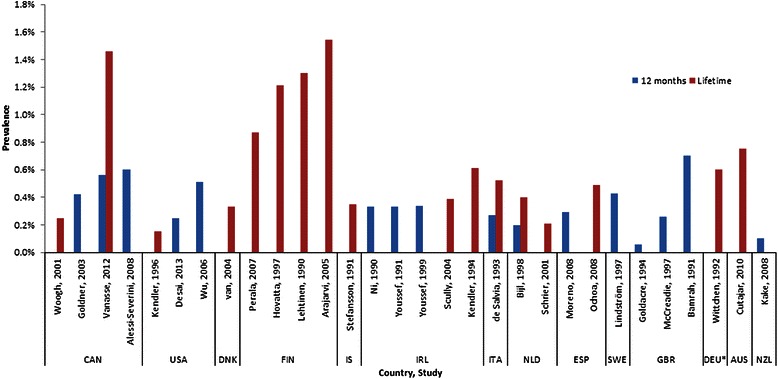
“Some extreme outliers were observed, especially in studies from countries other than Europe and North America; these may reflect true differences in the prevalence of schizophrenia across some North America Woogh, 2001 Canada 140,000 0.25 % Cohort NR Vanasse, 2012 Canada 5,996,925 1.46 % Cohort 18+ Kendler, 1994 US 8,…”
MethodInfluentialBijl, R. V., Ravelli, A., & van Zessen, G. (1998) · Social Psychiatry and Psychiatric Epidemiology · doi:10.1007/s001270050098 · Cited by 1,216 · cited 2×
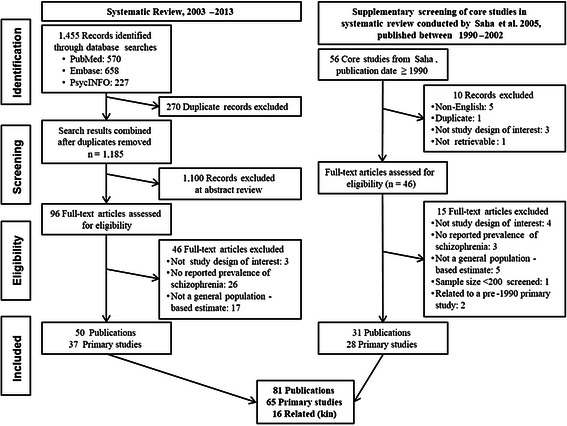
“In total, 65 primary studies [14–78] and 16 related publications [79–94] published from 1990–2013 were identified for inclusion in this review.”
BackgroundMcGrath, J., Saha, S., Welham, J., El Saadi, O., MacCauley, C., & Chant, D. (2004) · BMC Medicine · doi:10.1186/1741-7015-2-13 · Cited by 1,072
Serologic Evidence of Prenatal Influenza in the Etiology of Schizophrenia
Brown, A. S., Begg, M. D., Gravenstein, S., Schaefer, C. A., Wyatt, R. J., Bresnahan, M., Babulas, V. P., & Susser, E. S. (2004) · Archives of General Psychiatry · doi:10.1001/archpsyc.61.8.774 · Cited by 1,053 · cited 3×
“5 %) reported prevalence among diagnosed populations, and the age of patients sampled in each study varied widely, from narrow ranges such as 15–38 years [24] to no age restrictions.”
BackgroundSystematic Review of the Literature: Parental Outcomes After Diagnosis of Fetal Anomaly
Wool, C. (2011) · Advances in Neonatal Care · doi:10.1097/anc.0b013e31821bd92d · Cited by 952
Kendler, K. S. (1996) · Archives of General Psychiatry · doi:10.1001/archpsyc.1996.01830110060007 · Cited by 676 · cited 1×
“In total, 65 primary studies [14–78] and 16 related publications [79–94] published from 1990–2013 were identified for inclusion in this review.”
BackgroundPsychosis Screening Questionnaire
Bebbington, P., & Nayani, T. (2014) · PsycTESTS Dataset · doi:10.1037/t30040-000 · Cited by 541 · cited 1×
“Another possible explanation for the higher prevalence estimates reported by the WHS is its use of lay interviewers, who may classify disease differently than psychiatrists, even after the use of standardized reporting forms [96, 97].”
Background
Research works printed but not linked: 1
- Vuylsteek K Hallen M Epidemiology 1994 Amsterdam, Netherlands Ios Press
Cited by
Items 301–352 of 352
Erdős, Á. (2022) · Nemzeti Közszolgálati Egyetem · doi:10.17625/nke.2023.046 · Cited by 3
Analyzing the Successful Incompetent to Be Executed Cases in the United States: A First Pass
Su, I.-A., Blume, J. H., & Ceci, S. J. (2025) · Behavioral Sciences · doi:10.3390/bs15030325
“(Simeone et al., 2015).”
Reuß, B., Almamy, A., Kleine, A. D., Drummer, C., Behr, R., Asif, A. R., Ishikawa, H., Schwerk, C., & Schroten, H. (2025) · Current human cell research and applications · doi:10.1007/978-981-97-9495-9_7
Dopamine dysfunction in psychosis
McCutcheon, R. A., & Zauchenberger, C.-Z. (2025) · Handbook of behavioral neuroscience · doi:10.1016/b978-0-443-29867-7.00035-9
Bakken, T. L. (2025) · Springer eBooks · doi:10.1007/978-3-031-95318-7_1
Hematological side effects of clozapine - Assessment, management, and nursing considerations
Deb, B., & Kollipara, S. (2025) · Odisha Journal of Psychiatry · doi:10.4103/ojp.ojp_7_25
Epidemiology of psychiatric disorders in Texas prisons from 2016 to 2023
Zhong, R., Serna, M. K., Farroni, J. S., Digbeu, B. D. E., Baillargeon, G. M., Pulvino, J. S., Penn, J. V., Murray, O. J., & Baillargeon, J. (2025) · Epidemiology and Psychiatric Sciences · doi:10.1017/s2045796025100267
“46%forstudiesfrom2000to2009 (Simeone et al. , 2015).”
(2025) · Elsevier eBooks · doi:10.1016/b978-0-443-40300-2.00014-x
Janjani, P., Jalilian, M., & Keyhanfar, M. (2025) · Research Reports in Clinical Cardiology · doi:10.2147/rrcc.s554106
“19 Death from cardiovascular disease is a major cause of a 2 to 3 rate increase in mortality and a 20% reduction in life expectancy for patients with schizophrenia compared to the general population and a wide range of factors, from genes to the environment, play roles as risk factors for…”
Baba, K., Guo, W., Chen, Y., Nosaka, T., & Kato, T. (2022) · Figshare · doi:10.6084/m9.figshare.20098667
Olaya, J. C. (2019) · UNSWorks (University of New South Wales, Sydney, Australia) · doi:10.26190/unsworks/3703
Das CCBL2-Gen und seine Bedeutung für die Schizophrenie
Nawrath, J. (2019) · Elektronische Hochschulschriften der LMU München (Ludwig-Maximilians-Universität München) · doi:10.5282/edoc.24750
Lee, D. Y., Kim, C., Kim, J., Yun, J., Lee, Y. J., Chui, C. S. L., Son, S. J., Park, R. W., & You, S. C. (2024) · Figshare · doi:10.6084/m9.figshare.25237409
Lee, D. Y., Kim, C., Kim, J., Yun, J., Lee, Y., Chui, C. S. L., Son, S. J., Park, R. W., & You, S. C. (2024) · Figshare · doi:10.6084/m9.figshare.25237295
Cai, R., Decuypere, F., Chevalier, P., Desseilles, M., Lambert, M., Fakra, É., Wimmer, A., Guillon, P., Pype, S., Godet, A., et al. (2022) · Figshare · doi:10.6084/m9.figshare.20023181
Baba, K., Guo, W., Chen, Y., Nosaka, T., & Kato, T. (2022) · Figshare · doi:10.6084/m9.figshare.20098670
Inada, K., Saito, Y., Baba, K., Fukui, D., Masuda, Y., Inoue, S., & Masuda, T. (2024) · Figshare · doi:10.6084/m9.figshare.24940500
Lee, D. Y., Kim, C., Kim, J., Yun, J., Lee, Y., Chui, C. S. L., Son, S. J., Park, R. W., & You, S. C. (2024) · Figshare · doi:10.6084/m9.figshare.26681719
EXPLORING OXYTOCIN’S CONTRIBUTIONS TO NEUROPSYCHIATRICCONDITIONS AND ADDICTIVE STATES
Rodriguez, K. M. (2020) · OhioLink ETD Center (Ohio Library and Information Network)
Zhang, W. (2024) · eScholarship (California Digital Library)
Dawes, C. (2023) · Nottingham ePrints (University of Nottingham)
Grasa, E. (2020) · Dipòsit Digital de Documents de la UAB (Universitat Autònoma de Barcelona)
Santos Toscano, R. (2018) · UNED repository
Implementation of physical health screening for persons with schizophrenia spectrum disorders
Långstedt, C. (2025) · UTUPub (University of Turku)
Hearing Voices as Social Agents
Parish, A. M. (2024) · CU Scholar (University of Colorado Boulder) · Cited by 1
Stuchlíková, Z., Biačková, N., Laskov, O., Čechová, A., Böhmová, N.-A., Renková, V., Jelínková, B., Novák, T., & Klírová, M. (2026) · BMC Psychiatry · doi:10.1186/s12888-025-07749-5
“Given the lifetime prevalence of schizophrenia, estimated at 6.35 per 1,000 individuals [13], there is a growing need for effective treatment strategies to address cognitive symptoms.”
InfluentialFässler, L., Ersöz, B., Hahne, I. M., Koop, S., & Böge, K. (2026) · Frontiers in Psychology · doi:10.3389/fpsyg.2025.1727156
Kaya, B. (2019) · Hasan Kalyoncu University Institutional Repository (Hasan Kalyoncu University) · Cited by 4
Babaoğlu, E., Kanbay, Y., & Yalçıntürk, A. A. (2026) · Frontiers in Psychiatry · doi:10.3389/fpsyt.2026.1678728
Altered Brain Tissue Volumes With Valproate Treatment for Schizophrenia
Cawood, T., Harrison, O. K., McIlwain, M., Kydd, R. R., & Russell, B. R. (2026) · Journal of the Royal Society of New Zealand · doi:10.1002/snz2.70034
Carden, J., & Huxley, P. J. (2026) · Mental Health and Social Inclusion · doi:10.1108/mhsi-03-2025-0092
Bernardin, F. (2019) · theses.fr (ABES) · doi:10.70675/4113dfbcz3683z4694z8da5z842924846ffd · Cited by 3
Battal-Merlet, L. (2019) · theses.fr (ABES) · doi:10.70675/7e556f24z8bd5z4c89z8632zb1f371c1f12d
Zhou, J. (2020) · theses.fr (ABES) · doi:10.70675/d5d69c5azdaefz4c71z96a8z00e13384249d · Cited by 1
La cognition sociale et ses liens avec la neurocognition dans la schizophrénie
Dallagi-Belkilani, M. (2021) · theses.fr (ABES) · doi:10.70675/aa8d738az6204z4269za72bza294fac53ce6 · Cited by 2
Wang, S., Yu, M., He, Y., Wang, D., Liu, K., & Xiang, B. (2026) · Child Psychiatry & Human Development · doi:10.1007/s10578-026-02018-2
Fortier, A., Dumais, A., Athanassiou, M., Lipp, O., Benedictis, L. D., Zouaoui, I., Tikàsz, A., & Potvin, S. (2026) · European Archives of Psychiatry and Clinical Neuroscience · doi:10.1007/s00406-026-02252-8
“Affecting approximately 0.25 to 0.85% of the global popula - tion, schizophrenia is one of the top twenty causes of disability worldwide [1, 2].”
InfluentialLiberty or Life: Mental Health Care in Australia
MacDonald, K., & Ellis, A. (2026) · Cambridge University Press eBooks · doi:10.1017/9781009587747.019
Destreza motora como endofenotipo en los trastornos del espectro de la esquizofrenia
Sevilla‐Ramos, M. (2026) · Gredos (University of Salamanca)
Eker, Ö. O., Şimşek, Y., Özsoy, S., & Kılıç, C. (2026) · Critical Public Health · doi:10.1080/09581596.2026.2676424
Choi, Y., Kim, P.-W., Kwon, C., Kim, M.-J., Lee, K.-E., Lee, S., Hwang, S., Kim, J.-W., Oh, J.-W., Jeon, H.-L., et al. (2026) · Schizophrenia · doi:10.1038/s41537-026-00781-8
“Detailed study characteristics are presented in PICOS tables (Supplementary Material 4).”
InfluentialNemoto, T., Uchino, T., Ikeda, R., Nosaka, T., & Baba, K. (2026) · BMC Psychiatry · doi:10.1186/s12888-026-08397-z
“International studies report 12-month, lifetime, and point prevalences of schizophrenia of 0.33%, 0.48%, and 0.32%, respectively [2].”
InfluentialSchizophrénie, troubles apparentés et conduites suicidaires
Guillin, O. (2025) · Elsevier eBooks · doi:10.1016/b978-2-294-78794-2.00027-0
Namlı, A. N., Asan, Ö., Kavla, Y., Keskin, M., Boylu, M. E., & Atan, Y. (2026) · Journal of Forensic Sciences · doi:10.1111/1556-4029.70454
Scholle, O. H. F., Taipale, H. T., Dörks, M., Ohmes, J., Aagaard, L., Aizberg, O., Al‐Huseini, S., Alnor, M. A., Bajraktarov, S., Bertolini, P., et al. (2026) · medRxiv · doi:10.64898/2026.09.17.26363131
Mamah, D. T., Harms, M. P., Mutiso, V., Chen, S., Musyimi, C. W., Dong, F., Curtis, M., & Ndetei, D. M. (2026) · Schizophrenia Bulletin · doi:10.1093/schbul/sbag211
Chuang, F., Chang, S., Kuan, C., & Hwang, I. (2026) · International Journal of Mental Health Nursing · doi:10.1111/inm.70396
Metadata
- Authors
- Simeone, J. C., Ward, A. J., Rotella, P., Collins, J., & Windisch, R.
- Affiliations
- F. Hoffmann-La Roche AG (CH)
- Corresponding author
- Simeone, Jason C.
- Venue
- BMC Psychiatry
- Published
- 2015-08-12
- Volume
- 15
- Issue
- 1
- Pages
- 193-193
- ISSN
- 1471-244X (ISSN-L)
- PMC
- PMC4533792
- OpenAlex
- W1906444297
- Semantic Scholar
- ae85d72fa1cac51c6f1e1452e77b2b780e2bb4eb
- Cited by
- 327
- References
- 115
- Citations by year
- 2026: 16 · 2025: 26 · 2024: 31 · 2023: 37 · 2022: 46 · 2021: 33 · 2020: 40 · 2019: 40 · 2018: 30 · 2017: 14 · 2016: 13 · 2015: 1
- FWCI
- 2.66
- Type
- journal article
- Language
- en
- Open access
- gold
- doi.org
- Licence
- Locations
- BMC Psychiatry (publishedVersion, cc-by)
- Europe PMC (PubMed Central) (publishedVersion, cc-by)
- PubMed Central (publishedVersion, cc-by)
- PubMed (publishedVersion)
- Funders
- F. Hoffmann-La Roche
- Topics
- Health Sciences › Medicine › Psychiatry and Mental health › Schizophrenia research and treatment
- Health Sciences › Medicine › Psychiatry and Mental health › Mental Health Treatment and Access
- Social Sciences › Arts and Humanities › Philosophy › Mental Health and Psychiatry
- Keywords
- schizophrenia, prevalence, 12-month prevalence, lifetime prevalence, research design, regional variation, age adjustment, case finding, diagnostic criteria, schizophrenia spectrum disorders, general population
- MeSH terms
- Europe, Humans, Schizophrenia, Time Factors, Prevalence
About these checks
Registry, retraction, Cites and statistics results are computed, not judged, with one exception: a printed reference that no index lists is read once by a model before it counts as a citation error. Claims are extracted by a model and kept only when their quote appears verbatim in the text; each cited source is then checked, with a model’s help, for whether it says what the claim relies on. Those verdicts can be wrong — read the claim’s quote and the cited source before relying on one.
Statistics and arithmetic are recomputed, not judged.
Confidence bands are shown only for fields calibrated on our annotated test set. None is calibrated yet, so no band is shown.
What counts as a claim ›How we measure confidence ›How we check this ›
Are you an author, or do you see a problem with this page? Request a review
Data sources
Bibliographic data: Semantic Scholar, OpenAlex, Crossref.
Contains information from the Semantic Scholar Academic Graph Datasets, made available under the ODC Attribution License (ODC-BY 1.0).
Semantic Scholar’s data is described in: Kinney, R., et al. (2023). The Semantic Scholar Open Data Platform. arXiv:2301.10140.
