

The DOI matches its Crossref record; 61 of the 61 references it cites were found in a registry or an index.
The effectiveness of interventions targeting the stigma of mental illness at the workplace: a systematic review
Open accessAbstract
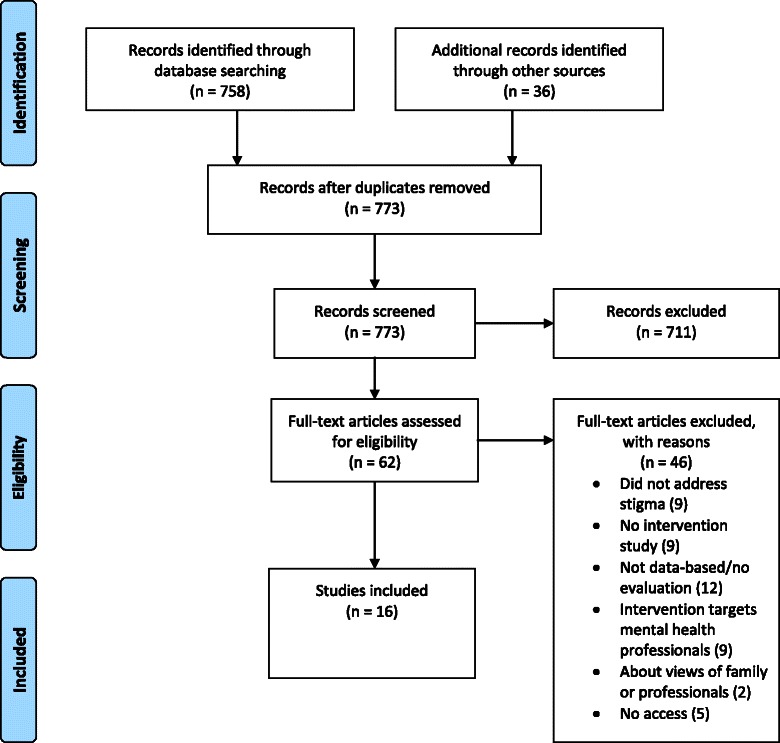
BACKGROUND: The majority of people experiencing mental-health problems do not seek help, and the stigma of mental illness is considered a major barrier to seeking appropriate treatment. More targeted interventions (e.g. at the workplace) seem to be a promising and necessary supplement to public campaigns, but little is known about their effectiveness. The aim of this systematic review is to provide an overview of the evidence on the effectiveness of interventions targeting the stigma of mental illness at the workplace. METHODS: Sixteen studies were included after the literature review. The effectiveness of anti-stigma interventions at the workplace was assessed by examining changes in: (1) knowledge of mental disorders and their treatment and recognition of signs/symptoms of mental illness, (2) attitudes towards people with mental-health problems, and (3) supportive behavior. RESULTS: The results indicate that anti-stigma interventions at the workplace can lead to improved employee knowledge and supportive behavior towards people with mental-health problems. The effects of interventions on employees' attitudes were mixed, but generally positive. The quality of evidence varied across studies. CONCLUSIONS: This highlights the need for more rigorous, higher-quality evaluations conducted with more diverse samples of the working population. Future research should explore to what extent changes in employees' knowledge, attitudes, and supportive behavior lead to affected individuals seeking help earlier. Such investigations are likely to inform important stakeholders about the potential benefits of current workplace anti-stigma interventions and provide guidance for the development and implementation of effective future interventions.
Overview
The claims and statistics of this paper haven’t been checked yet.
Run the check — free, no account needed. It reads the open-access text and checks the sources it cites.
Integrity signals
Registry
Cites
Statistics
Figures
Verification
Claims the paper makes
The claims and statistics of this paper haven’t been checked yet.
Run the check — free, no account needed. It reads the open-access text and checks the sources it cites.
Claims other papers make about this one
Each is checked against this paper’s own text: does it say what the citing paper says it does?
In the citing paper
“The best replicated of early findings - frontal hypometabolism and hippocampal atrophy 313,314 - remain foundational to current models of depression, although they are not pathognomonic.”
From Time for united action on depression: a Lancet–World Psychiatric Association Commission (2022) · cites this paper as [313]
In the citing paper
“Interventions that aim to reduce interpersonal stigma in the workplace have been evaluated, such as the Mental Health First Aid (MHFA) programme.108”
From The Lancet Commission on ending stigma and discrimination in mental health (2022) · cites this paper as [108]
In the citing paper
“Kiropoulos et al116 and Chruzander et al117 found improvement in QoL at post-treatment and follow-up assessments.”
From Quality of life in adults with multiple sclerosis: A systematic review (2020) · cites this paper as [116]
Self-check
Percentages, sums and reported differences re-computed from the paper’s own numbers.
The self-check needs the paper’s full text.
Citations
Cites
Preferred Reporting Items for Systematic Reviews and Meta-Analyses: the PRISMA statement
Moher, D., Liberati, A., Tetzlaff, J., Altman, D. G., & for the PRISMA Group (2009) · BMJ · doi:10.1136/bmj.b2535 · Cited by 83,823
Preferred reporting items for systematic reviews and meta-analyses: the PRISMA Statement.
(2009) · PubMed Central · Cited by 44,859
Preferred reporting items for systematic reviews and meta-analyses: The PRISMA statement
Moher, D., Liberati, A., Tetzlaff, J., Altman, D. G., & the PRISMA Group* (2009) · Annals of Internal Medicine · doi:10.7326/0003-4819-151-4-200908180-00135 · Cited by 37,554
Preferred Reporting Items for Systematic Reviews and Meta-Analyses: The PRISMA Statement
Moher, D., Liberati, A., Tetzlaff, J., & Altman, D. G. (2009) · Journal of Clinical Epidemiology · doi:10.1016/j.jclinepi.2009.06.005 · Cited by 19,575
Lippa, N. C., & Sanderson, S. C. (2013) · Human Heredity · doi:10.1159/000353712 · Cited by 6,095
The world health report 2001 - Mental health: new understanding, new hope
Sayers, J. (2001) · Europe PMC (PubMed Central) · doi:10.1590/s0042-96862001001100014 · Cited by 3,307
Clement, S., Schauman, O., Graham, T., Maggioni, F., Evans-Lacko, S., Bezborodovs, N., Morgan, C., Rüsch, N., Brown, J. S. L., & Thornicroft, G. (2015) · Psychological Medicine · doi:10.1017/s0033291714000129 · Cited by 3,152
Popay, J., Roberts, H., Sowden, A., Petticrew, M., Arai, L., Rodgers, M., Britten, N., Roen, K., & Duffy, S. (2006) · Lancaster University · doi:10.13140/2.1.1018.4643 · Cited by 2,070
Internalized stigma of mental illness: psychometric properties of a new measure
Ritsher, J. B., Otilingam, P. G., & Grajales, M. (2003) · Psychiatry Research · doi:10.1016/j.psychres.2003.08.008 · Cited by 1,727
Challenging the public stigma of mental illness: a meta-analysis of outcome studies
Corrigan, P. W., Morris, S. B., Michaels, P. J., Rafacz, J. D., & Rüsch, N. (2012) · Psychiatric Services · doi:10.1176/appi.ps.201100529 · Cited by 1,680
Research works printed but not linked: 4
- NICE. The guidelines manual: appendices B-I; Appendix B: Methodology checklist: systematic reviews and meta-analyses. 2012.
- Massey J. Increasing mental health literacy among student affairs staff: assessing ‘Mental Health First Aid’. 2010.
- Stuart H, Koller M, West Armstrong A. Opening Minds in a post-secondary environment: results of an online contact-based anti-stigma intervention for college staff – Starting the Conversation. Mental Health Commission of Canada. 2013. http://www.mentalhealthcommission.ca/English/system/files/private/document/Stigma_OM_Algonquin%20College_Starting_the_Conversation.pdf . Accessed 18 October 2014.
- Luong D, Kirsh B, Krupa T. Region of Peel Report Mental Health Commission of Canada. 2013. http://www.mentalhealthcommission.ca/English/system/files/private/document/Region_Of_Peel_Report_May_2013_Final_ENG.pdf . Accessed 18 October 2014.
Cited by
Sorted by citations
Time for united action on depression: a Lancet–World Psychiatric Association Commission
Herrman, H., Patel, V., Kieling, C., Berk, M., Buchweitz, C., Cuijpers, P., Furukawa, T. A., Kessler, R. C., Kohrt, B. A., Maj, M., et al. (2022) · The Lancet · doi:10.1016/s0140-6736(21)02141-3 · Cited by 1,104
The Lancet Commission on ending stigma and discrimination in mental health
Thornicroft, G., Sunkel, C., Alikhon Aliev, A., Baker, S., Brohan, E., el Chammay, R., Davies, K., Demissie, M., Duncan, J., Fekadu, W., et al. (2022) · The Lancet · doi:10.1016/s0140-6736(22)01470-2 · Cited by 748
Semahegn, A., Torpey, K., Manu, A., Assefa, N., Tesfaye, G., & Ankomah, A. (2020) · Systematic Reviews · doi:10.1186/s13643-020-1274-3 · Cited by 555
Morgan, A. J., Reavley, N. J., Ross, A., Too, L. S., & Jorm, A. F. (2018) · Journal of Psychiatric Research · doi:10.1016/j.jpsychires.2018.05.017 · Cited by 372
Jesulola, E., Micalos, P., & Baguley, I. J. (2018) · Behavioural Brain Research · doi:10.1016/j.bbr.2017.12.025 · Cited by 379
Metadata
- Authors
- Hanisch, S. E., Twomey, C. D., Szeto, A. C. H., Birner, U. W., Nowak, D., & Sabariego, C.
- Affiliations
- Institut für Medizinische Informationsverarbeitung, Biometrie und Epidemiologie (DE)
- University of Southampton (GB)
- University of Calgary (CA)
- Siemens (Germany) (DE)
- Institut und Poliklinik für Arbeits-, Sozial- und Umweltmedizin (DE)
- Corresponding author
- Hanisch, Sabine E.
- ORCID
- Venue
- BMC Psychiatry
- Published
- 2016-01-06
- Volume
- 16
- Issue
- 1
- Pages
- 1-1
- ISSN
- 1471-244X (ISSN-L)
- PMC
- PMC4704270
- OpenAlex
- W2226349369
- Cited by
- 564
- References
- 60
- Citations by year
- 2026: 21 · 2025: 34 · 2024: 49 · 2023: 52 · 2022: 50 · 2021: 115 · 2020: 70 · 2019: 48 · 2018: 52 · 2017: 49 · 2016: 22
- FWCI
- 8.93
- Type
- journal article
- Language
- en
- Open access
- gold
- doi.org
- Licence
- Locations
- BMC Psychiatry (publishedVersion, cc-by)
- Europe PMC (PubMed Central) (publishedVersion, cc-by)
- PubMed Central (publishedVersion, cc-by)
- PubMed (publishedVersion)
- Open access LMU (Ludwid Maxmilian's Universitat Munchen) (submittedVersion, cc-by)
- Funders
- European Commission
- Topics
- Health Sciences › Medicine › Psychiatry and Mental health › Mental Health Treatment and Access
- Health Sciences › Medicine › Public Health, Environmental and Occupational Health › Workplace Health and Well-being
- Social Sciences › Gender Studies › Gender Roles and Identity Studies
- Keywords
- mental health stigma, help-seeking, attitudes toward mental illness, supportiveness, employee attitudes, stigma reduction
- MeSH terms
- Mental Disorders, Humans, Health Knowledge, Attitudes, Practice, Workplace, Social Stigma
About these checks
Registry, retraction, Cites and statistics results are computed, not judged, with one exception: a printed reference that no index lists is read once by a model before it counts as a citation error. Claims are extracted by a model and kept only when their quote appears verbatim in the text; each cited source is then checked, with a model’s help, for whether it says what the claim relies on. Those verdicts can be wrong — read the claim’s quote and the cited source before relying on one.
Statistics and arithmetic are recomputed, not judged.
Confidence bands are shown only for fields calibrated on our annotated test set. None is calibrated yet, so no band is shown.
What counts as a claim ›How we measure confidence ›How we check this ›
Are you an author, or do you see a problem with this page? Request a review
