

The DOI matches its Crossref record; 60 of the 62 references it cites were found in a registry or an index.
Validation of the German version of the insomnia severity index in adolescents, young adults and adult workers: results from three cross-sectional studies
Open accessAbstract
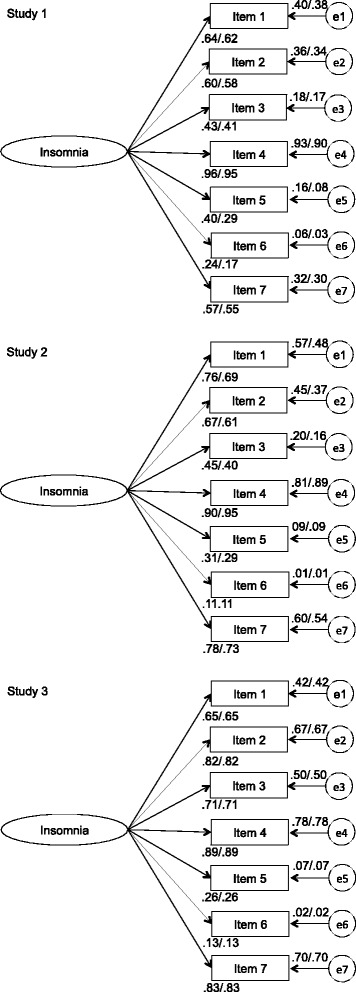
BACKGROUND: A variety of objective and subjective methods exist to assess insomnia. The Insomnia Severity Index (ISI) was developed to provide a brief self-report instrument useful to assess people's perception of sleep complaints. The ISI was developed in English, and has been translated into several languages including German. Surprisingly, the psychometric properties of the German version have not been evaluated, although the ISI is often used with German-speaking populations. METHODS: The psychometric properties of the ISI are tested in three independent samples: 1475 adolescents, 862 university students, and 533 police and emergency response service officers. In all three studies, participants provide information about insomnia (ISI), sleep quality (Pittsburgh Sleep Quality Index), and psychological functioning (diverse instruments). Descriptive statistics, gender differences, homogeneity and internal consistency, convergent validity, and factorial validity (including measurement invariance across genders) are examined in each sample. RESULTS: The findings show that the German version of the ISI has generally acceptable psychometric properties and sufficient concurrent validity. Confirmatory factor analyses show that a 1-factor solution achieves good model fit. Furthermore, measurement invariance across gender is supported in all three samples. CONCLUSIONS: While the ISI has been widely used in German-speaking countries, this study is the first to provide empirical evidence that the German version of this instrument has good psychometric properties and satisfactory convergent and factorial validity across various age groups and both men and women. Thus, the German version of the ISI can be recommended as a brief screening measure in German-speaking populations.
Overview
The claims and statistics of this paper haven’t been checked yet.
Run the check — free, no account needed. It reads the open-access text and checks the sources it cites.
Integrity signals
Registry
Cites
Statistics
Figures
Verification
Claims the paper makes
The claims and statistics of this paper haven’t been checked yet.
Run the check — free, no account needed. It reads the open-access text and checks the sources it cites.
Claims other papers make about this one
Each is checked against this paper’s own text: does it say what the citing paper says it does?
The source backs part of the claim, not all of it — or backs it for a different population, condition or comparison.
In the citing paper
“The German version of the ISI was validated in three different samples and shows satisfactory internal consistency across all three (α=0.76 in adolescents, α=0.77 in young adults, α=0.81 in adult workers).79”
From Clinical and cost-effectiveness of a guided internet-based Acceptance and Commitment Therapy to improve chronic pain-related disability in green professions (PACT-A): Study protocol of a pragmatic randomised controlled trial (2020) · cites this paper as [79]
Experimental — accuracy not yet measured
Self-check
Percentages, sums and reported differences re-computed from the paper’s own numbers.
The self-check needs the paper’s full text.
Citations
Cites
The Pittsburgh Sleep Quality Index: a new instrument for psychiatric practice and research
Buysse, D. J., Reynolds, C. F., Monk, T. H., Berman, S. R., & Kupfer, D. J. (1989) · Psychiatry Research · doi:10.1016/0165-1781(89)90047-4 · Cited by 35,234
Validation of the Insomnia Severity Index as an outcome measure for insomnia research
Bastien, C. (2001) · Sleep Medicine · doi:10.1016/s1389-9457(00)00065-4 · Cited by 8,067
Principles and practice in reporting structural equation analyses.
McDonald, R. P., & Ho, M.-H. R. (2002) · Psychological Methods · doi:10.1037/1082-989x.7.1.64 · Cited by 4,734 · cited 1×
“Parameter estimation was conducted using maximum likelihood (ML), and multiple goodnessof-fit indexes were considered to examine how well the theoretical model fitted the empirical data [45].”
MethodDiagnostic and Statistical Manual of Mental Disorders ( DSM ‐ IV ‐ TR )
Segal, D. L. (2010) · Wiley eBooks · doi:10.1002/9780470479216.corpsy0271 · Cited by 4,687
Structural Equation Modeling With AMOS: Basic Concepts, Applications, and Programming, Third Edition
Byrne, B. M. (2016) · doi:10.4324/9781315757421 · Cited by 4,653
Morin, C. M., Belleville, G., Bélanger, L., & Ivers, H. (2011) · Sleep · doi:10.1093/sleep/34.5.601 · Cited by 4,620
A First Course in Factor Analysis
Comrey, A. L., & Lee, H. B. (2013) · doi:10.4324/9781315827506 · Cited by 4,546
A First Course in Factor Analysis
Price, B., Comrey, A. L., & Lee, H. B. (1993) · Technometrics · doi:10.1080/00401706.1993.10485363 · Cited by 3,512
(1993) · Medical Entomology and Zoology · Cited by 2,324
Field Methods in Cross-Cultural Research
Shelly, R. K., Lonner, W. J., & Berry, J. W. (1988) · Contemporary Sociology A Journal of Reviews · doi:10.2307/2069488 · Cited by 2,113
Sleep-dependent memory consolidation
Stickgold, R. (2005) · Nature · doi:10.1038/nature04286 · Cited by 1,857
Athens Insomnia Scale: Validation of an instrument based on ICD-10 criteria
Soldatos, C. R., Dikeos, D. G., & Paparrigopoulos, T. J. (2000) · Journal of Psychosomatic Research · doi:10.1016/s0022-3999(00)00095-7 · Cited by 1,754
Insomnia: Definition, Prevalence, Etiology, and Consequences
Roth, T. G. (2007) · Journal of Clinical Sleep Medicine · doi:10.5664/jcsm.26929 · Cited by 1,539
Behavioral and Physiological Consequences of Sleep Restriction
Banks, S., & Dinges, D. F. (2007) · Journal of Clinical Sleep Medicine · doi:10.5664/jcsm.26918 · Cited by 1,505
Sleep loss, learning capacity and academic performance
CURCIO, G., FERRARA, M., & DEGENNARO, L. (2006) · Sleep Medicine Reviews · doi:10.1016/j.smrv.2005.11.001 · Cited by 1,310
Sex Differences in Insomnia: A Meta-Analysis
Zhang, B., & Wing, Y.-K. (2006) · Sleep · doi:10.1093/sleep/29.1.85 · Cited by 1,286
Shift work and disturbed sleep/wakefulness
Akerstedt, T. (2003) · Occupational Medicine · doi:10.1093/occmed/kqg046 · Cited by 1,101
Widaman, K. F., Ferrer, E. E., & Conger, R. D. (2010) · Child Development Perspectives · doi:10.1111/j.1750-8606.2009.00110.x · Cited by 961
Prevalence, course, and comorbidity of insomnia and depression in young adults.
Buysse, D. J., Angst, J., Gamma, A., Ajdacic, V., Eich, D., & Rössler, W. (2008) · Sleep · doi:10.1093/sleep/31.4.473 · Cited by 858
SF-36, Fragebogen zum Gesundheitszustand
Bullinger, M., & Kirchberger, I. (1998) · Cited by 835
Ravens-Sieberer, U., Gosch, A., Rajmil, L., Erhart, M., Bruil, J., Power, M., Duer, W., Auquier, P., Cloetta, B., Czemy, L., et al. (2008) · Value in Health · doi:10.1111/j.1524-4733.2007.00291.x · Cited by 807
Position statement on physical activity and exercise intensity terminology.
Norton, K., Norton, L., & Sadgrove, D. (2010) · Journal of Science and Medicine in Sport · doi:10.1016/j.jsams.2009.09.008 · Cited by 804
Validation of a Korean Version of the Insomnia Severity Index
Cho, Y. W., Song, M. L., & Morinc, C. M. (2014) · Journal of Clinical Neurology · doi:10.3988/jcn.2014.10.3.210 · Cited by 472
Chung, K.-F., Kan, K. K.-K., & Yeung, W.-F. (2011) · Sleep Medicine · doi:10.1016/j.sleep.2010.09.019 · Cited by 454
Savard, M.-H., Savard, J., Simard, S., & Ivers, H. (2005) · Psycho-Oncology · doi:10.1002/pon.860 · Cited by 449
ROBERTS, R. E., Roberts, C. R., & Duong, H. T. (2007) · Journal of Adolescent Health · doi:10.1016/j.jadohealth.2007.09.016 · Cited by 350
Insomnia Severity Index: psychometric properties with Chinese community‐dwelling older people
Yu, D. S. F. (2010) · Journal of Advanced Nursing · doi:10.1111/j.1365-2648.2010.05394.x · Cited by 330
Validation of the Insomnia Severity Index in Primary Care
Gagnon, C., Belanger, L., Ivers, H., & Morin, C. M. (2013) · The Journal of the American Board of Family Medicine · doi:10.3122/jabfm.2013.06.130064 · Cited by 319
Prevalence of Insomnia and its Treatment in Canada
Morin, C. M., LeBlanc, M., Bélanger, L., Ivers, H., Mérette, C., & Savard, J. (2011) · The Canadian Journal of Psychiatry · doi:10.1177/070674371105600905 · Cited by 310
Kalak, N., Gerber, M., Kirov, R., Mikoteit, T., Yordanova, J., Pühse, U., Holsboer-Trachsler, E., & Brand, S. (2012) · Journal of Adolescent Health · doi:10.1016/j.jadohealth.2012.02.020 · Cited by 230
Lang, C., Kalak, N., Brand, S., Holsboer‐Trachsler, E., Pühse, U., & Gerber, M. (2015) · Sleep Medicine Reviews · doi:10.1016/j.smrv.2015.07.004 · Cited by 228
Lang, C., Brand, S., Feldmeth, A. K., Holsboer-Trachsler, E., Pühse, U., & Gerber, M. (2013) · Physiology & Behavior · doi:10.1016/j.physbeh.2013.07.001 · Cited by 211
Self-citationGerber, M., Brand, S., Herrmann, C., Colledge, F., Holsboer‐Trachsler, E., & Pühse, U. (2014) · Physiology & Behavior · doi:10.1016/j.physbeh.2014.05.047 · Cited by 207
The Spanish version of the Insomnia Severity Index: A confirmatory factor analysis
Fernández‐Mendoza, J., Rodríguez‐Muñoz, A., Vela‐Bueno, A., Olavarrieta‐Bernardino, S., Calhoun, S. L., Bixler, E. O., & Vgontzas, A. N. (2011) · Sleep Medicine · doi:10.1016/j.sleep.2011.06.019 · Cited by 205
EEG Spectral Analysis in Primary Insomnia: NREM Period Effects and Sex Differences
Buysse, D. J., Germain, A., Hall, M. L., Moul, D. E., Nofzinger, E. A., Begley, A. E., Ehlers, C. L., Thompson, W. K., & Kupfer, D. J. (2008) · SLEEP · doi:10.1093/sleep/31.12.1673 · Cited by 185
Validity and reliability of the Iranian version of the insomnia severity index.
(2012) · Europe PMC (PubMed Central) · Cited by 171
Detecting insomnia: comparison of four self‐report measures of sleep in a young adult population
Smith, S. S., & Trinder, J. C. (2001) · Journal of Sleep Research · doi:10.1046/j.1365-2869.2001.00262.x · Cited by 144
Die Stellung der deutschen Sprache in der Welt
Ammon, U. (2014) · De Gruyter eBooks · doi:10.1515/9783110241075 · Cited by 140
The relationship between shift work, perceived stress, sleep and health in Swiss police officers
Gerber, M., Hartmann, T., Brand, S., Holsboer‐Trachsler, E., & Pühse, U. (2010) · Journal of Criminal Justice · doi:10.1016/j.jcrimjus.2010.09.005 · Cited by 127
THE SLEEP OF HEALTHY PEOPLE—A DIARY STUDY
Monk, T. H., Buysse, D. J., Rose, L. R., Hall, J. A., & Kupfer, D. J. (2000) · Chronobiology International · doi:10.1081/cbi-100101031 · Cited by 105
Hatzinger, M., Brand, S., Perren, S., Stadelmann, S., von Wyl, A., von Klitzing, K., & Holsboer‐Trachsler, E. (2007) · Journal of Psychiatric Research · doi:10.1016/j.jpsychires.2007.05.010 · Cited by 99
Fitness and Exercise as Correlates of Sleep Complaints
Gerber, M., Brand, S., Holsboer‐Trachsler, E., & Pühse, U. (2010) · Medicine & Science in Sports & Exercise · doi:10.1249/mss.0b013e3181c0ea8c · Cited by 97
Sierra, J. C., Guillén-Serrano, V., & Santos‐Iglesias, P. (2008) · Revista de Neurología · doi:10.33588/rn.4711.2008221 · Cited by 89
Kalak, N., Gerber, M., Kirov, R., Mikoteit, T., Pühse, U., Holsboer‐Trachsler, E., & Brand, S. (2012) · Journal of Psychiatric Research · doi:10.1016/j.jpsychires.2012.07.006 · Cited by 87
Women, anxiety and mood: a review of nomenclature, comorbidity and epidemiology
Alexander, J. L., Dennerstein, L., Kotz, K. J., & Richardson, G. (2007) · Expert Review of Neurotherapeutics · doi:10.1586/14737175.7.11s.s45 · Cited by 87
Brand, S., Beck, J., Gerber, M., Hatzinger, M., & Holsboer‐Trachsler, E. (2009) · The World Journal of Biological Psychiatry · doi:10.1080/15622970903079820 · Cited by 82
Ohayon, M. M., & Paiva, T. (2005) · Sleep Medicine · doi:10.1016/j.sleep.2005.03.006 · Cited by 76
Taylor, D. J. (2008) · SLEEP · doi:10.1093/sleep/31.4.447 · Cited by 70
‘Football Is Good for Your Sleep’
Brand, S., Beck, J., Gerber, M., Hatzinger, M., & Holsboer‐Trachsler, E. (2009) · Journal of Health Psychology · doi:10.1177/1359105309342602 · Cited by 68
Brand, S., Kalak, N., Gerber, M., Clough, P., Lemola, S., Pühse, U., & Holsboer‐Trachsler, E. (2014) · Journal of Health Psychology · doi:10.1177/1359105314542816 · Cited by 64
Translation and Validation of the Insomnia Severity Index in Hindi Language
Lahan, V., & Gupta, R. M. (2011) · Indian Journal of Psychological Medicine · doi:10.4103/0253-7176.92060 · Cited by 53
Gerber, M., Kellmann, M., Elliot, C., Hartmann, T., Brand, S., Holsboer‐Trachsler, E., & Pühse, U. (2013) · Journal of Occupational Health · doi:10.1539/joh.13-0030-oa · Cited by 48
Brand, S., Gerber, M., Pühse, U., & Holsboer‐Trachsler, E. (2010) · International Journal of Stress Management · doi:10.1037/a0019090 · Cited by 47
The relation between sleep and pain among a non-clinical sample of young adults
Brand, S., Gerber, M., Pühse, U., & Holsboer‐Trachsler, E. (2010) · European Archives of Psychiatry and Clinical Neuroscience · doi:10.1007/s00406-010-0113-2 · Cited by 30
The impact of lifestyle on the physical fitness of primary school children
Chung, J. W. Y., Chung, L. M. Y., & Chen, B. (2008) · Journal of Clinical Nursing · doi:10.1111/j.1365-2702.2008.02420.x · Cited by 21
Relation between the FITNESSGRAM® Assessment and Physical Activity Items
Martin, S. B., Tucker, J. S., Morrow, J. R., Greenleaf, C. A., Petrie, T. A., & Jackson, A. W. (2011) · Medicine & Science in Sports & Exercise · doi:10.1249/01.mss.0000402495.06073.94 · Cited by 6
INSOMNIA IN RELATION TO DEPRESSION AND SOMATIC SYMPTOMS
El-Anzi, F. O. (2006) · Psychological Reports · doi:10.2466/pr0.99.1.171-175 · Cited by 5
Donalies, E. (2016) · Publication Server of the Institute for German Language (Institute for German Language) · Cited by 5
INSOMNIA IN RELATION TO DEPRESSION AND SOMATIC SYMPTOMS
El-Anzi, F. O. (2006) · Psychological Reports · doi:10.2466/pr0.99.5.171-175 · Cited by 3
Brand, S., Kalak, N., Gerber, M., Pühse, U., & Holsboer‐Trachsler, E. (2013) · Pharmacopsychiatry · doi:10.1055/s-0033-1353327 · Cited by 2
Research works printed but not linked: 3
- Nunnally J, Bernstein B. Psychometric theory. New York: McGraw-Hill; 1994.
- Backhaus J, Riemann D. Schlafstörungen bewältigen [Coping with sleep disorders]. Weinheim: Beltz Psychologie Verlags Union; 1996.
- Von Zerssen D. Depressivitäts-Skala [Depression scale]. Göttingen: Hogrefe; 1976.
Cited by
Sorted by citations
Measuring Subjective Sleep Quality: A Review
Fabbri, M., Beracci, A., Martoni, M., Meneo, D., Tonetti, L., & Natale, V. (2021) · International Journal of Environmental Research and Public Health · doi:10.3390/ijerph18031082 · Cited by 660
The Impact of Migration Status on Adolescents’ Mental Health during COVID-19
Pieh, C., Dale, R., Jesser, A., Probst, T., Plener, P. L., & Humer, E. C. (2022) · Healthcare · doi:10.3390/healthcare10010176 · Cited by 178
Structural validity of the Insomnia Severity Index: A systematic review and meta-analysis
Manzar, M. D., Jahrami, H. A., & Bahammam, A. S. (2021) · Sleep Medicine Reviews · doi:10.1016/j.smrv.2021.101531 · Cited by 138
Insomnia Severity Index: A reliability generalisation meta‐analysis
Cerri, L., Justo, M. C., Clemente, V., Gomes, A. A., Pereira, A., & Marques, D. R. (2023) · Journal of Sleep Research · doi:10.1111/jsr.13835 · Cited by 90
Chronic Pain and Sleep Disorders in Primary Care
Jank, R., Gallee, A., Boeckle, M., Fiegl, S., & Pieh, C. (2017) · Pain Research and Treatment · doi:10.1155/2017/9081802 · Cited by 83
Metadata
- Authors
- Gerber, M., Lang, C., Lemola, S., Colledge, F., Kalak, N., Holsboer-Trachsler, E., Pühse, U., & Brand, S.
- Affiliations
- University of Basel (CH)
- University of Warwick (GB)
- Corresponding author
- Gerber, Markus
- Venue
- BMC Psychiatry
- Published
- 2016-05-31
- Volume
- 16
- Issue
- 1
- Pages
- 174-174
- ISSN
- 1471-244X (ISSN-L)
- PMC
- PMC4888604
- OpenAlex
- W2417740879
- Cited by
- 199
- References
- 62
- Citations by year
- 2026: 7 · 2025: 36 · 2024: 20 · 2023: 27 · 2022: 21 · 2021: 18 · 2020: 25 · 2019: 23 · 2018: 13 · 2017: 6 · 2016: 3
- FWCI
- 21.35
- Type
- journal article
- Language
- en
- Open access
- gold
- doi.org
- Licence
- Locations
- BMC Psychiatry (publishedVersion, cc-by)
- Europe PMC (PubMed Central) (publishedVersion, cc-by)
- PubMed Central (publishedVersion, cc-by)
- PubMed (publishedVersion)
- edoc (University of Basel) (submittedVersion)
- PUB – Publications at Bielefeld University (Bielefeld University) (submittedVersion, cc-by)
- Funders
- Freiwillige Akademische Gesellschaft
- Police Management of the Basel Police Force
- Topics
- Social Sciences › Psychology › Experimental and Cognitive Psychology › Sleep and related disorders
- Social Sciences › Decision Sciences › Management Science and Operations Research › Psychometric Methodologies and Testing
- Social Sciences › Psychology › Experimental and Cognitive Psychology › Anxiety, Depression, Psychometrics, Treatment, Cognitive Processes
- Keywords
- Insomnia Severity Index, German translation, psychometric validation, insomnia, sleep quality, measurement invariance, gender differences, adolescents, young adults, police officers, emergency response workers, screening tool, self-report questionnaire
- MeSH terms
- Adolescent, Adult, Cross-Sectional Studies, Factor Analysis, Statistical, Female, Humans, Sleep Initiation and Maintenance Disorders, Male, Psychometrics, Surveys and Questionnaires, Severity of Illness Index, Sleep, Translating, Reproducibility of Results, Young Adult, Self Report
About these checks
Registry, retraction, Cites and statistics results are computed, not judged, with one exception: a printed reference that no index lists is read once by a model before it counts as a citation error. Claims are extracted by a model and kept only when their quote appears verbatim in the text; each cited source is then checked, with a model’s help, for whether it says what the claim relies on. Those verdicts can be wrong — read the claim’s quote and the cited source before relying on one.
Statistics and arithmetic are recomputed, not judged.
Confidence bands are shown only for fields calibrated on our annotated test set. None is calibrated yet, so no band is shown.
What counts as a claim ›How we measure confidence ›How we check this ›
Are you an author, or do you see a problem with this page? Request a review
