

An Internet-based treatment for flying phobia (NO-FEAR Airlines): study protocol for a randomized controlled trial
Open accessThe DOI matches its Crossref record; 79 of the 81 references it cites were found in a registry or an index; 22 of the 53 sources its claims cite were checked for support.
Abstract
Background: Flying phobia (FP) is a common and disabling mental disorder. Although in vivo exposure is the treatment of choice, it is linked to a number of limitations in its implementation. Particularly important, is the limited access to the feared stimulus (i.e., plane). Moreover, the economic cost of in vivo exposure should be specially considered as well as the difficulty of applying the exposure technique in an appropriate way; controlling important variables such as the duration of the exposure or the number of sessions. ICTs could help to reduce these limitations. Computer-assisted treatments have remarkable advantages in treating FP. Furthermore, they can be delivered through the Internet, increasing their advantages and reaching more people in need. The Internet has been established as an effective way to treat a wide range of mental disorders. However, as far as we know, no controlled studies exist on FP treatment via the Internet. This study aims to evaluate the efficacy of an Internet-based treatment for FP (NO-FEAR Airlines) versus a waiting list control group. Secondary objectives will be to explore two ways of delivering NO-FEAR Airlines, with or without therapist guidance, and study the patients' acceptance of the program. This paper presents the study protocol. Methods/design: The study is a randomized controlled trial. A minimum of 57 participants will be randomly assigned to three conditions: a) NO-FEAR Airlines totally self-applied, b) NO-FEAR Airlines with therapist guidance, or c) a waiting list control group (6 weeks). Primary outcomes measures will be the Fear of Flying Questionnaire-II and the Fear of Flying Scale. Secondary outcomes will be included to assess other relevant clinical measures, such as the Fear and Avoidance Scales, Clinician Severity Scale, and Patient's Improvement scale. Analyses of post-treatment flights will be conducted. Treatment acceptance and preference measures will also be included. Intention-to-treat and per protocol analyses will be conducted. Discussion: An Internet-based treatment for FP could have considerable advantages in managing in vivo exposure limitations, specifically in terms of access to treatment, acceptance, adherence, and the cost-effectiveness of the intervention. This is the first randomized controlled trial to study this issue. Trial registration: Clinicaltrials.gov: NCT02298478. Trial registration date 3 November 2014. © 2016 The Author(s).
Overview
CoChat Summary
## TL;DR
This paper is a study protocol for the first randomized controlled trial testing NO-FEAR Airlines, an Internet-based exposure treatment for flying phobia, against a waiting-list control group. It also plans to compare self-applied versus therapist-guided delivery and assess patient acceptance.
## Key findings
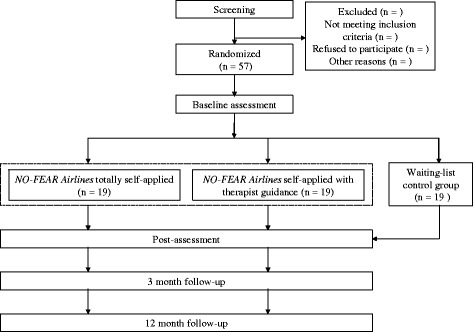
- The protocol targets a minimum of 57 participants randomly assigned to 3 groups: self-applied NO-FEAR Airlines, NO-FEAR Airlines with therapist guidance, or a 6-week waiting list.
- Primary outcomes are the Fear of Flying Questionnaire-II (FFQ-II) and the Fear of Flying Scale (FFS); secondary outcomes include fear/avoidance measures, clinician severity, patient improvement, and post-treatment flight behavior.
- The intervention is designed to be completed in 3–4 weeks with a maximum of 6 weeks, and therapist-guided participants may receive up to 6 telephone calls over 4 to 6 weeks for a maximum of 30 minutes of support.
- The paper reports that dropout rates around 30% were anticipated in the sample size calculation.
## Methods
- Design: A three-armed simple-blind randomized controlled trial with intention-to-treat and per-protocol analyses.
- Sample/data: Adults 18 years or older meeting DSM-5 criteria for specific situational phobia (flying phobia), with access to the Internet and ability to read Spanish; comorbid related disorders could be included if flying phobia was primary.
- Analysis: Group differences will be tested with chi-square tests for categorical variables and ANOVA for continuous outcomes; missing data will be handled with multiple imputation if assumed missing at random.
## Limitations
- The paper states that online and phone-based diagnostic assessment may alter psychometric properties compared with traditional assessment.
- The authors expect high dropout (around 30%), which could affect the study, although they account for this in sample size planning.
- The text says the heterogeneity of flying phobia and included comorbidities (panic, agoraphobia, claustrophobia, acrophobia) may influence outcomes; this is noted by the paper and is an evident design complexity.
Model-written summary. Check it against the paper before relying on it.
Integrity signals
Registry
Cites
Statistics
Figures
Verification
Claims the paper makes
10 Valid · 4 Not valid · 14 Not checked · 8 Own results and interpretations
Some cited sources support this claim and some don’t — read each source’s verdict below.
In the paper
“the results so far indicate a small but significant effect size of these self-help interventions compared to a control condition [43–47].”
§ An Internet-based treatment for flying phobia (NO-FEAR Airlines): study protocol for a randomized controlled trial > Background
What the sources say
- Disputedcites [43] Titov N Dear B Johnston L McEvoy P Wootton B Terides M Improving adherence and clinical outcomes in self-guided internet treatment for anxiety and depression: a 12-month follow-Up of a randomised controlled trial PLoS One 2014 9 2 e89591 10.1371/journal.pone.0089591 24586897 PMC3934918 sourceExperimental — accuracy not yet measured
The Results > Effect Sizes section reports large or moderate-to-large improvements within the treatment groups, but describes the small between-group effect sizes as non-significant. The Methods > Design and Sample Size section clarifies that this follow-up presents data for the waitlist control group after it received treatment, rather than a significant small effect against an untreated control condition. No page numbers are available in our copy. (LLM, conf=0.86)
Checked by a reasoning model — may be wrong.
- Not checked — no full text of the sourcecites [44] Berger T Caspar F Richardson R Kneubühler B Sutter D Andersson G Internet-based treatment of social phobia: a randomized controlled trial comparing unguided with two types of guided self-help Behav Res Ther 2011 49 3 158 169 10.1016/j.brat.2010.12.007 21255767 source
- Supportedcites [45] Cuijpers P Donker T Johansson R Mohr D van Straten A Andersson G Self-guided psychological treatment for depressive symptoms: a meta-analysis PLoS One 2011 6 6 e21274 10.1371/journal.pone.0021274 21712998 PMC3119687 source
The Results (p. 5) report a small, statistically significant effect for self-guided psychological treatment compared with control groups (d = 0.28; p < 0.001). The Discussion (p. 7) describes this finding as applying to participants with elevated depressive symptoms. (LLM, conf=0.93)
- Disputedcites [46] Farrer L Christensen H Griffiths K Mackinnon A Internet-based CBT for depression with and without telephone tracking in a national helpline: randomised controlled trial PLoS One 2011 6 11 e28099 10.1371/journal.pone.0028099 22140514 PMC3227639 sourceExperimental — accuracy not yet measured
The Results (Depression symptoms, Table 4; page not supplied) report significant differences from control, but explicitly describe the post-intervention effects as large, not small. They report g = 0.76 for web-only treatment and g = 1.04 for web treatment with tracking, with larger effects at six months. (LLM, conf=0.88)
Checked by a reasoning model — may be wrong.
- Partly supportedcites [47] Meyer B Bierbrodt J Schröder J Berger T Beevers C Weiss M Effects of an Internet intervention (Deprexis) on severe depression symptoms: Randomized controlled trial Internet Interv 2015 2 1 48 59 10.1016/j.invent.2014.12.003 sourceExperimental — accuracy not yet measured
The Results (§3.3) report a significant benefit over the control group at post-treatment, but its between-group effect size was medium (d = 0.57), not small. The small effect at follow-up (d = 0.33) was only marginally significant in the intention-to-treat sample (§3.5). The paper therefore supports a benefit for this intervention, but not the unqualified claim of a small, significant effect for self-help interventions generally. (LLM, conf=0.85)
hedgedstates a cause- Asserted: passes — The authors put it forward as true.
- Checkable: passes — It can be checked against evidence.
- Load-bearing: passes — The paper’s conclusions depend on it.
- Based: passes — The paper gives a reason why it holds.
- Disputed
The cited sources support only part of this claim — read each source’s verdict below.
In the paper
“The Internet has been shown to be an effective tool for treating a broad range of psychological disorders and psychiatric conditions, particularly depression and anxiety disorders [33–35]”
§ An Internet-based treatment for flying phobia (NO-FEAR Airlines): study protocol for a randomized controlled trial > Background
What the sources say
- Not checked — no full text of the sourcecites [33] Andersson G Internet-delivered psychological treatments Annu Rev Clin Psychol 2016 12 1 157 179 10.1146/annurev-clinpsy-021815-093006 26652054 source
- Partly supportedcites [34] Johansson R Andersson G Internet-based psychological treatments for depression Expert Rev Neurother 2012 12 7 861 870 10.1586/ern.12.63 22853793 sourceExperimental — accuracy not yet measured
The section “Internet-based psychological treatments for depression” reports that a transdiagnostic internet-based treatment appears effective for both depression and anxiety, and describes efficacy results for tailored treatments. The review does not establish effectiveness across the broader range of psychological disorders and psychiatric conditions claimed. (LLM, conf=0.84)
- Supportedcites [35] Andersson G Titov N Advantages and limitations of Internet-based interventions for common mental disorders World Psychiatry 2014 13 1 4 11 10.1002/wps.20083 24497236 PMC3918007 source
The abstract (p. 1) states that 'there is now a large body of evidence suggesting that Internet interventions work' and that these treatments 'often result in similar outcomes as in face-to-face psychotherapy'; the Conclusions (p. 5) repeat that there is 'considerable support for the use of the Internet for delivering evidence-based psychotherapy for common mental disorders'. The section on Internet-based treatments for mood and anxiety disorders (p. 3) documents trials across a range of psychiatric conditions (panic, social anxiety, generalized anxiety, PTSD, OCD, severe health anxiety, specific phobia, plus major depression, and transdiagnostic treatments for comorbidity, p. 4), with depression and anxiety being the focus of the field, matching the claim's 'broad range... particularly depression and anxiety'. The only qualification the source adds that the claim omits is that most studies concern mild-to-moderate severity, which does not contradict the attributed point. (LLM, conf=0.85)
plainstates a cause- Asserted: passes — The authors put it forward as true.
- Checkable: passes — It can be checked against evidence.
- Load-bearing: passes — The paper’s conclusions depend on it.
- Based: passes — The paper gives a reason why it holds.
Every source the paper cites for this claim was checked and supports it.
In the paper
“only 7.8 % search for a treatment [17]”
§ An Internet-based treatment for flying phobia (NO-FEAR Airlines): study protocol for a randomized controlled trial > Background
What the sources say
- Supportedcites [17] Mackenzie C Reynolds K Cairney J Streiner D Sareen J Disorder-specific mental health service use for mood and anxiety disorders: associations with age, sex, and psychiatric comorbidity Depress Anxiety 2012 29 3 234 242 10.1002/da.20911 22065571 PMC4284961 source
The Results report that 7.8% of people with specific phobias sought help for their disorder. The Discussion rounds this to 8%. Thus the figure applies specifically to specific phobias, rather than all phobias. (LLM, conf=0.94)
plain- Asserted: passes — The authors put it forward as true.
- Checkable: passes — It can be checked against evidence.
- Load-bearing: passes — The paper’s conclusions depend on it.
- Based: passes — The paper gives a reason why it holds.
- Supported
The sources with a verdict support this claim; the rest weren’t checked yet, have no full text we could read, or their verdicts aren’t rated yet.
In the paper
“VRET has been shown to be effective for FP treatment in several meta-analyses and systematic reviews [28–31].”
§ An Internet-based treatment for flying phobia (NO-FEAR Airlines): study protocol for a randomized controlled trial > Background
What the sources say
- Not checked — no full text of the sourcecites [28] Diemer J Mühlberger A Pauli P Zwanzger P Virtual reality exposure in anxiety disorders: Impact on psychophysiological reactivity World J Biol Psychiatry 2014 15 6 427 442 10.3109/15622975.2014.892632 24666248 source
- Not checked — no full text of the sourcecites [29] Gregg L Tarrier N Virtual reality in mental health Soc Psychiatry Psychiatr Epidemiol 2007 42 5 343 354 10.1007/s00127-007-0173-4 17431528 source
- Supportedcites [30] Meyerbröker K Emmelkamp P Virtual reality exposure therapy in anxiety disorders: a systematic review of process-and-outcome studies Depress Anxiety 2010 27 10 933 944 10.1002/da.20734 20734361 source
The Concluding Remarks state that there is considerable evidence that VRET is effective for fear of flying. The Meta-Analyses section reports a fear-of-flying effect size, and the review discusses multiple treatment studies, supporting its use as a systematic-review citation for this claim. (LLM, conf=0.94)
- Not checked — no full text of the sourcecites [31] McCann R Armstrong C Skopp N Edwards-Stewart A Smolenski D June J Virtual reality exposure therapy for the treatment of anxiety disorders: An evaluation of research quality J Anxiety Disord 2014 28 6 625 631 10.1016/j.janxdis.2014.05.010 25093964 source
boostedstates a cause- Asserted: passes — The authors put it forward as true.
- Checkable: passes — It can be checked against evidence.
- Load-bearing: unclear — It is unclear whether the paper’s conclusions depend on it.
- Based: passes — The paper gives a reason why it holds.
The cited sources support only part of this claim — read each source’s verdict below.
In the paper
“dropout rates are expected to be high (around 30 %), according to the literature [51, 52].”
§ An Internet-based treatment for flying phobia (NO-FEAR Airlines): study protocol for a randomized controlled trial > Discussion
What the sources say
- Supportedcites [51] Van Ballegooijen W Cuijpers P van Straten A Karyotaki E Andersson G Smit J Adherence to internet-based and face-to-face cognitive behavioural therapy for depression: a meta-analysis PLoS One 2014 9 7 e100674 10.1371/journal.pone.0100674 25029507 PMC4100736 source
The Introduction reports that a review found an average dropout rate of 31.75% for computerised CBT for depression, consistent with the cited estimate of around 30%. It also notes that the studies used differing definitions of dropout. (LLM, conf=0.91)
- Could not verifycites [52] Spek V Cuijpers P Nyklicek I Keyzer J Pop V Internet-based cognitive behavior therapy for symptoms of depression and anxiety: A meta-analysis Psychol Med 2007 37 319 328 10.1017/S0033291706008944 17112400 sourceExperimental — accuracy not yet measured
The supplied passage and the retrieved material labeled Abstract contain bibliographic information, not dropout findings. Searches for dropout, attrition, treatment completion, and 30% found no passage in our copy addressing the claimed rate. (LLM, conf=0.72)
plain- Asserted: passes — The authors put it forward as true.
- Checkable: passes — It can be checked against evidence.
- Load-bearing: unclear — It is unclear whether the paper’s conclusions depend on it.
- Based: passes — The paper gives a reason why it holds.
- Supported
12 more claims · 1 with their cited sources checked
Create a free account to see all 36 claims and to verify the 4 references still open.
- Probably not a substantial claim. 13
- It may state two separate claims as one. 10
Citations
Cites
Diagnostic and Statistical Manual of Mental Disorders
American Psychiatric Association (2013) · doi:10.1176/appi.books.9780890425596 · Cited by 116,369
Diagnostic and Statistical Manual of Mental Disorders
Williams, J. B. W., & First, M. (2013) · Encyclopedia of Social Work · doi:10.1093/acrefore/9780199975839.013.104 · Cited by 109,519
SPIRIT 2013 Statement: Defining Standard Protocol Items for Clinical Trials
Chan, A.-W., Tetzlaff, J. M., Altman, D. G., Laupacis, A., Gøtzsche, P. C., Krleža-Jerić, K., Hróbjartsson, A., Mann, H., Dickersin, K., Berlin, J. A., et al. (2013) · Annals of Internal Medicine · doi:10.7326/0003-4819-158-3-201302050-00583 · Cited by 7,363
SPIRIT 2013 explanation and elaboration: guidance for protocols of clinical trials
Chan, A.-W., Tetzlaff, J. M., Gotzsche, P. C., Altman, D. G., Mann, H., Berlin, J. A., Dickersin, K., Hrobjartsson, A., Schulz, K. F., Parulekar, W. R., et al. (2013) · BMJ · doi:10.1136/bmj.e7586 · Cited by 6,251
(1992) · Applied Ergonomics · doi:10.1016/0003-6870(92)90318-p · Cited by 5,737
The New Statistics: Why and How
Cumming, G. (2014) · Psychological Science · doi:10.1177/0956797613504966 · Cited by 3,200 · cited 1×
“Moreover, effect sizes and confidence intervals of the mean will be conducted, following the author’s recommendations and recent literature [66, 67].”
BackgroundEysenbach, G., & CONSORT-EHEALTH Group (2011) · Journal of Medical Internet Research · doi:10.2196/jmir.1923 · Cited by 1,863 · cited 1×
“org), the CONSORT-EHEALTH guidelines [48] and the SPIRIT guidelines (Standard Protocol Items: Recommendations”
BackgroundBrief standard self-rating for phobic patients
Marks, I. M., & Mathews, A. M. (1979) · Behaviour Research and Therapy · doi:10.1016/0005-7967(79)90041-x · Cited by 1,801 · cited 2×
“Other relevant clinical measures Fear and Avoidance Scales (adapted from Marks & Mathews [60]) are used to assess participants’ fear and avoidance on a scale ranging from 0 (“No fear at all,” “I never avoid”) to 10 (“Severe fear,” “I always avoid”) related to the main target behavior: “flying”.”
Internet-based cognitive behaviour therapy for symptoms of depression and anxiety: A meta-analysis
SPEK, V., CUIJPERS, P., NYKLÍČEK, I., RIPER, H., KEYZER, J., & POP, V. (2007) · Psychological Medicine · doi:10.1017/s0033291706008944 · Cited by 1,586
Credibility of analogue therapy rationales
Borkovec, T. D., & Nau, S. D. (1972) · Journal of Behavior Therapy and Experimental Psychiatry · doi:10.1016/0005-7916(72)90045-6 · Cited by 1,553
Research works printed but not linked: 3
- Brown TA Barlow DH Di Nardo PA Anxiety disorders interview schedule for DSM-IV (ADIS-IV): client interview schedule 1994 New York Graywind Publications Inc
- Di Nardo PA Brown TA Barlow DH Anxiety disorders interview schedule for DSM-IV: Lifetime version (ADIS-IV-L) 1994 New York Graywind Publications Inc
- Guy W Clinical global impressions. En ECDEU assessment manual for psychopharmacology 1976 Rockville National Institute for Mental Health
Cited by
Campos, D., Mira, A., Bretón-López, J., Castilla, D., Botella, C., Baños, R. M., & Quero, S. (2018) · Neuropsychiatric Disease and Treatment · doi:10.2147/ndt.s153041 · Cited by 30
“A detailed description of the recruitment process and procedure is provided in the study protocol.(57)”
InfluentialSelf-citationCampos, D., Bretón-López, J., Botella, C., Mira, A., Castilla, D., Mor, S., Baños, R., & Quero, S. (2019) · BMC Psychiatry · doi:10.1186/s12888-019-2060-4 · Cited by 32
“A detailed description of the measures and sources of assessment can be found in the study protocol [55].”
BackgroundSelf-citationMartín-Domingo, L., Adiloğlu-Yalçınkaya, L., Ertürk, M., & Farkić, J. M. (2024) · Research in Transportation Business & Management · doi:10.1016/j.rtbm.2024.101104 · Cited by 37
Das Potenzial der virtuellen Realität in der Verhaltenstherapie
Diemer, J. (2019) · Nervenheilkunde · doi:10.1055/a-0928-0734 · Cited by 8
“[26] Campos D, Bretón-López J, Boutella C, et al.”
An internet-based treatment for flying phobia using 360° images: A feasibility pilot study
Mor, S., Botella, C., Campos, D., Carlbring, P., Tur, C., & Quero, S. (2022) · Internet Interventions · doi:10.1016/j.invent.2022.100510 · Cited by 7
Self-citationMor, S., Botella, C., Campos, D., Tur, C., Castilla, D., Soler, C., & Quero, S. (2021) · Internet Interventions · doi:10.1016/j.invent.2021.100387 · Cited by 6
Self-citationRegidor, N. V., & Ausín, B. (2020) · Clínica Contemporánea · doi:10.5093/cc2020a8 · Cited by 12
“…et al., 2011; Linder et al., 2013; Per Carlbring et al., 2007; Pramana et al., 2014; 2018; Spence et al., 2011; Stolz et al., 2018) Fobia específica (Campos et al., 2016; Spence et al., 2011), Agorafobia (Christoforou et al., 2017) Trastorno de pánico (Linder et al., 2013; Pham et al., 2016).”
BackgroundInfluentialNomophobia and netlessphobia: implicatıons for psychologıcal resilience and happiness
Karagöz, Y., FİLİZ, M., Karaşın, Y., & Kuzgun, Ş. (2025) · British Journal of Guidance and Counselling · doi:10.1080/03069885.2025.2566284 · Cited by 2
“These conditions are characterised by the fear of being without a mobile phone (nomophobia) and the fear of losing internet connectivity (netlessphobia) (Campos et al., 2016; Ranjan et al., 2022).”
Flugangst aus der Erfahrung von wingwave®-Coaches
Naumenko, K., Niebuhr, F., & Steinhäuser, J. (2020) · Prävention und Gesundheitsförderung · doi:10.1007/s11553-020-00796-8 · Cited by 1
Robles, V. A. G. (2019) · Tesis Doctorals en Xarxa (Consorci de Serveis Universitaris de Catalunya) · doi:10.6035/14109.2019.233592
Wingwave®-Coaching bei Flugangst – eine Fallserie
Niebuhr, F., Naumenko, K., & Steinhäuser, J. (2020) · Prävention und Gesundheitsförderung · doi:10.1007/s11553-020-00793-x
An Internet-delivered treatment for Flying Phobia using 360º images: a feasibility study
Mor, S. (2022) · Tesis Doctorals en Xarxa (Consorci de Serveis Universitaris de Catalunya) · doi:10.6035/14109.2022.366833
Beyond Flying Bliss: An Integrative Review of Passenger Stress During the Aviation Experience
Chilunjika, S. R. T., & Ngulube, P. (2026) · Safety · doi:10.3390/safety12040099
“Perceived loss of control was the most frequently and consistently reported stressor, appearing across five studies [5,8,9,37,38].”
Metadata
- Authors
- Campos, D., Bretón-López, J., Botella, C., Mira, A., Castilla, D., Baños, R., Tortella-Feliu, M., & Quero, S.
- Affiliations
- Universitat Jaume I (ES)
- Universitat de València (ES)
- Corresponding author
- Quero, Soledad
- ORCID
- Venue
- BMC Psychiatry
- Published
- 2016-08-20
- Volume
- 16
- Issue
- 1
- Pages
- 296-296
- ISSN
- 1471-244X (ISSN-L)
- PMC
- PMC4992303
- OpenAlex
- W2512924759
- Semantic Scholar
- 2eda7d516c1dabeaa8c07dfefca66f7ac37b64b4
- Cited by
- 13
- References
- 81
- Citations by year
- 2026: 1 · 2025: 1 · 2024: 1 · 2022: 2 · 2021: 1 · 2020: 3 · 2019: 3 · 2018: 1
- FWCI
- 2.04
- Type
- journal article
- Language
- en
- Open access
- gold
- doi.org
- Licence
- Locations
- BMC Psychiatry (publishedVersion, cc-by)
- PubMed Central (publishedVersion, cc-by)
- PubMed (publishedVersion)
- Repositori UJI (Universitat Jaume I) (acceptedVersion, other-oa)
- LA Referencia (Red Federada de Repositorios Institucionales de Publicaciones Científicas) (submittedVersion, cc-by-sa)
- Funders
- American Concrete Institute Foundation
- Ministerio de Economía y Competitividad
- Generalitat Valenciana
- Centro de Investigación Biomédica en Red-Fisiopatología de la Obesidad y Nutrición
- Instituto de Salud Carlos III
- Topics
- Social Sciences › Psychology › Applied Psychology › Digital Mental Health Interventions
- Social Sciences › Psychology › Experimental and Cognitive Psychology › Anxiety, Depression, Psychometrics, Treatment, Cognitive Processes
- Physical Sciences › Computer Science › Human-Computer Interaction › Virtual Reality Applications and Impacts
- Keywords
- aviophobia, online therapy, in vivo exposure, therapist guidance, treatment acceptance, fear of flying
- MeSH terms
- Fear, Humans, Phobic Disorders, Surveys and Questionnaires, Therapy, Computer-Assisted, Waiting Lists, Single-Blind Method, Treatment Outcome, Internet
About these checks
Registry, retraction, Cites and statistics results are computed, not judged, with one exception: a printed reference that no index lists is read once by a model before it counts as a citation error. Claims are extracted by a model and kept only when their quote appears verbatim in the text; each cited source is then checked, with a model’s help, for whether it says what the claim relies on. Those verdicts can be wrong — read the claim’s quote and the cited source before relying on one.
The claim verdicts this report counts are experimental: their accuracy is not yet measured.
A language model drew the claims from the paper on 2026-10-11, under version 3 of the claim definition (model deepseek-v4.1-flash, prompt extract-v3).
A second model labelled each claim on 2026-10-11 (model jev-1.13-20260917, definition revision gold-guideline-v0.2).
Cited sources are checked with a language model’s help (gpt-6-sol and qwen3.8-omni-flash).
Statistics and arithmetic are recomputed, not judged.
Confidence bands are shown only for fields calibrated on our annotated test set. None is calibrated yet, so no band is shown.
What counts as a claim ›How we measure confidence ›How we check this ›
Are you an author, or do you see a problem with this page? Request a review
Data sources
Bibliographic data: Semantic Scholar, OpenAlex, Crossref.
Contains information from the Semantic Scholar Academic Graph Datasets, made available under the ODC Attribution License (ODC-BY 1.0).
Semantic Scholar’s data is described in: Kinney, R., et al. (2023). The Semantic Scholar Open Data Platform. arXiv:2301.10140.
