

Selective serotonin reuptake inhibitors versus placebo in patients with major depressive disorder. A systematic review with meta-analysis and Trial Sequential Analysis
Open accessThe DOI matches its Crossref record; 192 of the 194 references it cites were found in a registry or an index.
Abstract
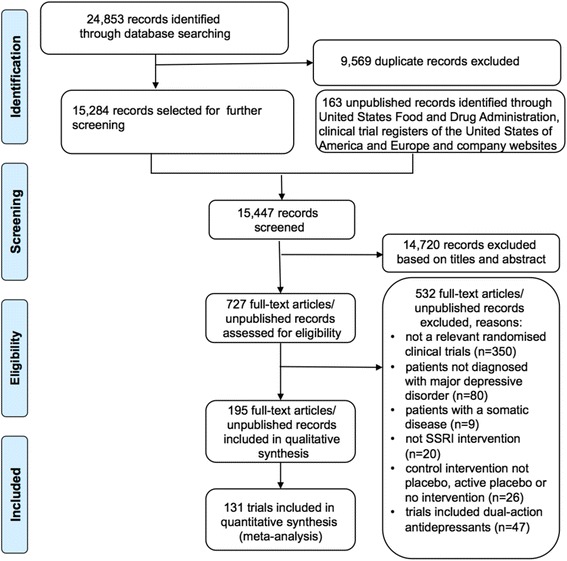
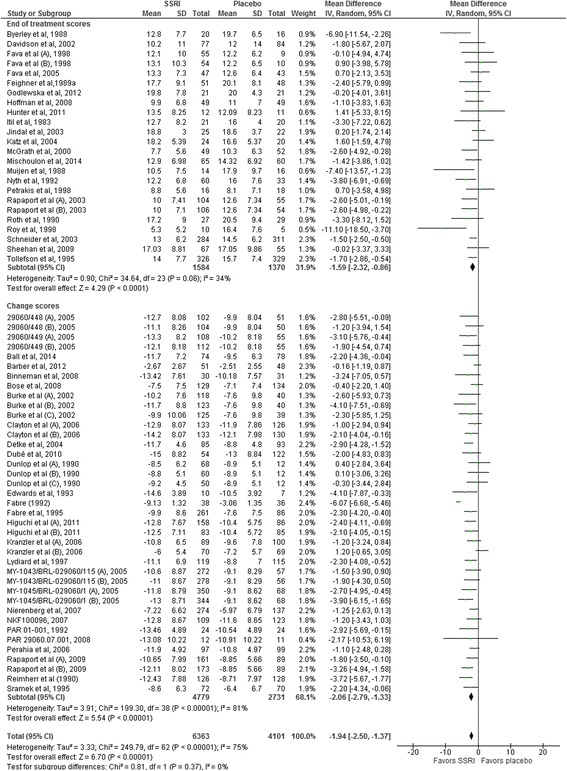
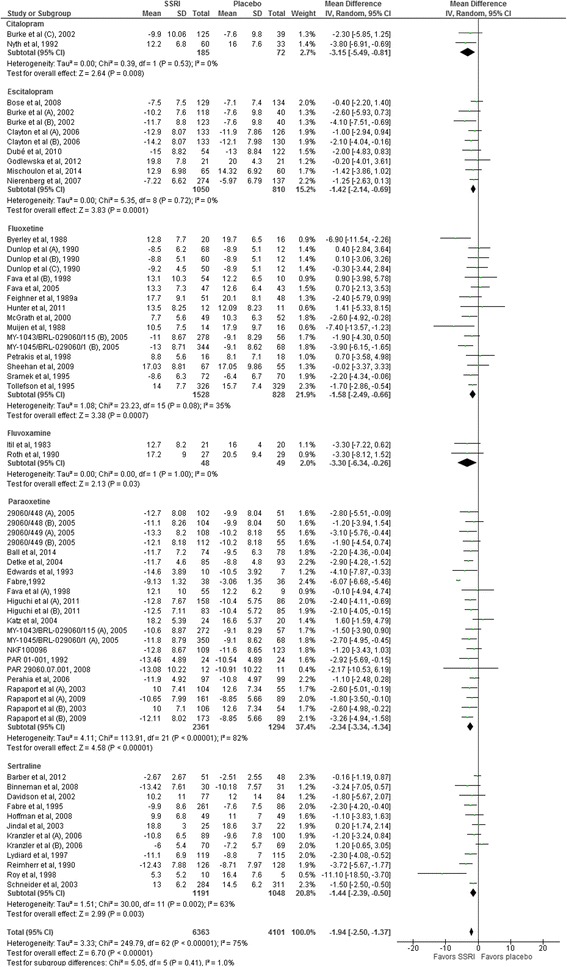
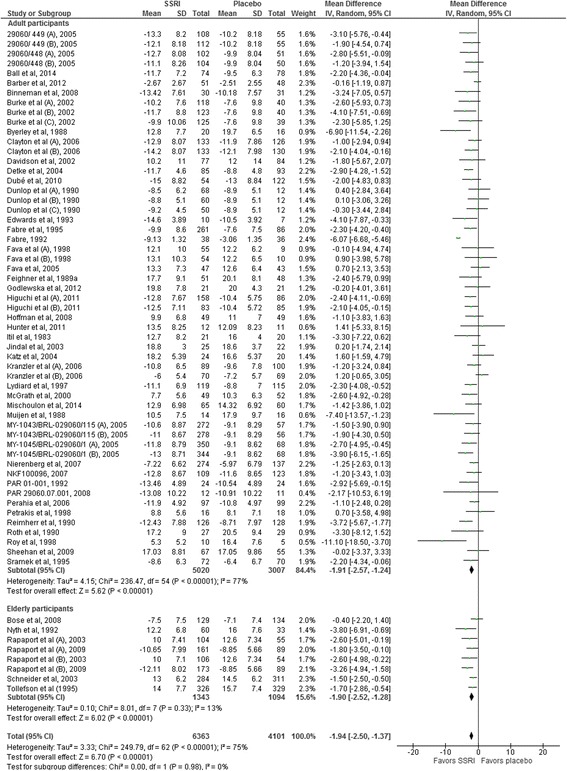
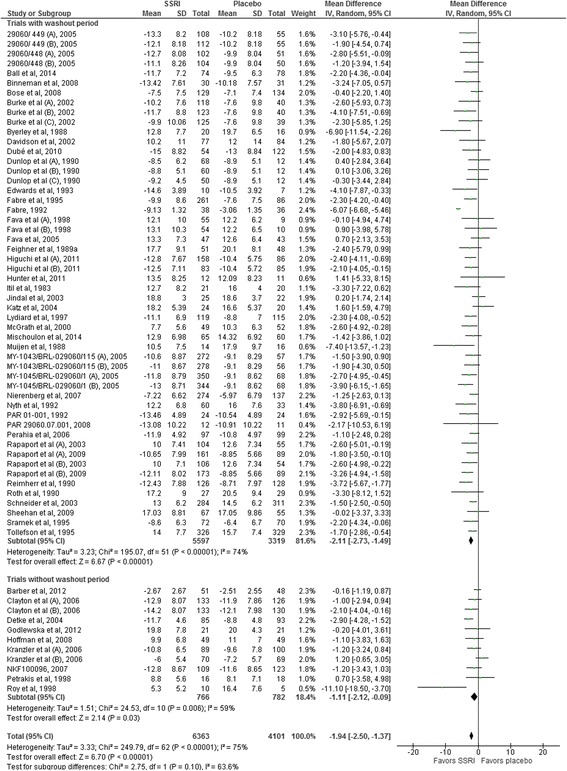
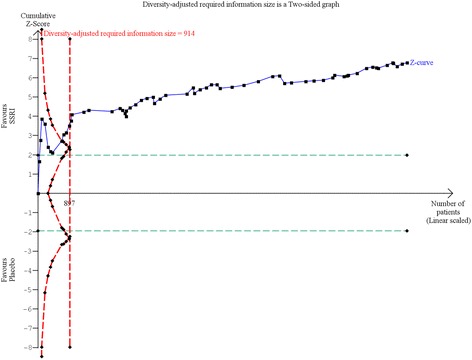
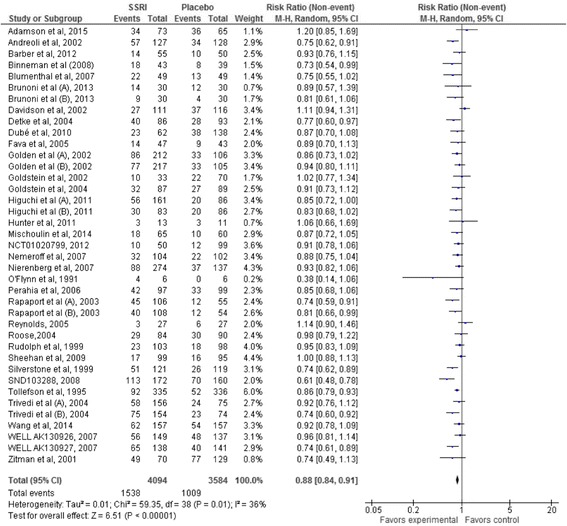
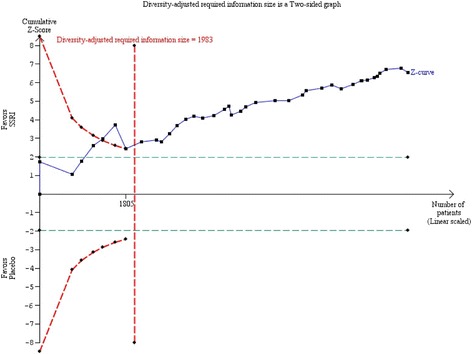
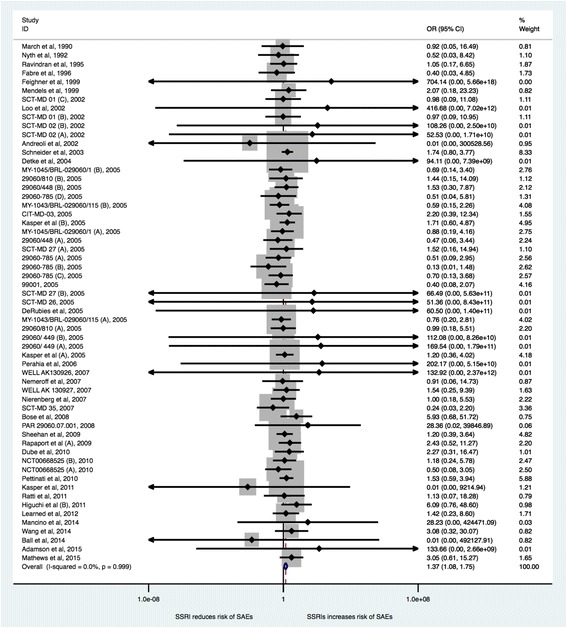
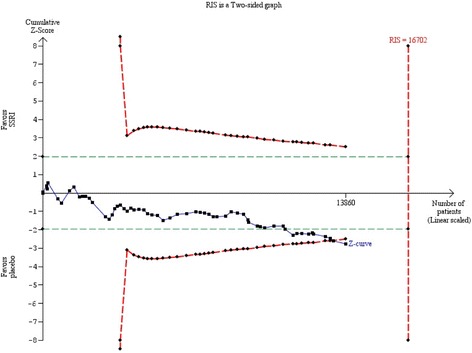
BACKGROUND: The evidence on selective serotonin reuptake inhibitors (SSRIs) for major depressive disorder is unclear. METHODS: Our objective was to conduct a systematic review assessing the effects of SSRIs versus placebo, 'active' placebo, or no intervention in adult participants with major depressive disorder. We searched for eligible randomised clinical trials in The Cochrane Library's CENTRAL, PubMed, EMBASE, PsycLIT, PsycINFO, Science Citation Index Expanded, clinical trial registers of Europe and USA, websites of pharmaceutical companies, the U.S. Food and Drug Administration (FDA), and the European Medicines Agency until January 2016. All data were extracted by at least two independent investigators. We used Cochrane systematic review methodology, Trial Sequential Analysis, and calculation of Bayes factor. An eight-step procedure was followed to assess if thresholds for statistical and clinical significance were crossed. Primary outcomes were reduction of depressive symptoms, remission, and adverse events. Secondary outcomes were suicides, suicide attempts, suicide ideation, and quality of life. RESULTS: ). The effect estimate, however, was below our predefined threshold for clinical significance of 3 HDRS points. SSRIs significantly decreased the risk of no remission (RR 0.88; 95% CI 0.84 to 0.91; P < 0.00001; 34 trials; Trial Sequential Analysis adjusted CI 0.83 to 0.92); Bayes factor (1426.81) did not confirm the effect). SSRIs significantly increased the risks of serious adverse events (OR 1.37; 95% CI 1.08 to 1.75; P = 0.009; 44 trials; Trial Sequential Analysis-adjusted CI 1.03 to 1.89). This corresponds to 31/1000 SSRI participants will experience a serious adverse event compared with 22/1000 control participants. SSRIs also significantly increased the number of non-serious adverse events. There were almost no data on suicidal behaviour, quality of life, and long-term effects. CONCLUSIONS: SSRIs might have statistically significant effects on depressive symptoms, but all trials were at high risk of bias and the clinical significance seems questionable. SSRIs significantly increase the risk of both serious and non-serious adverse events. The potential small beneficial effects seem to be outweighed by harmful effects. SYSTEMATIC REVIEW REGISTRATION: PROSPERO CRD42013004420.
Overview
The claims and statistics of this paper haven’t been checked yet.
Free: it reads the open-access text and checks the first 5 claims that cite a source we can check. Create a free account to check every claim.
Integrity signals
Registry
Cites
Statistics
Figures

Verification
Claims the paper makes
The claims and statistics of this paper haven’t been checked yet.
Free: it reads the open-access text and checks the first 5 claims that cite a source we can check. Create a free account to check every claim.
Claims other papers make about this one
Each is checked against this paper’s own text: does it say what the citing paper says it does?
The source backs part of the claim, not all of it — or backs it for a different population, condition or comparison.
In the citing paper
“there is extensive evidence that targeting and treating mental disorders has little or mixed impact on suicidal risk [10,11,12].”
From One Size Does Not Fit All: A Comprehensive Clinical Approach to Reducing Suicidal Ideation, Attempts, and Deaths (2019) · cites this paper as [12]
Experimental — accuracy not yet measuredThe source backs part of the claim, not all of it — or backs it for a different population, condition or comparison.
In the citing paper
“That review found, as all other previous reviews have shown, that SSRIs compared with placebo had a statistically significant effect on depressive symptoms.”
From Should antidepressants be used for major depressive disorder? (2020) · cites this paper as [28]
Experimental — accuracy not yet measuredThe source backs part of the claim, not all of it — or backs it for a different population, condition or comparison.
In the citing paper
“The few trials assessing long-term effects showed that such effects seemed even smaller than the short-term effects.”
From Should antidepressants be used for major depressive disorder? (2020) · cites this paper as [28]
Experimental — accuracy not yet measuredThe source backs part of the claim, not all of it — or backs it for a different population, condition or comparison.
In the citing paper
“The primary limitation of all the available evidence on the effects of antidepressants is that the majority of previous trials assessing the effects of antidepressants have been at high or unclear risk of bias.”
From Should antidepressants be used for major depressive disorder? (2020) · cites this paper as [28]
Experimental — accuracy not yet measuredThe source backs part of the claim, not all of it — or backs it for a different population, condition or comparison.
In the citing paper
“The above-mentioned systematic review assessing the effects of SSRIs (see ‘How good are antidepressants?’ section) also concluded that the vast majority of the included trials (39 out of 43 trials) with useful data were at high risk of ‘for profit’ bias.”
From Should antidepressants be used for major depressive disorder? (2020) · cites this paper as [28]
Experimental — accuracy not yet measured
14 more claims about this paper
Create a free account to see every claim other papers make about this one.
Self-check
Percentages, sums and reported differences re-computed from the paper’s own numbers.
The self-check needs the paper’s full text.
Citations
Cites
Meta-analysis in clinical trials
DerSimonian, R., & Laird, N. (1986) · Controlled Clinical Trials · doi:10.1016/0197-2456(86)90046-2 · Cited by 39,552
An inventory for measuring depression
BECK, A. T. (1961) · Archives of General Psychiatry · doi:10.1001/archpsyc.1961.01710120031004 · Cited by 38,032
Hamilton, M. (1960) · Journal of Neurology, Neurosurgery & Psychiatry · doi:10.1136/jnnp.23.1.56 · Cited by 32,817
Dermyshi, E., Wang, Y., Yan, C., Hong, W., Qiu, G., Gong, X., & Zhang, T. (2017) · Neonatology · doi:10.1159/000454668 · Cited by 24,451
A new depression scale designed to be sensitive to change
Montgomery, S. A., & Åsberg, M. (1979) · British Journal of Psychiatry · doi:10.1192/bjp.134.4.382 · Cited by 13,962
GRADE guidelines: 1. Introduction—GRADE evidence profiles and summary of findings tables
Guyatt, G., Oxman, A. D., Akl, E. A., Kunz, R., Vist, G., Brozek, J., Norris, S., Falck-Ytter, Y., Glasziou, P., & deBeer, H. (2011) · Journal of Clinical Epidemiology · doi:10.1016/j.jclinepi.2010.04.026 · Cited by 10,681
Hutton, B., Salanti, G., Caldwell, D. M., Chaimani, A., Schmid, C. H., Cameron, C., Ioannidis, J. P. A., Straus, S., Thorlund, K., Jansen, J. P., et al. (2015) · Annals of Internal Medicine · doi:10.7326/m14-2385 · Cited by 8,269
Scoville, W. B. (1949) · Journal of neurosurgery · doi:10.3171/jns.1949.6.1.0065 · Cited by 7,381
SPIRIT 2013 Statement: Defining Standard Protocol Items for Clinical Trials
Chan, A.-W., Tetzlaff, J. M., Altman, D. G., Laupacis, A., Gøtzsche, P. C., Krleža-Jerić, K., Hróbjartsson, A., Mann, H., Dickersin, K., Berlin, J. A., et al. (2013) · Annals of Internal Medicine · doi:10.7326/0003-4819-158-3-201302050-00583 · Cited by 7,363
Cochrane Handbook for Systematic Reviews of Interventions Version 5.0.1. The Cochrane Collaboration
Higgins, J. P. T., Green, S. R., & Higgins, J. P. T. (2008) · Cited by 7,261
Research works printed but not linked: 9
- Beck A Steer RA Brown GK Beck depression inventory—second edition: manual San Antonio: Psychological Corporation 1996 4 561 571
- The Nordic Cochrane Centre (The Cochrane Collaboration): Review Manager (RevMan) [Computer program]. Version 5.3. In.; 2008.
- Thorlund K Engstrøm J Wetterslev J Brok J Imberger G Gluud C User manual for trial sequential analysis (TSA) 2011 Copenhagen Copenhagen Trial Unit, Centre for Clinical Intervention Research 1 115
- Fabre LF Crismon L Efficacy of fluoxetine in outpatients with major depression Curr Ther Res Clin Exp 1985 37 1 1985
- Rickels K Amsterdam JD Avallone MF Fluoxetine in major depression: A controlled study Curr Ther Res Clin Exp 1986 39 4 1986
- MY-1045/BRL-029060/1 (PAR128) (Unpublished Data) GlaxoSmithKline. A Multicenter, Randomized, Double-Blind, Placebo-Controlled Comparison of Paroxetine and Fluoxetine in the Treatment of Major Depressive Disorder. http://www.gsk-clinicalstudyregister.com/files2/2821.pdf 2005, 1:1–5.
- MY-1043/BRL-029060/115 (Unpublished Data) GlaxoSmithKline. A multicenter, randomized, double-blind, placebo-controlled comparison of paroxetine and fluoxetine in the treatment of major depressive disorder. http://www.gsk-clinicalstudyregister.com/files2/2060.pdf 2005, 175:1–5.
- SCT-MD-26 (Unpublished Data) Forest Research Institute. Two-week double-blind placebo controlled study of escitalopram in the treatment of severe major depression. 2005, 135:2–4.
- SCT-MD-27 (Unpublished Data) Forest Research Institute. A double-blind flexible dose comparison of escitalopram sertraline and placebo in the treatment of major depressive disorder. 2005, 91:5–7.
Cited by
Items 301–366 of 366
Neural Perspective on Depression
Bedwell, J. S., Simpson, S. D., & Salgari, G. C. (2020) · Elsevier eBooks · doi:10.1016/b978-0-12-819641-0.00060-8
Nan, J. K.-M. (2019) · Springer eBooks · doi:10.1007/978-3-319-69892-2_857-1
(2018) · Drug and Therapeutics Bulletin · doi:10.1136/dtb.2018.6.0627
Afbouwen van antidepressivaPreprint
Brouwer, S. (2022) · Authorea · doi:10.22541/au.164882447.77664965/v2
Models of Suicide and Their Implications for Suicide Prevention
Lester, D. (2021) · Springer eBooks · doi:10.1007/978-3-030-41319-4_1-1
The serotonin theory of depression: how the media got it all wrong
(2022) · Pharmaceutical journal/The pharmaceutical journal · doi:10.1211/pj.2022.1.153955 · Cited by 1
Models of Suicide and Their Implications for Suicide Prevention
Lester, D. (2022) · Springer eBooks · doi:10.1007/978-3-030-42003-1_1
Hinweise zur Arbeit am Symptom
Zarbock, G., Wilckens, P.-S., & Semmler, N. (2022) · Springer eBooks · doi:10.1007/978-3-662-62068-7_5
Irving Kirsch opens a window on antidepressant medications
Chen, E., Oliver, A. K., & Raz, A. (2023) · American Journal of Clinical Hypnosis · doi:10.1080/00029157.2022.2121678
“, 2018); some used group data (Gibbons, Hur, Brown, Davis, & Mann, 2012), whereas others drew on patient-level analyses (Jakobsen et al., 2017); some used conventional statistics (Khin, Chen, Yang, Yang, & Laughren, 2011), whereas others used advanced computational methods (Turner et al.”
MethodAffective Disorders Using the Example of Unipolar Depression
Köhler, S., & Walter, H. (2023) · Springer eBooks · doi:10.1007/978-3-662-65774-4_12
O USO DE ANTIDEPRESSIVOS E O RISCO AUMENTADO DE SUICÍDIO/AUTOCÍDIO: uma revisão de literatura
Coutinho, M. A. P., Coelho, T. C., & Silva, C. D. L. E. (2023) · Psicologia e Saúde em Debate · doi:10.22289/2446-922x.v9n1a21
Damm, J. (2025) · PsyArXiv (OSF Preprints) · doi:10.31234/osf.io/xya7r
Silva, A. H. S., Argarini, R., Fithriyah, I., Atmaja, M. S. S., & Hamindo, S. J. (2023) · World Journal of Advanced Research and Reviews · doi:10.30574/wjarr.2023.19.3.1894
“[33,34] SSRIs Citalopram Fluoxetine Paroxetine Sertraline Selective serotonin reuptake inhibitors.”
Martín-López, J. E., Aguilera-Cobos, L., Rosario-Lozano, M. P., & Blasco‐Amaro, J. A. (2023) · doi:10.52766/vmzo8736
Cohen, S. E., Zantvoord, J. B., Storosum, B. W. C., Mattila, T. K., Daams, J. G., Wezenberg, B. N., de Boer, A., & Denys, D. A. J. P. (2023) · medRxiv · doi:10.1101/2023.11.24.23298989
Ghai, U., Chachra, P., Fanibunda, S. E., Mendon, S., Bhaskaran, A., Sarkar, A., Kukkemane, K., Singh, V. K., & Vaidya, V. A. (2023) · bioRxiv (Cold Spring Harbor Laboratory) · doi:10.1101/2023.12.29.573529
Mestermann, S., Rudtke, L., Brazdis, R.-M., Tsaktanis, T., Kornhuber, J., & Thürauf, N. (2024) · Behavioral Sciences · doi:10.3390/bs14030237
“Yet, the clinical effectiveness of clomipramine as well as SSRIs in depression [18] and OCD [19] is high.”
BackgroundA case of paroxetine-induced lower gastrointestinal bleeding: A multifaceted approach to healingPreprint
Jasassi, B. H. A., & Shuhoumi, M. A. A. (2024) · Research Square · doi:10.21203/rs.3.rs-4314191/v1
Duan, T., Cao, Z., Wang, X., Min, J., Sun, T., Luo, H., & Xu, C. (2024) · SSRN Electronic Journal · doi:10.2139/ssrn.4812481
Kinyanda, E., Kyohangirwe, L., Mpango, R. S., Tusiime, C., Rutakumwa, R., Ssebunnya, J., Obuku, A. E., Kiconco, B. E., Sekitoleko, I., Sentongo, H., et al. (2024) · Research Square · doi:10.21203/rs.3.rs-4319829/v1
Distinct classes of antidepressants commonly act to shape pallidal structure and function in micePreprint
Abe, Y., Sugiura, Y., Maeda, R., Taira, S., Yoshida, K., Ibi, D., Moritoh, S., Hashimoto, K., Yagishita, S., & Tanaka, K. F. (2024) · bioRxiv (Cold Spring Harbor Laboratory) · doi:10.1101/2024.09.23.614626 · Cited by 1
Rahajeng, B., Utami, P., Kusumastiwi, R. R. T., & Sari, P. A. K. (2024) · BIO Web of Conferences · doi:10.1051/bioconf/202413502005
Antidepressant Medication and Psychotherapy: Why It Matters
Chiesa, M. (2024) · British Journal of Psychotherapy · doi:10.1111/bjp.12938
Hartogsohn, I., Yavelberg, Y., & Ezra, O. B. (2025) · Journal of Psychedelic Studies · doi:10.1556/2054.2024.00359 · Cited by 1
Qvist, H.-P. Y., Qvist, J. Y., & Wiertz, D. (2025) · Social Science Research · doi:10.1016/j.ssresearch.2025.103172 · Cited by 1
“…while modern antidepressants have fewer side effects than earlier generations of antidepressants, side effects still occur – some relatively benign (e.g., nausea, diarrhea, loss of libido, dizziness), others more serious (e.g., falls, insomnia, and cognitive impairments) (Jakobsen et al., 2017).”
Coët, A., Blampied, F. M., & Rucklidge, J. J. (2025) · Journal of Affective Disorders Reports · doi:10.1016/j.jadr.2025.100913
Kato, K. (2025) · SN Comprehensive Clinical Medicine · doi:10.1007/s42399-025-01923-2
“Psychiatric treatment often reduces anxiety and depression, which have been known to significantly impact pain perception [9].”
Li, S.-J., Yuan, Q., Wu, W., Tan, A., Chen, Z., Chen, D., Shan, H., Chu, Q.-Y., Hu, W., Wu, K., et al. (2025) · SSRN Electronic Journal · doi:10.2139/ssrn.5343606
Tailoring In-Flight Food Consumption to Alleviate Fear of Flying Through Sensory Stimulation
Sansone, F., Gorini, F., Tonacci, A., & Venturi, F. (2025) · Applied Sciences · doi:10.3390/app15148057 · Cited by 1
Kyohangirwe, L., Mpango, R. S., Tusiime, C., Rutakumwa, R., Ssebunnya, J., Obuku, A. E., Kiconco, B. E., Sekitoleko, I., Sentongo, H., Kalani, K., et al. (2025) · PLoS ONE · doi:10.1371/journal.pone.0329591
Turning to turkey’s tryptophan to boost mood? Not so fast
Neff, A. (2019) · The Conversation · doi:10.64628/aai.vkuehcrj9
Enhancing depression management in people with learning disabilities
Musk, J., Atkinson, H., Richmond, L., & Mostyn, A. (2025) · Learning Disability Practice · doi:10.7748/ldp.2025.e2281
Werawattanachai, C., Hadee, P., Sornsoongneon, J., & Boonlue, T. (2025) · Journal of Pharmacology and Pharmacotherapeutics · doi:10.1177/0976500x251390085
Manook, A., Hiergeist, A., Liebisch, G., Dischinger, U., Petrera, A., Schwarzbach, J. V., Gessner, A., Gruber, O., & Baghai, T. C. (2025) · medRxiv · doi:10.64898/2025.12.01.25341376
Jørgensen, C. K., Juul, S., Siddiqui, F., Barbateskovic, M., Munkholm, K., Hengartner, M. P., Kirsch, I., Gluud, C. N., & Jakobsen, J. C. (2021) · Figshare · doi:10.6084/m9.figshare.15178659
Self-citationJuul, S., Siddiqui, F., Barbateskovic, M., Jørgensen, C. K., Hengartner, M. P., Kirsch, I., Gluud, C., & Jakobsen, J. C. (2021) · Figshare · doi:10.6084/m9.figshare.14677063
Self-citationJuul, S., Siddiqui, F., Barbateskovic, M., Jørgensen, C. K., Hengartner, M. P., Kirsch, I., Gluud, C., & Jakobsen, J. C. (2021) · Figshare · doi:10.6084/m9.figshare.14677060
Self-citationJørgensen, C. K., Juul, S., Siddiqui, F., Horowitz, M. A., Moncrieff, J., Munkholm, K., Hengartner, M. P., Kirsch, I., Gluud, C., & Jakobsen, J. C. (2023) · Figshare · doi:10.6084/m9.figshare.22618499
Self-citationJørgensen, C. K., Juul, S., Siddiqui, F., Horowitz, M. A., Moncrieff, J., Munkholm, K., Hengartner, M. P., Kirsch, I., Gluud, C., & Jakobsen, J. C. (2023) · Figshare · doi:10.6084/m9.figshare.22618496
Self-citationJørgensen, C. K., Juul, S., Siddiqui, F., Barbateskovic, M., Munkholm, K., Hengartner, M. P., Kirsch, I., Gluud, C., & Jakobsen, J. C. (2021) · Figshare · doi:10.6084/m9.figshare.15178662
Self-citationWang, L., Wang, Q., Jiang, W., Luo, J., Tong, J., Li, X., Fang, F., Wang, H., Zhao, W., Koszycki, D., et al. (2020) · Figshare · doi:10.6084/m9.figshare.12703893
Suicide-related events and the new generation of antidepressants: a comprehensive reviewPreprint
Oka, Y., & Takagi, T. (2026) · Research Square · doi:10.21203/rs.3.rs-8537181/v1
THE ROLE OF FOREST BATHING IN THE TREATMENT OF DEPRESSION- A NARRATIVE REVIEW
Zackiewicz, K., Ziemba, M., Wińska, A., Sędziak, O., Pietruszewska, H., Ogorek, A., Czerepak, I., Majchrzak, I., Liszka, P., & Żylińska, K. (2025) · International Journal of Innovative Technologies in Social Science · doi:10.31435/ijitss.4(48).2025.4523
Nadei, O. V., & Prokopenko, E. S. (2026) · Journal of Molecular Neuroscience · doi:10.1007/s12031-026-02491-3
“These challenges underscore the critical need to investigate the neurobiological underpinnings of depression (Jakobsen et al. 2017).”
Potential muscular doping effects of anti-depressants
Tutakhail, A. (2019) · theses.fr (ABES) · doi:10.70675/f3cbba2dza035z4ef0zaebbz68fe16432b48
Piksa, M., Cieslik-Starkiewicz, A., & Ryguła, R. (2026) · Psychopharmacology · doi:10.1007/s00213-026-07060-5
Lian, J., Wang, Y., Feng, G., & Miao, D. (2026) · Annals of General Psychiatry · doi:10.1186/s12991-026-00661-6 · Cited by 1
“While conventional treatments including pharmacotherapy and psychotherapy are effective for many patients, a considerable proportion of individuals do not achieve adequate response or experience intolerable side effects [4, 5].”
Sunzeri, F. (2026) · Springer eBooks · doi:10.1007/978-3-032-14465-2_16
Biologische interventies bij suïcidaliteit
Tonies, L., & van Veen, S. M. P. (2026) · doi:10.1007/978-90-368-3172-7_10
Deshmukh, K. V., Kale, P., Deshmukh, M., & Ghante, M. R. (2026) · Asian Journal of Pharmaceutical Analysis · doi:10.52711/2231-5675.2026.00017
Use of Clinically Important Differences in Randomized Controlled Trials for DepressionPreprint
Xiong, R., Wu, J., Wang, Z., Shi, D., & Qin, Z. (2026) · Research Square · doi:10.21203/rs.3.rs-9676507/v1
Li, D., Du, J., Bao, T., Zhang, Y., Feng, J., Liu, X., Wu, R., Bi, C., Ullah, A., & Shen, B. (2026) · Digital Health · doi:10.1177/20552076261456560
Joyner, A. K. C., Chapman, R. H., Cheng, Y.-Y. M., Xie, R., Parsley-Raines, L., Bright, J. L., & Stevens, W. (2026) · Value in Health · doi:10.1016/j.jval.2026.05.005
Liu, R., Liu, C., Li, C., Hu, D., Wang, L., Li, Z. J., Feng, D., & Guo, T. (2026) · Medicine · doi:10.1097/md.0000000000049464
Addressing Conflicts of Interest in Clinical Trials
Lundh, A., & Hróbjartsson, A. (2026) · Springer eBooks · doi:10.1007/978-3-032-27479-3_6
Gougeon, A., Grenier, E., Cau, V., Cuzol, P., Rabeyron, T., Berna, F. S., & Boussageon, R. (2026) · Psychiatry Research · doi:10.1016/j.psychres.2026.117326
Chen, W.-L., Lin, Y.-J., Liu, W.-J., Tsai, C.-I., Chiang, P., & Lee, C.-L. (2026) · Journal of Herbal Medicine · doi:10.1016/j.hermed.2026.101126
Apel, K., Scheel-Barteit, J., Berking, M., Kühlein, T., & Sebastião, M. (2026) · Scientific Reports · doi:10.1038/s41598-026-62116-y
Can Drugs Relieve the Societal Burden of Psychopathology?
Strayhorn, J. M., Chai, K. Y. Y., & Zhang‐James, Y. (2026) · SpringerBriefs in modern perspectives on disability research. · doi:10.1007/978-981-92-0922-4_4
Anghel, T., Cojocaru, A., Hogea, L., Costea, I., Marinca, A., Dumache, R., Nussbaum, L. A., & Trăilă, I.-A. (2026) · Journal of Clinical Medicine · doi:10.3390/jcm15166228
“…25 mg dose of COMP360 was associated with longer maintenance of antidepressant benefit at 52 weeks relative to the 1 mg and 10 mg comparator doses [46] is the first large-scale, dose-stratified evidence of this kind in psilocybin research and represents a meaningful addition to the literature.”
InfluentialAlves, N. V., SANT’ANA, G. A., Carrozza, J. F., Oliveira, G. M., Santos, C. F., & Calvo, A. M. (2026) · Pharmacy · doi:10.3390/pharmacy14050118
“These findings are consistent with the well-established safety profiles of SSRIs, SNRIs, and benzodiazepines, which commonly affect the central nervous system, autonomic function, and sexual health [23,25].”
A Bibliometric Analysis of Research on Depression and Exercise in Older Adults
Yuksel-Haji, C., Nacar, E., & Suner-Keklik, S. (2026) · European Journal of Multidisciplinary Health Sciences · doi:10.51754/ejmhs.1992421
Holas, P., & Piasecka, A. (2026) · Psychiatria i Psychologia Kliniczna · doi:10.15557/pipk.2026.0034
Wei, Y., Gong, K., Li, R., Zhang, Q., Zhong, Y., Zhao, W., Zuo, Y., Chue, S., & Zhao, L. (2026) · International Journal of Pharmaceutics · doi:10.1016/j.ijpharm.2026.127420
Song, Q., Bai, B., Chang, J., Jiang, Z., Lin, Z., Hu, D., & Ma, H. (2026) · Complementary Therapies in Medicine · doi:10.1016/j.ctim.2026.103450
Harris, J. R., van Haarst, A. D., Baccei, J., FRANEY, B. B., Everett, J., George, K., Paglialunga, S., Webster, K., Hillstrand, M., Banfield, C., et al. (2026) · Clinical and Translational Science · doi:10.1111/cts.70743
Metadata
- Authors
- Jakobsen, J. C., Katakam, K. K., Schou, A., Hellmuth, S. G., Stallknecht, S. E., Leth-Møller, K., Iversen, M., Banke, M. B., Petersen, I. J., Klingenberg, S. L., Krogh, J., Ebert, S. E., Timm, A., Lindschou, J., & Gluud, C.
- Affiliations
- Copenhagen University Hospital (DK)
- University of Copenhagen (DK)
- Corresponding author
- Jakobsen, Janus Christian
- ORCID
- Venue
- BMC Psychiatry
- Published
- 2017-02-08
- Volume
- 17
- Issue
- 1
- Pages
- 162-162
- ISSN
- 1471-244X (ISSN-L)
- PMC
- PMC5299662
- OpenAlex
- W2586384568
- Cited by
- 366
- References
- 194
- Citations by year
- 2026: 30 · 2025: 38 · 2024: 30 · 2023: 38 · 2022: 32 · 2021: 42 · 2020: 35 · 2019: 52 · 2018: 43 · 2017: 26
- FWCI
- 5.42
- Type
- journal article
- Language
- en
- Update notices
- correction (2017-05-03)
- Open access
- gold
- doi.org
- Licence
- cc-by
- Locations
- BMC Psychiatry (publishedVersion, cc-by)
- PubMed Central (publishedVersion, cc-by)
- PubMed (publishedVersion)
- Research at the University of Copenhagen (University of Copenhagen) (publishedVersion, cc-by)
- Funders
- Rigshospitalet
- Copenhagen Trial Unit, Centre for Clinical Intervention Research
- Topics
- Health Sciences › Medicine › Pharmacology (medical) › Treatment of Major Depression
- Health Sciences › Medicine › Psychiatry and Mental health › Mental Health Treatment and Access
- Social Sciences › Psychology › Experimental and Cognitive Psychology › Anxiety, Depression, Psychometrics, Treatment, Cognitive Processes
- Keywords
- selective serotonin reuptake inhibitors, major depressive disorder, antidepressant efficacy, placebo comparison, remission, adverse drug reactions, suicide risk, quality of life, trial bias, antidepressant safety, trial sequential analysis, Bayes factor, quality of evidence, antidepressant-induced mania, antidepressant-induced hypomania
- MeSH terms
- Adult, Depressive Disorder, Humans, Placebos, Quality of Life, Selective Serotonin Reuptake Inhibitors, Antidepressive Agents, Second-Generation, Suicidal Ideation
About these checks
Registry, retraction, Cites and statistics results are computed, not judged, with one exception: a printed reference that no index lists is read once by a model before it counts as a citation error. Claims are extracted by a model and kept only when their quote appears verbatim in the text; each cited source is then checked, with a model’s help, for whether it says what the claim relies on. Those verdicts can be wrong — read the claim’s quote and the cited source before relying on one.
Statistics and arithmetic are recomputed, not judged.
Confidence bands are shown only for fields calibrated on our annotated test set. None is calibrated yet, so no band is shown.
What counts as a claim ›How we measure confidence ›How we check this ›
Are you an author, or do you see a problem with this page? Request a review
Data sources
Bibliographic data: Semantic Scholar, OpenAlex, Crossref.
Contains information from the Semantic Scholar Academic Graph Datasets, made available under the ODC Attribution License (ODC-BY 1.0).
Semantic Scholar’s data is described in: Kinney, R., et al. (2023). The Semantic Scholar Open Data Platform. arXiv:2301.10140.
