

Predictors of remission from body dysmorphic disorder after internet-delivered cognitive behavior therapy: a machine learning approach
Open accessPublished version of a preprint
The DOI matches its Crossref record; 47 of the 48 references it cites were found in a registry or an index.
Abstract
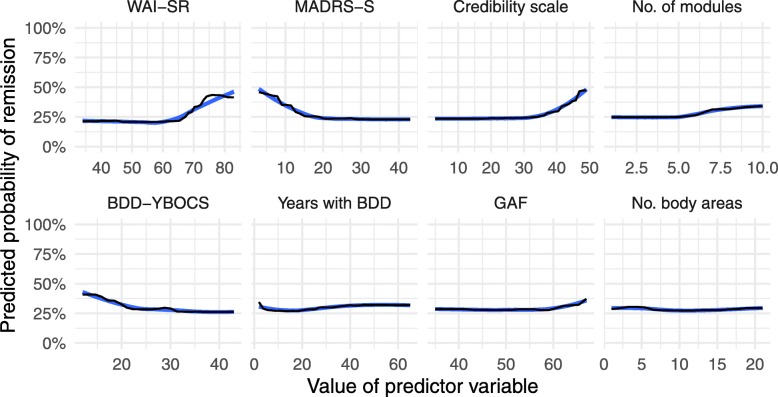
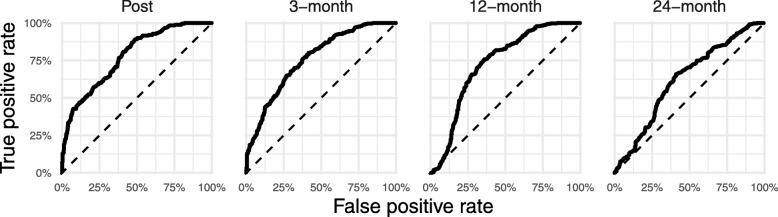
BACKGROUND: Previous attempts to identify predictors of treatment outcomes in body dysmorphic disorder (BDD) have yielded inconsistent findings. One way to increase precision and clinical utility could be to use machine learning methods, which can incorporate multiple non-linear associations in prediction models. METHODS: This study used a random forests machine learning approach to test if it is possible to reliably predict remission from BDD in a sample of 88 individuals that had received internet-delivered cognitive behavioral therapy for BDD. The random forest models were compared to traditional logistic regression analyses. RESULTS: Random forests correctly identified 78% of participants as remitters or non-remitters at post-treatment. The accuracy of prediction was lower in subsequent follow-ups (68, 66 and 61% correctly classified at 3-, 12- and 24-month follow-ups, respectively). Depressive symptoms, treatment credibility, working alliance, and initial severity of BDD were among the most important predictors at the beginning of treatment. By contrast, the logistic regression models did not identify consistent and strong predictors of remission from BDD. CONCLUSIONS: The results provide initial support for the clinical utility of machine learning approaches in the prediction of outcomes of patients with BDD. TRIAL REGISTRATION: ClinicalTrials.gov ID: NCT02010619.
Overview
The claims and statistics of this paper haven’t been checked yet.
Free: it reads the open-access text and checks the first 5 claims that cite a source we can check. Create a free account to check every claim.
Integrity signals
Registry
Cites
Statistics
Figures
Verification
Claims the paper makes
The claims and statistics of this paper haven’t been checked yet.
Free: it reads the open-access text and checks the first 5 claims that cite a source we can check. Create a free account to check every claim.
Claims other papers make about this one
Each is checked against this paper’s own text: does it say what the citing paper says it does?
The cited source doesn’t support the claim as written.
In the citing paper
“The studies that ranked high for selective reporting bias tended to report only user satisfaction data and treatment adherence, despite their methods considering the collection and assessment of psychiatric scale data and other effectiveness outcomes (29, 76, 79, 85–88, 92).”
From Examining the role of AI technology in online mental healthcare: opportunities, challenges, and implications, a mixed-methods review (2024) · cites this paper as [29]
Checked by a reasoning model — may be wrong.
Experimental — accuracy not yet measuredThe source backs part of the claim, not all of it — or backs it for a different population, condition or comparison.
In the citing paper
“Additionally, the studies reporting on the use of ML algorithms found significant success in outcome prediction and feature detection to support online therapy delivery (6, 19, 28, 29, 31, 33, 83, 85, 86, 92–94).”
From Examining the role of AI technology in online mental healthcare: opportunities, challenges, and implications, a mixed-methods review (2024) · cites this paper as [29]
Experimental — accuracy not yet measuredThe source backs part of the claim, not all of it — or backs it for a different population, condition or comparison.
In the citing paper
“As such, the relevant studies highlighted the importance of analyzing the large datasets produced by online mental healthcare interventions and the efficiency and accuracy of AI algorithms which in some cases were comparable to or better than human assessors (6, 19, 28, 29, 31, 33, 83, 85, 86, 92–94).”
From Examining the role of AI technology in online mental healthcare: opportunities, challenges, and implications, a mixed-methods review (2024) · cites this paper as [29]
Experimental — accuracy not yet measuredThe cited source says what the claim attributes to it.
In the citing paper
“In terms of allegiance bias, because of the scarcity and novelty of AI-augmented interventions and other AI algorithms, most of the included articles developed and studied their own AI tools, instead of AI tools developed by other researchers (29, 33, 73, 74, 76, 79, 80, 82–87, 90).”
From Examining the role of AI technology in online mental healthcare: opportunities, challenges, and implications, a mixed-methods review (2024) · cites this paper as [29]
The cited source says what the claim attributes to it.
In the citing paper
“Flygare et al. (2020) identified depressive symptoms, treatment credibility, number of body areas of concern, duration of symptoms, and working alliance as predictors of symptom remission with 78% accuracy, in patients participating in an eCBT program for BDD.”
From Examining the role of AI technology in online mental healthcare: opportunities, challenges, and implications, a mixed-methods review (2024) · cites this paper as [29]
1 more claim about this paper
Create a free account to see every claim other papers make about this one.
Self-check
Percentages, sums and reported differences re-computed from the paper’s own numbers.
The self-check needs the paper’s full text.
Citations
Cites
R: A Language and Environment for Statistical Computing
R Core Team (2025) · doi:10.32614/r.manuals · Cited by 352,181
Diagnostic and Statistical Manual of Mental Disorders
American Psychiatric Association (2013) · doi:10.1176/appi.books.9780890425596 · Cited by 116,369
Diagnostic and Statistical Manual of Mental Disorders
Williams, J. B. W., & First, M. (2013) · Encyclopedia of Social Work · doi:10.1093/acrefore/9780199975839.013.104 · Cited by 109,519
(1998) · The Journal of Clinical Psychiatry · Cited by 19,139
(1998) · PubMed · Cited by 10,216
(1976) · Medical Entomology and Zoology · Cited by 8,899
MissForest—Non-parametric missing value imputation for mixed-type data
Stekhoven, D. J., & Bühlmann, P. (2012) · Bioinformatics · doi:10.1093/bioinformatics/btr597 · Cited by 6,156
EQ-SD: a measure of health status from the EuroQol Group
Rabin, R., & Charro, F. D. (2001) · Annals of Medicine · doi:10.3109/07853890109002087 · Cited by 5,613
The National Institute for Clinical Excellence
(2001) · Nursing Management · doi:10.7748/nm.8.2.39.s15 · Cited by 3,876
Credibility of analogue therapy rationales
Borkovec, T. D., & Nau, S. D. (1972) · Journal of Behavior Therapy and Experimental Psychiatry · doi:10.1016/0005-7916(72)90045-6 · Cited by 1,553
Development and validation of a revised short version of the working alliance inventory
Hatcher, R. L., & Gillaspy, J. A. (2006) · Psychotherapy Research · doi:10.1080/10503300500352500 · Cited by 1,355
Estimating classification error rate: Repeated cross-validation, repeated hold-out and bootstrap
Kim, J.-H. (2009) · Computational Statistics & Data Analysis · doi:10.1016/j.csda.2009.04.009 · Cited by 792
Svanborg, P., & Åsberg, M. (1994) · Acta Psychiatrica Scandinavica · doi:10.1111/j.1600-0447.1994.tb01480.x · Cited by 693
(1997) · PubMed · Cited by 664
Analysis of a Random Forests Model
Gérard Biau, A. (2010) · arXiv (Cornell University) · doi:10.48550/arxiv.1005.0208 · Cited by 661
Öst, L.-G., Havnen, A., Hansen, B., & Kvale, G. (2015) · Clinical Psychology Review · doi:10.1016/j.cpr.2015.06.003 · Cited by 655
Comparability of telephone and face-to-face interviews in assessing axis I and II disorders
Rohde, P., Lewinsohn, P. M., & Seeley, J. R. (1997) · American Journal of Psychiatry · doi:10.1176/ajp.154.11.1593 · Cited by 522
Stepwise Selection in Small Data Sets A Simulation Study of Bias in Logistic Regression Analysis
Steyerberg, E. (1999) · Journal of Clinical Epidemiology · doi:10.1016/s0895-4356(99)00103-1 · Cited by 495
Veale, D., Gledhill, L. J., Christodoulou, P., & Hodsoll, J. (2016) · Body Image · doi:10.1016/j.bodyim.2016.07.003 · Cited by 431
A comparison of delusional and nondelusional body dysmorphic disorder in 100 cases.
Phillips, K. A., McElroy, S. L., Keck, P. E., Hudson, J. I., & Pope, H. G. (1994) · PubMed · Cited by 244
Probability Machines: Consistent Probability Estimation Using Nonparametric Learning Machines
Malley, J. D., Kruppa, J., Dasgupta, A., Malley, K. G., & Ziegler, A. (2012) · Methods of Information in Medicine · doi:10.3414/me00-01-0052 · Cited by 242
Psychosocial functioning and quality of life in body dysmorphic disorder
Phillips, K. A., Menard, W., Fay, C., & Pagano, M. E. (2005) · Comprehensive Psychiatry · doi:10.1016/j.comppsych.2004.10.004 · Cited by 242
Modular cognitive-behavioral therapy for body dysmorphic disorder: A randomized controlled trial
Wilhelm, S., Phillips, K. A., Didie, E., Buhlmann, U., Greenberg, J. L., Fama, J. M., Keshaviah, A., & Steketee, G. (2014) · Behavior Therapy · doi:10.1016/j.beth.2013.12.007 · Cited by 238
Harrison, A., Fernández de la Cruz, L., Enander, J., Radua, J., & Mataix-Cols, D. (2016) · Clinical Psychology Review · doi:10.1016/j.cpr.2016.05.007 · Cited by 215
Self-citationSuicidality in body dysmorphic disorder (BDD): A systematic review with meta-analysis
Angelakis, I., Gooding, P. A., & Panagioti, M. (2016) · Clinical Psychology Review · doi:10.1016/j.cpr.2016.08.002 · Cited by 209
The Science of Prognosis in Psychiatry: A Review
Fusar-Poli, P., Hijazi, Z., Stahl, D., & Steyerberg, E. W. (2018) · JAMA Psychiatry · doi:10.1001/jamapsychiatry.2018.2530 · Cited by 197
Veale, D., Anson, M., Miles, S., Pieta, M., Costa, A., & Ellison, N. (2014) · Psychotherapy and Psychosomatics · doi:10.1159/000360740 · Cited by 179
Phillips, K. A., Menard, W., Quinn, E., Didie, E. R., & Stout, R. L. (2013) · Psychological Medicine · doi:10.1017/s0033291712001730 · Cited by 174
Delusional versus nondelusional body dysmorphic disorder: Clinical features and course of illness
Phillips, K. A., Menard, W. E., Pagano, M. E., Fay, C., & Stout, R. L. (2005) · Journal of Psychiatric Research · doi:10.1016/j.jpsychires.2005.08.005 · Cited by 172
Coles, M. E., Cook, L. M., & Blake, T. R. (2007) · Behaviour Research and Therapy · doi:10.1016/j.brat.2006.12.009 · Cited by 171
Psychosis in body dysmorphic disorder
Phillips, K. A. (2003) · Journal of Psychiatric Research · doi:10.1016/s0022-3956(03)00098-0 · Cited by 154
Predictive analytics in mental health: applications, guidelines, challenges and perspectives
Hahn, T., Nierenberg, A. A., & Whitfield, S. (2016) · Molecular Psychiatry · doi:10.1038/mp.2016.201 · Cited by 150
Self-help with minimal therapist contact for obsessive–compulsive disorder: a review
Mataix-Cols, D., & Marks, I. M. (2006) · European Psychiatry · doi:10.1016/j.eurpsy.2005.07.003 · Cited by 146
Self-citationEnander, J., Andersson, E., Mataix-Cols, D., Lichtenstein, L., Alström, K., Andersson, G., Ljótsson, B., & Rück, C. (2016) · BMJ · doi:10.1136/bmj.i241 · Cited by 129
Self-citationLenhard, F., Sauer, S., Andersson, E., Månsson, K. N., Mataix‐Cols, D., Rück, C., & Serlachius, E. (2018) · International Journal of Methods in Psychiatric Research · doi:10.1002/mpr.1576 · Cited by 84
Self-citationOccupational functioning and impairment in adults with body dysmorphic disorder
Didie, E. R., Menard, W. E., Stern, A. P., & Phillips, K. A. (2008) · Comprehensive Psychiatry · doi:10.1016/j.comppsych.2008.04.003 · Cited by 83
Pearson, R., Pisner, D., Meyer, B., Shumake, J., & Beevers, C. G. (2019) · Psychological Medicine · doi:10.1017/s003329171800315x · Cited by 81 · cited 1×
“Similarly, a combined model of random forest and elastic net algorithms consistently outperformed a traditional linear regression model when predicting results after ICBT for depression [22].”
ResultPrediction of remission in obsessive compulsive disorder using a novel machine learning strategy
Askland, K. D., Garnaat, S., Sibrava, N. J., Boisseau, C. L., Strong, D., Mancebo, M., Greenberg, B., Rasmussen, S., & Eisen, J. (2015) · International Journal of Methods in Psychiatric Research · doi:10.1002/mpr.1463 · Cited by 75
Prevalence of body dysmorphic disorder among Swedish women: A population-based study
Brohede, S., Wingren, G. B., Wijma, B. E., & Wijma, K. (2014) · Comprehensive Psychiatry · doi:10.1016/j.comppsych.2014.12.014 · Cited by 57
Enander, J., Ivanov, V. Z., Andersson, E., Mataix-Cols, D., Ljótsson, B., & Rück, C. (2014) · BMJ Open · doi:10.1136/bmjopen-2014-005923 · Cited by 51
Self-citationde Graaf, L. E., Hollon, S. D., & Huibers, M. J. H. (2010) · Journal of Consulting and Clinical Psychology · doi:10.1037/a0018324 · Cited by 51
Empirically defining treatment response and remission in body dysmorphic disorder
Fernández de la Cruz, L., Enander, J., Rück, C., Wilhelm, S., Phillips, K. A., Steketee, G., Sarvode Mothi, S., Krebs, G., Bowyer, L., Monzani, B., et al. (2021) · Psychological Medicine · doi:10.1017/s0033291719003003 · Cited by 46
Self-citationColonnello, V., Leonardi, G., Farinelli, M., Bertoletti, E., & Russo, P. M. (2023) · Psychological Medicine · doi:10.1017/s0033291720005012 · Cited by 38
Veale, D. M., Miles, S., & Anson, M. (2015) · Behavior Therapy · doi:10.1016/j.beth.2015.06.003 · Cited by 34
Enander, J., Ljótsson, B., Anderhell, L., Runeborg, M., Flygare, O., Cottman, O., Andersson, E., Dahlén, S., Lichtenstein, L., Ivanov, V. Z., et al. (2019) · BMJ Open · doi:10.1136/bmjopen-2018-024307 · Cited by 33
Self-citationInternet administration of the Dimensional Obsessive-Compulsive Scale: a psychometric evaluation
Enander, J., Andersson, E., Kaldo, V., Lindefors, N., Andersson, G., & Rück, C. (2012) · Journal of Obsessive-Compulsive and Related Disorders · doi:10.1016/j.jocrd.2012.07.008 · Cited by 27
Self-citationBrohede, S., Wijma, B. E., Wijma, K., & Blomberg, K. (2016) · International Journal of Psychiatry in Clinical Practice · doi:10.1080/13651501.2016.1197273 · Cited by 18
Cited by
The promise of machine learning in predicting treatment outcomes in psychiatry
Chekroud, A. M., Bondar, J., Delgadillo, J., Doherty, G., Wasil, A., Fokkema, M., Cohen, Z., Belgrave, D., DeRubeis, R., Iniesta, R., et al. (2021) · World Psychiatry · doi:10.1002/wps.20882 · Cited by 531
“…and clinical data, therapyrelated predictors of treatment credibility and working alliance, assessed at week 2 of treatment, Flygare et al 82 used a random forest algorithm to predict remission from body dysmorphic disorder after iCBT in a sample of 88 patients, comparing the results to…”
MethodVieira, S., Liang, X., Guiomar, R. N. R. M., & Mechelli, A. (2022) · Clinical Psychology Review · doi:10.1016/j.cpr.2022.102193 · Cited by 94
Gutierrez, G., Stephenson, C., Eadie, J., Asadpour, K., & Alavi, N. (2024) · Frontiers in Psychiatry · doi:10.3389/fpsyt.2024.1356773 · Cited by 71
McNamara, M. E., Zisser, M., Beevers, C. G., & Shumake, J. (2022) · Behaviour Research and Therapy · doi:10.1016/j.brat.2022.104086 · Cited by 61
Haller, K., Becker, P., Niemeyer, H., & Boettcher, J. (2023) · Internet Interventions · doi:10.1016/j.invent.2023.100635 · Cited by 57
“19 Flygare et al. (2020) 88 RCT Pre, post, 3mFU, 12mFU, 24mFU Sweden 32.”
Metadata
- Authors
- Flygare, O., Enander, J., Andersson, E., Ljótsson, B., Ivanov, V. Z., Mataix-Cols, D., & Rück, C.
- Affiliations
- Karolinska University Hospital (SE)
- Corresponding author
- Flygare, Oskar
- Venue
- BMC Psychiatry
- Published
- 2020-05-19
- Volume
- 20
- Issue
- 1
- Pages
- 247-247
- ISSN
- 1471-244X (ISSN-L)
- PMC
- PMC7238519
- OpenAlex
- W3026717353
- Cited by
- 51
- References
- 48
- Citations by year
- 2026: 11 · 2025: 4 · 2024: 14 · 2023: 8 · 2022: 10 · 2021: 3 · 2020: 1
- FWCI
- 2.20
- Type
- journal article
- Language
- en
- Open access
- gold
- doi.org
- Licence
- cc-by
- creativecommons.org/licenses/by/4.0 (tdm)
- creativecommons.org/licenses/by/4.0 (vor)
- Locations
- BMC Psychiatry (publishedVersion, cc-by)
- PubMed Central (publishedVersion, cc-by)
- PubMed (publishedVersion)
- DOAJ (DOAJ: Directory of Open Access Journals) (submittedVersion, cc-by-sa)
- PsyArXiv (OSF Preprints) (submittedVersion, cc-by)
- PsyArXiv (OSF Preprints) (submittedVersion)
- OSF Preprints (OSF Preprints) (submittedVersion)
- Funders
- Karolinska Institutet (Clinical Scientist Training Programme)
- Fredrik och Ingrid Thurings Stiftelse (2018-00390)
- Topics
- Social Sciences › Psychology › Clinical Psychology › Body Image and Dysmorphia Studies
- Social Sciences › Psychology › Experimental and Cognitive Psychology › Anxiety, Depression, Psychometrics, Treatment, Cognitive Processes
- Social Sciences › Psychology › Applied Psychology › Digital Mental Health Interventions
- Keywords
- body dysmorphic disorder, treatment outcome prediction, remission, internet-based cognitive behavioral therapy, random forest, predictors of remission, depressive symptoms, treatment credibility, therapeutic relationship, follow-up outcomes
- MeSH terms
- Machine Learning, Internet-Based Intervention, Adult, Female, Humans, Male, Cognitive Behavioral Therapy, Treatment Outcome, Internet, Body Dysmorphic Disorders
About these checks
Registry, retraction, Cites and statistics results are computed, not judged, with one exception: a printed reference that no index lists is read once by a model before it counts as a citation error. Claims are extracted by a model and kept only when their quote appears verbatim in the text; each cited source is then checked, with a model’s help, for whether it says what the claim relies on. Those verdicts can be wrong — read the claim’s quote and the cited source before relying on one.
Statistics and arithmetic are recomputed, not judged.
Confidence bands are shown only for fields calibrated on our annotated test set. None is calibrated yet, so no band is shown.
What counts as a claim ›How we measure confidence ›How we check this ›
Are you an author, or do you see a problem with this page? Request a review
Data sources
Bibliographic data: Semantic Scholar, OpenAlex, Crossref.
Contains information from the Semantic Scholar Academic Graph Datasets, made available under the ODC Attribution License (ODC-BY 1.0).
Semantic Scholar’s data is described in: Kinney, R., et al. (2023). The Semantic Scholar Open Data Platform. arXiv:2301.10140.
