

Trends in psychiatric diagnoses, medications and psychological therapies in a large Swedish region: a population-based study
Open accessThe DOI matches its Crossref record; 34 of the 35 references it cites were found in a registry or an index; 11 of the 28 sources its claims cite were checked for support.
Abstract
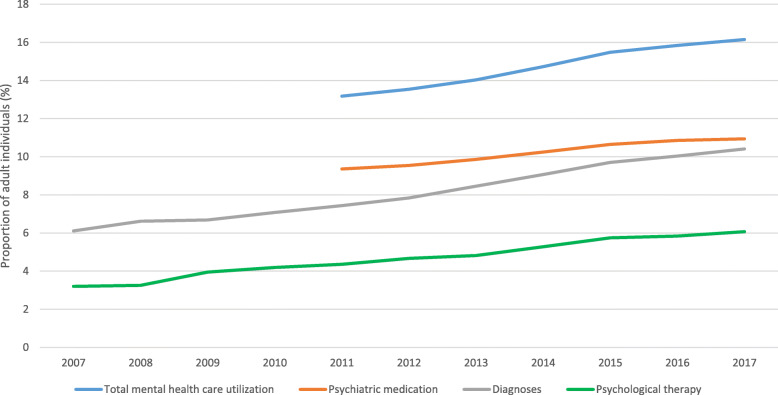
Background: Health services utilization for mental health disorders is reported to increase sharply in many countries. The aim of this study was to report trends in all aspects of mental health care utilization in a total population sample. Methods: Repeated cross-sectional register study of the Stockholm Region (VAL) including both primary and secondary care. Trends in the proportion of adults in the total population of Stockholm Region with a recorded ICD-10 psychiatric diagnosis or psychological therapy during 2007-2017 as well as claims of psychiatric medication from 2011 were calculated. Results: The proportion of adults utilizing any mental health care increased from 13.2% in 2011 to 16.1% in 2017. In 2017, 49.3% were treated in primary care, 32.2% in secondary care and 18.5% were jointly managed. The increase was most pronounced in younger adults. Women were more likely to receive mental health care than men in all ages. Medication decreased from 71.0 to 67.7%, while psychological therapy increased from 33.1 to 37.6%. The use of psychiatric medication increased with age while psychological therapy decreased. All time trends were statistically significant (p <.0001). Conclusion: Care for mental health disorders has been increasing mainly in primary care and was delivered to one in seven adult individuals in 2017. Interventions are needed to address the growing burden of mental health disorders while avoiding overtreatment. © 2020 The Author(s).
Overview
CoChat Summary
TL;DR
This repeated cross-sectional register study of all adults in the Stockholm Region found that mental health care utilization increased from 2011 to 2017, reaching 16.1% in 2017. The rise was driven mainly by primary care and younger adults, while medication use fell slightly and psychological therapy increased.
Key findings
- The proportion of adults utilizing any mental health care rose from 13.2% in 2011 to 16.1% in 2017; all time trends were statistically significant (p < .0001).
- In 2017, 49.3% of users were treated in primary care, 32.2% in secondary care, and 18.5% were jointly managed.
- Among people using mental health care, medication decreased from 71.0% to 67.7%, while psychological therapy increased from 33.1% to 37.6% between 2011 and 2017.
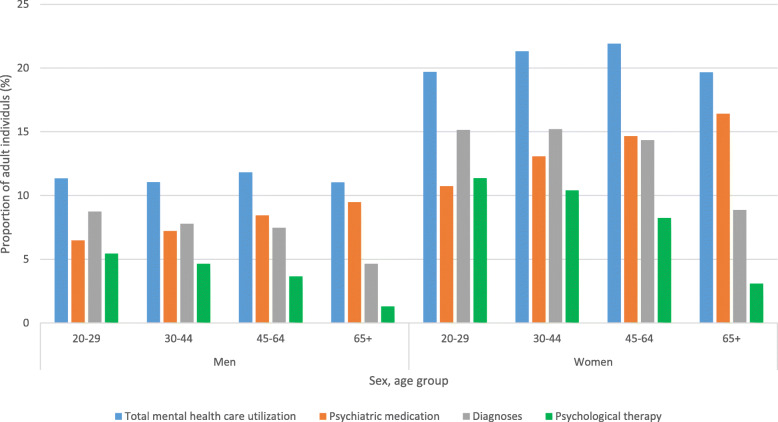
- In 2017, women were more likely than men to use mental health care in all age groups; for overall mental health care, relative risks ranged from 1.66 (20–29 years) to 1.93 (30–44 years), and for psychological therapy from 2.09 to 2.35.
Methods
- Repeated population-based cross-sectional register study using administrative health care data from the Stockholm Region (VAL), covering publicly funded primary and secondary care.
- Included the total adult population of Stockholm Region over 2007–2017 for diagnoses and psychological therapy, and 2011–2017 for psychiatric medication claims (VAL prescription data available since July 2010).
- Descriptive proportions/relative risks with 95% CIs, Cochran–Armitage trend tests, and direct standardization for age and sex-specific trends; overlap between diagnoses, medication, and therapy was also described.
Limitations
- The paper states that it had no information on the type of psychological therapy.
- The estimate of mental health care utilization was conservative and did not include psychological distress, insomnia, medications intended for sleep disorders, or short-term treatment of anxiety.
- Privately funded psychological therapy and therapy delivered in the workplace were not captured in VAL; the paper also notes that a 2013 change in primary-care ICD coding might have affected registration routines.
- Evident from the text: the study measures utilization/recorded care, not true underlying psychiatric morbidity, so increases in use cannot be taken as direct evidence of increases in disorder prevalence.
Model-written summary. Check it against the paper before relying on it.
Integrity signals
Registry
Cites
Statistics
Figures
Verification
Claims the paper makes
7 Valid · 1 Not valid · 3 Not checked · 50 Own results and interpretations
The cited sources support only part of this claim — read each source’s verdict below.
In the paper
“many studies from Sweden and other developed countries have shown increasing long-term trends in self-reported depressive and anxiety symptoms, particularly among young people [5, 6, 12–16]”
§ Trends in psychiatric diagnoses, medications and psychological therapies in a large Swedish region: a population-based study > Background
What the sources say
- Not checked — no full text of the sourcecites [5] Kosidou K Magnusson C Mittendorfer-Rutz E Hallqvist J Hellner Gumpert C Idrizbegovic S Dal H Dalman C Recent time trends in levels of self-reported anxiety, mental health service use and suicidal behaviour in Stockholm Acta Psychiatr Scand 2010 122 47 55 10.1111/j.1600-0447.2009.01487.x 19824989 source
- Not checked — no full text of the sourcecites [6] Sigfusdottir ID Asgeirsdottir BB Sigurdsson JF Gudjonsson GH Trends in depressive symptoms, anxiety symptoms and visits to healthcare specialists: a national study among Icelandic adolescents Scand J Public Health 2008 36 361 368 10.1177/1403494807088457 18539690 source
- Not checked — no full text of the sourcecites [12] Collishaw S Annual research review: secular trends in child and adolescent mental health J Child Psychol Psychiatry 2015 56 370 393 10.1111/jcpp.12372 25496340 source
- Not checked — no full text of the sourcecites [13] Collishaw S Maughan B Natarajan L Pickles A Trends in adolescent emotional problems in England: a comparison of two national cohorts twenty years apart J Child Psychol Psychiatry 2010 51 885 894 10.1111/j.1469-7610.2010.02252.x 20497281 source
- Partly supportedcites [14] McManus S Bebbington P Jenkins R Brugha T Mental health and wellbeing in England: adult psychiatric morbidity survey 2014 2016 Leeds NHS DigitalExperimental — accuracy not yet measured
Chapter 2 (pp. 48, 50) reports long-term increases in severe common mental disorder symptoms among young women in England and increases in generalized anxiety disorder and depression among adults aged 16–64. It does not establish trends in Sweden or show that young people generally experienced the increases; it cautions that the apparent increase among young women did not quite reach statistical significance. (LLM, conf=0.87)
- Not checked — no full text of the sourcecites [15] Fichter MM Xepapadakos F Quadflieg N Georgopoulou E Fthenakis WEA Comparative study of psychopathology in Greek adolescents in Germany and in Greece in 1980 and 1998–18 years apart Eur Arch Psychiatry Clin Neurosci 2004 254 27 35 10.1007/s00406-004-0450-0 14991376 source
- Partly supportedcites [16] Sweeting H Young R West P GHQ increases among Scottish 15 year olds 1987-2006 Soc Psychiatry Psychiatr Epidemiol 2009 44 579 586 10.1007/s00127-008-0462-6 19037574 PMC2693777 sourceExperimental — accuracy not yet measured
The Conclusion (page unavailable) reports increasing self-reported psychological distress among Scottish 15-year-olds, and the Introduction describes increases in depressive symptoms in some other countries. But the Introduction also says the findings of comparable studies are mixed; this source does not establish the claim's broad pattern across many studies or provide evidence from Sweden. (LLM, conf=0.84)
plainstates an association- Asserted: passes — The authors put it forward as true.
- Checkable: passes — It can be checked against evidence.
- Load-bearing: unclear — It is unclear whether the paper’s conclusions depend on it.
- Based: passes — The paper gives a reason why it holds.
A result the paper reports from its own data — it cites no other source for it, so there is none to check. The quote shows it is in the paper.
In the paper
“The increase was most pronounced in younger adults.”
- Also stated in: § Sex- and age differences in mental health care utilization · plain
“Stratified analyses reveal that the increase in mental health care utilization was most pronounced in younger individuals but decreased with age in both men and women”
- Also stated in: § Discussion · plain
“Health care utilization increased in all age groups but was more pronounced in younger individuals resulting in similar levels of mental health care utilization across age groups in 2017.”
§ Trends in psychiatric diagnoses, medications and psychological therapies in a large Swedish region: a population-based study > Abstract > Results
plainstates an association- Asserted: passes — The authors put it forward as true.
- Checkable: passes — It can be checked against evidence.
- Load-bearing: unclear — It is unclear whether the paper’s conclusions depend on it.
- Based: passes — The paper gives a reason why it holds.
- Also stated in: § Sex- and age differences in mental health care utilization · plain
A result the paper reports from its own data — it cites no other source for it, so there is none to check. The quote shows it is in the paper.
In the paper
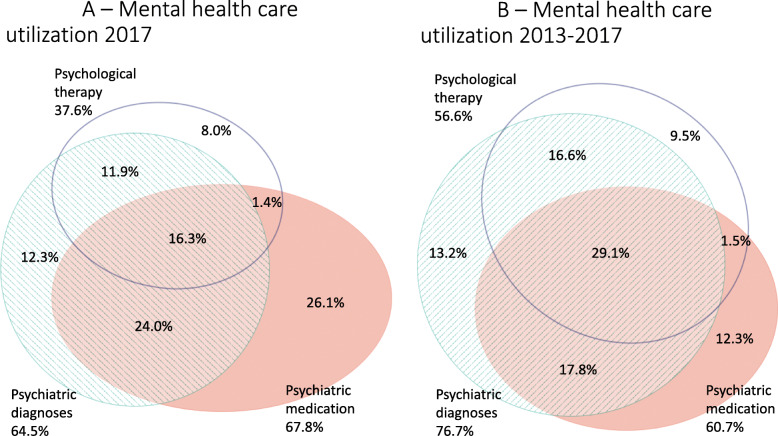
“Recorded diagnoses identified 65% of all the individuals that received care during 1 year (2017)”
§ Trends in psychiatric diagnoses, medications and psychological therapies in a large Swedish region: a population-based study > Results > Overlap between psychiatric diagnoses, psychiatric medication and psychological therapy
plain- Asserted: passes — The authors put it forward as true.
- Checkable: passes — It can be checked against evidence.
- Load-bearing: unclear — It is unclear whether the paper’s conclusions depend on it.
- Based: passes — The paper gives a reason why it holds.
A result the paper reports from its own data — it cites no other source for it, so there is none to check. The quote shows it is in the paper.
In the paper
“Medication decreased from 71.0 to 67.7%”
- Also stated in: § Time trends in the overall mental health care utilization · plain
“Among the individuals who utilized mental health care, use of medication decreased from 71.0 to 67.7%”
§ Trends in psychiatric diagnoses, medications and psychological therapies in a large Swedish region: a population-based study > Abstract > Results
plain- Asserted: passes — The authors put it forward as true.
- Checkable: passes — It can be checked against evidence.
- Load-bearing: passes — The paper’s conclusions depend on it.
- Based: passes — The paper gives a reason why it holds.
- Also stated in: § Time trends in the overall mental health care utilization · plain
A result the paper reports from its own data — it cites no other source for it, so there is none to check. The quote shows it is in the paper.
In the paper
“while psychological therapy increased from 33.1 to 37.6%.”
- Also stated in: § Results · plain
“while psychological therapy increased from 33.1 to 37.6%”
§ Trends in psychiatric diagnoses, medications and psychological therapies in a large Swedish region: a population-based study > Abstract > Results
plainstates a cause- Asserted: passes — The authors put it forward as true.
- Checkable: passes — It can be checked against evidence.
- Load-bearing: passes — The paper’s conclusions depend on it.
- Based: passes — The paper gives a reason why it holds.
- Also stated in: § Results · plain
26 more claims
Create a free account to see all 61 claims and every source verdict.
- It may state two separate claims as one. 21
- Probably not a substantial claim. 15
Claims other papers make about this one
Each is checked against this paper’s own text: does it say what the citing paper says it does?
The source backs part of the claim, not all of it — or backs it for a different population, condition or comparison.
In the citing paper
“Across the world, primary health care is the setting where most people with common mental disorders receive diagnosis and treatment [1–3].”
From Intolerance-of-uncertainty therapy versus metacognitive therapy for generalized anxiety disorder in primary health care: A randomized controlled pilot trial (2023) · cites this paper as [3]
Experimental — accuracy not yet measured
Self-check
Percentages, sums and reported differences re-computed from the paper’s own numbers.
Self-check results appear here once an independent check has confirmed them.
Cited works that were retracted
Works this paper cites that were later retracted, from the retraction notices publishers deposit. Major when the notice came out before this paper was published.
Rated major: it would touch a result — a value a result rests on, reported and recomputed p-values on opposite sides of the significance level, two passages that conflict with no sign which is right, or a cited work retracted before this paper was published.
In the paper
“Davis KAS, Coleman JRI, Adams M, Allen N, Breen G, Cullen B, Dickens C, Fox E, Graham N, Holliday J, Howard LM, John A, Lee W, McCabe R, McIntosh A, Pearsall R, Smith DJ, Sudlow C, Ward J, Zammit S, Hotopf M. Mental health in UK biobank: development, implementation and results from an online questionnaire completed by 157 366 participants. BJPsych Open. 2018;4:83–90.”
Cited work 10.1192/bjo.2018.12 · retracted 2019-06-17 · notice 10.1192/bjo.2019.46 · this paper published 2020-06-23
Citations
Cites
1 retracted
Davis, K. A. S., Coleman, J. R. I., Adams, M., Allen, N., Breen, G., Cullen, B., Dickens, C., Fox, E., Graham, N., Holliday, J., et al. (2018) · BJPsych Open · doi:10.1192/bjo.2018.12 · Cited by 236
RetractedWhiteford, H. A., Degenhardt, L., Rehm, J., Baxter, A. J., Ferrari, A. J., Erskine, H. E., Charlson, F. J., Norman, R. E., Flaxman, A. D., Johns, N., et al. (2013) · The Lancet · doi:10.1016/s0140-6736(13)61611-6 · Cited by 6,006
External review and validation of the Swedish national inpatient register
Ludvigsson, J. F., Andersson, E., Ekbom, A., Feychting, M., Kim, J.-L., Reuterwall, C., Heurgren, M., & Olausson, P. O. (2011) · BMC Public Health · doi:10.1186/1471-2458-11-450 · Cited by 5,055
Antidepressant Drug Effects and Depression Severity: A Patient-Level Meta-analysis
Fournier, J. C., DeRubeis, R. J., Hollon, S. D., Dimidjian, S., Amsterdam, J. D., Shelton, R. C., & Fawcett, J. (2010) · JAMA · doi:10.1001/jama.2009.1943 · Cited by 2,009
Wettermark, B., Hammar, N., MichaelFored, C., Leimanis, A., Otterblad Olausson, P., Bergman, U., Persson, I., Sundström, A., Westerholm, B., & Rosén, M. (2007) · Pharmacoepidemiology and Drug Safety · doi:10.1002/pds.1294 · Cited by 1,887
Attention-deficit hyperactivity disorder
Biederman, J., & Faraone, S. V. (2005) · The Lancet · doi:10.1016/s0140-6736(05)66915-2 · Cited by 1,463
When and how do young people seek professional help for mental health problems?
Rickwood, D. J., Deane, F. P., & Wilson, C. J. (2007) · Medical Journal of Australia · doi:10.5694/j.1326-5377.2007.tb01334.x · Cited by 1,195
Annual Research Review: Secular trends in child and adolescent mental health
Collishaw, S. (2015) · Journal of Child Psychology and Psychiatry · doi:10.1111/jcpp.12372 · Cited by 788
(2016) · City Research Online (City University London) · Cited by 747
Jorm, A. F., Patten, S. B., Brugha, T. S., & Mojtabai, R. (2017) · World Psychiatry · doi:10.1002/wps.20388 · Cited by 556
Cited by
Åkesdotter, C., Kenttä, G., Eloranta, S., Håkansson, A., & Franck, J. (2022) · BMJ Open Sport & Exercise Medicine · doi:10.1136/bmjsem-2021-001264 · Cited by 63
Secular trends in mental health problems among young people in Norway: a review and meta-analysis
Potrebny, T., Nilsen, S. A., Bakken, A., von Soest, T., Kvaløy, K., Samdal, O., Sivertsen, B., Aase, H., & Bang, L. (2024) · European Child & Adolescent Psychiatry · doi:10.1007/s00787-024-02371-4 · Cited by 87
“However, over a longer time period, the studies all show a general increase over time and secular trends in self-reported mental health problems coincide with increasing rates of treatment for mental disorders among young people [5, 46–49].”
Thom, J., Jonas, B., Reitzle, L., Mauz, E., Hölling, H., & Schulz, M. (2024) · Deutsches Ärzteblatt international · doi:10.3238/arztebl.m2024.0052 · Cited by 59
Risk of Psychiatric Disorders Among Spouses of Patients With Cancer in Denmark and Sweden
Hu, K., Liu, Q., László, K. D., Wei, D., Yang, F., Fall, K., Adami, H., Ye, W., Valdimarsdóttir, U. A., Li, J., et al. (2023) · JAMA Network Open · doi:10.1001/jamanetworkopen.2022.49560 · Cited by 47
Hu, K., Wang, J., Sparén, P., Herweijer, E., Sjölander, A., Adami, H., Valdimarsdóttir, U. A., Sundström, K., & Fang, F. (2023) · The Lancet Public Health · doi:10.1016/s2468-2667(23)00026-9 · Cited by 41
Gubi, E., Sjöqvist, H., Viksten-Assel, K., Bäärnhielm, S., Dalman, C., & Hollander, A.-C. (2022) · Social Psychiatry and Psychiatric Epidemiology · doi:10.1007/s00127-021-02145-2 · Cited by 34
“[33] for a detailed description of the different health care data registers).”
BackgroundSelf-citationChong, R. J., Hao, Y., Tan, E. W. Q., Mok, G. J. L., Sia, C., Ho, J. S. Y., Chan, M. Y., & Ho, A. F. W. (2025) · Journal of Clinical Medicine · doi:10.3390/jcm14061786 · Cited by 41
“Further research is needed to develop strategies to improve patient outcomes Recent years have witnessed a rise in diagnosed mental health disorders (depression, anxiety, stress) and their association with both CVD development and poorer AMI outcomes [3].”
Examining the mental health services among people with mental disorders: a literature review
Gao, Y., Burns, R. A., Leach, L., Chilver, M. R., & Butterworth, P. (2024) · BMC Psychiatry · doi:10.1186/s12888-024-05965-z · Cited by 43
“Fifteen studies analyzed the association between gender and mental health service use, with fourteen studies reporting that mental health service use was more frequent among females with mental disorders than males [2, 37, 42, 43, 47, 54, 66, 67, 90, 103, 119, 123, 128, 130].”
BackgroundLi, B., Allebeck, P., Burstöm, B., Danielsson, A., Degenhardt, L. J., Eikemo, T. A., Ferrari, A. J., Knudsen, A. K., Lundin, A., Manhica, H., et al. (2023) · International Journal of Methods in Psychiatric Research · doi:10.1002/mpr.1964 · Cited by 36
“This is somewhat surprising considering the close link between SEP and the risk of these disorders (Kosidou et al., 2011; Stansfeld et al., 2011), and the onset of many new cases in later life.”
BackgroundInfluentialDu, C., Hsiao, P. Y., Ludy, M., & Tucker, R. M. (2022) · Nutrients · doi:10.3390/nu14040775 · Cited by 34
“Medication and counseling are the two most common ways to treat mental illness and reduce related symptoms [10,11]; however, there are limitations associated with both strategies.”
BackgroundPhD studies hurt mental health, but less than previously feared
Keloharju, M., Knüpfer, S., Müller, D., & Tå̊g, J. (2024) · Research Policy · doi:10.1016/j.respol.2024.105078 · Cited by 28
“First, depression prevalence more than doubles during the seven years the subjects are followed, likely reflecting the effect of age on health (Baxter et al., 2014; Ferrari et al., 2013) and treatment behavior (Alonso et al., 2004; Forslund et al., 2020; Moitra et al., 2022).”
BackgroundInfluentialGubi, E., Sjöqvist, H., Dalman, C., Bäärnhielm, S., & Hollander, A. (2022) · Epidemiology and Psychiatric Sciences · doi:10.1017/s2045796022000142 · Cited by 31
“We obtained all exposure, outcome and covariate data from this linkage (see Forslund et al ., 2020) for details about the database and the component registers.”
MethodSelf-citationYang, Q., Bränn, E., Johnson, E., Sjölander, A., Fang, F., Öberg, A. S., Valdimarsdóttir, U. A., & Lu, D. (2024) · PLoS Medicine · doi:10.1371/journal.pmed.1004363 · Cited by 23
“Nearly half of mental health problems are managed in primary care in Sweden [29].”
BackgroundOn the transience or stability of subthreshold psychopathology
Schreuder, M. J., Wigman, J. T. W., Groen, R. N., Wichers, M., & Hartman, C. A. (2021) · Scientific Reports · doi:10.1038/s41598-021-02711-3 · Cited by 22
Cullen, A. E., Lindsäter, E., Rahman, S. G., Taipale, H. T., Tanskanen, A. J., Mittendorfer‐Rutz, E., & Helgesson, M. (2023) · BJPsych Open · doi:10.1192/bjo.2023.8 · Cited by 15
Låftman, S. B., Grigorian, K., Lundin, A., Östberg, V., & Raninen, J. (2024) · BMC Public Health · doi:10.1186/s12889-023-17443-4 · Cited by 19
“However, since a substantial proportion of young persons do not seek and receive care for their mental health conditions [43], and since other types of treatment such as psychological therapy are also common [44], these measures were not optimal proxies for depression and anxiety symptoms.”
BackgroundFors, A., Forslund, T., Sundström, A., & Wettermark, B. (2025) · European Journal of Clinical Pharmacology · doi:10.1007/s00228-025-03823-9 · Cited by 19
“…regarding the dispensed GLP-1 RA brand claimed benefit together with individual demographic and medical data were extracted from the health care data register VAL (Vårdanalysdatabaserna), a data warehouse governed by Region Stockholm which has previously been used in similar research [49, 50].”
Self-citationRabiee, R. H. S., Lundin, A., Agardh, E. E., Allebeck, P., & Danielsson, A. (2022) · Scandinavian Journal of Public Health · doi:10.1177/14034948221122431 · Cited by 14
“[15] Forslund T, kosidou k, Wicks S, et al.”
BackgroundMethodaf Winklerfelt Hammarberg, S., Toth-Pal, E., Jansson-Fröjmark, M., Lundgren, T., Westman, J., & Bohman, B. (2023) · PLoS ONE · doi:10.1371/journal.pone.0287171 · Cited by 9
Martini, M. I., Kuja‐Halkola, R., Butwicka, A., Rietz, E. D., Kanina, A., Brikell, I., Chang, Z., Larsson, H., Lichtenstein, P., Bölte, S., et al. (2025) · Journal of Child Psychology and Psychiatry · doi:10.1111/jcpp.14130 · Cited by 18
“…high and partly increasing probabilities of preceding psychiatric diagnoses between 2010 and 2020 observed in our sample might represent a population-wide effect of increased mental health problems (Plana-Ripoll et al., 2022) and care utilization (Forslund, Kosidou, Wicks, & Dalman, 2020).”
Physical-mental multimorbidity in a large primary health care population in Stockholm County, Sweden
Taloyan, M., Alinaghizadeh, H., Wettermark, B., Hasselström, J., & Bertilson, B. C. (2022) · Asian Journal of Psychiatry · doi:10.1016/j.ajp.2022.103354 · Cited by 14
“…(WHO) has identified filling the knowledge gap regarding mental and physical comorbidities in primary care patients as a key to improving patient access to effective disease prevention and treatment (Zarrinkoub et al., 2013; Forslund et al., 2020; Carlsson et al., 2013; Cars et al., 2016).”
Kohnke, H., Zielinski, A., Beckman, A., & Ohlsson, H. (2023) · BMC Health Services Research · doi:10.1186/s12913-023-10326-9 · Cited by 10
“Furthermore, PHC utilization for mental health issues has been shown to increase and diagnoses of depression and anxiety in PHC are twice as common in women as in men [31–33].”
BackgroundWelford, P., Danielsson, A., & Manhica, H. (2022) · Addiction · doi:10.1111/add.15807 · Cited by 15
“Psychiatric disorders tend to be underestimated within Swedish registries [54].”
BackgroundYang, Q., Lagerberg, T., Sjölander, A., Bertone‐Johnson, E. R., Fang, F., Ye, W., Chang, Z., Valdimarsdóttir, U. A., & Lu, D. (2022) · BMC Medicine · doi:10.1186/s12916-022-02671-z · Cited by 15
Diagnosing the context is as important as diagnosing the individual
Batstra, L., & FRANCES, A. J. (2025) · Frontiers in Psychiatry · doi:10.3389/fpsyt.2025.1698878 · Cited by 7
Kadowaki, Å., Alvunger, A.-K., Larsen, H. I., Persdotter, A., Zak, M. S., Johansson, P., & Nystrom, F. H. (2021) · BMC Family Practice · doi:10.1186/s12875-021-01526-5 · Cited by 7
Work-related stress, reason for consultation and diagnosis-specific sick leave: How do they add up?
Hultén, A.-M., Holmgren, K. E., & Bjerkeli, P. J. (2023) · PLoS ONE · doi:10.1371/journal.pone.0288751 · Cited by 12
“Consequently, disorders that are associated with stress, such as depression, anxiety and stress-related disorders, are often managed within primary health care and the utilization of mental health care provided by primary health care has increased [4].”
BackgroundFuglsang, C. H., Rasmussen, T. B., Rudolfsen, J. H., Olsen, J., Skipper, N., Ulrichsen, S. P., Sørensen, H. T., & Christiansen, C. F. (2024) · The Lancet Regional Health - Europe · doi:10.1016/j.lanepe.2024.101189 · Cited by 7
Selinheimo, S., Gluschkoff, K., Turunen, J., Mattila‐Holappa, P., Kausto, J., & Väänänen, A. (2023) · Journal of Psychiatric Research · doi:10.1016/j.jpsychires.2023.06.001 · Cited by 7
Gustafsson, L., Rawshani, A., Råmunddal, T., Redfors, B., Pétursson, P., Angerås, O., Hirlekar, G., Ömerovic, E., Dworeck, C., Völz, S., et al. (2023) · Resuscitation Plus · doi:10.1016/j.resplu.2023.100503 · Cited by 11
“…of the individuals with OHCA have a history of affective disorders, which suggests a high prevalence of psychiatric disease compared to other studies 24 but is consistent with the findings of increasing long-time trends in self-reported depressive and anxiety symptoms, especially among the young.”
ResultAnxiety and mood disorders on the rise: exploring clinical profiles and risk factors
Gkitakou, A., ten Have, M., Batelaan, N. M., Luik, A. I., & Penninx, B. W. J. H. (2025) · The British Journal of Psychiatry · doi:10.1192/bjp.2025.10454 · Cited by 8
“12,14 However, as our assessment of mental disorders is based on standardised psychiatric interviewing in a random, generalisable Dutch cohort, prevalence estimates are not dependent of or biased by medical care needs or services or clinician availability.”
Ketvel, L., Keltikangas‐Järvinen, L., Pahkala, K., Juonala, M., Ahola‐Olli, A., Lehtimäki, T. J., Viikari, J. S. A., Raitakari, O. T., Rovio, S., & Saarinen, A. I. L. (2023) · Cognitive Therapy and Research · doi:10.1007/s10608-023-10354-z · Cited by 6
“for burnout in the last decade (Forslund et al., 2020).”
Bülow, P. H., Finkel, D., Allgurin, M., Torgé, C. J., Jegermalm, M., Bravell, M. E., & Bülow, P. (2022) · International Journal of Mental Health Systems · doi:10.1186/s13033-022-00544-9 · Cited by 5
“The results indicate that the sectorization of psychiatric care might be as important in the studied municipality as the Mental Health Care Reform of 1995, although a relatively quiet revolution [8].”
BackgroundResultÅhlén, J., Bjureberg, J., Lenhard, F., Wahlund, T., Linde, J., & Mataix‐Cols, D. (2022) · British Journal of Clinical Psychology · doi:10.1111/bjc.12409 · Cited by 5
“Our sample had a higher educational level compared with the general Swedish population, and two out of three participants reported that they at some point had sought professional help for mental health issues, which is higher than expected in the general population in Sweden (Forslund et al., 2020).”
Influentialde Montgomery, C. J., Cullen, A. E., Taipale, H. T., Krasnik, A., Nørredam, M. L., & Mittendorfer‐Rutz, E. (2023) · Social Psychiatry and Psychiatric Epidemiology · doi:10.1007/s00127-023-02578-x · Cited by 5
Rabiee, R. H. S., Sjöqvist, H., Agardh, E. E., Lundin, A., & Danielsson, A. (2023) · Addiction · doi:10.1111/add.16158 · Cited by 4
Kiadaliri, A., Osooli, M., Ohlsson, H., Sundquist, J., & Sundquist, K. (2025) · BMC Psychiatry · doi:10.1186/s12888-025-06596-8 · Cited by 2
“A recent study reported rising age-and sex-standardized prevalence of psychiatric disorders in the Stockholm Region, Sweden, during 2007–2017 [3].”
Elenis, E., Holm, C. M., Axelssön, O., Svanberg, A. S., Lampic, C., & Sydsjö, G. (2025) · Acta Obstetricia Et Gynecologica Scandinavica · doi:10.1111/aogs.70037 · Cited by 2
“Since ~ 50% of psychiatric care in Sweden occurs in primary health care, 60 many individuals may have prescriptions without recorded diagnoses, explaining the difference noted.”
Bishop, L., Almquist, Y. B., Pitkänen, J., & Martikainen, P. (2023) · Advances in Life Course Research · doi:10.1016/j.alcr.2023.100561 · Cited by 3
Larsen, H. I., Thomas, K., Nordgren, L. B., Ruiz, E. S., Koshnaw, K., & Nilsén, P. (2024) · BMC Family Practice · doi:10.1186/s12875-024-02515-0 · Cited by 1
“In Sweden, primary care handles most patients with mental health problems, with 50% to 70% of patients diagnosed with psychiatric diseases being managed in this setting [2, 10].”
BackgroundAmin, R., Björkenstam, E., Helgesson, M., & Mittendorfer‐Rutz, E. (2024) · Social Psychiatry and Psychiatric Epidemiology · doi:10.1007/s00127-024-02777-0 · Cited by 1
“Based on the findings from a study on all individuals resident in the Stockholm region [27] and the fact that we screened for antidepressant medication use in both primary and specialised healthcare, our study population focusing on specialised healthcare can be estimated to include around half of…”
Human design: The unlimited adaptability fallacy
Hajj, L. E., Maiky, C., Maalouf, J. F., & Fares, H. (2025) · Ethics Medicine and Public Health · doi:10.1016/j.jemep.2025.101134 · Cited by 1
Johansson, F., Gunnarsson, L., Grossmann, L., Mataix‐Cols, D., de la Cruz, L. F., Fazel, S., Gardner, R. M., Dalman, C., Wallert, J., & Rück, C. (2025) · BMJ Mental Health · doi:10.1136/bmjment-2025-301959 · Cited by 4
Self-citationDahlén, E., Jarbin, H., Sundström, A., et al. (2026) · European Child & Adolescent Psychiatry · doi:10.1007/s00787-026-02960-5 · Cited by 1
“The mental health care utilisation pattern suggest that adults use psychological treatment to a lesser extent than pharmacological treatment [26].”
PhD Studies Hurt Mental Health, but Less than You ThinkPreprint
Keloharju, M., Knüpfer, S., Müller, D., & Tå̊g, J. (2022) · Research Square · doi:10.21203/rs.3.rs-2057354/v1
PhD Studies Hurt Mental Health, but Less Than Previously FearedPreprint
Keloharju, M., Knüpfer, S., Müller, D., et al. (2022) · SSRN Electronic Journal · doi:10.2139/ssrn.4190289
Loza, M. I., Hmeljak, J., Bountra, C., Audia, J. E., Chowdhury, S., Weiman, S., Merchant, K., & Blanco, M.-J. (2022) · Disease Models & Mechanisms · doi:10.1242/dmm.049755 · Cited by 1
“…in drug discovery and development, and approaches and technologies in central nervous system (CNS) research (as discussed in detail in, for example, Forlund et al., 2020; Olfson et al., 2015; Bloem et al., 2021; Sinnige et al., 2020; Lüscher Dias et al., 2020; Dhanwani et al., 2022; Anderson et…”
Gustafsson, L., Rawshani, A., Råmunddal, T., et al. (2023) · SSRN Electronic Journal · doi:10.2139/ssrn.4570259
Heshmati, A. F., Dunlavy, A. C., Mussino, E., Fritzell, S. C., & Juárez, S. (2025) · BMC Public Health · doi:10.1186/s12889-025-22248-8
“Of adults receiving mental health care, 49% are treated in primary care, 32% in secondary care, and 18.5% are jointly treated in both primary and secondary care [28].”
InfluentialLi, B., Liu, C., Almquist, Y. B., & Berg, L. (2025) · Social Psychiatry and Psychiatric Epidemiology · doi:10.1007/s00127-025-02918-z · Cited by 2
Ferry, F. R., Kent, L., Rosato, M., Curran, E., & Leavey, G. (2025) · Social Psychiatry and Psychiatric Epidemiology · doi:10.1007/s00127-025-02909-0 · Cited by 1
Rosenbaum, J. J., Varma, S., Kirkpatrick, M. G., & Udelsman, B. V. (2025) · Journal of Surgical Research · doi:10.1016/j.jss.2025.08.006
Anker, A. S. T., & Andersen, S. H. (2025) · Acta Psychiatrica Scandinavica · doi:10.1111/acps.70041
Ballin, M., Tuvendal, P., Bardage, C., et al. (2025) · medRxiv · doi:10.64898/2025.12.04.25341462
Nilsen, P., Nordgren, L., Thomas, K., Ruiz, E. S., & Larsen, H. (2026) · BMC Health Services Research · doi:10.1186/s12913-025-13903-2
Zarei, K., Sallin, K., Mattsson, M., Petrović, P., Lindevall, O., Ohlis, A., & Hollander, A. (2026) · BMC Psychiatry · doi:10.1186/s12888-026-07830-7 · Cited by 2
“Primary care for mental health, and specialized psychiatric care, including regional register-data from the child and adolescent psychiatric clinics in Stockholm (the “Pastill”-database) was obtained from the Stockholm region VAL-databases [24].”
Peristera, P., Andréasson, A., Kecklund, G., Lekander, M., & Westerlund, H. (2026) · Scandinavian Journal of Public Health · doi:10.1177/14034948251381537
“Some earlier studies have shown increases in self-reported depressive symptoms, anxiety and psychiatric service use over time, particularly among young women [16–26].”
Patrones de dispensación de psicofármacos en atención primaria rural del norte de Chile
García-González, W., Venegas-Bustos, J., Briceño‐Moya, J., Roco-Videla, A., & Flores-Carrasco, S. V. (2026) · Atención Primaria · doi:10.1016/j.aprim.2026.103486
Nordgren, L. B., Thomas, K., Ruiz, E. S., Koshnaw, K., Fredriksson, M., Nilsén, P., & Larsen, H. I. (2026) · BMC Health Services Research · doi:10.1186/s12913-026-15452-8
“…of qualified staff to properly address mental health issues, underutilization of psychological or behavioral interventions, long waiting times for care, and insufficient knowledge of various mental and biopsychosocial conditions among professionals and in the general population [2–4, 8, 10, 11].”
Metadata
- Authors
- Forslund, T., Kosidou, K., Wicks, S., & Dalman, C.
- Affiliations
- Region Stockholm (SE)
- Corresponding author
- Forslund, T.
- Venue
- BMC Psychiatry
- Published
- 2020-06-23
- Volume
- 20
- Issue
- 1
- Pages
- 328-328
- ISSN
- 1471-244X (ISSN-L)
- PMC
- PMC7313191
- OpenAlex
- W3035775929
- Cited by
- 63
- References
- 35
- Citations by year
- 2026: 7 · 2025: 15 · 2024: 11 · 2023: 15 · 2022: 11 · 2021: 4
- FWCI
- 8.19
- Type
- journal article
- Language
- en
- Open access
- gold
- doi.org
- Licence
- cc-by
- creativecommons.org/licenses/by/4.0 (tdm)
- creativecommons.org/licenses/by/4.0 (vor)
- Locations
- BMC Psychiatry (publishedVersion, cc-by)
- PubMed Central (publishedVersion, cc-by)
- PubMed (publishedVersion)
- DOAJ (DOAJ: Directory of Open Access Journals) (submittedVersion, cc-by-sa)
- Funders
- Stockholms Läns Landsting (N/A)
- Karolinska Institutet (N/A)
- Topics
- Health Sciences › Medicine › Psychiatry and Mental health › Mental Health Treatment and Access
- Social Sciences › Psychology › Clinical Psychology › Psychiatric care and mental health services
- Social Sciences › Psychology › Clinical Psychology › Psychology and Mental Health
- Keywords
- mental health service utilization, psychiatric diagnosis, psychiatric medication, psychotherapy, primary care, secondary care, ICD-10, temporal trends, overtreatment, gender differences, age differences, Stockholm region
- MeSH terms
- Adult, Aged, Mental Disorders, Cross-Sectional Studies, Female, Humans, Male, Middle Aged, Patient Acceptance of Health Care, Sweden, International Classification of Diseases, Young Adult
About these checks
Registry, retraction, Cites and statistics results are computed, not judged, with one exception: a printed reference that no index lists is read once by a model before it counts as a citation error. Claims are extracted by a model and kept only when their quote appears verbatim in the text; each cited source is then checked, with a model’s help, for whether it says what the claim relies on. Those verdicts can be wrong — read the claim’s quote and the cited source before relying on one.
The claim verdicts this report counts are experimental: their accuracy is not yet measured.
A language model drew the claims from the paper on 2026-10-11, under version 3 of the claim definition (model deepseek-v4.1-flash, prompt extract-v3).
A second model labelled each claim on 2026-10-11 (model jev-1.13-20260917, definition revision gold-guideline-v0.2).
Cited sources are checked with a language model’s help (gpt-6-sol).
Statistics and arithmetic are recomputed, not judged.
Confidence bands are shown only for fields calibrated on our annotated test set. None is calibrated yet, so no band is shown.
What counts as a claim ›How we measure confidence ›How we check this ›
Are you an author, or do you see a problem with this page? Request a review
Data sources
Bibliographic data: Semantic Scholar, OpenAlex, Crossref.
Contains information from the Semantic Scholar Academic Graph Datasets, made available under the ODC Attribution License (ODC-BY 1.0).
Semantic Scholar’s data is described in: Kinney, R., et al. (2023). The Semantic Scholar Open Data Platform. arXiv:2301.10140.
