

Longitudinal relationships among problematic mobile phone use, bedtime procrastination, sleep quality and depressive symptoms in Chinese college students: a cross-lagged panel analysis
Open accessThe DOI matches its Crossref record; 102 of the 102 references it cites were found in a registry or an index.
Abstract
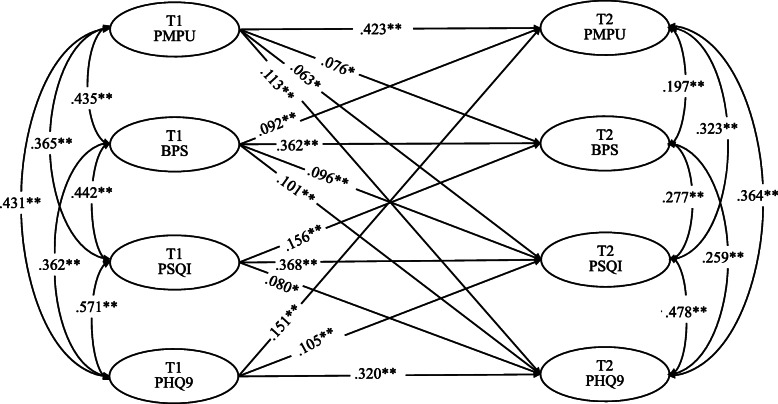
Background: Cross-sectional and longitudinal studies have found that problematic mobile phone use, bedtime procrastination, sleep quality, and depressive symptoms are strongly associated. However, studies are inconsistent regarding whether problematic mobile phone use predicts depressive symptoms or vice versa, and sleep factors have been infrequently focused on in this regard. In addition, few studies have examined the longitudinal associations and directions of effects between these factors. Therefore, this study aims to explore the longitudinal relationship among problematic mobile phone use, bedtime procrastination, sleep quality, and depressive symptoms in college students. Methods: Overall, 1181 college students completed questionnaires on problematic mobile phone use, bedtime procrastination, sleep quality, and depressive symptoms at two time points 12 months apart. A cross-lagged model was used to examine the longitudinal relationship between these factors. Results: Cross-lagged analyses showed significant bidirectional relationships of problematic mobile phone use with bedtime procrastination and depressive symptoms. Additionally, there were also significant bidirectional relationships of sleep quality with bedtime procrastination and depressive symptoms. Problematic mobile phone use predicted subsequent sleep quality one-way, and bedtime procrastination predicted subsequent depressive symptoms one-way. Conclusions: This study further expands our understanding of the longitudinal and bidirectional relationships among problematic mobile phone use, bedtime procrastination, sleep quality and depressive symptoms and helps school mental health educators design targeted interventions to reduce problematic mobile phone use, sleep problems, and depressive symptoms among college students.
Overview
The claims and statistics of this paper haven’t been checked yet.
Free: it reads the open-access text and checks the first 5 claims that cite a source we can check. Create a free account to check every claim.
Integrity signals
Registry
Cites
Statistics
Figures
Verification
Claims the paper makes
The claims and statistics of this paper haven’t been checked yet.
Free: it reads the open-access text and checks the first 5 claims that cite a source we can check. Create a free account to check every claim.
Claims other papers make about this one
Each is checked against this paper’s own text: does it say what the citing paper says it does?
The source backs part of the claim, not all of it — or backs it for a different population, condition or comparison.
In the citing paper
“Sleep quality, a known predictor of EF (Xie et al., 2019), is directly decreased by problematic phone usage (Cui et al., 2021).”
From The Relationship Between TikTok Usage and Executive Function Is Mediated by Problematic Social Media Use (2025) · cites this paper as Cui et al., 2021
Experimental — accuracy not yet measured
Self-check
Percentages, sums and reported differences re-computed from the paper’s own numbers.
The self-check needs the paper’s full text.
Citations
Cites
Hu, L., & Bentler, P. M. (1999) · Structural Equation Modeling A Multidisciplinary Journal · doi:10.1080/10705519909540118 · Cited by 108,788
The Pittsburgh Sleep Quality Index: a new instrument for psychiatric practice and research
Buysse, D. J., Reynolds, C. F., Monk, T. H., Berman, S. R., & Kupfer, D. J. (1989) · Psychiatry Research · doi:10.1016/0165-1781(89)90047-4 · Cited by 35,234
Sensitivity of Goodness of Fit Indexes to Lack of Measurement Invariance
Chen, F. F. (2007) · Structural Equation Modeling: A Multidisciplinary Journal · doi:10.1080/10705510701301834 · Cited by 12,217
Schermelleh-Engel, K., Moosbrugger, H., & Müller, H. (2003) · Department of Psychology - University of Koblenz-Landau · doi:10.23668/psycharchives.12784 · Cited by 8,975
Measurement Invariance, Factor Analysis and Factorial Invariance
Meredith, W. (1993) · Psychometrika · doi:10.1007/bf02294825 · Cited by 4,536 · cited 1×
“First, we evaluated the longitudinal measurement invariance of the four scales used in this study, including configural invariance, metric invariance, and scalar invariance [70].”
MethodThe Strength Model of Self-Control
Baumeister, R. F., Vohs, K. D., & Tice, D. M. (2007) · Current Directions in Psychological Science · doi:10.1111/j.1467-8721.2007.00534.x · Cited by 3,567 · cited 2×
“Moreover, according to the Strength Model of Self-Control [49], individuals with PMPU need to access limited and domain-general psychological resources in order to develop self-control.”
MethodSteel, P. (2007) · Psychological bulletin · doi:10.1037/0033-2909.133.1.65 · Cited by 3,417 · cited 1×
“According to Steel’s Temporary Motivation Theory (TMT) [87], whether an individual exhibits procrastination depends on the perceived utility of the task to that individual, and this comprehensive variable is related to value, expectation, and delay.”
MethodThe Smartphone addiction scale: development and validation of a short version for adolescents
Kwon, M., Kim, D.-J., Cho, H., & Yang, S. (2013) · PLoS ONE · doi:10.1371/journal.pone.0083558 · Cited by 2,177
Executive functions and self-regulation
Hofmann, W., Schmeichel, B. J., & Baddeley, A. D. (2012) · Trends in Cognitive Sciences · doi:10.1016/j.tics.2012.01.006 · Cited by 1,965
Sleep disturbance and psychiatric disorders: A longitudinal epidemiological study of young Adults
Breslau, N., Roth, T., Rosenthal, L., & Andreski, P. (1996) · Biological Psychiatry · doi:10.1016/0006-3223(95)00188-3 · Cited by 1,831 · cited 1×
“was an important predictor of depression in young adults [78].”
Background
Research works printed but not linked: 1
- Tao J Luo C Huang J Liang L Meta analysis of mobile phone dependence of Chinese college students Chin J School Health 2018 39 6 1391 1394
Cited by
Items 101–172 of 172
Feng, C., Zhang, H., Yu, K., Zhao, W., & Wu, A. M. S. (2025) · Addictive Behaviors · doi:10.1016/j.addbeh.2025.108568 · Cited by 4
Yasin, N., Mushtaq, R., & Karamat, A. (2024) · Journal of Professional & Applied Psychology · doi:10.52053/jpap.v5i2.271 · Cited by 3
THE EFFECTS OF SMARTPHONE ADDICTION, STRESS, AND BEDTIME PROCRASTINATION ON SLEEP QUALITY
Ünal‐Aydın, P. (2025) · Current Perspectives in Social Sciences · doi:10.53487/atasobed.1490033 · Cited by 5
Sezer, B., Ntoumanis, N., Riddell, H., & Gucciardi, D. F. (2025) · Psychology and Health · doi:10.1080/08870446.2025.2491593 · Cited by 7
Lin, X., Fu, X., Shen, Y., Liu, G., Ding, N., Zhang, G., & Qian, J. (2025) · Frontiers in Psychology · doi:10.3389/fpsyg.2025.1588090 · Cited by 7
Choi, Y., Kim, P.-W., Park, H., Jung, S., Kwon, O., Jung, I. C., Kim, H., & Shin, K.-M. (2024) · Journal of pharmacopuncture · doi:10.3831/kpi.2024.27.4.322 · Cited by 2
Islam, M. R., Ahmed, O., Naher, L., & Islam, M. N. (2025) · Addictive Behaviors Reports · doi:10.1016/j.abrep.2025.100599 · Cited by 5
Zhou, H., Wang, S., Lin, Y., Jiang, H., & Lu, J. (2025) · Child Psychiatry & Human Development · doi:10.1007/s10578-025-01859-7 · Cited by 4
Wang, X., & Niu, J. (2026) · INQUIRY The Journal of Health Care Organization Provision and Financing · doi:10.1177/00469580251411615 · Cited by 2
A meta-analytic reliability generalization study of the Bedtime Procrastination Scale
Oyar, E., Çelikten, S., & ERDEMİR, A. (2026) · Frontiers in Psychology · doi:10.3389/fpsyg.2026.1709258 · Cited by 2
Benlahcene, A., Shorouk, A., Taddese, E. T., & Govindarajoo, M. V. (2026) · International Journal of Adolescence and Youth · doi:10.1080/02673843.2026.2629232 · Cited by 5
Gorgol, J., & Nowosadko, N. A. (2026) · Chronobiology International · doi:10.1080/07420528.2026.2633237 · Cited by 2
Digital Engagement and Sleep Dysregulation in Young Adults: A Narrative Review
Khan, M. D., Junaidi, S., & Dalbah, M. I. (2026) · Cureus · doi:10.7759/cureus.105030 · Cited by 2
Yao, W., Hu, M., Hou, H., Yang, P., & Ni, S. (2026) · Psychology Research and Behavior Management · doi:10.2147/prbm.s579858 · Cited by 3
Kawakatsu, Y., Takahata, M., Satake, S., Sato, T., & Eakman, A. M. (2024) · Frontiers in Sleep · doi:10.3389/frsle.2024.1397311 · Cited by 2
Almalki, M. (2025) · JMIR Formative Research · doi:10.2196/67223 · Cited by 4
Babakhani, D., Shojaei, A., zad, E. P., Kazemi, M., & Foroughi, A. (2025) · Computers in Human Behavior Reports · doi:10.1016/j.chbr.2025.100826 · Cited by 5
Zhang, X., Zhang, C., Ren, Z., Chen, Z., & Bai, C. (2023) · Research Square · doi:10.21203/rs.3.rs-3123118/v1 · Cited by 3
Wang, Z., Hong, B., Su, Y., Li, M., Zou, K., Wang, L., Zhao, L., Jia, P., & Song, G.-Y. (2024) · Scientific Reports · doi:10.1038/s41598-024-72461-5 · Cited by 3
Wang, X., Zhang, L., Wu, M., Yuan, X., Ma, L., & Wang, W. (2025) · Journal of Medical Internet Research · doi:10.2196/70819 · Cited by 2
The Effect of Pre-Sleep Arousal on Bedtime Procrastination: A Longitudinal study
Miyagawa, S., & Maeda, S. (2025) · Behavioral Sleep Medicine · doi:10.1080/15402002.2025.2576902 · Cited by 3
Zhang, Y., Chen, H., Ross, B., Yu, Z., Wang, X., Zhang, X., Li, H., Li, M., Huang, M., Wang, D., et al. (2025) · Behavioral Sleep Medicine · doi:10.1080/15402002.2025.2583954 · Cited by 2
Xie, Z., Zhang, Z., Sun, J., & Han, J. (2025) · Sleep Medicine · doi:10.1016/j.sleep.2025.108694 · Cited by 1
Herdian, Nur’aeni, Nordin, N. A., & Nuryana, Z. (2026) · SN Social Sciences · doi:10.1007/s43545-026-01317-8 · Cited by 1
Gao, T., Zhang, W., & Su, Y. (2026) · MedComm · doi:10.1002/mco2.70620 · Cited by 2
Differential relationships between problematic internet use and sleep problems: a network analysis
Wang, X., Li, Y., Liu, Y., Zhang, N., Ding, Y., Fan, S., Tian, Z., Wu, Y., & Wang, L. (2026) · Psychology and Health · doi:10.1080/08870446.2026.2643687 · Cited by 1
Self-citationGrabo, L. M., & Bellingrath, S. (2026) · Journal of Health Psychology · doi:10.1177/13591053261425412 · Cited by 1
Xu, J., & Li, B. (2026) · Frontiers in Public Health · doi:10.3389/fpubh.2026.1831460 · Cited by 1
Bedtime Procrastination and Thought Control Among Hostellers and Day Scholars
Roy, R. S., John, S. M. T., & John, J. M. (2022) · International Journal of Engineering Technology and Management Sciences · doi:10.46647/ijetms.2022.v06i05.077 · Cited by 1
Yang, X., Lin, Y., Zhang, L., Wang, X., Chu, K. C., Zhao, C., & Zhang, G. (2022) · doi:10.2196/preprints.45252
Amini, A., Baharchatani, R., Reyhani, A., Darrudi, R., & Gholami, A. (2023) · Sleep and Vigilance · doi:10.1007/s41782-023-00226-7
Wang, Y., Lu, Y., Tian, X., Liu, Y., & Ma, W. (2023) · SSRN Electronic Journal · doi:10.2139/ssrn.4645302
The Impact of Mobile Phone Use on Students' Mental Health
Lui, T. (2024) · Lecture Notes in Education Psychology and Public Media · doi:10.54254/2753-7048/34/20231851 · Cited by 1
Domínguez-Lara, S., Sánchez‐Villena, A. R., Aranda, M., Gutiérrez, V. F., & Domingo, M. G. (2023) · African journal of rhetoric · doi:10.21134/haaj.v23i2.769 · Cited by 8
The Relationship Between Type D Personality, Bedtime Procrastination and Sleep Quality
Uygur, H., Demiröz, D., Uygur, Ö. F., & DUMAN, A. (2024) · Genel Tıp Dergisi · doi:10.54005/geneltip.1370039 · Cited by 1
Bolaños, A. D. R., Muñoz, Q. S. C., Pasaje, A. E. A., & Ortiz, D. P. (2024) · EDUWEB · doi:10.46502/issn.1856-7576/2024.18.01.2 · Cited by 2
Chen, D., Zhang, Y., Lin, J., Pang, D., Cheng, D., & Si, D. (2022) · Figshare · doi:10.6084/m9.figshare.19664371
Xie, W., Wang, L., & Yang, L. (2024) · SSRN Electronic Journal · doi:10.2139/ssrn.4791416
Yuan, G., Zhu, Z., Yang, H., Guo, H., Zhang, J., Zhang, K., Zhang, X., Lu, X., Du, J., Shi, H., et al. (2024) · Current Psychology · doi:10.1007/s12144-024-06054-w
Handayani, N. S., Julianti, A., Maryani, T., Fauziah, A. R., & Konradus, N. (2024) · Jurnal Kesehatan dan Kedokteran · doi:10.56127/jukeke.v3i2.1394
Pinheiro, M. C. (2024) · Digital Library of Theses and Dissertations (Universidade de São Paulo) · doi:10.11606/d.47.2024.tde-07082024-104301
Soltendieck, R. M. (2024) · Carleton University's Institutional Repository (MacOdrum Library, Carleton University) · doi:10.22215/etd/2024-16193
Exploring Sleep Quality as a Modifiable Risk Factor for Suicidal Ideation among Young Students
Imran, M., Farooq, I., & Ahmad, N. (2025) · Pakistan BioMedical Journal · doi:10.54393/pbmj.v8i9.1296
Chen, D., Zhang, Y., Lin, J., Pang, D., Cheng, D., & Si, D. (2022) · Figshare · doi:10.6084/m9.figshare.19664368
Chen, D., Zhang, Y., Lin, J., Pang, D., Cheng, D., & Si, D. (2022) · Figshare · doi:10.6084/m9.figshare.19664365
Zhang, Y., Li, S., Xu, H., Jin, Z., Li, R., Zhang, Y., & Wan, Y. (2023) · Figshare · doi:10.6084/m9.figshare.22697049
Self-citationA Review on Bedtime Procrastination and Its Influencing Factors
黄, 佳. (2023) · Advances in Psychology · doi:10.12677/ap.2023.134173 · Cited by 1
Screen time, social support, and depression among international university students
Sadeghiyan, M., Hasbini, W., Viljoen, S. J., Turner, A., & James-Keating, C. (2025) · Revista Estudios Psicológicos · doi:10.35622/j.rep.2025.03.003 · Cited by 2
Yuan, Y., Li, M., Liu, T., & Liu, T. (2026) · International Journal of Mental Health and Addiction · doi:10.1007/s11469-026-01636-0
Zhang, L., Song, Y., Zou, W., & Cao, R. (2026) · New Media & Society · doi:10.1177/14614448251410127
Ma, T., Wang, L., & Dou, B. (2026) · Frontiers in Psychology · doi:10.3389/fpsyg.2026.1779799
RetractedLitardo, F. E. T., Palacios, M. Á. C., Vilchis, E. T. P., & Meza, M. J. S. (2026) · ASCE MAGAZINE · doi:10.70577/asce.v5i1.727
Technology use and sleep: An examination of population data from the National Sleep Foundation
Carlson, S. E., Sparks, C., Dzierzewski, J. M., & Baron, K. G. (2026) · Sleep Health · doi:10.1016/j.sleh.2026.03.006 · Cited by 1
Yuyao, X., Wang, X., Alotaibi, K. A., Ahmad, J., & Khan, A. (2026) · Scientific Reports · doi:10.1038/s41598-026-48564-6 · Cited by 1
Zhang, R., Tan, H., Wang, L., & Zhang, S. (2026) · Depression and Anxiety · doi:10.1155/da/3056943
Petrova, Y. A., & Gubin, D. G. (2026) · Russian Journal of Preventive Medicine · doi:10.17116/profmed20262905191
Zhang, Z.-H., Chong, Z., Sheng, R., & Xu, W. (2026) · Current Psychology · doi:10.1007/s12144-026-09574-9
Zengyu, H., & Nor, H. A. M. (2026) · Discover Psychology · doi:10.1007/s44202-026-00716-5
Fabbri, M., & Martoni, M. (2026) · International Journal of Environmental Research and Public Health · doi:10.3390/ijerph23060728
The role of self-control and chronotype in predicting bedtime procrastination
Miyagawa, S., & Maeda, S. (2026) · Journal of Health Psychology Research · doi:10.11560/jhpr.24031160
Learner-Related Sources of Mental Fatigue in Online Education: A Scoping Review
Marzban, F., Inan, F. A., & Unal, D. (2026) · The Open/Technology in Education Society and Scholarship Association Journal · doi:10.18357/otessaj.2025.5.2.112 · Cited by 1
Zhong, L., Zhu, G., Li, J. R., Zhang, X., Wang, D., & Li, Y. P. (2026) · BMC Psychology · doi:10.1186/s40359-026-05167-0
Self-citationZhang, W., Wang, Z., Wang, Q., & Zhu, Y. (2026) · Behavioral Sciences · doi:10.3390/bs16081327
Okunlola, T., Lenka, A. K., Singh, M., Awasthi, S., Sharma, S., & Chanchal, R. (2026) · International Journal of Adolescent Medicine and Health · doi:10.1515/ijamh-2025-0168
Xu, L., Wu, Q., & Ye, H. (2026) · Sleep Medicine · doi:10.1016/j.sleep.2026.109215
Zhou, Z., He, Q., Qi, W., & Miao, M. (2026) · Journal of Pacific Rim Psychology · doi:10.1177/18344909261478831
Aparna, A., & Charulatha, R. (2026) · International Conference on Sustainable Computing and Smart Systems (ICSCSS) · doi:10.1109/icscss69635.2026.11645917
Begum, K., Javed, M., & Mangulkar, A. (2026) · Journal of Clinical Insights and Research in Dentistry · doi:10.5005/jcird-11034-0040
Chen, X., Cui, M., Sun, P., & Yan, L. (2026) · Current Psychology · doi:10.1007/s12144-026-10015-w
Che, X., Wei, X., Zhu, Y., Wang, C., Zhu, Y., Wang, Y., Chang, Z., Zheng, X., & Hui, Q. (2026) · Addictive Behaviors · doi:10.1016/j.addbeh.2026.108859 · Cited by 2
Xiang, L., Hu, C., & Gou, H. (2026) · International Journal of Sport and Exercise Psychology · doi:10.1080/1612197x.2026.2740803
Metadata
- Authors
- Cui, G., Yin, Y., Li, S., Chen, L., Liu, X., Tang, K., & Li, Y.
- Affiliations
- Shandong University of Traditional Chinese Medicine (CN)
- Central South University (CN)
- Corresponding author
- Yin, Yongtian
- Li, Shaojie
- Venue
- BMC Psychiatry
- Published
- 2021-09-10
- Volume
- 21
- Issue
- 1
- Pages
- 449-449
- ISSN
- 1471-244X (ISSN-L)
- PMC
- PMC8431882
- OpenAlex
- W3198662686
- Semantic Scholar
- 90c19b6ea267285c23d18645ce335d08f4bb3edd
- Cited by
- 171
- References
- 102
- Citations by year
- 2026: 37 · 2025: 40 · 2024: 43 · 2023: 30 · 2022: 20 · 2021: 1
- FWCI
- 32.92
- Type
- journal article
- Language
- en
- Open access
- gold
- doi.org
- Licence
- cc-by
- creativecommons.org/licenses/by/4.0 (tdm)
- creativecommons.org/licenses/by/4.0 (vor)
- Locations
- BMC Psychiatry (publishedVersion, cc-by)
- PubMed Central (publishedVersion, cc-by)
- PubMed (publishedVersion)
- DOAJ (DOAJ: Directory of Open Access Journals) (submittedVersion, cc-by-sa)
- Topics
- Social Sciences › Sociology and Political Science › Impact of Technology on Adolescents
- Social Sciences › Psychology › Experimental and Cognitive Psychology › Sleep and related disorders
- Social Sciences › Education › Youth Substance Use and School Attendance
- Keywords
- problematic mobile phone use, bedtime procrastination, sleep quality, depressive symptoms, university students, bidirectional relationship, longitudinal associations, smartphone addiction, sleep disorders
- MeSH terms
- Procrastination, Cell Phone Use, China, Cross-Sectional Studies, Depression, Humans, Sleep, Students
About these checks
Registry, retraction, Cites and statistics results are computed, not judged, with one exception: a printed reference that no index lists is read once by a model before it counts as a citation error. Claims are extracted by a model and kept only when their quote appears verbatim in the text; each cited source is then checked, with a model’s help, for whether it says what the claim relies on. Those verdicts can be wrong — read the claim’s quote and the cited source before relying on one.
Statistics and arithmetic are recomputed, not judged.
Confidence bands are shown only for fields calibrated on our annotated test set. None is calibrated yet, so no band is shown.
What counts as a claim ›How we measure confidence ›How we check this ›
Are you an author, or do you see a problem with this page? Request a review
Data sources
Bibliographic data: Semantic Scholar, OpenAlex, Crossref.
Contains information from the Semantic Scholar Academic Graph Datasets, made available under the ODC Attribution License (ODC-BY 1.0).
Semantic Scholar’s data is described in: Kinney, R., et al. (2023). The Semantic Scholar Open Data Platform. arXiv:2301.10140.
