

Longitudinal relationships among problematic mobile phone use, bedtime procrastination, sleep quality and depressive symptoms in Chinese college students: a cross-lagged panel analysis
Open accessThe DOI matches its Crossref record; 102 of the 102 references it cites were found in a registry or an index.
Abstract
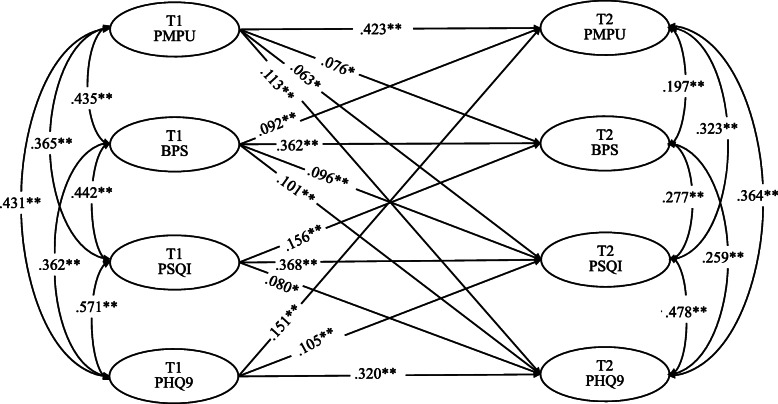
Background: Cross-sectional and longitudinal studies have found that problematic mobile phone use, bedtime procrastination, sleep quality, and depressive symptoms are strongly associated. However, studies are inconsistent regarding whether problematic mobile phone use predicts depressive symptoms or vice versa, and sleep factors have been infrequently focused on in this regard. In addition, few studies have examined the longitudinal associations and directions of effects between these factors. Therefore, this study aims to explore the longitudinal relationship among problematic mobile phone use, bedtime procrastination, sleep quality, and depressive symptoms in college students. Methods: Overall, 1181 college students completed questionnaires on problematic mobile phone use, bedtime procrastination, sleep quality, and depressive symptoms at two time points 12 months apart. A cross-lagged model was used to examine the longitudinal relationship between these factors. Results: Cross-lagged analyses showed significant bidirectional relationships of problematic mobile phone use with bedtime procrastination and depressive symptoms. Additionally, there were also significant bidirectional relationships of sleep quality with bedtime procrastination and depressive symptoms. Problematic mobile phone use predicted subsequent sleep quality one-way, and bedtime procrastination predicted subsequent depressive symptoms one-way. Conclusions: This study further expands our understanding of the longitudinal and bidirectional relationships among problematic mobile phone use, bedtime procrastination, sleep quality and depressive symptoms and helps school mental health educators design targeted interventions to reduce problematic mobile phone use, sleep problems, and depressive symptoms among college students.
Overview
The claims and statistics of this paper haven’t been checked yet.
Free: it reads the open-access text and checks the first 5 claims that cite a source we can check. Create a free account to check every claim.
Integrity signals
Registry
Cites
Statistics
Figures
Verification
Claims the paper makes
The claims and statistics of this paper haven’t been checked yet.
Free: it reads the open-access text and checks the first 5 claims that cite a source we can check. Create a free account to check every claim.
Claims other papers make about this one
Each is checked against this paper’s own text: does it say what the citing paper says it does?
The source backs part of the claim, not all of it — or backs it for a different population, condition or comparison.
In the citing paper
“Sleep quality, a known predictor of EF (Xie et al., 2019), is directly decreased by problematic phone usage (Cui et al., 2021).”
From The Relationship Between TikTok Usage and Executive Function Is Mediated by Problematic Social Media Use (2025) · cites this paper as Cui et al., 2021
Experimental — accuracy not yet measured
Self-check
Percentages, sums and reported differences re-computed from the paper’s own numbers.
The self-check needs the paper’s full text.
Citations
Cites
Hu, L., & Bentler, P. M. (1999) · Structural Equation Modeling A Multidisciplinary Journal · doi:10.1080/10705519909540118 · Cited by 108,788
The Pittsburgh Sleep Quality Index: a new instrument for psychiatric practice and research
Buysse, D. J., Reynolds, C. F., Monk, T. H., Berman, S. R., & Kupfer, D. J. (1989) · Psychiatry Research · doi:10.1016/0165-1781(89)90047-4 · Cited by 35,234
Sensitivity of Goodness of Fit Indexes to Lack of Measurement Invariance
Chen, F. F. (2007) · Structural Equation Modeling: A Multidisciplinary Journal · doi:10.1080/10705510701301834 · Cited by 12,217
Schermelleh-Engel, K., Moosbrugger, H., & Müller, H. (2003) · Department of Psychology - University of Koblenz-Landau · doi:10.23668/psycharchives.12784 · Cited by 8,975
Measurement Invariance, Factor Analysis and Factorial Invariance
Meredith, W. (1993) · Psychometrika · doi:10.1007/bf02294825 · Cited by 4,536 · cited 1×
“First, we evaluated the longitudinal measurement invariance of the four scales used in this study, including configural invariance, metric invariance, and scalar invariance [70].”
MethodThe Strength Model of Self-Control
Baumeister, R. F., Vohs, K. D., & Tice, D. M. (2007) · Current Directions in Psychological Science · doi:10.1111/j.1467-8721.2007.00534.x · Cited by 3,567 · cited 2×
“Moreover, according to the Strength Model of Self-Control [49], individuals with PMPU need to access limited and domain-general psychological resources in order to develop self-control.”
MethodSteel, P. (2007) · Psychological bulletin · doi:10.1037/0033-2909.133.1.65 · Cited by 3,417 · cited 1×
“According to Steel’s Temporary Motivation Theory (TMT) [87], whether an individual exhibits procrastination depends on the perceived utility of the task to that individual, and this comprehensive variable is related to value, expectation, and delay.”
MethodThe Smartphone addiction scale: development and validation of a short version for adolescents
Kwon, M., Kim, D.-J., Cho, H., & Yang, S. (2013) · PLoS ONE · doi:10.1371/journal.pone.0083558 · Cited by 2,177
Executive functions and self-regulation
Hofmann, W., Schmeichel, B. J., & Baddeley, A. D. (2012) · Trends in Cognitive Sciences · doi:10.1016/j.tics.2012.01.006 · Cited by 1,965
Sleep disturbance and psychiatric disorders: A longitudinal epidemiological study of young Adults
Breslau, N., Roth, T., Rosenthal, L., & Andreski, P. (1996) · Biological Psychiatry · doi:10.1016/0006-3223(95)00188-3 · Cited by 1,831 · cited 1×
“was an important predictor of depression in young adults [78].”
Background
Research works printed but not linked: 1
- Tao J Luo C Huang J Liang L Meta analysis of mobile phone dependence of Chinese college students Chin J School Health 2018 39 6 1391 1394
Cited by
Johansson, F., Rozental, A., Edlund, K., Côté, P., Sundberg, T., Onell, C., Rudman, A., & Skillgate, E. (2023) · JAMA Network Open · doi:10.1001/jamanetworkopen.2022.49346 · Cited by 124
Hill, V. M., Rebar, A. L., Ferguson, S. A., Shriane, A. E., & Vincent, G. E. (2022) · Sleep Medicine Reviews · doi:10.1016/j.smrv.2022.101697 · Cited by 134
Sánchez-Fernández, M., & Borda-Mas, M. (2023) · Education and Information Technologies · doi:10.1007/s10639-022-11437-2 · Cited by 98
Bauducco, S., Pillion, M., Bartel, K., Reynolds, C., Kahn, M., & Gradisar, M. (2024) · Sleep Medicine Reviews · doi:10.1016/j.smrv.2024.101933 · Cited by 102
“BP can be defined as a delaying going to bed at the intended time, without any external circumstances causing the delay [82 – 84], and has been investigated with predominantly smart phones [84,85].”
BackgroundLiu, F., Xu, Y., Yang, T., Li, Z., Dong, Y., Chen, L., & Sun, X. (2022) · Psychology Research and Behavior Management · doi:10.2147/prbm.s373095 · Cited by 60
“In a longitudinal study, Cui found that problematic mobile phone use was associated with bedtime procrastination.(30) The more time individuals spend using their mobile phones, the less time they spend on other activities (such as sleeping), which leads to procrastination.”
BackgroundSelf-citation
Metadata
- Authors
- Cui, G., Yin, Y., Li, S., Chen, L., Liu, X., Tang, K., & Li, Y.
- Affiliations
- Shandong University of Traditional Chinese Medicine (CN)
- Central South University (CN)
- Corresponding author
- Yin, Yongtian
- Li, Shaojie
- Venue
- BMC Psychiatry
- Published
- 2021-09-10
- Volume
- 21
- Issue
- 1
- Pages
- 449-449
- ISSN
- 1471-244X (ISSN-L)
- PMC
- PMC8431882
- OpenAlex
- W3198662686
- Semantic Scholar
- 90c19b6ea267285c23d18645ce335d08f4bb3edd
- Cited by
- 171
- References
- 102
- Citations by year
- 2026: 37 · 2025: 40 · 2024: 43 · 2023: 30 · 2022: 20 · 2021: 1
- FWCI
- 32.92
- Type
- journal article
- Language
- en
- Open access
- gold
- doi.org
- Licence
- cc-by
- creativecommons.org/licenses/by/4.0 (tdm)
- creativecommons.org/licenses/by/4.0 (vor)
- Locations
- BMC Psychiatry (publishedVersion, cc-by)
- PubMed Central (publishedVersion, cc-by)
- PubMed (publishedVersion)
- DOAJ (DOAJ: Directory of Open Access Journals) (submittedVersion, cc-by-sa)
- Topics
- Social Sciences › Sociology and Political Science › Impact of Technology on Adolescents
- Social Sciences › Psychology › Experimental and Cognitive Psychology › Sleep and related disorders
- Social Sciences › Education › Youth Substance Use and School Attendance
- Keywords
- problematic mobile phone use, bedtime procrastination, sleep quality, depressive symptoms, university students, bidirectional relationship, longitudinal associations, smartphone addiction, sleep disorders
- MeSH terms
- Procrastination, Cell Phone Use, China, Cross-Sectional Studies, Depression, Humans, Sleep, Students
About these checks
Registry, retraction, Cites and statistics results are computed, not judged, with one exception: a printed reference that no index lists is read once by a model before it counts as a citation error. Claims are extracted by a model and kept only when their quote appears verbatim in the text; each cited source is then checked, with a model’s help, for whether it says what the claim relies on. Those verdicts can be wrong — read the claim’s quote and the cited source before relying on one.
Statistics and arithmetic are recomputed, not judged.
Confidence bands are shown only for fields calibrated on our annotated test set. None is calibrated yet, so no band is shown.
What counts as a claim ›How we measure confidence ›How we check this ›
Are you an author, or do you see a problem with this page? Request a review
Data sources
Bibliographic data: Semantic Scholar, OpenAlex, Crossref.
Contains information from the Semantic Scholar Academic Graph Datasets, made available under the ODC Attribution License (ODC-BY 1.0).
Semantic Scholar’s data is described in: Kinney, R., et al. (2023). The Semantic Scholar Open Data Platform. arXiv:2301.10140.
