

Adaptive goal setting and financial incentives: a 2 × 2 factorial randomized controlled trial to increase adults’ physical activity
Open accessThe DOI matches its Crossref record; 69 of the 69 references it cites were found in a registry or an index.
Abstract
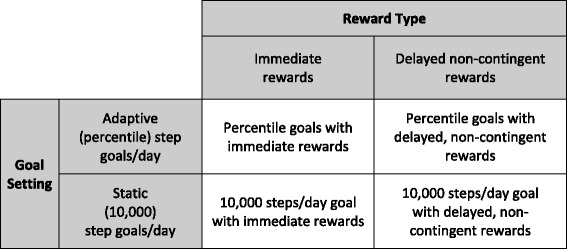
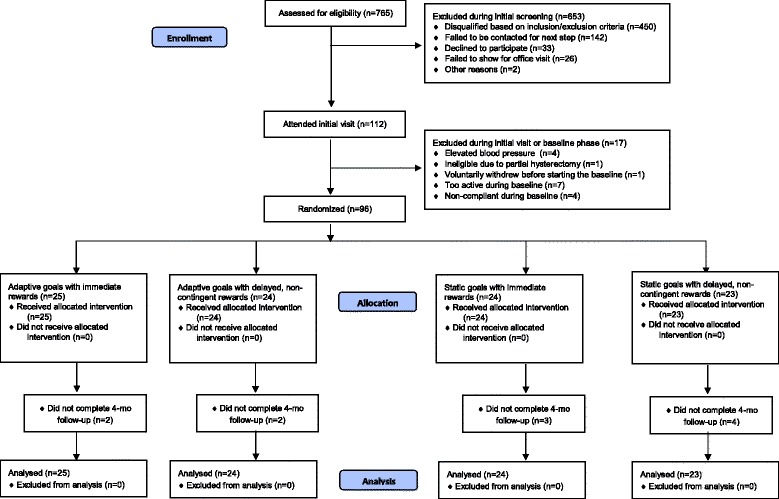
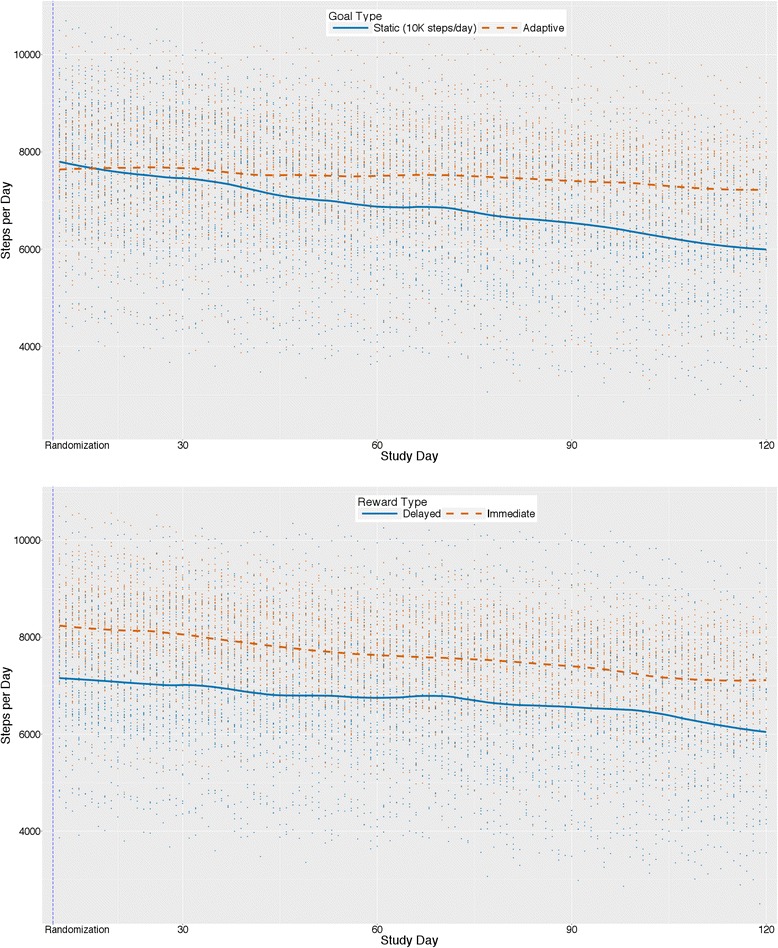
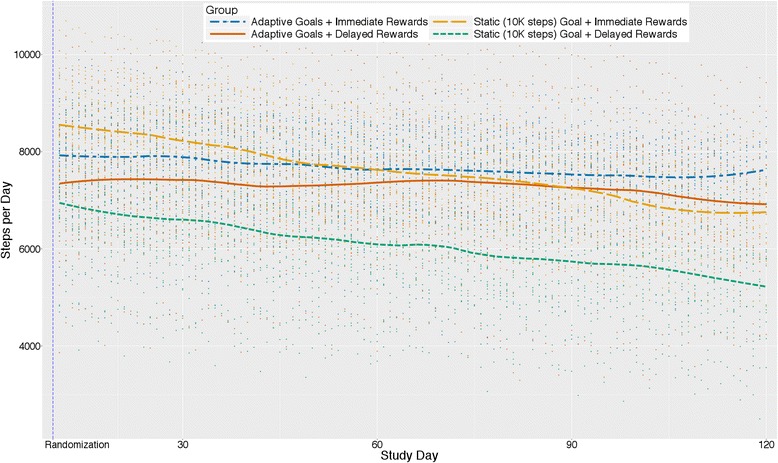
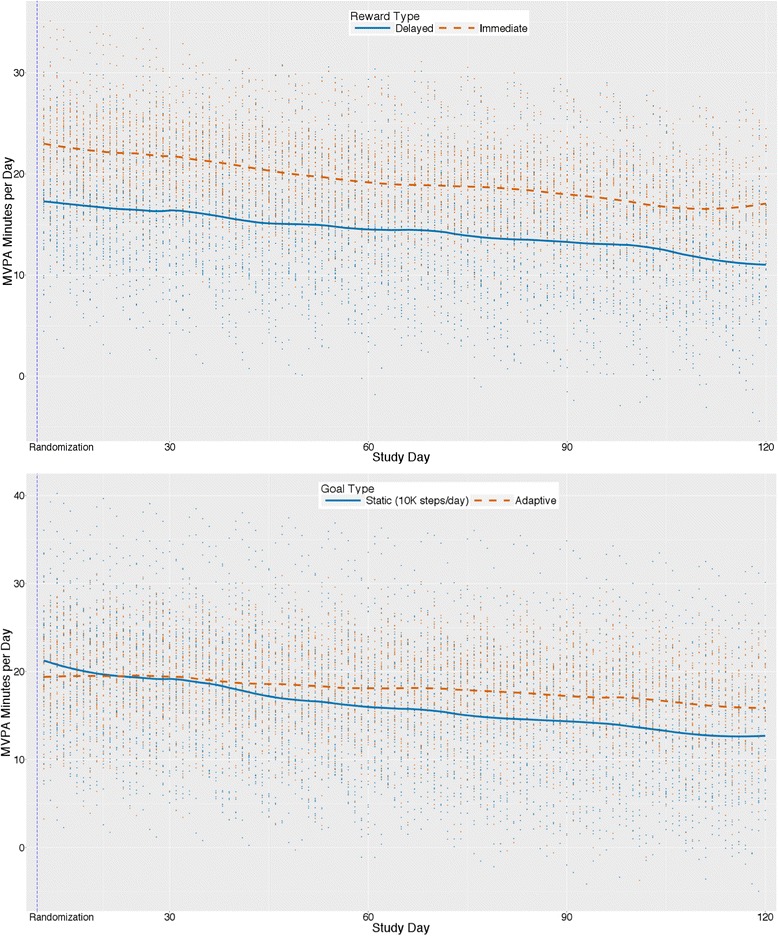
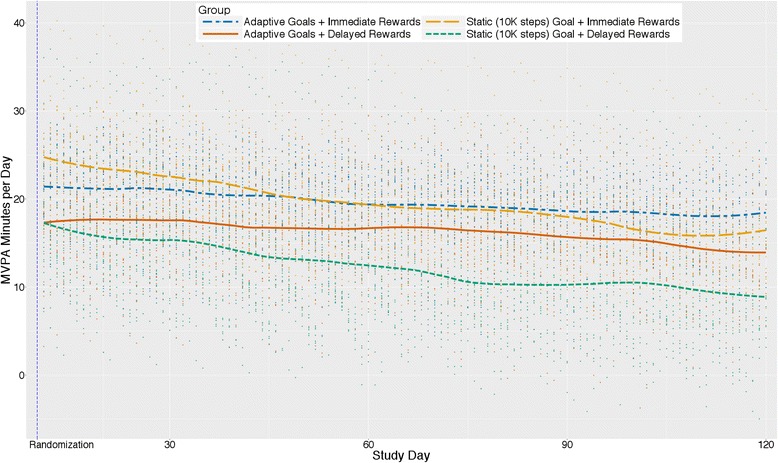
BACKGROUND: Emerging interventions that rely on and harness variability in behavior to adapt to individual performance over time may outperform interventions that prescribe static goals (e.g., 10,000 steps/day). The purpose of this factorial trial was to compare adaptive vs. static goal setting and immediate vs. delayed, non-contingent financial rewards for increasing free-living physical activity (PA). METHODS: A 4-month 2 × 2 factorial randomized controlled trial tested main effects for goal setting (adaptive vs. static goals) and rewards (immediate vs. delayed) and interactions between factors to increase steps/day as measured by a Fitbit Zip. Moderate-to-vigorous PA (MVPA) minutes/day was examined as a secondary outcome. RESULTS: Participants (N = 96) were mainly female (77%), aged 41 ± 9.5 years, and all were insufficiently active and overweight/obese (mean BMI = 34.1 ± 6.2). Participants across all groups increased by 2389 steps/day on average from baseline to intervention phase (p < .001). Participants receiving static goals showed a stronger increase in steps per day from baseline phase to intervention phase (2630 steps/day) than those receiving adaptive goals (2149 steps/day; difference = 482 steps/day, p = .095). Participants receiving immediate rewards showed stronger improvement (2762 step/day increase) from baseline to intervention phase than those receiving delayed rewards (2016 steps/day increase; difference = 746 steps/day, p = .009). However, the adaptive goals group showed a slower decrease in steps/day from the beginning of the intervention phase to the end of the intervention phase (i.e. less than half the rate) compared to the static goals group (-7.7 steps vs. -18.3 steps each day; difference = 10.7 steps/day, p < .001) resulting in better improvements for the adaptive goals group by study end. Rate of change over the intervention phase did not differ between reward groups. Significant goal phase x goal setting x reward interactions were observed. CONCLUSIONS: Adaptive goals outperformed static goals (i.e., 10,000 steps) over a 4-month period. Small immediate rewards outperformed larger, delayed rewards. Adaptive goals with either immediate or delayed rewards should be preferred for promoting PA. TRIAL REGISTRATION: ClinicalTrials.gov ID: NCT02053259 registered prospectively on January 31, 2014.
Overview
The claims and statistics of this paper haven’t been checked yet.
Free: it reads the open-access text and checks the first 5 claims that cite a source we can check. Create a free account to check every claim.
Integrity signals
Registry
Cites
Statistics
Figures
Verification
Claims the paper makes
The claims and statistics of this paper haven’t been checked yet.
Free: it reads the open-access text and checks the first 5 claims that cite a source we can check. Create a free account to check every claim.
Claims other papers make about this one
Each is checked against this paper’s own text: does it say what the citing paper says it does?
The source backs part of the claim, not all of it — or backs it for a different population, condition or comparison.
In the citing paper
“PA interventions, including texting, gamification and social or financial incentives, can promote PA”
From Smart wearable devices in cardiovascular care: Where we are and how to move forward (2021) · cites this paper as [43]
Experimental — accuracy not yet measuredThe cited source says what the claim attributes to it.
In the citing paper
“The trial showed that adaptive goals outperformed static goals and small, immediate rewards outperformed larger, delayed rewards, suggesting that adaptive goals with immediate rewards should be preferred to promote physical activity.”
From Smart wearable devices in cardiovascular care: Where we are and how to move forward (2021) · cites this paper as [43]
In the citing paper
“Rewards, especially monetary rewards, have been shown to provide significant extrinsic motivation toward behavior changes [31-33].”
In the citing paper
“The trial showed that adaptive goals outperformed static goals and small, immediate rewards outperformed larger, delayed rewards, suggesting that adaptive goals with immediate rewards should be preferred to promote physical activity.”
From Smart wearable devices in cardiovascular care: Where we are and how to move forward (2021) · cites this paper as [43]
Self-check
Percentages, sums and reported differences re-computed from the paper’s own numbers.
The self-check needs the paper’s full text.
Citations
Cites
Health Behavior and Health Education: Theory, Research, and Practice
(1992) · Annals of Internal Medicine · doi:10.7326/0003-4819-116-4-350_1 · Cited by 13,207
The Physical Activity Guidelines for Americans
Piercy, K. L., Troiano, R. P., Ballard, R. M., Carlson, S. A., Fulton, J. E., Galuska, D. A., George, S. M., & Olson, R. D. (2018) · JAMA · doi:10.1001/jama.2018.14854 · Cited by 9,755
‘Small Changes' to Diet and Physical Activity Behaviors for Weight Management
Hills, A. P., Byrne, N. M., Lindstrom, R., & Hill, J. O. (2013) · Obesity Facts · doi:10.1159/000345030 · Cited by 9,493
Kilzer, E., & Skinner, B. F. (1953) · The American Catholic Sociological Review · doi:10.2307/3707860 · Cited by 8,943
Child abuse: Adolescent records vs. adult recall
Femina, D. D., Yeager, C. A., & Lewis, D. O. (1990) · Child Abuse & Neglect · doi:10.1016/0145-2134(90)90033-p · Cited by 8,820
Physical Activity in the United States Measured by Accelerometer
TROIANO, R. P., BERRIGAN, D., DODD, K. W., MÂSSE, L. C., TILERT, T., & MCDOWELL, M. (2008) · Medicine & Science in Sports & Exercise · doi:10.1249/mss.0b013e31815a51b3 · Cited by 7,638 · cited 2×
“active [1, 2], with little change in population levels of”
Health Promotion by Social Cognitive Means
Bandura, A. (2004) · Health Education & Behavior · doi:10.1177/1090198104263660 · Cited by 7,238 · cited 2×
“Basic principles of positive reinforcement [18, 19] and behavioral economics [20–25] are integrated into many theoretical approaches (e.g., Transtheoretical Model [26, 27], Social Cognitive Theory [28, 29], and Ecological Models [30, 31]) and have been proposed as unifying behavior change principles behind preventive…”
Preacher, K. J., Curran, P. J., & Bauer, D. J. (2006) · Journal of Educational and Behavioral Statistics · doi:10.3102/10769986031004437 · Cited by 5,034 · cited 1×
“[53], which yielded values for model-estimated means.”
Symonds, P. M. (1954) · Journal of Educational Psychology · doi:10.1037/h0051901 · Cited by 4,875
Finkelstein, E. A., Trogdon, J. G., Cohen, J. W., & Dietz, W. (2009) · Health Affairs · doi:10.1377/hlthaff.28.5.w822 · Cited by 2,957 · cited 1×
“Drugs and financial burdens for chronic diseases related to inactivity that are in excess of $1400/year for obesity and $7383 for diabetes per person per year [65, 66].”
Stages of change and decisional balance for 12 problem behaviors.
Prochaska, J. O., Velicer, W. F., Rossi, J. S., Goldstein, M. G., Marcus, B. H., Rakowski, W., Fiore, C., Harlow, L. L., Redding, C. A., Rosenbloom, D., et al. (1994) · Health Psychology · doi:10.1037//0278-6133.13.1.39 · Cited by 2,469 · cited 2×
“Basic principles of positive reinforcement [18, 19] and behavioral economics [20–25] are integrated into many theoretical approaches (e.g., Transtheoretical Model [26, 27], Social Cognitive Theory [28, 29], and Ecological Models [30, 31]) and have been proposed as unifying behavior change principles behind preventive…”
Rankin, C. H., Abrams, T., Barry, R. J., Bhatnagar, S., Clayton, D. F., Colombo, J., Coppola, G., Geyer, M. A., Glanzman, D. L., Marsland, S., et al. (2009) · Neurobiology of Learning and Memory · doi:10.1016/j.nlm.2008.09.012 · Cited by 1,665 · cited 1×
“, losing motivation due to lack of novel reinforcing stimuli) [47].”
Self-regulation through goal setting
Latham, G. P., & Locke, E. A. (1991) · Organizational Behavior and Human Decision Processes · doi:10.1016/0749-5978(91)90021-k · Cited by 1,370
Global healthcare expenditure on diabetes for 2010 and 2030
Zhang, P., Zhang, X., Brown, J., Vistisen, D., Sicree, R., Shaw, J., & Nichols, G. (2010) · Diabetes Research and Clinical Practice · doi:10.1016/j.diabres.2010.01.026 · Cited by 1,145
How many steps/day are enough? for adults
Tudor-Locke, C., Craig, C. L., Brown, W. J., Clemes, S. A., De Cocker, K., Giles-Corti, B., Hatano, Y., Inoue, S., Matsudo, S. M., Mutrie, N., et al. (2011) · International Journal of Behavioral Nutrition and Physical Activity · doi:10.1186/1479-5868-8-79 · Cited by 1,087 · cited 1×
“Given existing evidence and theoretical support that behavior change is not a rational, linear, or even threshold process, offering criterion targets as goals may not be the most effective strategy [2, 16, 17].”
Gardner, C. D., Kiazand, A., Alhassan, S., Kim, S., Stafford, R. S., Balise, R. R., Kraemer, H. C., & King, A. C. (2007) · JAMA · doi:10.1001/jama.297.9.969 · Cited by 1,051
Behavior Modification: Principles and Procedures
Miltenberger, R. G. (1996) · Cited by 1,003
DECLINING RATES OF PHYSICAL ACTIVITY IN THE UNITED STATES: What Are the Contributors?
Brownson, R. C., Boehmer, T. K., & Luke, D. A. (2005) · Annual Review of Public Health · doi:10.1146/annurev.publhealth.26.021304.144437 · Cited by 952 · cited 1×
“physical activity (PA) over the past two decades [3, 4].”
The Look AHEAD Study: A Description of the Lifestyle Intervention and the Evidence Supporting It
The Look AHEAD Research Group (2006) · Obesity · doi:10.1038/oby.2006.84 · Cited by 873
Rachlin, H. (2009) · Harvard University Press eBooks · doi:10.2307/j.ctv1kwxfs2 · Cited by 530
Interventions to Increase Physical Activity Among Healthy Adults: Meta-Analysis of Outcomes
Conn, V. S., Hafdahl, A. R., & Mehr, D. R. (2011) · American Journal of Public Health · doi:10.2105/ajph.2010.194381 · Cited by 484 · cited 1×
“accumulate less than 7500 steps per day [6, 7] and less than 6 min of moderate-to-vigorous physical activity per day [1], the aforementioned review indicates a dire need for more potent intervention strategies and treatments to increase and sustain adults’ physical activity to levels of at least 10,000 steps or 30 min…”
Giles, E. L., Robalino, S., McColl, E., Sniehotta, F. F., & Adams, J. (2014) · PLoS ONE · doi:10.1371/journal.pone.0090347 · Cited by 470 · cited 1×
“ical or potential side-effects are open empirical questions [20, 55, 56, 58, 59, 63, 64].”
Ferguson, T., Rowlands, A. V., Olds, T., & Maher, C. (2015) · International Journal of Behavioral Nutrition and Physical Activity · doi:10.1186/s12966-015-0201-9 · Cited by 468 · cited 1×
“obese adults were the target population because they are less likely than their normal weight peers to meet physical activity guidelines when measured by either self-report or accelerometry, [44] and can benefit from improving energy-balance behaviors.”
Collins, L. M., Dziak, J. J., & Li, R. (2009) · Psychological Methods · doi:10.1037/a0015826 · Cited by 431 · cited 1×
“A factorial trial is an efficient design for untangling multicomponent interventions and theoretical mechanisms by design [41, 42].”
Reframing Health Behavior Change With Behavioral Economics
(2000) · Psychology Press eBooks · doi:10.4324/9781410605061 · Cited by 427 · cited 3×
“Consistent with behavioral economics [20], we rewarded actual behavior change and not intentions to change or changes to weight, and we used “smaller-sooner” rather than “larger-later” incentives.”
Finkelstein, E. A., Haaland, B. A., Bilger, M., Sahasranaman, A., Sloan, R. A., Nang, E. E. K., & Evenson, K. R. (2016) · The Lancet Diabetes & Endocrinology · doi:10.1016/s2213-8587(16)30284-4 · Cited by 402 · cited 1×
“(amount) as dimensions of incentive architecture, mainly for exercise session attendance [34], with recent exceptions [16, 35, 36] targeting steps/day.”
A review of the outcome expectancy construct in physical activity research
Williams, D. M., Anderson, E. S., & Winett, R. A. (2005) · Annals of Behavioral Medicine · doi:10.1207/s15324796abm2901_10 · Cited by 398 · cited 2×
“Basic principles of positive reinforcement [18, 19] and behavioral economics [20–25] are integrated into many theoretical approaches (e.g., Transtheoretical Model [26, 27], Social Cognitive Theory [28, 29], and Ecological Models [30, 31]) and have been proposed as unifying behavior change principles behind preventive…”
Reliability and validity of ten consumer activity trackers
Kooiman, T. J. M., Dontje, M. L., Sprenger, S. R., Krijnen, W. P., van der Schans, C. P., & de Groot, M. (2015) · BMC Sports Science, Medicine and Rehabilitation · doi:10.1186/s13102-015-0018-5 · Cited by 360 · cited 1×
“90) [49], and validity for measuring steps in the lab and during free-”
Accelerometer-Determined Steps per Day inUS Adults
TUDOR-LOCKE, C., JOHNSON, W. D., & KATZMARZYK, P. T. (2009) · Medicine & Science in Sports & Exercise · doi:10.1249/mss.0b013e318199885c · Cited by 355
Collins, L. M., Dziak, J. J., Kugler, K. C., & Trail, J. B. (2014) · American Journal of Preventive Medicine · doi:10.1016/j.amepre.2014.06.021 · Cited by 335 · cited 1×
“A factorial trial is an efficient design for untangling multicomponent interventions and theoretical mechanisms by design [41, 42].”
Yamanouchi, K., Shinozaki, T., Chikada, K., Nishikawa, T., Ito, K., Shimizu, S., Ozawa, N., Suzuki, Y., Maeno, H., Kato, K., et al. (1995) · Diabetes Care · doi:10.2337/diacare.18.6.775 · Cited by 330
Kruger, J. S., Ham, S. A., & Kohl, H. W. (2005) · MMWR Morbidity and Mortality Weekly Report · Cited by 326
Financial incentives for exercise adherence in adults
Mitchell, M. S., Goodman, J. M., Alter, D. A., John, L. K., Oh, P. I., Pakosh, M. T., & Faulkner, G. E. (2013) · American Journal of Preventive Medicine · doi:10.1016/j.amepre.2013.06.017 · Cited by 303 · cited 3×
“Participants in the delayed reward group did not receive praise messages or points for achieving goals, but were told at randomization they would receive a progressively increasing magnitude of monthly incentives (month 1 = $5; month 2 and 3 = $10 each; month 4 = $20; total $45) for wearing their Fitbit Zip, syncing r…”
Sidman, M., & Center, D. B. (1991) · Behavioral Disorders · doi:10.1177/019874299101600403 · Cited by 281 · cited 1×
“, loss of reward) [33] and may be more effective than non-contingent or”
McEwan, D., Harden, S. M., Zumbo, B. D., Sylvester, B. D., Kaulius, M., Ruissen, G. R., Dowd, A. J., & Beauchamp, M. R. (2016) · Health Psychology Review · doi:10.1080/17437199.2015.1104258 · Cited by 271 · cited 1×
“type of goal setting, with variability in effect sizes observed across interventions [54].”
Patel, M. S., Asch, D. A., Rosin, R., Small, D. S., Bellamy, S. L., Heuer, J., Sproat, S., Hyson, C., Haff, N., Lee, S. M., et al. (2016) · Annals of Internal Medicine · doi:10.7326/m15-1635 · Cited by 257
Promberger, M., & Marteau, T. M. (2013) · Health Psychology · doi:10.1037/a0032727 · Cited by 236 · cited 2×
“However, a recent systematic review strongly counters this criticism from both the psychological and economic literatures for health-related behaviors [57].”
Systematic review of the use of financial incentives in treatments for obesity and overweight
Paul‐Ebhohimhen, V., & Avenell, A. (2008) · Obesity Reviews · doi:10.1111/j.1467-789x.2007.00409.x · Cited by 228 · cited 1×
“ical or potential side-effects are open empirical questions [20, 55, 56, 58, 59, 63, 64].”
Reducing Sedentary Behavior: Role in Modifying Physical Activity
Epstein, L. H., & Roemmich, J. N. (2001) · Exercise and Sport Sciences Reviews · doi:10.1097/00003677-200107000-00003 · Cited by 225
Descriptive Epidemiology of Pedometer-Determined Physical Activity
TUDOR-LOCKE, C., HAM, S. A., MACERA, C. A., AINSWORTH, B. E., KIRTLAND, K. A., REIS, J. P., & KIMSEY, C. D. (2004) · Medicine & Science in Sports & Exercise · doi:10.1249/01.mss.0000139806.53824.2e · Cited by 204 · cited 1×
“accumulate less than 7500 steps per day [6, 7] and less than 6 min of moderate-to-vigorous physical activity per day [1], the aforementioned review indicates a dire need for more potent intervention strategies and treatments to increase and sustain adults’ physical activity to levels of at least 10,000 steps or 30 min…”
Adams, J., Giles, E. L., McColl, E., & Sniehotta, F. F. (2014) · Health Psychology Review · doi:10.1080/17437199.2013.848410 · Cited by 186 · cited 1×
“ical or potential side-effects are open empirical questions [20, 55, 56, 58, 59, 63, 64].”
Araiza, P., Hewes, H., Gashetewa, C., Vella, C. A., & Burge, M. R. (2006) · Metabolism · doi:10.1016/j.metabol.2006.06.009 · Cited by 183 · cited 2×
“Most PA interventions (research or commercial) aimed at the public often offer activity monitors and prescribe fixed criterion targets [9] or goals that increase linearly over the course of an intervention [10–12].”
Integrating theoretical approaches to promote physical activity
Epstein, L. H. (1998) · American Journal of Preventive Medicine · doi:10.1016/s0749-3797(98)00083-x · Cited by 180 · cited 1×
“Basic principles of positive reinforcement [18, 19] and behavioral economics [20–25] are integrated into many theoretical approaches (e.”
Patterns of adult stepping cadence in the 2005–2006 NHANES
Tudor-Locke, C., Camhi, S. M., Leonardi, C., Johnson, W. D., Katzmarzyk, P. T., Earnest, C. P., & Church, T. S. (2011) · Preventive Medicine · doi:10.1016/j.ypmed.2011.06.004 · Cited by 175 · cited 1×
“A secondary outcome was moderate-to-vigorous PA (MVPA) minutes per day defined as the sum of daily minutes with a step count (or cadence) of ≥100 steps per minute [48], computed using minute-level epoch data recorded by the Fitbit Zip.”
MethodTully, M. A., McBride, C., Heron, L., & Hunter, R. F. (2014) · BMC Research Notes · doi:10.1186/1756-0500-7-952 · Cited by 172
Finkelstein, E. A., Brown, D. S., Brown, D. R., & Buchner, D. M. (2008) · Preventive Medicine · doi:10.1016/j.ypmed.2008.05.002 · Cited by 171 · cited 1×
“ical or potential side-effects are open empirical questions [20, 55, 56, 58, 59, 63, 64].”
BackgroundSingle-Case Experimental Designs to Evaluate Novel Technology-Based Health Interventions
Dallery, J., Cassidy, R. N., & Raiff, B. R. (2013) · Journal of Medical Internet Research · doi:10.2196/jmir.2227 · Cited by 169
An Adaptive Physical Activity Intervention for Overweight Adults: A Randomized Controlled Trial
Adams, M. A., Sallis, J. F., Norman, G. J., Hovell, M. F., Hekler, E. B., & Perata, E. (2013) · PLoS ONE · doi:10.1371/journal.pone.0082901 · Cited by 167
Self-citationFinancial incentives and weight control
Jeffery, R. W. (2012) · Preventive Medicine · doi:10.1016/j.ypmed.2011.12.024 · Cited by 167 · cited 1×
“ical or potential side-effects are open empirical questions [20, 55, 56, 58, 59, 63, 64].”
Physical activity as a substitute for sedentary behavior in youth
Epstein, L. H., Roemmich, J. N., Paluch, R. A., & Raynor, H. A. (2005) · Annals of Behavioral Medicine · doi:10.1207/s15324796abm2903_6 · Cited by 162
Finkelstein, E. A., Linnan, L. A., Tate, D. F., & Birken, B. E. (2007) · Journal of Occupational & Environmental Medicine · doi:10.1097/jom.0b013e31813c6dcb · Cited by 149 · cited 1×
“ical or potential side-effects are open empirical questions [20, 55, 56, 58, 59, 63, 64].”
(2005) · PubMed · Cited by 147
Increasing Our Understanding of Reactivity to Pedometers in Adults
CLEMES, S. A., & PARKER, R. A. A. (2009) · Medicine & Science in Sports & Exercise · doi:10.1249/mss.0b013e31818cae32 · Cited by 116
Internet-based contingency management increases walking in sedentary adults
Kurti, A. N., & Dallery, J. (2013) · Journal of Applied Behavior Analysis · doi:10.1002/jaba.58 · Cited by 115
Poirier, J., Bennett, W. L., Jerome, G. J., Shah, N. G., Lazo, M., Yeh, H.-C., Clark, J. M., & Cobb, N. K. (2016) · Journal of Medical Internet Research · doi:10.2196/jmir.5295 · Cited by 111
Innovations in the Use of Interactive Technology to Support Weight Management
Spruijt-Metz, D., Wen, C. K. F., O’Reilly, G., Li, M., Lee, S., Emken, B. A., Mitra, U., Annavaram, M., Ragusa, G., & Narayanan, S. (2015) · Current Obesity Reports · doi:10.1007/s13679-015-0183-6 · Cited by 108
A dynamical systems model of Social Cognitive Theory
Martin, C. A., Rivera, D. E., Riley, W. T., Hekler, E. B., Buman, M. P., Adams, M. A., & King, A. C. (2014) · 2014 American Control Conference · doi:10.1109/acc.2014.6859463 · Cited by 82
Self-citationDevelopment of a dynamic computational model of social cognitive theory
Riley, W. T., Martin, C. A., Rivera, D. E., Hekler, E. B., Adams, M. A., Buman, M. P., Pavel, M., & King, A. C. (2016) · Translational Behavioral Medicine · doi:10.1007/s13142-015-0356-6 · Cited by 78
Self-citationRiley, W. T., Serrano, K. J., Nilsen, W., & Atienza, A. A. (2015) · Current Opinion in Psychology · doi:10.1016/j.copsyc.2015.03.024 · Cited by 76
Gupta, A., Calfas, K. J., Marshall, S. J., Robinson, T. N., Rock, C. L., Huang, J. S., Epstein-Corbin, M., Servetas, C., Donohue, M. C., Norman, G. J., et al. (2015) · Contemporary Clinical Trials · doi:10.1016/j.cct.2015.04.002 · Cited by 75 · cited 1×
“Results also suggest that escalating interval rewards for participation only, which are delayed and non-contingent relative to offering daily rewards for goal attainment, are less effective for promoting physical activity, even though many physical activity research studies use such an approach to providing incentives…”
Foxall, G. R. (2015) · Managerial and Decision Economics · doi:10.1002/mde.2712 · Cited by 62
Singh, A. K., Farmer, C., van den Berg, M., Killington, M., & Barr, C. (2015) · Disability and health journal · doi:10.1016/j.dhjo.2015.10.011 · Cited by 53
Selection by Consequences: One Unifying Principle for a Transdisciplinary Science of Prevention
Biglan, A. (2003) · Prevention Science · doi:10.1023/a:1026064014562 · Cited by 50 · cited 1×
“interval-based (delayed) reinforcement for long-term behavior change [20, 31, 32].”
RIBEIRO, M. A., MARTINS, M. A., & CARVALHO, C. R. F. (2014) · Medicine & Science in Sports & Exercise · doi:10.1249/mss.0000000000000190 · Cited by 49
Adams, M. A., Norman, G. J., Hovell, M. F., Sallis, J. F., & Patrick, K. (2009) · Health Psychology · doi:10.1037/a0012989 · Cited by 43 · cited 2×
“Basic principles of positive reinforcement [18, 19] and behavioral economics [20–25] are integrated into many theoretical approaches (e.g., Transtheoretical Model [26, 27], Social Cognitive Theory [28, 29], and Ecological Models [30, 31]) and have been proposed as unifying behavior change principles behind preventive…”
Self-citationIntroducing novel approaches for examining the variability of individuals’ physical activity
Rowlands, A. V., Gomersall, S. R., Tudor‐Locke, C., Bassett, D. R., Kang, M., Fraysse, F., Ainsworth, B. E., & Olds, T. (2014) · Journal of Sports Sciences · doi:10.1080/02640414.2014.951067 · Cited by 36 · cited 1×
“reported high levels of intra-individual variability in day-to-day steps over 1 year, and argued that interventions will need to start accounting for day-to-day fluctuations to promote and sustain physical activity [8].”
Hurley, J. C., Hollingshead, K. E., Todd, M., Jarrett, C. L., Tucker, W. J., Angadi, S. S., & Adams, M. A. (2015) · JMIR Research Protocols · doi:10.2196/resprot.4856 · Cited by 19 · cited 1×
“Sample size As described in detail elsewhere [39], simulations based on effect size estimates derived from”
Self-citationAdams, M. A. (2009) · eScholarship (California Digital Library) · Cited by 14
Self-citationA method for the delivery of reinforcement during exercise
Coleman, K. J., Paluch, R. A., & Epstein, L. H. (1997) · Behavior Research Methods, Instruments, & Computers · doi:10.3758/bf03204828 · Cited by 14
Research works printed but not linked: 5
- Hovell MF Wahlgren DR Adams MA The logical and empirical basis for the Behavioral Ecological Model. In: Emerging Theories in Health Promotion Practice and Research. Volume 2nd, edn. Edited by DiClemente RJ 2009 San Francisco Jossey-Bass
- America On the Move 100 Ways to Add 2000 Steps 2008
- Global Historical Climate Network Climate Data Online: Daily Summaries In.: National Centers for Environmental Informaiton, National Oceanic and Atmospheric Administration 2014
- U.S. Bureau of the Census. Real Median Household Income in the United States [MEHOINUSA672N]. In, vol. 2016: Washington: U.S. Bureau of the Census; 2011.
- Wing R Gillis B The Diabetes Prevention Program's Lifestyle Change Program Manual of Operations, Appendix G: Tool Box 1996 Pittsburgh, PA University of Pittsburgh
Cited by
Smart wearable devices in cardiovascular care: Where we are and how to move forward
Bayoumy, K., Gaber, M., Elshafeey, A., Mhaimeed, O., Dineen, E. H., Marvel, F. A., Martin, S. S., Muse, E. D., Turakhia, M. P., Tarakji, K. G., et al. (2021) · Nature Reviews Cardiology · doi:10.1038/s41569-021-00522-7 · Cited by 829
Digital Behaviour Change Interventions to Break and Form Habits
Pinder, C., Vermeulen, J., Cowan, B. R., & Beale, R. (2018) · ACM Transactions on Computer-Human Interaction · doi:10.1145/3196830 · Cited by 235
“Many theories incorporate elements of behaviourist operant conditioning, e.g., the use of positive reinforcement in the Transtheoretical Model and Social Cognitive Theory (Adams et al. 2017).”
BackgroundMethodInfluentialFinancial incentives for physical activity in adults: systematic review and meta-analysis
Mitchell, M. S., Orstad, S. L., Biswas, A., Oh, P. I., Jay, M., Pakosh, M. T., & Faulkner, G. (2020) · British Journal of Sports Medicine · doi:10.1136/bjsports-2019-100633 · Cited by 143
“For example, Adams et al 15 offered $1 US per day and produced an increase of 3907 steps compared with the no-incentive control.”
Tutorial for Using Control Systems Engineering to Optimize Adaptive Mobile Health Interventions
Hekler, E. B., Rivera, D. E., Martin, C. A., Phatak, S. S., Freigoun, M. T., Korinek, E., Klasnja, P., Adams, M. A., & Buman, M. P. (2018) · Journal of Medical Internet Research · doi:10.2196/jmir.8622 · Cited by 138
Self-citationText Message Interventions for Physical Activity: A Systematic Review and Meta-Analysis
Smith, D. M., Duque, L., Huffman, J. C., Healy, B. C., & Celano, C. M. (2020) · American Journal of Preventive Medicine · doi:10.1016/j.amepre.2019.08.014 · Cited by 129
Metadata
- Authors
- Adams, M. A., Hurley, J. C., Todd, M., Bhuiyan, N., Jarrett, C. L., Tucker, W. J., Hollingshead, K. E., & Angadi, S. S.
- Affiliations
- Arizona State University (US)
- Corresponding author
- Adams, Marc A.
- ORCID
- Venue
- BMC Public Health
- Published
- 2017-03-29
- Volume
- 17
- Issue
- 1
- Pages
- 286-286
- ISSN
- 1471-2458 (ISSN-L)
- PMC
- PMC5372290
- OpenAlex
- W2600230333
- Cited by
- 110
- References
- 69
- Citations by year
- 2026: 3 · 2025: 8 · 2024: 7 · 2023: 15 · 2022: 7 · 2021: 17 · 2020: 24 · 2019: 14 · 2018: 11 · 2017: 4
- FWCI
- 10.73
- Type
- journal article
- Language
- en
- Update notices
- correction (2017-04-06)
- Open access
- gold
- doi.org
- Licence
- cc-by
- creativecommons.org/licenses/by/4.0/ (tdm)
- creativecommons.org/licenses/by/4.0/ (vor)
- Locations
- BMC Public Health (publishedVersion, cc-by)
- PubMed Central (publishedVersion, cc-by)
- PubMed (publishedVersion)
- Arizona State University Library Digital Repository (Arizona State University) (submittedVersion, cc-by)
- DOAJ (DOAJ: Directory of Open Access Journals) (submittedVersion, cc-by-sa)
- Funders
- Arizona State University (none (startup funding))
- National Cancer Institute (R01CA198915)
- Topics
- Health Sciences › Medicine › Public Health, Environmental and Occupational Health › Physical Activity and Health
- Social Sciences › Psychology › Applied Psychology › Behavioral Health and Interventions
- Health Sciences › Health Professions › General Health Professions › Mobile Health and mHealth Applications
- Keywords
- financial incentives, immediate rewards, delayed rewards, physical activity promotion, step count, moderate-to-vigorous physical activity, free-living physical activity, behaviour change interventions, Fitbit, overweight and obesity, adults
- MeSH terms
- Adolescent, Adult, Female, Goals, Humans, Male, Middle Aged, Motivation, Obesity, Reward, Exercise, Treatment Outcome, Young Adult, Text Messaging, Accelerometry
About these checks
Registry, retraction, Cites and statistics results are computed, not judged, with one exception: a printed reference that no index lists is read once by a model before it counts as a citation error. Claims are extracted by a model and kept only when their quote appears verbatim in the text; each cited source is then checked, with a model’s help, for whether it says what the claim relies on. Those verdicts can be wrong — read the claim’s quote and the cited source before relying on one.
Statistics and arithmetic are recomputed, not judged.
Confidence bands are shown only for fields calibrated on our annotated test set. None is calibrated yet, so no band is shown.
What counts as a claim ›How we measure confidence ›How we check this ›
Are you an author, or do you see a problem with this page? Request a review
Data sources
Bibliographic data: Semantic Scholar, OpenAlex, Crossref.
Contains information from the Semantic Scholar Academic Graph Datasets, made available under the ODC Attribution License (ODC-BY 1.0).
Semantic Scholar’s data is described in: Kinney, R., et al. (2023). The Semantic Scholar Open Data Platform. arXiv:2301.10140.
