

Gender differences in the associations between age trends of social media interaction and well-being among 10–15 year olds in the UK
Open accessThe DOI matches its Crossref record; 40 of the 42 references it cites were found in a registry or an index.
Abstract
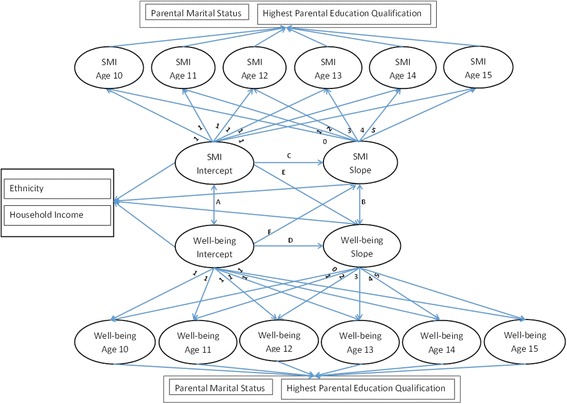
BACKGROUND: Adolescents are among the highest consumers of social media while research has shown that their well-being decreases with age. The temporal relationship between social media interaction and well-being is not well established. The aim of this study was to examine whether the changes in social media interaction and two well-being measures are related across ages using parallel growth models. METHODS: Data come from five waves of the youth questionnaire, 10-15 years, of the Understanding Society, the UK Household Longitudinal Study (pooled n = 9859). Social media interaction was assessed through daily frequency of chatting on social websites. Well-being was measured by happiness with six domains of life and the Strengths and Difficulties Questionnaire. RESULTS: Findings suggest gender differences in the relationship between interacting on social media and well-being. There were significant correlations between interacting on social media and well-being intercepts and between social media interaction and well-being slopes among females. Additionally higher social media interaction at age 10 was associated with declines in well-being thereafter for females, but not for males. Results were similar for both measures of well-being. CONCLUSIONS: High levels of social media interaction in early adolescence have implications for well-being in later adolescence, particularly for females. The lack of an association among males suggests other factors might be associated with their reduction in well-being with age. These findings contribute to the debate on causality and may inform future policy and interventions.
Overview
The claims and statistics of this paper haven’t been checked yet.
Free: it reads the open-access text and checks the first 5 claims that cite a source we can check. Create a free account to check every claim.
Integrity signals
Registry
Cites
Statistics
Figures
Verification
Claims the paper makes
The claims and statistics of this paper haven’t been checked yet.
Free: it reads the open-access text and checks the first 5 claims that cite a source we can check. Create a free account to check every claim.
Claims other papers make about this one
Each is checked against this paper’s own text: does it say what the citing paper says it does?
The source backs part of the claim, not all of it — or backs it for a different population, condition or comparison.
In the citing paper
“we controlled for the following confounders in our analyses: family income – equivalised fifths; family structure (two vs one parent); and age in years. In an attempt to take account of the potentially cyclical association between social media use and depressed mood we controlled for internalising symptoms”
From Social media use and adolescent mental health: Findings from the UK Millennium Cohort Study (2018) · cites this paper as [9]
Experimental — accuracy not yet measuredThe cited source says what the claim attributes to it.
In the citing paper
“The item used was developed by the Millennium Cohort Study team and is similar to items used in other large surveys including the UK Household Longitudinal Study [9] and Ofcom [5].”
From Social media use and adolescent mental health: Findings from the UK Millennium Cohort Study (2018) · cites this paper as [9]
The cited source says what the claim attributes to it.
In the citing paper
“a recent report using longitudinal data suggests that girls may be more affected than boys [9].”
From Social media use and adolescent mental health: Findings from the UK Millennium Cohort Study (2018) · cites this paper as [9]
The cited source says what the claim attributes to it.
In the citing paper
“the estimates of time spent using social media presented in our paper are consistent with those reported from other UK studies [9], [34].”
From Social media use and adolescent mental health: Findings from the UK Millennium Cohort Study (2018) · cites this paper as [9]
The cited source says what the claim attributes to it.
In the citing paper
“However, the questions used were similar to those from other large-scale population based surveys including the UK Household Longitudinal Study [9] and Ofcom [5].”
From Social media use and adolescent mental health: Findings from the UK Millennium Cohort Study (2018) · cites this paper as [9]
2 more claims about this paper
Create a free account to see every claim other papers make about this one.
Self-check
Percentages, sums and reported differences re-computed from the paper’s own numbers.
The self-check needs the paper’s full text.
Citations
Cites
The Strengths and Difficulties Questionnaire: A research note
Goodman, R. (1997) · Journal of Child Psychology and Psychiatry · doi:10.1111/j.1469-7610.1997.tb01545.x · Cited by 14,908 · cited 1×
“The SDQ is a validated instrument which screens for emotional and behavioural problems in children and adolescents aged 3-16 years [34].”
BackgroundApplied Longitudinal Data Analysis: Modeling Change and Event Occurrence
Singer, J. D., & Willett, J. B. (2003) · doi:10.1093/acprof:oso/9780195152968.001.0001 · Cited by 10,647
The Impact of Social Media on Children, Adolescents, and Families
O'Keeffe, G. S., Clarke-Pearson, K., & Council on Communications and Media (2011) · Pediatrics · doi:10.1542/peds.2011-0054 · Cited by 2,943
Goodman, R., Meltzer, H., & Bailey, V. (1998) · European Child & Adolescent Psychiatry · doi:10.1007/s007870050057 · Cited by 2,238
Systematic review of sedentary behaviour and health indicators in school-aged children and youth.
Tremblay, M. S., LeBlanc, A. G., Kho, M. E., Saunders, T. J., Larouche, R., Colley, R. C., Goldfield, G., & Gorber, S. (2011) · International Journal of Behavioral Nutrition and Physical Activity · doi:10.1186/1479-5868-8-98 · Cited by 2,085 · cited 1×
“Risk factors such as social isolation [10], low self-esteem [11, 12], increased obesity [13] and decreased physical activity [14] may all contribute to later life health issues.”
BackgroundFacebook Use Predicts Declines in Subjective Well-Being in Young Adults
Kross, E., Verduyn, P., Demiralp, E., Park, J., Lee, D. S., Lin, N., Shablack, H., Jonides, J., & Ybarra, O. (2013) · PLoS ONE · doi:10.1371/journal.pone.0069841 · Cited by 1,596 · cited 1×
“Many studies have examined the associations between screen-based media and negative markers of well-being such as depression, socio-emotional difficulties and anxiety with mixed results [11, 20, 23, 29].”
BackgroundDo social network sites enhance or undermine subjective well-being? A critical review
Verduyn, P., Ybarra, O., Résibois, M., Jonides, J., & Kross, E. (2017) · Social Issues and Policy Review · doi:10.1111/sipr.12033 · Cited by 1,209 · cited 10×
“, [22] suggest that the relationship operates differently for passive and active users.”
BackgroundResultInfluentialRelations among loneliness, social anxiety, and problematic Internet use
Caplan, S. E. (2007) · CyberPsychology & Behavior · doi:10.1089/cpb.2006.9963 · Cited by 948 · cited 1×
“Risk factors such as social isolation [10], low self-esteem [11, 12], increased obesity [13] and decreased physical activity [14] may all contribute to later life health issues.”
BackgroundValkenburg, P. M., & Peter, J. (2007) · Journal of Computer-Mediated Communication · doi:10.1111/j.1083-6101.2007.00368.x · Cited by 776
(2015) · Cited by 640
Research works printed but not linked: 5
- OfCom Children and parents: media use and attitudes report 2015 London Office of Communications
- Lynn P Burton J Kaminska O Knies G Nandi A An initial look at non-repsonse and attrition in Understanding Society Understanding Society Working Paper Series 2012 Colchester, UK University of Essex
- Muthén LK, Muthén BO: Mplus User's Guide. Seventh Edition. Los Angles, CA: Muthén & Muthén; 1998-2012.
- Lenhart A Purcell K Smith A Zickuhr K PIAL P Social Media & Mobile Internet use among Teens and young people 2010 Washington, DC Pew Research Center
- OfCom Children and parents: media use and attitudes report 2012 London Office of Communications
Cited by
Items 201–272 of 272
Mapping Linear and Configurational Dynamics to Fake News Sharing Behaviors in a Developing Economy
Mombeuil, C., Séraphin, H., & Diunugala, H. P. (2025) · Technologies · doi:10.3390/technologies13080341 · Cited by 3
Use of Online Resources by UK Undergraduate Students for Mental Health Questions
Vito, P. D. C. S., Macdonald, S. A., Brewster, S. A., Fusar‐Poli, P., & Uhlhaas, P. J. (2025) · International Journal of Human-Computer Interaction · doi:10.1080/10447318.2025.2545462 · Cited by 1
“Researchers have observed significant effects of gender on internet use: female adolescents have been shown to use social media more actively than males (Booker et al., 2018).”
Euseche, M., & Muñoz-García, A. (2025) · Religions · doi:10.3390/rel16111352 · Cited by 2
Repetitive negative thinking in adolescence: a mixed methods study
Huang, N. N., Moulds, M. L., Newby, J. M., & Werner‐Seidler, A. (2025) · Child and Adolescent Psychiatry and Mental Health · doi:10.1186/s13034-025-01005-0 · Cited by 3
Kuerban, A., & Shi, L. (2026) · Academic Pediatrics · doi:10.1016/j.acap.2026.103227 · Cited by 1
Social Media Use and Experiences of Cybervictimization: Links to Six Domains of Youth Well-Being
Gath, M. E., Monk, L., Gawn, J., Scott, A., & Gillon, G. T. (2026) · Journal of Psychologists and Counsellors in Schools · doi:10.1177/20556365261421831 · Cited by 3
“…that social media use is associated with adverse mental health outcomes in young people, such as anxiety and depression symptoms (Keles et al., 2020; Kelly et al., 2018; Riehm et al., 2019; Tsitsika et al., 2014) and poorer well-being (Boer et al., 2020; Booker et al., 2018; Twenge et al., 2018).”
Comunicación persuasiva en TikTok:
Belda, J. P. M., & Llamas, N. M. (2026) · Revista ICONO14 · doi:10.7195/ri14.v24i1.2329 · Cited by 1
Digital content preferences, digital game orientations and developmental domains in young children
Köroğlu, A. Y. (2026) · Early Years Journal of International Research and Development · doi:10.1080/09575146.2026.2651533 · Cited by 2
Potter, A. L., O’Leary, A., Incecik, E., Rose, K., Pavlopoulou, G., & Tibber, M. S. (2026) · Autism in Adulthood · doi:10.1177/25739581261435559 · Cited by 3
Zhang, X., Xun, H., & 王小梦 (2026) · System · doi:10.1016/j.system.2026.104050 · Cited by 4
Villodas, M. L., Acevedo, N., Wheeler, M., Hamati, F., & Kapur, I. (2026) · Journal of Policy Practice and Research · doi:10.1007/s42972-026-00155-5 · Cited by 1
أبعاد الرفاهية النفسية وفق نظرية رايف Ryff محددات للصمود الأکاديمي لدى الطلاب الموهوبين
طه, ه. ح. إ. (2020) · مجلة الخدمة النفسية · doi:10.21608/jps.2020.98773 · Cited by 1
Well-Being and Instagram Use Among University Students
Tekin, I., & Aydın, S. (2022) · International Journal of Adult Education and Technology · doi:10.4018/ijaet.310074 · Cited by 2
INVESTIGATION OF STUDENTS’ ATTITUDES TOWARD MATHEMATICS IN MIDDLE SCHOOLS IN SAUDI ARABIA
Alharthi, M. S. (2023) · European Journal of Education Studies · doi:10.46827/ejes.v10i4.4742 · Cited by 4
Women’s Social Relationships and Links with Health and Well-being over the Life Course
McMunn, A. (2023) · Oxford University Press eBooks · doi:10.1093/oso/9780192864642.003.0018 · Cited by 1
Shi, J., Hill, S., & Franzway, S. (2023) · Peter Lang eBooks · doi:10.3726/b20878 · Cited by 1
Stein, J., Weber, S., Hutmacher, F., & Appel, M. (2023) · Springer eBooks · doi:10.1007/978-3-662-66608-1_7 · Cited by 1
ICT Use and Children’s Self-reported Life Satisfaction
Ayllón, S., Brugarolas, P., & Lado, S. (2024) · Springer eBooks · doi:10.1007/978-3-031-46929-9_9 · Cited by 3
Malo, S., Benítez, I., & González‐Carrasco, M. (2024) · Child Indicators Research · doi:10.1007/s12187-024-10153-2 · Cited by 1
“The first, conducted by Booker et al. (2018 ), assessed SWB with an overall happiness score for positive aspects and the Strengths and Difficulties Questionnaire (SDQ) for the negative ones.”
InfluentialThe Influence of Social Media on Body Image
Yamout, F., & Ghaddar, A. (2023) · International Conference on Computational Science and Computational Intelligence (CSCI) · doi:10.1109/csci62032.2023.00125 · Cited by 1
Shater, A., Abualrish, M. A., & manei, M. M. A. A. (2024) · American Journal of Education and Technology · doi:10.54536/ajet.v3i3.2996 · Cited by 4
“3(3) 71-79, 2024 Previous studies have addressed the relationship between the use of social media and each of the following variables: grade, gender, level of achievement, the number of hours, and the type of medium (Alblwi et al. , 2021; Booker et al. , 2018; Oguguo et al. , 2020).”
BackgroundHow is the Development of Gender Study in The 21st-Century?: A Bibliometric Analysis
Kurniawan, C., & Wahyuni, F. (2022) · Advances in Social Science, Education and Humanities Research/Advances in social science, education and humanities research · doi:10.2991/assehr.k.220304.008 · Cited by 2
Papageorgiou, A., Fisher, C. M., & CROSS, D. S. (2022) · Research Square · doi:10.21203/rs.3.rs-1464702/v1 · Cited by 1
Bohnert, M., & Gracia, P. (2020) · SocArXiv (OSF Preprints) · doi:10.31235/osf.io/kf4tz · Cited by 3
Gracia, P., Bohnert, M., & Celik, S. (2022) · PsyArXiv (OSF Preprints) · doi:10.31234/osf.io/wfktu · Cited by 1
A Positive Empathy Intervention to Improve Well-being on InstagramPreprint
Depow, G. J., de Mello, V. O., & Inzlicht, M. (2023) · doi:10.31234/osf.io/8dz3w · Cited by 1
The Relationship Between Social Media Use and Women’s Well-being: Evidence from Meta-AnalysisPreprint
Zhang, N., Gao, X., Huang, Y., Zhou, Y., & Fang, Z. (2026) · Research Square · doi:10.21203/rs.3.rs-10667533/v1 · Cited by 1
Free and Guided Play and Unequal Childhoods
Hartas, D. (2020) · Springer eBooks · doi:10.1007/978-3-030-60001-3_2
Moderne liefde: de driehoeksverhouding tussen jou en mij en de smartphone
Garris, B. R. (2021) · Gezinstherapie Wereldwijd · doi:10.1007/s12440-021-00147-9
“Het blijkt dat problematisch internetgebruik, in tegenstelling tot gezond internetgebruik, verband kan houden met symptomen van (sociale) angst of depressie (Booker et al. 2018; Malak en Khalifeh 2018; Weinstein et al. 2015).”
BackgroundHAPPINESS IN ADOLESCENCE AND ASSOCIATED FACTORS: A LITERATURE REVIEW
da Costa, N. P., da Franca›, C., Godoy, F., do Nascimento, M. G., de Menezes, V. A., & Colares, V. (2021) · Psicologia Saúde & Doenças · doi:10.15309/21psd220319
Loh, B. (2022) · Perspectives on children and young people · doi:10.1007/978-981-16-9511-7_1
Mayungbo, O. A., Akingbade, R., & Ogunsanya, O. (2022) · European Journal of Psychology and Educational Research · doi:10.12973/ejper.3.2.161
Nordrum, E. I., & Gracia, P. (2023) · doi:10.31235/osf.io/u9v7c
Batsleer, J., & Duggan, J. R. (2020) · Policy Press eBooks · doi:10.51952/9781447355366.bm001
Gugushvili, N. (2023) · Research Publications (Maastricht University) · doi:10.26481/dis.20230320ng · Cited by 7
Possani, T. (2023) · Digital Library of Theses and Dissertations (Universidade de São Paulo) · doi:10.11606/t.59.2023.tde-02052023-081422
Mella, C., Sanga, J., & Kessy, S. S. A. (2023) · Business Management Review · doi:10.56279/bmrj.v26i1.4
“Relevant to the study are groups of the working age, Group Six (18-40 years) and Group Seven (41-65 years) (Booker et al., 2018).”
BackgroundMethodمحمد, ر. ف. ا. (2023) · Buḥūṯ fi Al-H̲idmaẗ Al-Iğtimāʿiyyaẗ Al-Tanmawiyyaẗ · doi:10.21608/baat.2023.225143.1074
Hynes, K. (2022) · ISU Red - Research and eData (Illinois State University) · doi:10.30707/etd2023.20231004061828814058.999969 · Cited by 2
A critical analysis of the Role of Social Media in Shaping National Well-Being
Dinescu, C. (2023) · Journal of Social Science · doi:10.46799/jss.v4i6.677
Lourenço, B. (2023) · Digital Library of Theses and Dissertations (Universidade de São Paulo) · doi:10.11606/t.5.2023.tde-22022024-123622
Vaillant-Coindard, E., Briet, G., Lespiau, F., Gisclard, B., & Charbonnier, É. (2024) · Research Square · doi:10.21203/rs.3.rs-4142891/v1
Nieboer, A. P., Luijten, C. C., & Cramm, J. M. (2024) · Social Indicators Research · doi:10.1007/s11205-024-03432-6
“This difference could be explained by girls’ increasing tendency to compare them - selves socially with others, whom they perceive as ‘better’ than themselves (Booker et al., 2018 ), which is expected to manifest as a lower perceived status level.”
Peksöz, E., & Ulusoy, Y. Ö. (2024) · Kocaeli Üniversitesi Eğitim Dergisi · doi:10.33400/kuje.1343516 · Cited by 1
Who Is Most at Risk?: Identifying the Risks for Mental Health Problems Related to Social Media
Hamilton, J. L., Kruzan, K. P., Szlyk, H. S., Reyes‐Portillo, J. A., Biernesser, C. L., Jensen, M. R., Zelazny, J. M., Primack, B. A., Torous, J. B., & Weigle, P. E. (2024) · Springer eBooks · doi:10.1007/978-3-031-69362-5_22 · Cited by 3
The McNair Team (2023) · McNair Scholars Research Journal · doi:10.32855/2642-2492.1155
Neuropsychological aspects of self-image in social media use
Krause, R., & Krause, M. (2025) · Frontiers in Psychology · doi:10.3389/fpsyg.2025.1643857 · Cited by 1
“Research by Booker et al. (2018) found that girls’ mental health may be affected to a greater extent than boys’, which is why we decided to focus on girls from primary and secondary schools in our research.”
InfluentialBanerjee, P., & Holly, L. (2025) · doi:10.2196/preprints.85094
Social Well-Being of Teenage Social Media Users in Gelam Village
Islami, M. W., & Maryam, E. W. (2025) · Indonesian Journal of Islamic Studies · doi:10.21070/ijis.v13i2.1801
“Namun menurut Putri , dkk., menyebut bahwa remaja yang tidak memiliki atau kurang aktif dalam bermain media sosial akan dianggap sebagai remaja yang kuno dan kurang pergaulan[13].”
Zou, H., Guo, R., Wang, Y., Li, C., & Tian, L. (2025) · Journal of Applied Developmental Psychology · doi:10.1016/j.appdev.2025.101886
Lei, Y., & Ma, D. (2025) · Research Square · doi:10.21203/rs.3.rs-7769901/v1
A Mixed Methods Examination of Perfectionism and Online Social Comparison Among Texas Choir Teachers
Nápoles, J., & Rinn, T. J. (2025) · Journal of Research in Music Education · doi:10.1177/00224294251394398 · Cited by 1
“There is also evidence that compared with men, women’s psychological well-being is more negatively impacted by consumption of social media (see e.g., Booker et al., 2018; Twenge & Martin, 2020).”
Scott, E. S., Canivet, C. A., & Östergren, P.-O. (2020) · Figshare · doi:10.6084/m9.figshare.13279064
Maurya, C., Dhillon, P., Sharma, H., & Kumar, P. (2024) · Figshare · doi:10.6084/m9.figshare.26673324
Scott, E. S., Canivet, C. A., & Östergren, P.-O. (2020) · Figshare · doi:10.6084/m9.figshare.13279058
Scott, E. S., Canivet, C. A., & Östergren, P.-O. (2020) · Figshare · doi:10.6084/m9.figshare.13279061
Health-related quality of life among urban children living in poverty
Hassan, N. M., Kassim, E. S., Yunus, N. M., Ali, S. A. M., & Said, Y. M. U. (2025) · BMC Psychology · doi:10.1186/s40359-025-03691-z · Cited by 1
Ytrearne, T. V., Hella, R. T., Hjetland, G. J., Skogen, J. C., & Langeland, E. (2026) · International Journal of Qualitative Studies on Health and Well-Being · doi:10.1080/17482631.2026.2639536 · Cited by 1
“This is in line with findings from other studies that claim that the use of social media among adolescents reduces experiences of loneliness and isolation (Booker et al., 2018), and negative thought patterns (von Tetzchner, 2012).”
Everyday Digital Technology Use and Youth Health: Scoping Review of Longitudinal Studies
Banerjee, P., & Holly, L. (2026) · JMIR Public Health and Surveillance · doi:10.2196/85094 · Cited by 3
Bohnert, M., Gracia, P., & Kelly, Y. J. (2026) · Youth & Society · doi:10.1177/0044118x261429123
Self-citationGrasaas, E., Ostojić, S. M., Stea, T. H., & Sandbakk, Ø. B. (2026) · BMC Pediatrics · doi:10.1186/s12887-026-06830-6
“High levels of screen time and social media use in early adolescence have further been associated with poorer well-being in later adolescence, particularly among girls [45], which underpin the importance of establishing healthy sleep-related habits in this period of life.”
Jefferson, R., Demkowicz, O., Nanda, P., Foulkes, L., Pryjmachuk, S., Dubicka, B., Winter, L. A., Neill, L., & Evans, R. (2025) · Public Health Research · doi:10.3310/gjod1728
Martín-Calvete, J. M., & Ramírez-Uclés, I. (2026) · Child and Adolescent Psychiatry and Mental Health · doi:10.1186/s13034-026-01061-0
Ercengiz, M., Makas, S., Bayraktar, M., Şata, M., & Uğur, E. (2026) · BMC Psychology · doi:10.1186/s40359-026-04961-0
“Although studies in the literature show that social media use is more common among women [105–107], gender-based differences in usage motivations may explain this finding.”
Twenge, J. M., Rodriguez, L. M., Hanjra, T., Chen, S., Rio, A., & Diomino, A. (2026) · Journal of Mood and Anxiety Disorders · doi:10.1016/j.xjmad.2026.100193
“Other work has shown that girls who used social media heavily at age 10 reported poorer mental health outcomes years later, an association not present for boys [4].”
Spyropoulou, E., & Mastrotheodoros, S. (2026) · Journal of Psychopathology and Behavioral Assessment · doi:10.1007/s10862-026-10306-3
“To evaluate the robustness of the findings, longitudinal measurement invariance was also tested, while controlling for sex and SES—two well-documented correlates of adolescent problematic SMU (e.g., Booker et al., 2018; ( N range = 205–306).”
Rita, P., António, N., Silva, S. F., & Vong, C. (2026) · Behaviour & Information Technology · doi:10.1080/0144929x.2026.2734875
Teoria wielkiego przeprogramowania dzieciństwa autorstwa Jonathana Haidta – analiza krytyczna
Bajek, W. (2026) · Problemy Opiekuńczo-Wychowawcze · doi:10.71358/pow.3317
Paracetamol overdose: systematic review of case reports and national toxicological data (2018-2023)
Mlíchová, J., Šimandl, O., Kotikova, K., Šimůnková, K., Torre, C., Palúch, Z., & Kmoníčková, E. (2026) · Central European Journal of Public Health · doi:10.21101/cejph.a8897
Intersectional Trajectories in Physical and Mental Health: A UK Longitudinal Study (2009-2024)Preprint
Holman, D., Bell, A., Bennett, M., Constante, H. M., Green, M. A., & Piekut, A. (2026) · medRxiv · doi:10.64898/2026.10.14.26365511
Ceauşu, F. (2026) · Advances in Social Sciences Research Journal · doi:10.14738/assrj.1310.12443
Metadata
- Authors
- Booker, C. L., Kelly, Y. J., & Sacker, A.
- Affiliations
- University of Essex (GB)
- University College London (GB)
- Corresponding author
- Booker, Cara L.
- Venue
- BMC Public Health
- Published
- 2018-03-20
- Volume
- 18
- Issue
- 1
- Pages
- 321-321
- ISSN
- 1471-2458 (ISSN-L)
- PMC
- PMC5859512
- OpenAlex
- W2795762168
- Cited by
- 268
- References
- 42
- Citations by year
- 2026: 24 · 2025: 26 · 2024: 31 · 2023: 47 · 2022: 44 · 2021: 28 · 2020: 49 · 2019: 15 · 2018: 2
- FWCI
- 53.47
- Type
- journal article
- Language
- en
- Open access
- gold
- doi.org
- Licence
- cc-by
- creativecommons.org/licenses/by/4.0/ (tdm)
- Locations
- BMC Public Health (publishedVersion, cc-by)
- Europe PMC (PubMed Central) (publishedVersion, cc-by)
- PubMed Central (publishedVersion, cc-by)
- PubMed (publishedVersion)
- Open Access at Essex (University of Essex) (acceptedVersion)
- DOAJ (DOAJ: Directory of Open Access Journals) (submittedVersion, cc-by-sa)
- UCL Discovery (University College London) (submittedVersion)
- Funders
- Economic and Social Research Council (RES-586-47-0001, RES-586-47-0002, RES-518-28-001, ES/J019119/1)
- Topics
- Social Sciences › Sociology and Political Science › Impact of Technology on Adolescents
- Social Sciences › Education › Child Development and Digital Technology
- Social Sciences › Psychology › Clinical Psychology › Child and Adolescent Psychosocial and Emotional Development
- Keywords
- social media use, adolescents, well-being, gender differences, age trends, happiness, Strengths and Difficulties Questionnaire, early adolescence, longitudinal development
- MeSH terms
- Adolescent, Child, Female, United Kingdom, Humans, Interpersonal Relations, Longitudinal Studies, Male, Mental Health, Surveys and Questionnaires, Sex Factors, Social Media
About these checks
Registry, retraction, Cites and statistics results are computed, not judged, with one exception: a printed reference that no index lists is read once by a model before it counts as a citation error. Claims are extracted by a model and kept only when their quote appears verbatim in the text; each cited source is then checked, with a model’s help, for whether it says what the claim relies on. Those verdicts can be wrong — read the claim’s quote and the cited source before relying on one.
Statistics and arithmetic are recomputed, not judged.
Confidence bands are shown only for fields calibrated on our annotated test set. None is calibrated yet, so no band is shown.
What counts as a claim ›How we measure confidence ›How we check this ›
Are you an author, or do you see a problem with this page? Request a review
Data sources
Bibliographic data: Semantic Scholar, OpenAlex, Crossref.
Contains information from the Semantic Scholar Academic Graph Datasets, made available under the ODC Attribution License (ODC-BY 1.0).
Semantic Scholar’s data is described in: Kinney, R., et al. (2023). The Semantic Scholar Open Data Platform. arXiv:2301.10140.
