

Gender differences in the associations between age trends of social media interaction and well-being among 10–15 year olds in the UK
Open accessThe DOI matches its Crossref record; 40 of the 42 references it cites were found in a registry or an index.
Abstract
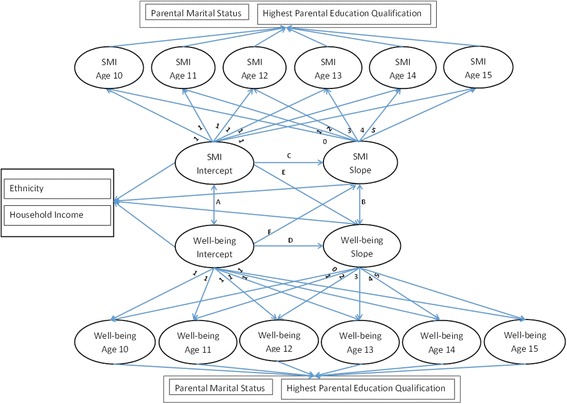
BACKGROUND: Adolescents are among the highest consumers of social media while research has shown that their well-being decreases with age. The temporal relationship between social media interaction and well-being is not well established. The aim of this study was to examine whether the changes in social media interaction and two well-being measures are related across ages using parallel growth models. METHODS: Data come from five waves of the youth questionnaire, 10-15 years, of the Understanding Society, the UK Household Longitudinal Study (pooled n = 9859). Social media interaction was assessed through daily frequency of chatting on social websites. Well-being was measured by happiness with six domains of life and the Strengths and Difficulties Questionnaire. RESULTS: Findings suggest gender differences in the relationship between interacting on social media and well-being. There were significant correlations between interacting on social media and well-being intercepts and between social media interaction and well-being slopes among females. Additionally higher social media interaction at age 10 was associated with declines in well-being thereafter for females, but not for males. Results were similar for both measures of well-being. CONCLUSIONS: High levels of social media interaction in early adolescence have implications for well-being in later adolescence, particularly for females. The lack of an association among males suggests other factors might be associated with their reduction in well-being with age. These findings contribute to the debate on causality and may inform future policy and interventions.
Overview
The claims and statistics of this paper haven’t been checked yet.
Free: it reads the open-access text and checks the first 5 claims that cite a source we can check. Create a free account to check every claim.
Integrity signals
Registry
Cites
Statistics
Figures
Verification
Claims the paper makes
The claims and statistics of this paper haven’t been checked yet.
Free: it reads the open-access text and checks the first 5 claims that cite a source we can check. Create a free account to check every claim.
Claims other papers make about this one
Each is checked against this paper’s own text: does it say what the citing paper says it does?
The source backs part of the claim, not all of it — or backs it for a different population, condition or comparison.
In the citing paper
“we controlled for the following confounders in our analyses: family income – equivalised fifths; family structure (two vs one parent); and age in years. In an attempt to take account of the potentially cyclical association between social media use and depressed mood we controlled for internalising symptoms”
From Social media use and adolescent mental health: Findings from the UK Millennium Cohort Study (2018) · cites this paper as [9]
Experimental — accuracy not yet measuredThe cited source says what the claim attributes to it.
In the citing paper
“The item used was developed by the Millennium Cohort Study team and is similar to items used in other large surveys including the UK Household Longitudinal Study [9] and Ofcom [5].”
From Social media use and adolescent mental health: Findings from the UK Millennium Cohort Study (2018) · cites this paper as [9]
The cited source says what the claim attributes to it.
In the citing paper
“a recent report using longitudinal data suggests that girls may be more affected than boys [9].”
From Social media use and adolescent mental health: Findings from the UK Millennium Cohort Study (2018) · cites this paper as [9]
The cited source says what the claim attributes to it.
In the citing paper
“the estimates of time spent using social media presented in our paper are consistent with those reported from other UK studies [9], [34].”
From Social media use and adolescent mental health: Findings from the UK Millennium Cohort Study (2018) · cites this paper as [9]
The cited source says what the claim attributes to it.
In the citing paper
“However, the questions used were similar to those from other large-scale population based surveys including the UK Household Longitudinal Study [9] and Ofcom [5].”
From Social media use and adolescent mental health: Findings from the UK Millennium Cohort Study (2018) · cites this paper as [9]
2 more claims about this paper
Create a free account to see every claim other papers make about this one.
Self-check
Percentages, sums and reported differences re-computed from the paper’s own numbers.
The self-check needs the paper’s full text.
Citations
Cites
The Strengths and Difficulties Questionnaire: A research note
Goodman, R. (1997) · Journal of Child Psychology and Psychiatry · doi:10.1111/j.1469-7610.1997.tb01545.x · Cited by 14,908 · cited 1×
“The SDQ is a validated instrument which screens for emotional and behavioural problems in children and adolescents aged 3-16 years [34].”
BackgroundApplied Longitudinal Data Analysis: Modeling Change and Event Occurrence
Singer, J. D., & Willett, J. B. (2003) · doi:10.1093/acprof:oso/9780195152968.001.0001 · Cited by 10,647
Goodman, R., Meltzer, H., & Bailey, V. (1998) · European Child & Adolescent Psychiatry · doi:10.1007/s007870050057 · Cited by 2,238
Systematic review of sedentary behaviour and health indicators in school-aged children and youth.
Tremblay, M. S., LeBlanc, A. G., Kho, M. E., Saunders, T. J., Larouche, R., Colley, R. C., Goldfield, G., & Gorber, S. (2011) · International Journal of Behavioral Nutrition and Physical Activity · doi:10.1186/1479-5868-8-98 · Cited by 2,085 · cited 1×
“Risk factors such as social isolation [10], low self-esteem [11, 12], increased obesity [13] and decreased physical activity [14] may all contribute to later life health issues.”
BackgroundThe Impact of Social Media on Children, Adolescents, and Families
O'Keeffe, G. S., Clarke-Pearson, K., & Council on Communications and Media (2011) · Pediatrics · doi:10.1542/peds.2011-0054 · Cited by 1,987
Facebook Use Predicts Declines in Subjective Well-Being in Young Adults
Kross, E., Verduyn, P., Demiralp, E., Park, J., Lee, D. S., Lin, N., Shablack, H., Jonides, J., & Ybarra, O. (2013) · PLoS ONE · doi:10.1371/journal.pone.0069841 · Cited by 1,596 · cited 1×
“Many studies have examined the associations between screen-based media and negative markers of well-being such as depression, socio-emotional difficulties and anxiety with mixed results [11, 20, 23, 29].”
BackgroundDo social network sites enhance or undermine subjective well-being? A critical review
Verduyn, P., Ybarra, O., Résibois, M., Jonides, J., & Kross, E. (2017) · Social Issues and Policy Review · doi:10.1111/sipr.12033 · Cited by 1,209 · cited 10×
“, [22] suggest that the relationship operates differently for passive and active users.”
BackgroundResultInfluentialRelations among loneliness, social anxiety, and problematic Internet use
Caplan, S. E. (2007) · CyberPsychology & Behavior · doi:10.1089/cpb.2006.9963 · Cited by 948 · cited 1×
“Risk factors such as social isolation [10], low self-esteem [11, 12], increased obesity [13] and decreased physical activity [14] may all contribute to later life health issues.”
BackgroundValkenburg, P. M., & Peter, J. (2007) · Journal of Computer-Mediated Communication · doi:10.1111/j.1083-6101.2007.00368.x · Cited by 776
(2015) · Cited by 640
Face-to-face or Facebook: Can social connectedness be derived online?
Grieve, R., Indian, M., Witteveen, K., Anne Tolan, G., & Marrington, J. (2013) · Computers in Human Behavior · doi:10.1016/j.chb.2012.11.017 · Cited by 609 · cited 1×
“High quality interactions [15–17], reduced social isolation [16, 18] or information seeking [19] are all mechanisms through which well-being may be increased with social media use.”
BackgroundOnline Social Networking and Mental Health
Pantic, I. (2014) · Cyberpsychology, Behavior, and Social Networking · doi:10.1089/cyber.2014.0070 · Cited by 530 · cited 1×
“Whether done in isolation or with friends, there may be risks to using social media, which could lead to poorer physical and mental health in adulthood [8, 9].”
BackgroundLiu, M., Wu, L., & Yao, S. (2016) · British Journal of Sports Medicine · doi:10.1136/bjsports-2015-095084 · Cited by 364 · cited 5×
“However among longitudinal studies’ findings suggest a negative, although non-significant association [26].”
BackgroundInfluentialSuchert, V., Hanewinkel, R., & Isensee, B. (2015) · Preventive Medicine · doi:10.1016/j.ypmed.2015.03.026 · Cited by 329 · cited 7×
“One review included all forms of screen-based media and separated associations by type of mental health indicator [11].”
BackgroundResultInfluentialThe health of young people in a global context
Blum, R. W., & Nelson-Mmari, K. (2004) · Journal of Adolescent Health · doi:10.1016/j.jadohealth.2003.10.007 · Cited by 317
Child Well-being in Rich Countries: A comparative overviewPreprint
Adamson, P. (2013) · RePEc: Research Papers in Economics · Cited by 297
Social Networking Sites: Their Users and Social Implications - A Longitudinal Study
Brandtzaeg, P. B. (2012) · Journal of Computer-Mediated Communication · doi:10.1111/j.1083-6101.2012.01580.x · Cited by 297
Physical activity, leisure-time screen use and depression among children and young adolescents
Kremer, P., Elshaug, C., Leslie, E., Toumbourou, J. W., Patton, G. C., & Williams, J. (2014) · Journal of Science and Medicine in Sport · doi:10.1016/j.jsams.2013.03.012 · Cited by 287 · cited 1×
“Many studies control for gender and do observe a significant gender main effect; however they do not test for gender interactions or stratify by gender [25, 40, 41].”
BackgroundValkenburg, P. M., & Peter, J. (2009) · Journal of Communication · doi:10.1111/j.1460-2466.2008.01405.x · Cited by 286
Brodersen, N. H., Steptoe, A., Williamson, S., & Wardle, J. (2005) · Annals of Behavioral Medicine · doi:10.1207/s15324796abm2901_2 · Cited by 253 · cited 2×
“The male models did show that both happiness and socio-emotional difficulties decreased with age, however if these reductions are not associated with social media interaction what other factors could be responsible? Many studies have shown that social media interaction is higher among females than males while males ar…”
BackgroundFrison, E., & Eggermont, S. (2020) · Communication Research · doi:10.1177/0093650215617506 · Cited by 239 · cited 2×
“chatting or sending personal messages, was indirectly associated with lower depressed mood through increased perceived friend support and decreased avoidant coping [20].”
BackgroundParenting Style and Youth Outcomes in the UK
Chan, T. W., & Koo, A. (2011) · European Sociological Review · doi:10.1093/esr/jcq013 · Cited by 237 · cited 1×
“Higher scores indicated higher levels of happiness [33].”
BackgroundMitchell, J. A., Pate, R. R., Beets, M. W., & Nader, P. R. (2013) · International Journal of Obesity · doi:10.1038/ijo.2012.41 · Cited by 234 · cited 1×
“Risk factors such as social isolation [10], low self-esteem [11, 12], increased obesity [13] and decreased physical activity [14] may all contribute to later life health issues.”
BackgroundTelevision Viewing in Early Childhood Predicts Adult Body Mass Index
Viner, R. M., & Cole, T. J. (2005) · The Journal of Pediatrics · doi:10.1016/j.jpeds.2005.05.005 · Cited by 224
Pathways and mechanisms in adolescence contribute to adult health inequalities
Due, P., Krølner, R., Rasmussen, M., Andersen, A., Trab Damsgaard, M., Graham, H., & Holstein, B. E. (2011) · Scandinavian Journal of Public Health · doi:10.1177/1403494810395989 · Cited by 210
Willoughby, T. (2008) · Developmental Psychology · doi:10.1037/0012-1649.44.1.195 · Cited by 205 · cited 2×
“Many studies control for gender and do observe a significant gender main effect; however they do not test for gender interactions or stratify by gender [25, 40, 41].”
BackgroundGámez-Guadix, M. (2014) · Cyberpsychology, Behavior, and Social Networking · doi:10.1089/cyber.2014.0226 · Cited by 189
Santos, R., Mota, J., Okely, A. D., Pratt, M., Moreira, C., Coelho-e-Silva, M. J., Vale, S., & Sardinha, L. B. (2014) · British Journal of Sports Medicine · doi:10.1136/bjsports-2012-091610 · Cited by 159 · cited 1×
“Risk factors such as social isolation [10], low self-esteem [11, 12], increased obesity [13] and decreased physical activity [14] may all contribute to later life health issues.”
BackgroundChild Well-Being in Rich Countries: A Comparative Overview. Innocenti Report Card 11.
Adamson, P. (2013) · Cited by 153
Romer, D., Bagdasarov, Z., & More, E. (2013) · Journal of Adolescent Health · doi:10.1016/j.jadohealth.2012.11.012 · Cited by 145
Sedentary behaviour and obesity: review of the current scientific evidence
Biddle, S., Cavill, N., Ekelund, U., Gorely, T., Griffiths, M. D., Jago, R., Oppert, J., Raats, M. M., Salmon, J., Stratton, G., et al. (2010) · Nottingham Trent University's Institutional Repository (Nottingham Trent Repository) · Cited by 141
Witt, E. A., Massman, A. J., & Jackson, L. A. (2011) · Computers in Human Behavior · doi:10.1016/j.chb.2010.10.025 · Cited by 108 · cited 2×
“Many studies control for gender and do observe a significant gender main effect; however they do not test for gender interactions or stratify by gender [25, 40, 41].”
BackgroundBooker, C. L., Skew, A. J., Kelly, Y. J., & Sacker, A. (2015) · American Journal of Public Health · doi:10.2105/ajph.2013.301783 · Cited by 95 · cited 5×
“Prior research shows that screen-based media interaction increases whilst well-being levels decrease throughout adolescence and these changes differ by gender [6, 27, 28].”
BackgroundMethodResultInfluentialSelf-citationMaynard, M. J., & Harding, S. (2009) · Social Psychiatry and Psychiatric Epidemiology · doi:10.1007/s00127-009-0047-z · Cited by 67 · cited 1×
“This finding of better well-being of ethnic minority adolescents in the UK has been found elsewhere [43, 44].”
BackgroundZilanawala, A., Sacker, A., Nazroo, J. Y., & Kelly, Y. J. (2015) · Social Science & Medicine · doi:10.1016/j.socscimed.2015.04.012 · Cited by 55 · cited 1×
“This finding of better well-being of ethnic minority adolescents in the UK has been found elsewhere [43, 44].”
BackgroundSelf-citationLiu, R., Shen, C.-X., Xu, L., & Gao, Q. (2013) · Computers & Education · doi:10.1016/j.compedu.2013.04.019 · Cited by 40 · cited 1×
“High quality interactions [15–17], reduced social isolation [16, 18] or information seeking [19] are all mechanisms through which well-being may be increased with social media use.”
BackgroundThe Good Childhood Report 2014
Pople, L., Raws, P., Mueller, D., Mahony, S., Rees, G., Bradshaw, J., Main, G., & Keung, A. (2014) · White Rose Research Online (University of Leeds, The University of Sheffield, University of York) · Cited by 40
Frison, E., & Eggermont, S. (2016) · Journal of Adolescence · doi:10.1016/j.adolescence.2016.08.008 · Cited by 39
Viner, R. (2005) · Journal of Adolescent Health · doi:10.1016/j.jadohealth.2004.11.012 · Cited by 38
Appendix: Understanding Society design overview
Burton, J., Laurie, H., & Lynn, P. J. (2011) · Open Access at Essex (University of Essex) · Cited by 13
Research works printed but not linked: 5
- OfCom Children and parents: media use and attitudes report 2015 London Office of Communications
- Lynn P Burton J Kaminska O Knies G Nandi A An initial look at non-repsonse and attrition in Understanding Society Understanding Society Working Paper Series 2012 Colchester, UK University of Essex
- Muthén LK, Muthén BO: Mplus User's Guide. Seventh Edition. Los Angles, CA: Muthén & Muthén; 1998-2012.
- Lenhart A Purcell K Smith A Zickuhr K PIAL P Social Media & Mobile Internet use among Teens and young people 2010 Washington, DC Pew Research Center
- OfCom Children and parents: media use and attitudes report 2012 London Office of Communications
Cited by
Social media use and adolescent mental health: Findings from the UK Millennium Cohort Study
Kelly, Y., Zilanawala, A., Booker, C., & Sacker, A. (2018) · EClinicalMedicine · doi:10.1016/j.eclinm.2018.12.005 · Cited by 740
Self-citationSocial Media and Mental Health: Benefits, Risks, and Opportunities for Research and Practice
Naslund, J. A., Bondre, A., Torous, J., & Aschbrenner, K. A. (2020) · Journal of Technology in Behavioral Science · doi:10.1007/s41347-020-00134-x · Cited by 746
“Social media use also appears to have a differential impact on mental health and emotional wellbeing between females and males (Booker et al. 2018), highlighting the need to explore unique experiences between gender groups to inform tailored programs and services.”
BackgroundMedia Use Is Linked to Lower Psychological Well-Being: Evidence from Three Datasets
Twenge, J. M., & Campbell, W. K. (2019) · Psychiatric Quarterly · doi:10.1007/s11126-019-09630-7 · Cited by 429
Windows of developmental sensitivity to social media
Orben, A., Przybylski, A. K., Blakemore, S.-J., & Kievit, R. A. (2022) · Nature Communications · doi:10.1038/s41467-022-29296-3 · Cited by 387
Viner, R. M., Gireesh, A., Stiglic, N., Hudson, L. D., Goddings, A.-L., Ward, J. L., & Nicholls, D. E. (2019) · The Lancet Child & Adolescent Health · doi:10.1016/s2352-4642(19)30186-5 · Cited by 295
Metadata
- Authors
- Booker, C. L., Kelly, Y. J., & Sacker, A.
- Affiliations
- University of Essex (GB)
- University College London (GB)
- Corresponding author
- Booker, Cara L.
- Venue
- BMC Public Health
- Published
- 2018-03-20
- Volume
- 18
- Issue
- 1
- Pages
- 321-321
- ISSN
- 1471-2458 (ISSN-L)
- PMC
- PMC5859512
- OpenAlex
- W2795762168
- Cited by
- 268
- References
- 42
- Citations by year
- 2026: 24 · 2025: 26 · 2024: 31 · 2023: 47 · 2022: 44 · 2021: 28 · 2020: 49 · 2019: 15 · 2018: 2
- FWCI
- 53.47
- Type
- journal article
- Language
- en
- Open access
- gold
- doi.org
- Licence
- cc-by
- creativecommons.org/licenses/by/4.0/ (tdm)
- Locations
- BMC Public Health (publishedVersion, cc-by)
- Europe PMC (PubMed Central) (publishedVersion, cc-by)
- PubMed Central (publishedVersion, cc-by)
- PubMed (publishedVersion)
- Open Access at Essex (University of Essex) (acceptedVersion)
- DOAJ (DOAJ: Directory of Open Access Journals) (submittedVersion, cc-by-sa)
- UCL Discovery (University College London) (submittedVersion)
- Funders
- Economic and Social Research Council (RES-586-47-0001, RES-586-47-0002, RES-518-28-001, ES/J019119/1)
- Topics
- Social Sciences › Sociology and Political Science › Impact of Technology on Adolescents
- Social Sciences › Education › Child Development and Digital Technology
- Social Sciences › Psychology › Clinical Psychology › Child and Adolescent Psychosocial and Emotional Development
- Keywords
- social media use, adolescents, well-being, gender differences, age trends, happiness, Strengths and Difficulties Questionnaire, early adolescence, longitudinal development
- MeSH terms
- Adolescent, Child, Female, United Kingdom, Humans, Interpersonal Relations, Longitudinal Studies, Male, Mental Health, Surveys and Questionnaires, Sex Factors, Social Media
About these checks
Registry, retraction, Cites and statistics results are computed, not judged, with one exception: a printed reference that no index lists is read once by a model before it counts as a citation error. Claims are extracted by a model and kept only when their quote appears verbatim in the text; each cited source is then checked, with a model’s help, for whether it says what the claim relies on. Those verdicts can be wrong — read the claim’s quote and the cited source before relying on one.
Statistics and arithmetic are recomputed, not judged.
Confidence bands are shown only for fields calibrated on our annotated test set. None is calibrated yet, so no band is shown.
What counts as a claim ›How we measure confidence ›How we check this ›
Are you an author, or do you see a problem with this page? Request a review
Data sources
Bibliographic data: Semantic Scholar, OpenAlex, Crossref.
Contains information from the Semantic Scholar Academic Graph Datasets, made available under the ODC Attribution License (ODC-BY 1.0).
Semantic Scholar’s data is described in: Kinney, R., et al. (2023). The Semantic Scholar Open Data Platform. arXiv:2301.10140.
