

The DOI matches its Crossref record; 60 of the 60 references it cites were found in a registry or an index.
The associations between screen time-based sedentary behavior and depression: a systematic review and meta-analysis
Open accessAbstract
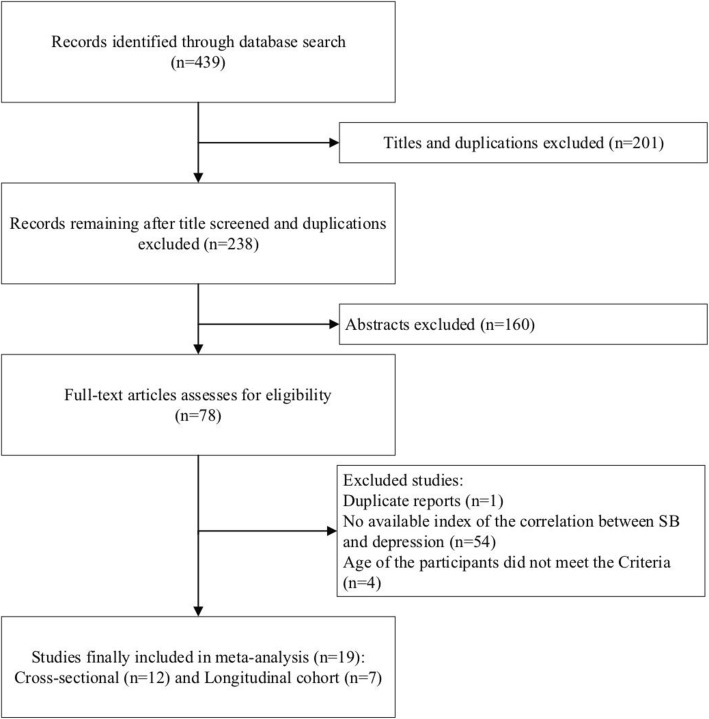
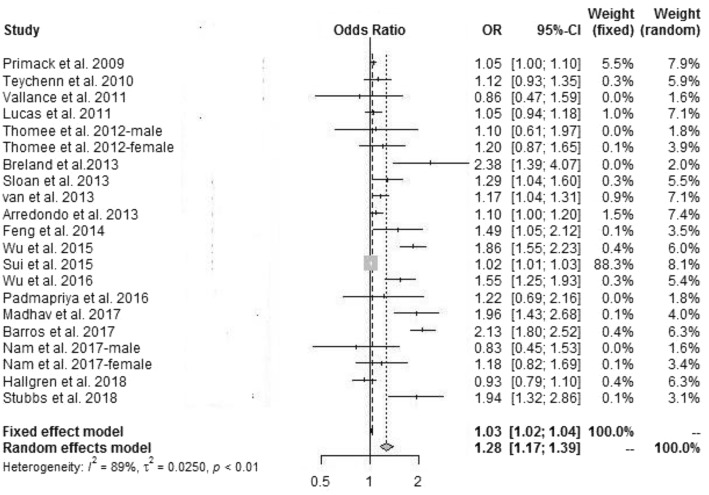
Background: The use of computers/TV has become increasingly common worldwide after entering the twenty-first century and depression represents a growing public health burden. Understanding the association between screen time-based sedentary behavior (ST-SB) and the risk of depression is important to the development of prevention and intervention strategies. Methods: We searched the electronic databases of Medline, Embase and the Cochrane Library. The odds ratio (OR) with corresponding 95% confidence intervals (CIs) was adopted as the pooled measurement. Subgroup analyses were investigated by stratified meta-analyses based on age, gender and reference group (reference category of screen time, e.g. 2 h/day, 4 h/day). Results: There were 12 cross-sectional studies and 7 longitudinal studies met the inclusion criteria. Overall, the pooled OR was 1.28 with high heterogeneity (I 2 = 89%). Compared to those who reported less SB, persons reporting more SB had a significantly higher risk of depression. When the gender was stratified, the pooled OR was 1.18 in female groups while no significant association was observed in males. Among the 19 studies, 5 studies used a reference group with ST = 2 h/days (pooled OR = 1.46), 9 studies used ≥4 h as a reference group (pooled OR = 1.38), 2 studies used 1 h as a reference group (pooled OR = 1.07) and for the remaining 3 studies, hours of ST were calculated as a continuous variable (pooled OR = 1.04). Conclusions: ST-SB is associated with depression risk and the effects vary in different populations. In addition, valid objective measures of SB should be developed in future studies.
Overview
The claims and statistics of this paper haven’t been checked yet.
Run the check — free, no account needed. It reads the open-access text and checks the sources it cites.
Integrity signals
Registry
Cites
Statistics
Figures
Verification
Claims the paper makes
The claims and statistics of this paper haven’t been checked yet.
Run the check — free, no account needed. It reads the open-access text and checks the sources it cites.
Claims other papers make about this one
Each is checked against this paper’s own text: does it say what the citing paper says it does?
In the citing paper
“More screen time has been associated with depressive symptoms among children and adolescents in several systematic reviews [11, 12, 43–50].”
From Screen time and mental health: a prospective analysis of the Adolescent Brain Cognitive Development (ABCD) Study (2024) · cites this paper as [49]
In the citing paper
“The results of the current review largely align with past systematic reviews, which have concluded that there is a positive association between screen time and depressive symptoms (Hoare et al., 2016;Liu et al., 2016;Stiglic & Viner, 2019;Wang et al., 2019), and a weak association between screen time and both anxiety and self-esteem (Stiglic & Viner, 2019).”
From The relationship between screen time and mental health in young people: A systematic review of longitudinal studies (2021) · cites this paper as Wang et al., 2019
Self-check
Percentages, sums and reported differences re-computed from the paper’s own numbers.
The self-check needs the paper’s full text.
Citations
Cites
Kessler, R. C., Berglund, P., Demler, O., Jin, R., Merikangas, K. R., & Walters, E. E. (2005) · Archives of General Psychiatry · doi:10.1001/archpsyc.62.6.593 · Cited by 20,391
Zhang, Q., Wang, C., Zheng, M., Li, Y., Li, J., Zhang, L., Shang, X., & Yan, C. (2014) · Cerebrovascular Diseases · doi:10.1159/000369778 · Cited by 11,609
Self-citationProjections of Global Mortality and Burden of Disease from 2002 to 2030
Mathers, C. D., & Loncar, D. (2006) · PLoS Medicine · doi:10.1371/journal.pmed.0030442 · Cited by 11,386
Murray, C. J. L., Vos, T., Lozano, R., Naghavi, M., Flaxman, A. D., Michaud, C., Ezzati, M., Shibuya, K., Salomon, J. A., Abdalla, S., et al. (2012) · The Lancet · doi:10.1016/s0140-6736(12)61689-4 · Cited by 8,888
Kessler, R. C., Berglund, P., Demler, O., Jin, R., Koretz, D., Merikangas, K. R., Rush, A. J., Walters, E. E., & Wang, P. S. (2003) · JAMA · doi:10.1001/jama.289.23.3095 · Cited by 7,988
The World Health Report 2002 - Reducing Risks, Promoting Healthy Life
Available, N. A. N. (2003) · Education for Health · doi:10.1080/1357628031000116808 · Cited by 6,078
Internet paradox: A social technology that reduces social involvement and psychological well-being?
Kraut, R., Patterson, M., Lundmark, V., Kiesler, S., Mukophadhyay, T., & Scherlis, W. (1998) · American Psychologist · doi:10.1037/0003-066x.53.9.1017 · Cited by 4,793 · cited 1×
“Another explanation refers to social interaction: prolonged sedentary behaviors, such as television viewing, may lead to social solitude and withdrawal from interpersonal relationships, which have been linked to increased feelings of social anxiety [48].”
BackgroundNo health without mental health
Prince, M. J., Patel, V., Saxena, S., Maj, M., Maselko, J., Phillips, M. R., & Rahman, A. (2007) · The Lancet · doi:10.1016/s0140-6736(07)61238-0 · Cited by 4,028
Kawachi, I. I. (2001) · Journal of Heredity · doi:10.1093/jurban/78.3.458 · Cited by 3,565
Systematic review of sedentary behaviour and health indicators in school-aged children and youth.
Tremblay, M. S., LeBlanc, A. G., Kho, M. E., Saunders, T. J., Larouche, R., Colley, R. C., Goldfield, G., & Gorber, S. (2011) · International Journal of Behavioral Nutrition and Physical Activity · doi:10.1186/1479-5868-8-98 · Cited by 2,085
Cited by
Sorted by citations
Items 101–200 of 299
Sedentary Behavior and Risk of Depression in Older Adults: A Systematic Meta-Analysis
Li, Q., Zhao, Z., Yang, C., Chen, Z., & Yin, W. (2024) · Iranian Journal of Public Health · doi:10.18502/ijph.v53i2.14914 · Cited by 11
Santos, J. D., Ihle, A., Peralta, M., Domingos, C., Gouveia, É. R., Ferrari, G., Werneck, A. O., Rodrigues, F. F., & Marques, A. (2022) · Frontiers in Public Health · doi:10.3389/fpubh.2021.799870 · Cited by 12
Different sedentary behavior domains present distinct associations with eating-related indicators
Júdice, P. B., Carraça, E. V., Santos, I., Palmeira, A. L., Jerónimo, F., & Silva, M. N. (2024) · BMC Public Health · doi:10.1186/s12889-024-17760-2 · Cited by 10
“SB domains are, thus, of critical importance, also for eating behavior regulation, as demonstrated in other outcomes (e.g., mental health) [53].”
BackgroundLi, J., Sun, W., Luo, Z., Liu, Y., Huang, X., Jiang, D., Li, S., Meng, J., Gu, F., Zhang, R., et al. (2024) · JMIR Public Health and Surveillance · doi:10.2196/53101 · Cited by 12
“In the current digital age, the internet plays a pivotal role in the lives of children and adolescents, presenting both positive and negative impacts on well-being [18,19].”
BackgroundLi, L., Guo, D., Shi, C., & Zheng, Y. (2025) · Journal of Affective Disorders · doi:10.1016/j.jad.2025.02.085 · Cited by 14
Hua, M., Hua, Y., Peng, Y., & Zhu, J. (2025) · Journal of Affective Disorders · doi:10.1016/j.jad.2025.05.029 · Cited by 12
Zahedi, S., Jaffer, R., & Iyer, A. (2021) · International Journal of Educational Research Open · doi:10.1016/j.ijedro.2021.100094 · Cited by 12
Gender Differences in the Association Between Screen Time and Depression
Kleidermacher, L. E., & Olfson, M. (2023) · AJPM Focus · doi:10.1016/j.focus.2023.100176 · Cited by 10
Movement behaviors associated with mental health among US military service members
Perez, L. G., Dong, L., Beckman, R., & Meadows, S. O. (2021) · Military Psychology · doi:10.1080/08995605.2021.1987084 · Cited by 12
“Although no screen time recommendations are available, one review found that more than 2 hours/day was consistently associated with increased risk of depression (Wang et al., 2019).”
BackgroundCamp, N., Ramos, A. C. F., Hunter, K. A., Boat, R., & Magistro, D. (2022) · Aging & Mental Health · doi:10.1080/13607863.2022.2046691 · Cited by 10
“This constant cycle of having a sedentary lifestyle, which leads to feeling fatigued, and therefore a reluctance to be active may be having a negative influence on mental health, including an increase in depressive symptoms (Wang et al., 2019; Zhai et al., 2015).”
BackgroundWerneck, A. O., Kandola, A. A., Tebar, W. R., da Silva, D. R. P., Stubbs, B., & Christófaro, D. G. D. (2022) · Brazilian Journal of Psychiatry · doi:10.47626/1516-4446-2022-2533 · Cited by 10
Luo, C., Duan, L., Li, Y., Xie, Q., Wang, L., Ru, K., Nazir, S., Jawad, M., Zhao, Y., Wang, F., et al. (2021) · Frontiers in Genetics · doi:10.3389/fgene.2021.676917 · Cited by 10
“With reference to linguistics, the She language (mainly refers to Shanke and Dongjia dialects) belongs to the Hmong-Mien language branch (Lu and Wang, 2019).”
BackgroundSelf-citationLi, G., He, Q., Sun, M., Ma, Z., Zhao, H., Wang, Y., Feng, Z., Li, T., Chu, J., Hu, W., et al. (2024) · Journal of Affective Disorders · doi:10.1016/j.jad.2024.08.011 · Cited by 10
Su, H., Lyu, D., Huang, K., & Yan, J. H. (2024) · Frontiers in Public Health · doi:10.3389/fpubh.2024.1432710 · Cited by 10
“Furthermore, sufficient sleep was linked to lower alcohol consumption (OR = 1.37, p = 0.015), as proper rest is associated with reduced stress and improved decision-making, which lowers the likelihood of drinking to alleviate stress (84).”
BackgroundInfluentialBertuol, C., da Silveira, M. H. C., Krug, R. D. R., Kupske, J. W., Mielke, G. I., & Duca, G. F. D. (2023) · BMC Public Health · doi:10.1186/s12889-023-16517-7 · Cited by 13
“This threshold was based on previous research which showed negative results for cardiovascular diseases, mental disorders, and all-cause mortality [7, 22].”
ResultShen, B., Cui, G., & Bo, J. (2023) · Journal of American College Health · doi:10.1080/07448481.2023.2252503 · Cited by 9
Zhu, J.-H., Shen, Z., Liu, B.-P., & Jia, C.-X. (2024) · Social Psychiatry and Psychiatric Epidemiology · doi:10.1007/s00127-024-02708-z · Cited by 10
Ferrari, G., Herrera‐Cuenca, M., Zimberg, I. Z., Guajardo, V., Gómez, G., Quesada, D., Rigotti, A., Cortés, L. Y., García, M. C. Y., Pareja, R. G., et al. (2021) · Assessment · doi:10.1177/10731911211017637 · Cited by 9
“Furthermore, SB is also negatively associated with mental health conditions, such as anxiety disorders (Allen et al., 2019), depression (Wang et al., 2019) and indicators of stress (Teychenne et al., 2019).”
BackgroundWu, H. T., Li, J., & Tsurumi, A. (2024) · Child and Adolescent Psychiatry and Mental Health · doi:10.1186/s13034-023-00688-7 · Cited by 9
“…depression and inattention problems, depression, anxiety, and poor self-esteem [7, 9, 10, 35–38]; and on cognitive functioning, including language development [39], executive and academic performance [9, 33], attention span [40], and hindered social interactions from a sedentary lifestyle [41].”
BackgroundImpact of occupational sedentary behavior on mental health: A systematic review and meta-analysis
Nasir, H., Duclos, M., Bagheri, R., Cole, A. M., Baker, J. S., Thivel, D., & Dutheil, F. (2025) · PLoS ONE · doi:10.1371/journal.pone.0328678 · Cited by 8
“Several meta-analysis demonstrated that individuals with higher sedentary behavior had a significantly higher risk of depression compared to those who reported being less sedentary [16–19].”
Goo, S. Y., Lee, T. H., Lim, H., Lee, E., Kim, J. Y., & Jeon, J. Y. (2023) · Mental health and physical activity · doi:10.1016/j.mhpa.2023.100539 · Cited by 8
It is time for more holistic practices in mental health
Ribeiro, S. T. G., Pimentel, A. P., Fernandes, V. D. R., Deslandes, A. C., & Amarante, P. (2024) · PLOS mental health. · doi:10.1371/journal.pmen.0000028 · Cited by 13
Bonnet, C. T., & Barela, J. Â. (2021) · Healthcare · doi:10.3390/healthcare9080995 · Cited by 9
“Since the end of the 20th century, people sit when using computers, the Internet, and entertainment technologies, and when engaged with display screens of all types [8,16,17].”
BackgroundInfluentialTempo de tela, sintomas depressivos e sono: o ensino superior remoto na Covid-19
Santos, R. M. S., Rodrigues, I. V. A., Santos, A. P. S., Silva-Santos, A. P., & Eleutério, N. M. (2022) · Revista Eletrônica Acervo Saúde · doi:10.25248/reas.e9686.2022 · Cited by 10
Scarabottolo, C. C., Tebar, W. R., Guerra, P. H., Martins, C., Ferrari, G., Beretta, V. S., & Christófaro, D. G. D. (2022) · International Journal of Environmental Research and Public Health · doi:10.3390/ijerph192416389 · Cited by 10
da Costa, M. E., Cândido, L. M., de Avelar, N. C. P., & Danielewicz, A. L. (2023) · Geriatric Nursing · doi:10.1016/j.gerinurse.2022.12.014 · Cited by 8
Lu, H., Liang, G., Li, D., Liu, M.-X., Yin, Z.-J., Li, Y.-Z., Zhang, T., & Pan, C.-W. (2023) · Psychology Health & Medicine · doi:10.1080/13548506.2023.2217380 · Cited by 8
“…et al., 2015; Wang et al., 2019; Y. Zhang et al., 2022), frequent screen-based activity increases the risk of low social adaptability (Lissak, 2018) and several negative emotional states, including depression (Wang et al., 2019), anxiety (Teychenne et al., 2015) and stress (Leppänen et al., 2020).”
BackgroundResultInfluentialSelf-citationDiabetes Diagnosis and Screen-Based Sedentary Behavior Among US Adults
An, R., & Yan, Y. (2016) · American Journal of Lifestyle Medicine · doi:10.1177/1559827616650416 · Cited by 8
Sedentary behavior and physical inactivity from a comprehensive perspective
Rey‐Brandariz, J., Rial-Vázquez, J., Varela‐Lema, L., Santiago-Pérez, M. I., Candal‐Pedreira, C., Guerra-Tort, C., Ruano‐Raviña, A., & Pérez‐Ríos, M. (2023) · Gaceta Sanitaria · doi:10.1016/j.gaceta.2023.102352 · Cited by 11
Prevalence and lifestyle determinants of depressive symptoms among Chinese children and adolescents
Ding, L., Wu, Z., Wu, Q., Wei, R., & Li, E. (2024) · Scientific Reports · doi:10.1038/s41598-024-78436-w · Cited by 8
Ding, K., Wang, F., Wang, K., Feng, X.-Z., Yang, M. J., Han, B., Li, G., & Li, S. (2023) · Behavioural Brain Research · doi:10.1016/j.bbr.2023.114710 · Cited by 7
“For example, a previous study showed that screen time-based sedentary behavior not only affects the mental health of adults, such as causing sleep disturbances [5], anxiety disorders [6], and depressive disorders [7], but may also lead to depression, anxiety, and other diseases in adolescents [8].”
Evolución de la prevalencia de sedentarismo en la población española entre los años 1987 y 2020
Montero-Torreiro, M. F., Rey‐Brandariz, J., Guerra-Tort, C., Candal‐Pedreira, C., Santiago-Pérez, M. I., Varela‐Lema, L., Luque, S. S., & Pérez‐Ríos, M. (2023) · Medicina Clínica · doi:10.1016/j.medcli.2023.10.010 · Cited by 8
Basterra, V., Gil-Conesa, M., Sayón-Orea, C., Lahortiga‐Ramos, F., de la Fuente‐Arrillaga, C., Martínez‐González, M. Á., & Bes‐Rastrollo, M. (2024) · Preventive Medicine · doi:10.1016/j.ypmed.2024.107912 · Cited by 9
“…replacing 1 h of daily screen use by 1 h of physical activity and its impact on not achieving optimal Psychological Well-Being within the 18-year follow-up of the SUN cohort. et al., 2012; Dempsey et al., 2014; Gao et al., 2019; Hamer et al., 2010; Vahedi and Saiphoo, 2018; Wang et al., 2019).”
Lu, S., Sun, J., Guo, Z., Yi, M., Zhang, Y., Wang, J., & Wang, Y. (2024) · Frontiers in Psychology · doi:10.3389/fpsyg.2024.1465974 · Cited by 8
“The ORs in previous meta-analyses among adults or older people [1.25, 95% CI 1.16–1.35 ( Zhai et al., 2015); 1.28, 95% CI 1.17–1.39 ( Wang et al., 2019)] were also higher than the ORs in the present study.”
ResultInfluentialZhang, Y., Janda, K. M., Ranjit, N., Salvo, D., Nielsen, A., & van den Berg, A. E. (2022) · International Journal of Environmental Research and Public Health · doi:10.3390/ijerph19031194 · Cited by 7
“Sedentary behavior, such as screen time, on the other hand, is known to be associated with greater risk of depression [13].”
BackgroundMa, Z., Zhao, F., Wang, Y.-Y., Liu, T., & Chao, N. (2022) · Frontiers in Psychiatry · doi:10.3389/fpsyt.2022.809745 · Cited by 7
Moss, S., Zhang, X., Taleb, Z. B., & Gu, X. (2024) · International Journal of Environmental Research and Public Health · doi:10.3390/ijerph21040401 · Cited by 10
“Another recent systematic review concluded that screen-based sedentary behavior was associated with a higher risk of depression, especially when it exceeded 2 h/day [25].”
BackgroundThe Digital Media Environment and Cardiovascular Risk in Children
Aglipay, M., Vanderloo, L. M., Cost, K. T., Maguire, J. L., & Birken, C. S. (2020) · Canadian Journal of Cardiology · doi:10.1016/j.cjca.2020.04.015 · Cited by 10
Cross-Sectional Associations of Lifestyle Behaviors with Depressive Symptoms in Adolescents
Kong, W., & Gu, J. (2022) · International Journal of Mental Health Promotion · doi:10.32604/ijmhp.2022.022123 · Cited by 6
The impact of social media usage on lifestyle behaviors and health
Cohen, G., Medina, E., Handysides, D. G., Shah, H., Aréchiga, A. E., & Shih, W. (2023) · Lifestyle Medicine · doi:10.1002/lim2.94 · Cited by 6
Janssen, T., McGuire, A., López‐Castro, T., Prince, M. A., & Grasso, D. J. (2023) · Psychological Assessment · doi:10.1037/pas0001248 · Cited by 6
Lin, X. Y., & Lachman, M. E. (2023) · Journal of Social and Personal Relationships · doi:10.1177/02654075231173928 · Cited by 6
“While there has been a widely held notion that reducing screen time can be bene fi cial for well-being (Wang et al., 2019), given the importance of network communication mode diversity, it may be bene fi cial to promote the use of multiple communication modes rather than to exclusively rely on one…”
BackgroundBasay, K., Başay, Ö., Akdogan, C., Karaisli, S., Satilmis, M., Gozen, B., & Sekerci, B. (2020) · Psihologija · doi:10.2298/psi190802009k · Cited by 9
Evidence review: The primary prevention of mental health conditions
VicHealth (2020) · doi:10.37309/2020.po906 · Cited by 6
Aggarwal, D., Das, A., Krishna, S. T. R., Hyndavi, S., Palepu, S., & Kumar, S. (2024) · Journal of Family Medicine and Primary Care · doi:10.4103/jfmpc.jfmpc_1915_23 · Cited by 8
“[11] Another observed negative impact of home quarantine was the adoption of unhealthy patterns of food consumption, compounded by sedentary lifestyles, which escalate the risk of obesity and type 2 diabetes mellitus.”
BackgroundGarrido-López, B., Villarino, M. Á. F., Valeiro, M. G., Andreu‐Caravaca, L., Martins, J., & Dopico-Calvo, X. (2025) · Education Sciences · doi:10.3390/educsci15040470 · Cited by 9
Investigating Cardiovascular Activation of Young Adults in Routine Driving
Hasan, M. T., Alghamdi, H., Taamneh, S., Manser, M. P., Wunderlich, R., Tsiamyrtzis, P., & Pavlidis, I. T. (2023) · IEEE Transactions on Affective Computing · doi:10.1109/taffc.2023.3291330 · Cited by 6
“Other studies linked extensive screen time with comorbidity arousing from the associated sedentary lifestyle [7], [8].”
BackgroundÁlvarez-Mon, M. Á., Sánchez‐Villegas, A., Gutiérrez-Rojas, L., & Martínez‐González, M. Á. (2024) · Journal of Epidemiology & Community Health · doi:10.1136/jech-2023-220577 · Cited by 5
“21”
Tang, Z., Xiang, H., Geng, Y., Liao, X., Zhang, M., & Zhang, T. (2023) · Nursing and Health Sciences · doi:10.1111/nhs.13059 · Cited by 6
“Some studies have found that screen time is positively associated with depressive symptoms through decreased sleep duration, sedentary behavior, and mobile device addiction (Lissak, 2018; Wang et al., 2019).”
Relationship between physical activity and risk of depression in a married group
Ni, R. J., & Yu, Y. W.-Y. (2024) · BMC Public Health · doi:10.1186/s12889-024-18339-7 · Cited by 5
“Sedentary behavior is now recognized as a causative factor for negative emotions or psychological disorders in numerous studies [68–70], and in studies of Chinese residents, regular, sustained physical activity [71] or moderate to high-intensity physical activity [72] can serve as a protective…”
Marchant, G., Servajean, P., Niçaise, V., & Boiché, J. C. S. (2020) · Health Psychology and Behavioral Medicine · doi:10.1080/21642850.2020.1820342 · Cited by 6
Öztürk, N., Öter, E. G., & Abacıgil, F. (2021) · Meandros Medical And Dental Journal · doi:10.4274/meandros.galenos.2021.70457 · Cited by 5
Zeng, Q., Zhang, Y., Li, H., Yuan, J., Feng, D., & Zhu, G. (2025) · Frontiers in Psychology · doi:10.3389/fpsyg.2025.1507198 · Cited by 4
Schuch, F. B., Waclawoscky, A., Tornquist, D., Oyeyemi, A. L., Sadarangani, K. P., Takano, K., Teychenne, M. J., Balanzá‐Martínez, V., O'Neil, A., Romain, A. J., et al. (2026) · BMJ Open · doi:10.1136/bmjopen-2024-085006 · Cited by 10
Gillespie, K. M., Morgan, M., Weir, B., Branjerdporn, G., Patell, S., Bowyer, J. W., Chan, F., & Bartlett, S. E. (2026) · Australian & New Zealand Journal of Psychiatry · doi:10.1177/00048674251412123 · Cited by 6
“…most screen time is typically spent in sedentary and socially isolating contexts, excessive use is likely to contribute to reduced physical activity, diminished sleep, weakened family connections and poorer mental health outcomes (Carson et al., 2016; dos Santos et al., 2024; Wang et al., 2019).”
Xia, Z., Tan, T. C., Liu, Y., Zheng, J., Li, Z., Gu, Q., & Huang, T. (2024) · Physiology & Behavior · doi:10.1016/j.physbeh.2024.114796 · Cited by 4
Frei, A. K., Studnitz, T., Seiffer, B., Welkerling, J., Zeibig, J., Herzog, E., Günak, M. M., Ehring, T. W., Takano, K., Nakagawa, T., et al. (2025) · Clinical Psychology & Psychotherapy · doi:10.1002/cpp.70046 · Cited by 4
Ironside, A. K., Ferguson, L. J., Katapally, T. R., Johnson, S. R., & Foulds, H. J. A. (2023) · International Journal of Behavioral Medicine · doi:10.1007/s12529-023-10167-0 · Cited by 4
“Screen time usage among Indigenous Peoples may also be higher than Canadian guidelines [8], which is linked to depression [21].”
Chaeroni, A., Pranoto, N. W., Talib, K., Ahmed, M., Khishe, M., Okilanda, A., & Lani, M. N. (2024) · Retos · doi:10.47197/retos.v56.104519 · Cited by 4
Ali, B. T. A., Saleh, N. O., Mreydem, H. W., Hammoudi, S. F., Lee, T., Chung, S., Hallit, S. R., & Salameh, P. (2021) · Sleep Medicine Research · doi:10.17241/smr.2021.01109 · Cited by 4
Lifestyle Changes among Mexican People during the COVID-19 Lockdown in 2020: A Cross-Sectional Study
Hernández-Nava, R. G., Sánchez-Mundo, M. D. L. L., García‐Barrientos, R., Espinosa-Solís, V., Aguayo, P. V., Salmerón-Muñiz, N. N., & Anaya-Tacuba, J. D. (2022) · Healthcare · doi:10.3390/healthcare10122537 · Cited by 5
“This increased screen use led to a sedentary lifestyle associated with a higher risk of obesity, type 2 diabetes, cerebrovascular diseases, and depression in adults [25,26].”
BackgroundDeshpande, S., Sachdev, A., Maharana, A., Zadey, S., Dharmadhikari, S. P., Ghate, S., Godatwar, P., Ojha, N. K., & Sharma, S. (2023) · JMIR Research Protocols · doi:10.2196/39707 · Cited by 4
“Adults and even children spend a large portion of their days on different screen-bearing devices including smartphones, tablets, laptops, computers, televisions, etc [1].”
BackgroundCompositional Data Analysis in Time-Use Epidemiology
Dumuid, D., Pedišić, Ž., Palarea‐Albaladejo, J., Fernández, J. A. M., Hron, K., & Olds, T. (2021) · Springer eBooks · doi:10.1007/978-3-030-71175-7_20 · Cited by 4
Bicer, C., & Balcıoğlu, Y. H. (2023) · Arquivos Brasileiros de Cardiologia · doi:10.36660/abc.20220894 · Cited by 4
Schuch, F. B., Waclawovsky, A. J., Tornquist, D., Oyeyemi, A., Sadarangani, K. P., Takano, K., Teychenne, M., Balanzá-Martínez, V., Romain, A. J., Anselmi, A., et al. (2024) · Research Square · doi:10.21203/rs.3.rs-3794023/v1 · Cited by 4
Tang, S., Liu, Y., Gu, Y. R., Yang, Q., & Wang, Q. (2024) · BMC Public Health · doi:10.1186/s12889-024-18793-3 · Cited by 3
“Gradually, indirect effects may occur, including obesity [5], high blood pressure [6], variation of lipoprotein parameters [7] and depression [8].”
BackgroundMeghji, K. A., Talpur, M., Khan, A., Fatima, H., Memon, U., & Monisha (2025) · Pakistan Journal of Health Sciences · doi:10.54393/pjhs.v6i3.2745 · Cited by 6
Stakeholder perspectives on digital wellbeing in Saudi Arabia: a cross-sectional survey
Alomairah, S. A., Carras, M. C., Aljuboori, D., Saquib, J., Saquib, N., Date, M., Kim, K., Aldayel, F. A., Kaufman, M. R., Clary, L. K., et al. (2025) · BMC Public Health · doi:10.1186/s12889-025-23674-4 · Cited by 3
Chen, Z., Sun, J., & Zhuang, W. (2022) · Frontiers in Psychology · doi:10.3389/fpsyg.2022.962520 · Cited by 3
“Previous studies implied that prolonged screening might also lead to poor health (Biswas et al., 2015; Zhai et al., 2015; Wang et al., 2019; Mougharbel and Goldfield, 2020).”
BackgroundMaciel, G. P., da Costa, B. G. G., Bezerra, I. N., da Silva, K. S., Lopes, I. E., de Castro, V. H. S., & Filho, V. C. B. (2023) · Journal of Pediatric Nursing · doi:10.1016/j.pedn.2023.10.027 · Cited by 3
Zheng, A., Pahlen, S., Vo, T., Lawrence, F., Dungore, F., Lor, E., Bowman, N. D., Corley, R. P., Friedman, N. P., Wadsworth, S. J., et al. (2024) · Computers in Human Behavior · doi:10.1016/j.chb.2024.108401 · Cited by 6
Al-akshar, S., Ibrahim, S. T., & Katapally, T. R. (2024) · PLOS Digital Health · doi:10.1371/journal.pdig.0000448 · Cited by 4
The influence of health-promoting schools on the students’ active and sedentary behaviour
Valencia‐Peris, A., Sanchis-Francés, L., & Chinchilla-Ramírez, C. (2025) · Psychology Society & Education · doi:10.21071/pse.v17i1.17384 · Cited by 3
“This trend is influenced by a combination of factors, including an increase in academic demands, as well as a rise in screen time associated with both educational and recreational activities (Wang et al., 2019).”
Wei, X., Li, S., Yue, W., Zhang, Z., Wei, J., Wang, L., Hu, B., Long, N., Li, C., Hou, B., et al. (2025) · BMC Public Health · doi:10.1186/s12889-025-22030-w · Cited by 3
“A meta-analysis revealed that people with a longer SB duration had a 1.28-fold greater risk of depression than did those who spent less time sitting in front of a screen [9].”
InfluentialGoux, D., & Eric Maurin, A. (2025) · The Economic Journal · doi:10.1093/ej/ueaf025 · Cited by 3
Stewart, C., Bennett-Fakahau, I., Nada‐Raja, S., & Stewart, K. (2024) · Kōtuitui New Zealand Journal of Social Sciences Online · doi:10.1080/1177083x.2024.2347409 · Cited by 3
“Excessive screen time, a prevalent issue in New Zealand (Norton 2022), has been linked to elevated levels of anxiety and depression (Maras et al. 2015; Wang et al. 2019).”
Tian, H., Wang, A., Wu, H., Zhou, C., Zhang, Z., & Wang, J. (2024) · Frontiers in Public Health · doi:10.3389/fpubh.2024.1425060 · Cited by 4
“The meta-analysis revealed that SE-SB is linked to an increased risk of depression (51).”
BackgroundWang, W., Wu, M., Yuan, X., Wang, X., Ma, L., Li, L., & Zhang, L. (2025) · JMIR Mental Health · doi:10.2196/71264 · Cited by 3
“Several investigations have explored associations between smartphone use behaviors—including smartphone screen time of use, number of smartphone unlocks, and text message volume—and mental health outcomes [5-8].”
Self-citationWagner, J. A., Bermúdez‐Millán, A., Berthold, S. M., Buckley, T., Buxton, O. M., Feinn, R., Kong, S., Kuoch, T., Master, L., Scully, M. F., et al. (2022) · Stress and Health · doi:10.1002/smi.3189 · Cited by 5
Abe, T., Okuyama, K., Hamano, T., Takeda, M., Yamasaki, M., Isomura, M., Nakano, K., Sundquist, K., & Nabika, T. (2021) · International Journal of Environmental Research and Public Health · doi:10.3390/ijerph18094520 · Cited by 3
“Individuals with a severe mental illness may under- or overestimate their symptom profiles [12].”
BackgroundFaúndez-Casanova, C., Alfaro, C. A., Vilaza, C. D., Oyarce, L. R., Albornoz, T. S., Amigo, L. S., & Castillo-Retamal, F. (2023) · Retos · doi:10.47197/retos.v49.94971 · Cited by 3
Lim, S. X., Lim, C. G. Y., Müller‐Riemenschneider, F., van Dam, R. M., Sim, X., Chong, M. F., & Chia, A. (2023) · Preventive Medicine · doi:10.1016/j.ypmed.2023.107821 · Cited by 3
Singh, A., Lekha, P. P. S., Jadhav, B. N., & Azeez, E. P. A. (2025) · Adolescent Psychiatry · doi:10.2174/0122106766351202250110055724 · Cited by 2
What if You Let Them Stand? A 2-Year Follow-up on Sit-Stand Desk
Silva, H., Teno, S. C., & Júdice, P. B. (2025) · Journal of Occupational and Environmental Medicine · doi:10.1097/jom.0000000000003438 · Cited by 3
Wan, Z., Cai, S., & Mo, H. (2026) · Journal of Affective Disorders · doi:10.1016/j.jad.2026.121326 · Cited by 2
Carlander, A., Cassel, S., Höök, M. J., Lundgren, O., Bagge, A. L., & Löf, M. (2026) · Acta Paediatrica · doi:10.1111/apa.70524 · Cited by 2
“Our general finding that screen time was negatively associated with mental health agreed with most studies [3–7, 9, 10, 24].”
Zhang, G.-X., Zhao, R. Z., Zhang, W., Yu, W., Zhang, X.-J., Gao, S., Leal, I. R. O., Carrilllo-Vico, A., Toledo, M. C., O′Farrill, Z., et al. (2021) · Neurology Perspectives · doi:10.1016/j.neurop.2021.10.004 · Cited by 3
“Studies have found that the daily amount of time spent looking at the screen is much higher than recommended for adults, which can contribute to mental illnesses, such as depression, etc.(36) During the COVID-19 pandemic, more than half of the population experienced changes in their eating habits, decreased physical a…”
Subjective impact of COVID-19 pandemic on youth with tic and OCD spectrum disorders
Tomczak, K. K., Worhach, J., Nguyen, S. T. T., Liu, S., Hoeppner, S. S., Zhang, B., & Greenberg, E. (2023) · Personalized Medicine in Psychiatry · doi:10.1016/j.pmip.2023.100103 · Cited by 2
“Previous research has found that excessive screen use (>2 h) in children and adolescents has been associated with higher risk of depression [38,39].”
BackgroundRole of polygenic risk scores in the association between chronotype and health risk behaviors
Zhang, Y., Li, S., Xie, Y., Xiao, W., Xu, H., Jin, Z., Li, R., Wan, Y., & Tao, F. (2023) · BMC Psychiatry · doi:10.1186/s12888-023-05337-z · Cited by 2
“Mental health, as one of the common effects leading to HRB, have also been reported in several studies [40, 41], with some studies finding the interaction between clock genes and mental health to be related to sleep behavior problems [42].”
ResultBreasts as a perceived barrier to physical activity in Mexican women: A cross-sectional study
Valles-Verdugo, G., Rentería, I., Figueroa, J. A. G., Ángeles, M. A. V., Martínez, P. Y. O., López, J. A. H., Gallegos-Ramírez, J. R., Chacón-Araya, Y., & Moncada‐Jiménez, J. (2024) · Women s Health · doi:10.1177/17455057241231477 · Cited by 2
Zhang, J., Yang, J., Chen, S., Feng, C., & Wang, S. (2025) · Frontiers in Psychiatry · doi:10.3389/fpsyt.2025.1570681 · Cited by 2
“Recent evidence suggests an association between sedentary behavior and depressive symptoms (9).”
Dong, S., Zhao, J., Hu, X., Chen, Z., Li, P., Ji, B., Jiang, Y., Wang, M., Kim, S. H., Liu, T., et al. (2025) · Geriatric Nursing · doi:10.1016/j.gerinurse.2025.04.034 · Cited by 2
Prevalence of Unhealthy Lifestyle Behaviours in Children and Adolescents with Mental Disorders
van Tetering, E. M. A., van der Mheen, M., Klip, H., Muskens, J. B., Polderman, T. J. C., Lindauer, R., & Staal, W. (2025) · Child Psychiatry & Human Development · doi:10.1007/s10578-025-01877-5 · Cited by 2
Hatha Yoga: efeito da prática nos níveis de ansiedade e depressão em estudantes universitários
Rodrigues, J., Lunardi, M., Bertoli, J., Biduski, G. M., & Freitas, C. D. L. R. (2021) · Extensio Revista Eletrônica de Extensão · doi:10.5007/1807-0221.2021.e72676 · Cited by 4
Demidova, T. Y., Korotkova, T. N., & Kochina, A. S. (2022) · Meditsinskiy sovet = Medical Council · doi:10.21518/2079-701x-2022-16-10-104-109 · Cited by 2
Okusu, A. R., da Silva, E. R. B., Gama, H. C., Leite, J. F., Pedrosa, M. D. S. B., Sáber, M. R., de Sousa, M. M., Quiroga, P. C. C., & Mariano, U. S. (2024) · EPITAYA eBooks · doi:10.47879/ed.ep.2024479p623 · Cited by 2
Smith, L., Gorely, T., Tully, M. A., Barnett, Y., Trott, M., Pardhan, S., Sánchez, G. F. L., Jacob, L., Shin, J. I., Pfifer, B., et al. (2021) · Journal of Physical Activity and Health · doi:10.1123/jpah.2021-0302 · Cited by 2
García, I. A. (2021) · UVaDOC UVaDOC University of Valladolid Documentary Repository (University of Valladolid) · doi:10.35376/10324/51836 · Cited by 2
Specific Types of Screen-Based Sedentary Time and Depressive Symptoms in Adolescents
Shande, L. (2022) · International Journal of Mental Health Promotion · doi:10.32604/ijmhp.2022.018542 · Cited by 1
Sedentary behavior and mental health in older adults
Yasunaga, A., Shibata, A., Koohsari, M. J., & Oka, K. (2021) · Stress Science Research · doi:10.5058/stresskagakukenkyu.2021005 · Cited by 1
Metadata
- Authors
- Wang, X., Li, Y., & Fan, H.
- Affiliations
- Shanxi Medical University (CN)
- Southern Medical University (CN)
- Corresponding author
- Wang, Xiao
- Fan, Haoliang
- Venue
- BMC Public Health
- Published
- 2019-11-14
- Volume
- 19
- Issue
- 1
- Pages
- 1524-1524
- ISSN
- 1471-2458 (ISSN-L)
- PMC
- PMC6857327
- OpenAlex
- W2988909975
- Cited by
- 299
- References
- 60
- Citations by year
- 2026: 43 · 2025: 49 · 2024: 51 · 2023: 48 · 2022: 53 · 2021: 40 · 2020: 14
- FWCI
- 3.15
- Type
- journal article
- Language
- en
- Open access
- gold
- doi.org
- Locations
- BMC Public Health (publishedVersion, cc-by)
- PubMed Central (publishedVersion, cc-by)
- PubMed (publishedVersion)
- DOAJ (DOAJ: Directory of Open Access Journals) (submittedVersion, cc-by-sa)
- Funders
- Technology Plans to Youth R&D Innovation (QCXM201705)
- Topics
- Health Sciences › Medicine › Public Health, Environmental and Occupational Health › Physical Activity and Health
- Social Sciences › Human Factors and Ergonomics › Ergonomics and Musculoskeletal Disorders
- Social Sciences › Sociology and Political Science › Impact of Technology on Adolescents
- Keywords
- screen time, sedentary behavior, depression, depression risk, gender differences, reference groups, television viewing, computer use
- MeSH terms
- Screen Time, Adolescent, Adult, Aged, Aged, 80 and over, Computers, Cross-Sectional Studies, Depression, Depressive Disorder, Female, Humans, Male, Mental Health, Middle Aged, Television, Exercise, Young Adult, Sedentary Behavior
About these checks
Registry, retraction, Cites and statistics results are computed, not judged, with one exception: a printed reference that no index lists is read once by a model before it counts as a citation error. Claims are extracted by a model and kept only when their quote appears verbatim in the text; each cited source is then checked, with a model’s help, for whether it says what the claim relies on. Those verdicts can be wrong — read the claim’s quote and the cited source before relying on one.
Statistics and arithmetic are recomputed, not judged.
Confidence bands are shown only for fields calibrated on our annotated test set. None is calibrated yet, so no band is shown.
What counts as a claim ›How we measure confidence ›How we check this ›
Are you an author, or do you see a problem with this page? Request a review
