

The role of telehealth during COVID-19 outbreak: a systematic review based on current evidence
Open accessPublished version of a preprint
The DOI matches its Crossref record; 43 of the 43 references it cites were found in a registry or an index.
Abstract
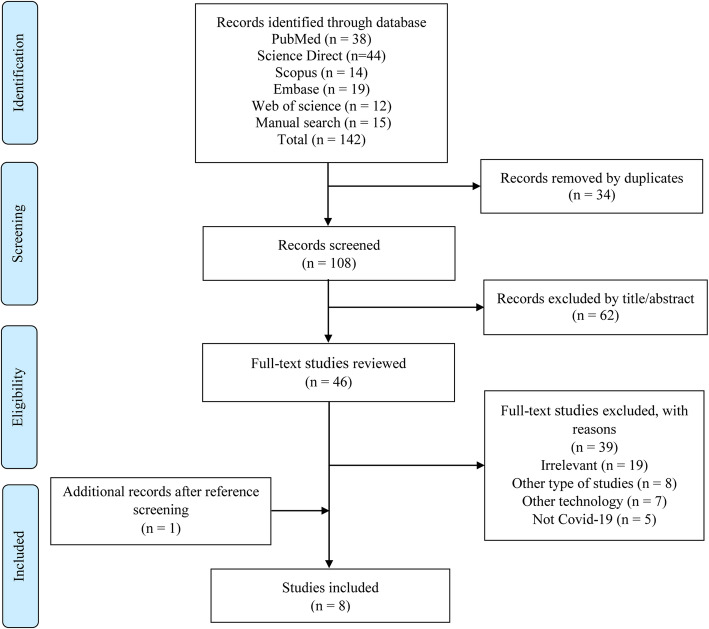
Background: The outbreak of coronavirus disease-19 (COVID-19) is a public health emergency of international concern. Telehealth is an effective option to fight the outbreak of COVID-19. The aim of this systematic review was to identify the role of telehealth services in preventing, diagnosing, treating, and controlling diseases during COVID-19 outbreak. Methods: This systematic review was conducted through searching five databases including PubMed, Scopus, Embase, Web of Science, and Science Direct. Inclusion criteria included studies clearly defining any use of telehealth services in all aspects of health care during COVID-19 outbreak, published from December 31, 2019, written in English language and published in peer reviewed journals. Two reviewers independently assessed search results, extracted data, and assessed the quality of the included studies. Quality assessment was based on the Critical Appraisal Skills Program (CASP) checklist. Narrative synthesis was undertaken to summarize and report the findings. Results: Eight studies met the inclusion out of the 142 search results. Currently, healthcare providers and patients who are self-isolating, telehealth is certainly appropriate in minimizing the risk of COVID-19 transmission. This solution has the potential to prevent any sort of direct physical contact, provide continuous care to the community, and finally reduce morbidity and mortality in COVID-19 outbreak. Conclusions: The use of telehealth improves the provision of health services. Therefore, telehealth should be an important tool in caring services while keeping patients and health providers safe during COVID-19 outbreak.
Overview
The claims and statistics of this paper haven’t been checked yet.
Free: it reads the open-access text and checks the first 5 claims that cite a source we can check. Create a free account to check every claim.
Integrity signals
Registry
Cites
Statistics
Figures
Verification
Claims the paper makes
The claims and statistics of this paper haven’t been checked yet.
Free: it reads the open-access text and checks the first 5 claims that cite a source we can check. Create a free account to check every claim.
Claims other papers make about this one
Each is checked against this paper’s own text: does it say what the citing paper says it does?
The source backs part of the claim, not all of it — or backs it for a different population, condition or comparison.
In the citing paper
“In Australia, a national study suggests that the COVID-19 pandemic considerably encouraged and promoted the use of telehealth and thanks to this window of opportunity, a lot of progress was made in the domain that, without that progress, telehealth use would have remained infrequent [50,51,52,53,54,55,56,57,58].”
From Telehealth and COVID-19 Pandemic: An Overview of the Telehealth Use, Advantages, Challenges, and Opportunities during COVID-19 Pandemic (2022) · cites this paper as [58]
Experimental — accuracy not yet measuredThe source backs part of the claim, not all of it — or backs it for a different population, condition or comparison.
In the citing paper
“In general, studies on the satisfactory level of use of telehealth services during the COVID-19 pandemic suggested it was above average by patients and health professional users and often they showed their willingness to continue with the use of telecare even after the pandemic [56,57,58,59,60,61,62].”
From Telehealth and COVID-19 Pandemic: An Overview of the Telehealth Use, Advantages, Challenges, and Opportunities during COVID-19 Pandemic (2022) · cites this paper as [58]
Experimental — accuracy not yet measuredThe source backs part of the claim, not all of it — or backs it for a different population, condition or comparison.
In the citing paper
“The pandemic has accelerated the adoption of digital health services.”
From Acceptance and perceived usefulness of digital health services in the management of chronic urticaria: a survey of patients and physicians (2025) · cites this paper as [36]
Experimental — accuracy not yet measuredThe source backs part of the claim, not all of it — or backs it for a different population, condition or comparison.
In the citing paper
“The application of digital health has rapidly grown worldwide over the past 4 decades, and accelerated particularly during the COVID-19 pandemic.[1][2][3]”
From The Digital Health Competencies in Medical Education Framework: An International Consensus Statement Based on a Delphi Study (2025) · cites this paper as [1]
Experimental — accuracy not yet measuredThe cited source says what the claim attributes to it.
In the citing paper
“TM is an important tool for health care delivery and has achieved even greater significance in the context of the COVID-19 pandemic [13,14].”
From Diagnostic Concordance of Telemedicine as Compared With Face-to-Face Care in Primary Health Care Clinics in Rural India: Randomized Crossover Trial (2023) · cites this paper as [13]
1 more claim about this paper
Create a free account to see every claim other papers make about this one.
Self-check
Percentages, sums and reported differences re-computed from the paper’s own numbers.
The self-check needs the paper’s full text.
Citations
Cites
Clinical features of patients infected with 2019 novel coronavirus in Wuhan, China
Huang, C., Wang, Y., Li, X., Ren, L., Zhao, J., Hu, Y., Zhang, L., Fan, G., Xu, J., Gu, X., et al. (2020) · The Lancet · doi:10.1016/s0140-6736(20)30183-5 · Cited by 48,884
Virtually perfect? Telemedicine for COVID-19
Hollander, J. E., & Carr, B. G. (2020) · New England Journal of Medicine · doi:10.1056/nejmp2003539 · Cited by 2,970 · cited 4×
“that is made possible by the reduction of person-toperson contact [7, 8].”
BackgroundInfluentialEarly dynamics of transmission and control of COVID-19: a mathematical modelling study
Kucharski, A. J., Russell, T. W., Diamond, C., Liu, Y., Edmunds, J., Funk, S., Eggo, R. M., Sun, F., Jit, M., Munday, J. D., et al. (2020) · The Lancet Infectious Diseases · doi:10.1016/s1473-3099(20)30144-4 · Cited by 2,671 · cited 1×
“Nowadays, the best preventive strategy is to avoid being exposed to the coronavirus, because there is no vaccine to overcome COVID-19 in the all countries [41].”
BackgroundAdhikari, S. P., Meng, S., Wu, Y.-J., Mao, Y.-P., Ye, R.-X., Wang, Q.-Z., Sun, C., Sylvia, S., Rozelle, S., Raat, H., et al. (2020) · Infectious Diseases of Poverty · doi:10.1186/s40249-020-00646-x · Cited by 2,402 · cited 1×
“of unwashed hands with eyes, nose, and mouth [42].”
BackgroundPopay, J., Roberts, H., Sowden, A., Petticrew, M., Arai, L., Rodgers, M., Britten, N., Roen, K., & Duffy, S. (2006) · Lancaster University · doi:10.13140/2.1.1018.4643 · Cited by 2,070
The mental health of medical workers in Wuhan, China dealing with the 2019 novel coronavirus.
Kang, L., Li, Y., Hu, S., Chen, M., Yang, C., Yang, B. X., Wang, Y., Hu, J., Lai, J., Ma, X., et al. (2020) · The Lancet Psychiatry · doi:10.1016/s2215-0366(20)30047-x · Cited by 2,061 · cited 1×
“Also, under strict infection control, unnecessary personnel such as clinical psychiatrists strongly refuse to enter ward of COVID-19 patients (10, 11).”
BackgroundOnline mental health services in China during the COVID-19 outbreak
Liu, S., Yang, L., Zhang, C., Xiang, Y.-T., Liu, Z., Hu, S., & Zhang, B. (2020) · The Lancet Psychiatry · doi:10.1016/s2215-0366(20)30077-8 · Cited by 1,992 · cited 1×
“During the COVID-19 outbreak in China, online mental health surveys with communication programs, such as Weibo, WeChat and TikTok have enabled mental health professionals and health authorities to render safety mental health services online during the COVID-19 pandemic [44].”
BackgroundIdentification of a new human coronavirus
van der Hoek, L., Pyrc, K., Jebbink, M. F., Vermeulen-Oost, W., Berkhout, R. J. M., Wolthers, K. C., Wertheim-van Dillen, P. M. E., Kaandorp, J., Spaargaren, J., & Berkhout, B. (2004) · Nature Medicine · doi:10.1038/nm1024 · Cited by 1,886 · cited 1×
“Coronaviruses, a genus of the coronaviridae family, may cause illness in animals or humans [1, 2].”
BackgroundTelehealth for global emergencies: Implications for coronavirus disease 2019 (COVID-19)
Smith, A. C., Thomas, E., Snoswell, C. L., Haydon, H., Mehrotra, A., Clemensen, J., & Caffery, L. J. (2020) · Journal of Telemedicine and Telecare · doi:10.1177/1357633x20916567 · Cited by 1,828 · cited 4×
“that is made possible by the reduction of person-toperson contact [7, 8].”
BackgroundInfluentialReview of the Clinical Characteristics of Coronavirus Disease 2019 (COVID-19)
Jiang, F., Deng, L., Zhang, L., Cai, Y., Cheung, C. W., & Xia, Z. (2020) · Journal of General Internal Medicine · doi:10.1007/s11606-020-05762-w · Cited by 1,410 · cited 1×
“Primitive symptoms of COVID-19 contain fever, dry cough, breathing difficulty, and boredom [4, 5].”
BackgroundTelehealth and patient satisfaction: a systematic review and narrative analysis
Kruse, C. S., Krowski, N., Rodriguez, B., Tran, L., Vela, J., & Brooks, M. (2017) · BMJ Open · doi:10.1136/bmjopen-2017-016242 · Cited by 1,350 · cited 1×
“The use of telehealth technology is a twenty-first century approach that is both patient-centered and protects patients, physicians, as well as others [16, 17].”
BackgroundDefining the Epidemiology of Covid-19 — Studies Needed
Lipsitch, M., Swerdlow, D. L., & Finelli, L. (2020) · New England Journal of Medicine · doi:10.1056/nejmp2002125 · Cited by 1,248 · cited 1×
“The disease originated in Wuhan, China, and has spread widely to other countries (3).”
BackgroundProgression of Mental Health Services during the COVID-19 Outbreak in China
Li, W., Yang, Y., Liu, Z.-H., Zhao, Y.-J., Zhang, Q., Zhang, L., Cheung, T., & Xiang, Y.-T. (2020) · International Journal of Biological Sciences · doi:10.7150/ijbs.45120 · Cited by 1,213 · cited 2×
“Also, the National Health Commission of China have published several online guideline and free electronic books about COVID-19 with the aim of helping the progress of Chinese people emergency interventions, safety, improving the quality and effectiveness of emergency interventions [10].”
BackgroundDorsey, E. R., & Topol, E. J. (2016) · New England Journal of Medicine · doi:10.1056/nejmra1601705 · Cited by 1,211
The Role of Telehealth in Reducing the Mental Health Burden from COVID-19
Zhou, X., Snoswell, C. L., Harding, L. E., Bambling, M., Edirippulige, S., Bai, X., & Smith, A. C. (2020) · Telemedicine and e-Health · doi:10.1089/tmj.2020.0068 · Cited by 1,159 · cited 3×
“Although the ultimate solution for COVID-19 will be multifaceted, it is one of the effective ways to use existing technologies to facilitate optimal service delivery while minimizing the hazard of direct person-to-person exposure [7, 14].”
BackgroundWax, R. S., & Christian, M. D. (2020) · Canadian Journal of Anesthesia/Journal canadien d'anesthésie · doi:10.1007/s12630-020-01591-x · Cited by 1,026 · cited 1×
“In this respect, technological advances provide new options [13].”
BackgroundVideo consultations for covid-19
Greenhalgh, T., Wherton, J., Shaw, S., & Morrison, C. (2020) · BMJ · doi:10.1136/bmj.m998 · Cited by 866 · cited 3×
“Furthermore, some physicians are concerned about technical and clinical quality, privacy, safety and accountability (23, 30).”
BackgroundCovid-19: a remote assessment in primary care
Greenhalgh, T., Koh, G. C. H., & Car, J. (2020) · BMJ · doi:10.1136/bmj.m1182 · Cited by 705 · cited 1×
“Furthermore, some physicians are concerned about technical and clinical quality, privacy, safety and accountability (23, 30).”
BackgroundTelemedicine in the era of COVID-19
Portnoy, J., Waller, M., & Elliott, T. (2020) · The Journal of Allergy and Clinical Immunology In Practice · doi:10.1016/j.jaip.2020.03.008 · Cited by 616
Reeves, J. J., Hollandsworth, H. M., Torriani, F. J., Taplitz, R., Abeles, S., Tai-Seale, M., Millen, M., Clay, B. J., & Longhurst, C. A. (2020) · Journal of the American Medical Informatics Association · doi:10.1093/jamia/ocaa037 · Cited by 429 · cited 2×
“Based on the study conducted in the USA, phone calls and electronic health records (EHR) can facilitates screening or treating a patient without the need for inperson visits and improve decision making process among healthcare team in an ambulatory and urgent care [35].”
BackgroundRyu, S. (2012) · Healthcare Informatics Research · doi:10.4258/hir.2012.18.2.153 · Cited by 422
Bradford, N., Caffery, L., & Smith, A. (2016) · Rural and Remote Health · doi:10.22605/rrh3808 · Cited by 336 · cited 1×
“Telehealth services are delivered using real-time or store-and-forward techniques (19).”
BackgroundCOVID-19: Pandemic Contingency Planning for the Allergy and Immunology Clinic
Shaker, M. S., Oppenheimer, J., Grayson, M., Stukus, D., Hartog, N., Hsieh, E. W. Y., Rider, N., Dutmer, C. M., Vander Leek, T. K., Kim, H., et al. (2020) · The Journal of Allergy and Clinical Immunology: In Practice · doi:10.1016/j.jaip.2020.03.012 · Cited by 331 · cited 2×
“Greenhawt/ 26/03/2020 [38] USA, Canada Crosssectional Telephone, electronic medical record, patient portal messaging, digital photography, video using a HIPAA-compliant platform, website • Delivering allergy services • Phone triage as available options in allergic rhinitis • Provide telehealth visits • Follow-up visit…”
A randomized trial of telemedicine-based collaborative care for depression
Fortney, J. C., Pyne, J. M., Edlund, M. J., Williams, D. K., Robinson, D. E., Mittal, D., & Henderson, K. L. (2007) · Journal of General Internal Medicine · doi:10.1007/s11606-007-0201-9 · Cited by 315 · cited 1×
“There are various benefits in using technology of telehealth, especially in non-emergency / routine care and in cases where services do not require direct patientprovider interaction, such as providing psychological services [24].”
BackgroundChauhan, V., Galwankar, S., Arquilla, B., Garg, M., Somma, S., El-Menyar, A., Krishnan, V., Gerber, J., Holland, R., & Stawicki, S. (2020) · Journal of Emergencies Trauma and Shock · doi:10.4103/jets.jets_32_20 · Cited by 234 · cited 2×
“Natural disasters and epidemics pose many challenges in providing health care [12].”
BackgroundCOVID-19: Global radiation oncology’s targeted response for pandemic preparedness
Simcock, R., Thomas, T. V., Estes, C., Filippi, A. R., Katz, M. S., Pereira, I. J., & Saeed, H. (2020) · Clinical and Translational Radiation Oncology · doi:10.1016/j.ctro.2020.03.009 · Cited by 230 · cited 2×
“in multiple cancer settings including lung, endometrial, colorectal, and prostate [37].”
BackgroundJiang, X., Deng, L., Zhu, Y., Ji, H., Tao, L., Liu, L., Yang, D., & Ji, W. (2020) · Psychiatry Research · doi:10.1016/j.psychres.2020.112903 · Cited by 209 · cited 1×
“Chinese government officials launched a remote consultation network that can be carried out internet or telephone consultations in a safe setting to ensure the continuous provision of mental health services and reduce the hazard of cross infections [45].”
BackgroundUtilization of Telemedicine Among Rural Medicare Beneficiaries
Mehrotra, A., Jena, A. B., Busch, A. B., Souza, J., Uscher-Pines, L., & Landon, B. E. (2016) · JAMA · doi:10.1001/jama.2016.2186 · Cited by 187
Zhou, T., Huang, S., Cheng, J., & Xiao, Y. (2020) · Telemedicine and e-Health · doi:10.1089/tmj.2020.0079 · Cited by 165
Action at a distance: geriatric research during a pandemic
Nicol, G. E., Piccirillo, J. F., Mulsant, B. H., & Lenze, E. J. (2020) · Journal of the American Geriatrics Society · doi:10.1111/jgs.16443 · Cited by 156 · cited 2×
“/ 24/03/2020 [36] USA, Canada Crosssectional Social media or other digital platforms including telephone, email and videoconferencing • Facilitating electronic informed consent, digital assessment tools and virtual study visits • E-consent, remote assessment, and telephone or videoconference visits • Provide e-consult…”
BackgroundShaw, S. E., Seuren, L. M., Wherton, J., Cameron, D., A'Court, C., Vijayaraghavan, S., Morris, J., Bhattacharya, S., & Greenhalgh, T. (2020) · Journal of Medical Internet Research · doi:10.2196/18378 · Cited by 155
Telemedicine: Potential applications in epidemic situations
Ohannessian, R. (2015) · European Research in Telemedicine / La Recherche Européenne en Télémédecine · doi:10.1016/j.eurtel.2015.08.002 · Cited by 151
Yang, Y., Zhou, Y., Liu, X., & Tan, J. (2020) · Clinical Oral Investigations · doi:10.1007/s00784-020-03267-8 · Cited by 134 · cited 2×
“In addition to taking actions to protect the health and safety of patients, also staff should take mobile health technology to develop staffing plans and carry out billing for healthcare services [39].”
BackgroundTelemedicine can lower costs and improve access.
Charles, B. L. (2000) · PubMed · Cited by 124
Davarpanah, A. H., Mahdavi, A., Sabri, A., Langroudi, T. F., Kahkouee, S., Haseli, S., Kazemi, M. A., Mehrian, P., Mahdavi, A., Falahati, F., et al. (2020) · Journal of the American College of Radiology · doi:10.1016/j.jacr.2020.03.015 · Cited by 82
Sauers‐Ford, H. S., Hamline, M. Y., Gosdin, M. M., Kair, L. R., Weinberg, G. M., Marcin, J. P., & Rosenthal, J. L. (2019) · Academic Emergency Medicine · doi:10.1111/acem.13763 · Cited by 81
From Isolation to Coordination: How Can Telemedicine Help Combat the COVID-19 Outbreak?Preprint
Zhai, Y., Wang, Y., Zhang, M., Gittell, J. H., Jiang, S., Chen, B., Cui, F., He, X., Zhao, J., & Wang, X. (2020) · medRxiv · doi:10.1101/2020.02.20.20025957 · Cited by 80 · cited 2×
“Live video conferencing can lead to the avoidance of direct physical contact, thereby diminishing the hazard of exposure to respiratory secretions, preventing the potential transmission of infection to physicians and other health staffs (34).”
BackgroundEthics of Outbreaks Position Statement. Part 2: Family-Centered Care
Papadimos, T. J., Marcolini, E. G., Hadian, M., Hardart, G. E., Ward, N., Levy, M. M., Stawicki, S. P., & Davidson, J. E. (2018) · Critical Care Medicine · doi:10.1097/ccm.0000000000003363 · Cited by 56 · cited 1×
“appointed and enforced around the world, and most cities have been quarantined [9].”
BackgroundMorenz, A. M., Wescott, S., Mostaghimi, A., Sequist, T. D., & Tobey, M. L. (2019) · JAMA Dermatology · doi:10.1001/jamadermatol.2019.0872 · Cited by 48 · cited 1×
“telehealth, but hindrances still exist [28, 29].”
Use of Smartphones for Clinical and Medical Education
Valle, J., Godby, T., Paul, D. P., Smith, H., & Coustasse, A. (2017) · The Health Care Manager · doi:10.1097/hcm.0000000000000176 · Cited by 46 · cited 1×
“With the rapid evolution and downsizing of portable electronics, most families have at least one device of digital, such as smartphones [20] and webcams that provide communication between patient and healthcare provider [21].”
BackgroundCOVID‐19 outbreak represents a new way of mental health service delivery
Canady, V. A. (2020) · Mental Health Weekly · doi:10.1002/mhw.32282 · Cited by 39 · cited 1×
“Physicians who are in quarantine can employ these services to take care of their patients remotely [8, 22].”
BackgroundSmartphones and Medical Applications in the Emergency Department Daily Practice.
Jahanshir, A., Karimialavijeh, E., Sheikh, H., Vahedi, M., & Momeni, M. (2017) · PubMed Central · Cited by 36
(2006)
Cited by
Health systems resilience in managing the COVID-19 pandemic: lessons from 28 countries
Haldane, V., De Foo, C., Abdalla, S. M., Jung, A.-S., Tan, M., Wu, S., Chua, A., Verma, M., Shrestha, P., Singh, S., et al. (2021) · Nature Medicine · doi:10.1038/s41591-021-01381-y · Cited by 1,264
Effective public health measures to mitigate the spread of COVID-19: a systematic review
Ayouni, I., Maatoug, J., Dhouib, W., Zammit, N., Fredj, S. B., Ghammam, R., & Ghannem, H. (2021) · BMC Public Health · doi:10.1186/s12889-021-11111-1 · Cited by 418
Omboni, S., Padwal, R. S., Alessa, T., Benczúr, B., Green, B. B., Hubbard, I., Kario, K., Khan, N. A., Konradi, A., Logan, A. G., et al. (2022) · Connected Health · doi:10.20517/ch.2021.03 · Cited by 370
Wearable sensors for telehealth based on emerging materials and nanoarchitectonics
Vaghasiya, J. V., Mayorga-Martinez, C. C., & Pumera, M. (2023) · npj Flexible Electronics · doi:10.1038/s41528-023-00261-4 · Cited by 302
Challenges of Telemedicine during the COVID-19 pandemic: a systematic review
Ftouni, R., AlJardali, B., Hamdanieh, M., Ftouni, L., & Salem, N. (2022) · BMC Medical Informatics and Decision Making · doi:10.1186/s12911-022-01952-0 · Cited by 291
“Telemedicine offers the public an efficient and safe way to consult healthcare professionals about the symptoms of infectious diseases, prevention and treatment measures, psychological troubles, and other issues [8].”
Metadata
- Authors
- Monaghesh, E., & Hajizadeh, A.
- Affiliations
- Tabriz University of Medical Sciences (IR)
- Corresponding author
- Hajizadeh, Alireza
- Venue
- BMC Public Health
- Published
- 2020-08-01
- Volume
- 20
- Issue
- 1
- Pages
- 1193-1193
- ISSN
- 1471-2458 (ISSN-L)
- PMC
- PMC7395209
- OpenAlex
- W3046280637
- Cited by
- 1,941
- References
- 43
- Citations by year
- 2026: 117 · 2025: 246 · 2024: 297 · 2023: 392 · 2022: 502 · 2021: 354 · 2020: 31
- FWCI
- 53.44
- Type
- journal article
- Language
- en
- Open access
- gold
- doi.org
- Licence
- cc-by
- creativecommons.org/licenses/by/4.0 (tdm)
- creativecommons.org/licenses/by/4.0 (vor)
- Locations
- BMC Public Health (publishedVersion, cc-by)
- Research Square (acceptedVersion, cc-by)
- PubMed Central (publishedVersion, cc-by)
- PubMed (publishedVersion)
- DOAJ (DOAJ: Directory of Open Access Journals) (submittedVersion, cc-by-sa)
- Topics
- Health Sciences › Medicine › Public Health, Environmental and Occupational Health › Telemedicine and Telehealth Implementation
- Health Sciences › Dentistry › General Dentistry › Dental Research and COVID-19
- Physical Sciences › Computer Science › Information Systems › Healthcare during COVID-19 Pandemic
- Keywords
- telemedicine, COVID-19 pandemic, telehealth services, COVID-19 prevention, COVID-19 diagnosis, COVID-19 treatment, disease control, self-isolation, infection transmission prevention, continuity of care
- MeSH terms
- COVID-19, Disease Outbreaks, Humans, Pneumonia, Viral, Telemedicine, Coronavirus Infections, Pandemics
About these checks
Registry, retraction, Cites and statistics results are computed, not judged, with one exception: a printed reference that no index lists is read once by a model before it counts as a citation error. Claims are extracted by a model and kept only when their quote appears verbatim in the text; each cited source is then checked, with a model’s help, for whether it says what the claim relies on. Those verdicts can be wrong — read the claim’s quote and the cited source before relying on one.
Statistics and arithmetic are recomputed, not judged.
Confidence bands are shown only for fields calibrated on our annotated test set. None is calibrated yet, so no band is shown.
What counts as a claim ›How we measure confidence ›How we check this ›
Are you an author, or do you see a problem with this page? Request a review
Data sources
Bibliographic data: Semantic Scholar, OpenAlex, Crossref.
Contains information from the Semantic Scholar Academic Graph Datasets, made available under the ODC Attribution License (ODC-BY 1.0).
Semantic Scholar’s data is described in: Kinney, R., et al. (2023). The Semantic Scholar Open Data Platform. arXiv:2301.10140.
