

What predicts people’s belief in COVID-19 misinformation? A retrospective study using a nationwide online survey among adults residing in the United States
The DOI matches its Crossref record; 52 of the 52 references it cites were found in a registry or an index.
Abstract
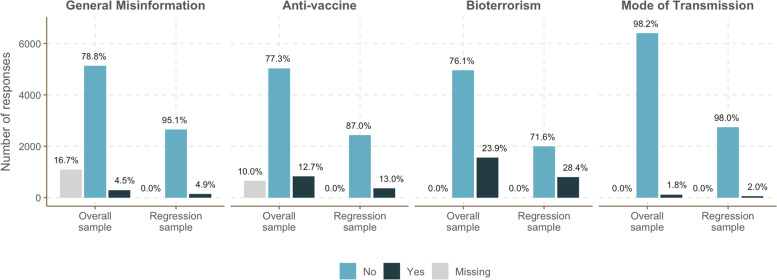
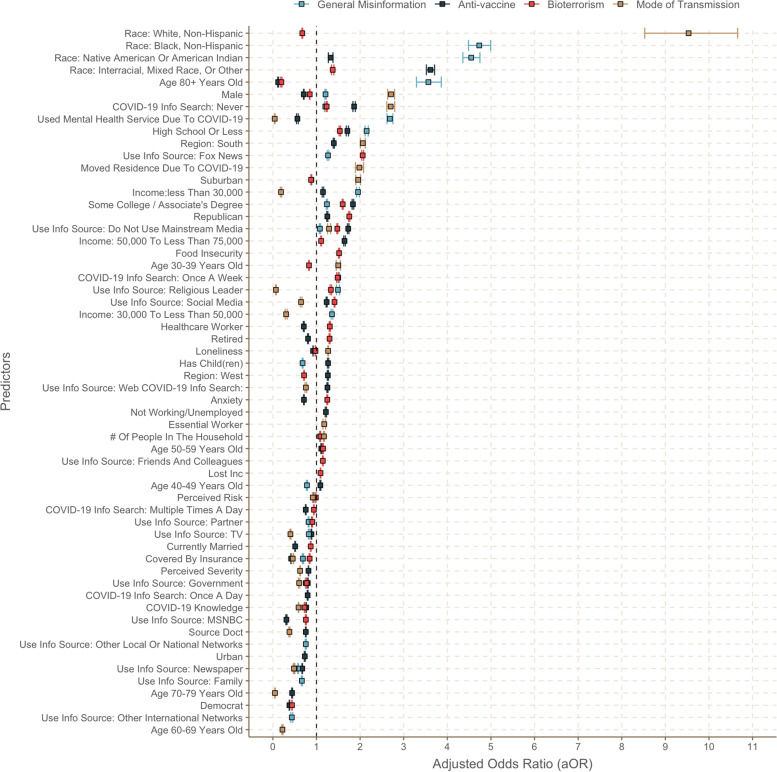
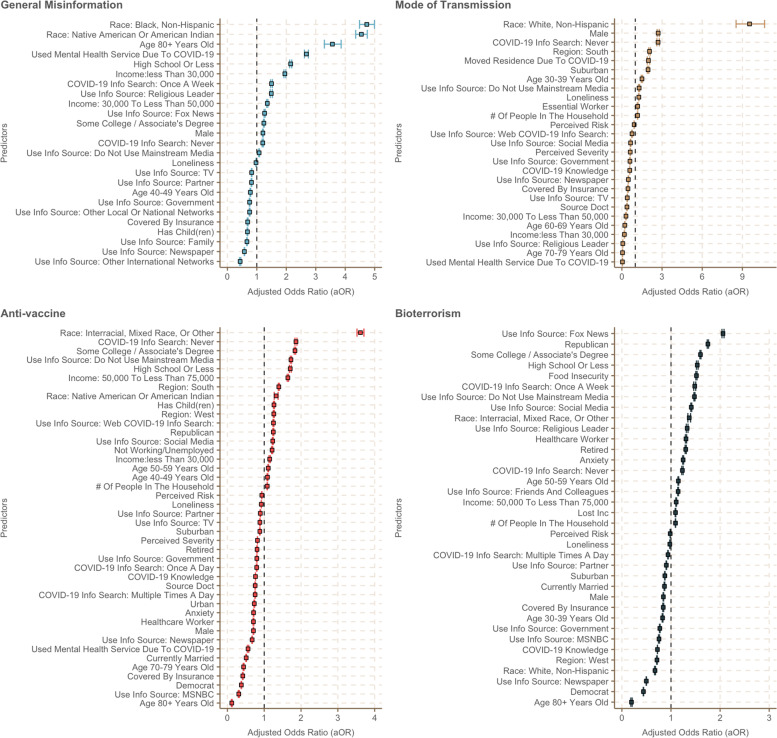
Background: Tackling infodemics with flooding misinformation is key to managing the COVID-19 pandemic. Yet only a few studies have attempted to understand the characteristics of the people who believe in misinformation. Methods: Data was used from an online survey that was administered in April 2020 to 6518 English-speaking adult participants in the United States. We created binary variables to represent four misinformation categories related to COVID-19: general COVID-19-related, vaccine/anti-vaccine, COVID-19 as an act of bioterrorism, and mode of transmission. Using binary logistic regression and the LASSO regularization, we then identified the important predictors of belief in each type of misinformation. Nested vector bootstrapping approach was used to estimate the standard error of the LASSO coefficients. Results: About 30% of our sample reported believing in at least one type of COVID-19-related misinformation. Belief in one type of misinformation was not strongly associated with belief in other types. We also identified 58 demographic and socioeconomic factors that predicted people’s susceptibility to at least one type of COVID-19 misinformation. Different groups, characterized by distinct sets of predictors, were susceptible to different types of misinformation. There were 25 predictors for general COVID-19 misinformation, 42 for COVID-19 vaccine, 36 for COVID-19 as an act of bioterrorism, and 27 for mode of COVID-transmission. Conclusion: Our findings confirm the existence of groups with unique characteristics that believe in different types of COVID-19 misinformation. Findings are readily applicable by policymakers to inform careful targeting of misinformation mitigation strategies.
Overview
The claims and statistics of this paper haven’t been checked yet.
Free: it reads the open-access text and checks the first 5 claims that cite a source we can check. Create a free account to check every claim.
Integrity signals
Registry
Cites
Statistics
Figures
Verification
Claims the paper makes
The claims and statistics of this paper haven’t been checked yet.
Free: it reads the open-access text and checks the first 5 claims that cite a source we can check. Create a free account to check every claim.
Claims other papers make about this one
Each is checked against this paper’s own text: does it say what the citing paper says it does?
The source backs part of the claim, not all of it — or backs it for a different population, condition or comparison.
In the citing paper
“These indicators mirror the factors contributing to belief in misinformation and greater susceptibility to getting COVID-19.2,3,7”
From A Pandemic of Misinformation: Understanding Influences on Beliefs in Health and Conspiracy Myths (2025) · cites this paper as [2]
Experimental — accuracy not yet measuredThe cited source says what the claim attributes to it.
In the citing paper
“Belief in misinformation can negatively impact health.2,6”
From A Pandemic of Misinformation: Understanding Influences on Beliefs in Health and Conspiracy Myths (2025) · cites this paper as [2]
The cited source says what the claim attributes to it.
In the citing paper
“Additionally, people who used Fox News, a religious leader, or social media were more likely to believe in COVID-19-related misinformation compared to people who used a newspaper or a government website.2”
From A Pandemic of Misinformation: Understanding Influences on Beliefs in Health and Conspiracy Myths (2025) · cites this paper as [2]
In the citing paper
“A study examining factors that predict COVID-19 misinformation beliefs found that people with lower education, reported being Black or Hispanic, were residents of Southern US, and identified as Republican were more likely to believe in COVID-19-related misinformation.2”
From A Pandemic of Misinformation: Understanding Influences on Beliefs in Health and Conspiracy Myths (2025) · cites this paper as [2]
In the citing paper
“Dissemination of misinformation creates distrust in public health initiatives, leading to poor health-related decisions and worse public health outcomes.2”
From A Pandemic of Misinformation: Understanding Influences on Beliefs in Health and Conspiracy Myths (2025) · cites this paper as [2]
Self-check
Percentages, sums and reported differences re-computed from the paper’s own numbers.
The self-check needs the paper’s full text.
Citations
Cites
An Introduction to Statistical Learning
James, G., Witten, D., Hastie, T., & Tibshirani, R. (2013) · Springer Texts in Statistics · doi:10.1007/978-1-4614-7138-7 · Cited by 12,106
The Health Belief Model and Preventive Health Behavior
Rosenstock, I. M. (1974) · Health Education Monographs · doi:10.1177/109019817400200405 · Cited by 3,643
The adequacy of response rates to online and paper surveys: what can be done?
Nulty, D. D. (2008) · Assessment & Evaluation in Higher Education · doi:10.1080/02602930701293231 · Cited by 2,581
Zarocostas, J. (2020) · The Lancet · doi:10.1016/s0140-6736(20)30461-x · Cited by 2,344
Flexible Imputation of Missing Data, Second Edition
van Buuren, S. (2018) · doi:10.1201/9780429492259 · Cited by 2,273
Defining “Fake News”: A typology of scholarly definitions
Tandoc, E. C., Lim, Z. W., & Ling, R. (2018) · Digital Journalism · doi:10.1080/21670811.2017.1360143 · Cited by 2,172
Shaping perceptions to motivate healthy behavior: The role of message framing.
Rothman, A. J., & Salovey, P. (1997) · Psychological Bulletin · doi:10.1037/0033-2909.121.1.3 · Cited by 1,932
Systematic Literature Review on the Spread of Health-related Misinformation on Social Media
Wang, Y., McKee, M., Torbica, A., & Stuckler, D. (2019) · Social Science & Medicine · doi:10.1016/j.socscimed.2019.112552 · Cited by 1,806
Measuring the impact of COVID-19 vaccine misinformation on vaccination intent in the UK and USA
Loomba, S., de Figueiredo, A., Piatek, S. J., de Graaf, K., & Larson, H. J. (2021) · Nature Human Behaviour · doi:10.1038/s41562-021-01056-1 · Cited by 1,800 · cited 2×
“Moreover, misinformation impacted sociodemographic groups differently [5].”
BackgroundFactors affecting response rates of the web survey: A systematic review
Fan, W., & Yan, Z. (2010) · Computers in Human Behavior · doi:10.1016/j.chb.2009.10.015 · Cited by 1,521
Susceptibility to misinformation about COVID-19 around the world
Roozenbeek, J., Schneider, C. R., Dryhurst, S., Kerr, J., Freeman, A. L. J., Recchia, G., van der Bles, A. M., & van der Linden, S. (2020) · Royal Society Open Science · doi:10.1098/rsos.201199 · Cited by 1,447 · cited 5×
“Second, we explored people’s belief in different types of misinformation, informed by the published literature [15, 17, 29, 31], rather than aggregating misinformation into a single index.”
BackgroundMethodInfluentialThe psychological drivers of misinformation belief and its resistance to correction
Ecker, U. K. H., Lewandowsky, S., Cook, J., Schmid, P., Fazio, L. K., Brashier, N., Kendeou, P., Vraga, E. K., & Amazeen, M. A. (2022) · Nature Reviews Psychology · doi:10.1038/s44159-021-00006-y · Cited by 1,372 · cited 2×
“This observed difference may be explained by the existence of diverse psychological factors [48] that influence people’s tendency to fall for misinformation and their complex interactions with the environmental and sociodemographic factors, which calls for further research dedicated to this topic.”
BackgroundResultPublic health and online misinformation: challenges and recommendations
Swire-Thompson, B., & Lazer, D. (2020) · Annual Review of Public Health · doi:10.1146/annurev-publhealth-040119-094127 · Cited by 1,170
Tailored and Targeted Health Communication: Strategies for Enhancing Information Relevance
Kreuter, M. W., & Wray, R. J. (2003) · American Journal of Health Behavior · doi:10.5993/ajhb.27.1.s3.6 · Cited by 1,095
Addressing Health-Related Misinformation on Social Media
Chou, W.-Y. S., Oh, A., & Klein, W. M. P. (2018) · JAMA · doi:10.1001/jama.2018.16865 · Cited by 933
A meta-analysis of studies of the Health Belief Model with adults
Harrison, J. A., Mullen, P. D., & Green, L. W. (1992) · Health Education Research · doi:10.1093/her/7.1.107 · Cited by 806
See Something, Say Something: Correction of Global Health Misinformation on Social Media
Bode, L., & Vraga, E. K. (2018) · Health Communication · doi:10.1080/10410236.2017.1331312 · Cited by 745
Impact of Rumors and Misinformation on COVID-19 in Social Media
Tasnim, S., Hossain, M. M., & Mazumder, H. (2020) · Journal of Preventive Medicine and Public Health · doi:10.3961/jpmph.20.094 · Cited by 719
Types, sources, and claims of Covid-19 misinformation
Brennen, J. S., Simon, F., Howard, P., & Nielsen, R. (2023) · Reuters Institute for the Study of Journalism · doi:10.60625/risj-awvq-sr55 · Cited by 663
Dead and Alive: Beliefs in Contradictory Conspiracy Theories
Wood, M. J., Douglas, K. M., & Sutton, R. M. (2012) · Social Psychological and Personality Science · doi:10.1177/1948550611434786 · Cited by 660
COVID-19 and the policy sciences: initial reactions and perspectives
Weible, C. M., Nohrstedt, D., Cairney, P., Carter, D. P., Anderson, D., Durnová, A. P., Heikkila, T., Ingold, K., McConnell, A., & Stone, D. (2020) · Policy Sciences · doi:10.1007/s11077-020-09381-4 · Cited by 602 · cited 1×
“Background The COVID-19 infodemic, defined as “too much information including false or misleading information in digital and physical environments during a disease outbreak,” [1] has been one of the primary impediments to curbing the persisting COVID-19 pandemic by polarizing opinions and affecting compliance with pub…”
BackgroundReliance on emotion promotes belief in fake news
Martel, C., Pennycook, G., & Rand, D. G. (2020) · Cognitive Research: Principles and Implications · doi:10.1186/s41235-020-00252-3 · Cited by 470 · cited 1×
“The lack of strong correlation between beliefs in different types of misinformation is particularly interesting as it contradicts some prior literature that either showed strong positive associations between beliefs in mutually exclusive conspiracy theories [46] or described common psychological factors or mechanisms…”
ResultBridgman, A., Merkley, E., Loewen, P. J., Owen, T., Ruths, D., Teichmann, L., & Zhilin, O. (2020) · Harvard Kennedy School Misinformation Review · doi:10.37016/mr-2020-028 · Cited by 419
Barua, Z., Barua, S., Aktar, S., Kabir, N., & Li, M. (2020) · Progress in Disaster Science · doi:10.1016/j.pdisas.2020.100119 · Cited by 407
An exploratory study of COVID-19 misinformation on Twitter
Shahi, G. K., Dirkson, A., & Majchrzak, T. A. (2021) · Online Social Networks and Media · doi:10.1016/j.osnem.2020.100104 · Cited by 352
Lee, J. J., Kang, K.-A., Wang, M. P., Zhao, S. Z., Wong, J. Y. H., O'Connor, S., Yang, S. C., & Shin, S. (2020) · Journal of Medical Internet Research · doi:10.2196/22205 · Cited by 317
The Impact of Communications on the Self-Regulation of Health Beliefs, Decisions, and Behavior
Leventhal, H., Safer, M. A., & Panagis, D. M. (1983) · Health Education Quarterly · doi:10.1177/109019818301000101 · Cited by 296
Fighting an Infodemic: COVID-19 Fake News Dataset
Patwa, P., Sharma, S., Pykl, S., Guptha, V., Kumari, G., Akhtar, M. S., Ekbal, A., Das, A., & Chakraborty, T. (2021) · Communications in Computer and Information Science · doi:10.1007/978-3-030-73696-5_3 · Cited by 271
Ali, S. H., Foreman, J., Capasso, A., Jones, A. M., Tozan, Y., & DiClemente, R. J. (2020) · BMC Medical Research Methodology · doi:10.1186/s12874-020-01011-0 · Cited by 247
Self-citationMisinformation as a Misunderstood Challenge to Public Health
Southwell, B. G., Niederdeppe, J., Cappella, J. N., Gaysynsky, A., Kelley, D. E., Oh, A., Peterson, E. B., & Chou, W.-Y. S. (2019) · American Journal of Preventive Medicine · doi:10.1016/j.amepre.2019.03.009 · Cited by 243
Key Guidelines in Developing a Pre-Emptive COVID-19 Vaccination Uptake Promotion Strategy
French, J., Deshpande, S., Evans, W., & Obregon, R. (2020) · International Journal of Environmental Research and Public Health · doi:10.3390/ijerph17165893 · Cited by 199
SNP Selection in genome‐wide and candidate gene studies via penalized logistic regression
Ayers, K. L., & Cordell, H. J. (2010) · Genetic Epidemiology · doi:10.1002/gepi.20543 · Cited by 197
Ideal and Maximum Length for a Web Survey
Revilla, M., & Ochoa, C. (2017) · International Journal of Market Research · doi:10.2501/ijmr-2017-039 · Cited by 195
The different forms of COVID-19 misinformation and their consequences
Enders, A. M., Uscinski, J. E., Klofstad, C., & Stoler, J. (2020) · Harvard Kennedy School Misinformation Review · doi:10.37016/mr-2020-48 · Cited by 193
Evaluating Deep Learning Approaches for Covid19 Fake News Detection
Wani, A., Joshi, I., Khandve, S., Wagh, V., & Joshi, R. B. (2021) · Communications in computer and information science · doi:10.1007/978-3-030-73696-5_15 · Cited by 189
Deal, A., Hayward, S. E., Huda, M., Knights, F., Crawshaw, A. F., Carter, J., Hassan, O. B., Farah, Y., Ciftci, Y., Rowland-Pomp, M., et al. (2021) · Journal of Migration and Health · doi:10.1016/j.jmh.2021.100050 · Cited by 155
A variable selection method for genome-wide association studies
He, Q., & Lin, D. Y. (2010) · Bioinformatics · doi:10.1093/bioinformatics/btq600 · Cited by 155
Lies Kill, Facts Save: Detecting COVID-19 Misinformation in Twitter
Al-Rakhami, M. S., & Al-Amri, A. M. (2020) · IEEE Access · doi:10.1109/access.2020.3019600 · Cited by 153
COVID-19 misinformation and the 2020 U.S. presidential election
Chen, E., Chang, H., Rao, A., Lerman, K., Cowan, G., & Ferrara, E. (2021) · Harvard Kennedy School Misinformation Review · doi:10.37016/mr-2020-57 · Cited by 95
Factors Predicting Willingness to Share COVID-19 Misinformation
Lobato, E. J. C., Powell, M., Padilla, L., & Holbrook, C. (2020) · Frontiers in Psychology · doi:10.3389/fpsyg.2020.566108 · Cited by 86
Analysis of multilocus models of association
Devlin, B., Roeder, K., & Wasserman, L. (2003) · Genetic Epidemiology · doi:10.1002/gepi.10237 · Cited by 78
Different types of COVID-19 misinformation have different emotional valence on Twitter
Charquero‐Ballester, M., Walter, J. G., Nissen, I. A., & Bechmann, A. (2021) · Big Data & Society · doi:10.1177/20539517211041279 · Cited by 68
Prevalence and source analysis of COVID-19 misinformation in 138 countries
Al-Zaman, M. S. (2021) · IFLA Journal · doi:10.1177/03400352211041135 · Cited by 59
Model Generalization on COVID-19 Fake News Detection
Bang, Y., Ishii, E., Cahyawijaya, S., Ji, Z., & Fung, P. (2021) · Communications in Computer and Information Science · doi:10.1007/978-3-030-73696-5_13 · Cited by 52
Anxiety and public responses to covid-19: Early data from Thailand
Goodwin, R. B., Wiwattanapantuwong, J., Tuicomepee, A., Suttiwan, P., & Watakakosol, R. (2020) · Journal of Psychiatric Research · doi:10.1016/j.jpsychires.2020.06.026 · Cited by 50
The use of vector bootstrapping to improve variable selection precision in Lasso models
Laurin, C., Boomsma, D. I., & Lubke, G. H. (2016) · Statistical Applications in Genetics and Molecular Biology · doi:10.1515/sagmb-2015-0043 · Cited by 49
Olapeju, B., Hendrickson, Z. M., Rosen, J. G., Shattuck, D. C., Storey, J. D., Krenn, S., Shaivitz, M., Serlemitsos, E., Tseng, T., Tsang, S. W., et al. (2021) · PLOS Global Public Health · doi:10.1371/journal.pgph.0000049 · Cited by 33
Szebeni, Z., Lönnqvist, J., & Jasinskaja‐Lahti, I. (2021) · Frontiers in Psychology · doi:10.3389/fpsyg.2021.790848 · Cited by 32
Kim, S., Capasso, A., Cook, S., Ali, S. H., Jones, A. M., Foreman, J., DiClemente, R. J., & Tozan, Y. (2021) · PLoS ONE · doi:10.1371/journal.pone.0260643 · Cited by 24
Self-citationThéllier, M., Houzé, S., Pradine, B., Piarroux, R., Musset, L., Kendjo, É., & French Imported Malaria Study Group (2022) · JAMIA Open · doi:10.1093/jamiaopen/ooac012 · Cited by 2
The Disproportionate Burden of COVID-19 for Immigrants in the Bronx, New York
Ross, J., Diaz, C. M., & Starrels, J. L. (2020) · JAMA Internal Medicine · doi:10.1001/jamainternmed.2020.2131
Bastick, Z., & Mallet, M. (2021) · SSRN Electronic Journal · doi:10.2139/ssrn.3883432
Research works printed but not linked: 6
- Pan American Health Organization Understanding the infodemic and misinformation in the fight against COVID-19 2020
- Mitchell A Oliphant JB Americans immersed in COVID-19 news; most think media are doing fairly well covering it 2020
- Evanega S Lynas M Adams J Smolenyak K Insights CG Coronavirus misinformation: quantifying sources and themes in the COVID-19 ‘infodemic’ JMIR Preprints 2020 19 10 2020
- Hossain T Logan RL IV Ugarte A Matsubara Y Young S Singh S COVIDLies: detecting COVID-19 misinformation on social media 2020
- Hastie T, Qian J. Glmnet vignette. Retrieved June 2014;9(2016):1–30.
- Gambino CP Acosta YD Grieco EM English-speaking ability of the foreign-born population in the United States: 2012 2014 Washinton, D.C. U.S. Census Bureau
Cited by
Kisa, S., & Kisa, A. (2024) · Journal of Medical Internet Research · doi:10.2196/56931 · Cited by 132
“These approaches involve targeting specific misinformed subgroups [26], using infographics to clarify scientific processes [14], and focusing on community protection while reframing reckless behaviors [22].”
InfluentialA Pandemic of Misinformation: Understanding Influences on Beliefs in Health and Conspiracy Myths
Carletto, E., Carson, K. A., Yeh, H.-C., Dietz, K., Showell, N., Marsteller, J. A., & Cooper, L. A. (2025) · Journal of General Internal Medicine · doi:10.1007/s11606-024-08867-8 · Cited by 15
Metadata
- Authors
- Kim, S., Capasso, A., Ali, S. H., Headley, T., DiClemente, R. J., & Tozan, Y.
- Venue
- BMC Public Health
- Published
- 2022-11-18
- Volume
- 22
- Issue
- 1
- ISSN
- 1471-2458
- PMC
- PMC9673212
- Cited by
- 24
- References
- 52
- Language
- en
- Licence
- creativecommons.org/licenses/by/4.0 (tdm)
- creativecommons.org/licenses/by/4.0 (vor)
About these checks
Registry, retraction, Cites and statistics results are computed, not judged, with one exception: a printed reference that no index lists is read once by a model before it counts as a citation error. Claims are extracted by a model and kept only when their quote appears verbatim in the text; each cited source is then checked, with a model’s help, for whether it says what the claim relies on. Those verdicts can be wrong — read the claim’s quote and the cited source before relying on one.
Statistics and arithmetic are recomputed, not judged.
Confidence bands are shown only for fields calibrated on our annotated test set. None is calibrated yet, so no band is shown.
What counts as a claim ›How we measure confidence ›How we check this ›
Are you an author, or do you see a problem with this page? Request a review
Data sources
Bibliographic data: Semantic Scholar, OpenAlex, Crossref.
Contains information from the Semantic Scholar Academic Graph Datasets, made available under the ODC Attribution License (ODC-BY 1.0).
Semantic Scholar’s data is described in: Kinney, R., et al. (2023). The Semantic Scholar Open Data Platform. arXiv:2301.10140.
