

Mindfulness and compassion-oriented practices at work reduce distress and enhance self-care of palliative care teams: a mixed-method evaluation of an "on the job" program.
Open accessThe DOI matches its Crossref record; 77 of the 79 references it cites were found in a registry or an index, and 1 are not checked yet; 25 of the 77 sources its claims cite were checked for support.
Abstract
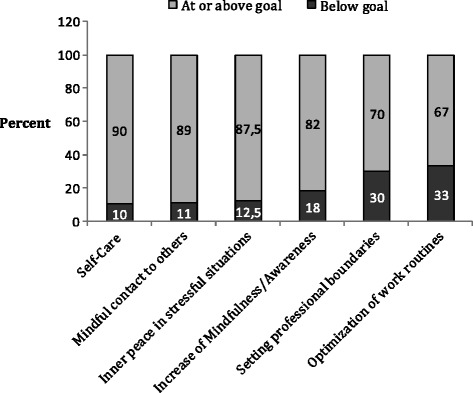
Background: Maintaining a sense of self-care while providing patient centered care, can be difficult for practitioners in palliative medicine. We aimed to pilot an "on the job" mindfulness and compassion-oriented meditation training for interdisciplinary teams designed to reduce distress, foster resilience and strengthen a prosocial motivation in the clinical encounter. Methods: Our objective was to explore the feasibility and effectiveness of this newly developed training. The study design was an observational, mixed-method pilot evaluation, with qualitative data, self-report data, as well as objective data (cortisol) measured before and after the program. Twenty-eight staff members of an interdisciplinary palliative care team participated in the 10-week training conducted at their workplace. Measures were the Perceived Stress Questionnaire, the Maslach Burnout Inventory, the somatic complaints subscale of the SCL-90-R, the Emotion Regulation Skills Questionnaire, the Hospital Anxiety and Depression Scale, and a Goal Attainment Scale that assessed two individual goals. Semi-structured interviews were employed to gain insight into the perceived outcomes and potential mechanisms of action of the training. T-tests for dependent samples were employed to test for differences between baseline and post-intervention. Results: Significant improvements were found in two of three burnout components (emotional exhaustion and personal accomplishment), anxiety, stress, two emotional regulation competences and joy at work. Furthermore, 85% of the individual goals were attained. Compliance and acceptance rates were high and qualitative data revealed a perceived enhancement of self-care, the integration of mindful pauses in work routines, a reduction in rumination and distress generated in the patient contact as well as an enhancement of interpersonal connection skills. An improvement of team communication could also be identified. Conclusions: Our findings suggest that the training may be a feasible, effective and practical way of reducing caregiver-distress and enhancing the resources of palliative care teams.
Verified 2026-11-25 · 1 reference not checked yet
Overview
CoChat Summary
TL;DR
This mixed-method pre-post pilot of a 10-week workplace mindfulness/compassion program for palliative care staff found improved self-reported distress, emotion regulation, and work enjoyment, with no significant cortisol change. The intervention appeared feasible and acceptable, with 85% of individual goals attained and positive qualitative reports of better self-care and team functioning.
Key findings
- 28 staff members participated; 27 attended regularly and 26 returned post-intervention assessments. In the total staff population, 85% (28 of 33) engaged in the program.
- Significant pre-post improvements were reported in two burnout components: emotional exhaustion decreased and personal accomplishment increased; anxiety and perceived stress also decreased, including PSQ total score and subscales worries, tension, and demands.
- Two emotion-regulation competences improved significantly: awareness and resilience (ability to deal with difficult emotions). Work enjoyment also increased significantly.
- 85% of individual goals were attained. In qualitative interviews, participants reported enhanced self-care, more mindful pauses in work routines, reduced rumination and distress in patient contact, improved interpersonal connection skills, and better team communication.
- Cortisol awakening response did not change significantly over the course of the program.
Methods
- Observational, mixed-method pre-post pilot study with measurements at baseline (t0) and after a 10-week intervention (t1).
- Participants were 28 staff members from an interdisciplinary palliative care center in Bonn, Germany, recruited by internal advertisements; 26 completed post-intervention assessments. Data included questionnaires, saliva cortisol samples (4 samples each pre/post), home journals, and semi-structured interviews with all participants.
- Quantitative analyses used dependent-samples t-tests and Cohen’s d; qualitative interviews were analyzed using integrative interview analysis with iterative group coding.
Limitations
- The paper states that the 5-week Metta and Tong-len portion may have been too short for the practices to unfold their full potential.
- The lack of a control group means effects cannot be causally attributed to the intervention; the paper also states the small sample size limits statistical power and generalizability.
- The text also makes evident that post-intervention data were missing for 2 of the 27 regular participants and that the sample came from a single palliative care center in one faith-based hospital in Bonn, Germany, which further limits generalizability (evident from the text).
Model-written summary. Check it against the paper before relying on it.
Integrity signals
Registry
Cites
Statistics
Figures
Verification
Claims the paper makes
16 Valid · 1 Not valid · 33 Not checked · 69 Own results and interpretations
Every source the paper cites for this claim was checked and supports it.
In the paper
“Difficulties in managing emotions arise for example through moral distress and frequent exposure to suffering [7].”
§ Mindfulness and compassion-oriented practices at work reduce distress and enhance self-care of palliative care teams: a mixed-method evaluation of an “on the job“ program > Background
What the sources say
- Supportedcites [7] Fillion L, Truchon M, L’Heureux M, Gélinas C, Bellemare M, Langlois L, et al. Impact of Work Environment on Nurses’ Job Satisfaction and Well-Being: Improving End-of-Life Care and Services. Final report [Internet]. Montreal: IRSST; 2014. Report No.: R-846. Available online at: http://www.irsst.qc.ca/publications-et-outils/publication/i/100782/n/work-environment-onnurses-job-r-846. Accessed 17 Oct 2016. source
The 'Emotional stressors' section lists 'the difficulty of managing emotions' among the emotional stressors together with moral stressors (opposing values) and the patient's and family's distress, and the dedicated section 'Lack of emotional support and difficulty managing emotions' documents that difficulty in the end-of-life context. The 'Our earlier research' section supplies the exposure element: 'Exposure to the distress and suffering of the dying and their loved ones is a prime example... The caregiver witnesses this distress frequently and must deal with it... emotional suffering can be compounded by moral conflicts or ethical suffering.' The source's evidence concerns ICU and palliative-care nurses in Quebec, which the generic citing sentence does not contradict; the only softening is that the report phrases moral conflict as compounding emotional suffering rather than as a strict cause. (LLM, conf=0.80)
plainstates a cause- Asserted: passes — The authors put it forward as true.
- Checkable: passes — It can be checked against evidence.
- Load-bearing: passes — The paper’s conclusions depend on it.
- Based: passes — The paper gives a reason why it holds.
- Supported
Every source the paper cites for this claim was checked and supports it.
In the paper
“Similarly, a Canadian study with 42 nurses providing end-of-life care in intensive care units, found that in addition to organizational and professional factors, emotional factors represented a significant source of distress in palliative care.”
§ Mindfulness and compassion-oriented practices at work reduce distress and enhance self-care of palliative care teams: a mixed-method evaluation of an “on the job“ program > Background
What the sources say
- Supportedcites [7] Fillion L, Truchon M, L’Heureux M, Gélinas C, Bellemare M, Langlois L, et al. Impact of Work Environment on Nurses’ Job Satisfaction and Well-Being: Improving End-of-Life Care and Services. Final report [Internet]. Montreal: IRSST; 2014. Report No.: R-846. Available online at: http://www.irsst.qc.ca/publications-et-outils/publication/i/100782/n/work-environment-onnurses-job-r-846. Accessed 17 Oct 2016. source
The Study 1 summary (page unavailable) describes a Quebec study of 42 ICU nurses providing end-of-life palliative care. It groups the stressors they experienced into organizational, professional and emotional categories; the Discussion of Results of Study 1 further describes emotional stressors as linked to the other two categories. (LLM, conf=0.94)
plainstates an association- Asserted: passes — The authors put it forward as true.
- Checkable: passes — It can be checked against evidence.
- Load-bearing: unclear — It is unclear whether the paper’s conclusions depend on it.
- Based: passes — The paper gives a reason why it holds.
- Supported
The sources with a verdict support this claim; the rest weren’t checked yet, have no full text we could read, or their verdicts aren’t rated yet.
In the paper
“However, relying solely on self-protection strategies can also strain well-being over the long-term [11, 12].”
§ Mindfulness and compassion-oriented practices at work reduce distress and enhance self-care of palliative care teams: a mixed-method evaluation of an “on the job“ program > Background
What the sources say
- Not checked — no full text of the sourcecites [11] Marr L Can compassion fatigue? J Palliat Med 2009 12 8 739 740 10.1089/jpm.2009.9577 19663577 source
- Supportedcites [12] Hayes SC Luoma JB Bond FW Masuda A Lillis J Acceptance and commitment therapy: model, processes and outcomes Behav Res Ther 2006 44 1 1 25 10.1016/j.brat.2005.06.006 16300724 source
In the ACT/RFT theory of psychopathology (p. 7), the paper says that immediate goals such as feeling good and defending a conceptualized self can displace long-term desired qualities of life. It also says avoidance can narrow the range of possible behaviors. Together, these passages support the claim's cautious paraphrase about long-term well-being. (LLM, conf=0.87)
plainstates a cause- Asserted: passes — The authors put it forward as true.
- Checkable: passes — It can be checked against evidence.
- Load-bearing: passes — The paper’s conclusions depend on it.
- Based: passes — The paper gives a reason why it holds.
Every source the paper cites for this claim was checked and supports it.
In the paper
“Recent evidence also supports the role of awareness as an important pathway for fostering self-care in palliative care practitioners [61].”
§ Mindfulness and compassion-oriented practices at work reduce distress and enhance self-care of palliative care teams: a mixed-method evaluation of an “on the job“ program > Discussion
What the sources say
- Supportedcites [61] Sansó N Galiana L Oliver A Pascual A Sinclair S Benito E Palliative care professionals’ inner life: exploring the relationships among awareness, self-care, and compassion satisfaction and fatigue, burnout, and coping with death J Pain Symptom Manag 2015 50 2 200 207 10.1016/j.jpainsymman.2015.02.013 25701688 source
The Discussion describes awareness as a salient component of self-care in palliative care practice and says the study successfully tested an awareness-based model of self-care. This supports the cited sentence’s characterization of awareness as an important pathway for fostering self-care. (LLM, conf=0.90)
plainstates an association- Asserted: passes — The authors put it forward as true.
- Checkable: passes — It can be checked against evidence.
- Load-bearing: unclear — It is unclear whether the paper’s conclusions depend on it.
- Based: passes — The paper gives a reason why it holds.
- Supported
Every source the paper cites for this claim was checked and supports it.
In the paper
“According to a recent survey of palliative care practitioners (n = 387) higher levels of self-awareness go hand in hand with lower levels of burnout and compassion fatigue [61].”
§ Mindfulness and compassion-oriented practices at work reduce distress and enhance self-care of palliative care teams: a mixed-method evaluation of an “on the job“ program > Discussion
What the sources say
- Supportedcites [61] Sansó N Galiana L Oliver A Pascual A Sinclair S Benito E Palliative care professionals’ inner life: exploring the relationships among awareness, self-care, and compassion satisfaction and fatigue, burnout, and coping with death J Pain Symptom Manag 2015 50 2 200 207 10.1016/j.jpainsymman.2015.02.013 25701688 source
The Abstract reports a cross-sectional survey completed by 387 Spanish palliative care professionals. The Discussion states that professionals with greater awareness experienced lower compassion fatigue and burnout. Page numbers are not provided for these passages. (LLM, conf=0.94)
plainstates an associationn = 387- Asserted: passes — The authors put it forward as true.
- Checkable: passes — It can be checked against evidence.
- Load-bearing: passes — The paper’s conclusions depend on it.
- Based: passes — The paper gives a reason why it holds.
- Supported
36 more claims
Create a free account to see all 119 claims and to verify the 5 references still open.
- It may state two separate claims as one. 48
- Probably not a substantial claim. 49
- Borderline: one of the tests for a substantial claim is unclear. 1
Citations
Cites
The Hospital Anxiety and Depression Scale
Zigmond, A. S., & Snaith, R. P. (1983) · Acta Psychiatrica Scandinavica · doi:10.1111/j.1600-0447.1983.tb09716.x · Cited by 47,139
(2014) · Cited by 15,747
Depression and quality of life in older persons: A review
Sivertsen, H., Bjørkløf, G. H., Engedal, K., Selbæk, G., & Helvik, A.-S. (2015) · Dementia and Geriatric Cognitive Disorders · doi:10.1159/000437299 · Cited by 14,152
Mindfulness: A proposed operational definition.
Bishop, S. R., Lau, M., Shapiro, S., Carlson, L., Anderson, N. D., Carmody, J., Segal, Z. V., Abbey, S., Speca, M., Velting, D., et al. (2004) · Clinical Psychology: Science and Practice · doi:10.1093/clipsy.bph077 · Cited by 7,234 · cited 1×
“In addition to its focus on attention regulation, mindfulness encompasses an orientation towards experience characterized by an attitude of curiosity and acceptance [21].”
BackgroundAcceptance and commitment therapy: model, processes and outcomes
Hayes, S. C., Luoma, J. B., Bond, F. W., Masuda, A., & Lillis, J. (2006) · Behaviour Research and Therapy · doi:10.1016/j.brat.2005.06.006 · Cited by 6,587 · cited 1×
“However, relying solely on self-protection strategies can also strain well-being over the long-term [11, 12].”
BackgroundMindfulness-based stress reduction and health benefits
Grossman, P., Niemann, L., Schmidt, S., & Walach, H. (2004) · Journal of Psychosomatic Research · doi:10.1016/s0022-3999(03)00573-7 · Cited by 3,958
Self-citationChampion, D. F., & Westbrook, B. W. (1984) · Measurement and Evaluation in Counseling and Development · doi:10.1080/07481756.1984.12022754 · Cited by 2,388
Fredrickson, B. L., Cohn, M. A., Coffey, K. A., Pek, J., & Finkel, S. M. (2008) · Journal of Personality and Social Psychology · doi:10.1037/a0013262 · Cited by 2,365 · cited 1×
“Existing evidence also suggest that practicing Metta meditation can strongly increase personal resources with self-generated positive emotions being the central mechanism of change [31].”
BackgroundMaslach, C., & Jackson, S. E. (2024) · PsycTESTS Dataset · doi:10.1037/t55656-000 · Cited by 2,359
Handbook of Research Methods in Social and Personality Psychology
(2024) · Cambridge University Press eBooks · doi:10.1017/9781009170123 · Cited by 2,121
Research works printed but not linked: 3
- McKnight D Tonglen Meditation’s effect on levels of compassion and self-compassion: a proof of concept study and instructional guide. Thesis completed as part of the Upaya Buddhist chaplaincy training program 2012
- Halifax J Singer T Bolz M Being with dying- curriculum for the professional training program in compassionate end-of-life care Compassion: bridging practice and science eBook 2013 Munich, Germany Max Planck Society 466 478
- Helfferich C Kruse J Hermeneutisches Fremdverstehen als eine sensibilisierende Praxeologie für sozialarbeiterische Beratungskontexte. Oder: Vom “professionellen Blick” zum “hermeneutischen Ohr” [Hermeneutic understanding as a sensitizing praxeology] 2007 Barbara-Budrich-Verlag Leverkusen, Germany
Cited by
Quality of Life in Nursing Professionals: Burnout, Fatigue, and Compassion Satisfaction
Ruiz-Fernández, M. D., Pérez-García, E., & Ortega-Galán, Á. M. (2020) · International Journal of Environmental Research and Public Health · doi:10.3390/ijerph17041253 · Cited by 262
Conversano, C., Ciacchini, R., Orrù, G., Di Giuseppe, M., Gemignani, A., & Poli, A. (2020) · Frontiers in Psychology · doi:10.3389/fpsyg.2020.01683 · Cited by 243
Jiménez-Picón, N., Romero-Martín, M., Ponce-Blandón, J. A., Ramirez-Baena, L., Palomo-Lara, J. C., & Gómez-Salgado, J. (2021) · International Journal of Environmental Research and Public Health · doi:10.3390/ijerph18105491 · Cited by 156
Dijxhoorn, A.-F. Q., Brom, L., van der Linden, Y. M., Leget, C., & Raijmakers, N. J. (2021) · Palliative Medicine · doi:10.1177/0269216320956825 · Cited by 142
Mills, J., Wand, T., & Fraser, J. (2018) · BMC Palliative Care · doi:10.1186/s12904-018-0318-0 · Cited by 181
“That mindfulness exercises were used spontaneously by participants in practice settings suggests that the benefits of formal mindfulness training initiatives extend beyond the training room and into the clinical milieu [23, 24].”
BackgroundWhat Is the State of Compassion Education? A Systematic Review of Compassion Training in Health Care
Sinclair, S., Kondejewski, J., Jaggi, P., Dennett, L., Ordons, A. R. D., & Hack, T. F. (2021) · Academic Medicine · doi:10.1097/acm.0000000000004114 · Cited by 174
Self-citationMindfulness training in the workplace: Exploring its scope and outcomes
Johnson, K. R., Park, S., & Chaudhuri, S. (2020) · European journal of training and development · doi:10.1108/ejtd-09-2019-0156 · Cited by 121
Compassion in palliative care: a review
Brito-Pons, G., & Librada-Flores, S. (2018) · Current Opinion in Supportive & Palliative Care · doi:10.1097/spc.0000000000000393 · Cited by 83
Klein, A., Taieb, O., Xavier, S., Baubet, T., & Reyre, A. (2020) · EXPLORE · doi:10.1016/j.explore.2019.09.002 · Cited by 79
Hutchins (2015) · doi:10.1097/acm.0000000000002546 · Cited by 67
Sinclair, S., Kondejewski, J., Jaggi, P., Ordons, A. R. D., Kassam, A., Hayden, A., Harris, D., & Hack, T. F. (2021) · BMC Medical Education · doi:10.1186/s12909-021-02863-w · Cited by 84
“training [85–87, 94, 97, 102], agreed that the training achieved stated objectives [68, 90], were satisfied with the facilitation, teaching, and workload of the program [64, 85–87, 103], and would recommend the training to their coworkers [68, 103].”
BackgroundInfluentialSelf-citationThe THRIVE© Program: Building Oncology Nurse Resilience Through Self-Care Strategies
Blackburn, L. M., Thompson, K., Frankenfield, R., Harding, A., & Lindsey, A. (2020) · Oncology nursing forum · doi:10.1188/20.onf.e25-e34 · Cited by 73
Koh, M. Y. H., Hum, A. Y. M., Khoo, H. S., Ho, A. H. Y., Chong, P. H., Ong, W. Y., Ong, J. Y. J., Neo, P. S. H., & Yong, W. C. (2019) · Journal of Pain and Symptom Management · doi:10.1016/j.jpainsymman.2019.08.008 · Cited by 78
Olson, E. T., Hansen, M. M., & Vermeesch, A. L. (2020) · International Journal of Environmental Research and Public Health · doi:10.3390/ijerph17249340 · Cited by 77
“[31] and the importance of developing a mindful presence, cultivating loving-kindness, and inner-self acceptance into daily work activities.”
BackgroundApplication of the Roy Adaptation Theory to a care program for nurses
Callis, A. (2020) · Applied Nursing Research · doi:10.1016/j.apnr.2020.151340 · Cited by 80
“As previously discussed, studies have shown spiritual wellbeing was found to reduce emotional exhaustion (Rushton et al., 2015) and spiritual beliefs helped nurses in their view of death (Peterson et al., 2010).”
Diehl, E., Rieger, S., Letzel, S., Schablon, A., Nienhaus, A., Pinzón, L. C. E., & Dietz, P. (2021) · BMC Nursing · doi:10.1186/s12912-021-00687-z · Cited by 55
McFarland, D. C., & Hlubocky, F. J. (2021) · Psychology Research and Behavior Management · doi:10.2147/prbm.s256228 · Cited by 65
Zeng, X., Wang, R., Oei, T. P. S., & Leung, F. Y. K. (2018) · Mindfulness · doi:10.1007/s12671-018-0992-2 · Cited by 58
Sapeta, P., Centeno, C., Belar, A., & Arantzamendi, M. (2021) · Palliative Medicine · doi:10.1177/02692163211047149 · Cited by 59
Mindfulness training for tourism and hospitality frontline employees
Johnson, K. R., & Park, S. (2020) · Industrial and Commercial Training · doi:10.1108/ict-10-2019-0095 · Cited by 58
Friedman, C. (2021) · Inclusion · doi:10.1352/2326-6988-9.1.63 · Cited by 37
Watts, K., O’Connor, M., Johnson, C. E., Breen, L. J., Kane, R. T., Choules, K., Doyle, C., Buchanan, G., & Yuen, K. (2021) · Journal of Palliative Medicine · doi:10.1089/jpm.2020.0358 · Cited by 44
“41 The intentional cultivation of both mindfulness and compassion among health professionals involved in palliative and EOL care is a rapidly developing area of research.”
InfluentialMontero‐Marín, J., Kuyken, W., Gasión, V., Barceló‐Soler, A., Rojas, L., Manrique, A., Esteban, R., & García‐Campayo, J. (2020) · International Journal of Environmental Research and Public Health · doi:10.3390/ijerph17051643 · Cited by 39
“This aspect does not emerge explicitly in noncontrolled trials, but it needs to be considered in terms of whether more robust studies should be conducted [81,82].”
BackgroundZheng, Y., Zhou, J., Zeng, X., Jiang, M., & Oei, T. P. S. (2022) · Journal of Happiness Studies · doi:10.1007/s10902-022-00525-2 · Cited by 42
Medical assistance in dying: A political issue for nurses and nursing in Canada
Banner, D., Schiller, C. J., & Freeman, S. (2019) · Nursing Philosophy · doi:10.1111/nup.12281 · Cited by 36
Zheng, Y., Yan, L., Chen, Y., Zhang, X., Sun, W., Lv, J., Zhou, J., Gu, X., Zhao, X., Luo, W., et al. (2023) · Mindfulness · doi:10.1007/s12671-023-02121-8 · Cited by 30
An Exploratory Study of a 3-Minute Mindfulness Intervention on Compassion Fatigue in Nurses
Owens, R. A., Alfes, C. M., Evans, S., Wyka, K., & Fitzpatrick, J. J. (2020) · Holistic Nursing Practice · doi:10.1097/hnp.0000000000000402 · Cited by 42
A critical methodological review of mixed methods designs used in mindfulness research
Huynh, T., Hatton-Bowers, H., & Howell Smith, M. (2019) · Mindfulness · doi:10.1007/s12671-018-1038-5 · Cited by 30
Keesler, J. M., & Troxel, J. M. (2020) · Intellectual and developmental disabilities · doi:10.1352/1934-9556-58.3.221 · Cited by 39
Zhou, J., Zheng, Y., Zeng, X., Jiang, M., & Oei, T. P. S. (2021) · Mindfulness · doi:10.1007/s12671-021-01610-y · Cited by 36
A Novel Framework for Inner-Outer Sustainability Assessment
Cooper, K. J., & Gibson, R. B. (2022) · Challenges · doi:10.3390/challe13020064 · Cited by 35
Primary palliative care for surgeons: a narrative review and synthesis of core competencies
Marterre, B., Kopecky, K. E., & Miller, P. (2021) · Annals of Palliative Medicine · doi:10.21037/apm-21-369 · Cited by 30
“The application of mindfulness-based interventions can increase introspection, reflection, selfawareness, empathy (188,199-204), metacognition, and meaning reconstruction (205,206).”
MethodDescribing Complexity in Palliative Home Care Through HexCom: A Cross-Sectional, Multicenter Study
Busquet-Duran, X., Jiménez-Zafra, E. M., Manresa‐Domínguez, J. M., Tura-Poma, M., la Rosa, O. B.-D., Moragas-Roca, A., Padilla, M. C. G., Moreno, S. M., Martínez-Losada, E., Crespo-Ramírez, S., et al. (2020) · Journal of Multidisciplinary Healthcare · doi:10.2147/jmdh.s240835 · Cited by 31
Differential Effects of Two Contemplative Practice-based Programs for Health Care Professionals
Sansó, N., Galiana, L., González, B., Sarmentero, J., Reynes, M., Oliver, A., & García-Toro, M. (2019) · Psychosocial Intervention · doi:10.5093/pi2019a12 · Cited by 30
“…on stress reduction (traditionally known as Mindful-Based Stress Reduction Training, MBSTR), and specific programs, oriented to compassion, such as the Compassion Cultivation Training (CCT) (Amutio-Kareaga, García-Campayo, Delgado, Hermosilla, & Martínez-Taboada, 2017; Orellana-Rios et al., 2018).”
BackgroundEmotional bond: The nature of relationship in palliative care for cancer patients
Vanaki, Z., Aghaei, M. H., & Mohammadi, E. (2020) · Indian Journal of Palliative Care · doi:10.4103/ijpc.ijpc_181_19 · Cited by 27
Knudsen, R. K., Gregersen, T. A., Ammentorp, J., Tousig, C. G., & Timmermann, C. (2020) · Scandinavian Journal of Caring Sciences · doi:10.1111/scs.12906 · Cited by 23
“(24) addressed this question and found that patients perceived compassion as being an innate quality embedded in the virtues of healthcare professionals, but that training - including meditation - may help sustain and nurture it over time.”
BackgroundPhysician-patient boundaries in palliative care
Ho, C. Y., Lim, N.-A., Rahman, N. D. A., Chiam, M., Zhou, J. X., Phua, G. L. G., Ong, E. K., Lim, C., Chowdhury, A. R., & Krishna, L. K. R. (2023) · BMC Palliative Care · doi:10.1186/s12904-023-01161-0 · Cited by 18
“Two, the Krishna Model may be used to facilitate faculty development programs on identifying ‘at risk’ physicians such as those identifying strongly with a saviour complex and differing goals of care which make them especially prone to boundary-crossings [4, 47].”
BackgroundMethodCovington, L., Banerjee, M., Pereira, A., & Price, M. (2022) · Journal of Palliative Care · doi:10.1177/08258597221100330 · Cited by 21
García, P. B., & Gómez, M. S. (2021) · Enfermería Clínica · doi:10.1016/j.enfcli.2020.11.006 · Cited by 29
“The Pause”: A Delphi Methodology Examining an End-of-Life Practice
Cunningham, T., Ducar, D., & Keim‐Malpass, J. (2019) · Western Journal of Nursing Research · doi:10.1177/0193945919826314 · Cited by 18
Jang, M. H., Jeong, Y. M., & Park, G. (2022) · Journal of Nursing Management · doi:10.1111/jonm.13572 · Cited by 19
Benefits of Using The Pause after Death in Emergency Departments: A Delphi Study
Cunningham, T., & Ducar, D. (2019) · Southern Medical Journal · doi:10.14423/smj.0000000000001012 · Cited by 17
Marsh, E., Vallejos, E. P., & Spence, A. (2024) · PLoS ONE · doi:10.1371/journal.pone.0295631 · Cited by 28
Rahimi‐Ardabili, H., Vartanian, L. R., Zwar, N. A., Sharpe, A., & Reynolds, R. C. (2020) · Public Health Nutrition · doi:10.1017/s1368980020000658 · Cited by 20
Compassion in the Clinical Context: Constrained, Distributed, and Adaptive
Ordons, A. R. D., MacIsaac, L., Hui, J., Everson, J., & Ellaway, R. (2019) · Journal of General Internal Medicine · doi:10.1007/s11606-019-05467-9 · Cited by 20
Román-Niaves, M. S., Coo, C., Llorens, S., & Salanova, M. (2022) · International Journal of Environmental Research and Public Health · doi:10.3390/ijerph19127500 · Cited by 22
Nielsen, C. L., Lindhardt, C. L., Näslund-Koch, L., Frandsen, T. F., Clemensen, J., & Timmermann, C. (2024) · Journal of Advanced Nursing · doi:10.1111/jan.16484 · Cited by 20
Wellness in Physician Assistant Education: Exploring Mindfulness, Well-Being, and Stress
Hoover, E. B., Butaney, B., LeLacheur, S., Straker, H. O., Bernard, K. S., Coplan, B. H., Carr, C., Blesse-Hampton, L., & Naidu, A. (2022) · The Journal of Physician Assistant Education · doi:10.1097/jpa.0000000000000427 · Cited by 14
“There appears to be a strong relationship between higher levels of mindfulness and general well-being, a finding supported in previous research.(6,7,14,16,17) What is more interesting, however, is that specific aspects of mindfulness appear to be differentially relevant towell-being.”
ResultThe Experiences of Well-being of Palliative Care Providers in Malaysia: A Thematic Analysis
Tan, S. B., Lee, Y. L., Tan, S. N., Ng, T. Y., Teo, Y. T., Lim, P. K., Loh, E. C., & Lam, C. L. (2020) · Journal of Hospice and Palliative Nursing · doi:10.1097/njh.0000000000000678 · Cited by 15
Yong, J., Park, J., Park, Y. G., Lee, H., Lee, G., & Rim, S. (2020) · The Journal of Continuing Education in Nursing · doi:10.3928/00220124-20200415-06 · Cited by 14
Loving‐kindness and compassion meditations in the workplace: A meta‐analysis and future prospects
Wang, R., Gu, X., Zhang, Y., Luo, K., & Zeng, X. (2023) · Stress and Health · doi:10.1002/smi.3273 · Cited by 15
Worldviews and environmental ethics: Contributions of brain processing networks
Woollacott, M. H., Shumway‐Cook, A., & Tassell-Matamua, N. (2023) · EXPLORE · doi:10.1016/j.explore.2023.03.005 · Cited by 16
Bonde, E. H., Mikkelsen, E. G., Fjorback, L. O., & Juul, L. (2022) · Frontiers in Psychology · doi:10.3389/fpsyg.2022.1020454 · Cited by 20
“However, as demonstrated in the explanatory themes, similar results have been found among individuals in previous studies (Orellana-Rios et al., 2017; Hegney et al., 2021), indicating validity of the obtained results.”
ResultKaur, A., Sharma, M. P., & Chaturvedi, S. K. (2021) · BMJ Supportive & Palliative Care · doi:10.1136/bmjspcare-2021-003318 · Cited by 12
“17 39 Thus, CS might be an intricate construct which needs more exploration.”
BackgroundClinician distress in seriously ill patient care: A dimensional analysis
Foxwell, A. M., Meghani, S. H., & Ulrich, C. M. (2021) · Nursing Ethics · doi:10.1177/09697330211003259 · Cited by 16
Nurse Burnout in Hospice and Palliative Care: A Scoping Review
Frechman, E., & Wright, P. M. (2021) · Illness Crisis & Loss · doi:10.1177/10541373211039825 · Cited by 18
Lautwein, F., Schallenburger, M., Scherg, A., Schlieper, D., Karger, A., Regel, Y. U., Schwartz, J., & Neukirchen, M. (2023) · BMC Palliative Care · doi:10.1186/s12904-023-01158-9 · Cited by 12
“However, the short-term focus of the training sessions can make it difficult for them to become permanent [12].”
BackgroundMethodInfluentialSelf-citationThe neuropalliative multidisciplinary team—Members and their roles
Brennan, F. P., Gardiner, M. D., & Narasimhan, M. (2022) · Handbook of clinical neurology · doi:10.1016/b978-0-323-85029-2.00010-5 · Cited by 11
An evaluation of the information needs of radiotherapy patients and their families
Durnin, R., Shepherd, P., & Gilleece, T. (2020) · Journal of Radiotherapy in Practice · doi:10.1017/s1460396920000497 · Cited by 9
Liao, L. (2017) · Canadian Medical Education Journal · doi:10.36834/cmej.42975 · Cited by 12
School and Intrapersonal Predictors and Stability of Rural Special Education Teacher Burnout
Ruble, L. A., McGrew, J. H., Fischer, M. W., Findley, J. A., & Stayton, R. (2023) · Rural Special Education Quarterly · doi:10.1177/87568705231180885 · Cited by 25
García, P. B., & Gómez, M. S. (2021) · Enfermería Clínica (English Edition) · doi:10.1016/j.enfcle.2020.11.005 · Cited by 27
Fiore, J. (2021) · The Arts in Psychotherapy · doi:10.1016/j.aip.2021.101797 · Cited by 11
Swan, A., Azhar, A., Anderson, A. E., Williams, J. L., Liu, D., & Bruera, E. D. (2020) · Journal of Pain and Symptom Management · doi:10.1016/j.jpainsymman.2020.09.024 · Cited by 11
Health professionals’ quality of life in relation to end of life care
Linzitto, J. P., & Grance, G. (2017) · Current Opinion in Supportive and Palliative Care · doi:10.1097/spc.0000000000000307 · Cited by 10
Resilience-building in palliative care professionals: scoping review
Yongpraderm, S., Inpithuk, P., & Wongprom, I. (2025) · BMJ Supportive & Palliative Care · doi:10.1136/spcare-2024-005144 · Cited by 13
“21–23 25 26 28–31 These strategies aim to cultivate a supportive work environment, with peer-based interventions specifically fostering social support among colleagues.”
InfluentialAssessing Occupational Burnout Among a Cohort of New York City Sonographers: A Pilot Study
Callpani, V., Cunha, T. D., Fearing, T., & Jean-Baptiste, C. (2023) · Journal of diagnostic medical sonography · doi:10.1177/87564793231220546 · Cited by 7
“23 In addition, overall perceived stress, as well as the worries, tension, and demands dimensions of stress, decreased after the intervention.”
Hobi, M., Yegorova‐Lee, S., Chan, C. C.-L., et al. (2022) · BMJ Open · doi:10.1136/bmjopen-2022-062631 · Cited by 6
Piloting a Mindfulness App for Use by Nursing Staff at Work
Fordham, K., & Sorensen, J. (2022) · Journal for Nurses in Professional Development · doi:10.1097/nnd.0000000000000883 · Cited by 8
“Mindfulness interventions weremore successful when used with introductory education (Level II: Delaney, 2018; Hevezi, 2016; Sharp Donahoo et al., 2018), were convenient (Level II: Morrison Wylde et al., 2017), included reminders (Level II: Orellana-Rios et al., 2017; Sharp Donahoo et al., 2018), were supplemented with…”
BackgroundMethodInfluentialPintado, S. (2018) · Terapia psicológica · doi:10.4067/s0718-48082018000200071 · Cited by 28
“Orellana-Ríos et al. 2017 Alemania Comparativo pre-post tratamiento Sin grupo control 28 profesionales de cuidados paliativos PSS MBI SCL-90-R ERSQ-27 HADS GAS Meditación metta, atención plena y compasión 10 semanas Mejora en realización personal, aumento en conciencia y resiliencia, y disminución…”
BackgroundBREATHE-EASE Goals for Reducing Special Education Teacher Burnout
Ruble, L. A., McGrew, J. H., Dueber, D., & Salyers, M. P. (2024) · Teacher Education and Special Education The Journal of the Teacher Education Division of the Council for Exceptional Children · doi:10.1177/08884064241288262 · Cited by 10
Developing a meta-understanding of ‘human aspects’ of providing palliative care
Croker, A., Fisher, K., Hungerford, P., Gourlay, J., May, J., Lees, S., & Chapman, J. (2022) · Palliative Care and Social Practice · doi:10.1177/26323524221083679 · Cited by 8
Tolonen, I., Saarinen, A. I. L., Keltikangas‐Järvinen, L., Siira, V., Kähönen, M. A. P., & Hintsanen, M. (2021) · Frontiers in Psychology · doi:10.3389/fpsyg.2021.730188 · Cited by 8
Boyle, D. A., & Steinheiser, M. M. (2021) · Journal of Infusion Nursing · doi:10.1097/nan.0000000000000419 · Cited by 7
McCarthy, B., Connaire, K., & Timmins, F. (2021) · European Journal of Oncology Nursing · doi:10.1016/j.ejon.2021.101899 · Cited by 6
Chiang, S.-W., Wu, S., & Peng, T. (2020) · Asian Nursing Research · doi:10.1016/j.anr.2020.10.006 · Cited by 6
Spirituality in Professional Higher Education
Zsolnai, L., Miller, L., Woollacott, M. H., & Bermúdez, J. (2025) · Journal of Human Values · doi:10.1177/09716858251352086 · Cited by 9
“It has also been shown that enhancement of the spiritual health of clinicians not only increases their satisfaction with life but also reduces job burnout and assists them in applying spiritual care to patients (Hu et al., 2019; Orellana-Rios et al., 2018).”
Cuchet, I., Maneval, A., & Dambrun, M. (2025) · Scientific Reports · doi:10.1038/s41598-025-00776-y · Cited by 8
“First, for professionals who manage to adopt a trajectory of resilience, compassion satisfaction could be a central element 32 .”
Self-Care in Palliative Healthcare Professionals: A Qualitative Study
Bovero, A., Spada, M. F., Cito, A. L., Pidinchedda, A. V., Tosi, C., & Carletto, S. (2025) · Nursing Reports · doi:10.3390/nursrep15050139 · Cited by 9
Román-Niaves, M. S., Vasquez, C., Coo, C., Nielsen, K. M., Llorens, S., & Salanova, M. (2024) · Current Psychology · doi:10.1007/s12144-024-05959-w · Cited by 19
“Some interventions included 10-week group programs for cultivating mindful presence (Orellana-Rios et al., 2017), 12-session programs exploring compassion attributes (Santos et al., 2022) and an 8-week compassion training (Scarlet et al., 2017).”
InfluentialOwens, R., Houchins, J. R., Nolan, S., Smalling, M., Attia, E., & Fitzpatrick, J. J. (2024) · Holistic Nursing Practice · doi:10.1097/hnp.0000000000000628 · Cited by 3
“26 While there appears to be no standard definition of “brief” MBI, 30 minutes or less during any one instance, accumulating to no more than 100 minutes per week, and lasting 4 weeks, was identified as consistent with studies defining their intervention as brief.”
BackgroundSantos, L., Pinheiro, M. D. R., & Rijo, D. (2023) · Mindfulness · doi:10.1007/s12671-023-02239-9 · Cited by 7
“…and diminish interpersonal conflicts, establishing the foundation for a secure organizational climate, which in turn could increase the professionals’ capacity to handle challenging situations and improve the workplace functioning (Condon & Makransky, 2020; Orellana-Rios et al., 2017).”
BackgroundResultAghaei, M. H., Vanaki, Z., & Mohammadi, E. (2022) · Nursing Open · doi:10.1002/nop2.1357 · Cited by 6
Hess, F., Klußmann, A., Harth, V., & Mache, S. (2025) · BMC Palliative Care · doi:10.1186/s12904-025-01721-6 · Cited by 7
“Furthermore, a supportive work environment has been demonstrated to have a significant positive impact on the satisfaction and well-being of nursing staff, which in turn as a beneficial effect on the quality of patient care [10, 13].”
Stress, mental health, and resources of palliative care professionals
Cuchet, I., Maneval, A., & Dambrun, M. (2025) · Palliative & Supportive Care · doi:10.1017/s1478951524002050 · Cited by 5
Reducing Problematic Loot-box Use with Self-control Intervention: A Randomized Controlled Trial
Wang, Y., Zhao, L., Wan, K., & Zeng, X. (2024) · International Journal of Mental Health and Addiction · doi:10.1007/s11469-024-01413-x · Cited by 6
“Feedback from the intervention group indicated high levels of satisfaction, with ratings comparable to those of similar interventions (Orellana-Rios et al., 2018; Zhou et al., 2021).”
Walsh, R. J. (2024) · Journal of diagnostic medical sonography · doi:10.1177/87564793241230953 · Cited by 3
“Moreover, Callpani et al. 13 directed us toward studies in sonography education 31 and palliative care 32 that model possibilities to applying mindfulness training more widely to sonography workplaces and mitigate stress, a factor initially identified in Daugherty 19 as potentially associated with…”
BackgroundBedir, M., & Bülbül, A. E. (2023) · Current Psychology · doi:10.1007/s12144-023-05516-x · Cited by 8
Resourcefulness and stress among hospice and palliative nurses: the role of positive thinking
Gergis, M. A., Bekhet, A. K., Kozlowski-Gibson, M., Hovland, C. A., Dahlin, C. M., Ent, M. R., & Thoman, J. (2023) · International Journal of Palliative Nursing · doi:10.12968/ijpn.2023.29.2.91 · Cited by 3
La compasión: clave en la renovación de la atención en salud
Bedregal, P., Lermanda, V., & Brito‐Pons, G. (2020) · ARS MEDICA Revista de Ciencias Médicas · doi:10.11565/arsmed.v45i1.1581 · Cited by 5
“Por otra parte, Orellana-Ríos et al. (2018) muestra que el entrenamiento en atención plena y compasión mejora la satisfacción laboral, el autocuidado y reduce el estrés laboral.”
BackgroundMindfulness and self-care in healthcare professionals: A qualitative metasynthesis
Ortiz-Moreno, S., Giménez‐Díez, D., Pastor-Méndez, A., Escobar-García, P., Gómez‐Ibáñez, R., Aguayo–González, M., Maldonado‐Alía, R., & Watson, C. (2025) · Archives of Psychiatric Nursing · doi:10.1016/j.apnu.2025.152002 · Cited by 2
Consedine, N. S., Pavlova, A., & Baguley, S. I. (2024) · Journal of General Internal Medicine · doi:10.1007/s11606-024-09259-8 · Cited by 2
Maus, K., Peusquens, F., Kriegsmann-Rabe, M., Matthias, J.-K., Ateş, G., Jaspers, B., Geiser, F., & Radbruch, L. (2024) · Palliative Care and Social Practice · doi:10.1177/26323524241254839 · Cited by 2
“2,3 Both in the context of pandemic research and in general scientific usage, it is noticeable that resilience in the medical context is predominantly used with regard to the well-being of teams, 4–6 but less with regard to patients and relatives.”
BackgroundSelf-citationPeter, S., Volkert, A. M., Radbruch, L., Rolke, R., Voltz, R., Pfaff, H., & Scholten, N. (2022) · International Journal of Environmental Research and Public Health · doi:10.3390/ijerph192114541 · Cited by 4
Self-citationPreferred Self-Care Behaviors of Participants Who Have Completed a Caring Science Online Course
McGinnis, E. M., & Sitzman, K. (2022) · International Journal for Human Caring · doi:10.20467/ijhc-2021-0008 · Cited by 2
YETİŞKİNLERDE BENLİK SAYGISI VE AFFETME: MERHAMETİN ARACI ROLÜNÜN İNCELENMESİ
KURTULUŞ, H. Y., Batmaz, H., UYSAL, Y. A. Ö., & Kurtuluş, E. (2022) · Trakya Eğitim Dergisi · doi:10.24315/tred.941451 · Cited by 3
Spiritual Care as Part of an Interprofessional Model for Debriefing on an Oncology Unit
Stilos, K. K., Ford, B., Chakraborty, A., & Takahashi, D. (2021) · Journal of Pastoral Care & Counseling Advancing theory and professional practice through scholarly and reflective publications · doi:10.1177/15423050211021387 · Cited by 2
Maus, K., Peusquens, F., Rabe, L. M., & Radbruch, L. (2021) · Spiritual Care · doi:10.1515/spircare-2020-0121 · Cited by 4
Self-citationTeamarbeit und Selbstreflexion
Hirsmüller, S., Kern, M., Schallenburger, M., & Schröer, M. (2019) · Elsevier eBooks · doi:10.1016/b978-3-437-15315-0.00010-3 · Cited by 2
Self-citationChen, Y., & Wu, M. (2025) · International Journal of General Medicine · doi:10.2147/ijgm.s538736 · Cited by 6
Metadata
- Authors
- Orellana-Rios, C. L., Radbruch, L., Kern, M., Regel, Y. U., Anton, A., Sinclair, S., & Schmidt, S.
- Affiliations
- University of Freiburg (DE)
- University Hospital Bonn (DE)
- Institute for Frontier Areas of Psychology and Mental Health (DE)
- University of Calgary (CA)
- Corresponding author
- Orellana-Rios, Claudia L.
- Venue
- BMC Palliative Care
- Published
- 2017-07-06
- Volume
- 17
- Issue
- 1
- Pages
- 3-3
- ISSN
- 1472-684X (ISSN-L)
- PMC
- PMC5501358
- OpenAlex
- W2726206043
- Semantic Scholar
- 7488be35c75cb0f77b37883970f953fd1589c37f
- Cited by
- 162
- References
- 79
- Citations by year
- 2026: 5 · 2025: 17 · 2024: 16 · 2023: 21 · 2022: 24 · 2021: 33 · 2020: 25 · 2019: 11 · 2018: 7 · 2017: 2
- FWCI
- 15.23
- Type
- journal article
- Language
- en
- Update notices
- erratum (2017-10-10)
- Open access
- gold
- doi.org
- Licence
- cc-by
- Locations
- BMC Palliative Care (publishedVersion, cc-by)
- Europe PMC (PubMed Central) (publishedVersion, cc-by)
- PubMed Central (publishedVersion, cc-by)
- PubMed (publishedVersion)
- DOAJ (DOAJ: Directory of Open Access Journals) (submittedVersion, cc-by-sa)
- FreiDok plus (Universitätsbibliothek Freiburg) (submittedVersion)
- Libraries and Cultural Resources (University of Calgary) (submittedVersion)
- Funders
- Maaßen-Stiftungs-gGmbH , Steinen, Germany (None)
- ALPHA NRW (Ansprechstellen im Land NRW zur Palliativversorgung, Hospizarbeit und Angehörigenbegleitung), Münster, Germany (None)
- Buddha-Stiftung, Darmstadt, Germany (None)
- Topics
- Social Sciences › Psychology › Clinical Psychology › Mindfulness and Compassion Interventions
- Health Sciences › Health Professions › General Health Professions › Healthcare professionals’ stress and burnout
- Social Sciences › Psychology › Social Psychology › Stress and Burnout Research
- Keywords
- mindfulness training, compassion-focused therapy, palliative care team, burnout, caregiver distress, self-care, emotion regulation, anxiety, resilience, team communication, cortisol, interdisciplinary teams
- MeSH terms
- Occupational Stress, Adult, Anxiety, Depression, Empathy, Female, Germany, Humans, Hydrocortisone, Male, Middle Aged, Palliative Care, Pilot Projects, Psychometrics, Surveys and Questionnaires, Self Care, Workplace, Qualitative Research, Mindfulness
About these checks
Registry, retraction, Cites and statistics results are computed, not judged, with one exception: a printed reference that no index lists is read once by a model before it counts as a citation error. Claims are extracted by a model and kept only when their quote appears verbatim in the text; each cited source is then checked, with a model’s help, for whether it says what the claim relies on. Those verdicts can be wrong — read the claim’s quote and the cited source before relying on one.
The claim verdicts this report counts are experimental: their accuracy is not yet measured.
A language model drew the claims from the paper on 2026-10-11, under version 3 of the claim definition (model deepseek-v4.1-flash, prompt extract-v3).
A second model labelled each claim on 2026-10-11 (model jev-1.13-20260917, definition revision gold-guideline-v0.2).
Cited sources are checked with a language model’s help (qwen3.8-omni-flash and gpt-6-sol).
Statistics and arithmetic are recomputed, not judged.
Confidence bands are shown only for fields calibrated on our annotated test set. None is calibrated yet, so no band is shown.
What counts as a claim ›How we measure confidence ›How we check this ›
Are you an author, or do you see a problem with this page? Request a review
Data sources
Bibliographic data: Semantic Scholar, OpenAlex, Crossref.
Contains information from the Semantic Scholar Academic Graph Datasets, made available under the ODC Attribution License (ODC-BY 1.0).
Semantic Scholar’s data is described in: Kinney, R., et al. (2023). The Semantic Scholar Open Data Platform. arXiv:2301.10140.
