

Mindfulness and compassion-oriented practices at work reduce distress and enhance self-care of palliative care teams: a mixed-method evaluation of an "on the job" program.
Open accessThe DOI matches its Crossref record; 77 of the 79 references it cites were found in a registry or an index, and 1 are not checked yet; 25 of the 77 sources its claims cite were checked for support.
Abstract
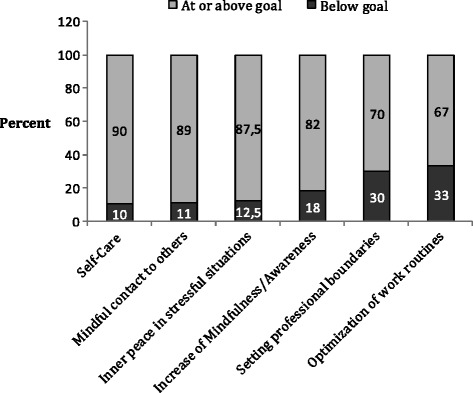
Background: Maintaining a sense of self-care while providing patient centered care, can be difficult for practitioners in palliative medicine. We aimed to pilot an "on the job" mindfulness and compassion-oriented meditation training for interdisciplinary teams designed to reduce distress, foster resilience and strengthen a prosocial motivation in the clinical encounter. Methods: Our objective was to explore the feasibility and effectiveness of this newly developed training. The study design was an observational, mixed-method pilot evaluation, with qualitative data, self-report data, as well as objective data (cortisol) measured before and after the program. Twenty-eight staff members of an interdisciplinary palliative care team participated in the 10-week training conducted at their workplace. Measures were the Perceived Stress Questionnaire, the Maslach Burnout Inventory, the somatic complaints subscale of the SCL-90-R, the Emotion Regulation Skills Questionnaire, the Hospital Anxiety and Depression Scale, and a Goal Attainment Scale that assessed two individual goals. Semi-structured interviews were employed to gain insight into the perceived outcomes and potential mechanisms of action of the training. T-tests for dependent samples were employed to test for differences between baseline and post-intervention. Results: Significant improvements were found in two of three burnout components (emotional exhaustion and personal accomplishment), anxiety, stress, two emotional regulation competences and joy at work. Furthermore, 85% of the individual goals were attained. Compliance and acceptance rates were high and qualitative data revealed a perceived enhancement of self-care, the integration of mindful pauses in work routines, a reduction in rumination and distress generated in the patient contact as well as an enhancement of interpersonal connection skills. An improvement of team communication could also be identified. Conclusions: Our findings suggest that the training may be a feasible, effective and practical way of reducing caregiver-distress and enhancing the resources of palliative care teams.
Verified 2026-11-22 · 1 reference not checked yet
Overview
CoChat Summary
TL;DR
This mixed-method pre-post pilot of a 10-week workplace mindfulness/compassion program for palliative care staff found improved self-reported distress, emotion regulation, and work enjoyment, with no significant cortisol change. The intervention appeared feasible and acceptable, with 85% of individual goals attained and positive qualitative reports of better self-care and team functioning.
Key findings
- 28 staff members participated; 27 attended regularly and 26 returned post-intervention assessments. In the total staff population, 85% (28 of 33) engaged in the program.
- Significant pre-post improvements were reported in two burnout components: emotional exhaustion decreased and personal accomplishment increased; anxiety and perceived stress also decreased, including PSQ total score and subscales worries, tension, and demands.
- Two emotion-regulation competences improved significantly: awareness and resilience (ability to deal with difficult emotions). Work enjoyment also increased significantly.
- 85% of individual goals were attained. In qualitative interviews, participants reported enhanced self-care, more mindful pauses in work routines, reduced rumination and distress in patient contact, improved interpersonal connection skills, and better team communication.
- Cortisol awakening response did not change significantly over the course of the program.
Methods
- Observational, mixed-method pre-post pilot study with measurements at baseline (t0) and after a 10-week intervention (t1).
- Participants were 28 staff members from an interdisciplinary palliative care center in Bonn, Germany, recruited by internal advertisements; 26 completed post-intervention assessments. Data included questionnaires, saliva cortisol samples (4 samples each pre/post), home journals, and semi-structured interviews with all participants.
- Quantitative analyses used dependent-samples t-tests and Cohen’s d; qualitative interviews were analyzed using integrative interview analysis with iterative group coding.
Limitations
- The paper states that the 5-week Metta and Tong-len portion may have been too short for the practices to unfold their full potential.
- The lack of a control group means effects cannot be causally attributed to the intervention; the paper also states the small sample size limits statistical power and generalizability.
- The text also makes evident that post-intervention data were missing for 2 of the 27 regular participants and that the sample came from a single palliative care center in one faith-based hospital in Bonn, Germany, which further limits generalizability (evident from the text).
Model-written summary. Check it against the paper before relying on it.
Integrity signals
Registry
Cites
Statistics
Figures
Verification
Claims the paper makes
16 Valid · 1 Not valid · 33 Not checked · 69 Own results and interpretations
Every source the paper cites for this claim was checked and supports it.
In the paper
“Difficulties in managing emotions arise for example through moral distress and frequent exposure to suffering [7].”
§ Mindfulness and compassion-oriented practices at work reduce distress and enhance self-care of palliative care teams: a mixed-method evaluation of an “on the job“ program > Background
What the sources say
- Supportedcites [7] Fillion L, Truchon M, L’Heureux M, Gélinas C, Bellemare M, Langlois L, et al. Impact of Work Environment on Nurses’ Job Satisfaction and Well-Being: Improving End-of-Life Care and Services. Final report [Internet]. Montreal: IRSST; 2014. Report No.: R-846. Available online at: http://www.irsst.qc.ca/publications-et-outils/publication/i/100782/n/work-environment-onnurses-job-r-846. Accessed 17 Oct 2016. source
The 'Emotional stressors' section lists 'the difficulty of managing emotions' among the emotional stressors together with moral stressors (opposing values) and the patient's and family's distress, and the dedicated section 'Lack of emotional support and difficulty managing emotions' documents that difficulty in the end-of-life context. The 'Our earlier research' section supplies the exposure element: 'Exposure to the distress and suffering of the dying and their loved ones is a prime example... The caregiver witnesses this distress frequently and must deal with it... emotional suffering can be compounded by moral conflicts or ethical suffering.' The source's evidence concerns ICU and palliative-care nurses in Quebec, which the generic citing sentence does not contradict; the only softening is that the report phrases moral conflict as compounding emotional suffering rather than as a strict cause. (LLM, conf=0.80)
plainstates a cause- Asserted: passes — The authors put it forward as true.
- Checkable: passes — It can be checked against evidence.
- Load-bearing: passes — The paper’s conclusions depend on it.
- Based: passes — The paper gives a reason why it holds.
- Supported
Every source the paper cites for this claim was checked and supports it.
In the paper
“Similarly, a Canadian study with 42 nurses providing end-of-life care in intensive care units, found that in addition to organizational and professional factors, emotional factors represented a significant source of distress in palliative care.”
§ Mindfulness and compassion-oriented practices at work reduce distress and enhance self-care of palliative care teams: a mixed-method evaluation of an “on the job“ program > Background
What the sources say
- Supportedcites [7] Fillion L, Truchon M, L’Heureux M, Gélinas C, Bellemare M, Langlois L, et al. Impact of Work Environment on Nurses’ Job Satisfaction and Well-Being: Improving End-of-Life Care and Services. Final report [Internet]. Montreal: IRSST; 2014. Report No.: R-846. Available online at: http://www.irsst.qc.ca/publications-et-outils/publication/i/100782/n/work-environment-onnurses-job-r-846. Accessed 17 Oct 2016. source
The Study 1 summary (page unavailable) describes a Quebec study of 42 ICU nurses providing end-of-life palliative care. It groups the stressors they experienced into organizational, professional and emotional categories; the Discussion of Results of Study 1 further describes emotional stressors as linked to the other two categories. (LLM, conf=0.94)
plainstates an association- Asserted: passes — The authors put it forward as true.
- Checkable: passes — It can be checked against evidence.
- Load-bearing: unclear — It is unclear whether the paper’s conclusions depend on it.
- Based: passes — The paper gives a reason why it holds.
- Supported
The sources with a verdict support this claim; the rest weren’t checked yet, have no full text we could read, or their verdicts aren’t rated yet.
In the paper
“However, relying solely on self-protection strategies can also strain well-being over the long-term [11, 12].”
§ Mindfulness and compassion-oriented practices at work reduce distress and enhance self-care of palliative care teams: a mixed-method evaluation of an “on the job“ program > Background
What the sources say
- Not checked — no full text of the sourcecites [11] Marr L Can compassion fatigue? J Palliat Med 2009 12 8 739 740 10.1089/jpm.2009.9577 19663577 source
- Supportedcites [12] Hayes SC Luoma JB Bond FW Masuda A Lillis J Acceptance and commitment therapy: model, processes and outcomes Behav Res Ther 2006 44 1 1 25 10.1016/j.brat.2005.06.006 16300724 source
In the ACT/RFT theory of psychopathology (p. 7), the paper says that immediate goals such as feeling good and defending a conceptualized self can displace long-term desired qualities of life. It also says avoidance can narrow the range of possible behaviors. Together, these passages support the claim's cautious paraphrase about long-term well-being. (LLM, conf=0.87)
plainstates a cause- Asserted: passes — The authors put it forward as true.
- Checkable: passes — It can be checked against evidence.
- Load-bearing: passes — The paper’s conclusions depend on it.
- Based: passes — The paper gives a reason why it holds.
Every source the paper cites for this claim was checked and supports it.
In the paper
“Recent evidence also supports the role of awareness as an important pathway for fostering self-care in palliative care practitioners [61].”
§ Mindfulness and compassion-oriented practices at work reduce distress and enhance self-care of palliative care teams: a mixed-method evaluation of an “on the job“ program > Discussion
What the sources say
- Supportedcites [61] Sansó N Galiana L Oliver A Pascual A Sinclair S Benito E Palliative care professionals’ inner life: exploring the relationships among awareness, self-care, and compassion satisfaction and fatigue, burnout, and coping with death J Pain Symptom Manag 2015 50 2 200 207 10.1016/j.jpainsymman.2015.02.013 25701688 source
The Discussion describes awareness as a salient component of self-care in palliative care practice and says the study successfully tested an awareness-based model of self-care. This supports the cited sentence’s characterization of awareness as an important pathway for fostering self-care. (LLM, conf=0.90)
plainstates an association- Asserted: passes — The authors put it forward as true.
- Checkable: passes — It can be checked against evidence.
- Load-bearing: unclear — It is unclear whether the paper’s conclusions depend on it.
- Based: passes — The paper gives a reason why it holds.
- Supported
Every source the paper cites for this claim was checked and supports it.
In the paper
“According to a recent survey of palliative care practitioners (n = 387) higher levels of self-awareness go hand in hand with lower levels of burnout and compassion fatigue [61].”
§ Mindfulness and compassion-oriented practices at work reduce distress and enhance self-care of palliative care teams: a mixed-method evaluation of an “on the job“ program > Discussion
What the sources say
- Supportedcites [61] Sansó N Galiana L Oliver A Pascual A Sinclair S Benito E Palliative care professionals’ inner life: exploring the relationships among awareness, self-care, and compassion satisfaction and fatigue, burnout, and coping with death J Pain Symptom Manag 2015 50 2 200 207 10.1016/j.jpainsymman.2015.02.013 25701688 source
The Abstract reports a cross-sectional survey completed by 387 Spanish palliative care professionals. The Discussion states that professionals with greater awareness experienced lower compassion fatigue and burnout. Page numbers are not provided for these passages. (LLM, conf=0.94)
plainstates an associationn = 387- Asserted: passes — The authors put it forward as true.
- Checkable: passes — It can be checked against evidence.
- Load-bearing: passes — The paper’s conclusions depend on it.
- Based: passes — The paper gives a reason why it holds.
- Supported
36 more claims
Create a free account to see all 119 claims and to verify the 5 references still open.
- It may state two separate claims as one. 48
- Probably not a substantial claim. 49
- Borderline: one of the tests for a substantial claim is unclear. 1
Citations
Cites
The Hospital Anxiety and Depression Scale
Zigmond, A. S., & Snaith, R. P. (1983) · Acta Psychiatrica Scandinavica · doi:10.1111/j.1600-0447.1983.tb09716.x · Cited by 47,139
(2014) · Cited by 15,747
Depression and quality of life in older persons: A review
Sivertsen, H., Bjørkløf, G. H., Engedal, K., Selbæk, G., & Helvik, A.-S. (2015) · Dementia and Geriatric Cognitive Disorders · doi:10.1159/000437299 · Cited by 14,152
Mindfulness: A proposed operational definition.
Bishop, S. R., Lau, M., Shapiro, S., Carlson, L., Anderson, N. D., Carmody, J., Segal, Z. V., Abbey, S., Speca, M., Velting, D., et al. (2004) · Clinical Psychology: Science and Practice · doi:10.1093/clipsy.bph077 · Cited by 7,234 · cited 1×
“In addition to its focus on attention regulation, mindfulness encompasses an orientation towards experience characterized by an attitude of curiosity and acceptance [21].”
BackgroundAcceptance and commitment therapy: model, processes and outcomes
Hayes, S. C., Luoma, J. B., Bond, F. W., Masuda, A., & Lillis, J. (2006) · Behaviour Research and Therapy · doi:10.1016/j.brat.2005.06.006 · Cited by 6,587 · cited 1×
“However, relying solely on self-protection strategies can also strain well-being over the long-term [11, 12].”
BackgroundMindfulness-based stress reduction and health benefits
Grossman, P., Niemann, L., Schmidt, S., & Walach, H. (2004) · Journal of Psychosomatic Research · doi:10.1016/s0022-3999(03)00573-7 · Cited by 3,958
Self-citationChampion, D. F., & Westbrook, B. W. (1984) · Measurement and Evaluation in Counseling and Development · doi:10.1080/07481756.1984.12022754 · Cited by 2,388
Fredrickson, B. L., Cohn, M. A., Coffey, K. A., Pek, J., & Finkel, S. M. (2008) · Journal of Personality and Social Psychology · doi:10.1037/a0013262 · Cited by 2,365 · cited 1×
“Existing evidence also suggest that practicing Metta meditation can strongly increase personal resources with self-generated positive emotions being the central mechanism of change [31].”
BackgroundMaslach, C., & Jackson, S. E. (2024) · PsycTESTS Dataset · doi:10.1037/t55656-000 · Cited by 2,359
Handbook of Research Methods in Social and Personality Psychology
(2024) · Cambridge University Press eBooks · doi:10.1017/9781009170123 · Cited by 2,121
Lr, D., & Derogatis, L. R. (1983) · Medical Entomology and Zoology · Cited by 2,027
Meta-analysis of experiments with matched groups or repeated measures designs
Dunlap, W. P., Cortina, J. M., Vaslow, J. B., & Burke, M. J. (1996) · Psychological Methods · doi:10.1037/1082-989x.1.2.170 · Cited by 1,693 · cited 1×
“Effect size Cohen’s d was computed from t-values by the formula d = tc[2(1 - r)/n] 1/2 as recommended for paired samples [58].”
MethodWest, C. P., Huschka, M. M., Novotny, P. J., Sloan, J. A., Kolars, J. C., Habermann, T. M., & Shanafelt, T. D. (2006) · JAMA · doi:10.1001/jama.296.9.1071 · Cited by 1,454 · cited 1×
“Likewise, a separate study suggests that the quality of care may be compromised through detachment and lack of support [14].”
BackgroundMindfulness-based stress reduction and health benefits: A meta-analysis
Grossman, P., Niemann, L., Schmidt, S., & Walach, H. (2003) · Focus on Alternative and Complementary Therapies · doi:10.1111/j.2042-7166.2003.tb04008.x · Cited by 1,394 · cited 1×
“in their meta-analysis regarding the efficacy of mindfulness based interventions on mental health variables [60].”
BackgroundSelf-citationSinger, T., & Klimecki, O. M. (2014) · Current Biology · doi:10.1016/j.cub.2014.06.054 · Cited by 1,254
Lutz, A., Brefczynski-Lewis, J., Johnstone, T., & Davidson, R. J. (2008) · PLoS ONE · doi:10.1371/journal.pone.0001897 · Cited by 942
Dressendörfer, R. A., Kirschbaum, C., Rohde, W., Stahl, F., & Strasburger, C. J. (1992) · The Journal of Steroid Biochemistry and Molecular Biology · doi:10.1016/0960-0760(92)90294-s · Cited by 882
Differential pattern of functional brain plasticity after compassion and empathy training
Klimecki, O. M., Leiberg, S., Ricard, M., & Singer, T. (2014) · Social Cognitive and Affective Neuroscience · doi:10.1093/scan/nst060 · Cited by 676
The combined dexamethasone/CRH test: A refined laboratory test for psychiatric disorders
Heuser, I., Yassouridis, A., & Holsboer, F. (1994) · Journal of Psychiatric Research · doi:10.1016/0022-3956(94)90017-5 · Cited by 662 · cited 1×
“the total amount of cortisol under the curve; AUC basal, denoting the initial amount of cortisol secretion over time; and AUC net, describing the difference between AUC total and AUC basal [53].”
BackgroundHospital anxiety and depression scale, Deutsche version (HADS-D)
Petermann, F. (2011) · Zeitschrift für Psychiatrie, Psychologie und Psychotherapie · doi:10.1024/1661-4747/a000077 · Cited by 558 · cited 1×
“Convergent Validity has been demonstrated for the HADS-D through well documented correlations with related measures [45].”
MethodEmotion-regulation skills as a treatment target in psychotherapy
Berking, M., Wupperman, P., Reichardt, A., Pejic, T., Dippel, A., & Znoj, H. (2008) · Behaviour Research and Therapy · doi:10.1016/j.brat.2008.08.005 · Cited by 532 · cited 1×
“measures of psychopathology and emotion regulation deficit has been shown in multiple samples [49, 50].”
BackgroundIrving, J. A., Dobkin, P. L., & Park, J. (2009) · Complementary Therapies in Clinical Practice · doi:10.1016/j.ctcp.2009.01.002 · Cited by 531
Research Design and Issues of Validity
Brewer, M. B., & Crano, W. D. (2014) · Handbook of Research Methods in Social and Personality Psychology · doi:10.1017/cbo9780511996481.005 · Cited by 522
Dissecting the neural mechanisms mediating empathy
Decety, J. (2011) · Emotion Review · doi:10.1177/1754073910374662 · Cited by 521 · cited 1×
“Since emotional regulation plays a crucial role in the empathic response, [70] we assume the significant improvement of two emotional regulation skills: i.”
BackgroundCompassion: a scoping review of the healthcare literature
Sinclair, S., Norris, J. M., McConnell, S. J., Chochinov, H. M., Hack, T. F., Hagen, N. A., McClement, S., & Bouchal, S. R. (2016) · BMC Palliative Care · doi:10.1186/s12904-016-0080-0 · Cited by 507 · cited 2×
“demands and negative workplace cultures, can hinder the delivery of compassionate medicine [6].”
BackgroundResultSelf-citationFliege, H., Rose, M., Arck, P., Walter, O. B., Kocalevent, R.-D., Weber, C., & Klapp, B. F. (2005) · Psychosomatic Medicine · doi:10.1097/01.psy.0000151491.80178.78 · Cited by 496
Meditation increases compassionate responses to suffering.
Condon, P., Desbordes, G., Miller, W. B., & DeSteno, D. (2013) · Psychological Science · doi:10.1177/0956797613485603 · Cited by 451
A brief mindfulness-based stress reduction intervention for nurses and nurse aides
Mackenzie, C. S., Poulin, P. A., & Seidman-Carlson, R. (2006) · Applied Nursing Research · doi:10.1016/j.apnr.2005.08.002 · Cited by 448
Kearney, M. K., Weininger, R. B., Vachon, M. L. S., Harrison, R. L., & Mount, B. M. (2009) · JAMA · doi:10.1001/jama.2009.352 · Cited by 440 · cited 1×
“This is not surprising, since learning to rest in the experience of suffering and developing healing connections are key aspects of palliative care [71, 72].”
BackgroundBerking, M., Margraf, M., Ebert, D., Wupperman, P., Hofmann, S. G., & Junghanns, K. (2011) · Journal of Consulting and Clinical Psychology · doi:10.1037/a0023421 · Cited by 395 · cited 1×
“measures of psychopathology and emotion regulation deficit has been shown in multiple samples [49, 50].”
BackgroundSansó, N., Galiana, L., Oliver, A., Pascual, A., Sinclair, S., & Benito, E. (2015) · Journal of Pain and Symptom Management · doi:10.1016/j.jpainsymman.2015.02.013 · Cited by 330
Self-citationCompassion in Health Care: An Empirical Model
Sinclair, S., McClement, S., Raffin-Bouchal, S., Hack, T. F., Hagen, N. A., McConnell, S., & Chochinov, H. M. (2016) · Journal of Pain and Symptom Management · doi:10.1016/j.jpainsymman.2015.10.009 · Cited by 328 · cited 1×
“This finding leads to the question of how compassion can be developed in the case of health care providers and is also in consonance with the research work on healthcare compassion published recently by Sinclair and colleagues [6, 73, 74].”
ResultSelf-citationKlingberg, I. (2003) · Forum Psychotherapeutische Praxis · doi:10.1026//1616-1041.3.4.198 · Cited by 287
Slocum-Gori, S., Hemsworth, D., Chan, W. W., Carson, A., & Kazanjian, A. (2013) · Palliative Medicine · doi:10.1177/0269216311431311 · Cited by 276
Validierung des “Perceived Stress Questionnaire“ (PSQ) an einer deutschen Stichprobe
Fliege, H., Rose, M., Arck, P., Levenstein, S., & Klapp, B. F. (2001) · Diagnostica · doi:10.1026//0012-1924.47.3.142 · Cited by 272
Staff stress in hospice/palliative care: a review
Vachon, M. L. (1995) · Palliative Medicine · doi:10.1177/026921639500900202 · Cited by 253 · cited 2×
“practitioners go hand in hand with experiences of personal fulfillment and high job satisfaction [1].”
BackgroundBoellinghaus, I., Jones, F. W., & Hutton, J. (2014) · Mindfulness · doi:10.1007/s12671-012-0158-6 · Cited by 250
The Assessment of Psychological Strain in Work Contexts
Mohr, G., Müller, A., Rigotti, T., Aycan, Z., & Tschan, F. (2006) · European Journal of Psychological Assessment · doi:10.1027/1015-5759.22.3.198 · Cited by 236 · cited 1×
“chological regeneration and be a risk factor for depression [69].”
BackgroundOxford Textbook of Palliative Medicine
(2015) · doi:10.1093/med/9780199656097.001.0001 · Cited by 234
Cortisol as a marker for improvement in mindfulness-based stress reduction
Matousek, R. H., Dobkin, P. L., & Pruessner, J. (2010) · Complementary Therapies in Clinical Practice · doi:10.1016/j.ctcp.2009.06.004 · Cited by 233 · cited 1×
“Additionally, since 70% of our sample consisted of nurses with varying work shifts, CAR may have been affected by confounding variables like the diurnal rhythm [67, 68].”
BackgroundBerking, M., & Znoj, H. (2008) · Zeitschrift für Psychiatrie, Psychologie und Psychotherapie · doi:10.1024/1661-4747.56.2.141 · Cited by 227
Duarte, J., & Pinto-Gouveia, J. (2016) · International Journal of Nursing Studies · doi:10.1016/j.ijnurstu.2016.10.002 · Cited by 225
Caring for ourselves: A therapist's guide to personal and professional well-being.
Baker, E. K. (2003) · doi:10.1037/10482-000 · Cited by 223 · cited 1×
“Furthermore, balancing self and others interests is important for self-care [62].”
BackgroundHealing Connections: On Moving from Suffering to a Sense of Well-Being
Mount, B. M., Boston, P. H., & Cohen, S. R. (2007) · Journal of Pain and Symptom Management · doi:10.1016/j.jpainsymman.2006.09.014 · Cited by 219 · cited 1×
“This is not surprising, since learning to rest in the experience of suffering and developing healing connections are key aspects of palliative care [71, 72].”
BackgroundKlimecki, O., & Singer, T. (2011) · Pathological Altruism · doi:10.1093/acprof:oso/9780199738571.003.0253 · Cited by 173
Christopher, M. S., Goerling, R. J., Rogers, B. S., Hunsinger, M., Baron, G., Bergman, A. L., & Zava, D. T. (2016) · Journal of Police and Criminal Psychology · doi:10.1007/s11896-015-9161-x · Cited by 170
Influence of mindfulness practice on cortisol and sleep in long-term and short-term meditators
Brand, S., Holsboer-Trachsler, E., Naranjo, J. R., & Schmidt, S. (2012) · Neuropsychobiology · doi:10.1159/000330362 · Cited by 169
Self-citationEffects of spiritual care training for palliative care professionals
Wasner, M., Longaker, C., Fegg, M. J., & Borasio, G. D. (2005) · Palliative Medicine · doi:10.1191/0269216305pm995oa · Cited by 169
Passage meditation reduces perceived stress in health professionals: A randomized, controlled trial.
Oman, D., Hedberg, J., & Thoresen, C. E. (2006) · Journal of Consulting and Clinical Psychology · doi:10.1037/0022-006x.74.4.714 · Cited by 149
(1989) · Social Science Open Access Repository (GESIS – Leibniz Institute for the Social Sciences) · Cited by 147
Leung, M.-K., Chan, C. C. H., Yin, J., Lee, C.-F., So, K.-F., & Lee, T. M. C. (2013) · Social Cognitive and Affective Neuroscience · doi:10.1093/scan/nss076 · Cited by 144
Sinclair, S. (2011) · Canadian Medical Association Journal · doi:10.1503/cmaj.100511 · Cited by 143
Self-citationStress, Burnout, Compassion Fatigue, and Mental Health in Hospice Workers in Minnesota
Whitebird, R. R., Asche, S. E., Thompson, G. L., Rossom, R., & Heinrich, R. (2013) · Journal of Palliative Medicine · doi:10.1089/jpm.2013.0202 · Cited by 115
Change in stress levels following mindfulness-based stress reduction in a therapeutic community
Marcus, M. T., Fine, P. M., Moeller, F. G., Khan, M. M., Pitts, K., Swank, P. R., & Liehr, P. (2003) · Addictive Disorders & Their Treatment · doi:10.1097/00132576-200302030-00001 · Cited by 106
Perez, G. K., Haime, V., Jackson, V., Chittenden, E., Mehta, D. H., & Park, E. R. (2015) · Journal of Palliative Medicine · doi:10.1089/jpm.2014.0221 · Cited by 103 · cited 2×
“According to a qualitative study conducted recently, palliative care practitioners recognize mindfulness as an important tool to enhance work sustainability [27].”
BackgroundCompassion training in healthcare: what are patients’ perspectives on training healthcare providers?
Sinclair, S., Torres, M.-B., Raffin-Bouchal, S., Hack, T. F., McClement, S., Hagen, N. A., & Chochinov, H. M. (2016) · BMC Medical Education · doi:10.1186/s12909-016-0695-0 · Cited by 100
Self-citation(2013) · Cited by 96
Escuriex, B. F., & Labbé, E. E. (2011) · Mindfulness · doi:10.1007/s12671-011-0068-z · Cited by 95
Matousek, R. H., Pruessner, J. C., & Dobkin, P. L. (2011) · Complementary Therapies in Clinical Practice · doi:10.1016/j.ctcp.2010.10.005 · Cited by 93
Gockel, A., Burton, D., James, S., & Bryer, E. (2013) · Mindfulness · doi:10.1007/s12671-012-0134-1 · Cited by 89
The integration of mindfulness training and health coaching: an exploratory study
Spence, G. B., Cavanagh, M. J., & Grant, A. M. (2008) · Coaching: An International Journal of Theory, Research and Practice · doi:10.1080/17521880802328178 · Cited by 86
Niu, S.-F., Chung, M.-H., Chu, H., Tsai, J.-C., Lin, C.-C., Liao, Y.-M., Ou, K.-L., O’Brien, A. P., & Chou, K.-R. (2015) · International Journal of Nursing Studies · doi:10.1016/j.ijnurstu.2015.04.001 · Cited by 80 · cited 1×
“Additionally, since 70% of our sample consisted of nurses with varying work shifts, CAR may have been affected by confounding variables like the diurnal rhythm [67, 68].”
BackgroundMindfulness in East and West – Is It the Same?
Schmidt, S. (2011) · Studies in Neuroscience, Consciousness and Spirituality · doi:10.1007/978-94-007-2079-4_2 · Cited by 76 · cited 1×
“The concept of mindfulness, as it is defined in Buddhism, can be described as awareness of the present moment with a certain width of the mind in which one attempts to observe without interfering [20].”
BackgroundSelf-citationBramstedt, K. A. (2012) · Journal of Bioethical Inquiry · doi:10.1007/s11673-012-9362-2 · Cited by 60
Wie viel Tod verträgt das Team?: Eine bundesweite Befragung der Palliativstationen in Deutschland
Müller, M., Pfister, D., Markett, S., & Jaspers, B. (2009) · Der Schmerz · doi:10.1007/s00482-009-0845-y · Cited by 50
O’Mahony, S., Gerhart, J. I., Grosse, J., Abrams, I., & Levy, M. M. (2016) · Palliative Medicine · doi:10.1177/0269216315596459 · Cited by 47 · cited 1×
“In fact, a recent study investigating the prevalence of posttraumatic stress disorder symptoms, depression and coping revealed that practitioners who are prone to avoidant coping strategies may have a higher risk for developing posttraumatic stress disorder symptoms [13].”
BackgroundMeditation Effects in the Social Domain: Self-Other Connectedness as a General Mechanism?
Trautwein, F.-M., Naranjo, J. R., & Schmidt, S. (2014) · Studies in Neuroscience, Consciousness and Spirituality · doi:10.1007/978-3-319-01634-4_10 · Cited by 45 · cited 1×
“ness of the feelings connected to them [28].”
BackgroundSelf-citation(2000) · doi:10.1037/10522-079 · Cited by 33
The use of Goal Attainment Scaling in a community health promotion initiative with seniors
Kloseck, M. (2007) · BMC Geriatrics · doi:10.1186/1471-2318-7-16 · Cited by 29
Meier, D. E., & Beresford, L. (2006) · Journal of Palliative Medicine · doi:10.1089/jpm.2006.9.1045 · Cited by 26
Berking, M., & Znoj, H. (2008) · Cited by 21
Vachon, M., Fillion, L., Achille, M. A., Duval, S., & Leung, D. Y. L. (2011) · Qualitative Research in Psychology · doi:10.1080/14780880903551564 · Cited by 20
Buddhist spirituality—a compassionate perspective on hospice care
Mcgrath, P. (1998) · Mortality · doi:10.1080/713685956 · Cited by 17
Professional Boundaries: Building a Trusting Relationship With Patients
Hall, K. (2011) · Home Healthcare Now · doi:10.1097/nhh.0b013e318211966a · Cited by 10
Subjective Concepts of Chronically Ill Patients Using Distant Healing
Güthlin, C., Anton, A., Kruse, J., & Walach, H. (2011) · Qualitative Health Research · doi:10.1177/1049732311421914 · Cited by 9
Self-citationMarr, L. (2009) · Journal of Palliative Medicine · doi:10.1089/jpm.2009.9577 · Cited by 6 · cited 1×
“However, relying solely on self-protection strategies can also strain well-being over the long-term [11, 12].”
BackgroundWie viel Tod verträgt das Team?: Eine bundesweite Befragung der Palliativstationen in Deutschland
Müller, M., Pfister, D. J. K. P., Markett, S. A., et al. (2009) · Der Schmerz · Cited by 6
(2014) · doi:10.70010/dgae5191
Research works printed but not linked: 3
- McKnight D Tonglen Meditation’s effect on levels of compassion and self-compassion: a proof of concept study and instructional guide. Thesis completed as part of the Upaya Buddhist chaplaincy training program 2012
- Halifax J Singer T Bolz M Being with dying- curriculum for the professional training program in compassionate end-of-life care Compassion: bridging practice and science eBook 2013 Munich, Germany Max Planck Society 466 478
- Helfferich C Kruse J Hermeneutisches Fremdverstehen als eine sensibilisierende Praxeologie für sozialarbeiterische Beratungskontexte. Oder: Vom “professionellen Blick” zum “hermeneutischen Ohr” [Hermeneutic understanding as a sensitizing praxeology] 2007 Barbara-Budrich-Verlag Leverkusen, Germany
Cited by
Quality of Life in Nursing Professionals: Burnout, Fatigue, and Compassion Satisfaction
Ruiz-Fernández, M. D., Pérez-García, E., & Ortega-Galán, Á. M. (2020) · International Journal of Environmental Research and Public Health · doi:10.3390/ijerph17041253 · Cited by 262
Conversano, C., Ciacchini, R., Orrù, G., Di Giuseppe, M., Gemignani, A., & Poli, A. (2020) · Frontiers in Psychology · doi:10.3389/fpsyg.2020.01683 · Cited by 243
Jiménez-Picón, N., Romero-Martín, M., Ponce-Blandón, J. A., Ramirez-Baena, L., Palomo-Lara, J. C., & Gómez-Salgado, J. (2021) · International Journal of Environmental Research and Public Health · doi:10.3390/ijerph18105491 · Cited by 156
Dijxhoorn, A.-F. Q., Brom, L., van der Linden, Y. M., Leget, C., & Raijmakers, N. J. (2021) · Palliative Medicine · doi:10.1177/0269216320956825 · Cited by 142
Mills, J., Wand, T., & Fraser, J. (2018) · BMC Palliative Care · doi:10.1186/s12904-018-0318-0 · Cited by 181
“That mindfulness exercises were used spontaneously by participants in practice settings suggests that the benefits of formal mindfulness training initiatives extend beyond the training room and into the clinical milieu [23, 24].”
Background
Metadata
- Authors
- Orellana-Rios, C. L., Radbruch, L., Kern, M., Regel, Y. U., Anton, A., Sinclair, S., & Schmidt, S.
- Affiliations
- University of Freiburg (DE)
- University Hospital Bonn (DE)
- Institute for Frontier Areas of Psychology and Mental Health (DE)
- University of Calgary (CA)
- Corresponding author
- Orellana-Rios, Claudia L.
- Venue
- BMC Palliative Care
- Published
- 2017-07-06
- Volume
- 17
- Issue
- 1
- Pages
- 3-3
- ISSN
- 1472-684X (ISSN-L)
- PMC
- PMC5501358
- OpenAlex
- W2726206043
- Semantic Scholar
- 7488be35c75cb0f77b37883970f953fd1589c37f
- Cited by
- 162
- References
- 79
- Citations by year
- 2026: 5 · 2025: 17 · 2024: 16 · 2023: 21 · 2022: 24 · 2021: 33 · 2020: 25 · 2019: 11 · 2018: 7 · 2017: 2
- FWCI
- 15.23
- Type
- journal article
- Language
- en
- Update notices
- erratum (2017-10-10)
- Open access
- gold
- doi.org
- Licence
- cc-by
- Locations
- BMC Palliative Care (publishedVersion, cc-by)
- Europe PMC (PubMed Central) (publishedVersion, cc-by)
- PubMed Central (publishedVersion, cc-by)
- PubMed (publishedVersion)
- DOAJ (DOAJ: Directory of Open Access Journals) (submittedVersion, cc-by-sa)
- FreiDok plus (Universitätsbibliothek Freiburg) (submittedVersion)
- Libraries and Cultural Resources (University of Calgary) (submittedVersion)
- Funders
- Maaßen-Stiftungs-gGmbH , Steinen, Germany (None)
- ALPHA NRW (Ansprechstellen im Land NRW zur Palliativversorgung, Hospizarbeit und Angehörigenbegleitung), Münster, Germany (None)
- Buddha-Stiftung, Darmstadt, Germany (None)
- Topics
- Social Sciences › Psychology › Clinical Psychology › Mindfulness and Compassion Interventions
- Health Sciences › Health Professions › General Health Professions › Healthcare professionals’ stress and burnout
- Social Sciences › Psychology › Social Psychology › Stress and Burnout Research
- Keywords
- mindfulness training, compassion-focused therapy, palliative care team, burnout, caregiver distress, self-care, emotion regulation, anxiety, resilience, team communication, cortisol, interdisciplinary teams
- MeSH terms
- Occupational Stress, Adult, Anxiety, Depression, Empathy, Female, Germany, Humans, Hydrocortisone, Male, Middle Aged, Palliative Care, Pilot Projects, Psychometrics, Surveys and Questionnaires, Self Care, Workplace, Qualitative Research, Mindfulness
About these checks
Registry, retraction, Cites and statistics results are computed, not judged, with one exception: a printed reference that no index lists is read once by a model before it counts as a citation error. Claims are extracted by a model and kept only when their quote appears verbatim in the text; each cited source is then checked, with a model’s help, for whether it says what the claim relies on. Those verdicts can be wrong — read the claim’s quote and the cited source before relying on one.
The claim verdicts this report counts are experimental: their accuracy is not yet measured.
A language model drew the claims from the paper on 2026-10-11, under version 3 of the claim definition (model deepseek-v4.1-flash, prompt extract-v3).
A second model labelled each claim on 2026-10-11 (model jev-1.13-20260917, definition revision gold-guideline-v0.2).
Cited sources are checked with a language model’s help (qwen3.8-omni-flash and gpt-6-sol).
Statistics and arithmetic are recomputed, not judged.
Confidence bands are shown only for fields calibrated on our annotated test set. None is calibrated yet, so no band is shown.
What counts as a claim ›How we measure confidence ›How we check this ›
Are you an author, or do you see a problem with this page? Request a review
Data sources
Bibliographic data: Semantic Scholar, OpenAlex, Crossref.
Contains information from the Semantic Scholar Academic Graph Datasets, made available under the ODC Attribution License (ODC-BY 1.0).
Semantic Scholar’s data is described in: Kinney, R., et al. (2023). The Semantic Scholar Open Data Platform. arXiv:2301.10140.
