

Scoping review on shamanistic trances practices
Open accessThe DOI matches its Crossref record; 83 of the 85 references it cites were found in a registry or an index; 36 of the 110 sources its claims cite were checked for support.
Abstract
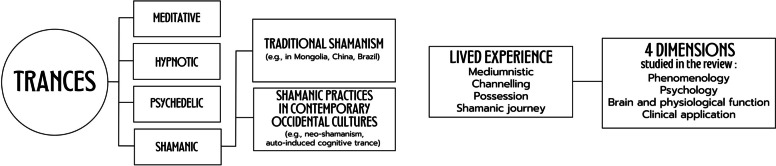
BACKGROUND: Shamanism is a spiritual tradition in which trance practitioners deliberately modify their state of consciousness to seemingly interact with an invisible world to resolve their community members' problems. This review aims to provide a multidisciplinary overview of scientific research on shamanic trance. METHODS: The search was performed using PubMed and Google Scholar databases. Twenty-seven articles were found to be eligible, and their data were classified into four dimensions, namely, a) phenomenology, b) psychology, c) neuro-physiological functions, and d) clinical applications. RESULTS: These studies suggest that these trances are non-pathological, different from normal states of consciousness in terms of phenomenology and neurophysiology, and influenced by multiple personal and environmental variables. Furthermore, while trances may offer therapeutic potential, their scope should be approached cautiously, underscoring the need for rigorous studies to assess the effectiveness of shamanic approaches for complementary therapies. CONCLUSION: Overall, shamanic trance and its potential benefits remain an intriguing and multifaceted area of scientific study, offering insights into the intersections of consciousness, spirituality, and possibly therapy.
Overview
CoChat Summary
TL;DR
This scoping review maps 27 original articles on shamanic and neo-shamanic trance across phenomenology, psychology, neurophysiology, and clinical applications. Overall, the paper argues that shamanic trances appear non-pathological and potentially beneficial, but the evidence is preliminary and methodologically weak.
Key findings
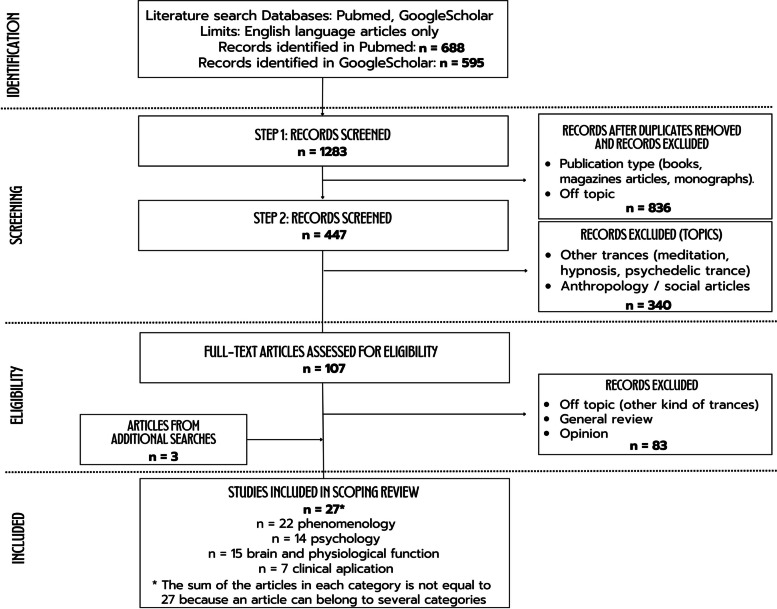
- The review included 27 original articles selected from 1,283 records screened, with the final set spanning phenomenology, psychology, brain/physiology, and clinical applications.
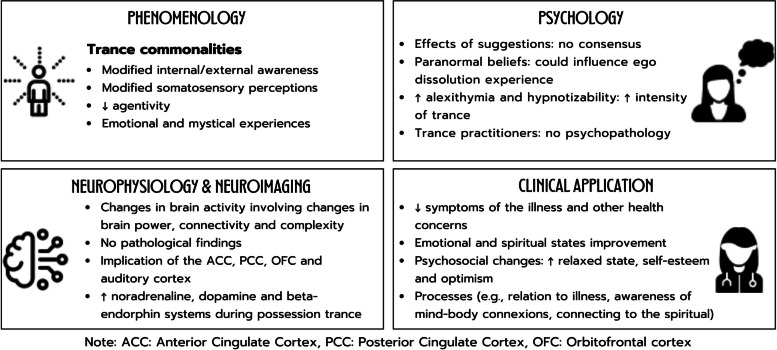
- Phenomenology studies reported recurring features across trance types: modified internal/external consciousness, altered somatosensory perception, altered agency/automaticity, and emotionally intense or mystical states; for example, one drumming study with N = 37 identified 8 domains: complex imagery, unity, spiritual experience, happiness, disembodiment, insight, visual alterations, and altered perceptions.
- Psychological findings suggest trance experience can be influenced by suggestion, paranormal/supernatural beliefs, alexithymia, and hypnotizability; in one novice study (N = 39), shamanic-journey instructions increased subjective heaviness, dreamlike states, and subjective heart-rate decrease, while another (N = 24) found no suggestion effect.
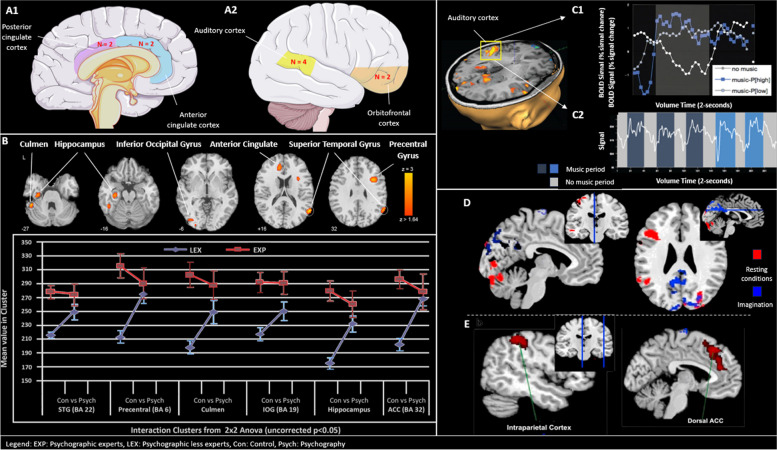
- Across neurophysiological studies, the paper reports no neurophysiological signs of epileptogenic or psychotic states, and notes patterns such as increased alpha/theta activity in some possession/salpuri studies, DMN involvement, and mixed findings in auditory and frontal regions.
- Clinical studies were small but generally encouraging: in temporomandibular disorder research (N = 20), worst pain improved from 7.48 ± 1.4 before intervention to 3.6 ± 2.5 at the end and 3.4 ± 2.5 at 9 months; in a PTSD case series (N = 6), PTSD symptoms decreased in all participants but one and quality of life improved in all patients.
Methods
- Scoping review conducted according to PRISMA-ScR, using PubMed and Google Scholar searches first in September 2020 and again in September 2022.
- Included studies had to be about shamanic trance and practices derived from shamanism, in English, and about Humankind; books, magazines, and monographs were excluded.
- Screening proceeded in three steps: title/abstract screening of 1,283 articles, full-text review of 447 articles, and final inclusion of 27 original articles; findings were organized into four dimensions: phenomenology, psychology, brain/physiological functions, and clinical applications.
Limitations
- The paper states that the field is still in its infancy, and that the included studies had major methodological problems: absence of control groups, lack of randomization, small sample sizes, insufficient statistical analysis, and limited information on shamans’ recruitment, qualifications, and expertise.
- The search was limited to two databases and to English-language articles, which the authors say may miss relevant studies.
- The review only retained papers centered on shamanic trance and the four chosen categories, so it likely excluded some related anthropological/ethnopsychiatric material and other trance-related records; this is a limitation stated in the paper.
Model-written summary. Check it against the paper before relying on it.
Integrity signals
Registry
Cites
Statistics
Figures
Verification
Claims the paper makes
24 Valid · 1 Not valid · 34 Not checked · 28 Own results and interpretations
The cited sources support only part of this claim — read each source’s verdict below.
In the paper
“In the context of shamanic journeys, a study investigating different phenomenological domains by questionnaire highlighted 8 domains reported by shamans during drumming: complex imagery, experience of unity, spiritual experience, state of happiness, disembodiment, insight, elementary visual alterations, and altered perceptions (N = 37) [22].”
§ Scoping review on shamanistic trances practices > Results > Phenomenology studies
What the sources say
- Partly supportedcites [22] Huels ER, Kim H, Lee U, Bel-Bahar T, Colmenero AV, Nelson A, Blain-Moraes S, Mashour GA, Harris RE. Neural correlates of the shamanic state of consciousness. Front Hum Neurosci. 2021;15:610466. 10.3389/fnhum.2021.610466. 33815077 PMC8012721 sourceExperimental — accuracy not yet measured
Split into 2 atoms — 1 confirmed, 1 partially supported, 0 disputed, 0 misattributed, 0 unverifiable. Expand the claim to see per-atom verdicts.
plainn = 37- Asserted: passes — The authors put it forward as true.
- Checkable: passes — It can be checked against evidence.
- Load-bearing: unclear — It is unclear whether the paper’s conclusions depend on it.
- Based: passes — The paper gives a reason why it holds.
- Partly supported
The sources with a verdict support this claim; the rest weren’t checked yet, have no full text we could read, or their verdicts aren’t rated yet.
In the paper
“a mystical experience (feeling of ecstasy) (N = 1) [29, 74]”
§ Scoping review on shamanistic trances practices > Results > Phenomenology studies
What the sources say
- Not checked — no full text of the sourcecites [29] Park JR, Yagyu T, Saito N, Kinoshita T, Hirai T. Dynamics of brain electric field during recall of Salpuri dance performance. Percept Mot Skills. 2002;95:955–62. 10.2466/pms.2002.95.3.955. 12509202 source
- Supportedcites [74] Rogerson RG, Barnstaple RE, DeSouza JF. Neural Correlates of a Trance Process and Alternative States of Consciousness in a Traditional Healer. Brain Sci. 2021;11:497. 10.3390/brainsci11040497. 33919770 PMC8070722 source
The Results report that the subject experienced an “ecstatic feeling or sensation” during trance. The Introduction describes the study as examining a single experienced traditional healer, matching N = 1. (LLM, conf=0.91)
plainSingle case- Asserted: passes — The authors put it forward as true.
- Checkable: passes — It can be checked against evidence.
- Load-bearing: unclear — It is unclear whether the paper’s conclusions depend on it.
- Based: passes — The paper gives a reason why it holds.
The cited sources support only part of this claim — read each source’s verdict below.
In the paper
“bodily manifestations (rapid fluttering of the eyelids, accelerated breathing, feeling of dizziness, buzzing head, heaviness, modification of heart rate) [4, 15, 74]”
§ Scoping review on shamanistic trances practices > Results > Phenomenology studies
What the sources say
- Partly supportedcites [4] Gingras B, Pohler G, Fitch WT. Exploring shamanic journeying: repetitive drumming with shamanic instructions induces specific subjective experiences but no larger cortisol decrease than instrumental meditation music. PLoS One. 2014;9:e102103. 10.1371/journal.pone.0102103. 24999623 PMC4085008 sourceExperimental — accuracy not yet measured
The Results (Analysis of the experience questionnaire; page unavailable) report that participants given shamanic instructions with repetitive drumming experienced heaviness and a subjective decrease in heart rate. Our copy does not report rapid eyelid fluttering, accelerated breathing, dizziness, or a buzzing head. The heart-rate finding is a reported sensation, not a measured physiological change. (LLM, conf=0.88)
- Not matchedcites [15] Krycka KC. Shamanic practices and the treatment of life-threatening medical conditions. J Transpers Psychol. 2000;32:69.
Its entry has no title and year that we can search by.
- Partly supportedcites [74] Rogerson RG, Barnstaple RE, DeSouza JF. Neural Correlates of a Trance Process and Alternative States of Consciousness in a Traditional Healer. Brain Sci. 2021;11:497. 10.3390/brainsci11040497. 33919770 PMC8070722 sourceExperimental — accuracy not yet measured
The Results section reports that one traditional healer experienced rapid eyelid fluttering and increased breathing during trance. It does not report dizziness, a buzzing head, heaviness, or a change in heart rate; those parts of the cited list are not supported by this paper. (LLM, conf=0.88)
plainstates an association- Asserted: passes — The authors put it forward as true.
- Checkable: passes — It can be checked against evidence.
- Load-bearing: unclear — It is unclear whether the paper’s conclusions depend on it.
- Based: passes — The paper gives a reason why it holds.
- Partly supported
The cited sources support only part of this claim — read each source’s verdict below.
In the paper
“a modification of perception and awareness of the body (e.g., mental imagery, sensation of floating, communication with entities, reliving traumatic experiences from a new perspective/better understanding of life/disease) (N = 15, N = 4) [15, 19, 74]”
§ Scoping review on shamanistic trances practices > Results > Phenomenology studies
What the sources say
- Not matchedcites [15] Krycka KC. Shamanic practices and the treatment of life-threatening medical conditions. J Transpers Psychol. 2000;32:69.
Its entry has no title and year that we can search by.
- Not checked — no full text of the sourcecites [19] Wahbeh H, Shainsky L, Weaver A, Engels-Smith J. Shamanic healing for veterans with PTSD: a case series. Explore (NY). 2017;13:207–17. 10.1016/j.explore.2017.02.003. 28336055 source
- Partly supportedcites [74] Rogerson RG, Barnstaple RE, DeSouza JF. Neural Correlates of a Trance Process and Alternative States of Consciousness in a Traditional Healer. Brain Sci. 2021;11:497. 10.3390/brainsci11040497. 33919770 PMC8070722 sourceExperimental — accuracy not yet measured
The Results report altered bodily awareness, mental imagery, and a sensation of flying or floating during trance. But Materials and Methods identifies this as a single-participant study, so it does not support the stated sample sizes of N = 15 and N = 4; the reported experience also does not include reliving trauma or gaining a new understanding of life or disease. Page numbers were not available in our copy. (LLM, conf=0.86)
plainn = 15- Asserted: passes — The authors put it forward as true.
- Checkable: passes — It can be checked against evidence.
- Load-bearing: unclear — It is unclear whether the paper’s conclusions depend on it.
- Based: passes — The paper gives a reason why it holds.
- Not matched
Every source the paper cites for this claim was checked and supports it.
In the paper
“Other studies based on free speech similarly reported an increase in internal and external awareness (N = 1) [74]”
§ Scoping review on shamanistic trances practices > Results > Phenomenology studies
What the sources say
- Supportedcites [74] Rogerson RG, Barnstaple RE, DeSouza JF. Neural Correlates of a Trance Process and Alternative States of Consciousness in a Traditional Healer. Brain Sci. 2021;11:497. 10.3390/brainsci11040497. 33919770 PMC8070722 source
The Materials and Methods describe a follow-up interview inviting the single participant to elaborate on her trance experience. In the Results, she reports heightened awareness of light, odor, and sound, alongside an intensified sense of presence in her body. These accounts support the paraphrase about external and internal awareness. (LLM, conf=0.87)
plainstates a causeSingle case- Asserted: passes — The authors put it forward as true.
- Checkable: passes — It can be checked against evidence.
- Load-bearing: unclear — It is unclear whether the paper’s conclusions depend on it.
- Based: passes — The paper gives a reason why it holds.
- Supported
61 more claims · 16 with their cited sources checked
Create a free account to see all 87 claims and to verify the 7 references still open.
- Probably not a substantial claim. 8
- It may state two separate claims as one. 14
Citations
Cites
PRISMA Extension for Scoping Reviews (PRISMA-ScR): Checklist and Explanation
Tricco, A. C., Lillie, E., Zarin, W., O'Brien, K. K., Colquhoun, H., Levac, D., Moher, D., Peters, M. D. J., Horsley, T., Weeks, L., et al. (2018) · Annals of Internal Medicine · doi:10.7326/m18-0850 · Cited by 43,565 · cited 1×
“We conducted a literature review based on the guidelines provided by the Preferred Reporting Items for Systematic Reviews and Meta-Analyses Extension for Scoping Reviews (PRISMA-ScR) [72].”
MethodDevelopment and validation of brief measures of positive and negative affect: The PANAS scales.
Watson, D., Clark, L. A., & Tellegen, A. (1988) · Journal of Personality and Social Psychology · doi:10.1037/0022-3514.54.6.1063 · Cited by 32,433 · cited 1×
“At the emotional level, experts in trance reported an increase in surprise and happiness during trance on the positive and negative affect scale ( N = 16) [60, 81].”
BackgroundThe Brain's Default Network: Anatomy, Function, and Relevance to Disease
Buckner, R. L., Andrews‐Hanna, J. R., & Schacter, D. L. (2008) · Annals of the New York Academy of Sciences · doi:10.1196/annals.1440.011 · Cited by 9,761
Development, reliability, and validity of a dissociation scale
BERNSTEIN, E. M., & PUTNAM, F. W. (1986) · The Journal of Nervous and Mental Disease · doi:10.1097/00005053-198612000-00004 · Cited by 3,793 · cited 1×
“Additionally, the Dis-sociative Experience Scale [86] indicated that although shamans’ scores were generally below the pathological threshold of 30, their scores were higher than the average scale’s scores found in Western and Chinese general populations, without causing clinically significant…”
BackgroundNeural correlates of the psychedelic state as determined by fMRI studies with psilocybin
Carhart-Harris, R. L., Erritzoe, D., Williams, T., Stone, J. M., Reed, L. J., Colasanti, A., Tyacke, R. J., Leech, R., Malizia, A. L., Murphy, K., et al. (2012) · Proceedings of the National Academy of Sciences · doi:10.1073/pnas.1119598109 · Cited by 1,172 · cited 1×
“Additionally, a decrease in activation of the OFC at the onset of trance perception could be the neuronal correlate marking deepness of the trance [74], akin to findings in psy-chedelic studies [95, 96].”
ResultAberrant “Default Mode” Functional Connectivity in Schizophrenia
Garrity, A. G., Pearlson, G. D., McKiernan, K., Lloyd, D., Kiehl, K. A., & Calhoun, V. D. (2007) · American Journal of Psychiatry · doi:10.1176/ajp.2007.164.3.450 · Cited by 1,114
Advancing Research and Practice: The Revised APA Division 30 Definition of Hypnosis
Elkins, G. R., Barabasz, A. F., Council, J. R., & Spiegel, D. (2015) · International Journal of Clinical and Experimental Hypnosis · doi:10.1080/00207144.2014.961870 · Cited by 499 · cited 2×
“Finally, hypnotizability, which is the individual’s ability to experience suggested changes in physiology, sensations, emotions, thoughts, or behavior following suggestions during hypnosis [38], has been studied in regard to the shamanic trance experience.”
BackgroundSkudlarski, P., Jagannathan, K., Anderson, K., Stevens, M. C., Calhoun, V. D., Skudlarska, B. A., & Pearlson, G. (2010) · Biological Psychiatry · doi:10.1016/j.biopsych.2010.03.035 · Cited by 466 · cited 1×
“Various studies showed that the DMN’s connectivity may distinguish schizophrenia from trance states [60] as it seems preserved only in trance experts during trance [8, 60, 92–94].”
BackgroundPalhano-Fontes, F., Andrade, K. C., Tofoli, L. F., Santos, A. C., Crippa, J. A. S., Hallak, J. E. C., Ribeiro, S., & de Araujo, D. B. (2015) · PLOS ONE · doi:10.1371/journal.pone.0118143 · Cited by 454 · cited 1×
“Additionally, a decrease in activation of the OFC at the onset of trance perception could be the neuronal correlate marking deepness of the trance [74], akin to findings in psy-chedelic studies [95, 96].”
ResultResting-state functional network correlates of psychotic symptoms in schizophrenia
Rotarska-Jagiela, A., van de Ven, V., Oertel-Knöchel, V., Uhlhaas, P. J., Vogeley, K., & Linden, D. E. J. (2010) · Schizophrenia Research · doi:10.1016/j.schres.2010.01.001 · Cited by 336
Drugs as instruments: A new framework for non-addictive psychoactive drug use
Müller, C. P., & Schumann, G. (2011) · Behavioral and Brain Sciences · doi:10.1017/s0140525x11000057 · Cited by 286
Hypnotic modulation of resting state fMRI default mode and extrinsic network connectivity
Demertzi, A., Soddu, A., Faymonville, M.-É., Bahri, M. A., Gosseries, O., Vanhaudenhuyse, A., Phillips, C. L. M., Maquet, P., Noirhomme, Q., Luxen, A., et al. (2011) · Progress in brain research · doi:10.1016/b978-0-444-53839-0.00020-x · Cited by 163 · cited 1×
“Hypnotic trance can be defined as a process involving a modulation of self-awareness [36, 37], “focused attention and reduced peripheral awareness characterized by an enhanced capacity for response to suggestion” [38].”
BackgroundSelf-citationWINKELMAN, M. J. (1990) · Ethos · doi:10.1525/eth.1990.18.3.02a00040 · Cited by 155
Wittkower, E. D. (1970) · International Journal of Social Psychiatry · doi:10.1177/002076407001600207 · Cited by 154 · cited 1×
“Regardless of social status, people who report experiencing possession trances all describe a temporary inability to control their body and a loss of identity [65].”
BackgroundTimmermann, C., Bauer, P. R., Gosseries, O., Vanhaudenhuyse, A., Vollenweider, F., Laureys, S., Singer, T., Antonova, E., & Lutz, A. (2023) · Trends in Cognitive Sciences · doi:10.1016/j.tics.2022.11.006 · Cited by 150
Self-citationClinical Trials of Meditation Practices in Health Care: Characteristics and Quality
Ospina, M. B., Bond, K., Karkhaneh, M., Buscemi, N., Dryden, D. M., Barnes, V., Carlson, L. E., Dusek, J. A., & Shannahoff-Khalsa, D. (2008) · The Journal of Alternative and Complementary Medicine · doi:10.1089/acm.2008.0307 · Cited by 140 · cited 1×
“While meditative techniques are numerous, they present many similarities, such as a quiet location with few distractions, a specific posture, a focus on attention, and an open attitude of letting thoughts come and go without judgment [35].”
BackgroundTowards an experiential analysis of shamanism
PETERS, L. G., & PRICE‐WILLIAMS, D. (1980) · American Ethnologist · doi:10.1525/ae.1980.7.3.02a00010 · Cited by 123 · cited 1×
“Studies should also investigate the different types of shamanic trances depending on their induction methods to understand the difference in experience [55].”
BackgroundRecommendations for Developing Classroom Performance Assessments and Scoring Rubrics
Moskal, B. (2020) · Scholarworks (University of Massachusetts Amherst) · doi:10.7275/jz85-rj16 · Cited by 109 · cited 1×
“The complexity of the written content produced during the trance was assessed using an analytic assessment [88].”
MethodNeurophysiological correlates of hypnosis and dissociation
(1991) · The Journal of Neuropsychiatry and Clinical Neurosciences · doi:10.1176/jnp.3.4.440 · Cited by 108 · cited 1×
“…dissociation (splitting of mental processes and bodily awareness and perceptions), sug-gestibility (tendency to comply with suggestions and to exhibit reduced critical thinking) [39], and automaticity (altered sense of agency, which is lived as a non-volun-tary response to a suggestion) [40].”
BackgroundNeuroimaging during Trance State: A Contribution to the Study of Dissociation
Peres, J. F., Moreira-Almeida, A., Caixeta, L., Leao, F., & Newberg, A. (2012) · PLoS ONE · doi:10.1371/journal.pone.0049360 · Cited by 105 · cited 10×
“Adapted with permission from [80].”
BackgroundResultInfluentialFlor-Henry, P., Shapiro, Y., & Sombrun, C. (2017) · Cogent Psychology · doi:10.1080/23311908.2017.1313522 · Cited by 101 · cited 7×
“Conversely, shamanic practitioners and drum listeners exhibited decreased alpha frequency band and connectivity [22, 83], with beta and gamma bands linked to complex internal imagery [22, 51].”
BackgroundInfluentialElectroencephalographic measurement of possession trance in the field
Oohashi, T., Kawai, N., Honda, M., Nakamura, S., Morimoto, M., Nishina, E., & Maekawa, T. (2002) · Clinical Neurophysiology · doi:10.1016/s1388-2457(02)00002-0 · Cited by 98 · cited 8×
“In fact, Neurophysiological studies confirm the absence of neurological issues in shamanic trances [78, 79, 82].”
BackgroundInfluentialBrain Network Reconfiguration and Perceptual Decoupling During an Absorptive State of Consciousness
Hove, M. J., Stelzer, J., Nierhaus, T., Thiel, S. D., Gundlach, C., Margulies, D. S., Van Dijk, K. R. A., Turner, R., Keller, P. E., & Merker, B. (2016) · Cerebral Cortex · doi:10.1093/cercor/bhv137 · Cited by 97 · cited 10×
“Moreover, three fMRI studies have highlighted the implication of important areas of the default mode network (DMN) with the activation of the PCC [8, 60] and the modulation of the orbitofrontal cortex (OFC) during trance [60, 74].”
BackgroundInfluentialConflicting perspectives on shamans and shamanism: Points and counterpoints.
Krippner, S. (2002) · American Psychologist · doi:10.1037//0003-066x.57.11.962 · Cited by 96 · cited 1×
“They are usually called upon by people in difficulty, the “consultants”, to help them with traditional rituals [57, 58].”
BackgroundDuring, E. H., Elahi, F. M., Taieb, O., Moro, M.-R., & Baubet, T. (2011) · The Canadian Journal of Psychiatry · doi:10.1177/070674371105600407 · Cited by 83 · cited 2×
“This offers them a particular status with an immediate and integrative response from society [28, 53–56].”
BackgroundKindermann, S. S., Brown, G. G., Zorrilla, L. T. E., Olsen, R. K., & Jeste, D. V. (2003) · Schizophrenia Research · doi:10.1016/j.schres.2003.08.010 · Cited by 83 · cited 1×
“Additionally, mediumistic studies found increased activity and connectivity in the auditory cortex, possibly associated with participants hearing voices [60, 80], similar to auditory hallucinations in psychotic patients [97].”
BackgroundNeural mechanisms of hypnosis and meditation
Benedittis, G. D. (2015) · Journal of Physiology-Paris · doi:10.1016/j.jphysparis.2015.11.001 · Cited by 77 · cited 1×
“Meditative trance is defined as a group of “states, processes, and practices that self-regulate the body and mind, thereby affecting mental and physical events by engaging a specific attentional set” [34].”
BackgroundDissociation and alexithymia among men with alcoholism
Evren, C., Sar, V., Evren, B., Semiz, U., Dalbudak, E., & Cakmak, D. (2008) · Psychiatry and Clinical Neurosciences · doi:10.1111/j.1440-1819.2007.01775.x · Cited by 67 · cited 1×
“Personality traits were also explored in a study that showed a positive relationship between alexithymia (involving the inability to distinguish between inner feelings and their associated body sensations [84]) and trance intensity.”
BackgroundEffectiveness of Complementary Therapies in Cancer Patients: A Systematic Review
Guerra-Martín, M. D., Tejedor-Bueno, M. S., & Correa-Casado, M. (2021) · International Journal of Environmental Research and Public Health · doi:10.3390/ijerph18031017 · Cited by 66
Soul Retrieval: Mending the Fragmented Self
Ingerman, S. (1991) · Medical Entomology and Zoology · Cited by 65
Ferracuti, S., & Sacco, R. (1996) · Journal of Personality Assessment · doi:10.1207/s15327752jpa6603_4 · Cited by 64 · cited 1×
“Moreover, possession trance showed increased noradrenaline, dopamine, and beta-endorphin levels, possibly explaining memory alterations and changes in pain or motor behaviors [21, 53, 77–79, 98, 99].”
BackgroundLee, B., Kirmayer, L. J., & Groleau, D. (2009) · Culture Medicine and Psychiatry · doi:10.1007/s11013-009-9161-3 · Cited by 60 · cited 3×
“Clinically, a study of shamanism in a therapeutic setting highlights the need to develop symbolic therapy models that focus on patients’ expectations, beliefs and culture [58].”
BackgroundShamanism in Cross-Cultural Perspective
Winkelman, M. (2012) · International Journal of Transpersonal Studies · doi:10.24972/ijts.2012.31.2.47 · Cited by 60 · cited 4×
“This terminology finds its origins from the tungus of Siberia and emerged in the intellectual circles of Europe with Russian scientific expeditions into Siberia in the seventeenth and eight-eenth centuries [26, 52].”
BackgroundInfluentialScales, Scales and More Scales
Weitzenhoffer, A. M. (2002) · American Journal of Clinical Hypnosis · doi:10.1080/00029157.2002.10403481 · Cited by 52 · cited 1×
“…dissociation (splitting of mental processes and bodily awareness and perceptions), sug-gestibility (tendency to comply with suggestions and to exhibit reduced critical thinking) [39], and automaticity (altered sense of agency, which is lived as a non-volun-tary response to a suggestion) [40].”
BackgroundNeural Correlates of the Shamanic State of Consciousness
Huels, E. R., Kim, H., Lee, U., Bel-Bahar, T., Colmenero, A. V., Nelson, A., Blain-Moraes, S., Mashour, G. A., & Harris, R. E. (2021) · Frontiers in Human Neuroscience · doi:10.3389/fnhum.2021.610466 · Cited by 52 · cited 7×
“Conversely, shamanic practitioners and drum listeners exhibited decreased alpha frequency band and connectivity [22, 83], with beta and gamma bands linked to complex internal imagery [22, 51].”
BackgroundInfluentialHow Chanting Relates to Cognitive Function, Altered States and Quality of Life
Perry, G., Polito, V., Sankaran, N., & Thompson, W. F. (2022) · Brain Sciences · doi:10.3390/brainsci12111456 · Cited by 47 · cited 1×
“…in common: they are all induced by a shamanic inductor such as percussions, sounds, repetitive movements, dances, songs, chanting, prayers (e.g., mantra recitation), prolonged postures, sensory restriction or overload, fasting, and psyche-delics (i.e., psilocybin, ayahuasca, peyote) [23, 27–31].”
BackgroundPhenomenological Experience in Response to Monotonous Drumming and Hypnotizability
Maurer, R. L., Kumar, V. K., Woodside, L., & Pekala, R. J. (1997) · American Journal of Clinical Hypnosis · doi:10.1080/00029157.1997.10403417 · Cited by 46 · cited 3×
“Furthermore, people with greater suggestibility are also more likely to have a more intense shamanic experience [85].”
BackgroundHypnosis modulates behavioural measures and subjective ratings about external and internal awareness
Demertzi, A., Vanhaudenhuyse, A., Noirhomme, Q., Faymonville, M.-É., & Laureys, S. (2015) · Journal of Physiology-Paris · doi:10.1016/j.jphysparis.2015.11.002 · Cited by 46 · cited 1×
“Hypnotic trance can be defined as a process involving a modulation of self-awareness [36, 37], “focused attention and reduced peripheral awareness characterized by an enhanced capacity for response to suggestion” [38].”
BackgroundSelf-citationNeurophysiology of hypnosis in chronic pain: A review of recent literature
Bicego, A., Rousseaux, F., Faymonville, M.-E., Nyssen, A.-S., & Vanhaudenhuyse, A. (2021) · American Journal of Clinical Hypnosis · doi:10.1080/00029157.2020.1869517 · Cited by 44
Self-citationA Cross-Cultural Study of the Possession-Trance in Singapore
Kua, E. H., Sim, L. P., & Chee, K. T. (1986) · Australian & New Zealand Journal of Psychiatry · doi:10.3109/00048678609158883 · Cited by 43 · cited 1×
“They generally experience in their youth a specific trance that is considered as the initial “shamanic call” of future shamans, which would reveal capacities to easily experience a shamanic trance, or as a defense mechanism against a difficult situation or an offense of the spirits [53, 54].”
BackgroundTransformation in Dang-ki Healing: The Embodied Self and Perceived Legitimacy
Lee, B.-O. (2016) · Culture, Medicine, and Psychiatry · doi:10.1007/s11013-016-9497-4 · Cited by 39 · cited 6×
“Similarly, another case study suggested that it would be the feeling of control over the possession trance, moving from spontaneous possession to voluntary possession induced by rituals, that would promote the positive adaptation of shamans [76].”
BackgroundInfluentialTrends in Contemporary Research on Shamanism
DuBois, T. A. (2011) · Numen · doi:10.1163/156852710x514339-2 · Cited by 36 · cited 1×
“Those practices foster personal and communal empowerment through different trainings allowing most people to induce the trance voluntarily [68, 69].”
BackgroundCatecholamines and opioid peptides increase in plasma in humans during possession trances
Kawai, N., Honda, M., Nakamura, S., Samatra, P., Sukardika, K., Nakatani, Y., Shimojo, N., & Oohashi, T. (2001) · Neuroreport · doi:10.1097/00001756-200111160-00009 · Cited by 35 · cited 7×
“…sudden excitement marking entry into trance, staring and/or unfocused eyes, masked expression, muscle rigidity/limb stiffness, tremors/convulsions, repeated automatic movements, falls and loss of consciousness, as well as stiffening and tremors of the limbs ( N = 24, N = 3, N = 12) [77–79].”
BackgroundInfluentialNeural correlates of psychotic-like experiences during spiritual-trance state
Mainieri, A. G., Peres, J. F. P., Moreira-Almeida, A., Mathiak, K., Habel, U., & Kohn, N. (2017) · Psychiatry Research: Neuroimaging · doi:10.1016/j.pscychresns.2017.06.006 · Cited by 35 · cited 9×
“Moreover, three fMRI studies have highlighted the implication of important areas of the default mode network (DMN) with the activation of the PCC [8, 60] and the modulation of the orbitofrontal cortex (OFC) during trance [60, 74].”
BackgroundInfluentialClinical Hypnosis for Procedural Pain and Distress in Children: A Scoping Review
Geagea, D., Tyack, Z., Kimble, R., Polito, V., Ayoub, B., Terhune, D. B., & Griffin, B. (2023) · Pain Medicine · doi:10.1093/pm/pnac186 · Cited by 35 · cited 1×
“Several studies have reported some clinical benefits of hypnotic, meditative and psychedelic trances on pain, emotional regulation, sleep, fatigue, stress, cognitive difficulties and quality of life [43–48].”
BackgroundMental Illness Among Bhutanese Shamans in Nepal
van Ommeren, M., Komproe, I., Cardeña, E., Thapa, S. B., Prasain, D., de Jong, J. T. V. M., & Sharma, B. (2004) · Journal of Nervous & Mental Disease · doi:10.1097/01.nmd.0000122381.09491.7f · Cited by 34 · cited 3×
“…42) did not differ significantly from the other Bhutanese refugees ( N = 532) over the past 12 months and lifetime in terms of major depressive episode, specific phobia, persistent somatoform pain, post-traumatic stress disorder (PTSD), generalized anxiety disorder, or dissociative disorders [16].”
BackgroundAltered States, Conflicting Cultures: Shamans, Neo‐shamans and Academics
Wallis, R. J. (1999) · Anthropology of Consciousness · doi:10.1525/ac.1999.10.2-3.41 · Cited by 34 · cited 1×
“Those practices foster personal and communal empowerment through different trainings allowing most people to induce the trance voluntarily [68, 69].”
BackgroundAlterations of consciousness: An empirical analysis for social scientists.
Barušs, I. (2003) · American Psychological Association eBooks · doi:10.1037/10562-000 · Cited by 34
Gingras, B., Pohler, G., & Fitch, W. T. (2014) · PLoS ONE · doi:10.1371/journal.pone.0102103 · Cited by 32 · cited 6×
“While some authors have shown a change in the experience, such as heaviness, dreamlike states, and a subjective decrease in heart rate (not found with physiological measures) [4], others have found no influence of suggestions [83].”
BackgroundInfluentialPolito, V., Langdon, R., & Brown, J. (2010) · Consciousness and Cognition · doi:10.1016/j.concog.2010.05.013 · Cited by 31 · cited 5×
“…identifying feelings”) predicts the intensity of trance on two dimensions (“oceanic boundlessness”, i.e., positive experiences of ego dissolution and loss of boundaries; and “visionary restructuralization”, i.e., hallucinations and illusions as well as changes in the meaning of objects) [3].”
BackgroundResultInfluentialA physiological examination of perceived incorporation during trance
Wahbeh, H., Cannard, C., Okonsky, J., & Delorme, A. (2019) · F1000Research · doi:10.12688/f1000research.17157.2 · Cited by 31 · cited 8×
“Although differences were observed for body temperature and skin conductance during channeling trance, they did not reach the significance threshold [62].”
BackgroundInfluentialBehavioural and brain responses in cognitive trance: A TMS-EEG case study
Gosseries, O., Fecchio, M., Wolff, A., Sanz, L. R. D., Sombrun, C., Vanhaudenhuyse, A., & Laureys, S. (2020) · Clinical Neurophysiology · doi:10.1016/j.clinph.2019.11.011 · Cited by 31 · cited 8×
“In fact, Neurophysiological studies confirm the absence of neurological issues in shamanic trances [78, 79, 82].”
BackgroundMethodInfluentialSelf-citationBecker, J. (1994) · Leonardo Music Journal · doi:10.2307/1513180 · Cited by 29
La transe cognitive auto-induite : caractéristiques et applications thérapeutiques potentielles
Grégoire, C., Sombrun, C., Gosseries, O., & Vanhaudenhuyse, A. (2021) · HEGEL - HEpato-GastroEntérologie Libérale · doi:10.3917/heg.112.0192 · Cited by 28
Self-citationThe Psychological Health of Shamans: A Reevaluation
Walsh, R. (1997) · Journal of the American Academy of Religion · doi:10.1093/jaarel/lxv.1.101 · Cited by 27 · cited 2×
“Despite geographical or temporal differences and distinctions related to the specificities of different cultures, the practices, techniques, and basic beliefs involved are surprisingly similar [11, 20].”
BackgroundAn Assessment of Contextual Mediation in Trance States of Shamanic Journeys
Houran, J., Lange, R., & Crist-Houran, M. (1997) · Perceptual and Motor Skills · doi:10.2466/pms.1997.85.1.59 · Cited by 26 · cited 4×
“Both ancestral [14, 15, 85] and modern (e.g., Foundation for Shamanic Studies 1979, TranceScience Research Institute, 2019) traditions share the common denominator of using sound to bring the individual into trance.”
BackgroundInfluentialPossession Trance in a Semi-Urban Community in Sri Lanka
Wijesinghe, C. P., Dissanayake, S. A. W., & Mendis, N. (1976) · Australian & New Zealand Journal of Psychiatry · doi:10.3109/00048677609159490 · Cited by 26 · cited 4×
“This offers them a particular status with an immediate and integrative response from society [28, 53–56].”
BackgroundInfluentialA Test for Shamanic Trance in Central Montana Rock Art
Greer, M., & Greer, J. W. (2003) · Plains Anthropologist · doi:10.1080/2052546.2003.11949299 · Cited by 24
Grégoire, C., Marie, N., Sombrun, C., Faymonville, M.-É., Kotsou, I., van Nitsen, V., de Ribaucourt, S., Jérusalem, G., Laureys, S., Vanhaudenhuyse, A., et al. (2022) · Frontiers in Psychology · doi:10.3389/fpsyg.2022.807741 · Cited by 23 · cited 4×
“The understanding of these complex phenomena can only be achieved by putting neurophysiological, psychological, phenomenological and, where relevant, clinical data into perspective [70].”
BackgroundInfluentialSelf-citationRecent Insight on How the Neuroscientific Approach Helps Clinicians
Vanhaudenhuyse, A., Nyssen, A.-S., & Faymonville, M.-E. (2020) · OBM Integrative and Complementary Medicine · doi:10.21926/obm.icm.2002028 · Cited by 22
Self-citationCharacteristics of English-speaking trance channelers
Wahbeh, H., & Butzer, B. (2020) · EXPLORE · doi:10.1016/j.explore.2020.02.002 · Cited by 21 · cited 3×
“Second, channeling trance involves both spiritual communication and spirit possession [61].”
BackgroundMethodInfluentialElectroencephalogram characteristics during possession trances in healthy individuals
Kawai, N., Honda, M., Nishina, E., Yagi, R., & Oohashi, T. (2017) · NeuroReport · doi:10.1097/wnr.0000000000000857 · Cited by 20 · cited 10×
“In fact, Neurophysiological studies confirm the absence of neurological issues in shamanic trances [78, 79, 82].”
BackgroundInfluentialFeasibility and short-term outcomes of a shamanic treatment for temporomandibular joint disorders.
(2007) · PubMed · Cited by 19
The Nature of the Shamanic State of Consiousness: A Review
Wright, P. A. (1989) · Journal of Psychoactive Drugs · doi:10.1080/02791072.1989.10472140 · Cited by 19 · cited 1×
“…is generally curative (diagnosis and treatment of illnesses), but it also seemingly allows shamans to accompany deceased persons’ souls to other realities, to locate animals for successful hunts, to solve problems encountered by members of the community and to predict future events [8, 13–19].”
BackgroundThe Psychobiology of Trance: II: Physiological and Endocrine Correlates
Ervin, F. R., Palmour, R. M., Pearson Murphy, B. E., Prince, R., & Simons, R. C. (1988) · Transcultural Psychiatric Research Review · doi:10.1177/136346158802500402 · Cited by 19
Dynamics of Brain Electric Field during Recall of Salpuri Dance Performance
Park, J. R., Yagyu, T., Saito, N., Kinoshita, T., & Hirai, T. (2002) · Perceptual and Motor Skills · doi:10.2466/pms.2002.95.3.955 · Cited by 17 · cited 3×
“The first case study conducted with an expert in Korean shamanistic dancing (Salpuri dance) showed an increase in alpha1 and theta band activity in the frontal and occipital regions as well as a decrease in generalized frequency (Phi) during the Korean shamanistic trance [29].”
BackgroundShamans as Healers, Counselors, and Psychotherapists
Krippner, S. (2012) · International Journal of Transpersonal Studies · doi:10.24972/ijts.2012.31.2.72 · Cited by 16 · cited 1×
“During traditional rituals, shamans report reaching the spirit world in shamanic trance to help members of their community and solve their physical, psychological, and spiritual problems [12].”
BackgroundRogerson, R. G., Barnstaple, R. E., & DeSouza, J. F. (2021) · Brain Sciences · doi:10.3390/brainsci11040497 · Cited by 14 · cited 9×
“Moreover, three fMRI studies have highlighted the implication of important areas of the default mode network (DMN) with the activation of the PCC [8, 60] and the modulation of the orbitofrontal cortex (OFC) during trance [60, 74].”
BackgroundInfluentialLong-term Outcomes of Shamanic Treatment for Temporomandibular Joint Disorders
Vuckovic, N. H., Williams, L. A., Schneider, J., Ramirez, M., & Gullion, C. M. (2012) · The Permanente Journal · doi:10.7812/tpp/12-004 · Cited by 13 · cited 3×
“Vuckovic and colleagues conducted a clinical trial that resulted in 3 cohort studies in 2007, 2010 and 2012 [17, 18, 90].”
BackgroundMethodShamanic Healing for Veterans with PTSD: A Case Series
Wahbeh, H., Shainsky, L., Weaver, A., & Engels-Smith, J. (2017) · EXPLORE · doi:10.1016/j.explore.2017.02.003 · Cited by 13 · cited 5×
“Wahbeh and colleagues [19] published a case series in which 8 sessions of shamanic therapy were proposed by 12 expert shamanic practitioners for 15 to 20 weeks to veterans ( N = 6) with PTSD. Shamanic healing methods were derived from core shamanic principles taught by the Foundation for Shamanic…”
BackgroundMethodInfluentialIs the shaman indeed risen in post-Soviet Siberia?
Sundström, O. (2012) · Scripta Instituti Donneriani Aboensis · doi:10.30674/scripta.67426 · Cited by 12 · cited 1×
“This terminology finds its origins from the tungus of Siberia and emerged in the intellectual circles of Europe with Russian scientific expeditions into Siberia in the seventeenth and eight-eenth centuries [26, 52].”
BackgroundKuda Kepang: A Case Report of Javanese Cultural-Related Trance in Medan
Hendriko, T., & Effendy, E. (2019) · Open Access Macedonian Journal of Medical Sciences · doi:10.3889/oamjms.2019.823 · Cited by 12 · cited 1×
“For instance, in Javanese culture, dancers called kuda lumping keep performing their dance until the spirit or endang (the king of horse) seemingly enters their body [64].”
BackgroundBLANC, F. (2010) · Anthropology of Consciousness · doi:10.1111/j.1556-3537.2010.01022.x · Cited by 11 · cited 3×
“At the end of the trance, the shamans return to the consultants to give them therapeutic advice [21].”
BackgroundDoes Shamanism Have a History? With Attention to Early Chinese Shamanism
Michael, T. (2017) · Numen · doi:10.1163/15685276-12341477 · Cited by 11 · cited 2×
“In their society, shamans are people among thousands chosen by the spirits and are considered guides [17, 23, 26, 30].”
BackgroundVuckovic, N., Schneider, J., Williams, L. A., & Ramirez, M. (2010) · EXPLORE · doi:10.1016/j.explore.2010.08.005 · Cited by 9 · cited 7×
“After the shamanic therapy, the worst pain score improved the most (from a mean of 7.48 ± 1.4 before the intervention to 3.6 ± 2.5 at the end of the intervention) [17].”
BackgroundMethodInfluentialKonopacki, M., & Madison, G. (2018) · Journal of Sleep And Sleep Disorder Research · doi:10.14302/issn.2574-4518.jsdr-17-1794 · Cited by 9 · cited 5×
“While some authors have shown a change in the experience, such as heaviness, dreamlike states, and a subjective decrease in heart rate (not found with physiological measures) [4], others have found no influence of suggestions [83].”
BackgroundInfluentialRites, marges et usages des drogues : représentations sociales et normativité contextuelle
Perreault, M. (2010) · Drogues, santé et société · doi:10.7202/038915ar · Cited by 8 · cited 2×
“For example, the use of psychoactive substances, which is originally used in many shamanic practices, is for some people automatically associated with shamanic trance, but it is far from being systematic [49].”
BackgroundSpirit Mediumship and Mental Health: Therapeutic Self-transformation Among Dang-kis in Singapore
Lee, B.-O., & Kirmayer, L. J. (2023) · Culture, Medicine, and Psychiatry · doi:10.1007/s11013-021-09765-y · Cited by 7 · cited 9×
“This is reflected by partial amnesia (often reported in channeling) or even complete amnesia for the possession trance [75–80].”
BackgroundMethodInfluentialA Critical Overview of the Psychiatric Approaches to Shamanism
Mitrani, P. (1992) · Diogenes · doi:10.1177/039219219204015813 · Cited by 6 · cited 2×
“These latter findings suggest that possession trance might involve less control over the body and self-awareness compared to other trance types [5, 100] (Fig.”
BackgroundParacoustics: Sound & the Paranormal
Parsons, S. T., & Cooper, C. E. (2015) · Cited by 1
(1988) · Bulletin of Science Technology & Society · doi:10.1177/0270467688008004133 · Cited by 1 · cited 1×
“This, in order to avoid the “West-ern fallacy” of applying a Western explanatory model to the experiences of other cultures [101], but also to better understand Western practices derived from the shamanic tradition (e.g., AICT).”
Background(2000) · CrossRef Listing of Deleted DOIs · doi:10.1016/s0246-1072(21)44460-3
Research works printed but not linked: 10
- Shear, J. (Éd.). Explaining Consciousness (1st edition). Bradford Books. 1997.
- Bourguignon E. Spirit Possession and Altered States of Consciousness. In: The Evolution of an Inquiry. 1978. p. 479–515 ISBN 978–0–520–31282–1.
- Krycka KC. Shamanic practices and the treatment of life-threatening medical conditions. J Transpers Psychol. 2000;32:69.
- McClenon J. Wondrous healing: Shamanism, human evolution, and the origin of religion. USA: Northern Illinois University Press; 2002. ISBN 978–0–87580–590–0.
- MacDonald MN. The study of shamanism: local and universal dimensions. J Ritual Stud. 2002;16:88–107.
- Krippner S. The epistemology and technologies of shamanic states of consciousness. J Conscious Stud. 2000;7:93–118.
- Timmermann C, Bauer PR, Gosseries O, Vanhaudenhuyse A, Vollenweider F, Laureys S, Singer T, Antonova E, Lutz A. A neurophenomenological approach to non-ordinary states of consciousness: Hypnosis, meditation, and psychedelics. Trends Cogn Sci. 2023;27(2):139–59. 10.1016/j.tics.2022.11.006. 36566091 · DOI · Paper page
- Chaumeil JP. Perrin, M. — Le chamanisme. Journal de la société des américanistes 1995, 374–375.
- Pekala RJ. In: Quantifying Consciousness: An Empirical Approach; Quantifying consciousness: An empirical approach. New York: Plenum Press; 1991. p. xxiii, 422 ISBN 978–0–306–43750–2.
- Roney-Dougal S. Walking Between the Worlds: Links between Psi, Psychdelics, Shamanism and Psychosis. 2012.
Cited by
Collignon, G., Bicego, A., Faymonville, M.-É., Gosseries, O., Bonhomme, V. L., Dive, D., Sombrun, C., Bioy, A., & Vanhaudenhuyse, A. (2025) · OBM Integrative and Complementary Medicine · doi:10.21926/obm.icm.2501012 · Cited by 6
Self-citationSun, H., & Kim, E. (2025) · Religions · doi:10.3390/rel16070893 · Cited by 7
A Fragmented Mind: Altered States of Consciousness and Spirit Possession Between Rituals and Therapy
Leo, D. G. (2025) · Integrative Psychological and Behavioral Science · doi:10.1007/s12124-025-09929-0 · Cited by 5
“…of Dionysus (Mysteries of Dionysus – commonly spread during ancient Greece and the Roman period) to Haitian Voodoo, passing from Tarantism, Christian mysticism, and Shamanism, common tracts can be seen in the use of ASCs to communicate with the divine (Marie et al., 2024 ; Randal et al., 2018 ).”
Exploring Mystical-Type Experiences Through Auto-Induced Cognitive Trance
Bicego, A., Alnagger, N., Cardeña, E., Sombrun, C., Martial, C., Annen, J., Gosseries, O., & Vanhaudenhuyse, A. (2025) · International Journal of Clinical and Experimental Hypnosis · doi:10.1080/00207144.2025.2544055 · Cited by 5
“…practitioners alter their conscious experience, often describe their experience as entering a “supernatural” world which manifests phenom-enologically as experiencing a sense of boundarylessness or sense of unity, out-of-body experiences, and possession (Marie et al., 2024; Winkelman, 2024).”
Self-citationBaldaccini, S. (2025) · HEGEL - HEpato-GastroEntérologie Libérale · doi:10.3917/heg.154.0027 · Cited by 1
Metadata
- Authors
- Marie, N., Lafon, Y., Bicego, A., Grégoire, C., Rousseaux, F., Bioy, A., Vanhaudenhuyse, A., & Gosseries, O.
- Affiliations
- University of Liège (BE)
- Université Paris 8 (FR)
- Corresponding author
- Marie, Nolwenn
- Vanhaudenhuyse, Audrey
- Gosseries, Olivia
- ORCID
- Venue
- BMC Complementary Medicine and Therapies
- Published
- 2024-11-04
- Volume
- 24
- Issue
- 1
- Pages
- 381-381
- ISSN
- 2662-7671 (ISSN-L)
- PMC
- PMC11536825
- OpenAlex
- W4404040770
- Cited by
- 21
- References
- 85
- Citations by year
- 2026: 10 · 2025: 11
- FWCI
- 6.43
- Type
- journal article
- Language
- en
- Open access
- gold
- doi.org
- Licence
- cc-by-nc-nd
- creativecommons.org/licenses/by-nc-nd/4.0 (tdm)
- creativecommons.org/licenses/by-nc-nd/4.0 (vor)
- Locations
- BMC Complementary Medicine and Therapies (publishedVersion, cc-by-nc-nd)
- PubMed Central (publishedVersion, cc-by-nc-nd)
- PubMed (publishedVersion)
- ORBi (University of Liège) (submittedVersion, cc-by-nc-nd)
- HAL (submittedVersion)
- DOAJ (DOAJ: Directory of Open Access Journals) (submittedVersion)
- Funders
- AstraZeneca
- Mind Science Foundation
- AstraZeneca Foundation
- European Commission
- Fonds De La Recherche Scientifique - FNRS
- Stichting Tegen Kanker (C/2020/1357, 2017-064)
- Fundação Bial
- Koning Boudewijnstichting
- Fonds Léon Fredericq
- Fondation contre le Cancer
- Topics
- Social Sciences › Psychology › Social Psychology › Paranormal Experiences and Beliefs
- Social Sciences › Health › Religion, Spirituality, and Psychology
- Social Sciences › Arts and Humanities › Religious studies › Religious Studies and Spiritual Practices
- Keywords
- shamanism, trance, altered states of consciousness, complementary therapy, spirituality
- MeSH terms
- Consciousness, Humans, Shamanism, Spirituality
About these checks
Registry, retraction, Cites and statistics results are computed, not judged, with one exception: a printed reference that no index lists is read once by a model before it counts as a citation error. Claims are extracted by a model and kept only when their quote appears verbatim in the text; each cited source is then checked, with a model’s help, for whether it says what the claim relies on. Those verdicts can be wrong — read the claim’s quote and the cited source before relying on one.
The claim verdicts this report counts are experimental: their accuracy is not yet measured.
A language model drew the claims from the paper on 2026-10-10, under version 3 of the claim definition (model deepseek-v4.1-flash, prompt extract-v3).
A second model labelled each claim on 2026-10-10 (model jev-1.13-20260917, definition revision gold-guideline-v0.2).
Cited sources are checked with a language model’s help (gpt-6-sol).
Statistics and arithmetic are recomputed, not judged.
Confidence bands are shown only for fields calibrated on our annotated test set. None is calibrated yet, so no band is shown.
What counts as a claim ›How we measure confidence ›How we check this ›
Are you an author, or do you see a problem with this page? Request a review
Data sources
Bibliographic data: Semantic Scholar, OpenAlex, Crossref.
Contains information from the Semantic Scholar Academic Graph Datasets, made available under the ODC Attribution License (ODC-BY 1.0).
Semantic Scholar’s data is described in: Kinney, R., et al. (2023). The Semantic Scholar Open Data Platform. arXiv:2301.10140.
