

Teaching history taking to medical students: a systematic review
Open accessThe DOI matches its Crossref record; 65 of the 69 references it cites were found in a registry or an index.
Abstract
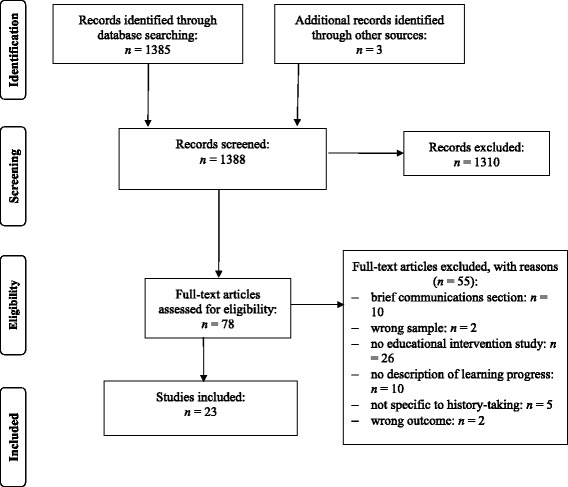
BACKGROUND: This paper is an up-to-date systematic review on educational interventions addressing history taking. The authors noted that despite the plethora of specialized training programs designed to enhance students' interviewing skills there had not been a review of the literature to assess the quality of each published method of teaching history taking in undergraduate medical education based on the evidence of the program's efficacy. METHODS: The databases PubMed, PsycINFO, Google Scholar, opengrey, opendoar and SSRN were searched using key words related to medical education and history taking. Articles that described an educational intervention to improve medical students' history-taking skills were selected and reviewed. Included studies had to evaluate learning progress. Study quality was assessed using the Medical Education Research Study Quality Instrument (MERSQI). RESULTS: Seventy-eight full-text articles were identified and reviewed; of these, 23 studies met the final inclusion criteria. Three studies applied an instructional approach using scripts, lectures, demonstrations and an online course. Seventeen studies applied a more experiential approach by implementing small group workshops including role-play, interviews with patients and feedback. Three studies applied a creative approach. Two of these studies made use of improvisational theatre and one introduced a simulation using Lego® building blocks. Twenty-two studies reported an improvement in students' history taking skills. Mean MERSQI score was 10.4 (range 6.5 to 14; SD = 2.65). CONCLUSIONS: These findings suggest that several different educational interventions are effective in teaching history taking skills to medical students. Small group workshops including role-play and interviews with real patients, followed by feedback and discussion, are widespread and best investigated. Feedback using videotape review was also reported as particularly instructive. Students in the early preclinical state might profit from approaches helping them to focus on interview skills and not being distracted by thinking about differential diagnoses or clinical management. The heterogeneity of outcome data and the varied ways of assessment strongly suggest the need for further research as many studies did not meet basic methodological criteria. Randomized controlled trials using external assessment methods, standardized measurement tools and reporting long-term data are recommended to evaluate the efficacy of courses on history taking.
Overview
The claims and statistics of this paper haven’t been checked yet.
Free: it reads the open-access text and checks the first 5 claims that cite a source we can check. Create a free account to check every claim.
Integrity signals
Registry
Cites
Statistics
Figures
Verification
Claims the paper makes
The claims and statistics of this paper haven’t been checked yet.
Free: it reads the open-access text and checks the first 5 claims that cite a source we can check. Create a free account to check every claim.
Claims other papers make about this one
Each is checked against this paper’s own text: does it say what the citing paper says it does?
The source backs part of the claim, not all of it — or backs it for a different population, condition or comparison.
In the citing paper
“Getting together the relevant information such as personal and psychosocial state, related personal and family medical background, the reason for consulting, plus the physical examination findings, should allow the physician to generate a diagnosis hypothesis.”
From The virtual patient as a learning tool: a mixed quantitative qualitative study (2018) · cites this paper as [7]
Experimental — accuracy not yet measuredThe source backs part of the claim, not all of it — or backs it for a different population, condition or comparison.
In the citing paper
“Both groups completed three sessions per week for four consecutive weeks—a duration previously shown to be sufficient for improving interview skills [10].”
From Feasibility study of using GPT for history-taking training in medical education: a randomized clinical trial (2025) · cites this paper as [10]
Experimental — accuracy not yet measuredIn the citing paper
“Moreover, it is possible to find systematic reviews that include studies where VP has been compared with some of those strategies and where it showed positive results against traditional lectures and even standardized patients, but evidence is not [7] conclusive and heterogeneity of the data suggest that more research is needed [7, 26, 29].”
From The virtual patient as a learning tool: a mixed quantitative qualitative study (2018) · cites this paper as [7]
Self-check
Percentages, sums and reported differences re-computed from the paper’s own numbers.
The self-check needs the paper’s full text.
Citations
Cites
Preferred Reporting Items for Systematic Reviews and Meta-Analyses: the PRISMA statement
Moher, D., Liberati, A., Tetzlaff, J., Altman, D. G., & for the PRISMA Group (2009) · BMJ · doi:10.1136/bmj.b2535 · Cited by 83,823
Preferred Reporting Items for Systematic Reviews and Meta-Analyses: The PRISMA Statement
Moher, D., Liberati, A., Tetzlaff, J., Altman, D. G., & The PRISMA Group (2009) · PLoS Medicine · doi:10.1371/journal.pmed.1000097 · Cited by 64,042 · cited 1×
“This review process was conducted according to the PRISMA statement [35, 36].”
MethodPreferred reporting items for systematic reviews and meta-analyses: the PRISMA Statement.
(2009) · PubMed Central · Cited by 44,859
Liberati, A., Altman, D. G., Tetzlaff, J., Mulrow, C., Gøtzsche, P. C., Ioannidis, J. P. A., Clarke, M., Devereaux, P. J., Kleijnen, J., & Moher, D. (2009) · PLoS Medicine · doi:10.1371/journal.pmed.1000100 · Cited by 28,164 · cited 1×
“This review process was conducted according to the PRISMA statement [35, 36].”
MethodPreferred Reporting Items for Systematic Reviews and Meta-Analyses: The PRISMA Statement
Moher, D., Liberati, A., Tetzlaff, J., & Altman, D. G. (2009) · Journal of Clinical Epidemiology · doi:10.1016/j.jclinepi.2009.06.005 · Cited by 19,575
Wang, G., Ma, R., Qiao, G., Wada, K., Aizawa, Y., & Satoh, T. (2015) · Integrative Medicine International · doi:10.1159/000368408 · Cited by 18,657
Hampton, J. R., Harrison, M. J., Mitchell, J. R., Prichard, J. S., & Seymour, C. (1975) · BMJ · doi:10.1136/bmj.2.5969.486 · Cited by 1,018
Association Between Funding and Quality of Published Medical Education Research
Reed, D. A., Cook, D. A., Beckman, T. J., Levine, R. B., Kern, D. E., & Wright, S. M. (2007) · JAMA · doi:10.1001/jama.298.9.1002 · Cited by 958 · cited 1×
“Study quality was considered using the Medical Education Research Study Quality Instrument (MERSQI), a tool developed especially to assess educational studies [39].”
MethodDoctor-patient communication: the Toronto consensus statement.
Simpson, M., Buckman, R., Stewart, M., Maguire, P., Lipkin, M., Novack, D., & Till, J. (1991) · BMJ · doi:10.1136/bmj.303.6814.1385 · Cited by 877
The Medical School Objectives Writing Group (1999) · Academic Medicine · doi:10.1097/00001888-199901001-00010 · Cited by 558
Research works printed but not linked: 3
- Davidoff F Deutsch S Egan KL Ende J Who Has Seen A Blood Sugar? - Reflections on Medical Education. Edited by the American College of Physicians 1996 Philadelphia American College of Physicians
- General Medical Council Tomorrow’s Doctors: Recommendations on Undergraduate Medical Education 1991 London General Medical Council
- Fischer T Chenot J-F Kleiber C Kochen MM Simmenroth-Nayda A Staats H Herrmann-Lingen C Kurs “ärztliche Basisfertigkeiten” - Evaluation eines primärärztlich orientierten Unterrichtskonzepts im Rahmen der neuen Approbationsordnung GMS Z Med Ausbild 2005 22 Doc59
Cited by
Items 201–231 of 231
Shikino, K., Tsukamoto, T., Noda, K., Ohira, Y., Yokokawa, D., Hirose, Y., Sato, E., Mito, T., Ota, T., Katsuyama, Y., et al. (2023) · Figshare · doi:10.6084/m9.figshare.22678212
van der Mei, S. H., & Justus Liebig University Giessen (2020) · University writing server of the Justus Liebig University Giessen (Justus-Liebig-Universität Gießen) · doi:10.22029/jlupub-14831
Connolly, M., Iohom, G., O’Brien, N., Volz, J., O’Muircheartaigh, A. C., Serchan, P., Biculescu, A., Gadre, K. G., Soare, C. G., Griseto, L., et al. (2024) · Figshare · doi:10.6084/m9.figshare.25751430
He, J., Wu, B., Zhong, H., Zhan, J., Zhu, L., Zhang, J., Zeng, Y., & Li, Z. (2024) · Figshare · doi:10.6084/m9.figshare.25485823
Reiser, S. (2025) · Common Library Network (Der Gemeinsame Bibliotheksverbund)
The integral partnership between history and medical education, in three parts
Barr, J. (2026) · Advances in Health Sciences Education · doi:10.1007/s10459-026-10509-z
Menichetti, J., Gerwing, J., Henry, S. G., & Pieterse, A. H. (2026) · Patient Education and Counseling · doi:10.1016/j.pec.2026.109591
Pedagogical Proposal for Patient-Centered Anamnesis in Medical English Teaching
Suarez, Y. F., Castellanos, C. L. A., Pérez, S. E. S., Arce, H. D. L. C. A., & Ramírez, A. E. G. (2026) · SAP Multidisciplinary Open · doi:10.62486/mo2026261
Fujikawa, H., Mori, H., Kondo, K., Nishizaki, Y., Yano, Y., & Naito, T. (2026) · Journal of Medical Education and Curricular Development · doi:10.1177/23821205261443614
Physicians as context engineers: redefining clinical competency for artificial intelligence
Sanghyun, A. H. N. (2026) · Journal of Korean Medical Association · doi:10.5124/jkma.26.0022
Ahn, S., & Yang, E. B. (2026) · Korean journal of medical education · doi:10.3946/kjme.2026.188
Aljedaani, S., Sultan, I. E., & El-Tarhouny, S. (2026) · International Medical Education · doi:10.3390/ime5020051 · Cited by 1
“These skills are crucial for effective patient communication and clinical decision-making [2].”
Documentation and interpretation of neurological assessment findings
Verma, V. (2026) · Elsevier eBooks · doi:10.1016/b978-0-443-33855-7.00010-3
Lyons, P., Maliampurakal, A., Irvine, J., Hughes, M., Paton, C. C., Boyle, J. G., & Kerins, J. (2026) · BMC Medical Education · doi:10.21203/rs.3.rs-9618243/v1
As Humanidades no ensino médico
Gonçalves‐Pereira, M. (2025) · Portuguese National Funding Agency for Science, Research and Technology (RCAAP Project by FCT) · doi:10.34619/lz7h-ukvo
Ganiem, L. M., Solihat, A., & Hani, R. (2026) · Jurnal Manajemen Informasi Kesehatan (Health Information Management) · doi:10.51851/jmik.v11i1.960
“Simulated patients are commonly used in medical communication research because they enable standardized consultation scenarios and facilitate consistent evaluation of interactional processes across clinical encounters (Keifenheim et al., 2015; Tsukamoto et al., 2012).”
Schlick, C., Rädel-Ablass, K., Schliz, K., & Miersch, C. (2026) · Research Square · doi:10.21203/rs.3.rs-10473687/v1
Goyal, K., Noori, S., Malhan, N., & Moyo, S. (2026) · doi:10.2196/preprints.108381
He, Y., Chen, C., Yin, R., Zhang, W., Chang, H., Yang, W., Li, F., Li, X., Xia, Z., Xie, X., et al. (2026) · JMIR Medical Education · doi:10.2196/92486
“The acquisition of MHT skills is essentially the transformation from “declarative knowledge” to “procedural skills” [1,38].”
Saeki, I., Kurihara, S., Hirahara, S., Suwa, T., Hattori, M., Nakashima, Y., Hiyama, E., Takahashi, S., & Hasunuma, N. (2026) · Research Square · doi:10.21203/rs.3.rs-10696465/v1
Dankyi, S. (2022) · University of the Western Cape Electronic Theses and Dissertations Repository (University of the Western Cape) · Cited by 2
Data Equity in Clinical Settings
Taparra, K., Kekumano, K., Shih, J. J., Apana, N., & Shontell, R. K. (2026) · Wiley eBooks · doi:10.1002/9781394311446.ch12
Methodological quality of systematic reviews on medical education. A meta‐research
Martimbianco, A. L. C., de Faria, R. M. D., Sá, K. M. M., do Nascimento, Y. Y., Yarak, S., & Riera, R. (2026) · Review of Education · doi:10.1002/rev3.70234
THE USE OF MNEMONIC PHRASES IN TEACHING INFECTIOUS DISEASES TO INTERNATIONAL MEDICAL STUDENTS
Sоrokhan, V. D., & Sorokhan, R. V. (2026) · Clinical & experimental pathology · doi:10.24061/1727-4338.xxv.3.97.2026.31
Yi, Y., Park, J., & Kim, S. (2026) · arXiv (Cornell University) · doi:10.48550/arxiv.2610.29312
“The first axis is an 11-category history-taking taxonomy grounded in the OSCE history-taking structure of AMEE Guide No. 81 [1] and validated against the systematic review of medical-student history-taking instruction by Keifenheim et al. [28] (Table 2).”
Xu, H., Ding, Y., Gu, Z., & 邱爽 (2026) · Indian Journal of Pharmaceutical Education and Research · doi:10.5530/ijper.20276972
Jinabhai, A. N. (2026) · Optician · doi:10.12968/opti.2026.274.7070.17
de Medeiros, S. G. L., Vasconcelos, M. H., Victer, E. D. F., & Rodrigues, G. C. (2026) · RECIMA21 - Revista Científica Multidisciplinar · doi:10.47820/recima21.v7i11.9278
Metadata
- Authors
- Keifenheim, K. E., Teufel, M., Ip, J., Speiser, N., Leehr, E. J., Zipfel, S., & Herrmann-Werner, A.
- Affiliations
- Universitätsklinikum Tübingen (DE)
- Brown University (US)
- Corresponding author
- Keifenheim, Katharina E.
- Venue
- BMC Medical Education
- Published
- 2015-09-28
- Volume
- 15
- Issue
- 1
- Pages
- 159-159
- ISSN
- 1472-6920 (ISSN-L)
- PMC
- PMC4587833
- OpenAlex
- W2128813077
- Cited by
- 218
- References
- 69
- Citations by year
- 2026: 21 · 2025: 37 · 2024: 41 · 2023: 24 · 2022: 20 · 2021: 22 · 2020: 11 · 2019: 16 · 2018: 7 · 2017: 9 · 2016: 8 · 2015: 1
- FWCI
- 1.20
- Type
- journal article
- Language
- en
- Open access
- gold
- doi.org
- Licence
- Locations
- BMC Medical Education (publishedVersion, cc-by)
- PubMed Central (publishedVersion, cc-by)
- PubMed (publishedVersion)
- Funders
- Deutsche Forschungsgemeinschaft
- Eberhard Karls Universität Tübingen
- Topics
- Social Sciences › Education › Innovations in Medical Education
- Health Sciences › Health Professions › General Health Professions › Patient-Provider Communication in Healthcare
- Social Sciences › Education › Simulation-Based Education in Healthcare
- Keywords
- medical history, medical students, undergraduate medical education, educational intervention, role play, small group workshops, feedback, videotape review, improvisational theatre, simulation-based training, preclinical education
- MeSH terms
- Education, Medical, Humans, Medical History Taking, Students, Medical, Teaching
About these checks
Registry, retraction, Cites and statistics results are computed, not judged, with one exception: a printed reference that no index lists is read once by a model before it counts as a citation error. Claims are extracted by a model and kept only when their quote appears verbatim in the text; each cited source is then checked, with a model’s help, for whether it says what the claim relies on. Those verdicts can be wrong — read the claim’s quote and the cited source before relying on one.
Statistics and arithmetic are recomputed, not judged.
Confidence bands are shown only for fields calibrated on our annotated test set. None is calibrated yet, so no band is shown.
What counts as a claim ›How we measure confidence ›How we check this ›
Are you an author, or do you see a problem with this page? Request a review
Data sources
Bibliographic data: Semantic Scholar, OpenAlex, Crossref.
Contains information from the Semantic Scholar Academic Graph Datasets, made available under the ODC Attribution License (ODC-BY 1.0).
Semantic Scholar’s data is described in: Kinney, R., et al. (2023). The Semantic Scholar Open Data Platform. arXiv:2301.10140.
