

Teaching history taking to medical students: a systematic review
Open accessThe DOI matches its Crossref record; 65 of the 69 references it cites were found in a registry or an index.
Abstract
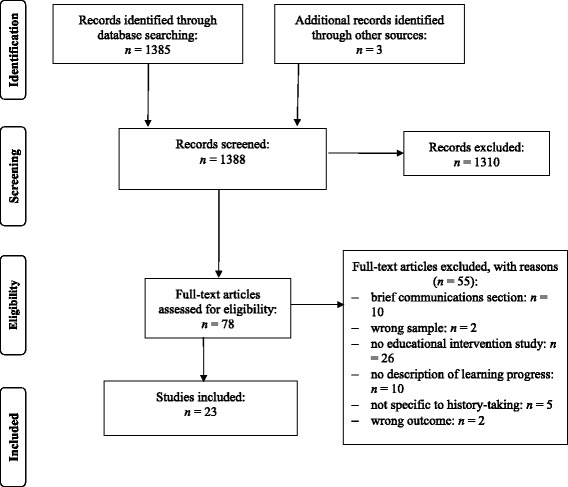
BACKGROUND: This paper is an up-to-date systematic review on educational interventions addressing history taking. The authors noted that despite the plethora of specialized training programs designed to enhance students' interviewing skills there had not been a review of the literature to assess the quality of each published method of teaching history taking in undergraduate medical education based on the evidence of the program's efficacy. METHODS: The databases PubMed, PsycINFO, Google Scholar, opengrey, opendoar and SSRN were searched using key words related to medical education and history taking. Articles that described an educational intervention to improve medical students' history-taking skills were selected and reviewed. Included studies had to evaluate learning progress. Study quality was assessed using the Medical Education Research Study Quality Instrument (MERSQI). RESULTS: Seventy-eight full-text articles were identified and reviewed; of these, 23 studies met the final inclusion criteria. Three studies applied an instructional approach using scripts, lectures, demonstrations and an online course. Seventeen studies applied a more experiential approach by implementing small group workshops including role-play, interviews with patients and feedback. Three studies applied a creative approach. Two of these studies made use of improvisational theatre and one introduced a simulation using Lego® building blocks. Twenty-two studies reported an improvement in students' history taking skills. Mean MERSQI score was 10.4 (range 6.5 to 14; SD = 2.65). CONCLUSIONS: These findings suggest that several different educational interventions are effective in teaching history taking skills to medical students. Small group workshops including role-play and interviews with real patients, followed by feedback and discussion, are widespread and best investigated. Feedback using videotape review was also reported as particularly instructive. Students in the early preclinical state might profit from approaches helping them to focus on interview skills and not being distracted by thinking about differential diagnoses or clinical management. The heterogeneity of outcome data and the varied ways of assessment strongly suggest the need for further research as many studies did not meet basic methodological criteria. Randomized controlled trials using external assessment methods, standardized measurement tools and reporting long-term data are recommended to evaluate the efficacy of courses on history taking.
Overview
The claims and statistics of this paper haven’t been checked yet.
Free: it reads the open-access text and checks the first 5 claims that cite a source we can check. Create a free account to check every claim.
Integrity signals
Registry
Cites
Statistics
Figures
Verification
Claims the paper makes
The claims and statistics of this paper haven’t been checked yet.
Free: it reads the open-access text and checks the first 5 claims that cite a source we can check. Create a free account to check every claim.
Claims other papers make about this one
Each is checked against this paper’s own text: does it say what the citing paper says it does?
The source backs part of the claim, not all of it — or backs it for a different population, condition or comparison.
In the citing paper
“Getting together the relevant information such as personal and psychosocial state, related personal and family medical background, the reason for consulting, plus the physical examination findings, should allow the physician to generate a diagnosis hypothesis.”
From The virtual patient as a learning tool: a mixed quantitative qualitative study (2018) · cites this paper as [7]
Experimental — accuracy not yet measuredThe source backs part of the claim, not all of it — or backs it for a different population, condition or comparison.
In the citing paper
“Both groups completed three sessions per week for four consecutive weeks—a duration previously shown to be sufficient for improving interview skills [10].”
From Feasibility study of using GPT for history-taking training in medical education: a randomized clinical trial (2025) · cites this paper as [10]
Experimental — accuracy not yet measuredIn the citing paper
“Moreover, it is possible to find systematic reviews that include studies where VP has been compared with some of those strategies and where it showed positive results against traditional lectures and even standardized patients, but evidence is not [7] conclusive and heterogeneity of the data suggest that more research is needed [7, 26, 29].”
From The virtual patient as a learning tool: a mixed quantitative qualitative study (2018) · cites this paper as [7]
Self-check
Percentages, sums and reported differences re-computed from the paper’s own numbers.
The self-check needs the paper’s full text.
Citations
Cites
Preferred Reporting Items for Systematic Reviews and Meta-Analyses: the PRISMA statement
Moher, D., Liberati, A., Tetzlaff, J., Altman, D. G., & for the PRISMA Group (2009) · BMJ · doi:10.1136/bmj.b2535 · Cited by 83,823
Preferred Reporting Items for Systematic Reviews and Meta-Analyses: The PRISMA Statement
Moher, D., Liberati, A., Tetzlaff, J., Altman, D. G., & The PRISMA Group (2009) · PLoS Medicine · doi:10.1371/journal.pmed.1000097 · Cited by 64,042 · cited 1×
“This review process was conducted according to the PRISMA statement [35, 36].”
MethodPreferred reporting items for systematic reviews and meta-analyses: the PRISMA Statement.
(2009) · PubMed Central · Cited by 44,859
Liberati, A., Altman, D. G., Tetzlaff, J., Mulrow, C., Gøtzsche, P. C., Ioannidis, J. P. A., Clarke, M., Devereaux, P. J., Kleijnen, J., & Moher, D. (2009) · PLoS Medicine · doi:10.1371/journal.pmed.1000100 · Cited by 28,164 · cited 1×
“This review process was conducted according to the PRISMA statement [35, 36].”
MethodPreferred Reporting Items for Systematic Reviews and Meta-Analyses: The PRISMA Statement
Moher, D., Liberati, A., Tetzlaff, J., & Altman, D. G. (2009) · Journal of Clinical Epidemiology · doi:10.1016/j.jclinepi.2009.06.005 · Cited by 19,575
Wang, G., Ma, R., Qiao, G., Wada, K., Aizawa, Y., & Satoh, T. (2015) · Integrative Medicine International · doi:10.1159/000368408 · Cited by 18,657
Hampton, J. R., Harrison, M. J., Mitchell, J. R., Prichard, J. S., & Seymour, C. (1975) · BMJ · doi:10.1136/bmj.2.5969.486 · Cited by 1,018
Association Between Funding and Quality of Published Medical Education Research
Reed, D. A., Cook, D. A., Beckman, T. J., Levine, R. B., Kern, D. E., & Wright, S. M. (2007) · JAMA · doi:10.1001/jama.298.9.1002 · Cited by 958 · cited 1×
“Study quality was considered using the Medical Education Research Study Quality Instrument (MERSQI), a tool developed especially to assess educational studies [39].”
MethodDoctor-patient communication: the Toronto consensus statement.
Simpson, M., Buckman, R., Stewart, M., Maguire, P., Lipkin, M., Novack, D., & Till, J. (1991) · BMJ · doi:10.1136/bmj.303.6814.1385 · Cited by 877
The Medical School Objectives Writing Group (1999) · Academic Medicine · doi:10.1097/00001888-199901001-00010 · Cited by 558
Research works printed but not linked: 3
- Davidoff F Deutsch S Egan KL Ende J Who Has Seen A Blood Sugar? - Reflections on Medical Education. Edited by the American College of Physicians 1996 Philadelphia American College of Physicians
- General Medical Council Tomorrow’s Doctors: Recommendations on Undergraduate Medical Education 1991 London General Medical Council
- Fischer T Chenot J-F Kleiber C Kochen MM Simmenroth-Nayda A Staats H Herrmann-Lingen C Kurs “ärztliche Basisfertigkeiten” - Evaluation eines primärärztlich orientierten Unterrichtskonzepts im Rahmen der neuen Approbationsordnung GMS Z Med Ausbild 2005 22 Doc59
Cited by
Items 101–200 of 231
Shikino, K., Tsukamoto, T., Noda, K., Ohira, Y., Yokokawa, D., Hirose, Y., Sato, E., Mito, T., Ota, T., Katsuyama, Y., et al. (2023) · BMC Medical Education · doi:10.1186/s12909-023-04246-9 · Cited by 5
“Medical inter-views conducted with simulated patients are important as they expand the knowledge gained during undergraduate studies and actual medical practice [4].”
BackgroundJadue, M., Munitiz, P., Torres, L.-M., Blacutt, M., Rivera, S. A., & Reyes, E.-P. (2023) · Salud Ciencia y Tecnología - Serie de Conferencias · doi:10.56294/sctconf2023427 · Cited by 4
Skill Session on Writing Patient Assessments for Pediatric Clerkship Students
Khera, S., Gavvala, S., Parlar-Chun, R. L., Huh, H. S., Hsu, J. W.-C., & Ford, C. D. (2020) · MedEdPORTAL · doi:10.15766/mep_2374-8265.11029 · Cited by 4
Simulated patients’ experience of adopting telesimulation for history taking during a pandemic
Freeman, K., Xin, W. W., & Canning, C. A. (2021) · The Asia Pacific Scholar · doi:10.29060/taps.2021-6-3/cs2344 · Cited by 4
Fink, M. C., Reitmeier, V., Siebeck, M., Fischer, F., & Fischer, M. R. (2022) · Springer eBooks · doi:10.1007/978-3-030-89147-3_9 · Cited by 4
The Role of the Comprehensive Patient History in the Problem‐Oriented Approach
Englar, D. R. E. (2019) · Wiley eBooks · doi:10.1002/9781119414612.ch2 · Cited by 4
Joos, C., Albrink, K., Hummers, E., Müller, F., Antweiler, K., Schröder, D., & Noack, E. M. (2024) · JAMIA Open · doi:10.1093/jamiaopen/ooae102 · Cited by 3
Jacobs, D. (2025) · British Journal of Nursing · doi:10.12968/bjon.2024.0193 · Cited by 3
Mnemonic of three cutaneous C's – Essential questions of history taking in dermatology
Salava, A. (2025) · JDDG Journal der Deutschen Dermatologischen Gesellschaft · doi:10.1111/ddg.15795 · Cited by 3
Byun, J., Kim, H., Lim, J., Choi, J., & Ahn, S. (2026) · Korean journal of medical education · doi:10.3946/kjme.2025.108 · Cited by 3
“A comprehensive review utilizing the Medical Education Research Study Quality Instrument found that “learning by doing” approaches significantly outperformed traditional meth-ods such as lectures, demonstrations, and self-study [1].”
Liu, Y., Zhu, Y., Zhang, W., Lu, X., Wu, L., Yue, M., Xia, O., & Shi, C. (2026) · JMIR Medical Education · doi:10.2196/89367 · Cited by 3
“Consequently, how to effectively cultivate this practical skill remains a core challenge for medical educators [5].”
Hirosawa, T., Yokose, M., Sakamoto, T., Hayashi, A., Harada, Y., Tokumasu, K., Mizuta, K., & Shimizu, T. (2026) · JMIR Formative Research · doi:10.2196/92016 · Cited by 3
“Medical interviewing is a cornerstone of modern health care, including medical education and practice [1-3].”
Schüffel, W. D. (2019) · Springer eBooks · doi:10.1007/978-3-030-12584-4_3 · Cited by 3
., W.-U.-N., Orakzai, G. S., & Jamil, B. (2022) · Pakistan Armed Forces Medical Journal · doi:10.51253/pafmj.v72i2.7366 · Cited by 4
Current approach to fever of unknown origin in the intensive care unit
Guerreiro, G., & Póvoa, P. M. S. R. (2023) · Intensive and Critical Care Nursing · doi:10.1016/j.iccn.2023.103444 · Cited by 3
Arranz, S. D., Martín, D. M., Martínez, F. C., Neria, F., Martínez, P. C., & Moral, R. R. (2023) · Healthcare · doi:10.3390/healthcare11121699 · Cited by 4
“Especially in the early stages of their training, when their understanding of the functional relationships between psychosocial aspects and health problems are still incomplete, students are required to learn a structured way of incorporating the more technical aspects of clinical questioning (medical history) and phy…”
BackgroundFranchina, S., Besnier, E., Veber, B., Dureuil, B., & Compère, V. (2019) · Anesthésie & Réanimation · doi:10.1016/j.anrea.2019.06.004 · Cited by 3
Severe Drug-Induced Liver Injury From Over-the-Counter Medication
Satoh, K., Okuyama, M., Hirasawa, N., & Nakae, H. (2023) · Cureus · doi:10.7759/cureus.33558 · Cited by 5
“Engel and Morgan described the medical interview as "the most powerful and sensitive and most versatile instrument available to the physician,” and this is still true today, after half a century [2].”
BackgroundGoh, P. H., Phuah, L. A., Hidayat, W., Mathew, C., Elias, A., Jambunathan, P. K., Dominic, N. A., Selvaratnam, L., & Arasoo, V. J. T. (2023) · Sex Education · doi:10.1080/14681811.2023.2244447 · Cited by 3
“Discussion was not limited to the clinical context, however, as Keifenheim et al. (2015) have proposed that a preoccupation with clinical reasoning may reduce medical students’ engagement with history-taking exercises – particularly among those with less clinical experience and knowledge.”
Training in Consultation-Liaison Psychiatry and Psychosomatic Medicine
Söllner, W., Guthrie, E., & Berney, A. (2018) · Integrating psychiatry and primary care · doi:10.1007/978-3-319-74736-1_17 · Cited by 3
King, R., Martin, A., Batt, A. M., Martin, S., Barr, N., Hwang, C., Lord, B., O'Meara, P. F., Reynolds, L., Hammarbäck, S., et al. (2025) · Paramedicine · doi:10.1177/27536386251336760 · Cited by 3
“49,61 62 – 64 However, the disparity between the contemporary biomedical-natured approach of paramedic information gathering and the actual holistic biopsychosocial needs of the majority of patients seen by paramedics, remains inconsistent and unchallenged.”
Tokushima, Y., Tago, M., Tokushima, M., Yamashita, S., Hirakawa, Y., Aihara, H., Katsuki, N. E., Fujiwara, M., & Yamashita, S. (2022) · International Journal of General Medicine · doi:10.2147/ijgm.s388798 · Cited by 2
“To train for this skill, small-group workshops involving role-play and interviews with a simulated patient, virtual patient, or actual patient, followed by discussion and feedback using a video review, have become popular as an educational method.(23) In addition, feedback from supervisors is especially effective in i…”
MethodWietek, T. F., Erschens, R. S., Griewatz, J., Zipfel, S., & Herrmann‐Werner, A. (2023) · Frontiers in Medicine · doi:10.3389/fmed.2023.1026096 · Cited by 2
Self-citationKumar, A., Rizk, D. E. E., Jufairi, Z. A., Garadah, T. S., Alsubaiei, A. A. K., Atwa, H. S. M., Shehata, M. H., Ansari, A., & Deifalla, A. (2025) · BMC Medical Education · doi:10.1186/s12909-025-07912-2 · Cited by 4
“There may be subjectivity in evaluating interpersonal skills [27, 28], underlining the need for more specific behavioural anchors and regular rater calibration to maintain consistency.”
Wei, J., Dang, D. K., Yang, K., Stokes, E., Mazeh, A. C., Lim, A. S., Dai, D. W., Moore, J. D., Fan, Y., Gašević, D., et al. (2026) · International Conference on Learning Analytics and Knowledge (LAK) · doi:10.1145/3785022.3785059 · Cited by 2
Undergraduate medical education in the U.S. and Israel: contrasts and common challenges
Feldman, A. M. (2015) · Israel Journal of Health Policy Research · doi:10.1186/s13584-015-0053-4 · Cited by 15
Canadian medical schools’ preclerkship paediatric clinical skills curricula: How can we improve?
Hudson, A. S., McLaughlin, R., Miller, S. G., Holland, J., & BLAKE, K. D. (2019) · Paediatrics & Child Health · doi:10.1093/pch/pxz106 · Cited by 2
“Adolescents 8 (47) Parent and grade-schooler 6 (35) Parent and toddler 6 (35) Parent and infant 5 (29) Parent and neonate 2 (12) Preclerkship medical students are guaranteed exposure toa: Adolescents 9 (53) Grade schooler 8 (47) Toddler 9 (53) Infant 5 (29) Neonate 11 (65) No age group guaranteed 5 (24)”
BackgroundInfluentialMoll, K. R., Eberman, L. E., Picha, K. J., Nye, J. R. E., Uriegas, N. A., & Winkelmann, Z. K. (2023) · Athletic Training Education Journal · doi:10.4085/1062-6050-019.23 · Cited by 2
Lost in translation: Unveiling medical students' untold errors of medical history documentation
Lange, S., Krüger, N., Warm, M., Buechel, J., Genzel‐Boroviczény, O., Fischer, M. R., & Dimitriadis, K. A. (2024) · The Clinical Teacher · doi:10.1111/tct.13749 · Cited by 4
“7 15 A documentation analysis was also carried out with postgraduate clinicians.”
Barba, E. C., Arranz, S. D., Rodríguez, A. A. M., & Neria, F. (2024) · Educación Médica · doi:10.1016/j.edumed.2024.100907 · Cited by 2
How to take a comprehensive patient history
Butler, S. (2024) · Emergency Nurse · doi:10.7748/en.2024.e2209 · Cited by 2
Patel, K. S., Anderson, R. J., Becker, C., Taylor, W. C., Liu, A. F., Varshney, A. S., Ali, N. B., Nath, B. J., Pelletier, S. R., Shields, H. M., et al. (2024) · Advances in Medical Education and Practice · doi:10.2147/amep.s472324 · Cited by 2
“14,15 Furthermore, the patient’s point of view has become increasingly important for their satisfaction with the hospital experience.”
BackgroundInitial Evaluation of a GenAI-Based Virtual Patient for Philippine Medical Education
Rodrigo, M. M. T., Castañeda, S., Alaan, J. A. M. V., Caoile, P. S. P., Dayupay, A. I., Sanchez, R. J. C., & Vidal, E. C. E. (2025) · Lecture notes in computer science · doi:10.1007/978-3-031-98465-5_45 · Cited by 2
Smart Anamnesis for Gyn-Obs: Issues and Opportunities
Vaira, L., & Bochicchio, M. A. (2017) · Lecture notes of the Institute for Computer Sciences, Social Informatics and Telecommunications Engineering · doi:10.1007/978-3-319-67636-4_11 · Cited by 2
“History taking and communication skills programs have become cornerstones in medical education over the past 30 years and are implemented in most US, Canadian, German and UK medical schools [4].”
BackgroundAdolescent narrative comments in assessing medical students
Tan, A., Hudson, A. S., & BLAKE, K. D. (2017) · The Clinical Teacher · doi:10.1111/tct.12667 · Cited by 2
Systems Design, Modeling, and Simulation in Medicine
Prescher, H., Hamilton, A. J., & Rozenblit, J. W. (2017) · Simulation foundations, methods and applications · doi:10.1007/978-3-319-61264-5_10 · Cited by 2
An Effective Teaching Method to Enhance History-Taking Skills for Chinese Medical Students
Huang, S.-M., Xu, P., Feng, L., Lu, C., & Yang, J. (2018) · International Journal of Higher Education · doi:10.5430/ijhe.v7n2p144 · Cited by 2
“In contrast to practice, a theoretical examination mainly depends on memory, whereas history taking is closely related to the situation, the attitudes of patient and doctor, patient's cultural background, patient's education degree and other factors (Keifenheim et al., 2015).”
BackgroundMethodRudnik, M., & Walecki, P. K. (2019) · Bio-Algorithms and Med-Systems · doi:10.1515/bams-2019-0011 · Cited by 2
Travel Histories in Children: How Well Do Interns and Medical Students Do?
Blakemore, S., Hofto, M. E., Shah, N. P., Gaither, S. L., Chilukuri, P., & Tofil, N. M. (2020) · Southern Medical Journal · doi:10.14423/smj.0000000000001143 · Cited by 2
“Many medical schools begin teaching how to obtain a medical history in the preclinical years, although the methods by which history taking is taught varies widely by institution.(16) There are no articles that specifically look at teaching travel history in medical school or residency; however, a study has shown that…”
BackgroundStudy Habits of Highly Effective Medical Students: A Medical Student’s Perspective [Letter]
Ali, D. N. (2021) · Advances in Medical Education and Practice · doi:10.2147/amep.s332045 · Cited by 2
“Studies have found that working in small groups that includes role play and interviewing is beneficial in terms of teaching history taking to medical students.(2) Furthermore, it is a feasible suggestion to make that developing history taking and physical examination skills not only to prepare for exams but to develop…”
BackgroundIdentifying the Structural and Functional Dimensions of Chronic Disease Follow-Up Interviews
Kebir, Y., & de Almeida, V. S. (2022) · Health Communication · doi:10.1080/10410236.2022.2141040 · Cited by 2
“Some studies have also shown that the communication challenges encountered in medical interactions are highly context-specific and make each consultation a unique interaction (Keifenheim et al., 2015).”
BackgroundCognitive biases and their effects on practice: a case study reflection
Patenotte, P., & Darby, I. (2023) · Journal of Paramedic Practice · doi:10.12968/jpar.2023.15.5.cpd1 · Cited by 1
Giroux, D., Branconnier, C., Bussières, A., Théroux, J., & Blanchette, M. (2024) · Chiropractic & Manual Therapies · doi:10.1186/s12998-023-00522-z · Cited by 1
“Although physical examination findings contribute only to about 12% of the diagnosis, it often allows to exclude hypotheses raised during the patient’s history and increases the professionals’ confidence in their diagnoses [11, 12].”
BackgroundFaj, D., Žontar, D., Remedios, D., Chabukovska-Radulovska, J., Kralik, I., Sera, T., Žiliukas, J., Gershan, V., & Vassileva, J. (2025) · European Journal of Radiology · doi:10.1016/j.ejrad.2025.112381 · Cited by 1
“Although it is concerning that medical imaging is frequently performed before clinical examination, 80 % of a clinical diagnosis comes from history [23] behoving referrers to ensure adequate information is available from patients ’ history to inform justification.”
The primacy of first impressions: when moments become medicine
Daly, M. J. (2026) · Academic Medicine · doi:10.1093/acamed/wvag095 · Cited by 1
Liu, Y., Zhu, Y., Shi, C., Lu, X., Wu, L., Yue, M., Hong, X., Xia, O., & Zhang, W. (2026) · JMIR Medical Education · doi:10.2196/101425 · Cited by 1
“For medical students, mastering a complete history-taking process and developing fluent clinical interview skills are core tasks in the transition from classroom learning to clinical practice [3].”
The ability of the emergency medical service personnel to take patients’ medical history
Sadrollahi, A., Gharataghani, A., Mahmoudi, M., & Gholipour, F. (2017) · Journal of Emergency Practice and Trauma · doi:10.15171/jept.2017.32 · Cited by 1
“A clinical technician must know what information should be collected, how to interpret the information, and finally how to evaluate them (6).”
BackgroundMethodInfluentialEnhancing Advanced Practice Nursing Students' Verbal Patient Report Skills
Johnson, C., & Blakely, K. K. (2019) · Journal of Nursing Education · doi:10.3928/01484834-20190103-12 · Cited by 1
Clinical communication skills in India
Khursheed, T., Kutikuppala, L. V. S., Sinha, A. V., & Naineni, K. (2022) · Journal of Indira Gandhi Institute Of Medical Sciences · doi:10.4103/jigims.jigims_6_22 · Cited by 1
Nguyen, S. N., Pham, H. T., Vu, L. T., Pham, T. X., & Gottlieb, B. R. (2023) · Journal of Medical Education and Curricular Development · doi:10.1177/23821205231175034 · Cited by 1
“For example, a review of strategies for teaching medical history identifies several effective approaches, including role-plays, interviews with real patients followed by feedback and discussion, and opportunities for videotaped reviews.(17) Niedermier(18) describes the effectiveness of a formal curriculum Table 1.”
BackgroundThe attitude of the Public Toward Social History Taking in Southern Saudi Arabia
Alkhaldy, H. Y. M., Manya, A. S. A., Alshehri, R. M., Alamri, R. S. M., Alqhtany, N. A. A., Almusaad, S., Al-Qahtani, W. H., Sabah, Z. U., & Algarni, A. M. (2023) · Patient Preference and Adherence · doi:10.2147/ppa.s414213 · Cited by 1
“Many methods could be used to teach students how to improve their history-taking skills.(25) Dedicated sessions on teaching medical students how to better communicate during challenging scenarios like social history gathering and transcultural communication can produce better student performance and satisfaction with…”
BackgroundThe Importance of Sexual History-Taking Within Surgery
Chinn, J. O., & Hawn, M. T. (2024) · Academic Medicine · doi:10.1097/acm.0000000000005965 · Cited by 1
Technology-enhanced learning in medical education in the age of artificial intelligence
Kim, K. (2025) · Forum for education studies. · doi:10.59400/fes2730 · Cited by 1
“Nevertheless, conventional VPs have several limitations; specifically, doctor-patient interactions often fall short in creating an authentic and realistic setting for taking patient history through medical interviews where interactive encounters are essential [38].”
Douge, N., Toperzer, R., & DeLisser, H. M. (2025) · Palliative Medicine Reports · doi:10.1089/pmr.2024.0101 · Cited by 1
“…connection and relational conversation, rather than the clinically-focused, information-extracting conversations students are taught to do in their early training, 33,34 and so enables an enhanced opportunity for students to be social-ized toward seeking to genuinely know and understand patients.”
Evaluation of a brief didactics training for peer teachers of medical history taking
Nagel, J., Zelenak, C., Fangauf, S. V., Seemann, C., Bläsing, L., Kappe, H., Demmer, I., & Herrmann‐Lingen, C. (2025) · Zeitschrift für Evidenz Fortbildung und Qualität im Gesundheitswesen · doi:10.1016/j.zefq.2025.09.002 · Cited by 1
Carius, B. M., April, M. D., Pedersen, C., & Schauer, S. G. (2021) · Southern Medical Journal · doi:10.14423/smj.0000000000001195 · Cited by 1
Syllabus Selection: Innovative Learning Activity
Minchew, L. A., & Morgan, C. (2016) · Journal of Nursing Education · doi:10.3928/01484834-20161011-11
Using Alumnae as Standardized Patients
Kelley, C. G., & Alfes, C. M. (2018) · Nurse Educator · doi:10.1097/00006223-900000000-99564
Lakdawala, B. M., Dadhaniya, P. M., & Kacha, T. G. (2018) · Indian Journal of Mental Health(IJMH) · doi:10.30877/ijmh.6.1.2019.43-55
“Qualitative feedback by both interns and faculties were positive and encouraging which was similar to the studies done in the past [71-72].”
ResultPsychosomatic Medicine in Germany
Schüffel, W. D., Herrmann, M., Köllner, V., Merkle, W., Teufel, M., & Veit, I. (2019) · Springer eBooks · doi:10.1007/978-3-030-12584-4_11
Self-citationHolguín, E. P., Alsina, N. M., & Herreros, B. (2021) · Educación Médica · doi:10.1016/j.edumed.2021.03.001
Rupa, R., Pojskić, M., Nimsky, C., & Voellger, B. (2021) · Healthcare · doi:10.3390/healthcare9091141
A telemedicina jelentősége az orvos-beteg kommunikáció oktatásában a Covid19 járvány tükrében
Meiszter, E., & Koppán, Á. (2021) · Porta Lingua · doi:10.48040/pl.2021.14
Aquatic plants in Central Norway, more new finds.
Fremstad, E. (2011) · Blyttia
Case History for the Pediatric Eye Examination
Moy, A. (2022) · Advances in medical diagnosis, treatment, and care (AMDTC) book series · doi:10.4018/978-1-7998-8044-8.ch001
mHealth, Data, and Privacy: The Case of the Higher Education Community
Blackmon, S. J., & Lanford, T. J. (2022) · Advances in medical education, research, and ethics (AMERE) book series · doi:10.4018/978-1-7998-9490-2.ch009
Woolliscroft, J. O. (2020) · Elsevier eBooks · doi:10.1016/b978-0-12-819620-5.00004-7
Gardner, R. (2019) · Comprehensive healthcare simulation · doi:10.1007/978-3-030-26849-7_10 · Cited by 1
Kashyap, A., Gandhi, J. A., & Shinde, P. H. (2022) · Medical Student Research Journal · doi:10.15404/msrj/12.2022.224
History taking & physical assessment
Nicolson, P. J. A., Deveza, L. A., & Holden, M. A. (2023) · Elsevier eBooks · doi:10.1016/b978-0-323-99269-5.00008-6
The Validity and Reliability of the Patient-Physician Interview Skill Evaluation Form in Five Steps
Tengiz, F. İ., Başer, A., Sezer, H., Şahin, H., & Tekindal, M. A. (2023) · Kocaeli Üniversitesi Sağlık Bilimleri Dergisi · doi:10.30934/kusbed.1098962
TEACHING METHODS FOR MEDICAL PRACTICE IN MEDICAL EDUCATION
Hulya, G. U. C. (2023) · doi:10.59287/umeha.802
Teaching Dental Students How to Obtain a Pain History
Cervantes-Chavarría, A. R. (2023) · Biomedical Journal of Scientific & Technical Research · doi:10.26717/bjstr.2023.52.008209
Roles of the Professional Program Instructor
Gibbons, P. M., Spangler, D. M., Miller, L. M. J., Hofmeister, E. H., Greenhill, L. M., Polisetti, S. M., Young, K. P., Wu, S. C., Huddleston, G., Englar, R. E., et al. (2023) · Wiley eBooks · doi:10.1002/9781119852865.ch6
Oshimi, T. (2024) · MedEdPublish · doi:10.12688/mep.19911.1 · Cited by 1
“History-taking, characterized by extracting pertinent personal, psychosocial, and symptomatic data from a patient, is central to this process (Keifenheim et al. , 2015).”
Шетелдік студенттердің практикалық дағдыларын дамыту үшін CyberPatient™ платформасын пайдалану
Кулбаева, С. Н., Yadav, M., Касаева, Л. Т., Токсанбаева, Ж. С., Салимбаева, Б. Т., & Штобза, О. С. (2024) · Репродуктивная медицина · doi:10.37800/rm.1.2024.158-165
Importance of case history in disease diagnosis as perceived by medicos
Rao, N. S. S., & Indu, K. (2024) · Southeast Asian Journal of Health Professional · doi:10.18231/j.sajhp.2024.009
Császár, J., Jámbor, M., Barta, A., Végh, A., & Fogarasi, K. (2024) · Porta Lingua · doi:10.48040/pl.2024.1.4
A kék szem elkülönítő kórismei értéke
Pfliegler, G. (2024) · Hematológia–Transzfuziológia · doi:10.1556/2068.2024.30006
Diagnosing acute appendicitis: a case study
Mooney, J., & Hodgkinson, J. D. (2024) · British Journal of Nursing · doi:10.12968/bjon.2023.0187
The Efficacy of the Psychiatry Clerkship in Developing Students’ Comprehensive Clinical Skills
Ney, J., Smoller, C., Kwon, J., & Chand, S. P. (2024) · Academic Psychiatry · doi:10.1007/s40596-024-02082-7
“Other studies have explored how various instructional methods—including scripts, lectures, small group workshops, and even improvisational theater— can positively impact students’ history-taking skills [12].”
Implementing the H&P 360 in Three Medical Institutions: Usability Study
Hayer, R., Tang, W., Bisschops, J., Schneider, G. W., Kirley, K., Khan, T., Rieger, E. Y., Walford, E., Anderson, I. J., Press, V. G., et al. (2025) · JMIR Medical Education · doi:10.2196/66221
“Through medical history, physicians elicit 60%-80% of the information relevant to diagnosis and treatment [1].”
Implementing Subtle Clinical Indicators in Geriatric Assessments
Ahmad, A., Kusz, H., & Hussain, M. (2025) · Sage Open Aging · doi:10.1177/30495334251330682
“Medical education emphasizes history-taking and physical examination skills; however, it overlooks the importance of subtle observations which can offer valuable insights especially in the context of geriatric care (Keifenheim et al., 2015).”
Effective client communication in emergency and critical care
Auger, E. A. (2025) · The Veterinary Nurse · doi:10.12968/vetn.2025.0003
Artificial Intelligence Virtual Patient: A proof of concept studyPreprint
Chan, B. S. H., Dodds, T., Xiang, J., Jo, L., Dyer, P., Kannan, B., Hannah, G., Torda, A. J., & Marjot, J. (2025) · Research Square · doi:10.21203/rs.3.rs-6272736/v1
Clinci, D., Cojocaru, A. C., & VIȘAN, I.-R. (2025) · doi:10.52744/978-606-26-1957-2.12
Waterhouse, G. F., Gray, D., Wilcock, R. A., Phillips, E., & Whitehead, T. (2025) · Health Communication · doi:10.1080/10410236.2025.2532759
“For adult patient history taking, various educational interventions have been designed, implemented and evaluated (e.g., Keifenheim et al., 2015).”
Moreira, J. D., Nessen, E. J., McLaughlin, J., Dwyer, L., Michaelidis, S., & Pesanelli, K. (2025) · AJP Advances in Physiology Education · doi:10.1152/advan.00200.2024
A Structured Approach to History and Physical Examination in Oncology for Medical Learners
Abojaib, L., Patel, A., & Preti, B. T. B. (2025) · International Medical Education · doi:10.3390/ime4040054
“A systematic review by Keifenheim et al. [1] identified different ways of teaching H&P to medical students, including role-play and interviews with real patients, followed by feedback and discussion.”
Connolly, M., Iohom, G., O’Brien, N., Volz, J., O’Muircheartaigh, A. C., Serchan, P., Biculescu, A., Gadre, K. G., Soare, C. G., Griseto, L., et al. (2024) · Figshare · doi:10.6084/m9.figshare.26716255
Connolly, M., Iohom, G., O’Brien, N., Volz, J., O’Muircheartaigh, A. C., Serchan, P., Biculescu, A., Gadre, K. G., Soare, C. G., Griseto, L., et al. (2024) · Figshare · doi:10.6084/m9.figshare.25751496
Giroux, D., Branconnier, C., Bussières, A., Théroux, J., & Blanchette, M. (2024) · Figshare · doi:10.6084/m9.figshare.25310035
Shikino, K., Tsukamoto, T., Noda, K., Ohira, Y., Yokokawa, D., Hirose, Y., Sato, E., Mito, T., Ota, T., Katsuyama, Y., et al. (2023) · Figshare · doi:10.6084/m9.figshare.22678215
Messung von klinischen Diagnosekompetenzen bei Medizinstudierenden in einer simulierten Lernumgebung
Reitmeier, V. (2020) · Electronic Theses of LMU Munich (Ludwig-Maximilians-Universität München) · doi:10.5282/edoc.26192 · Cited by 1
Dewi, S. P., Wilson, A., Duvivier, R. J., Kelly, B. J., & Gilligan, C. (2024) · Figshare · doi:10.6084/m9.figshare.26728687
Confidence and information seeking in medical decision making
Aiyer, S. (2025) · Oxford University Research Archive (ORA) (University of Oxford) · doi:10.5287/ora-r8robxmvx
Connolly, M., Iohom, G., O’Brien, N., Volz, J., O’Muircheartaigh, A. C., Serchan, P., Biculescu, A., Gadre, K. G., Soare, C. G., Griseto, L., et al. (2024) · Figshare · doi:10.6084/m9.figshare.26716249
Connolly, M., Iohom, G., O’Brien, N., Volz, J., O’Muircheartaigh, A. C., Serchan, P., Biculescu, A., Gadre, K. G., Soare, C. G., Griseto, L., et al. (2024) · Figshare · doi:10.6084/m9.figshare.26716252
Metadata
- Authors
- Keifenheim, K. E., Teufel, M., Ip, J., Speiser, N., Leehr, E. J., Zipfel, S., & Herrmann-Werner, A.
- Affiliations
- Universitätsklinikum Tübingen (DE)
- Brown University (US)
- Corresponding author
- Keifenheim, Katharina E.
- Venue
- BMC Medical Education
- Published
- 2015-09-28
- Volume
- 15
- Issue
- 1
- Pages
- 159-159
- ISSN
- 1472-6920 (ISSN-L)
- PMC
- PMC4587833
- OpenAlex
- W2128813077
- Cited by
- 218
- References
- 69
- Citations by year
- 2026: 21 · 2025: 37 · 2024: 41 · 2023: 24 · 2022: 20 · 2021: 22 · 2020: 11 · 2019: 16 · 2018: 7 · 2017: 9 · 2016: 8 · 2015: 1
- FWCI
- 1.20
- Type
- journal article
- Language
- en
- Open access
- gold
- doi.org
- Licence
- Locations
- BMC Medical Education (publishedVersion, cc-by)
- PubMed Central (publishedVersion, cc-by)
- PubMed (publishedVersion)
- Funders
- Deutsche Forschungsgemeinschaft
- Eberhard Karls Universität Tübingen
- Topics
- Social Sciences › Education › Innovations in Medical Education
- Health Sciences › Health Professions › General Health Professions › Patient-Provider Communication in Healthcare
- Social Sciences › Education › Simulation-Based Education in Healthcare
- Keywords
- medical history, medical students, undergraduate medical education, educational intervention, role play, small group workshops, feedback, videotape review, improvisational theatre, simulation-based training, preclinical education
- MeSH terms
- Education, Medical, Humans, Medical History Taking, Students, Medical, Teaching
About these checks
Registry, retraction, Cites and statistics results are computed, not judged, with one exception: a printed reference that no index lists is read once by a model before it counts as a citation error. Claims are extracted by a model and kept only when their quote appears verbatim in the text; each cited source is then checked, with a model’s help, for whether it says what the claim relies on. Those verdicts can be wrong — read the claim’s quote and the cited source before relying on one.
Statistics and arithmetic are recomputed, not judged.
Confidence bands are shown only for fields calibrated on our annotated test set. None is calibrated yet, so no band is shown.
What counts as a claim ›How we measure confidence ›How we check this ›
Are you an author, or do you see a problem with this page? Request a review
Data sources
Bibliographic data: Semantic Scholar, OpenAlex, Crossref.
Contains information from the Semantic Scholar Academic Graph Datasets, made available under the ODC Attribution License (ODC-BY 1.0).
Semantic Scholar’s data is described in: Kinney, R., et al. (2023). The Semantic Scholar Open Data Platform. arXiv:2301.10140.
