

Training to reduce LGBTQ-related bias among medical, nursing, and dental students and providers: a systematic review
Open accessThe DOI matches its Crossref record; 82 of the 83 references it cites were found in a registry or an index.
Abstract
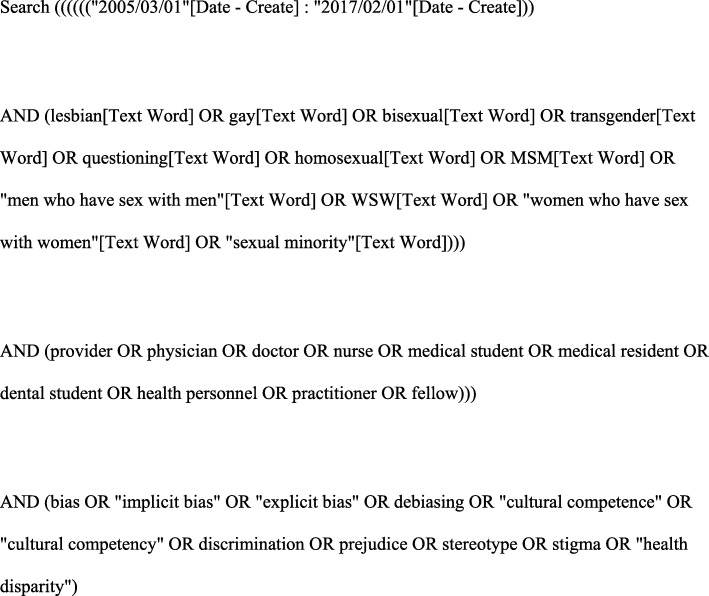
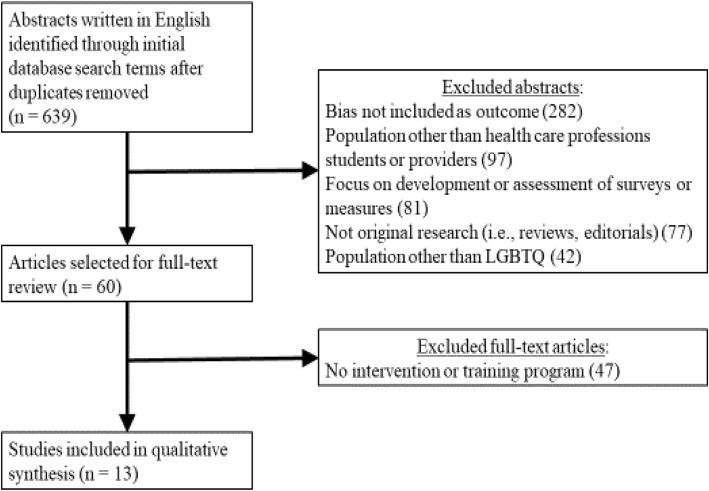
BACKGROUND: Lesbian, gay, bisexual, transgender and questioning (LGBTQ) individuals experience higher rates of health disparities. These disparities may be driven, in part, by biases of medical providers encountered in health care settings. Little is known about how medical, nursing, or dental students are trained to identify and reduce the effects of their own biases toward LGBTQ individuals. Therefore, a systematic review was conducted to determine the effectiveness of programs to reduce health care student or provider bias towards these LGBTQ patients. METHODS: The authors performed searches of online databases (MEDLINE/PubMed, PsycINFO, Web of Science, Scopus, Ingenta, Science Direct, and Google Scholar) for original articles, published in English, between March 2005 and February 2017, describing intervention studies focused on reducing health care student or provider bias towards LGBTQ individuals. Data extracted included sample characteristics (i.e., medical, nursing, or dental students or providers), study design (i.e., pre-post intervention tests, qualitative), program format, program target (i.e., knowledge, comfort level, attitudes, implicit bias), and relevant outcomes. Study quality was assessed using a five-point scale. RESULTS: The search identified 639 abstracts addressing bias among medical, nursing, and dental students or providers; from these abstracts, 60 articles were identified as medical education programs to reduce bias; of these articles, 13 described programs to reduce bias towards LGBTQ patients. Bias-focused educational interventions were effective at increasing knowledge of LGBTQ health care issues. Experiential learning interventions were effective at increasing comfort levels working with LGBTQ patients. Intergroup contact was effective at promoting more tolerant attitudes toward LGBTQ patients. Despite promising support for bias education in increasing knowledge and comfort levels among medical, nursing, and dental students or providers towards LGBTQ persons, this systematic review did not identify any interventions that assessed changes in implicit bias among students or providers. CONCLUSIONS: Strategies for assessing and mitigating implicit bias towards LGBTQ patients are discussed and recommendations for medical, nursing, and dental school curricula are presented.
Overview
The claims and statistics of this paper haven’t been checked yet.
Free: it reads the open-access text and checks the first 5 claims that cite a source we can check. Create a free account to check every claim.
Integrity signals
Registry
Cites
Statistics
Figures
Verification
Claims the paper makes
The claims and statistics of this paper haven’t been checked yet.
Free: it reads the open-access text and checks the first 5 claims that cite a source we can check. Create a free account to check every claim.
Claims other papers make about this one
Each is checked against this paper’s own text: does it say what the citing paper says it does?
In the citing paper
“Individuals who are lesbian, gay, bisexual, transgender, transsexual, two-spirit, queer, or questioning (LGBTQ+) are particularly affected by inequalities in health care, which arise due to particular needs for treatment47 and due to bias in health care practitioners.48”
From Addressing bias in big data and AI for health care: A call for open science (2021) · cites this paper as [48]
Self-check
Percentages, sums and reported differences re-computed from the paper’s own numbers.
The self-check needs the paper’s full text.
Citations
Cites
Preferred Reporting Items for Systematic Reviews and Meta-Analyses: the PRISMA statement
Moher, D., Liberati, A., Tetzlaff, J., Altman, D. G., & for the PRISMA Group (2009) · BMJ · doi:10.1136/bmj.b2535 · Cited by 83,823
Preferred reporting items for systematic reviews and meta-analyses: The PRISMA statement
Moher, D., Liberati, A., Tetzlaff, J., Altman, D. G., & the PRISMA Group* (2009) · Annals of Internal Medicine · doi:10.7326/0003-4819-151-4-200908180-00135 · Cited by 37,554
A meta-analytic test of intergroup contact theory.
Pettigrew, T. F., & Tropp, L. R. (2006) · Journal of personality and social psychology · doi:10.1037/0022-3514.90.5.751 · Cited by 9,708
Measuring individual differences in implicit cognition: the implicit association test
Greenwald, A. G., McGhee, D. E., & Schwartz, J. L. K. (1998) · Journal of Personality and Social Psychology · doi:10.1037/0022-3514.74.6.1464 · Cited by 9,210
Unequal treatment: confronting racial and ethnic disparities in health care
(2003) · Choice Reviews Online · doi:10.5860/choice.40-5843 · Cited by 7,043
Implicit social cognition: Attitudes, self-esteem, and stereotypes
Greenwald, A. G., & Banaji, M. R. (1995) · Psychological Review · doi:10.1037/0033-295x.102.1.4 · Cited by 6,682
Understanding and using the Implicit Association Test: III. Meta-analysis of predictive validity.
Greenwald, A. G., Poehlman, T. A., Uhlmann, E. L., & Banaji, M. R. (2009) · Journal of Personality and Social Psychology · doi:10.1037/a0015575 · Cited by 3,257
Implicit bias in healthcare professionals: a systematic review
FitzGerald, C., & Hurst, S. (2017) · BMC Medical Ethics · doi:10.1186/s12910-017-0179-8 · Cited by 2,556
Beyond curriculum reform: confronting medicineʼs hidden curriculum
Hafferty, F. W. (1998) · Academic Medicine · doi:10.1097/00001888-199804000-00013 · Cited by 1,881
Physicians and Implicit Bias: How Doctors May Unwittingly Perpetuate Health Care Disparities
Chapman, E. N., Kaatz, A., & Carnes, M. (2013) · Journal of General Internal Medicine · doi:10.1007/s11606-013-2441-1 · Cited by 1,300
Research works printed but not linked: 7
- Institute of Medicine Collecting sexual orientation and gender identity data in electronic health records: workshop summary 2013 Washington DC National Academy of Sciences 23967501
- Krehely J How to close the LGBT health disparities gap. Center for American Progress 2009 1 9
- Legal L When health care Isn't caring: lambda Legal's survey of discrimination against LGBT people and people with HIV 2010 New York Lamba Legal
- Grant JM Mottet LA Tanis J National Transgender Discrimination Survey Report on health and health care 2010 Washington DC National Center for Transgender Equality and National Gay and Lesbian Task Force
- Stone J Moskowitz GB Zestcott CA A brief, active learning workshop for reducing implicit bias among medical students. Manuscript in preparation 2017
- AAMC Advisory Committee on Sexual Orientation GI, and Sex Development,. Implementing Curricular and Institutional Climate Changes to Improve Health Care for Individuals Who Are LGBT, Gender Nonconforming, or Born with DSD: A Resource for Medical Educators 2014
- Staats C, Capatosto K, Wright RA, Jackson VW. State of the science: implicit bias review. 2016th ed. Colubus: Kirwan Institute for the Study of race and ethnicity, The Ohio Statee University.
Cited by
Items 101–200 of 413
Twelve tips for LGBT+-inclusive undergraduate and postgraduate medical education
Muschialli, L., Coduri-Fulford, S., Garbett, Z., & Connolly, D. J. (2024) · Medical Teacher · doi:10.1080/0142159x.2024.2344617 · Cited by 12
“…should encourage self-reflection in students, and should promote discussions in supportive and individualised small group settings about preconceived opinions and subconscious biases in collaboration with intersectionally diverse students and educators (Morris et al. 2019; Tollemache et al. 2021).”
Bunting, S. R., Chirica, M. G., Ritchie, T. D., Garber, S. S., & Batteson, T. J. (2021) · LGBT Health · doi:10.1089/lgbt.2020.0288 · Cited by 12
“39 Although these works represent an important step, gaps remain that must be closed to address the health disparities of all SGM patients.”
InfluentialMansfield, S. A., Morrison, Z. D., Utria, A. F., Reyes, C., Garcia, A. V., & Stallion, A. (2022) · Journal of Pediatric Surgery · doi:10.1016/j.jpedsurg.2022.02.010 · Cited by 12
Voultsos, P. P., Papana, A., Alexandri, S., & Zymvragou, C.-E. (2023) · BMC Medical Education · doi:10.1186/s12909-023-04666-7 · Cited by 12
O ensino da sexualidade em cursos de Graduação em Enfermagem: revisão sistemática da literatura
Beraldi, M. L., Paranhos, W. R., Garcia, O. R. Z., & Horta, A. L. D. M. (2024) · Interface - Comunicação Saúde Educação · doi:10.1590/interface.230310 · Cited by 11
“Pensar em um currículo que perceba, em nível global, o contexto social cis-heteronormativo e que discorra a respeito dos vieses inconscientes é uma maneira de desvendar o currículo oculto 33 .”
BackgroundIntergroup Contact Improves Medical Student Attitudes and Skill in Transgender Health Care
Ruprecht, K. A., Dunlop, W. A., Wah, E., Phillips, C. B., & Martin, S. (2023) · Transgender Health · doi:10.1089/trgh.2021.0203 · Cited by 11
“37,39 All current studies that examine TGD teaching interventions are limited by a lack of longer-term follow-up analysis; thus, it is unclear whether postses-sion attitude changes are sustained.”
Physician Perceptions on Cancer Screening for LGBTQ+ Patients
Nelson, N. G., Lombardo, J. F., Shimada, A., Ruggiero, M. L., Smith, A. P., Ko, K., Leader, A. E., Mitchell, E. P., & Simone, N. L. (2023) · Cancers · doi:10.3390/cancers15113017 · Cited by 11
“Educational training has been shown to improve providers’ knowledge and comfort levels regarding LGBTQ+ patient care and reduce explicit biases, even though these methods on their own were not shown to eliminate implicit biases [22].”
BackgroundMapping research on LGBT+ persons’ health: a bibliometric analysis
Moro, G. L., Brescia, V., Scaioli, G., Angelis, A. D., Siliquini, R., & Bert, F. (2024) · Perspectives in Public Health · doi:10.1177/17579139241247758 · Cited by 11
“11 in recent years, the medical community has increasingly recognized the health needs of LGBT + individuals.”
BackgroundFu, M. X., Onanuga, S., Ye, X., Aiyappan, R., Zou, T., Smith, S., & Baptista, A. (2024) · Medical Education Online · doi:10.1080/10872981.2024.2405484 · Cited by 11
“Exposure to culture change and bias reductions can be introduced whilst in training [23].”
BackgroundInfluentialBunting, S. R., Feinstein, B. A., Calabrese, S. K., Hazra, A., Sheth, N. K., Wang, G., & Garber, S. S. (2022) · JAIDS Journal of Acquired Immune Deficiency Syndromes · doi:10.1097/qai.0000000000003072 · Cited by 11
Staggs, S., Sewell, R. L., Buchanan, C., Claussen, L. R., Franklin, R., Levett, L., Poppy, D. C., Porto, A., Reirden, D. H., Simon, A., et al. (2021) · Transgender Health · doi:10.1089/trgh.2021.0016 · Cited by 10
“18 The accelerating trend of gender diverse and other LGBTQ + health care education publications demonstrates the surging motivation for improvement in knowledge and comfort for trainees and providers.”
Flores, J., Emory, K., Santos, X., Mashford‐Pringle, A., Barahona-López, K., Bozinovic, K., Adams, J., Chen, C., Zuo, Y., & Nguyen, D. (2022) · Frontiers in Sociology · doi:10.3389/fsoc.2022.790397 · Cited by 10
“Bias toward marginalized groups, including Indigenous populations, has been documented as a recurring problem in Canada’s healthcare system, which results in lower quality of care, leaving communities vulnerable to potential cases of COVID-19 (Skosireva et al., 2014; Morris et al., 2019; Wylie and McConkey, 2019).”
BackgroundHealthcare Rights for Gender and Sexual Minorities
Gilmore, J. (2023) · Sustainable development · doi:10.5772/intechopen.111641 · Cited by 10
Tyrie, D., Oliva, A., Llorin, H., & Zayhowski, K. (2024) · Journal of Genetic Counseling · doi:10.1002/jgc4.1842 · Cited by 10
“…in the United States do not have Lesbian, Gay, Bisexual, Transgender, Queer, Intersex, Asexual + (LGBTQIA + ) specific care training requirements and inclusion of such training is program discretionary (Berro et al., 2020; Morris et al., 2019 ; Sheehan et al., 2020 ; Stevens et al., 2023 ).”
Ortiz-Paredes, D., Chanady, T., Wassef, K., Knight, R., & Ferlatte, O. (2024) · Culture Health & Sexuality · doi:10.1080/13691058.2024.2340090 · Cited by 10
“This same review also highlighted the need to engage LGBTQ+ individuals when sensitising health professionals as a form of patient-led education (Morris et al. 2019).”
Yu, H., McHugh, M. D., Bauermeister, J. A., Hanneman, T., & Brom, H. M. (2025) · BMJ Quality & Safety · doi:10.1136/bmjqs-2024-018235 · Cited by 10
Experiences of LGBTQ-identifying students, interns and practitioners of dietetics
DeBiasse, M. A., Branham, A., & McFarland, N. (2022) · Journal of Critical Dietetics · doi:10.32920/cd.v6i2.1444 · Cited by 10
“In their systematic review, Morris et al. (2019) reviewed n=13 articles which described programs designed to reduce bias towards LGBTQidentifying patients among medical, nursing and dental students in order to determine which programs were effective in bias reduction.”
BackgroundMueller, R. C., & DeSimone, M. E. (2023) · Nurse Educator · doi:10.1097/nne.0000000000001427 · Cited by 9
Brooks, B. D., Job, S. A., Kaniuka, A. R., Kolb, R., Charvel, P. U., & Araújo, F. (2023) · Psychology and Health · doi:10.1080/08870446.2023.2220008 · Cited by 9
“For instance, a systematic review (Morris et al., 2019) of 60 SGM-related bias reduction programs for medical trainees and providers recommended providing continuous training in the following areas: (1) increasing knowledge about sexual orientation, gender identity, effects of discrimination on…”
Medical students’ perceptions of LGBTQ+ healthcare in Singapore and the United Kingdom
Fu, M. X., Zou, T., Aiyappan, R., Ye, X., Onanuga, S., Tan, A., Smith, S. E., & Baptista, A. (2023) · Frontiers in Medicine · doi:10.3389/fmed.2023.1236715 · Cited by 9
Gold, B. O., Lei, P., Kamran, S. C., Haas-Kogan, D. A., Franco, I. “., Zietman, A. L., Smart, A., & Wo, J. Y.-L. (2024) · Advances in Radiation Oncology · doi:10.1016/j.adro.2024.101461 · Cited by 9
“33 In the open discussion section, one theme that arose was staff hesitation about asking SOGI questions, especially for older patients.”
BackgroundLeBlanc, M. E., Trinh, M.-H., Zubizarreta, D., & Reisner, S. L. (2024) · Preventive Medicine Reports · doi:10.1016/j.pmedr.2024.102734 · Cited by 9
“Henning-Smith, 2017; Keuroghlian et al., 2017; Korpaisarn and Safer, 2018; Morris et al., 2019; Phelan et al., 2017; Streed and Davis, 2018).”
BackgroundImplicit bias assessment by career stage in medical education training: a narrative review
Crump, A. A., Al-Jorani, M. S., Ahmed, S., Abrol, E. S., & Jain, S. (2025) · BMC Medical Education · doi:10.1186/s12909-024-06319-9 · Cited by 9
“Solutions for implicit bias in medical training ranged broadly depending on the discussed bias, with many focusing on role-playing, reading, and reflection to demonstrate patient perspectives and highlight necessary skills to address bias in a clinical setting [101].”
Bias and discrimination in surgery: Where are we and what can we do about it?
Morrison, Z. D., Perez, N. P., Ahmad, H., Utria, A. F., McCulloh, C. J., López, M. E., Reyes-Ferral, C., Newman, E. A., & Martin, K. (2022) · Journal of Pediatric Surgery · doi:10.1016/j.jpedsurg.2022.02.012 · Cited by 9
Developing an Entrustable Professional Activity to Improve the Care of LGBTQ+ Youth
Roth, L. T., Cooper, M. B., Lurie, B., & Wueste, B. (2022) · Academic Pediatrics · doi:10.1016/j.acap.2022.09.006 · Cited by 9
Reimagining sexual and reproductive healthcare for LGBTQ communities
Kenner, C. E., Cherry, J., Mizock, L. M., Distefano, A., Tosh, J., & Gurse, C. (2023) · Culture Health & Sexuality · doi:10.1080/13691058.2022.2159066 · Cited by 9
“Authors reviewing interventions aimed at decreasing provider bias against gender and sexuality diverse patients found training to be a promising route among medical, nursing and dental providers and students in North America (Morris et al. 2019); it is important to note that other researchers have recommended training…”
BackgroundEmbracing Spectrum: Celebrating LGBTQIA+ Journeys in Aesthetic Medicine: A Kaleidoscope of Identity
Rahman, E., Rao, P., Webb, W. R., Philipp‐Dormston, W. G., Sayed, K., de Almeida, A. R. T., Mosahebi, A., CARRUTHERS, J. D. A., & CARRUTHERS, A. J. (2024) · Aesthetic Plastic Surgery · doi:10.1007/s00266-024-03923-4 · Cited by 9
“It is incumbent upon practitioners to actively seek out knowledge and resources to develop cultural competency and understanding of LGBTQIA ? experiences [43].”
Teelin, K., Shubkin, C. D., & Brown, A. E. C. (2021) · The Journal of Pediatrics · doi:10.1016/j.jpeds.2021.09.018 · Cited by 9
Fradelos, Ε. C., Montegrico, J., Cornelius, J. B., Bakalis, V. I., Malliarou, M. M., Papathanasiou, I. V., Fasoi, G., Kelesi, Μ., Kaba, E., & Alikari, V. (2022) · Healthcare · doi:10.3390/healthcare10122547 · Cited by 9
“For example, anal cancer, breast cancer, substance abuse, cardiovascular diseases, and mental health issues occur more frequently among LGBT individuals when compared to heterosexuals [4].”
BackgroundBunting, S. R., Goetz, T. G., Gabrani, A., Blansky, B., Marr, M. C., & Sánchez, N. F. (2022) · Annals of LGBTQ Public and Population Health · doi:10.1891/lgbtq-2021-0027 · Cited by 9
Strategies to Counteract Impact of Harmful Bias in Selection of Medical Residents
Edje, L. C., Casillas, C., & O’Toole, J. K. (2023) · Academic Medicine · doi:10.1097/acm.0000000000005258 · Cited by 9
Carmichael, T., Copel, L. C., & McDermott‐Levy, R. (2024) · Nurse Educator · doi:10.1097/nne.0000000000001600 · Cited by 8
“15,16,18,31,32 Positive health care experiences for TGNB people have been associated with receiving care from HCPs who had knowledge of TGNB health care needs and who had positive attitudes about gender diversity.”
Investigating Skin Cancer Risk and Sun Safety Practices Among LGBTQ+ Communities in Canada
Lagacé, F., Mahmood, F., Conte, S., Mija, L. A., Moustaqim‐Barrette, A., LeBeau, J., McKenna, A., Maazi, M., Hanna, J., Kelly, A., et al. (2024) · Current Oncology · doi:10.3390/curroncol31120593 · Cited by 8
“An acknowledgment of such differences can help guide physicians’ counseling efforts and allow for the development of culturally competent public health interventions, specifically focusing on the needs of the LGBTQ+ population that already faces important health disparities [17].”
The impact of psycho-education on school-children’s homophobic attitudes
Iuso, S., Petito, A., Ventriglio, A., Severo, M., Bellomo, A., & Limone, P. (2022) · International Review of Psychiatry · doi:10.1080/09540261.2022.2034603 · Cited by 8
“The effectiveness of psycho-educational interventions around homophobic bullying has been previously tested (Morris et al., 2019).”
BackgroundResultInfluentialRamesh, A., Brown, K. Y., Juárez, P. D., Tabatabai, M., & Matthews-Juarez, P. (2023) · The Annals of Family Medicine · doi:10.1370/afm.2925 · Cited by 8
Self-citationWang, Y., Miao, N., You, M., Wang, T.-Y., Hsu, C., Lee, P., & Du, S.-C. (2023) · Nurse Education Today · doi:10.1016/j.nedt.2023.105914 · Cited by 8
Teoh, K., Dunning, A., Taylor, A. K., Göpfert, A., Chew-Graham, C. A., Spiers, J., Appleby, L., van Hove, M., Buszewicz, M., & Riley, R. A. (2023) · BJPsych Open · doi:10.1192/bjo.2023.619 · Cited by 8
Goldfarb, R., Katz, M. A., Travers, R., Poliwoda, J., Sadri, M., Valiant, C., Murugan, A. A., Tang, J. H., Henry, G., & Coleman, T. A. (2024) · International Journal of Transgender Health · doi:10.1080/26895269.2024.2305196 · Cited by 8
U.S. Pediatric Residents’ Preparedness, Attitudes, and Knowledge in LGBTQ+ Health Care
Nowaskie, D. Z., Dauterman, J. W., Dauterman, L. C., & Menez, O. (2024) · Journal of Pediatric Health Care · doi:10.1016/j.pedhc.2023.12.002 · Cited by 8
Gender and Sexuality Awareness in Medical Education and Practice: Mixed Methods Study
Khamisy‐Farah, R., Biras, E., Shehadeh, R., Tuma, R., Atwan, H., Siri, A., Converti, M., Chirico, F., Szarpak, Ł., Biz, C., et al. (2024) · JMIR Medical Education · doi:10.2196/59009 · Cited by 8
Correro, A. N., Hinrichs, K. L. M., Krishnan, M., Cottingham, M. E., Trittschuh, E. H., Parmenter, B. A., Kang, J., & Stelmokas, J. (2022) · The Clinical Neuropsychologist · doi:10.1080/13854046.2022.2148379 · Cited by 8
“See also Morris and colleague’s systematic review of trainings meant to reduce student or provider biases toward LGBTQ + people (Morris et al., 2019).”
Patel, A. U., & Nowaskie, D. Z. (2023) · Journal of Gay & Lesbian Mental Health · doi:10.1080/19359705.2023.2197848 · Cited by 8
“Not only can training improve knowledge about the needs of LGBTQ+ populations, but it can also improve attitudes and comfort when working with LGBTQ+ patients (Morris et al., 2019).”
BackgroundZajac, K. K., Gunn, J., Sharaiha, R. E., & Zoorob, D. G. (2023) · Cureus · doi:10.7759/cureus.41834 · Cited by 8
“One meta-analysis evaluating the effectiveness of interactive programs on reducing LGBTQ+ healthcare disparities and bias showed increased comfort levels and tolerance after participating in these educational sessions [18].”
BackgroundA framework for addressing health inequities in sexual and gender diverse populations by nurses
Beckie, T. M., Lengacher, C. A., Rodriguez, C., Parés‐Avila, J. A., Turner, D. E., Sanchez, M. A., & Nair, U. S. (2022) · Nursing Outlook · doi:10.1016/j.outlook.2022.04.001 · Cited by 8
Transgender Healthcare and Indian Medical Students: Is Curricular Revamping the Need of the Hour?
Menon, A. (2022) · Chettinad Health City Medical Journal · doi:10.24321/2278.2044.202204 · Cited by 8
Willey, K., Fortuna, J., Guerra, J., Gross, A., Turner, S., Grant, T., & Williams, B. W. (2023) · Internet Journal of Allied Health Sciences and Practice · doi:10.46743/1540-580x/2023.2218 · Cited by 8
Primeau, C. A., Philpott, H. T., Vader, K., Unger, J., Le, C. Y., Birmingham, T. B., & MacDermid, J. C. (2023) · BMC Medical Education · doi:10.1186/s12909-023-04499-4 · Cited by 8
Gender inclusive care toolkit for hospitals
Dhillon, G. S., Grewal, H., Monga, V., Munjal, R. S., Buddhavarapu, V. S., Verma, R. K., Sharma, P., & Kashyap, R. (2023) · The Lancet Regional Health - Americas · doi:10.1016/j.lana.2023.100583 · Cited by 8
Hillyard, M., Cockbain, B. C., Drummond, C., Rimes, K. A., & Roberts, E. (2026) · The British Journal of Psychiatry · doi:10.1192/bjp.2026.10589 · Cited by 7
Boddu, S. P., Gill, V. S., Haglin, J. M., Brinkman, J. C., Deckey, D. G., & Bingham, J. S. (2024) · Arthroplasty Today · doi:10.1016/j.artd.2024.101353 · Cited by 7
“Current literature presents reducing stigma, training against LGBTQIA þ -related bias, and promoting inclusive environments within healthcare spaces as one avenue for promoting healthcare utilization in this population [22,23].”
Providing Care to People With Intellectual and Developmental Disabilities in Medical Education
Lunsky, I. O., Gutiérrez, G., Rabu, O., Gemmill, M., & Hamer, D. M. (2024) · American Journal on Intellectual and Developmental Disabilities · doi:10.1352/1944-7558-129.6.476 · Cited by 7
“…by healthcare professionals, may become ingrained through medical training and into their professional lives, impacting their interactions with individuals with IDD, and contributing to the reported health disparities in this population (Morris et al., 2019; Pelleboer-Gunnink et al., 2017).”
BackgroundInfluentialRoy, E., & Clark, K. D. (2024) · BMC Nursing · doi:10.1186/s12912-024-02618-0 · Cited by 7
Unveiling barriers and opportunities for LGBTQIA+ customer’s financial well-being
Sengupta, S., & Mundi, H. S. (2025) · Journal of Services Marketing · doi:10.1108/jsm-08-2024-0429 · Cited by 7
Baiocco, R., Micoli, A., Antoniucci, C., Rosati, F., Pellegrini, V., & Pistella, J. (2025) · Sexuality Research and Social Policy · doi:10.1007/s13178-025-01150-3 · Cited by 8
Cooney, E. E., Yeh, P. T., Kennedy, K. S., Kaptchuk, R. P., Wong, B., & Kennedy, C. E. (2025) · EClinicalMedicine · doi:10.1016/j.eclinm.2025.103460 · Cited by 7
Endocrine Nurses Society Position Statement on Transgender and Gender Diverse Care
Dwyer, A. A., & Greenspan, D. (2021) · Journal of the Endocrine Society · doi:10.1210/jendso/bvab105 · Cited by 9
“Training programs have been shown to increase knowledge, confidence, and comfort in TGD care in students and practicing providers alike [32,33].”
BackgroundScientific production on LGBTQIA+ health: a critical analysis of the literature
de Almeida, L. E., de Oliveira, J. M., de Oliveira, V., & Mialhe, F. L. (2022) · Saúde e Sociedade · doi:10.1590/s0104-12902022210836en · Cited by 7
Stout, J., Stahl, A., & Fortenberry, J. D. (2023) · Medical Teacher · doi:10.1080/0142159x.2023.2197136 · Cited by 7
Effectiveness of an LGBTQ+ E-Learning Module for Social Workers: A Randomized Controlled Trial
Schaub, J., Keemink, J. R., Stander, W. J., & Montgomery, P. (2023) · Research on Social Work Practice · doi:10.1177/10497315231208199 · Cited by 7
“…LGBTQ + knowledge gains among helping professionals are typically assessed using non-standardized measures designed by researchers speci fi cally for their training programs that employ multiple-choice, Likert scale, or true – false formats, according to a systematic review (Morris et al., 2019).”
Kitzie, V., Vera, A. N., Lookingbill, V., & Wagner, T. L. (2023) · Journal of Documentation · doi:10.1108/jd-06-2023-0122 · Cited by 7
Carvalhais, M., Portovedo, D., de Oliveira, M. A., Barbosa, R. G., Costa, S. E. N., Torres, A., & Santos, A. (2020) · Revista de Investigação & Inovação em Saúde · doi:10.37914/riis.v3i2.95 · Cited by 7
“A educação cultural focada no conhecimento sobre a comunidade LGBT pode beneficiar não só os comportamentos dos profissionais de saúde no cuidado ao cliente, como também a efetividade em reduzir a discriminação, o preconceito e as atitudes negativas da população (Orgel, 2017).”
BackgroundLara-Garrido, A. S., Bernardo, G. Á., & Berbén, A. B. G. (2022) · OBETS Revista de Ciencias Sociales · doi:10.14198/obets2022.17.2.09 · Cited by 7
“En cuanto al ámbito sanitario, este estudio detecta la existencia de discriminación por parte del cuerpo médico hacia las personas LGTB (Morris et al., 2019).”
BackgroundNursing students' attitudes towards sexuality before training in sexual and reproductive health
Martínez‐Vázquez, S., Hernández‐Martínez, A., Peinado‐Molina, R. A., & Martínez‐Galiano, J. M. (2023) · Nursing Open · doi:10.1002/nop2.1959 · Cited by 7
Handlovsky, I., Wonsiak, T., & Amato, A. (2023) · Nursing Philosophy · doi:10.1111/nup.12466 · Cited by 5
Exploring Culturally Responsive Voice Care: Mitigating Disparities by Addressing Implicit Bias
Morton‐Jones, M. E., & Sund, L. T. (2023) · Perspectives of the ASHA Special Interest Groups · doi:10.1044/2023_persp-23-00137 · Cited by 6
Huang, M., Allen, J., & Fooladi, E. (2024) · Nurse Education Today · doi:10.1016/j.nedt.2024.106363 · Cited by 6
Haghiri‐Vijeh, R. (2024) · Nursing Philosophy · doi:10.1111/nup.70007 · Cited by 6
Polish validation of the LGBTQ+ Healthcare Experiences Scale (LGBTQ+ HCES)
Czapla, M., Stańczykiewicz, B., Kurpas, D., Uchmanowicz, I., Uchmanowicz, B., Juárez‐Vela, R., & Karniej, P. (2025) · Advances in Clinical and Experimental Medicine · doi:10.17219/acem/209762 · Cited by 6
Bunting, S. R., Calabrese, S. K., Spigner, S. T., Goetz, T. G., Morrison, S. D., Zucker, S. M., Ritchie, T. D., Garber, S. S., & Batteson, T. J. (2022) · LGBT Health · doi:10.1089/lgbt.2021.0023 · Cited by 6
“11,13,15 It is also possible that differential judgments of social complexity may reflect known disparities in the social stressors encountered by SGM people and differences in quality of care, which are well documented.”
Produção científica em saúde da população LGBTQIA+: uma análise crítica do conteúdo da literatura
de Almeida, L. E., de Oliveira, J. M., de Oliveira, V., & Mialhe, F. L. (2022) · Saúde e Sociedade · doi:10.1590/s0104-12902022210836pt · Cited by 6
Maihle, C., Anderson, A. M., & von Sadovszky, V. (2023) · The Journal of Continuing Education in Nursing · doi:10.3928/00220124-20231211-08 · Cited by 6
Benavides, A., Carrasco, B., Chávez, C., Garrido, V., & Orellana, M. J. (2020) · Revista Confluencia · doi:10.52611/confluencia.num2.2020.472 · Cited by 6
Beayno, A., & Angelova, Y. (2022) · Journal of the Academy of Consultation-Liaison Psychiatry · doi:10.1016/j.jaclp.2021.10.001 · Cited by 6
Talham, C. J., Ishino, F. A. M., & Williams, F. (2022) · LGBT Health · doi:10.1089/lgbt.2021.0338 · Cited by 6
“In addition, implicit bias trainings to improve health care provider knowledge of the needs of SM individuals could be implemented to improve quality of care and health care trust and utilization among this population.(54)”
BackgroundEliscu, A. H., Jamilkowski, J., Gonzalez, A., Higham, J. M., Kenny, L., & McGovern, M. M. (2023) · Community Mental Health Journal · doi:10.1007/s10597-022-01069-8 · Cited by 6
“Implementing cultural sensitivity training for providers and staff which includes bias-focused education and experiential learning interventions can increase knowledge and comfort levels (Morris et al., 2019).”
BackgroundTransgender Education in North American Family Medicine Clerkships: A CERA Study
VanDerKolk, K., McKinney, V. R., Graves, L. E., & Harper, D. M. (2021) · Family Medicine · doi:10.22454/fammed.2021.509974 · Cited by 6
“I have access to a preexisting curriculum in transgender health care 94 6 (6) 20 (21) 29 (31) 31 (33) 8 (9)”
BackgroundTabatabai, M., Matthews-Juarez, P., Bahri, N., Cooper, R. L., Alcendor, D. J., Ramesh, A., Wilus, D. M., Singh, K. P., & Juárez, P. D. (2023) · Patient Experience Journal · doi:10.35680/2372-0247.1784 · Cited by 6
Self-citationStarting the Discussion: A Call to Enhance Care for People With Stimulant Use Disorder
Alves, J., Rust, V., Baldwin, M., Puleikis, L., Claude, A., Brett, M., LaBelle, C. T., & Ventura, A. S. (2023) · Substance Abuse · doi:10.1177/08897077231191005 · Cited by 6
A Comparative Analysis of Attitudes Toward Sexual Orientation and Gender Identity Minority People
Rye, B. J., & Goldszmidt, R. A. (2025) · Social Sciences · doi:10.3390/socsci14030145 · Cited by 5
Wickman, J., Mukherjee, S., Mintz, A., & Northridge, J. L. (2025) · Journal of Adolescent Health · doi:10.1016/j.jadohealth.2025.01.009 · Cited by 5
Naipaul, J., & Kyriakou, S. (2026) · Journal of Homosexuality · doi:10.1080/00918369.2026.2644418 · Cited by 5
Burton, C. H., van Zuilen, M. H., Wong, C. N., Primbas, A. D., Danielewicz, M., Farrell, T. W., Aggarwal, R. A., Streed, C. G., Josyula, A. V., Karani, R., et al. (2026) · Journal of the American Geriatrics Society · doi:10.1111/jgs.70470 · Cited by 5
“Indeed, many clinicians and trainees report feeling unprepared to provide inclusive and affirming care, starting with an unfamiliarity with the basic terminology used to refer to LGBTQI+ persons and communities [43, 44].”
Current Resources for Evidence-Based Practice, July 2020
Bovbjerg, M. L., & Cheyney, M. J. (2020) · Journal of Obstetric, Gynecologic & Neonatal Nursing · doi:10.1016/j.jogn.2020.06.002 · Cited by 5
Human Rights in Contemporary Society - Challenges From an International Perspective
Mali, J. (2023) · Sustainable development · doi:10.5772/intechopen.104238 · Cited by 5
Shuck, V., Salmela, J. A., Prinster, M., & Geisler, C. C. (2023) · Journal of Human Behavior in the Social Environment · doi:10.1080/10911359.2023.2212014 · Cited by 5
“In addition, priming social justice ideals can reorient concerned individuals to consider the importance of equality when confronted with out-groups, therefore reducing bias (Morris et al., 2019).”
InfluentialMitchell, S., Good, B., Potetz, J., & Kirby, K. F. (2023) · Clinical Simulation in Nursing · doi:10.1016/j.ecns.2023.05.004 · Cited by 5
Kruse, M. I., Bigham, B. L., & Phillips, S. P. (2024) · AEM Education and Training · doi:10.1002/aet2.10958 · Cited by 5
Burnett, C., Boehmer, U., & Jesdale, B. M. (2024) · Patient Education and Counseling · doi:10.1016/j.pec.2024.108347 · Cited by 5
Choo, S., Lee, H., Yi, H., & Kim, S. (2022) · LGBT Health · doi:10.1089/lgbt.2021.0269 · Cited by 5
“22 In Korea, however, there are few schools or other training institutions that address homophobia, teach health care providers to be LGB affirming, or offer instruction on topics specific to the lives and the health needs of sexual minority individuals.”
Promoting a gender-affirming environment in research: implications for research nurses
Thangthaeng, N., HILLARD, M. A., CAYFORD, M., Barrett, S., Ducar, D., & Larkin, M. (2022) · Journal of research in nursing · doi:10.1177/17449871211068647 · Cited by 5
“…educational interventions, like lectures, training, and discussions have been developed, a review of 639 abstracts examining bias among medical, nursing, and dental students or providers reported no interventions had been found to be effective in reducing the implicit bias (Morris et al., 2019).”
BackgroundChakrapani, V., Nair, S. S., Subramaniam, S., Ranade, K., Mohan, B. R., Nelson, R., Sivaraman, S., Shunmugam, M., Kaur, J., Rawat, S. M., et al. (2023) · Venereology · doi:10.3390/venereology2030009 · Cited by 5
Integrating LGBTQI+ Content in Nursing Education Using Immersive Virtual Reality: Embodying Eden
Hannans, J. (2023) · Nursing Education Perspectives · doi:10.1097/01.nep.0000000000001181 · Cited by 5
An Assessment of LGBTQ+ Cultural Competency and Attitudes of US Otolaryngologists
Patel, A. U., & Moyer, J. S. (2022) · OTO Open · doi:10.1177/2473974x221126167 · Cited by 5
Exploring Implicit Bias Toward LGBTQIA+ People: A Faculty Development Experience
Fontenot, J., Landry, J. B., & Richardson, H. (2022) · Teaching and learning in nursing · doi:10.1016/j.teln.2022.08.001 · Cited by 5
Onteeru, M., & Zhang, R. (2023) · Journal of surgical education · doi:10.1016/j.jsurg.2022.12.008 · Cited by 5
Knowledge, attitudes, and willingness of oral health professionals to treat transgender patients.
Marshall-Paquin, T. L., Boyd, L. D., & Palica, R. J. (2021) · PubMed Central · Cited by 5
Jerala, N., & Petek, D. (2025) · European Journal of General Practice · doi:10.1080/13814788.2025.2536236 · Cited by 4
“…as appropriate and professional, and in line with the GP characteristics and actions described above. however, even when providers make commitments to equitable care explicit, research shows common implicit biases operating outside of conscious awareness may undermine that commitment [25].”
Faune, K. L., Cabanas, A. M., Pinazo, F., & Zambrano, N. (2026) · BMC Medical Education · doi:10.1186/s12909-026-08963-9 · Cited by 4
Liantonio, J., Tapper, C. X., Danielewicz, M., Spina, E., & Javier, N. M. (2022) · Journal of Pain and Symptom Management · doi:10.1016/j.jpainsymman.2022.12.009 · Cited by 4
Hoai, B. N., Pham, Q. M., Hahn, E. W., Ta, T. M. T., Böge, K., Kemna, S., Jannini, E. A., & Nguyen, V. B. D. (2025) · The Journal of Sexual Medicine · doi:10.1093/jsxmed/qdaf038 · Cited by 4
Metadata
- Authors
- Morris, M., Cooper, R. L., Ramesh, A., Tabatabai, M., Arcury, T. A., Shinn, M., Im, W., Juarez, P., & Matthews-Juarez, P.
- Affiliations
- Meharry Medical College (US)
- Wake Forest University Health Sciences (US)
- Vanderbilt University (US)
- Corresponding author
- Morris, Matthew
- ORCID
- Venue
- BMC Medical Education
- Published
- 2019-08-30
- Volume
- 19
- Issue
- 1
- Pages
- 325-325
- ISSN
- 1472-6920 (ISSN-L)
- PMC
- PMC6716913
- OpenAlex
- W2970002910
- Cited by
- 363
- References
- 83
- Citations by year
- 2026: 35 · 2025: 51 · 2024: 49 · 2023: 93 · 2022: 77 · 2021: 37 · 2020: 19 · 2019: 1
- FWCI
- 5.14
- Type
- journal article
- Language
- en
- Open access
- gold
- doi.org
- Licence
- cc-by
- creativecommons.org/licenses/by/4.0/ (tdm)
- creativecommons.org/licenses/by/4.0/ (vor)
- Locations
- BMC Medical Education (publishedVersion, cc-by)
- Europe PMC (PubMed Central) (publishedVersion, cc-by)
- PubMed Central (publishedVersion, cc-by)
- PubMed (publishedVersion)
- DOAJ (DOAJ: Directory of Open Access Journals) (submittedVersion, cc-by-sa)
- Funders
- Health Resources and Services Administration (UH1HP30348)
- Topics
- Social Sciences › Psychology › Social Psychology › LGBTQ Health, Identity, and Policy
- Health Sciences › Medicine › Public Health, Environmental and Occupational Health › Cultural Competency in Health Care
- Health Sciences › Medicine › Public Health, Environmental and Occupational Health › Obesity and Health Practices
- Keywords
- LGBTQ health disparities, provider bias, implicit bias, medical students, nursing students, dental students, health professions education, experiential learning, intergroup contact
- MeSH terms
- Sexual and Gender Minorities, Attitude of Health Personnel, Humans, Physician-Patient Relations, Prejudice, Students, Dental, Students, Medical, Students, Nursing, Homophobia
About these checks
Registry, retraction, Cites and statistics results are computed, not judged, with one exception: a printed reference that no index lists is read once by a model before it counts as a citation error. Claims are extracted by a model and kept only when their quote appears verbatim in the text; each cited source is then checked, with a model’s help, for whether it says what the claim relies on. Those verdicts can be wrong — read the claim’s quote and the cited source before relying on one.
Statistics and arithmetic are recomputed, not judged.
Confidence bands are shown only for fields calibrated on our annotated test set. None is calibrated yet, so no band is shown.
What counts as a claim ›How we measure confidence ›How we check this ›
Are you an author, or do you see a problem with this page? Request a review
Data sources
Bibliographic data: Semantic Scholar, OpenAlex, Crossref.
Contains information from the Semantic Scholar Academic Graph Datasets, made available under the ODC Attribution License (ODC-BY 1.0).
Semantic Scholar’s data is described in: Kinney, R., et al. (2023). The Semantic Scholar Open Data Platform. arXiv:2301.10140.
