

Training to reduce LGBTQ-related bias among medical, nursing, and dental students and providers: a systematic review
Open accessThe DOI matches its Crossref record; 82 of the 83 references it cites were found in a registry or an index.
Abstract
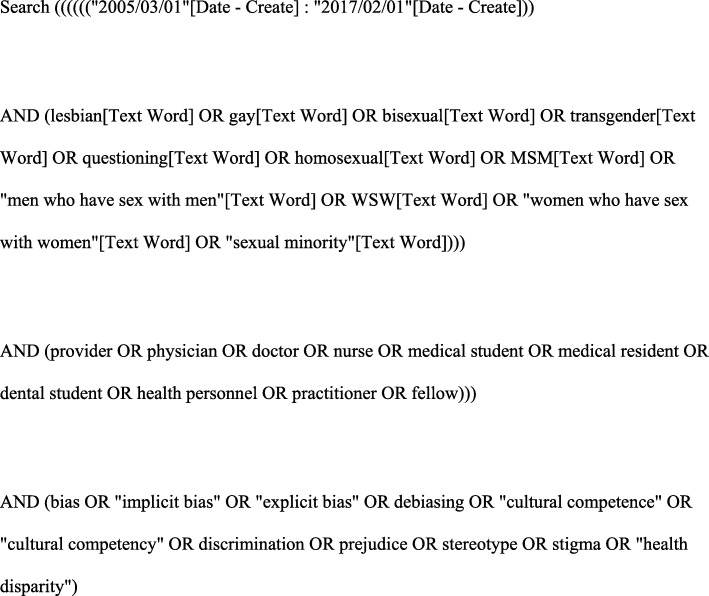
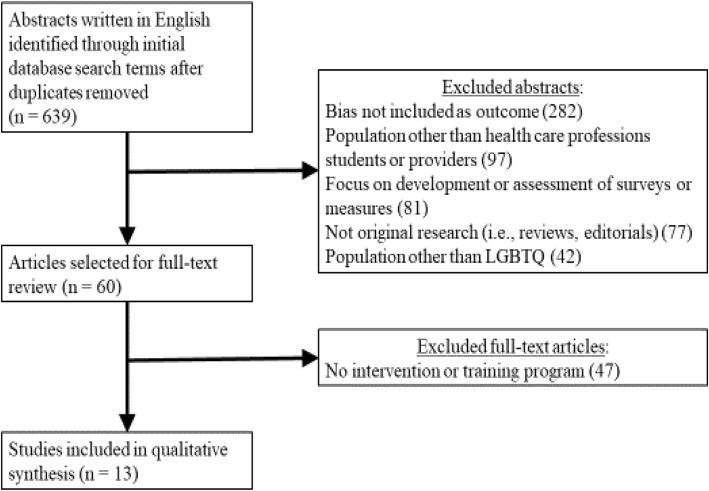
BACKGROUND: Lesbian, gay, bisexual, transgender and questioning (LGBTQ) individuals experience higher rates of health disparities. These disparities may be driven, in part, by biases of medical providers encountered in health care settings. Little is known about how medical, nursing, or dental students are trained to identify and reduce the effects of their own biases toward LGBTQ individuals. Therefore, a systematic review was conducted to determine the effectiveness of programs to reduce health care student or provider bias towards these LGBTQ patients. METHODS: The authors performed searches of online databases (MEDLINE/PubMed, PsycINFO, Web of Science, Scopus, Ingenta, Science Direct, and Google Scholar) for original articles, published in English, between March 2005 and February 2017, describing intervention studies focused on reducing health care student or provider bias towards LGBTQ individuals. Data extracted included sample characteristics (i.e., medical, nursing, or dental students or providers), study design (i.e., pre-post intervention tests, qualitative), program format, program target (i.e., knowledge, comfort level, attitudes, implicit bias), and relevant outcomes. Study quality was assessed using a five-point scale. RESULTS: The search identified 639 abstracts addressing bias among medical, nursing, and dental students or providers; from these abstracts, 60 articles were identified as medical education programs to reduce bias; of these articles, 13 described programs to reduce bias towards LGBTQ patients. Bias-focused educational interventions were effective at increasing knowledge of LGBTQ health care issues. Experiential learning interventions were effective at increasing comfort levels working with LGBTQ patients. Intergroup contact was effective at promoting more tolerant attitudes toward LGBTQ patients. Despite promising support for bias education in increasing knowledge and comfort levels among medical, nursing, and dental students or providers towards LGBTQ persons, this systematic review did not identify any interventions that assessed changes in implicit bias among students or providers. CONCLUSIONS: Strategies for assessing and mitigating implicit bias towards LGBTQ patients are discussed and recommendations for medical, nursing, and dental school curricula are presented.
Overview
The claims and statistics of this paper haven’t been checked yet.
Free: it reads the open-access text and checks the first 5 claims that cite a source we can check. Create a free account to check every claim.
Integrity signals
Registry
Cites
Statistics
Figures
Verification
Claims the paper makes
The claims and statistics of this paper haven’t been checked yet.
Free: it reads the open-access text and checks the first 5 claims that cite a source we can check. Create a free account to check every claim.
Claims other papers make about this one
Each is checked against this paper’s own text: does it say what the citing paper says it does?
In the citing paper
“Individuals who are lesbian, gay, bisexual, transgender, transsexual, two-spirit, queer, or questioning (LGBTQ+) are particularly affected by inequalities in health care, which arise due to particular needs for treatment47 and due to bias in health care practitioners.48”
From Addressing bias in big data and AI for health care: A call for open science (2021) · cites this paper as [48]
Self-check
Percentages, sums and reported differences re-computed from the paper’s own numbers.
The self-check needs the paper’s full text.
Citations
Cites
Preferred Reporting Items for Systematic Reviews and Meta-Analyses: the PRISMA statement
Moher, D., Liberati, A., Tetzlaff, J., Altman, D. G., & for the PRISMA Group (2009) · BMJ · doi:10.1136/bmj.b2535 · Cited by 83,823
Preferred reporting items for systematic reviews and meta-analyses: The PRISMA statement
Moher, D., Liberati, A., Tetzlaff, J., Altman, D. G., & the PRISMA Group* (2009) · Annals of Internal Medicine · doi:10.7326/0003-4819-151-4-200908180-00135 · Cited by 37,554
A meta-analytic test of intergroup contact theory.
Pettigrew, T. F., & Tropp, L. R. (2006) · Journal of personality and social psychology · doi:10.1037/0022-3514.90.5.751 · Cited by 9,708
Measuring individual differences in implicit cognition: the implicit association test
Greenwald, A. G., McGhee, D. E., & Schwartz, J. L. K. (1998) · Journal of Personality and Social Psychology · doi:10.1037/0022-3514.74.6.1464 · Cited by 9,210
Unequal treatment: confronting racial and ethnic disparities in health care
(2003) · Choice Reviews Online · doi:10.5860/choice.40-5843 · Cited by 7,043
Implicit social cognition: Attitudes, self-esteem, and stereotypes
Greenwald, A. G., & Banaji, M. R. (1995) · Psychological Review · doi:10.1037/0033-295x.102.1.4 · Cited by 6,682
Understanding and using the Implicit Association Test: III. Meta-analysis of predictive validity.
Greenwald, A. G., Poehlman, T. A., Uhlmann, E. L., & Banaji, M. R. (2009) · Journal of Personality and Social Psychology · doi:10.1037/a0015575 · Cited by 3,257
Implicit bias in healthcare professionals: a systematic review
FitzGerald, C., & Hurst, S. (2017) · BMC Medical Ethics · doi:10.1186/s12910-017-0179-8 · Cited by 2,556
Beyond curriculum reform: confronting medicineʼs hidden curriculum
Hafferty, F. W. (1998) · Academic Medicine · doi:10.1097/00001888-199804000-00013 · Cited by 1,881
Physicians and Implicit Bias: How Doctors May Unwittingly Perpetuate Health Care Disparities
Chapman, E. N., Kaatz, A., & Carnes, M. (2013) · Journal of General Internal Medicine · doi:10.1007/s11606-013-2441-1 · Cited by 1,300
Long-term reduction in implicit race bias: A prejudice habit-breaking intervention
Devine, P. G., Forscher, P. S., Austin, A. J., & Cox, W. T. L. (2012) · Journal of Experimental Social Psychology · doi:10.1016/j.jesp.2012.06.003 · Cited by 1,259
Pervasiveness and correlates of implicit attitudes and stereotypes
Nosek, B. A., Smyth, F. L., Hansen, J. J., Devos, T., Lindner, N. M., Ranganath, K. A., Smith, C. T., Olson, K. R., Chugh, D., Greenwald, A. G., et al. (2007) · European Review of Social Psychology · doi:10.1080/10463280701489053 · Cited by 1,247
Mental contamination and mental correction: Unwanted influences on judgments and evaluations.
Wilson, T. D., & Brekke, N. (1994) · Psychological Bulletin · doi:10.1037/0033-2909.116.1.117 · Cited by 1,157
Lesbian, Gay, Bisexual, and Transgender–Related Content in Undergraduate Medical Education
Obedin-Maliver, J., Goldsmith, E. S., Stewart, L., White, W., Tran, E., Brenman, S., Wells, M., Fetterman, D. M., Garcia, G., & Lunn, M. R. (2011) · JAMA · doi:10.1001/jama.2011.1255 · Cited by 1,157
Dasgupta, N., & Greenwald, A. G. (2001) · Journal of Personality and Social Psychology · doi:10.1037//0022-3514.81.5.800 · Cited by 1,102
Fredriksen-Goldsen, K. I., Kim, H.-J., Barkan, S. E., Muraco, A., & Hoy-Ellis, C. P. (2013) · American Journal of Public Health · doi:10.2105/ajph.2012.301110 · Cited by 965
An empirical study of decline in empathy in medical school
Hojat, M., Mangione, S., Nasca, T. J., Rattner, S., Erdmann, J. B., Gonnella, J. S., & Magee, M. (2004) · Medical Education · doi:10.1111/j.1365-2929.2004.01911.x · Cited by 864
A Population-Based Study of Sexual Orientation Identity and Gender Differences in Adult Health
Conron, K. J., Mimiaga, M. J., & Landers, S. J. (2010) · American Journal of Public Health · doi:10.2105/ajph.2009.174169 · Cited by 857
Unequal Treatment—Confronting Racial and Ethnic Disparities in Healthcare
Osundeko, O. (2004) · PubMed Central · Cited by 797
Millett, G. A., Peterson, J. L., Flores, S. A., Hart, T. A., Jeffries, W. L., Wilson, P. A., Rourke, S. B., Heilig, C. M., Elford, J., Fenton, K. A., et al. (2012) · The Lancet · doi:10.1016/s0140-6736(12)60899-x · Cited by 724
The relationship between suicide risk and sexual orientation: results of a population-based study.
Remafedi, G., French, S., Story, M., Resnick, M. D., & Blum, R. (1998) · American Journal of Public Health · doi:10.2105/ajph.88.1.57 · Cited by 637
Transgender Youth: Invisible and Vulnerable
Grossman, A. H., & D'augelli, A. R. (2006) · Journal of Homosexuality · doi:10.1300/j082v51n01_06 · Cited by 588
Inpatient care for septicemia or sepsis: a challenge for patients and hospitals.
Hall, M. J., Williams, S. N., DeFrances, C. J., & Golosinskiy, A. (2011) · PubMed · Cited by 578
Health Care Providers’ Implicit and Explicit Attitudes Toward Lesbian Women and Gay Men
Sabin, J. A., Riskind, R. G., & Nosek, B. A. (2015) · American Journal of Public Health · doi:10.2105/ajph.2015.302631 · Cited by 512
Statistically small effects of the Implicit Association Test can have societally large effects.
Greenwald, A. G., Banaji, M. R., & Nosek, B. A. (2015) · Journal of Personality and Social Psychology · doi:10.1037/pspa0000016 · Cited by 505
Reducing Racial Bias Among Health Care Providers: Lessons from Social-Cognitive Psychology
Burgess, D., van Ryn, M., Dovidio, J., & Saha, S. (2007) · Journal of General Internal Medicine · doi:10.1007/s11606-007-0160-1 · Cited by 495
Quinn, G. P., Sanchez, J. A., Sutton, S. K., Vadaparampil, S. T., Nguyen, G. T., Green, B. L., Kanetsky, P. A., & Schabath, M. B. (2015) · CA: A Cancer Journal for Clinicians · doi:10.3322/caac.21288 · Cited by 479
Imagining Intergroup Contact Can Improve Intergroup Attitudes
Turner, R. N., Crisp, R. J., & Lambert, E. (2007) · Group Processes & Intergroup Relations · doi:10.1177/1368430207081533 · Cited by 473
Variation of Mood and Empathy During Internship
Bellini, L. M. (2002) · JAMA · doi:10.1001/jama.287.23.3143 · Cited by 413
The State of Research on Racial/Ethnic Discrimination in The Receipt of Health Care
Shavers, V. L., Fagan, P., Jones, D., Klein, W. M. P., Boyington, J., Moten, C., & Rorie, E. (2012) · American Journal of Public Health · doi:10.2105/ajph.2012.300773 · Cited by 386
Zestcott, C. A., Blair, I. V., & Stone, J. (2016) · Group Processes & Intergroup Relations · doi:10.1177/1368430216642029 · Cited by 381
Dovidio, J. F., & Fiske, S. T. (2012) · American Journal of Public Health · doi:10.2105/ajph.2011.300601 · Cited by 350
Buchmueller, T., & Carpenter, C. S. (2010) · American Journal of Public Health · doi:10.2105/ajph.2009.160804 · Cited by 349
Dilley, J. A., Simmons, K. W., Boysun, M. J., Pizacani, B. A., & Stark, M. J. (2010) · American Journal of Public Health · doi:10.2105/ajph.2007.130336 · Cited by 318
Mood Change and Empathy Decline Persist during Three Years of Internal Medicine Training
Bellini, L. M., & Shea, J. A. (2005) · Academic Medicine · doi:10.1097/00001888-200502000-00013 · Cited by 314
van Ryn, M., Hardeman, R., Phelan, S. M., PhD, D. J. B., Dovidio, J. F., Herrin, J., Burke, S. E., Nelson, D. B., Perry, S., Yeazel, M., et al. (2015) · Journal of General Internal Medicine · doi:10.1007/s11606-015-3447-7 · Cited by 302
Lesbian, Gay, Bisexual, and Transgender (LGBT) Physicians' Experiences in the Workplace
Eliason, M. J., Dibble, S. L., & Robertson, P. A. (2011) · Journal of Homosexuality · doi:10.1080/00918369.2011.614902 · Cited by 275
Health Care Access Among Individuals Involved in Same-Sex Relationships
Heck, J. E., Sell, R. L., & Gorin, S. S. (2006) · American Journal of Public Health · doi:10.2105/ajph.2005.062661 · Cited by 268
Lueke, A., & Gibson, B. (2015) · Social Psychological and Personality Science · doi:10.1177/1948550614559651 · Cited by 265
Breaking the prejudice habit: Mechanisms, timecourse, and longevity
Forscher, P. S., Mitamura, C., Dix, E. L., Cox, W. T. L., & Devine, P. G. (2017) · Journal of Experimental Social Psychology · doi:10.1016/j.jesp.2017.04.009 · Cited by 255
Kelley, L., Chou, C. L., Dibble, S. L., & Robertson, P. A. (2008) · Teaching and Learning in Medicine · doi:10.1080/10401330802199567 · Cited by 250
Non‐conscious bias in medical decision making: what can be done to reduce it?
Stone, J., & Moskowitz, G. B. (2011) · Medical Education · doi:10.1111/j.1365-2923.2011.04026.x · Cited by 247
Burke, S. E., Dovidio, J. F., Przedworski, J. M., Hardeman, R. R., Perry, S. P., Phelan, S. M., Nelson, D. B., Burgess, D. J., Yeazel, M. W., & van Ryn, M. (2015) · Academic Medicine · doi:10.1097/acm.0000000000000661 · Cited by 247
Multiple chronic conditions among adults aged 45 and over: trends over the past 10 years.
Freid, V. M., Bernstein, A. B., & Bush, M. A. (2012) · PubMed · Cited by 245
Conducting a best evidence systematic review. Part 1: From idea to data coding. BEME Guide No. 13
Hammick, M., Dornan, T., & Steinert, Y. (2010) · Medical Teacher · doi:10.3109/01421590903414245 · Cited by 230
Sullivan, P. S., Rosenberg, E. S., Sanchez, T. H., Kelley, C. F., Luisi, N., Cooper, H. L., Diclemente, R. J., Wingood, G. M., Frew, P. M., Salazar, L. F., et al. (2015) · Annals of Epidemiology · doi:10.1016/j.annepidem.2015.03.006 · Cited by 215
Vulnerable populations in healthcare
Waisel, D. B. (2013) · Current Opinion in Anaesthesiology · doi:10.1097/aco.0b013e32835e8c17 · Cited by 207
Mereish, E. H., & Bradford, J. B. (2014) · Journal of Studies on Alcohol and Drugs · doi:10.15288/jsad.2014.75.179 · Cited by 176
Kitts, R. L. (2010) · Journal of Homosexuality · doi:10.1080/00918369.2010.485872 · Cited by 174
Interventions to Reduce Sexual Prejudice: A Study-Space Analysis and Meta-Analytic Review
Bartos, S. E., Berger, I., & Hegarty, P. V. (2014) · The Journal of Sex Research · doi:10.1080/00224499.2013.871625 · Cited by 174
Differences in health risk behaviors across understudied LGBT subgroups.
Smalley, K. B., Warren, J. C., & Barefoot, K. N. (2016) · Health Psychology · doi:10.1037/hea0000231 · Cited by 170
Charlton, B. M., Corliss, H. L., Missmer, S. A., Frazier, A. L., Rosario, M., Kahn, J. A., & Austin, S. B. (2011) · Journal of Adolescent Health · doi:10.1016/j.jadohealth.2011.03.013 · Cited by 163
Blair, I. V., Havranek, E. P., Price, D. W., Hanratty, R., Fairclough, D. L., Farley, T., Hirsh, H. K., & Steiner, J. F. (2013) · American Journal of Public Health · doi:10.2105/ajph.2012.300812 · Cited by 160
Shires, D. A., & Jaffee, K. (2015) · Health & Social Work · doi:10.1093/hsw/hlv025 · Cited by 155
Does Perspective-Taking Increase Patient Satisfaction in Medical Encounters?
Blatt, B., LeLacheur, S. F., Galinsky, A. D., Simmens, S. J., & Greenberg, L. (2010) · Academic Medicine · doi:10.1097/acm.0b013e3181eae5ec · Cited by 146
Dasgupta, N., & Rivera, L. M. (2008) · Social Cognition · doi:10.1521/soco.2008.26.1.112 · Cited by 138
Fallin-Bennett, K. (2015) · Academic Medicine · doi:10.1097/acm.0000000000000662 · Cited by 133
Strong, K. L., & Folse, V. N. (2015) · Journal of Nursing Education · doi:10.3928/01484834-20141224-07 · Cited by 133
Matthews, A. K., Brandenburg, D. L., Johnson, T. P., & Hughes, T. L. (2003) · Preventive Medicine · doi:10.1016/j.ypmed.2003.09.034 · Cited by 131
Carabez, R. M., Pellegrini, M., Mankovitz, A., Eliason, M. J., & Dariotis, W. M. (2014) · Journal of Nursing Education · doi:10.3928/01484834-20141228-03 · Cited by 122
Barriers to Cervical Cancer Screening Among Lesbians
Tracy, J. K., Lydecker, A. D., & Ireland, L. (2010) · Journal of Women's Health · doi:10.1089/jwh.2009.1393 · Cited by 120
Torres, C. G., Renfrew, M. R., Kenst, K. S., Tan‐McGrory, A., Betancourt, J. R., & López, L. (2015) · BMC Pediatrics · doi:10.1186/s12887-015-0505-6 · Cited by 103
State of the Science: Implicit Bias Review 2013
Staats, C., Contractor, D., Capatosto, K., & Wright, R. A. (2013) · Issue Lab (Candid) · Cited by 99
Cochran, S. D., Bandiera, F. C., & Mays, V. M. (2013) · American Journal of Public Health · doi:10.2105/ajph.2013.301423 · Cited by 98
Exploring Unconscious Bias in Disparities Research and Medical Education
van Ryn, M., & Saha, S. (2011) · JAMA · doi:10.1001/jama.2011.1275 · Cited by 96
Attitude and Perceptions of the Other Underrepresented Minority in Surgery
Lee, K. P., Kelz, R. R., Dubé, B., & Morris, J. B. (2014) · Journal of surgical education · doi:10.1016/j.jsurg.2014.05.008 · Cited by 96
Hardacker, C. T., Rubinstein, B., Hotton, A., & Houlberg, M. (2014) · Journal of Nursing Management · doi:10.1111/jonm.12125 · Cited by 94
Sexual Communication Skills in Residency Training: The Robert Wood Johnson Model
Rosen, R. C., Kountz, D. S., Post‐Zwicker, T., Leiblum, S. R., & Wiegel, M. (2006) · The Journal of Sexual Medicine · doi:10.1111/j.1743-6109.2005.00135.x · Cited by 93
Thomas, D. D., & Safer, J. D. (2015) · Endocrine Practice · doi:10.4158/ep15777.or · Cited by 83 · cited 1×
“Significant knowledge gains were observed for students attending single-session programs [60, 62, 67, 68] and for students and providers attending more time-intensive program formats [64, 70].”
BackgroundKamen, C., Palesh, O., Gerry, A. A., Andrykowski, M. A., Heckler, C., Mohile, S., Morrow, G. R., Bowen, D., & Mustian, K. (2014) · LGBT Health · doi:10.1089/lgbt.2013.0022 · Cited by 78
Brief loving-kindness meditation reduces racial bias, mediated by positive other-regarding emotions
Stell, A. J., & Farsides, T. (2016) · Motivation and Emotion · doi:10.1007/s11031-015-9514-x · Cited by 78
Eriksson, S. E. S., & Safer, J. D. (2016) · Endocrine Practice · doi:10.4158/ep151141.or · Cited by 78
Teaching and learning about human sexuality in undergraduate medical education
Dixon‐Woods, M., Regan, J., Robertson, N., Young, B., Cordle, C. J., & Tobin, M. D. (2002) · Medical Education · doi:10.1046/j.1365-2923.2002.01198.x · Cited by 74
Khan, A., Plummer, D., Hussain, R., & Minichiello, V. (2007) · Sexually Transmitted Infections · doi:10.1136/sti.2007.028050 · Cited by 73
Policy Implications of Implicit Social Cognition
Nosek, B. A., & Riskind, R. G. (2012) · Social Issues and Policy Review · doi:10.1111/j.1751-2409.2011.01037.x · Cited by 55
Costa, A. B., Pase, P. F., de Camargo, E. S., Guaranha, C., Caetano, A. H., Kveller, D. B., Filho, H. T. D. R., Catelan, R. F., Koller, S. H., & Nardi, H. C. (2016) · Journal of Health Psychology · doi:10.1177/1359105316628748 · Cited by 52
Bauermeister, J. A., Eaton, L. A., & Stephenson, R. B. (2016) · Behavioral Medicine · doi:10.1080/08964289.2015.1110560 · Cited by 45
Factors Related to Homophobia Among Nursing Students
Rowniak, S. R. (2015) · Journal of Homosexuality · doi:10.1080/00918369.2015.1037135 · Cited by 44
Reygan, F. C. G., & D’Alton, P. (2012) · Psycho-Oncology · doi:10.1002/pon.3103 · Cited by 36
Tarasoff, L. A., Epstein, R., Green, D. C., Anderson, S. T., & Ross, L. E. (2014) · Medical Humanities · doi:10.1136/medhum-2014-010516 · Cited by 31
Student-Initiated Sexual Health Selective as a Curricular Tool
Johnson, K., Rullo, J., & Faubion, S. S. (2015) · Sexual Medicine · doi:10.1002/sm2.57 · Cited by 29
Impact of Interviews on Heterosexual Students' Expressions of Cultural Competency
Isaac, C. A., & Behar‐Horenstein, L. S. (2016) · The Qualitative Report · doi:10.46743/2160-3715/2016.2502 · Cited by 3
Research works printed but not linked: 7
- Institute of Medicine Collecting sexual orientation and gender identity data in electronic health records: workshop summary 2013 Washington DC National Academy of Sciences 23967501
- Krehely J How to close the LGBT health disparities gap. Center for American Progress 2009 1 9
- Legal L When health care Isn't caring: lambda Legal's survey of discrimination against LGBT people and people with HIV 2010 New York Lamba Legal
- Grant JM Mottet LA Tanis J National Transgender Discrimination Survey Report on health and health care 2010 Washington DC National Center for Transgender Equality and National Gay and Lesbian Task Force
- Stone J Moskowitz GB Zestcott CA A brief, active learning workshop for reducing implicit bias among medical students. Manuscript in preparation 2017
- AAMC Advisory Committee on Sexual Orientation GI, and Sex Development,. Implementing Curricular and Institutional Climate Changes to Improve Health Care for Individuals Who Are LGBT, Gender Nonconforming, or Born with DSD: A Resource for Medical Educators 2014
- Staats C, Capatosto K, Wright RA, Jackson VW. State of the science: implicit bias review. 2016th ed. Colubus: Kirwan Institute for the Study of race and ethnicity, The Ohio Statee University.
Cited by
Addressing bias in big data and AI for health care: A call for open science
Norori, N., Hu, Q., Aellen, F. M., Faraci, F. D., & Tzovara, A. (2021) · Patterns · doi:10.1016/j.patter.2021.100347 · Cited by 903
“48”
LGBTQ + cultural competency training for health professionals: a systematic review
Yu, H., Flores, D. D., Bonett, S., & Bauermeister, J. A. (2023) · BMC Medical Education · doi:10.1186/s12909-023-04373-3 · Cited by 185
Broken down by bias: Healthcare biases experienced by BIPOC and LGBTQ+ patients.
Casanova-Pérez, R., Apodaca, C., Bascom, E., Mohanraj, D., Lane, C., Vidyarthi, D., Beneteau, E., Sabin, J., Pratt, W., Weibel, N., et al. (2021) · PubMed Central · Cited by 119
Transgender and gender diverse health education for future nurses: Students' knowledge and attitudes
Sherman, A. D. F., McDowell, A., Clark, K. D., Balthazar, M. S., Klepper, M., & Bower, K. M. (2020) · Nurse Education Today · doi:10.1016/j.nedt.2020.104690 · Cited by 115
“These future directions align with findings from a recent systematic review of interventions aimed to reduce bias related to sexual orientation and gender identity among nursing, dental, and medical students (Morris et al., 2019).”
BackgroundParenteau, A. M., Boyer, C. J., Campos, L., Carranza, A. F., Deer, L. K., Hartman, D. T., Bidwell, J. T., & Hostinar, C. E. (2022) · Development and Psychopathology · doi:10.1017/s0954579422000499 · Cited by 113
“However, interventions aimed at promoting positive attitudes toward LGBTQ þ and obese populations have been less successful, with recent reviews documenting mixed results (Morris et al., 2019; Phelan et al., 2015).”
BackgroundResult
Metadata
- Authors
- Morris, M., Cooper, R. L., Ramesh, A., Tabatabai, M., Arcury, T. A., Shinn, M., Im, W., Juarez, P., & Matthews-Juarez, P.
- Affiliations
- Meharry Medical College (US)
- Wake Forest University Health Sciences (US)
- Vanderbilt University (US)
- Corresponding author
- Morris, Matthew
- ORCID
- Venue
- BMC Medical Education
- Published
- 2019-08-30
- Volume
- 19
- Issue
- 1
- Pages
- 325-325
- ISSN
- 1472-6920 (ISSN-L)
- PMC
- PMC6716913
- OpenAlex
- W2970002910
- Cited by
- 363
- References
- 83
- Citations by year
- 2026: 35 · 2025: 51 · 2024: 49 · 2023: 93 · 2022: 77 · 2021: 37 · 2020: 19 · 2019: 1
- FWCI
- 5.14
- Type
- journal article
- Language
- en
- Open access
- gold
- doi.org
- Licence
- cc-by
- creativecommons.org/licenses/by/4.0/ (tdm)
- creativecommons.org/licenses/by/4.0/ (vor)
- Locations
- BMC Medical Education (publishedVersion, cc-by)
- Europe PMC (PubMed Central) (publishedVersion, cc-by)
- PubMed Central (publishedVersion, cc-by)
- PubMed (publishedVersion)
- DOAJ (DOAJ: Directory of Open Access Journals) (submittedVersion, cc-by-sa)
- Funders
- Health Resources and Services Administration (UH1HP30348)
- Topics
- Social Sciences › Psychology › Social Psychology › LGBTQ Health, Identity, and Policy
- Health Sciences › Medicine › Public Health, Environmental and Occupational Health › Cultural Competency in Health Care
- Health Sciences › Medicine › Public Health, Environmental and Occupational Health › Obesity and Health Practices
- Keywords
- LGBTQ health disparities, provider bias, implicit bias, medical students, nursing students, dental students, health professions education, experiential learning, intergroup contact
- MeSH terms
- Sexual and Gender Minorities, Attitude of Health Personnel, Humans, Physician-Patient Relations, Prejudice, Students, Dental, Students, Medical, Students, Nursing, Homophobia
About these checks
Registry, retraction, Cites and statistics results are computed, not judged, with one exception: a printed reference that no index lists is read once by a model before it counts as a citation error. Claims are extracted by a model and kept only when their quote appears verbatim in the text; each cited source is then checked, with a model’s help, for whether it says what the claim relies on. Those verdicts can be wrong — read the claim’s quote and the cited source before relying on one.
Statistics and arithmetic are recomputed, not judged.
Confidence bands are shown only for fields calibrated on our annotated test set. None is calibrated yet, so no band is shown.
What counts as a claim ›How we measure confidence ›How we check this ›
Are you an author, or do you see a problem with this page? Request a review
Data sources
Bibliographic data: Semantic Scholar, OpenAlex, Crossref.
Contains information from the Semantic Scholar Academic Graph Datasets, made available under the ODC Attribution License (ODC-BY 1.0).
Semantic Scholar’s data is described in: Kinney, R., et al. (2023). The Semantic Scholar Open Data Platform. arXiv:2301.10140.
