

Training to reduce LGBTQ-related bias among medical, nursing, and dental students and providers: a systematic review
Open accessThe DOI matches its Crossref record; 82 of the 83 references it cites were found in a registry or an index.
Abstract
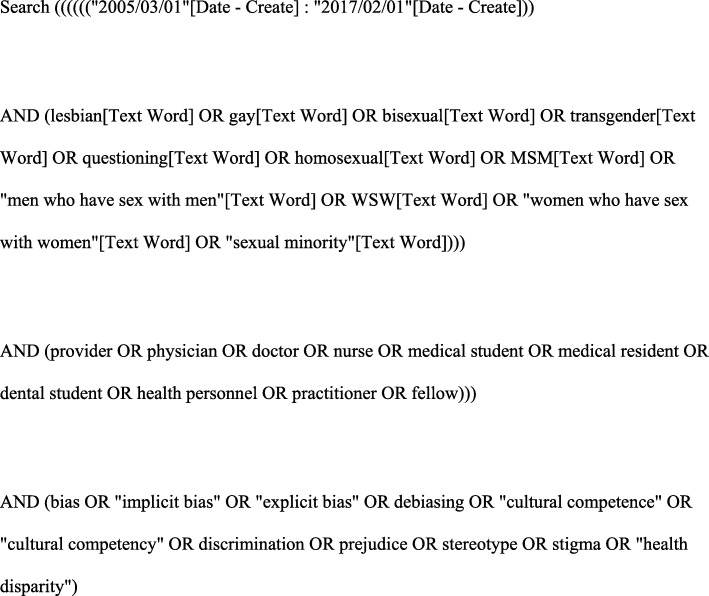
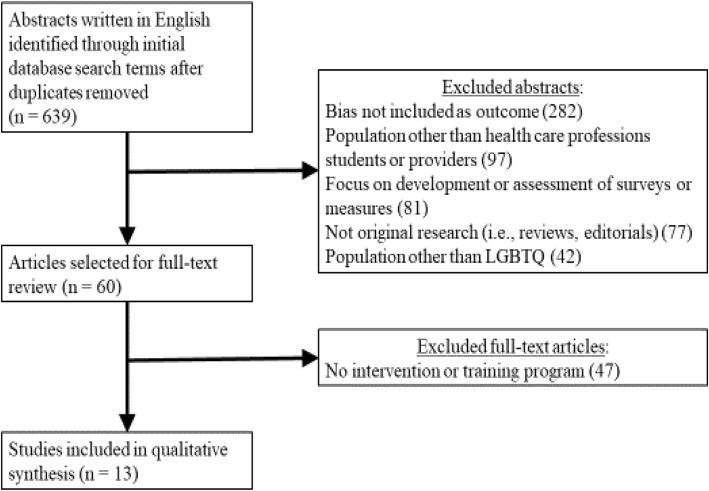
BACKGROUND: Lesbian, gay, bisexual, transgender and questioning (LGBTQ) individuals experience higher rates of health disparities. These disparities may be driven, in part, by biases of medical providers encountered in health care settings. Little is known about how medical, nursing, or dental students are trained to identify and reduce the effects of their own biases toward LGBTQ individuals. Therefore, a systematic review was conducted to determine the effectiveness of programs to reduce health care student or provider bias towards these LGBTQ patients. METHODS: The authors performed searches of online databases (MEDLINE/PubMed, PsycINFO, Web of Science, Scopus, Ingenta, Science Direct, and Google Scholar) for original articles, published in English, between March 2005 and February 2017, describing intervention studies focused on reducing health care student or provider bias towards LGBTQ individuals. Data extracted included sample characteristics (i.e., medical, nursing, or dental students or providers), study design (i.e., pre-post intervention tests, qualitative), program format, program target (i.e., knowledge, comfort level, attitudes, implicit bias), and relevant outcomes. Study quality was assessed using a five-point scale. RESULTS: The search identified 639 abstracts addressing bias among medical, nursing, and dental students or providers; from these abstracts, 60 articles were identified as medical education programs to reduce bias; of these articles, 13 described programs to reduce bias towards LGBTQ patients. Bias-focused educational interventions were effective at increasing knowledge of LGBTQ health care issues. Experiential learning interventions were effective at increasing comfort levels working with LGBTQ patients. Intergroup contact was effective at promoting more tolerant attitudes toward LGBTQ patients. Despite promising support for bias education in increasing knowledge and comfort levels among medical, nursing, and dental students or providers towards LGBTQ persons, this systematic review did not identify any interventions that assessed changes in implicit bias among students or providers. CONCLUSIONS: Strategies for assessing and mitigating implicit bias towards LGBTQ patients are discussed and recommendations for medical, nursing, and dental school curricula are presented.
Overview
The claims and statistics of this paper haven’t been checked yet.
Free: it reads the open-access text and checks the first 5 claims that cite a source we can check. Create a free account to check every claim.
Integrity signals
Registry
Cites
Statistics
Figures
Verification
Claims the paper makes
The claims and statistics of this paper haven’t been checked yet.
Free: it reads the open-access text and checks the first 5 claims that cite a source we can check. Create a free account to check every claim.
Claims other papers make about this one
Each is checked against this paper’s own text: does it say what the citing paper says it does?
In the citing paper
“Individuals who are lesbian, gay, bisexual, transgender, transsexual, two-spirit, queer, or questioning (LGBTQ+) are particularly affected by inequalities in health care, which arise due to particular needs for treatment47 and due to bias in health care practitioners.48”
From Addressing bias in big data and AI for health care: A call for open science (2021) · cites this paper as [48]
Self-check
Percentages, sums and reported differences re-computed from the paper’s own numbers.
The self-check needs the paper’s full text.
Citations
Cites
Preferred Reporting Items for Systematic Reviews and Meta-Analyses: the PRISMA statement
Moher, D., Liberati, A., Tetzlaff, J., Altman, D. G., & for the PRISMA Group (2009) · BMJ · doi:10.1136/bmj.b2535 · Cited by 83,823
Preferred reporting items for systematic reviews and meta-analyses: The PRISMA statement
Moher, D., Liberati, A., Tetzlaff, J., Altman, D. G., & the PRISMA Group* (2009) · Annals of Internal Medicine · doi:10.7326/0003-4819-151-4-200908180-00135 · Cited by 37,554
A meta-analytic test of intergroup contact theory.
Pettigrew, T. F., & Tropp, L. R. (2006) · Journal of personality and social psychology · doi:10.1037/0022-3514.90.5.751 · Cited by 9,708
Measuring individual differences in implicit cognition: the implicit association test
Greenwald, A. G., McGhee, D. E., & Schwartz, J. L. K. (1998) · Journal of Personality and Social Psychology · doi:10.1037/0022-3514.74.6.1464 · Cited by 9,210
Unequal treatment: confronting racial and ethnic disparities in health care
(2003) · Choice Reviews Online · doi:10.5860/choice.40-5843 · Cited by 7,043
Implicit social cognition: Attitudes, self-esteem, and stereotypes
Greenwald, A. G., & Banaji, M. R. (1995) · Psychological Review · doi:10.1037/0033-295x.102.1.4 · Cited by 6,682
Understanding and using the Implicit Association Test: III. Meta-analysis of predictive validity.
Greenwald, A. G., Poehlman, T. A., Uhlmann, E. L., & Banaji, M. R. (2009) · Journal of Personality and Social Psychology · doi:10.1037/a0015575 · Cited by 3,257
Implicit bias in healthcare professionals: a systematic review
FitzGerald, C., & Hurst, S. (2017) · BMC Medical Ethics · doi:10.1186/s12910-017-0179-8 · Cited by 2,556
Beyond curriculum reform: confronting medicineʼs hidden curriculum
Hafferty, F. W. (1998) · Academic Medicine · doi:10.1097/00001888-199804000-00013 · Cited by 1,881
Physicians and Implicit Bias: How Doctors May Unwittingly Perpetuate Health Care Disparities
Chapman, E. N., Kaatz, A., & Carnes, M. (2013) · Journal of General Internal Medicine · doi:10.1007/s11606-013-2441-1 · Cited by 1,300
Research works printed but not linked: 7
- Institute of Medicine Collecting sexual orientation and gender identity data in electronic health records: workshop summary 2013 Washington DC National Academy of Sciences 23967501
- Krehely J How to close the LGBT health disparities gap. Center for American Progress 2009 1 9
- Legal L When health care Isn't caring: lambda Legal's survey of discrimination against LGBT people and people with HIV 2010 New York Lamba Legal
- Grant JM Mottet LA Tanis J National Transgender Discrimination Survey Report on health and health care 2010 Washington DC National Center for Transgender Equality and National Gay and Lesbian Task Force
- Stone J Moskowitz GB Zestcott CA A brief, active learning workshop for reducing implicit bias among medical students. Manuscript in preparation 2017
- AAMC Advisory Committee on Sexual Orientation GI, and Sex Development,. Implementing Curricular and Institutional Climate Changes to Improve Health Care for Individuals Who Are LGBT, Gender Nonconforming, or Born with DSD: A Resource for Medical Educators 2014
- Staats C, Capatosto K, Wright RA, Jackson VW. State of the science: implicit bias review. 2016th ed. Colubus: Kirwan Institute for the Study of race and ethnicity, The Ohio Statee University.
Cited by
Items 201–300 of 413
Karniej, P., Juárez‐Vela, R., Dissen, A., Martínez‐Sabater, A., Pozo‐Herce, P. D., Gea-Caballero, V., Echániz-Serrano, E., Chover‐Sierra, E., Pérez-Elvira, R., & Czapla, M. (2025) · Advances in Clinical and Experimental Medicine · doi:10.17219/acem/203430 · Cited by 4
Shastri, V., Carlson, C., Gia, D.-H., Bhatia, R., Vallario, M., Healer, S., Iyer, S., & Gould, C. E. (2025) · Gerontology & Geriatrics Education · doi:10.1080/02701960.2025.2491520 · Cited by 4
“National surveys of medical school deans indicated that only 2–5 hours of didactics were spent discussing the needs of LGBTQ+ adults, without a focus on bias reduction strategies (Morris et al., 2019).”
Soomar, S. M., Cassum, L. A., Mughal, F. B., Akhtar, A., & Soomar, S. M. (2025) · BMC Nursing · doi:10.1186/s12912-025-03154-1 · Cited by 4
“Additionally, this inclusive practice will indirectly influence other healthcare providers, who will observe nurses demonstrating welcoming and non-discriminatory behaviors towards GSD clients, further fostering a more equitable healthcare environment [11, 12].”
Burton, W. N., Schultz, A. B., & Quinn, C. (2021) · Journal of Occupational and Environmental Medicine · doi:10.1097/jom.0000000000002231 · Cited by 4
Attuning and Queering SAMHSA’s Strategic Prevention Framework
Mendoza, N. S., Mackey, C., Harner, V., & Jackson, K. F. (2021) · Social Work Research · doi:10.1093/swr/svab012 · Cited by 4
An, Y., & Chung, C. (2022) · Korean journal of women health nursing/Yeoseong geon'gang ganho hag'hoeji/Yeoseong geon-gang ganho hakoeji · doi:10.4069/kjwhn.2022.03.11 · Cited by 4
“[26], educating medical students and healthcare providers about SGM persons contributed to improved knowledge about SGM health issues and decreased prejudice against them.”
BackgroundNurses’ Attitudes towards Selected Social Groups: Cross-Sectional Survey among Polish Nurses
Lesińska‐Sawicka, M. (2022) · Healthcare · doi:10.3390/healthcare10050795 · Cited by 4
“An effective knowledge of sign language can facilitate proper communication with hearing-impaired patients, as well as assessment and action oriented to the patients’ expectations [48,49], thus building a correct image of the patient and adopting an adequate nursing attitude.”
BackgroundDickinson, T., Normandin, M., & Mulheren, R. W. (2023) · Teaching and Learning in Communication Sciences & Disorders · doi:10.30707/tlcsd7.2.1690393489.698367 · Cited by 4
Veterinary education and experience shape beliefs about dog breeds Part 1: Pain sensitivity
Caddiell, R. M. P., White, P. A., Lascelles, B. D. X., Royal, K. D., Heugten, K. A., & Gruen, M. E. (2023) · Scientific Reports · doi:10.1038/s41598-023-40671-y · Cited by 4
Lamba, S., Jones, K. T., Grozdanic, T., & Moy, E. M. (2024) · LGBT Health · doi:10.1089/lgbt.2023.0224 · Cited by 5
“36 In addition, facility culture and leadership played a significant role in promoting veteran-first care.”
Nursing implications for transgender and gender diverse perioperative patients: A discussion paper
O'Shea, O., & Foran, P. (2024) · Journal of Perioperative Nursing · doi:10.26550/2209-1092.1319 · Cited by 4
The teaching of sexuality in Undergraduate Nursing courses: a systematic literature review
Beraldi, M. L., Paranhos, W. R., Garcia, O. R. Z., & Horta, A. L. D. M. (2024) · Interface - Comunicação Saúde Educação · doi:10.1590/interface.240005 · Cited by 4
Jadoon, A. H., Shahzad, M. A., Khattak, S. I., Ali, A., Jennings, H. M., & Khattak, M. I. (2025) · BMC Public Health · doi:10.1186/s12889-025-22073-z · Cited by 4
“Member checking adds qualitative rigour by enabling participants to confirm that their responses were interpreted correctly, enhancing the credibility and trustworthiness of the findings [37].”
Jessani, A., Athanasakos, A., & Tiwari, T. (2025) · Journal of Dental Education · doi:10.1002/jdd.13887 · Cited by 4
Effective Screening and Treatment to Reduce Suicide Risk Among Sexual and Gender Minority Youth
Murray, P. J., & Thoma, B. C. (2021) · PEDIATRICS · doi:10.1542/peds.2021-051831 · Cited by 4
Adherence to Oral Pre-Exposure Prophylaxis Intervention by Transgender Women: A Systematic Review
Quevedo, J. E. M., Arizabaleta, M. D. M. P., Villegas-Trujillo, L. M., & Rodríguez-Ortiz, A. (2023) · AIDS Education and Prevention · doi:10.1521/aeap.2023.35.5.362 · Cited by 4
Rao, P., Rahman, E., Webb, W. R., Garcia, P. E., Ioannidis, S., Kefalas, N., Scapolan, M., Philipp‐Dormston, W. G., & CARRUTHERS, J. D. A. (2024) · European Journal of Plastic Surgery · doi:10.1007/s00238-024-02226-w · Cited by 4
Halloran, J., Szilagyi, N., Stevens, J., & Olezeski, C. L. (2022) · Transgender Health · doi:10.1089/trgh.2021.0124 · Cited by 4
Handlovsky, I., Amato, A. T., Ferlatte, O., Kia, H., Gagnon, M., & Worthington, C. (2023) · Journal of Homosexuality · doi:10.1080/00918369.2023.2212100 · Cited by 4
“Interventions can include targeted efforts for employers and employees such as in-service educational support services and anti-discrimination workshops (Baker & Lucas, 2017; Gahagan & Subirana-Malaret, 2018; Morris et al., 2019).”
BackgroundO’Leary, A., Willis, L. A., Henny, K. D., Madden, M., & Koenig, L. J. (2023) · AIDS Education and Prevention · doi:10.1521/aeap.2023.35.6.439 · Cited by 3
Russell, M., Russell, A. N., Pahsini, K., & Marinschek, S. (2025) · Occupational Therapy in Mental Health · doi:10.1080/0164212x.2025.2489161 · Cited by 3
“As Morris et al. (2019) emphasized, experiential learning experiences play a critical role in shaping comfort levels and attitudes, making them essential for fostering competency and inclusivity in clinical practice.”
Pozzo, J. D., Esopenko, C., Flatt, J. D., & Dams-O’Connor, K. (2025) · Family & Community Health · doi:10.1097/fch.0000000000000436 · Cited by 3
Choo, S., Kim, R., Lee, H., Yi, H., Kim, R., & Kim, S. (2025) · Epidemiology and Health · doi:10.4178/epih.e2025032 · Cited by 3
“This gap underscores the need for more inclusive medical education to improve the knowledge, attitudes, and comfort levels of healthcare professionals in treating LGBTQ patients [47].”
On the contextuality of gender biases in pain care: theory and evidence
Bernardes, S. F., & Samulowitz, A. (2026) · Health Psychology Review · doi:10.1080/17437199.2026.2643504 · Cited by 3
“…et al., 2016), either by integrating sex/gender and related intersectionality issues in healthcare curricula and formal education (Labaka et al., 2023; Moretti et al., 2023; Morris et al., 2019) or by implementing gender awareness training modules (Morais et al., 2022; Vela et al., 2022).”
Health Equity in Rheumatology: A Global Health Perspective
Sandhu, N. K., Wright, G. C., Fajardo, K. I., & Gupta, L. (2023) · touchREVIEWS in RMD · doi:10.17925/rmd.2023.2.1.42 · Cited by 3
LGBTQ+ cultural competency of Irish mental health professional students
Moroney, D., & Jay, S. (2023) · Journal of Gay & Lesbian Mental Health · doi:10.1080/19359705.2023.2262944 · Cited by 3
“However due to their own personal experiences and socialization, health care providers often hold negative attitudes and implicit bias against the LGBTQ+ community (Morris et al., 2019).”
Interracial and Interethnic Marriages: Given Recent History, Have Things Been Getting Better?
Woolley, M. E., Greif, G. L., & Stubbs, V. (2024) · Social Work Research · doi:10.1093/swr/svae024 · Cited by 3
Shukla, A., Yalamanchi, S., Cabeza, G. T., Albright, A., Weber, Z., & Newton, A. D. (2025) · PLoS ONE · doi:10.1371/journal.pone.0313492 · Cited by 4
Self-reported life experiences of members of the LGBTQ+ community in Accra, Ghana
Anuga, D. W., Iddrisu, M., & Konlan, K. D. (2025) · PLoS ONE · doi:10.1371/journal.pone.0325148 · Cited by 3
“Legal protections, anti-discrimination laws, and societal education campaigns are critical to creating an environment where LGBTQ individuals can live without fear of violence or harassment [6,17–21].”
InfluentialJones, Q. B., Batchelder, H. R., Sanchez, M., & Rolls, J. (2024) · The Journal of Physician Assistant Education · doi:10.1097/jpa.0000000000000584 · Cited by 3
“6,12,14 In addition, student populations are reporting increased rates of LGBTQ status and may drive program changes.”
Alcendor, D. J., Juárez, P. D., Ramesh, A., Brown, K. Y., Tabatabai, M., & Matthews-Juarez, P. (2024) · Archives of Internal Medicine Research · doi:10.26502/aimr.0172 · Cited by 3
“LGBTQ+ persons have endured long-standing mistreatment, discrimination, and in some cases, had their health care needs ignored by the primary care and other health care providers who may possess explicit or implicit biases that lead to their discomfort in addressing them [18-20].”
BackgroundSelf-citationAssessing gaps in predoctoral dental curriculum for LGBTQ+ specific content
Cabeza, G. T., Albright, A., Yalamanchi, S., Newton, A. D., Weber, Z., & Shukla, A. (2024) · Journal of Dental Education · doi:10.1002/jdd.13720 · Cited by 3
“However, there is extensive scientific research 20,35,36 that supports the unique health needs of LGBTQ + individuals and could be utilized to bridge training and/or resources.”
Influences of Social Media Usages on Attitude Toward and Knowledge About the LGBT+ Community
Hoai, B. N., Pham, Q. M., Thắng, N. C., Nguyen, H. K., Ho, S. A., Nguyen, B. T., Phan, V. N., Nguyen, V. B. D., Sansone, A., & Jannini, E. A. (2025) · Journal of Homosexuality · doi:10.1080/00918369.2025.2588238 · Cited by 3
“Indeed, educational interventions focusing on the diversity in gender identity and sexual orientation, regardless of type or method, all show positive effects on modulating student attitudes, especially those in health sciences (Morris et al., 2019).”
Counce, T. L., Ko, A., Martinez, A. D., Rivera, J. M., Browne, C., & Solis, L. G. (2021) · Journal of Osteopathic Medicine · doi:10.1515/jom-2020-0295 · Cited by 3
History taking in gynecology revisited.
Aryal, S., & Atreya, A. (2022) · Acta bio-medica dell'Ateneo parmense/Acta biomedica · doi:10.23750/abm.v92i6.11940 · Cited by 3
Why Is Sex/Gender-Specific Medicine Needed?
Kim, N., & Schiebinger, L. L. (2022) · Springer eBooks · doi:10.1007/978-981-19-0120-1_1 · Cited by 3
Aguillera, F., Melo-Silva, L. L., Ribeiro, M. A., & Zanoto, P. A. (2023) · Pedro e João Editores eBooks · doi:10.51795/9786526504512 · Cited by 3
Kupferman, R., Gray, B., Rocheleau, B., Mallar, C., Hannifan, K., Hayes, V., Mallory, L. A., & Brown, B. (2023) · Journal of Maine Medical Center · doi:10.46804/2641-2225.1157 · Cited by 3
Emergency department care experiences among 2SLGBTQQIA+ patients: a mixed methods study
Chard, S., Karabelas-Pittman, S., Martin, K., Chapple, E., Messenger, D. W., Bartels, S. A., & Walker, M. (2025) · BMC Health Services Research · doi:10.1186/s12913-025-12684-y · Cited by 3
“These intersecting and compounding avenues of oppression, discrimination, and marginalization further contribute to care avoidance and exacerbate health issues [14].”
Tiainen, A., Roos, M., & Kylmä, J. (2024) · Hoitotiede · Cited by 3
Blanchard, E. E., Evans, R. R., Abdullatif, H., Brown, M., Carter, T., & LaChenaye, J. M. (2022) · Transgender Health · doi:10.1089/trgh.2022.0041 · Cited by 3
“33 Another approach would be to provide instruction on how the provision of culturally competent care to transgender patients equates to better, more comprehensive care, as opposed to a personal acceptance of a patient’s transgender status.”
Rangan, R. (2022) · Indian Journal of Medical Ethics · doi:10.20529/ijme.2022.059 · Cited by 4
Wille, L., Woznicki, N. W., Yang, J., Taylor, Z., Aguilar, S., Islam, T., Schnarrs, P. W., & Parent, M. C. (2024) · Annals of LGBTQ Public and Population Health · doi:10.1891/lgbtq-2023-0025 · Cited by 3
Tran, V. (2024) · TSpace (University of Toronto) · doi:10.13140/rg.2.2.16435.23840 · Cited by 3
Awareness of LGBTQ+ health disparities: A survey study of complementary integrative health providers
Burnham, K. D., Lady, S. D., & Martin, C. (2023) · Journal of Chiropractic Education · doi:10.7899/jce-22-2 · Cited by 2
Why Is Sex/Gender-Specific Medicine Important?
Kim, N. (2024) · Springer eBooks · doi:10.1007/978-981-97-0130-8_1 · Cited by 3
Reynolds, R., Knight, J., Dorsey, B. F., Phillips, C., Kharkar, V., Blickensderfer, K., Keyser, C., Hatch, B., Connelly, E., Decker, J., et al. (2024) · Cureus · doi:10.7759/cureus.70779 · Cited by 2
“Educating future healthcare professionals about the specific needs of GSD individuals is essential in mitigating discrimination and improving the delivery of patient-centered and GSD-inclusive care [4-7].”
BackgroundThe equality equation: toward a rainbow-friendly financial sector in India
Mundi, H. S. (2025) · Equality Diversity and Inclusion An International Journal · doi:10.1108/edi-07-2024-0339 · Cited by 2
Ojha, N. K. (2025) · Spectrum of Humanities and Social Sciences · doi:10.3126/shss.v1i1.79802 · Cited by 2
Mental and behavioral health care access and satisfaction among older sexual minority women
Scheer, J. R., Epshteyn, G., Girard, R., Stage, M. A., Chadbourne, E. M., Caceres, B. A., Wall, M. M., & Hughes, T. L. (2025) · Academia Mental Health and Well-Being · doi:10.20935/mhealthwellb7867 · Cited by 2
“…of economic disparities and discrimination and incorporate culturally and structurally competent practices into routine care, as research has demonstrated persistent gaps in provider training and preparedness to deliver culturally responsive services to sexual and gender minority populations [65].”
Whaikid, P., & Piaseu, N. (2025) · Journal of Homosexuality · doi:10.1080/00918369.2025.2579571 · Cited by 2
“In addition, previous systematic reviews of health staff focused on general attitudes and implicit biases (Morris et al., 2019), while others explored the effectiveness of training programs designed to improve cultural competency (Yu et al., 2023).”
Ma, H., Cham, C. Y. C., Zhang, W., Tang, S. K., Ng, A. Y. M., Ho, S., & Wong, J. Y. H. (2025) · Journal of research in nursing · doi:10.1177/17449871251389564 · Cited by 2
“At the institutional level, LGBT + -related training was associated with improved inclusivity towards LGBT + clients (Morris et al., 2019; Sherman et al., 2023).”
Duong, K. D., Spohn, S., Guss, H., Streed, C. G., & Zumwalt, A. (2026) · Medical Teacher · doi:10.1080/0142159x.2025.2609723 · Cited by 2
Ali, U., Maqsood, K., Ullah, A., Rafiq, B., Tariq, N., Ali, A., & Hashmi, A. M. (2026) · PLOS Global Public Health · doi:10.1371/journal.pgph.0004948 · Cited by 2
Guigayoma, J. P., Bermudez, A. N. C., Palatino, M. C., Nazareno, J., Cu‐Uvin, S., Operario, D., & Restar, A. (2021) · AIDS Education and Prevention · doi:10.1521/aeap.2021.33.6.495 · Cited by 2
Shi, R., Yeoh, C. B., Lee, J., Tan, K. S., Yang, G., Haviland, K., Walters, C. B., & Tollinche, L. E. (2022) · Transgender Health · doi:10.1089/trgh.2021.0001 · Cited by 2
Response to a Reader’s Letter “Medical School Training Can Improve Patient Care”
Ramesh, A., Juárez, P. D., & Matthews-Juarez, P. (2022) · Journal of Primary Care & Community Health · doi:10.1177/21501319211070639 · Cited by 2
Self-citationKhallouq, B. A. B., Carter, J. S., Carter, S. K., & Taliaferro, L. A. (2022) · Springer eBooks · doi:10.1007/978-3-031-06329-9_5 · Cited by 2
Mental health and inclusivity support and education in a UK dental school: a cross-sectional survey
Lennox, C., Pandya, J., Lyttle, R., Pandya, S., Penlington, C., & Bowes, C. (2022) · BDJ · doi:10.1038/s41415-022-5311-6 · Cited by 2
“27 for LGBT+ individuals helped us to formulate an action plan of improving education on reducing barriers to health care as a dental profession.”
Lewis, B. E., & Naik, A. R. (2023) · BMC Medical Education · doi:10.1186/s12909-023-04829-6 · Cited by 2
Lara-Garrido, A. S., Rivarola, L. P., & Bernardo, G. Á. (2024) · Alternativas Cuadernos de trabajo Social · doi:10.14198/altern.26263 · Cited by 2
Cyclical uncertainty: Healthcare providers and gender affirming care in Central Appalachia
Harless, C., Ulrich, I. P., Giddings, T., Oat‐Judge, J., & Johnson, A. H. (2024) · International Journal of Transgender Health · doi:10.1080/26895269.2024.2440859 · Cited by 2
Goldowsky, A. M., Clukey, J., Streed, C. G., Paul, S., & Vélez, C. D. (2025) · Digestive Diseases and Sciences · doi:10.1007/s10620-025-08921-3 · Cited by 2
“These curricula take various forms including asynchronous online modules, single lectures, and lecture series, and the amount of time dedicated to them is variable [35].”
InfluentialMa, C., & Li, J.-Y. (2025) · BMC Medical Education · doi:10.1186/s12909-025-07204-9 · Cited by 1
“Additionally, previous research has shown that healthcare professionals often have limited knowledge of the LGBTQ + community, which can lead to discrimination [50].”
dos Santos, W. A., Montovani, E. H., Lopes, J. W., Nogueira, A. C. R., de Freitas, P. F. S., Assis, L. B. D., & Bteshe, M. (2020) · Research Society and Development · doi:10.33448/rsd-v9i8.5301 · Cited by 2
Reimagining Bias: Making Strange With Disclosure
Paton, M., Soleas, E., & Hodges, B. D. (2021) · Journal of Continuing Education in the Health Professions · doi:10.1097/ceh.0000000000000342 · Cited by 2
Byrne, M. D., & Borzalski, C. (2023) · CIN Computers Informatics Nursing · doi:10.1097/cin.0000000000001064 · Cited by 2
Orvostanhallgatók sztereotípiái különböző társadalmi csoportokkal kapcsolatban
Jáki, T., Pejin, L., Csaba, E., Paulik, E., & Molnár, R. (2023) · Orvosi Hetilap · doi:10.1556/650.2023.32922 · Cited by 2
Valenti, K. G., Doyon, K., Morgan, B. R., Quinn, G. P., & Bekelman, D. B. (2024) · Journal of Hospice and Palliative Nursing · doi:10.1097/njh.0000000000001030 · Cited by 2
Blais, M., Soares, A., Brazeau, C., Myles, D., & Morand, É. (2022) · Archipel (Université du Québec à Montréal) · Cited by 2
Using Cultural Humility in Care Provided for LGBTQ People
Ruud, M. N. (2022) · Springer eBooks · doi:10.1007/978-3-030-89594-5_115 · Cited by 1
Importance of Education in the Sex/Gender-Specific Medicine
Kim, N. (2022) · Springer eBooks · doi:10.1007/978-981-19-0120-1_29 · Cited by 1
The Changing Practice of Medicine
Godbey, E. A., Roseff, S. D., & Russell, D. E. (2024) · Wiley eBooks · doi:10.1002/9781683673941.ch3 · Cited by 1
Promoting allyship to support and uplift the LGBTQIA+ community
Huynh, D. J., Paul, S., & Duong, N. K. (2024) · Nature Reviews Gastroenterology & Hepatology · doi:10.1038/s41575-024-00928-x · Cited by 1
“Some examples, among others, include revising patient intake forms to be more inclusive (such as by inquiring about gender identity and preferred pronouns), advo-cating for hospital-wide non-discrimination policies and transforming medical school curricula to include LGBTQIA+-centred topics 8 .”
The Need for Affirming Health Care among LGBTQ+ Survivors of Intimate Partner Violence
Bermea, A. M., & Henderson, T. L. (2024) · Global Journal of Human-Social Science · doi:10.34257/gjhsscvol24is5pg33 · Cited by 1
The Cost-Effectiveness and Cost Savings of Gender-Affirming Mastectomy
Conway, B. J., Polovneff, A. O., McGinley, E. L., McMains, C. J., Pezzin, L. E., & Krucoff, K. B. (2025) · Transgender Health · doi:10.1089/trgh.2024.0123 · Cited by 1
Addressing Stereotypes and Prejudices in Healthcare: The Imperative for Pedagogical Interventions
Travaglione, F., & Avellino, A. (2025) · Advances in medical education, research, and ethics (AMERE) book series · doi:10.4018/979-8-3693-4334-0.ch014 · Cited by 1
Smith, D., Hester, S. M., Emmert, R., Bryant, J., & Hartwell, M. L. (2025) · AJO International · doi:10.1016/j.ajoint.2025.100127 · Cited by 1
Mehra, S., Singh, H., Sidhu, T. K., Bansal, K., Garg, B., Singh, G., Singh, G. P., Bihari, K., & Boparai, K. (2025) · International Journal of Community Medicine and Public Health · doi:10.18203/2394-6040.ijcmph20251384 · Cited by 1
Porter, A. W., Gomez, N. A. G., Graefe, B., Falcon, A. L., & Foronda, C. L. (2025) · Nurse Educator · doi:10.1097/nne.0000000000001897 · Cited by 1
George, T. P., Kershner, S. H., & DeCristofaro, C. (2025) · Online Journal of Rural Nursing and Health Care · doi:10.14574/ojrnhc.v25i1.780 · Cited by 1
O’Neill, P., Becker, W., Cunningham, C. A., Jones, D. E., & Linden‐Carmichael, A. N. (2025) · Prevention Science · doi:10.1007/s11121-025-01825-8 · Cited by 1
“Previous intervention research aimed at medical education programs indicates various types of interventions yield positive effects, including greater knowledge of LGBTQ health care concerns and increased levels of comfort in treating patients who identify as LGBTQ (Morris et al., 2019).”
Hosoda-Urban, T., & Yokota, K. (2025) · Medical Education Online · doi:10.1080/10872981.2025.2535411 · Cited by 1
“However, critiques have emerged regarding the limited use of validated measures [5,6,8].”
Ma, H., Wong, J. Y. H., Ma, Y., Cham, C. Y. C., Chu, T. Y., Tsang, Z. L. Y., Li, S., & Goh, W. L. (2025) · Journal of Transcultural Nursing · doi:10.1177/10436596251375920 · Cited by 1
“Few studies involved LGBTQIA + communities in curriculum design or addressed transgender-specific needs, undermining cultural relevance and effectiveness (Morris et al., 2019).”
An Equity-Centered Trauma-Informed Approach to Nursing Education
Berry, S. N., & Nutter, E. (2025) · Journal of Nursing Education · doi:10.3928/01484834-20250530-05 · Cited by 1
da Silva, T. M. H. R. (2026) · IGI Global eBooks · doi:10.4018/979-8-3373-1330-6.ch004 · Cited by 1
Gender-Affirming Care: A 21st Century Bibliometric Perspective
Vervalcke, J., Barouti, K., Ciancia, S., Motmans, J., & T'Sjoen, G. G. (2026) · International Journal of Sexual Health · doi:10.1080/19317611.2026.2633626 · Cited by 1
“In-the-field In-the-field learning experiences were the most effective at increasing provider comfort (Morris et al., 2019).”
Intong, J., & Poralan, P. S. (2026) · International Journal For Multidisciplinary Research · doi:10.36948/ijfmr.2026.v08i02.70662 · Cited by 1
Jeffrey, S., Ferfolja, T., Eathorne, A., & Armour, M. (2026) · Women s Reproductive Health · doi:10.1080/23293691.2026.2636627 · Cited by 1
Pizarra, A. R. (2026) · International Journal of Social Determinants of Health and Health Services · doi:10.1177/27551938261431282 · Cited by 1
Framing health inequalities in general practice education: a critical documentary analysis
Grant, L., & Park, S. E. (2026) · Education for Primary Care · doi:10.1080/14739879.2026.2654134 · Cited by 1
“…obscure the political nature of inequality: rather than naming specific marginalised populations, documents tend to refer ambiguously to ‘culture’ or ‘background’, failing to differentiate the distinct mechanisms by which factors like racism, sexism and ableism imprint on bodies and health [31–34].”
Isaacs, K., Young, K. M., Boggiano, V. L., Yu, R., & McCloskey, K. (2026) · North Carolina Medical Journal · doi:10.18043/001c.162212 · Cited by 1
Parish, S. J., Kling, J. M., Coleman, E., Eardley, I., Bober, S. L., Heruti, R. J., Aurioles, E. R., & Reisman, Y. (2026) · Sexual Medicine Reviews · doi:10.1093/sxmrev/qeag030 · Cited by 1
Singer, R., Gannon, T., Higgins, A., Roland, D., Barrett, M. J., Tagg, A., Kelleher, S. T., & Hall, D. (2026) · Archives of Disease in Childhood · doi:10.1136/archdischild-2026-330818 · Cited by 1
Callihoo, S., Dhillon, N., Saini, H., Singh, K., Stuart-Verner, B., & Santos, R. D. S. (2026) · IEEE International Requirements Engineering Conference Workshops (REW) · doi:10.1109/rew72749.2026.00083 · Cited by 1
Teaching Cognitive/Behavioral Neuroscience Through a DEI Lens
Opper, J. K. (2023) · Teaching of Psychology · doi:10.1177/00986283231183936 · Cited by 1
“…(2018) found that Asian American adults tend to be both underdiagnosed and undertreated for mental health conditions compared to white adults, and Morris et al. (2019) argue that documented health care disparities for LGBTQIA + individuals exist in large part due to stigmatization and implicit…”
Fayed, A. M., & van Eck, C. F. (2023) · Elsevier eBooks · doi:10.1016/b978-0-323-91259-4.00026-6 · Cited by 1
Combs, R. M., Decker, H. R., Noonan, E. J., Weingartner, L. A., & Bohnert, C. A. (2023) · International Journal of Healthcare Simulation · doi:10.54531/zsan7948 · Cited by 1
Os desafios da promoção à saúde mental da população LGBTQIAPN+ em meio a COVID-19: um ensaio crítico
Sandoval-Rueda, M. C., Torres, A. G., Harada, Y. A. A., & Martins, A. M. (2023) · CLAEC e-Books · doi:10.23899/9786589284475.13 · Cited by 1
Vivência das Pessoas LGBTI+ na atenção em saúde
Mena, I. M., & Bellenzani, R. (2023) · CLAEC e-Books · doi:10.23899/9786589284475.5 · Cited by 1
Metadata
- Authors
- Morris, M., Cooper, R. L., Ramesh, A., Tabatabai, M., Arcury, T. A., Shinn, M., Im, W., Juarez, P., & Matthews-Juarez, P.
- Affiliations
- Meharry Medical College (US)
- Wake Forest University Health Sciences (US)
- Vanderbilt University (US)
- Corresponding author
- Morris, Matthew
- ORCID
- Venue
- BMC Medical Education
- Published
- 2019-08-30
- Volume
- 19
- Issue
- 1
- Pages
- 325-325
- ISSN
- 1472-6920 (ISSN-L)
- PMC
- PMC6716913
- OpenAlex
- W2970002910
- Cited by
- 363
- References
- 83
- Citations by year
- 2026: 35 · 2025: 51 · 2024: 49 · 2023: 93 · 2022: 77 · 2021: 37 · 2020: 19 · 2019: 1
- FWCI
- 5.14
- Type
- journal article
- Language
- en
- Open access
- gold
- doi.org
- Licence
- cc-by
- creativecommons.org/licenses/by/4.0/ (tdm)
- creativecommons.org/licenses/by/4.0/ (vor)
- Locations
- BMC Medical Education (publishedVersion, cc-by)
- Europe PMC (PubMed Central) (publishedVersion, cc-by)
- PubMed Central (publishedVersion, cc-by)
- PubMed (publishedVersion)
- DOAJ (DOAJ: Directory of Open Access Journals) (submittedVersion, cc-by-sa)
- Funders
- Health Resources and Services Administration (UH1HP30348)
- Topics
- Social Sciences › Psychology › Social Psychology › LGBTQ Health, Identity, and Policy
- Health Sciences › Medicine › Public Health, Environmental and Occupational Health › Cultural Competency in Health Care
- Health Sciences › Medicine › Public Health, Environmental and Occupational Health › Obesity and Health Practices
- Keywords
- LGBTQ health disparities, provider bias, implicit bias, medical students, nursing students, dental students, health professions education, experiential learning, intergroup contact
- MeSH terms
- Sexual and Gender Minorities, Attitude of Health Personnel, Humans, Physician-Patient Relations, Prejudice, Students, Dental, Students, Medical, Students, Nursing, Homophobia
About these checks
Registry, retraction, Cites and statistics results are computed, not judged, with one exception: a printed reference that no index lists is read once by a model before it counts as a citation error. Claims are extracted by a model and kept only when their quote appears verbatim in the text; each cited source is then checked, with a model’s help, for whether it says what the claim relies on. Those verdicts can be wrong — read the claim’s quote and the cited source before relying on one.
Statistics and arithmetic are recomputed, not judged.
Confidence bands are shown only for fields calibrated on our annotated test set. None is calibrated yet, so no band is shown.
What counts as a claim ›How we measure confidence ›How we check this ›
Are you an author, or do you see a problem with this page? Request a review
Data sources
Bibliographic data: Semantic Scholar, OpenAlex, Crossref.
Contains information from the Semantic Scholar Academic Graph Datasets, made available under the ODC Attribution License (ODC-BY 1.0).
Semantic Scholar’s data is described in: Kinney, R., et al. (2023). The Semantic Scholar Open Data Platform. arXiv:2301.10140.
