

Training to reduce LGBTQ-related bias among medical, nursing, and dental students and providers: a systematic review
Open accessThe DOI matches its Crossref record; 82 of the 83 references it cites were found in a registry or an index.
Abstract
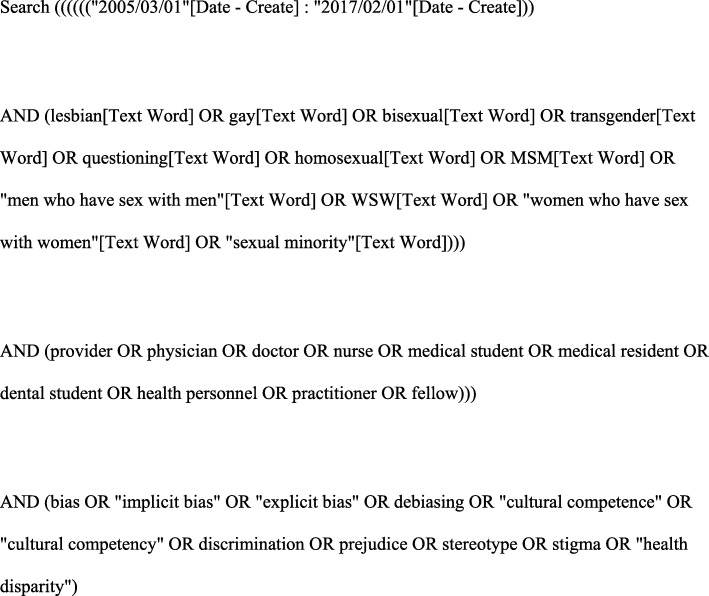
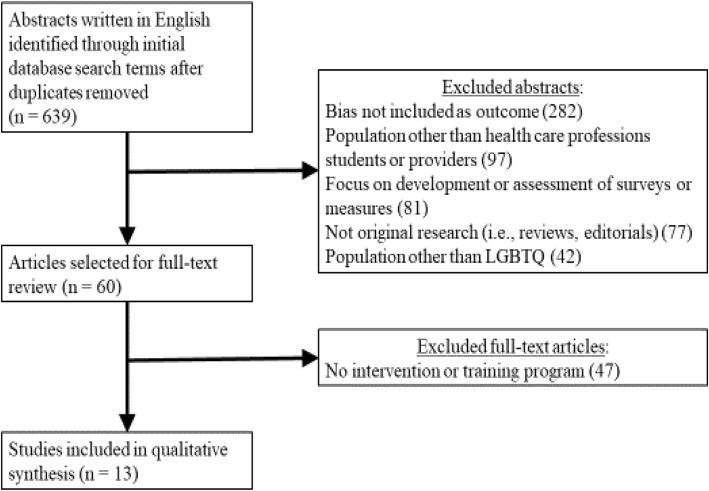
BACKGROUND: Lesbian, gay, bisexual, transgender and questioning (LGBTQ) individuals experience higher rates of health disparities. These disparities may be driven, in part, by biases of medical providers encountered in health care settings. Little is known about how medical, nursing, or dental students are trained to identify and reduce the effects of their own biases toward LGBTQ individuals. Therefore, a systematic review was conducted to determine the effectiveness of programs to reduce health care student or provider bias towards these LGBTQ patients. METHODS: The authors performed searches of online databases (MEDLINE/PubMed, PsycINFO, Web of Science, Scopus, Ingenta, Science Direct, and Google Scholar) for original articles, published in English, between March 2005 and February 2017, describing intervention studies focused on reducing health care student or provider bias towards LGBTQ individuals. Data extracted included sample characteristics (i.e., medical, nursing, or dental students or providers), study design (i.e., pre-post intervention tests, qualitative), program format, program target (i.e., knowledge, comfort level, attitudes, implicit bias), and relevant outcomes. Study quality was assessed using a five-point scale. RESULTS: The search identified 639 abstracts addressing bias among medical, nursing, and dental students or providers; from these abstracts, 60 articles were identified as medical education programs to reduce bias; of these articles, 13 described programs to reduce bias towards LGBTQ patients. Bias-focused educational interventions were effective at increasing knowledge of LGBTQ health care issues. Experiential learning interventions were effective at increasing comfort levels working with LGBTQ patients. Intergroup contact was effective at promoting more tolerant attitudes toward LGBTQ patients. Despite promising support for bias education in increasing knowledge and comfort levels among medical, nursing, and dental students or providers towards LGBTQ persons, this systematic review did not identify any interventions that assessed changes in implicit bias among students or providers. CONCLUSIONS: Strategies for assessing and mitigating implicit bias towards LGBTQ patients are discussed and recommendations for medical, nursing, and dental school curricula are presented.
Overview
The claims and statistics of this paper haven’t been checked yet.
Free: it reads the open-access text and checks the first 5 claims that cite a source we can check. Create a free account to check every claim.
Integrity signals
Registry
Cites
Statistics
Figures
Verification
Claims the paper makes
The claims and statistics of this paper haven’t been checked yet.
Free: it reads the open-access text and checks the first 5 claims that cite a source we can check. Create a free account to check every claim.
Claims other papers make about this one
Each is checked against this paper’s own text: does it say what the citing paper says it does?
In the citing paper
“Individuals who are lesbian, gay, bisexual, transgender, transsexual, two-spirit, queer, or questioning (LGBTQ+) are particularly affected by inequalities in health care, which arise due to particular needs for treatment47 and due to bias in health care practitioners.48”
From Addressing bias in big data and AI for health care: A call for open science (2021) · cites this paper as [48]
Self-check
Percentages, sums and reported differences re-computed from the paper’s own numbers.
The self-check needs the paper’s full text.
Citations
Cites
Preferred Reporting Items for Systematic Reviews and Meta-Analyses: the PRISMA statement
Moher, D., Liberati, A., Tetzlaff, J., Altman, D. G., & for the PRISMA Group (2009) · BMJ · doi:10.1136/bmj.b2535 · Cited by 83,823
Preferred reporting items for systematic reviews and meta-analyses: The PRISMA statement
Moher, D., Liberati, A., Tetzlaff, J., Altman, D. G., & the PRISMA Group* (2009) · Annals of Internal Medicine · doi:10.7326/0003-4819-151-4-200908180-00135 · Cited by 37,554
A meta-analytic test of intergroup contact theory.
Pettigrew, T. F., & Tropp, L. R. (2006) · Journal of personality and social psychology · doi:10.1037/0022-3514.90.5.751 · Cited by 9,708
Measuring individual differences in implicit cognition: the implicit association test
Greenwald, A. G., McGhee, D. E., & Schwartz, J. L. K. (1998) · Journal of Personality and Social Psychology · doi:10.1037/0022-3514.74.6.1464 · Cited by 9,210
Unequal treatment: confronting racial and ethnic disparities in health care
(2003) · Choice Reviews Online · doi:10.5860/choice.40-5843 · Cited by 7,043
Implicit social cognition: Attitudes, self-esteem, and stereotypes
Greenwald, A. G., & Banaji, M. R. (1995) · Psychological Review · doi:10.1037/0033-295x.102.1.4 · Cited by 6,682
Understanding and using the Implicit Association Test: III. Meta-analysis of predictive validity.
Greenwald, A. G., Poehlman, T. A., Uhlmann, E. L., & Banaji, M. R. (2009) · Journal of Personality and Social Psychology · doi:10.1037/a0015575 · Cited by 3,257
Implicit bias in healthcare professionals: a systematic review
FitzGerald, C., & Hurst, S. (2017) · BMC Medical Ethics · doi:10.1186/s12910-017-0179-8 · Cited by 2,556
Beyond curriculum reform: confronting medicineʼs hidden curriculum
Hafferty, F. W. (1998) · Academic Medicine · doi:10.1097/00001888-199804000-00013 · Cited by 1,881
Physicians and Implicit Bias: How Doctors May Unwittingly Perpetuate Health Care Disparities
Chapman, E. N., Kaatz, A., & Carnes, M. (2013) · Journal of General Internal Medicine · doi:10.1007/s11606-013-2441-1 · Cited by 1,300
Research works printed but not linked: 7
- Institute of Medicine Collecting sexual orientation and gender identity data in electronic health records: workshop summary 2013 Washington DC National Academy of Sciences 23967501
- Krehely J How to close the LGBT health disparities gap. Center for American Progress 2009 1 9
- Legal L When health care Isn't caring: lambda Legal's survey of discrimination against LGBT people and people with HIV 2010 New York Lamba Legal
- Grant JM Mottet LA Tanis J National Transgender Discrimination Survey Report on health and health care 2010 Washington DC National Center for Transgender Equality and National Gay and Lesbian Task Force
- Stone J Moskowitz GB Zestcott CA A brief, active learning workshop for reducing implicit bias among medical students. Manuscript in preparation 2017
- AAMC Advisory Committee on Sexual Orientation GI, and Sex Development,. Implementing Curricular and Institutional Climate Changes to Improve Health Care for Individuals Who Are LGBT, Gender Nonconforming, or Born with DSD: A Resource for Medical Educators 2014
- Staats C, Capatosto K, Wright RA, Jackson VW. State of the science: implicit bias review. 2016th ed. Colubus: Kirwan Institute for the Study of race and ethnicity, The Ohio Statee University.
Cited by
Items 301–400 of 413
O apagamento LGBTQIA+ pelos meios de comunicação
Podolan, P. G. (2023) · CLAEC e-Books · doi:10.23899/9786589284475.4 · Cited by 1
Canesin, M., & Ângelo, A. D. (2023) · CLAEC e-Books · doi:10.23899/9786589284475.7 · Cited by 1
Filho, A. F. R. (2023) · CLAEC e-Books · doi:10.23899/9786589284475.2 · Cited by 1
Chiya, W. H., Luvuno, Z., Ngcobo, S. J., Nxumalo, C. T., Naidoo, D., Harris, O., & Zamudio‐Haas, S. (2023) · International Journal of Research in Business and Social Science (2147-4478) · doi:10.20525/ijrbs.v12i10.3104 · Cited by 1
“The literature also reveals that there is limited knowledge on how health professional school students are trained to identify and eliminate the effects of their own biases toward SGM individuals (Morris, Cooper et al. 2019).”
BackgroundExperiences and Expectations of LGBTQ+ Students Before Entering College
Cole, J. S., Burkhart, J., & BrckaLorenz, A. (2025) · New Directions for Higher Education · doi:10.1002/he.20537 · Cited by 1
Larenas-Rosa, D., & Montenegro-Cárdenas, V. (2025) · Revista Chilena de Fonoaudiología · doi:10.5354/0719-4692.2025.80331 · Cited by 1
The “Dravidian model”: egalitarianism and healthcare reform
Kumbhar, K. (2023) · Indian Journal of Medical Ethics · doi:10.20529/ijme.2022.062 · Cited by 1
Greene, M. Z., Herrmann, M., & Trimberger, B. (2023) · Research Square · doi:10.21203/rs.3.rs-1902727/v1 · Cited by 1
Frankis, J. S. (2024) · Evidence-Based Nursing · doi:10.1136/ebnurs-2024-104159 · Cited by 1
“57 Although some curriculums have been implemented, 52 56 58 existing training may not be sufficient to remove inherent LGBT+ biases among healthcare practitioners, 52 necessitating further research and development.”
Palmou, P. (2024) · UBIR (University of Greater Manchester) · doi:10.13140/rg.2.2.17170.26561 · Cited by 1
A Qualitative, Formative Evaluation of Cultural Competencies in a Baccalaureate Nursing Program
Mercado, L. J. (2021) · ScholarWorks (Walden University) · Cited by 1
Implementing Implicit Bias Educational Modules into Nursing Student Curricula
Chin, K. M. (2023) · ScholarSpace (University of Hawaii at Manoa) · Cited by 1
10 Patient-Centered Questions for Clinical Encounters with Transgender Patients
Blossom, K. (2020) · Dominican Scholar (Dominican University of California) · doi:10.33015/dominican.edu/2020.pas.01
Sociocultural Considerations in Trauma Treatment
Greenberg, T. M. (2020) · Springer eBooks · doi:10.1007/978-3-030-45285-8_9
Huertos, D., & Enríque, J. (2014) · University of Valladolid Documentary Repository (University of Valladolid)
Using Cultural Humility in Care Provided for LGBTQ People
Ruud, M. N. (2021) · Springer eBooks · doi:10.1007/978-3-030-48277-0_115-1
Pasia, K. M. (2022) · Research Square · doi:10.21203/rs.3.rs-1785702/v1
Maka, P., Rosander, A., Sato, D., & Elkbuli, A. (2022) · The American Surgeon · doi:10.1177/00031348221124326
As questões LGBT no ensino da odontologia
Souto, F. C. D. B. (2023) · doi:10.14393/ufu.di.2023.8001
Krüger, P., Pfister, A., Eder, M., & Mikolasek, M. (2023) · Nomos Verlagsgesellschaft mbH & Co. KG eBooks · doi:10.5771/9783748938385-251
Special Population: LGBTQ Community
Austen, J. M., Lahlou, R. M., & Moore, M. A. (2023) · Springer eBooks · doi:10.1007/978-3-031-29171-5_26
Roberts, B. (2023) · Open Access Victoria University of Wellington | Te Herenga Waka (Figshare) · doi:10.26686/wgtn.24055221
Nguyen, M. K., Anthony, S. P., Manganiello, M. P., Bell, K. A., & Papanagnou, D. (2023) · Cureus · doi:10.7759/cureus.44999
O papel da voz na identidade de gênero
dos Santos, S. S., Cielo, C. A., Schwarz, K., & Lobato, M. I. R. (2023) · CLAEC e-Books · doi:10.23899/9786589284475.14
Geopolitics in Gay Advertising via Instagram
Oliveira, F. A., & Lima, J. B. (2023) · CLAEC e-Books · doi:10.23899/9786589284475.16
Arenhart, C. G. M. (2023) · CLAEC e-Books · doi:10.23899/9786589284475.8
BALLROOM: performance e resistência LGBTQIAPN+
Ferreira, L. D. F., & Sousa, P. F. D. O. (2023) · CLAEC e-Books · doi:10.23899/9786589284475.15
Silva, R., & Oliveira, F. A. (2023) · CLAEC e-Books · doi:10.23899/9786589284475.19
de Castilhos, A. P. D. S. M., de Castilhos, G. M., & Poll, R. E. (2023) · CLAEC e-Books · doi:10.23899/9786589284475.1
Desnaturalizando a norma: reflexões sobre uma formação de professores inclusiva e QUEER
Guzmán, J. (2023) · CLAEC e-Books · doi:10.23899/9786589284475.17
Taborda, J. C., & de Oliveira, E. A. (2023) · CLAEC e-Books · doi:10.23899/9786589284475.11
Oliveira, F. A., & Silva, R. (2023) · CLAEC e-Books · doi:10.23899/9786589284475.12
de Sousa, M. L. M., & Júnior, J. R. L. B. (2023) · CLAEC e-Books · doi:10.23899/9786589284475.6
Sousa, C. D. O. (2023) · CLAEC e-Books · doi:10.23899/9786589284475.10
Corpos em diálogo: relato de experiência com grupo de apoio às pessoas trans
Bender, M. S., Saraiva, E. S., Uziel, A. P., & de Freitas, S. M. (2023) · CLAEC e-Books · doi:10.23899/9786589284475.9
Insights in Gender, Sex and Sexualities: 2022
Woodward, K. (2024) · Frontiers research topics · doi:10.3389/978-2-8325-4633-8
Medical education level’s relationship with attitudes toward women and LGBTIQ+ individuals
Akdemir, E. M., Karaman, İ. G. Y., Altınöz, Ş. T., Köşger, F., & Altınöz, A. E. (2024) · Journal of Clinical Psychiatry · doi:10.5505/kpd.2024.65390
Insights in Healthcare Professions Education: 2023
(2024) · Frontiers research topics · doi:10.3389/978-2-8325-5189-9
History in context: teaching the history of dentistry with rare materials
Theis-Mahon, N. R., Opryszko, A., Miller, A. S., Beck, E., & Hendrickson, L. G. (2024) · Journal of the Medical Library Association JMLA · doi:10.5195/jmla.2024.1934
Torres, S. D., Mateluna, C. B., Asencio, C. G., Burgos, N. S., & Machuca, A. T. (2022) · Revista Confluencia · doi:10.52611/confluencia.num1.2022.753
“En el ámbito de salud, esta población sufre discriminación por parte de los profesionales 3,4,5 , generando malestar psicológico, evitando acudir a servicios asistenciales por temor al maltrato 6 , afectando así en la adherencia de salud y la comunicación entre el personal y paciente 7 .”
Cardona, M. R., Guisao, S. D. P., & Villegas, L. F. O. (2024) · Lumini-Science Journal of Health Sciences · doi:10.35997/lumini-science.v1i1.4
Khamuani, M. P., & Patera, E. (2025) · Biomedical visualization · doi:10.1007/978-3-031-81795-3_6
Rose, T. L., & Veltman, A. (2025) · Communication & Medicine · doi:10.3138/cam-2025-0204
Kassaras, I. (2025) · Sexuality & Culture · doi:10.1007/s12119-025-10353-0
“…to high levels of religiosity, conservatism, authoritarianism, and limited social contact with LGBTQIA2 + people, while factors like education, social liberalism, and prior interactions promote positive views (Lewis et al., 2017; Morris et al., 2019; Norton & Herek, 2013; Papadaki et al., 2015 ).”
Hardikar, U., Vincent, A., Venkataman, V., & Channell, M. K. (2023) · Rowan Digitals Works (Rowan University) · doi:10.31986/issn.2689-0690_rdw.stratford_research_day.144_2023
Increasing Gender Affirming Content in the Australian Gynaecology Curriculum: A Commentary
Jeffrey, S., Adler, H., Gunther, K., Newman, C. E., Ferfolja, T., Ng, C. H. M., & Armour, M. (2025) · Women s Reproductive Health · doi:10.1080/23293691.2025.2508978
Decreasing Ageism Bias Through an Interprofessional Clinical Simulation Experience
Gilroy, M., Carp, S., Griech, S. F., Ehrhardt, K., Brown, M. C., Stein, R., & Spong, K. (2025) · The Journal of Physician Assistant Education · doi:10.1097/jpa.0000000000000677
Jones, M., Bennett, C., Bauer, J. D., McCartan, J., & Dart, J. (2025) · Nurse Education Today · doi:10.1016/j.nedt.2025.106803
Mashoud, I. W., Abu-Ba’are, G. R., & de Padua, A. (2025) · International Health Trends and Perspectives · doi:10.32920/ihtp.v5i2.2370
Lim, G., Lusby, S., Carman, M., & Bourne, A. (2025) · Journal of Family Violence · doi:10.1007/s10896-025-00942-w
Difficulties and Feelings Experienced by Undergraduate Dental Students When Caring for Patients
Rodrigues, B. S., Santos‐Sousa, A. L., Castro, T. F. D., Valente, V. B., Miyahara, G. I., & Bernabé, D. G. (2025) · Journal of Dental Education · doi:10.1002/jdd.70005
“The adoption of non-stigmatizing language and anti-bias education can reduce these unconscious stigmas and lead to a better relationship between professional and patient [25, 26].”
Assessment of knowledge and perception about LGBTQ+ community in Indian medical students
Kimmatkar, A., Devaragudi, S., Kolte, R., Shahi, H., Pradeep, A., Sangaraju, S. L., & Mandavkar, A. A. (2025) · International Journal of Research in Medical Sciences · doi:10.18203/2320-6012.ijrms20253584
Valenti, K. G., Nwakasi, C. C., Almack, K., Bybee, S., Nweke, C., & Coats, H. (2025) · The Gerontologist · doi:10.1093/geront/gnaf265
United Nations Policies to Create Safe Medical Care for LGBTQI+ People
Knotts, B., & Boyer, S. (2022) · Emerald Group Publishing Limited eBooks · doi:10.1108/978-1-64802-956-120251014
Falk, D., Adeleke, C. A., Vasconcelos, M. M., & Faro, A. (2025) · Societies · doi:10.3390/soc15120335
“Provider training should also emphasize inclusive communication, implicit bias reduction, and affirming care practices to foster trust and safety in clinical encounters [42].”
Gleicher, S. T., Chalmiers, M. A., Aiyanyor, B., Jain, R., Kotha, N. V., Scott, K., Song, R. S., Tram, J., Vuong, C., & Kesselheim, J. (2022) · Figshare · doi:10.6084/m9.figshare.21251701
Nowaskie, D. Z., & Patel, A. U. (2020) · Figshare · doi:10.6084/m9.figshare.13336075
Gleicher, S. T., Chalmiers, M. A., Aiyanyor, B., Jain, R., Kotha, N. V., Scott, K., Song, R. S., Tram, J., Vuong, C., & Kesselheim, J. (2022) · Figshare · doi:10.6084/m9.figshare.21251704
Marr, M. C., Heffron, A. S., & Kwan, J. M. (2022) · Figshare · doi:10.6084/m9.figshare.19634803
Voultsos, P. P., Papana, A., Alexandri, S., & Zymvragou, C.-E. (2024) · Figshare · doi:10.6084/m9.figshare.26620216
Gleicher, S. T., Chalmiers, M. A., Aiyanyor, B., Jain, R., Kotha, N. V., Scott, K., Song, R. S., Tram, J., Vuong, C., & Kesselheim, J. (2022) · Figshare · doi:10.6084/m9.figshare.21251698
Primeau, C. A., Philpott, H. T., Vader, K., Unger, J., Le, C. Y., Birmingham, T. B., & MacDermid, J. C. (2023) · Figshare · doi:10.6084/m9.figshare.23714287
Hampton, C. (2024) · DigitalGeorgetown (Georgetown University Library)
An exploration of the disparities toward the LGBTQ+ population in oncology clinical trials
Jean, K. (2024) · D-Scholarship@Pitt (University of Pittsburgh)
Understanding and promoting the development of intercultural competencies in physiotherapy students
DiBiasio, P. A. (2025) · VUBIR (Vrije Universiteit Brussel)
Mötet mellan sjukvården och HBTQ+-individer : En kvalitativ litteraturöversikt
Klaxman, M., & Ahmadi, A. (2023) · KTH Publication Database DiVA (KTH Royal Institute of Technology)
Salvador Lara Garrido, A. (2023) · Institutional Repository of the University of Granada (University of Granada)
A Staff Education Program on the Education of Nurses on Transgender Health Care
Collins, D. (2024) · ScholarWorks (Walden University)
Rapid synthesis: Exploring models to support trans individuals’ access to care
Ali, A., Waddell, K., Massarella, C., Woodward, K., & Lavis, J. (2023) · MacSphere (McMaster University) · doi:10.71548/3024
Ferber, G. (2022) · Papyrus : Institutional Repository (Université de Montréal) · doi:10.71781/610
Robinson, A. (2025) · Springer eBooks · doi:10.1007/978-3-031-93533-6_45
Pape, E., Beyts, C., Verhelle, J. N., Delforge, L., Denys, A., & van Ramshorst, G. H. (2026) · European Journal of Oncology Nursing · doi:10.1016/j.ejon.2026.103100
Galbraith, E. (2026) · Springer eBooks · doi:10.1007/978-3-032-05946-8_11
Fagundes, M. A., Paula, A., Mialhe, F. L., GASPARONI, L. M., Salas, M. M. S., de Oliveira, V., Mitterhofer, W. J. S., Botazzo, C., & de Almeida, L. E. (2026) · Brazilian Journal of Dental Education · doi:10.30979/brazjdenteduc.v26.2439
Kalluru, P. K. R., Valisekka, S. S., Katamreddy, Y., Cherukuri, A., Kuchi, D., Siddenthi, S. M., & Mandyam, S. (2026) · World Journal of Methodology · doi:10.5662/wjm.v16.i1.109316
Kelsall-Knight, L., Goldberg, J., McMillan, K., Darling, E. K., & Downing, C. (2026) · JMIR Research Protocols · doi:10.2196/93408
“It is expected that many interventions will be underpinned by broad concepts such as cultural competence or cultural humility [16], while fewer studies may explicitly report the use of established pedagogical or theoretical frameworks specific to inclusive or equity-oriented education [24].”
Nursing Staff Experiences of Discrimination in Their Care for Delirium: A Qualitative Study
Snelson, S. (2025) · UCL Discovery (University College London)
Freitag, T. M., Mayer, K. H., Peretti, M., King, D. S., Loo, S. S., Grasso, C., & Keuroghlian, A. S. (2026) · Annals of LGBTQ Public and Population Health · doi:10.1891/lgbtq-2025-0014
Schroeder, K. M., Armstrong, K. J., Decker, M. N., Moffit, D. M., & Tritsch, A. J. (2026) · Journal of Athletic Training Education and Practice · doi:10.4085/1947-380x-25-055
Xue, G., Barnes, A., Messinger, J., & Shihabuddin, C. D. (2026) · Research Square · doi:10.21203/rs.3.rs-8896078/v1
Acceptability of Sexual Orientation Disclosure Interventions in Primary Care Survey
Truong, R. (2023) · TSpace (University of Toronto)
Evaluating Curricular Impact on LGBTQ+ Health Competency: A Longitudinal Survey of Medical Students
Liu, V., Eckstein, B., & Armin, J. S. (2026) · Cureus · doi:10.7759/cureus.105920
“Developing a standardized methodology to assess LGBTQ+ health competencies and educational gaps would be highly beneficial [23-25] and enable potential replication across academic settings.”
Equipping NPD Practitioners for Equity: A Learning Needs Assessment and Educational Plan
Phan, S., Dharmasukrit, C., King, A. A., Ngo, V., & Hampton, M. D. (2026) · Journal for Nurses in Professional Development · doi:10.1097/nnd.0000000000001252
de Mello, H. B., Arantes, R. L., SCHETTERT, L. R., Müller, T. D., Dresch, R. C., Prates, J. M., Peixoto, M. C. D. O., & Spaniol, B. (2026) · Revista JRG de Estudos Acadêmicos · doi:10.55892/jrg.v9i20.3260
Mercer, J. A., Bandy, S. M., Tang, P., Encino, B. A., Crayton, K., Ryan, L., Lee, G., & Lipscomb, J. (2026) · American Journal of Pharmaceutical Education · doi:10.1016/j.ajpe.2026.102004
Insights From a Novel 2S/LGBTQIA+ Liaison Nurse Role: A Mixed-Methods Single Case Study
Slemon, A., Handlovsky, I., Schmied, S., & Goodyear, T. (2026) · Advances in Nursing Science · doi:10.1097/ans.0000000000000632
Pustake, M. V., Garikiparthy, V., Ganiyani, M. A., Ogedegbe, O. J., Joshi, S., Khosla, A. A., Syed, S., Harisingani, A., Tiwari, N., Saowapa, S., et al. (2026) · Journal of Family Medicine and Primary Care · doi:10.4103/jfmpc.jfmpc_1582_25
“[10] The racial and ethnic composition in this dataset, approximately 73–74% White non‑Hispanic across LGBTQ+ and non‑LGBTQ+ groups, closely aligns with national estimates from the FSS Claims Data and NHIS.”
Cruciani, G., Quintigliano, M., Mezzalira, S., Scandurra, C., & Carone, N. (2026) · LGBT Health · doi:10.1177/23258292261451886
Gewirtz‐Meydan, A., Berkowitz, R., Maoz, S., Shilo, G., & Hess, G. (2026) · Journal of Homosexuality · doi:10.1080/00918369.2026.2686439
Analgesic Approaches and Considerations in the Transgender Patient Population
Engstrom, K., Smith, N., Schofield, K. A., Fonseca, F., Sunga, K., & Brown, C. S. (2026) · Springer eBooks · doi:10.1007/978-3-032-21675-5_23
Choudhary, B., Krishna, B. H., & Keerthi, G. S. (2023) · African Journal of Biomedical Research · doi:10.69980/ajbr.v26i3.9807
Çataldaş, S. K., Rummens, J. A., Zieglerᶜ, E., Ummakᵈ, E., Ayhan, C. H., & Oflazᶠ, F. (2026) · Research Square · doi:10.21203/rs.3.rs-9792879/v1
Quintigliano, M., Cruciani, G., Mezzalira, S., Scandurra, C., & Carone, N. (2026) · Healthcare · doi:10.3390/healthcare14142168
Connolly, S. (2025) · Digital Commons - URI (University of Rhode Island) · doi:10.23860/diss-4447
Metadata
- Authors
- Morris, M., Cooper, R. L., Ramesh, A., Tabatabai, M., Arcury, T. A., Shinn, M., Im, W., Juarez, P., & Matthews-Juarez, P.
- Affiliations
- Meharry Medical College (US)
- Wake Forest University Health Sciences (US)
- Vanderbilt University (US)
- Corresponding author
- Morris, Matthew
- ORCID
- Venue
- BMC Medical Education
- Published
- 2019-08-30
- Volume
- 19
- Issue
- 1
- Pages
- 325-325
- ISSN
- 1472-6920 (ISSN-L)
- PMC
- PMC6716913
- OpenAlex
- W2970002910
- Cited by
- 363
- References
- 83
- Citations by year
- 2026: 35 · 2025: 51 · 2024: 49 · 2023: 93 · 2022: 77 · 2021: 37 · 2020: 19 · 2019: 1
- FWCI
- 5.14
- Type
- journal article
- Language
- en
- Open access
- gold
- doi.org
- Licence
- cc-by
- creativecommons.org/licenses/by/4.0/ (tdm)
- creativecommons.org/licenses/by/4.0/ (vor)
- Locations
- BMC Medical Education (publishedVersion, cc-by)
- Europe PMC (PubMed Central) (publishedVersion, cc-by)
- PubMed Central (publishedVersion, cc-by)
- PubMed (publishedVersion)
- DOAJ (DOAJ: Directory of Open Access Journals) (submittedVersion, cc-by-sa)
- Funders
- Health Resources and Services Administration (UH1HP30348)
- Topics
- Social Sciences › Psychology › Social Psychology › LGBTQ Health, Identity, and Policy
- Health Sciences › Medicine › Public Health, Environmental and Occupational Health › Cultural Competency in Health Care
- Health Sciences › Medicine › Public Health, Environmental and Occupational Health › Obesity and Health Practices
- Keywords
- LGBTQ health disparities, provider bias, implicit bias, medical students, nursing students, dental students, health professions education, experiential learning, intergroup contact
- MeSH terms
- Sexual and Gender Minorities, Attitude of Health Personnel, Humans, Physician-Patient Relations, Prejudice, Students, Dental, Students, Medical, Students, Nursing, Homophobia
About these checks
Registry, retraction, Cites and statistics results are computed, not judged, with one exception: a printed reference that no index lists is read once by a model before it counts as a citation error. Claims are extracted by a model and kept only when their quote appears verbatim in the text; each cited source is then checked, with a model’s help, for whether it says what the claim relies on. Those verdicts can be wrong — read the claim’s quote and the cited source before relying on one.
Statistics and arithmetic are recomputed, not judged.
Confidence bands are shown only for fields calibrated on our annotated test set. None is calibrated yet, so no band is shown.
What counts as a claim ›How we measure confidence ›How we check this ›
Are you an author, or do you see a problem with this page? Request a review
Data sources
Bibliographic data: Semantic Scholar, OpenAlex, Crossref.
Contains information from the Semantic Scholar Academic Graph Datasets, made available under the ODC Attribution License (ODC-BY 1.0).
Semantic Scholar’s data is described in: Kinney, R., et al. (2023). The Semantic Scholar Open Data Platform. arXiv:2301.10140.
