

Effects of workload, work complexity, and repeated alerts on alert fatigue in a clinical decision support system
Open accessThe DOI matches its Crossref record; 44 of the 45 references it cites were found in a registry or an index; 18 of the 56 sources its claims cite were checked for support.
Abstract
Background: Although alert fatigue is blamed for high override rates in contemporary clinical decision support systems, the concept of alert fatigue is poorly defined. We tested hypotheses arising from two possible alert fatigue mechanisms: (A) cognitive overload associated with amount of work, complexity of work, and effort distinguishing informative from uninformative alerts, and (B) desensitization from repeated exposure to the same alert over time. Methods: Retrospective cohort study using electronic health record data (both drug alerts and clinical practice reminders) from January 2010 through June 2013 from 112 ambulatory primary care clinicians. Results: On average, one-quarter of drug alerts received by a primary care clinician, and one-third of clinical reminders, were repeats for the same patient within the same year. Alert acceptance was associated with work complexity and repeated alerts, but not with the amount of work. Likelihood of reminder acceptance dropped by 30% for each additional reminder received per encounter, and by 10% for each five reminders received per day.
Overview
CoChat Summary
TL;DR
In a retrospective cohort of 112 primary care clinicians, alert acceptance fell with greater work complexity and more repeated alerts, but not with amount of workload or desensitization over time. Reducing within-patient repeat alerts may be a promising target for reducing alert fatigue.
Key findings
- Alert acceptance decreased with repeated alerts and complexity: for best-practice advisories (BPAs), each additional BPA per encounter reduced acceptance by 30% (IRR 0.70, p < .001), and each 5-percentage-point increase in repeated BPAs reduced acceptance by 10% (IRR 0.90, p < .001).
- Workload amount was not associated with acceptance: patients per year and encounters per year were not significant predictors. Patient comorbidity was associated with lower BPA acceptance in bivariate analysis (IRR 0.27, p = .008) but narrowly lost significance in the multivariable model (IRR 0.49, p = .06).
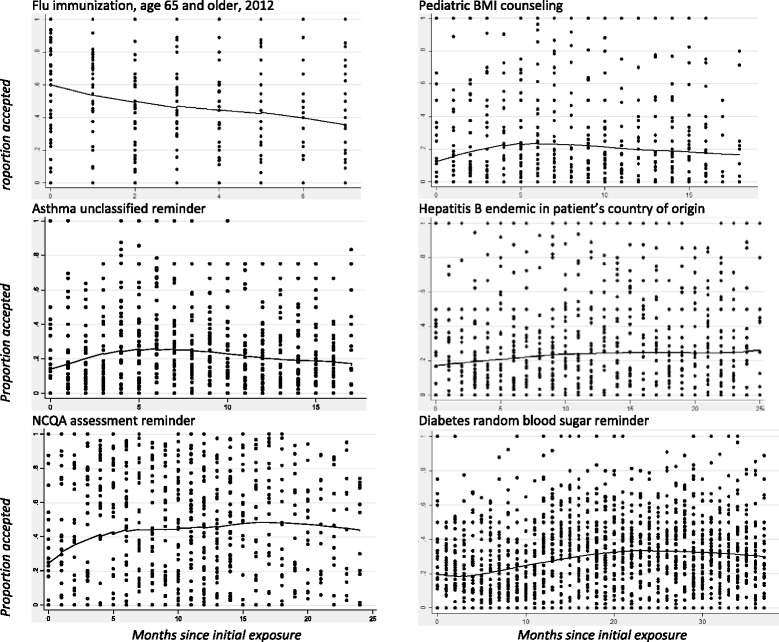
- No desensitization pattern was found: among 6 newly deployed BPAs, only 1 showed an early peak followed by decline (slopes +0.16 to −0.34; p = .03 to .24), likely due to flu seasonality; the others had no clear temporal pattern.
- Nurse practitioners were more than 4 times as likely as physicians to accept drug alerts (multivariable IRR 4.56, p = .002; bivariate IRR 3.97, p = .002). Repeated alerts were highly sticky: if the first BPA was overridden, 87.9% of subsequent instances were overridden; if the first was accepted, 51.9% of subsequent instances were overridden. For drug alerts, the corresponding override rates were 99.9% and 58.4%.
Methods
- Retrospective cohort using EHR data from January 2010 through June 2013 at the Institute for Family Health, including 112 ambulatory primary care clinicians (93 physicians, 19 nurse practitioners), 430,803 encounters, 99,649 patients, 1,266,325 BPAs, and 326,203 drug-drug interaction/drug-allergy interaction alerts.
- Clinician-level negative binomial models with an offset of log(number of alerts fired) and cluster-robust standard errors; predictors included clinician type, meaningful use attestation, sex, patients per year, encounters per year, alerts per encounter, patient comorbidity, percent within-patient repeats, order sets used, and labs ordered.
- Desensitization was tested on 6 newly deployed BPAs available continuously for ≥6 months and presented to ≥10 clinicians ≥5 times each; monthly acceptance rates for 46 clinicians were graphed with lowess smoothing and modeled with Poisson, zero-inflated Poisson, negative binomial, or zero-inflated negative binomial models selected by likelihood ratio and Vuong tests.
Limitations
- The paper states it was observational, used novel metrics because no validated metrics existed, and relied on a single commercial EHR with interruptive alerts, limiting generalizability. It had no DDI/DAI severity information and no manual review to distinguish appropriate from inappropriate overrides; repeats were assumed to be potentially uninformative, though relevance depends on the clinical situation.
- The paper also states that secondary EHR data lacked ambient noise, interruptions, time pressure, quality of patient-clinician interaction, and multitasking, likely biasing findings toward the null; high alert volume may have produced ceiling effects; and desensitization models used robust rather than cluster-robust errors.
- Evident from the text: drug alert acceptance was <1%, creating floor effects that weakened DDI/DAI analyses, and the clinician-level observational design cannot establish causality.
Model-written summary. Check it against the paper before relying on it.
Integrity signals
Registry
Cites
Statistics
Figures
Verification
Claims the paper makes
11 Valid · 0 Not valid · 17 Not checked · 46 Own results and interpretations
Every source the paper cites for this claim was checked and supports it.
In the paper
“In practice, however, 49–96% of alerts are overridden [7], raising questions about the effectiveness of decision support.”
§ Effects of workload, work complexity, and repeated alerts on alert fatigue in a clinical decision support system > Background
What the sources say
- Supportedcites [7] van der Sijs H Aarts J Vulto A Berg M Overriding of drug safety alerts in computerized physician order entry J Am Med Inform Assoc 2006 13 2 138 147 10.1197/jamia.M1809 16357358 PMC1447540 source
The Results section states that drug safety alerts are overridden in 49% to 96% of cases. It notes an exception: serious overdose alerts were overridden in about one fourth of cases. (LLM, conf=0.93)
plain- Asserted: passes — The authors put it forward as true.
- Checkable: passes — It can be checked against evidence.
- Load-bearing: passes — The paper’s conclusions depend on it.
- Based: passes — The paper gives a reason why it holds.
- Supported
The cited sources support only part of this claim — read each source’s verdict below.
In the paper
“This was because a substantial body of work [7, 8, 32, 33] suggests that repeated CDSS alerts are less likely to be informative (that is, they are often equivalent to false alarms).”
§ Effects of workload, work complexity, and repeated alerts on alert fatigue in a clinical decision support system > Methods > Cognitive overload hypotheses
What the sources say
- Partly supportedcites [7] van der Sijs H Aarts J Vulto A Berg M Overriding of drug safety alerts in computerized physician order entry J Am Med Inform Assoc 2006 13 2 138 147 10.1197/jamia.M1809 16357358 PMC1447540 sourceExperimental — accuracy not yet measured
The Results describe many alerts as irrelevant or false positive and recommend preventing some repeat alerts, including interaction alerts previously found not to cause problems for a particular patient. But the paper does not establish that repeated alerts generally become less informative or are often false alarms; it also cautions that an alert a clinician already knows can still flag a potentially unsafe situation. Page numbers were not available in our copy. (LLM, conf=0.82)
- Partly supportedcites [8] Hsieh TC Kuperman GJ Jaggi T Characteristics and consequences of drug allergy alert overrides in a computerized physician order entry system J Am Med Inform Assoc 2004 11 6 482 491 10.1197/jamia.M1556 15298998 PMC524628 sourceExperimental — accuracy not yet measured
The Abstract (page not specified) describes redundant drug-allergy alerts from repeated prescription renewals and alerts with low predictive value. The Discussion (page not specified) says frequent false alerts can obscure important warnings. The paper does not establish that repeated CDSS alerts generally are less informative or that repetition itself makes an alert a false alarm. (LLM, conf=0.84)
- Partly supportedcites [32] Stultz JS Nahata MC Appropriateness of commercially available and partially customized medication dosing alerts among pediatric patients J Am Med Inform Assoc 2014 21 e1 e35 e42 10.1136/amiajnl-2013-001725 23813540 PMC3957387 sourceExperimental — accuracy not yet measured
The Discussion (page unavailable) reports that most pediatric dosing alerts studied were inappropriate and that excessive inappropriate alerting may contribute to alert fatigue. This supports the concern that many alerts are uninformative, but the paper does not establish that an alert becomes less informative when repeated. (LLM, conf=0.83)
- Not checked — no full text of the sourcecites [33] Feldman PH McDonald MV Exploring the utility of automated drug alerts in home health care J Healthc Qual 2006 28 1 29 40 10.1111/j.1945-1474.2006.tb00592.x 16681298 source
hedgedstates an association- Asserted: passes — The authors put it forward as true.
- Checkable: passes — It can be checked against evidence.
- Load-bearing: passes — The paper’s conclusions depend on it.
- Based: passes — The paper gives a reason why it holds.
- Partly supported
The cited sources support only part of this claim — read each source’s verdict below.
In the paper
“One study supporting the desensitization explanation showed that response to clinical trial recruiting alerts in the EHR declined by approximately 2.7% per week, falling from about 50% to about 35% over 36 weeks [19].”
§ Effects of workload, work complexity, and repeated alerts on alert fatigue in a clinical decision support system > Background
What the sources say
- Partly supportedcites [19] Embi PJ Leonard AC Evaluating alert fatigue over time to EHR-based clinical trial alerts: findings from a randomized controlled study J Am Med Inform Assoc 2012 19 e1 e145 e148 10.1136/amiajnl-2011-000743 22534081 PMC3392862 sourceExperimental — accuracy not yet measured
The Results (page not provided) report that responses to EHR-based clinical trial alerts fell from about 50% initially to 35% at week 36. The reported decline was 2.7% per two-week period, not per week as the citing sentence states. (LLM, conf=0.92)
plainstates an association- Asserted: passes — The authors put it forward as true.
- Checkable: passes — It can be checked against evidence.
- Load-bearing: unclear — It is unclear whether the paper’s conclusions depend on it.
- Based: passes — The paper gives a reason why it holds.
- Partly supported
Every source the paper cites for this claim was checked and supports it.
In the paper
“a retrospective chart review in which expert reviewers identified inappropriate DDI overrides found the only factor associated with inappropriate overrides to be number of noncritical alerts received at the same time [23].”
§ Effects of workload, work complexity, and repeated alerts on alert fatigue in a clinical decision support system > Discussion
What the sources say
- Supportedcites [23] Miller AM Boro MS Korman NE Davoren JB Provider and pharmacist responses to warfarin drug–drug interaction alerts: a study of healthcare downstream of CPOE alerts J Am Med Inform Assoc 2011 18 Suppl 1 i45 i50 10.1136/amiajnl-2011-000262 22037888 PMC3241165 source
The Data categorization section says raters classified override responses as appropriate or inappropriate, and the paper describes the study as a retrospective chart review. The Results section reports that the number of simultaneous non-critical alerts was the only factor associated with an inappropriate provider response, including in multivariate analysis. This finding concerns critical DDI alerts involving warfarin. (LLM, conf=0.91)
plainstates an association- Asserted: passes — The authors put it forward as true.
- Checkable: passes — It can be checked against evidence.
- Load-bearing: unclear — It is unclear whether the paper’s conclusions depend on it.
- Based: passes — The paper gives a reason why it holds.
- Supported
A result the paper reports from its own data — it cites no other source for it, so there is none to check. The quote shows it is in the paper.
In the paper
“With every additional BPA per encounter, the likelihood a clinician would accept any BPA dropped by 30% (IRR = 0.70; p < .001; Table 2).”
§ Effects of workload, work complexity, and repeated alerts on alert fatigue in a clinical decision support system > Results > Cognitive overload hypothesis
plainstates a cause- Asserted: passes — The authors put it forward as true.
- Checkable: passes — It can be checked against evidence.
- Load-bearing: passes — The paper’s conclusions depend on it.
- Based: passes — The paper gives a reason why it holds.
29 more claims
Create a free account to see all 74 claims and to verify the 3 references still open.
- Probably not a substantial claim. 27
- It may state two separate claims as one. 14
- The quote only partly states this claim. 2
Claims other papers make about this one
Each is checked against this paper’s own text: does it say what the citing paper says it does?
The source backs part of the claim, not all of it — or backs it for a different population, condition or comparison.
In the citing paper
“Complementary work on alert fatigue and automation bias shows that clinician interaction with decision support systems can recursively influence both inputs and outcomes, creating feedback loops that invalidate original performance assumptions [19,20].”
From Validation is not enough: Longitudinal evidence of post-deployment fragility in clinical AI systems (2026) · cites this paper as [20]
Experimental — accuracy not yet measuredIn the citing paper
“In this framework, environmental factors (interruptions), along with the factors of task demand (task time, task difficulty) [19], technology (system usability) [20] and individual characteristics (professional competency, self-efficacy and mood), are the key variables that influence psychophysiological responses, workload modification and performance in human–machine interaction tasks [21].”
From Workflow interruption and nurses’ mental workload in electronic health record tasks: An observational study (2023) · cites this paper as [19]
Self-check
Percentages, sums and reported differences re-computed from the paper’s own numbers.
Each contradiction between two passages listed here was confirmed by an independent check.
Rated minor: it would not touch a result — a value no result rests on, a p-value that stays on the same side of the significance level, or a conflict that is clerical, resolved elsewhere in the paper, or outside its own findings.
In the paper
“Under time constraints, 8 of 211 alerts (13%) were handled incorrectly because of skill-based errors”
§ Effects of workload, work complexity, and repeated alerts on alert fatigue in a clinical decision support system > Discussion
Reported 13 · recomputed 3.791469
Rated minor: it would not touch a result — a value no result rests on, a p-value that stays on the same side of the significance level, or a conflict that is clerical, resolved elsewhere in the paper, or outside its own findings.
In the paper
§ Effects of workload, work complexity, and repeated alerts on alert fatigue in a clinical decision support system > Abstract > Results
“On average, one-quarter of drug alerts received by a primary care clinician, and one-third of clinical reminders, were repeats for the same patient within the same year.”
§ Effects of workload, work complexity, and repeated alerts on alert fatigue in a clinical decision support system > Results
“More than a quarter of BPAs were repeats for the same clinician for the same patient within the same year (median 26.2% per clinician; interquartile range [IQR] 16.5% to 35.1%). Similarly, of all DDI/DAI received by a clinician, almost 1/3 represented repeats for the same patient within the same year (median 31.8% per clinician; IQR 25.6% to 38.2%).”
Citations
Cites
(1967) · Project Euclid (Cornell University) · Cited by 4,720
Proceedings of the fifth Berkeley symposium on mathematical statistics and probability.
Kojima, K.-I. (1969) · Europe PMC (PubMed Central) · Cited by 3,648
Regression standard errors in clustered samples
Rogers, W. H. (1993) · Stata technical bulletin · Cited by 2,694
Bates, D. W. (1998) · JAMA · doi:10.1001/jama.280.15.1311 · Cited by 2,107
The “Meaningful Use” Regulation for Electronic Health Records
Blumenthal, D., & Tavenner, M. (2010) · New England Journal of Medicine · doi:10.1056/nejmp1006114 · Cited by 2,059 · cited 1×
“As a result of this promising history, as well as the federal EHR incentive program (the “meaningful use” program) [4], contemporary EHR products routinely integrate eprescribing with CDSS.”
BackgroundAmerican Academy of Family Physicians
(1966) · New England Journal of Medicine · doi:10.1056/nejm196611172752014 · Cited by 1,948
Ash, J. S. (2003) · Journal of the American Medical Informatics Association · doi:10.1197/jamia.m1471 · Cited by 1,789
Proceedings of the Human Factors and Ergonomics Society 54th Annual Meeting
Kluge, A., Badura, B., Urbas, L., & Burkolter, D. (2010) · Cited by 1,127
Overriding of Drug Safety Alerts in Computerized Physician Order Entry
van der Sijs, H., Aarts, J., Vulto, A., & Berg, M. (2006) · Journal of the American Medical Informatics Association · doi:10.1197/jamia.m1809 · Cited by 1,117 · cited 5×
“We considered alerts that were repeated the same year as potentially uninformative, following the work of previous researchers who have identified repeated alerts as duplicative and likely to have low relevance [7, 8, 32, 33].”
BackgroundInfluential(2003) · Cited by 969
Cited by
Items 301–400 of 668
Curtis, C. A., Nguyen, M. U., Rathnasekara, G. K., Manderson, R. J., Chong, M. Y., Malawaraarachchi, J. K., Song, Z., Kanumuri, P., Potenzi, B., & Lim, A. K. H. (2021) · Internal Medicine Journal · doi:10.1111/imj.15543 · Cited by 7
Willis, S. J., Elder, H. R., Cocoros, N. M., Callahan, M., Hsu, K., & Klompas, M. (2021) · Open Forum Infectious Diseases · doi:10.1093/ofid/ofab574 · Cited by 5
“Soliciting feedback from providers about the medical or social complexity of patients who have positive chlamydia results and the frequency of alerts may help overcome alert fatigue associated with BPAs as well [23].”
BackgroundSmith, C. F., Duncombe, S., Fleming, S., Hirst, Y., Black, G. B., Bankhead, C. R., & Nicholson, B. D. (2023) · BJGP Open · doi:10.3399/bjgpo.2022.0163 · Cited by 6
“However, like previous research (27, 28, 34), we were also told that higher volumes of tasks and alerts leads to clinicians ignoring them, and heard calls to simplify, automate, and “stop the pop” i.”
BackgroundResultUtilizing Technology to Manage Symptoms
Oldenmenger, W. H., van den Hurk, C. J. G., & Howell, D. (2020) · Springer eBooks · doi:10.1007/978-3-030-60697-8_5 · Cited by 5
Drug Alert Experience and Salience during Medical Residency at Two Healthcare Institutions
Gadhiya, K. P., Zamora, E., Saiyed, S. M., Friedlander, D., & Kaelber, D. C. (2021) · Applied Clinical Informatics · doi:10.1055/s-0041-1729167 · Cited by 6
Findings from the 2018 Yearbook Section on Human Factors and Organizational Issues
Sylvia Pelayo, A., Viitanen, J., & Issues, S. E. F. T. I. Y. S. O. H. F. A. O. (2018) · Yearbook of Medical Informatics · doi:10.1055/s-0038-1667074 · Cited by 5
“[2] conducted a well-done hypothesis-driven study.”
The Impact of Healthcare IT on Clinical Quality, Productivity and Workers
Bronsoler, A., Doyle, J. J., & Reenen, J. M. V. (2021) · National Bureau of Economic Research · doi:10.3386/w29218 · Cited by 5
Lipschuetz, M., & Topaz, M. (2026) · International Journal of Nursing Studies · doi:10.1016/j.ijnurstu.2026.105369 · Cited by 9
Next-Generation Clinical Health Leveraging Intelligent Systems and IoT for Better Care
Raja, R. V., Joel, M. R., Kumar, V. V., NagaLakshmi, B., Krishnan, S., & Ishwarya, K. (2024) · Advances in medical technologies and clinical practice book series · doi:10.4018/979-8-3693-8990-4.ch009 · Cited by 4
Blackley, S. V., Lo, Y.-C., Varghese, S., CHANG, F. Y., James, O. D., Seger, D. L., Blumenthal, K. G., Goss, F. R., & Zhou, L. (2025) · Journal of the American Medical Informatics Association · doi:10.1093/jamia/ocaf022 · Cited by 4
AI-DRIVEN CLINICAL DECISION SUPPORT: ENHANCING CARE QUALITY THROUGH EHR-INTEGRATED INTELLIGENCE
Sr. Lead Architect Specialist | Sr. Solutions Architect State Compensation Insurance Fund Pleasanton, C. 9., & Sargam, G. S. (2025) · International Journal of Advanced Research in Computer Science · doi:10.26483/ijarcs.v16i3.7262 · Cited by 5
Wigger, G. W., Zafar, M. A., & Elwing, J. (2020) · Journal of Scleroderma and Related Disorders · doi:10.1177/2397198320913686 · Cited by 4
Chidambaram, V., Jones, J. M., Lokhandwala, P. M., et al. (2021) · Transfusion · doi:10.1111/trf.16547 · Cited by 4
“Lack of systematic use of this prompt, “alert fatigue” and decisions to override such reminders impede successful implementation of this EMR-based strategy.(14) This study raises several issues related to HBV testing and vaccination.”
BackgroundElectronic Medical Records for (Visceral) Medicine: An Overview of the Current Status and Prospects
Kernebeck, S., Busse, T. S., Jux, C., Bork, U., & Ehlers, J. P. (2021) · Visceral Medicine · doi:10.1159/000519254 · Cited by 4
Acceptance of Acute Kidney Injury Alert by Providers in Cardiac Surgery Intensive Care Unit
Nevin, C., Shawwa, K., Pincavitch, J. D., Neely, R. L., Goodwin, D., McCarthy, P. J., Mohamed, N. M., Mullett, C. J., Smith, G. S., Kellum, J. A., et al. (2022) · Applied Clinical Informatics · doi:10.1055/a-2000-7499 · Cited by 6
Imlawi, J. M. (2023) · International Journal of Online and Biomedical Engineering (iJOE) · doi:10.3991/ijoe.v19i02.37239 · Cited by 7
Dashboarding to Monitor Machine-Learning-Based Clinical Decision Support Interventions
Hekman, D. J., Barton, H. J., Maru, A., Wills, G. J., Cochran, A. L., Fritsch, C., Wiegmann, D. A., Liao, F., & Patterson, B. W. (2023) · Applied Clinical Informatics · doi:10.1055/a-2219-5175 · Cited by 6
Stevens, E. R., Xu, L., Kwon, J., Tasneem, S., Henning, N., Feldthouse, D. M., Kim, E. J., Hess, R., Dauber-Decker, K. L., Smith, P. D., et al. (2024) · JMIR Formative Research · doi:10.2196/54996 · Cited by 4
“Due to these limitations associated with the physician-driven iCPR implementation model, such as “alert fatigue” and time constraints [21,22], the iCPR intervention was adapted so antibiotic stewardship tasks could be delegated to other qualified members of the medical team.”
MethodRole of Artificial Intelligence in Clinical and Hospital Pharmacy
Sridhar, S. B., Karattuthodi, M. S., & Parakkal, S. A. (2024) · Nutritional neurosciences · doi:10.1007/978-981-97-2577-9_12 · Cited by 17
Kim, K., Faruque, S. C., Kulp, D., Lam, S., Sperling, L. S., & Eapen, D. J. (2024) · American Journal of Preventive Cardiology · doi:10.1016/j.ajpc.2024.100710 · Cited by 4
“One of the primary aims of this build was to create an actionable, visible practice recommendation that would not rely on disruptive Best Practice Alerts (BPAs), which are commonly ignored, over-ridden, and contribute to alert fatigue [11,12].”
BackgroundA critical review of clinician-directed nudges
Last, B. S., Beidas, R. S., Hoskins, K., Waller, C. R., & Khazanov, G. K. (2024) · Current Opinion in Psychology · doi:10.1016/j.copsyc.2024.101856 · Cited by 5
Sowan, A. K., Leibas, M., Tarriela, A., & Reed, C. C. (2018) · JMIR Human Factors · doi:10.2196/11846 · Cited by 4
“Although the integration of CPGs’ recommendations into an EHR is complex and multifaceted, in many cases and based on end users’ perspectives, poor adherence to automated CPGs is attributed to poor usability of the IT system [17-21].”
BackgroundLimiting the Number of Open Records in an Electronic Health Record
Su, C. T. (2019) · JAMA · doi:10.1001/jama.2019.11493 · Cited by 4
Morquin, D. (2020) · La Revue de Médecine Interne · doi:10.1016/j.revmed.2020.03.011 · Cited by 5
Comparison of referral methods into a smoking cessation program
Davis, J. M., Thomas, L. C., Dirkes, J., Datta, S., & Dennis, P. A. (2020) · Journal of Comparative Effectiveness Research · doi:10.2217/cer-2020-0004 · Cited by 5
Poly, T. N., Islam, M. M., & Li, Y. (2022) · Studies in health technology and informatics · doi:10.3233/shti220089 · Cited by 8
Davidson, L. F., Martin, V. S., & Faro, E. Z. (2022) · Journal of Pediatric Nursing · doi:10.1016/j.pedn.2022.06.007 · Cited by 5
A population‐based, electronic health record‐guided approach to improve the quality of dementia care
Reuben, D. B., Rosenstein, H. L., Chen, K., Pillai, A., Lee, D. R., Meshkat, S. D., & Chen, G. I. (2022) · Journal of the American Geriatrics Society · doi:10.1111/jgs.18193 · Cited by 4
Lukac, P. J., Bell, D. S., Sreedharan, P., GORNBEIN, J. A., & Lerner, C. F. (2023) · Applied Clinical Informatics · doi:10.1055/a-2011-8167 · Cited by 4
Kumar, A., Patel, P., Robert, D., Kumar, S., Khetani, A., Reddy, B., & Srivastava, A. (2023) · BJR|Open · doi:10.1093/bjro/tzae029 · Cited by 11
“32 ,33 There are several limitations for our service evaluation.”
BackgroundRenalViz: Visual analysis of cohorts with chronic kidney disease
Höhn, M., Schwindt-Drews, S., Hahn, S., et al. (2024) · Computers & Graphics · doi:10.1016/j.cag.2024.104120 · Cited by 4
Physician Well-being and the Future of Health Information Technology
Koon, S. (2021) · Mayo Clinic Proceedings Innovations Quality & Outcomes · doi:10.1016/j.mayocpiqo.2021.06.001 · Cited by 8
Chien, S.-C., Chin, Y.-P., Yoon, C.-H., Chen, C.-Y., Hsu, C.-K., Chien, C., & Li, Y. (2021) · Applied Sciences · doi:10.3390/app112412004 · Cited by 4
“One indication of alert fatigue is when clini‐ cians spend less time per alert, sometimes going as far as not reading the alert at all [33].”
BackgroundDavies, D. (2018) · Australian Journal of Primary Health · doi:10.1071/py17164 · Cited by 4
Exploring the Content of the Nurse-to-Nurse Change of Shift Hand-off Communication
Galatzan, B. J. (2019) · UA Campus Repository (The University of Arizona) · Cited by 6
Sharman, S. J., Danby, M. C., & Gray, A. D. (2023) · Memory · doi:10.1080/09658211.2023.2294692 · Cited by 5
“Indeed, research has shown that smokers become desensitised to the health warnings on cigarette packets (Drovandi et al., 2018) and that critical care works become desensitised to alerts in their environment (Ancker et al., 2017).”
BackgroundMinick, K. I., Krueger, A., Millward, A., Veale, K., Kamerath, J. H., Woodfield, D., Cook, P., Fowles, T. R., Bledsoe, J. R., Balls, A., et al. (2024) · The American Journal of Emergency Medicine · doi:10.1016/j.ajem.2024.11.042 · Cited by 3
Picco, L., Xia, T., Laing, R., Grist, E., Dostal, J., & Nielsen, S. (2025) · Drug and Alcohol Review · doi:10.1111/dar.14009 · Cited by 3
“For example, Victoria ’ s PDMP has been in operation longer and therefore pharmacists may experience possible alert fatigue, paying less attention or placing less emphasis on PDMP alerts [38].”
Luo, D., Ye, X., Zhao, H., et al. (2025) · International Journal of Medical Informatics · doi:10.1016/j.ijmedinf.2025.105960 · Cited by 3
Cheong, S. C., So, S. L., Lal, A., & Coveliers-Munzi, J. (2025) · Frontiers in Pediatrics · doi:10.3389/fped.2025.1581578 · Cited by 4
Risk prediction models for delirium in ICU patients: a systematic review and critical appraisal
Chen, W., Ding, L., Sha, Y., Lü, G., Qian, K., Wang, B., & Wang, H. (2025) · BMC Anesthesiology · doi:10.1186/s12871-025-03562-5 · Cited by 6
“Traditional regression models are intuitively understandable, whereas many machine learning models function as “black boxes,” providing accurate predictions but limited insight [55], which represents a significant barrier to clinical adoption [56].”
Wi, C.-I., Overgaard, S. M., Malik, M., Watson, D., Sharma, D., Le‐Rademacher, J. G., Kelleher, D. P., Zheng, L., Ohde, J. W., Lynch, B., et al. (2026) · Journal of the National Medical Association · doi:10.1016/j.jnma.2026.04.001 · Cited by 7
Hadidi, S. E., Bazan, N. S., Byrne, S., Darweesh, E. A. G., & Bermingham, M. (2022) · Future Journal of Pharmaceutical Sciences · doi:10.1186/s43094-022-00429-1 · Cited by 3
“While such interventions may be effective [33], it has been shown that multiple and repetitive electronic interventions can lead to a risk of alert fatigue and the prescriber may be less likely to accept the suggested interventions due to desensitisation or cognitive overload [34].”
BackgroundMa, J. E., Lowe, J., Berkowitz, C. M., Kim, A., Togo, I., Musser, R. C., Fischer, J. E., Shah, K., Ibrahim, S., Bosworth, H. B., et al. (2023) · Journal of Medical Internet Research · doi:10.2196/41884 · Cited by 4
Segar, M. W., Patel, K. V., Keshvani, N., Kannan, V., Willett, D. L., Klonoff, D. C., & Pandey, A. (2024) · Journal of Diabetes Science and Technology · doi:10.1177/19322968241264747 · Cited by 4
“27,28 This issue underscores the need for more refined alert systems that minimize unnecessary interruptions while providing clinically relevant and timely information.”
Sugimoto, K., Wada, S., Konishi, S., Sato, J., Okada, K., Kido, S., Tomiyama, N., Matsumura, Y., & Takeda, T. (2025) · Journal of Imaging Informatics in Medicine · doi:10.1007/s10278-024-01338-w · Cited by 4
“A beneficial clinical decision support system should adjust notification frequencies to reduce alert fatigue and alert overrides [25–27].”
Brand, L., Mitrov‐Winkelmolen, L., Kuijper, T. M., et al. (2025) · BMC Medical Informatics and Decision Making · doi:10.1186/s12911-025-02963-3 · Cited by 3
“Excess alerts, as described in literature, ranges from approximately 20% up to 80% [22, 24, 40].”
Raven, K., Zhang, J., Vagliano, I., Jaspers, M., Peute, L., & Medlock, S. K. (2025) · International Journal of Medical Informatics · doi:10.1016/j.ijmedinf.2025.106011 · Cited by 5
Morales, F. L., Xu, F., Lee, H. A., Navarro, H. T., Bechel, M. A., Cameron, E. L., Kelso, J., Weiss, C. H., & Amaral, L. A. N. (2025) · Nature Communications · doi:10.1038/s41467-025-61418-5 · Cited by 3
“However,over-recognitioncarriesrisks, such as unnecessary treatments (e.g. placing a non-ARDS patient in prone position or treating a non-ARDS patient with low tidal volume ventilation or neuromuscular blockade 20,21 ) or alert fatigue 22 – 24 .”
Engaging physicians to prescribe more cost-effectively: Blueprint for change.
Gorfinkel, I. S., Brown, A., & Lexchin, J. (2020) · PubMed · Cited by 3
Pengukuran tingkat kelelahan kerja teller bank menggunakan Bourdon Wiersma test
Mariawati, A. S., Herlina, L., Fitriyani, A., & Umyati, A. (2022) · Journal Industrial Servicess · doi:10.36055/jiss.v7i2.14432 · Cited by 3
“Kelelahan pada pekerja dapat berdampak terhadap penurunan performansi dan produktivitas kerja serta penurunan konsentrasi kerja [20], [21].”
BackgroundChen, R., Kuo, B. L., Kalur, A., Muste, J. C., Deal, C. L., & Singh, R. P. (2022) · Ophthalmic surgery, lasers & imaging retina · doi:10.3928/23258160-20220601-02 · Cited by 3
Management Opportunities and Challenges After Achieving Widespread Health System Digitization
Cross, D. A., Adler‐Milstein, J., & Holmgren, A. J. (2022) · Emerald Group Publishing Limited eBooks · doi:10.1108/s1474-823120220000021004 · Cited by 5
Clinician interest in clinical decision support for PSA-based prostate cancer screening
Harper, J., Hunt, T. C., Choudry, M. M., Kapron, A. L., Cooney, K. A., Martin, C., Ambrose, J. P., & O'Neil, B. B. (2023) · Urologic Oncology Seminars and Original Investigations · doi:10.1016/j.urolonc.2022.11.015 · Cited by 6
Clinician Perspectives on Clinical Decision Support for Familial Hypercholesterolemia
Bangash, H., Elsekaily, O., Saadatagah, S., Sutton, J. A., Johnsen, P. J., Gundelach, J. H., Kamzabek, A., Freimuth, R. R., Caraballo, P. J., & Kullo, I. J. (2023) · Journal of Personalized Medicine · doi:10.3390/jpm13060929 · Cited by 4
Nguyen, P., Schiaffino, M. K., Zhang, Z., Choi, H. W., & Huh, J. (2023) · JAMIA Open · doi:10.1093/jamiaopen/ooad061 · Cited by 3
Qualitative analysis of a remote monitoring intervention for managing heart failure
Klaiman, T. A., Iannotte, L. G., Josephs, M., Russell, L. B., Norton, L. A., Mehta, S. J., Troxel, A. B., Zhu, J., Volpp, K. G. M., & Asch, D. A. (2023) · BMC Cardiovascular Disorders · doi:10.1186/s12872-023-03456-9 · Cited by 4
“Other studies have found that alert fatigue reduces physician responses over time [11, 12] which may have influenced the number of alerts that were addressed.”
BackgroundImpact of Visit Volume on the Effectiveness of Electronic Tools to Improve Heart Failure Care
Mukhopadhyay, A., Reynolds, H. R., King, W. C., Phillips, L. M., Nagler, A. R., Szerencsy, A. C., Saxena, A., Klapheke, N., Katz, S. D., Horwitz, L. I., et al. (2023) · JACC Heart Failure · doi:10.1016/j.jchf.2023.11.002 · Cited by 3
Clinical decision support to improve CBC and differential ordering
Mahowald, G. K., Lewandrowski, K. B., & Dighe, A. S. (2024) · American Journal of Clinical Pathology · doi:10.1093/ajcp/aqae024 · Cited by 3
Utilizing electronic medical records alert to improve documentation of neonatal acute kidney injury
Nada, A., & Bagwell, A. (2024) · Pediatric Nephrology · doi:10.1007/s00467-024-06352-2 · Cited by 5
Yarahuan, J. K., Kandaswamy, S., Ray, E., Leroux, R., Liang, W. H., Orenstein, E. W., & Stokes, C. L. (2025) · Applied Clinical Informatics · doi:10.1055/a-2540-2349 · Cited by 3
Lee, A. H.-Y., Aaronson, E. L., Hibbert, K. A., Flynn, M. H., Rutkey, H., Mort, E. A., Sonis, J. D., & Safavi, K. C. (2021) · Journal of Medical Internet Research · doi:10.2196/26946 · Cited by 7
“The focus of this study is on alert fatigue, as recent articles have shown that an increase in the number of alerts decreases the provider’s acceptance rate [20] and many alerts in the EHR may not directly change clinical care [21].”
BackgroundStakeholder Perspectives on an Inpatient Hypoglycemia Informatics Alert: Mixed Methods Study
Mathioudakis, N. N., Aboabdo, M., Abusamaan, M. S., Yuan, C. T., Lewis-Boyér, L., Pilla, S. J., Johnson, E. N., Desai, S. V., Knight, A. M., Greene, P. S., et al. (2021) · JMIR Human Factors · doi:10.2196/31214 · Cited by 5
“Absolute incremental improvements in clinical processes or outcomes were demonstrated for CDSS that offered the ability to execute the desired action, and a trend toward improvement was shown for those that allowed for acknowledgment, were behavior-targeted, embedded in the EMR, and interrupted [14].”
BackgroundInfluentialHabib, A. R., & Lo, N. C. (2022) · BMJ · doi:10.1136/bmj.o354 · Cited by 3
Joshi, P., Navaneethan, S. D., & Estrella, M. M. (2022) · Kidney Medicine · doi:10.1016/j.xkme.2022.100497 · Cited by 3
“display was noninterruptive, prior studies indicate that both repeated alerts and a higher volume of alerts can increase alert fatigue.(10) Third, the informational presentations on the CDS tool were likely insufficient to overcome the primary care providers’ unfamiliarity with the KFRE.”
BackgroundHarmon, E., Blackwell, J., Pan, J. A., Miller, M., Laja, O., Brock, L., Adams, J., Dunn, S. P., Voss, J. D., & Mehta, N. K. (2020) · The American Journal of Cardiology · doi:10.1016/j.amjcard.2020.09.051 · Cited by 3
Bugs in the Virtual Clinic: Confronting Telemedicine’s Challenges Through Empathy and Support
Crotty, B. H., & Somai, M. M. (2022) · Journal of Participatory Medicine · doi:10.2196/25688 · Cited by 5
“Although EHR implementations were a prerequisite for digital care, they created their own problems: they have been associated with increasing clinicians’ workloads and physician burnout [15], were not easily interoperable with one another [16], contributed to increasing health care costs [17], became more complex over…”
BackgroundWhat Is Artificial Intelligence?
Quinn, C. E. (2025) · Springer eBooks · doi:10.1007/978-3-032-01613-3_1 · Cited by 3
Explainable Health Risk Predictor with Transformer-based Medicare Claim EncoderPreprint
Lahlou, C., Crayton, A., Trier, C., & Willett, E. (2021) · arXiv (Cornell University) · doi:10.48550/arxiv.2105.09428 · Cited by 12
“The filtered representations were down-sampled to contain key attributes selected by clinical experts 3 .”
MethodPatients want to talk about their out‐of‐pocket costs—Can real‐time benefit tools help?
Sloan, C. E., & Ubel, P. A. (2023) · Journal of the American Geriatrics Society · doi:10.1111/jgs.18342 · Cited by 3
“Clinicians have expressed concern that RTBT alerts may interrupt their workflow too much or at inappropriate times, decreasing their utility and causing alert fatigue.(15,20) As the main users and beneficiaries of RTBTs, patients and clinicians should have a seat at the table when health systems decide what informatio…”
BackgroundValidation is not enough: Longitudinal evidence of post-deployment fragility in clinical AI systems
Kopanitsa, G. (2026) · PLOS Digital Health · doi:10.1371/journal.pdig.0001534 · Cited by 9
“Complementary work on alert fatigue and automation bias shows that clinician interaction with decision support systems can recursively influence both inputs and outcomes, creating feedback loops that invalidate original performance assumptions [19,20].”
Dutta, S., Dunham, L. N., McEvoy, D. S., Cash, R. E., Meeker, M. A., & White, B. A. (2024) · Annals of Emergency Medicine · doi:10.1016/j.annemergmed.2024.07.010 · Cited by 2
Yan, C., Shan, Y., Lu, H., Han, L., Xie, T., & Wang, W. (2024) · Nursing and Health Sciences · doi:10.1111/nhs.70006 · Cited by 3
The Elements of Style for Interruptive Electronic Health Record Alerts
Pourian, J., Blebea, C., Subramanian, C. R., Auerbach, A. D., & Khanna, R. R. (2024) · Applied Clinical Informatics · doi:10.1055/a-2508-7039 · Cited by 2
Daunt, R., Dalton, K., Curtin, D., & O’Mahony, D. (2025) · Drugs & Aging · doi:10.1007/s40266-025-01222-4 · Cited by 2
“Other considerations for electronic alert systems include grading the priority of alerts, choosing appropriate timing, avoiding excessive number of alerts and cognitive overload and ensuring that they do not undermine clinical autonomy [43, 44].”
CARE Framework for Healthcare Cybersecurity Defense: A Human-Centric Approach
Rahmany, M., & Selvi, A. (2025) · E-Health Telecommunication Systems and Networks · doi:10.4236/etsn.2025.142003 · Cited by 2
Wang, S., & Yu, L. (2025) · Langenbeck s Archives of Surgery · doi:10.1007/s00423-025-03843-0 · Cited by 4
“…years, scholars have studied CDSS for antibiotic prescriptions [ 3 ], prediction of cancer [4 ], the impact of workload, work complexity, and repeated alarms on alarm fatigue [ 5 ], pharmacological risk assessment [6 ], development and effectiveness of pressure ulcer prevention and care [7 ].”
Barlow, S. H., Chicklore, S., He, Y., Ourselin, S., Wagner, T., Barnes, A., & Cook, G. (2025) · Frontiers in Digital Health · doi:10.3389/fdgth.2025.1702082 · Cited by 3
Potential of digital technology for hypertension management: current status and future prospects
Fujiwara, T., & Kario, K. (2026) · Expert Review of Medical Devices · doi:10.1080/17434440.2026.2626018 · Cited by 2
“Large volumes of BP data generated by telemonitoring systems may strain clinical workflows and, if not properly filtered and prioritized, could reduce efficiency and increase the risk of missed clinically relevant signals [64,70,71].”
Liu, Y., John, J., Sarkar, S., Zakkar, A., Kinkopf, P., Teo, P. T., & Abazeed, M. E. (2026) · JCO Clinical Cancer Informatics · doi:10.1200/cci-25-00284 · Cited by 4
Diagnostic stewardship monitoring systems: institutional and system-level approaches
Park, K. (2026) · Critical Reviews in Clinical Laboratory Sciences · doi:10.1080/10408363.2026.2666326 · Cited by 2
Brima, Y., & Atemkeng, M. (2026) · Scientific Reports · doi:10.1038/s41598-026-56413-9 · Cited by 5
“This strategy facilitated reliable performance assessment while guarding against biased estimates due to class imbalance.”
Clej, E. E., Fizedean, C. M., Mavrea, A., Ilie, A. C., Bratu, M. L., & Marc, F. (2026) · Healthcare · doi:10.3390/healthcare14142063 · Cited by 2
“…scoring nudges, and documentation reminders may exceed the cognitive capacity required for meaningful interpretation, especially when alerts compete with bedside care, and prior work has shown that workload, work complexity, and repeated alerts together amplify the desensitization effect [4].”
Pilot study: An on-demand reminder system increases adherence of birth control pill users
Sahlman, J., Matero, H., & Kärkkäinen, H. (2018) · Clinical Obstetrics Gynecology and Reproductive Medicine · doi:10.15761/cogrm.1000217 · Cited by 3
“In clinical support systems, constant repeated alerts have been shown to cause clinicians to override the alerts [6].”
BackgroundLam, S. W., Strange, C., Brantly, M., & Stoller, J. K. (2021) · Chronic Obstructive Pulmonary Diseases Journal of the COPD Foundation · doi:10.15326/jcopdf.2021.0260 · Cited by 2
Improving Knowledge of Active Safety and QI Projects Amongst Practitioners in a Pediatric ICU
Flaherty, B. F., Hummel, K., Vijayarajah, S., White, B. R., Outsen, S., & Larsen, G. Y. (2022) · Pediatric Quality and Safety · doi:10.1097/pq9.0000000000000569 · Cited by 2
Supporting quality and safety in general practice: Response rates to computer decision support
Davies, D., Morgan, M. A. J., & de Wet, C. (2022) · Australian Journal of General Practice · doi:10.31128/ajgp-08-21-6112 · Cited by 3
Klatte, D. C. F., Clift, K. E., Macklin‐Mantia, S. K., Millares, L., Hoogenboom, S. A. M., Presutti, R. J., & Wallace, M. B. (2023) · Preventive Medicine Reports · doi:10.1016/j.pmedr.2023.102110 · Cited by 5
Alshehri, N., & Alanazi, A. (2023) · Pharmacy · doi:10.3390/pharmacy11040119 · Cited by 6
Duckro, A. N., Mueller, S. R., Kraus, C. R., Steiner, C., & Steiner, J. F. (2023) · The Permanente Journal · doi:10.7812/tpp/23.095 · Cited by 2
Jung, W., Yu, J. Y., Park, H., Chae, M. K., Lee, S. S., Choi, J. S., Kang, M., Chang, D. K., & Cha, W. C. (2023) · Scientific Reports · doi:10.1038/s41598-023-40188-4 · Cited by 2
“The aim is to fine-tune the system through step-by-step, systematic alterations to reduce inappropriate or excessive alerts, which may lessen alert fatigue experienced by physicians 4,8,12,21 .”
BackgroundSloss, E. A., Jones, T., Baker, K. M., Robins, J. L. W., & Thacker, L. R. (2023) · CIN Computers Informatics Nursing · doi:10.1097/cin.0000000000001035 · Cited by 3
Novel ways to analyse and cope alert-fatigue phenomenon in intensive care units
Rozenes, S., Fux, A., Kagan, I., Hellerman, M., Tadmor, B., & Benis, A. (2024) · ITM Web of Conferences · doi:10.1051/itmconf/20246202001 · Cited by 2
Spiegel, M. C., & Goodwin, A. J., IV (2024) · Journal of Clinical and Translational Science · doi:10.1017/cts.2024.566 · Cited by 3
Iterative Development of a Clinical Decision Support Tool to Enhance Naloxone Coprescribing
Wu, R., Foster, E., Zhang, Q., Eynatian, T., Mishuris, R. G., & Cordella, N. (2024) · Applied Clinical Informatics · doi:10.1055/a-2447-8463 · Cited by 2
Gautam, G., & Moradikor, N. (2025) · Progress in brain research · doi:10.1016/bs.pbr.2025.01.017 · Cited by 2
Tran, M., Rhee, J., Blazek, K. D., Balasooriya, C. D., & Vuong, K. (2025) · Primary Health Care Research & Development · doi:10.1017/s1463423625000143 · Cited by 2
“Such programmes also interrupt clinic workflow, with most alerts often being dismissed and contributing to ‘ alert fatigue ’ (Ancker et al. 2017).”
Joshi, M., Sivanandarajah, P., Wright, M. D., et al. (2025) · Nursing Open · doi:10.1002/nop2.70213 · Cited by 2
“Conversely, technologies that provide non-actionable data or create additional workload through excess alerts may exacerbate current challenges and further erode all staff productivity and morale (Ancker et al. 2017).”
Zhong, H., Jack, M., O’Leary, K. J., et al. (2025) · Clinical and Translational Science · doi:10.1111/cts.70193 · Cited by 2
Altinger, G., Jones, C. M. P., Ferreira, G. E., Soon, J., Hoffmann, T., Maher, C. G., Chang, J. R., Linder, J. A., & Traeger, A. C. (2025) · BMJ Quality & Safety · doi:10.1136/bmjqs-2025-018793 · Cited by 2
“19 Unlike interruptive alerts, default nudges could be seamlessly implemented within the existing order forms, minimising disruption or alert fatigue.”
Metadata
- Authors
- with the HITEC Investigators, Ancker, J. S., Edwards, A., Nosal, S., Hauser, D., Mauer, E., & Kaushal, R.
- Affiliations
- Weill Cornell Medicine (US)
- Institute for Family Health (US)
- Corresponding author
- Ancker, Jessica S.
- Venue
- BMC Medical Informatics and Decision Making
- Published
- 2017-04-10
- Volume
- 17
- Issue
- 1
- Pages
- 36-36
- ISSN
- 1472-6947 (ISSN-L)
- PMC
- PMC5387195
- OpenAlex
- W2605753964
- Cited by
- 709
- References
- 43
- Citations by year
- 2026: 160 · 2025: 87 · 2024: 76 · 2023: 82 · 2022: 90 · 2021: 74 · 2020: 73 · 2019: 38 · 2018: 26 · 2017: 2
- FWCI
- 52.24
- Type
- journal article
- Language
- en
- Update notices
- correction (2019-11-18)
- Open access
- gold
- doi.org
- Licence
- cc-by
- creativecommons.org/licenses/by/4.0/ (tdm)
- creativecommons.org/licenses/by/4.0/ (vor)
- Locations
- BMC Medical Informatics and Decision Making (publishedVersion, cc-by)
- PubMed Central (publishedVersion, cc-by)
- PubMed (publishedVersion)
- DOAJ (DOAJ: Directory of Open Access Journals) (submittedVersion, cc-by-sa)
- Funders
- New York State Department of Health (C025877)
- Agency for Healthcare Research and Quality (K01HS021531)
- Topics
- Health Sciences › Health Professions › Health Information Management › Electronic Health Records Systems
- Health Sciences › Medicine › Surgery › Healthcare Technology and Patient Monitoring
- Health Sciences › Medicine › Family Practice › Clinical Reasoning and Diagnostic Skills
- Keywords
- alarm fatigue, clinical decision support, drug alerts, alert override, cognitive overload, workload, job complexity, desensitization, nurse practitioners, primary care providers, electronic health records
- MeSH terms
- Alert Fatigue, Health Personnel, Adult, Humans, Nurse Practitioners, Retrospective Studies, Workload, Decision Support Systems, Clinical, Electronic Health Records, Physicians, Primary Care
About these checks
Registry, retraction, Cites and statistics results are computed, not judged, with one exception: a printed reference that no index lists is read once by a model before it counts as a citation error. Claims are extracted by a model and kept only when their quote appears verbatim in the text; each cited source is then checked, with a model’s help, for whether it says what the claim relies on. Those verdicts can be wrong — read the claim’s quote and the cited source before relying on one.
The claim verdicts this report counts are experimental: their accuracy is not yet measured.
A language model drew the claims from the paper on 2026-10-10, under version 3 of the claim definition (model deepseek-v4.1-flash, prompt extract-v3).
A second model labelled each claim on 2026-10-10 (model jev-1.13-20260917, definition revision gold-guideline-v0.2).
Cited sources are checked with a language model’s help (gpt-6-sol).
Statistics and arithmetic are recomputed, not judged.
Confidence bands are shown only for fields calibrated on our annotated test set. None is calibrated yet, so no band is shown.
What counts as a claim ›How we measure confidence ›How we check this ›
Are you an author, or do you see a problem with this page? Request a review
Data sources
Bibliographic data: Semantic Scholar, OpenAlex, Crossref.
Contains information from the Semantic Scholar Academic Graph Datasets, made available under the ODC Attribution License (ODC-BY 1.0).
Semantic Scholar’s data is described in: Kinney, R., et al. (2023). The Semantic Scholar Open Data Platform. arXiv:2301.10140.
