

Effects of workload, work complexity, and repeated alerts on alert fatigue in a clinical decision support system
Open accessThe DOI matches its Crossref record; 44 of the 45 references it cites were found in a registry or an index; 18 of the 56 sources its claims cite were checked for support.
Abstract
Background: Although alert fatigue is blamed for high override rates in contemporary clinical decision support systems, the concept of alert fatigue is poorly defined. We tested hypotheses arising from two possible alert fatigue mechanisms: (A) cognitive overload associated with amount of work, complexity of work, and effort distinguishing informative from uninformative alerts, and (B) desensitization from repeated exposure to the same alert over time. Methods: Retrospective cohort study using electronic health record data (both drug alerts and clinical practice reminders) from January 2010 through June 2013 from 112 ambulatory primary care clinicians. Results: On average, one-quarter of drug alerts received by a primary care clinician, and one-third of clinical reminders, were repeats for the same patient within the same year. Alert acceptance was associated with work complexity and repeated alerts, but not with the amount of work. Likelihood of reminder acceptance dropped by 30% for each additional reminder received per encounter, and by 10% for each five reminders received per day.
Overview
CoChat Summary
TL;DR
In a retrospective cohort of 112 primary care clinicians, alert acceptance fell with greater work complexity and more repeated alerts, but not with amount of workload or desensitization over time. Reducing within-patient repeat alerts may be a promising target for reducing alert fatigue.
Key findings
- Alert acceptance decreased with repeated alerts and complexity: for best-practice advisories (BPAs), each additional BPA per encounter reduced acceptance by 30% (IRR 0.70, p < .001), and each 5-percentage-point increase in repeated BPAs reduced acceptance by 10% (IRR 0.90, p < .001).
- Workload amount was not associated with acceptance: patients per year and encounters per year were not significant predictors. Patient comorbidity was associated with lower BPA acceptance in bivariate analysis (IRR 0.27, p = .008) but narrowly lost significance in the multivariable model (IRR 0.49, p = .06).
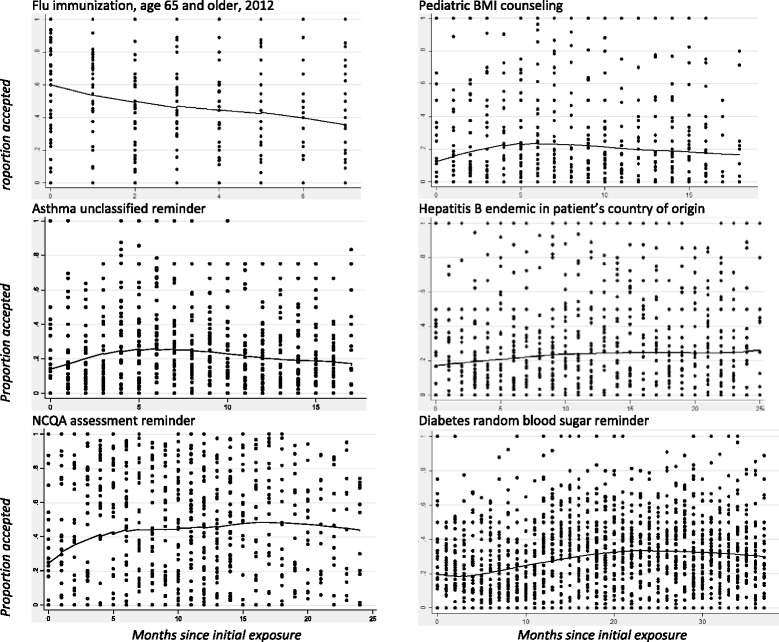
- No desensitization pattern was found: among 6 newly deployed BPAs, only 1 showed an early peak followed by decline (slopes +0.16 to −0.34; p = .03 to .24), likely due to flu seasonality; the others had no clear temporal pattern.
- Nurse practitioners were more than 4 times as likely as physicians to accept drug alerts (multivariable IRR 4.56, p = .002; bivariate IRR 3.97, p = .002). Repeated alerts were highly sticky: if the first BPA was overridden, 87.9% of subsequent instances were overridden; if the first was accepted, 51.9% of subsequent instances were overridden. For drug alerts, the corresponding override rates were 99.9% and 58.4%.
Methods
- Retrospective cohort using EHR data from January 2010 through June 2013 at the Institute for Family Health, including 112 ambulatory primary care clinicians (93 physicians, 19 nurse practitioners), 430,803 encounters, 99,649 patients, 1,266,325 BPAs, and 326,203 drug-drug interaction/drug-allergy interaction alerts.
- Clinician-level negative binomial models with an offset of log(number of alerts fired) and cluster-robust standard errors; predictors included clinician type, meaningful use attestation, sex, patients per year, encounters per year, alerts per encounter, patient comorbidity, percent within-patient repeats, order sets used, and labs ordered.
- Desensitization was tested on 6 newly deployed BPAs available continuously for ≥6 months and presented to ≥10 clinicians ≥5 times each; monthly acceptance rates for 46 clinicians were graphed with lowess smoothing and modeled with Poisson, zero-inflated Poisson, negative binomial, or zero-inflated negative binomial models selected by likelihood ratio and Vuong tests.
Limitations
- The paper states it was observational, used novel metrics because no validated metrics existed, and relied on a single commercial EHR with interruptive alerts, limiting generalizability. It had no DDI/DAI severity information and no manual review to distinguish appropriate from inappropriate overrides; repeats were assumed to be potentially uninformative, though relevance depends on the clinical situation.
- The paper also states that secondary EHR data lacked ambient noise, interruptions, time pressure, quality of patient-clinician interaction, and multitasking, likely biasing findings toward the null; high alert volume may have produced ceiling effects; and desensitization models used robust rather than cluster-robust errors.
- Evident from the text: drug alert acceptance was <1%, creating floor effects that weakened DDI/DAI analyses, and the clinician-level observational design cannot establish causality.
Model-written summary. Check it against the paper before relying on it.
Integrity signals
Registry
Cites
Statistics
Figures
Verification
Claims the paper makes
11 Valid · 0 Not valid · 17 Not checked · 46 Own results and interpretations
Every source the paper cites for this claim was checked and supports it.
In the paper
“In practice, however, 49–96% of alerts are overridden [7], raising questions about the effectiveness of decision support.”
§ Effects of workload, work complexity, and repeated alerts on alert fatigue in a clinical decision support system > Background
What the sources say
- Supportedcites [7] van der Sijs H Aarts J Vulto A Berg M Overriding of drug safety alerts in computerized physician order entry J Am Med Inform Assoc 2006 13 2 138 147 10.1197/jamia.M1809 16357358 PMC1447540 source
The Results section states that drug safety alerts are overridden in 49% to 96% of cases. It notes an exception: serious overdose alerts were overridden in about one fourth of cases. (LLM, conf=0.93)
plain- Asserted: passes — The authors put it forward as true.
- Checkable: passes — It can be checked against evidence.
- Load-bearing: passes — The paper’s conclusions depend on it.
- Based: passes — The paper gives a reason why it holds.
- Supported
The cited sources support only part of this claim — read each source’s verdict below.
In the paper
“This was because a substantial body of work [7, 8, 32, 33] suggests that repeated CDSS alerts are less likely to be informative (that is, they are often equivalent to false alarms).”
§ Effects of workload, work complexity, and repeated alerts on alert fatigue in a clinical decision support system > Methods > Cognitive overload hypotheses
What the sources say
- Partly supportedcites [7] van der Sijs H Aarts J Vulto A Berg M Overriding of drug safety alerts in computerized physician order entry J Am Med Inform Assoc 2006 13 2 138 147 10.1197/jamia.M1809 16357358 PMC1447540 sourceExperimental — accuracy not yet measured
The Results describe many alerts as irrelevant or false positive and recommend preventing some repeat alerts, including interaction alerts previously found not to cause problems for a particular patient. But the paper does not establish that repeated alerts generally become less informative or are often false alarms; it also cautions that an alert a clinician already knows can still flag a potentially unsafe situation. Page numbers were not available in our copy. (LLM, conf=0.82)
- Partly supportedcites [8] Hsieh TC Kuperman GJ Jaggi T Characteristics and consequences of drug allergy alert overrides in a computerized physician order entry system J Am Med Inform Assoc 2004 11 6 482 491 10.1197/jamia.M1556 15298998 PMC524628 sourceExperimental — accuracy not yet measured
The Abstract (page not specified) describes redundant drug-allergy alerts from repeated prescription renewals and alerts with low predictive value. The Discussion (page not specified) says frequent false alerts can obscure important warnings. The paper does not establish that repeated CDSS alerts generally are less informative or that repetition itself makes an alert a false alarm. (LLM, conf=0.84)
- Partly supportedcites [32] Stultz JS Nahata MC Appropriateness of commercially available and partially customized medication dosing alerts among pediatric patients J Am Med Inform Assoc 2014 21 e1 e35 e42 10.1136/amiajnl-2013-001725 23813540 PMC3957387 sourceExperimental — accuracy not yet measured
The Discussion (page unavailable) reports that most pediatric dosing alerts studied were inappropriate and that excessive inappropriate alerting may contribute to alert fatigue. This supports the concern that many alerts are uninformative, but the paper does not establish that an alert becomes less informative when repeated. (LLM, conf=0.83)
- Not checked — no full text of the sourcecites [33] Feldman PH McDonald MV Exploring the utility of automated drug alerts in home health care J Healthc Qual 2006 28 1 29 40 10.1111/j.1945-1474.2006.tb00592.x 16681298 source
hedgedstates an association- Asserted: passes — The authors put it forward as true.
- Checkable: passes — It can be checked against evidence.
- Load-bearing: passes — The paper’s conclusions depend on it.
- Based: passes — The paper gives a reason why it holds.
- Partly supported
The cited sources support only part of this claim — read each source’s verdict below.
In the paper
“One study supporting the desensitization explanation showed that response to clinical trial recruiting alerts in the EHR declined by approximately 2.7% per week, falling from about 50% to about 35% over 36 weeks [19].”
§ Effects of workload, work complexity, and repeated alerts on alert fatigue in a clinical decision support system > Background
What the sources say
- Partly supportedcites [19] Embi PJ Leonard AC Evaluating alert fatigue over time to EHR-based clinical trial alerts: findings from a randomized controlled study J Am Med Inform Assoc 2012 19 e1 e145 e148 10.1136/amiajnl-2011-000743 22534081 PMC3392862 sourceExperimental — accuracy not yet measured
The Results (page not provided) report that responses to EHR-based clinical trial alerts fell from about 50% initially to 35% at week 36. The reported decline was 2.7% per two-week period, not per week as the citing sentence states. (LLM, conf=0.92)
plainstates an association- Asserted: passes — The authors put it forward as true.
- Checkable: passes — It can be checked against evidence.
- Load-bearing: unclear — It is unclear whether the paper’s conclusions depend on it.
- Based: passes — The paper gives a reason why it holds.
- Partly supported
Every source the paper cites for this claim was checked and supports it.
In the paper
“a retrospective chart review in which expert reviewers identified inappropriate DDI overrides found the only factor associated with inappropriate overrides to be number of noncritical alerts received at the same time [23].”
§ Effects of workload, work complexity, and repeated alerts on alert fatigue in a clinical decision support system > Discussion
What the sources say
- Supportedcites [23] Miller AM Boro MS Korman NE Davoren JB Provider and pharmacist responses to warfarin drug–drug interaction alerts: a study of healthcare downstream of CPOE alerts J Am Med Inform Assoc 2011 18 Suppl 1 i45 i50 10.1136/amiajnl-2011-000262 22037888 PMC3241165 source
The Data categorization section says raters classified override responses as appropriate or inappropriate, and the paper describes the study as a retrospective chart review. The Results section reports that the number of simultaneous non-critical alerts was the only factor associated with an inappropriate provider response, including in multivariate analysis. This finding concerns critical DDI alerts involving warfarin. (LLM, conf=0.91)
plainstates an association- Asserted: passes — The authors put it forward as true.
- Checkable: passes — It can be checked against evidence.
- Load-bearing: unclear — It is unclear whether the paper’s conclusions depend on it.
- Based: passes — The paper gives a reason why it holds.
- Supported
A result the paper reports from its own data — it cites no other source for it, so there is none to check. The quote shows it is in the paper.
In the paper
“With every additional BPA per encounter, the likelihood a clinician would accept any BPA dropped by 30% (IRR = 0.70; p < .001; Table 2).”
§ Effects of workload, work complexity, and repeated alerts on alert fatigue in a clinical decision support system > Results > Cognitive overload hypothesis
plainstates a cause- Asserted: passes — The authors put it forward as true.
- Checkable: passes — It can be checked against evidence.
- Load-bearing: passes — The paper’s conclusions depend on it.
- Based: passes — The paper gives a reason why it holds.
29 more claims
Create a free account to see all 74 claims and to verify the 3 references still open.
- Probably not a substantial claim. 27
- It may state two separate claims as one. 14
- The quote only partly states this claim. 2
Claims other papers make about this one
Each is checked against this paper’s own text: does it say what the citing paper says it does?
The source backs part of the claim, not all of it — or backs it for a different population, condition or comparison.
In the citing paper
“Complementary work on alert fatigue and automation bias shows that clinician interaction with decision support systems can recursively influence both inputs and outcomes, creating feedback loops that invalidate original performance assumptions [19,20].”
From Validation is not enough: Longitudinal evidence of post-deployment fragility in clinical AI systems (2026) · cites this paper as [20]
Experimental — accuracy not yet measuredIn the citing paper
“In this framework, environmental factors (interruptions), along with the factors of task demand (task time, task difficulty) [19], technology (system usability) [20] and individual characteristics (professional competency, self-efficacy and mood), are the key variables that influence psychophysiological responses, workload modification and performance in human–machine interaction tasks [21].”
From Workflow interruption and nurses’ mental workload in electronic health record tasks: An observational study (2023) · cites this paper as [19]
Self-check
Percentages, sums and reported differences re-computed from the paper’s own numbers.
Each contradiction between two passages listed here was confirmed by an independent check.
Rated minor: it would not touch a result — a value no result rests on, a p-value that stays on the same side of the significance level, or a conflict that is clerical, resolved elsewhere in the paper, or outside its own findings.
In the paper
“Under time constraints, 8 of 211 alerts (13%) were handled incorrectly because of skill-based errors”
§ Effects of workload, work complexity, and repeated alerts on alert fatigue in a clinical decision support system > Discussion
Reported 13 · recomputed 3.791469
Rated minor: it would not touch a result — a value no result rests on, a p-value that stays on the same side of the significance level, or a conflict that is clerical, resolved elsewhere in the paper, or outside its own findings.
In the paper
§ Effects of workload, work complexity, and repeated alerts on alert fatigue in a clinical decision support system > Abstract > Results
“On average, one-quarter of drug alerts received by a primary care clinician, and one-third of clinical reminders, were repeats for the same patient within the same year.”
§ Effects of workload, work complexity, and repeated alerts on alert fatigue in a clinical decision support system > Results
“More than a quarter of BPAs were repeats for the same clinician for the same patient within the same year (median 26.2% per clinician; interquartile range [IQR] 16.5% to 35.1%). Similarly, of all DDI/DAI received by a clinician, almost 1/3 represented repeats for the same patient within the same year (median 31.8% per clinician; IQR 25.6% to 38.2%).”
Citations
Cites
(1967) · Project Euclid (Cornell University) · Cited by 4,720
Proceedings of the fifth Berkeley symposium on mathematical statistics and probability.
Kojima, K.-I. (1969) · Europe PMC (PubMed Central) · Cited by 3,648
Regression standard errors in clustered samples
Rogers, W. H. (1993) · Stata technical bulletin · Cited by 2,694
Bates, D. W. (1998) · JAMA · doi:10.1001/jama.280.15.1311 · Cited by 2,107
The “Meaningful Use” Regulation for Electronic Health Records
Blumenthal, D., & Tavenner, M. (2010) · New England Journal of Medicine · doi:10.1056/nejmp1006114 · Cited by 2,059 · cited 1×
“As a result of this promising history, as well as the federal EHR incentive program (the “meaningful use” program) [4], contemporary EHR products routinely integrate eprescribing with CDSS.”
BackgroundAmerican Academy of Family Physicians
(1966) · New England Journal of Medicine · doi:10.1056/nejm196611172752014 · Cited by 1,948
Ash, J. S. (2003) · Journal of the American Medical Informatics Association · doi:10.1197/jamia.m1471 · Cited by 1,789
Proceedings of the Human Factors and Ergonomics Society 54th Annual Meeting
Kluge, A., Badura, B., Urbas, L., & Burkolter, D. (2010) · Cited by 1,127
Overriding of Drug Safety Alerts in Computerized Physician Order Entry
van der Sijs, H., Aarts, J., Vulto, A., & Berg, M. (2006) · Journal of the American Medical Informatics Association · doi:10.1197/jamia.m1809 · Cited by 1,117 · cited 5×
“We considered alerts that were repeated the same year as potentially uninformative, following the work of previous researchers who have identified repeated alerts as duplicative and likely to have low relevance [7, 8, 32, 33].”
BackgroundInfluential(2003) · Cited by 969
Cited by
Items 201–300 of 668
Bangash, H., Saadatagah, S., Naderian, M., Hamed, M. E., Alhalabi, L., Sherafati, A., Sutton, J. A., Elsekaily, O., Mir, A., Gundelach, J. H., et al. (2024) · npj Digital Medicine · doi:10.1038/s41746-024-01069-w · Cited by 12
Grammatikopoulou, M., Zachariadou, M., Zande, M., Giannios, G., Chytas, A., Karanikas, H., Georgakopoulos, S. V., Karanikas, D., Nikolaidis, G., Natsiavas, P., et al. (2024) · Research in Social and Administrative Pharmacy · doi:10.1016/j.sapharm.2024.04.004 · Cited by 13
Improving fluoroquinolone use in the outpatient setting using a patient safety initiative
Jindai, K., Goto, M., MacKay, K., et al. (2018) · Infection Control and Hospital Epidemiology · doi:10.1017/ice.2018.169 · Cited by 10
Age-Dependent Hemoglobin A1c Therapeutic Targets Reduce Diabetic Medication Changes in the Elderly
McCormick, T. A., Adams, J., Lee, E. A., Emptage, N. P., Palmer-Toy, D. E., Martin, J. P., Broder, B. I., Kanter, M. H., Davis, A., & McGlynn, E. A. (2019) · eGEMs (Generating Evidence & Methods to improve patient outcomes) · doi:10.5334/egems.303 · Cited by 12
A nurse practitioner led protocol to address polypharmacy in long-term care
Bergman-Evans, B. (2020) · Geriatric Nursing · doi:10.1016/j.gerinurse.2020.07.002 · Cited by 14
“Clinicians have been found to be less likely to accept alerts as they receive more of them, particularly more repeated alerts.(36) After no change, the primary recommendation was to decrease the number or dose.”
BackgroundSepsis Prediction in Hospitalized Children: Model Development and Validation
Stephen, R. J., Carroll, M. S., Hoge, J., Maciorowski, K., Jones, R. C., Lucey, K. E., O’Connell, M., Schwab, C., Rojas, J., & Sanchez-Pinto, L. N. (2023) · Hospital Pediatrics · doi:10.1542/hpeds.2022-006964 · Cited by 10
Do Electronic Medical Records Improve Advance Directive Documentation? A Systematic Review
Lemon, C. A., de Ridder, M., & Khadra, M. H. (2018) · American Journal of Hospice and Palliative Medicine® · doi:10.1177/1049909118796191 · Cited by 11
Evaluation of Point-of-Care Decision Support for Adult Acne Treatment by Primary Care Clinicians
Li, D. G., Pournamdari, A. B., Liu, K. J., Laskowski, K. R., Joyce, C., & Mostaghimi, A. (2020) · JAMA Dermatology · doi:10.1001/jamadermatol.2020.0135 · Cited by 11
Pater, J. A., Chopra, S., Carroll, J., Zaccour, J., Nova, F. F., Toscos, T., Guha, S., & Chang, F. L. (2024) · CHI Conference on Human Factors in Computing Systems · doi:10.1145/3613904.3642827 · Cited by 11
“Simply creating additional dashboards with objective patient data is not enough [4].”
Active Choice Nudge to Increase Screening for Primary Aldosteronism in At-Risk Patients
Passman, J. E., Hwang, J., Tang, J., Fagen, M., Epps, M., Peifer, M. K., Howell, J. T., Cohen, J. B., Delgado, M. K., Wachtel, H., et al. (2024) · Journal of the American College of Surgeons · doi:10.1097/xcs.0000000000001221 · Cited by 12
What Is Fair? Defining Fairness in Machine Learning for Health
Gao, J., Chou, B., McCaw, Z. R., Thurston, H., Varghese, P., Hong, C., & Gronsbell, J. L. (2025) · Statistics in Medicine · doi:10.1002/sim.70234 · Cited by 30
“If the same computer-aided diagnosis system also has a lower positive predictive value for women aged 40-49, then clinicians may disregard its recommendations, as they are more likely to be false positives [80].”
Physician Perspectives on Implementation of Real-Time Benefit Tools: A Qualitative Study
Everson, J., Whitmore, C. C., Mattingly, T. J., Sinaiko, A. D., & Dusetzina, S. B. (2022) · Applied Clinical Informatics · doi:10.1055/a-1947-2674 · Cited by 9
Community pharmacist perceptions of drug–drug interactions
Dahri, K. M., Araujo, L., Chen, S., et al. (2022) · Canadian Pharmacists Journal / Revue des Pharmaciens du Canada · doi:10.1177/17151635221140379 · Cited by 9
“Repeated exposure to alerts can also cause desensitization and lead to alert fatigue.(7) Although many overrides are justified, they can be associated with medication errors and serious adverse events if clinically important information is inadvertently ignored.”
BackgroundKaur, D., Panos, R. J., Badawi, O., Bapat, S. S., Wang, L., & Gupta, A. D. (2020) · International Journal of Medical Informatics · doi:10.1016/j.ijmedinf.2020.104165 · Cited by 9
Niazkhani, Z., Fereidoni, M., Khazaee, P. R., Shiva, A., Makhdoomi, K., Georgiou, A., & Pirnejad, H. (2020) · BMC Medical Informatics and Decision Making · doi:10.1186/s12911-020-01196-w · Cited by 14
Leveraging the Hyperledger Fabric for Enhancing the Efficacy of Clinical Decision Support Systems
Gangula, R., Thalla, S., Ikedum, I., Okpala, C., & Sneha, S. (2021) · Blockchain in Healthcare Today · doi:10.30953/bhty.v4.154 · Cited by 9
“Furthermore, CDSS is aimed to assist providers in arriving at diagnosis by providing suggestions regarding the treatment plan (1, 8).”
BackgroundMethodInfluentialImproving timeliness of hepatitis B vaccine administration in an urban safety net level III NICU
Hayashi, M., Grover, T. R., Small, S., Staples, T., & Roosevelt, G. (2021) · BMJ Quality & Safety · doi:10.1136/bmjqs-2020-012869 · Cited by 12
Lau, L., Bagri, H., Legal, M., et al. (2021) · The Canadian Journal of Hospital Pharmacy · doi:10.4212/cjhp.v74i3.3147 · Cited by 9
Kalfsvel, L. S., Hoek, K., Bethlehem, C., van der Kuy, P. H. M., van den Broek, W. W., Versmissen, J., & van Rosse, F. (2022) · British Journal of Clinical Pharmacology · doi:10.1111/bcp.15427 · Cited by 12
“During the evaluation of the potentiality of errors to reach the patient, we assumed that EPS notifications would have led to change in the prescription, while factors such as alert fatigue causes alerts to be overridden in a real-life setting.(30) Also, the single centre study design might be a limitation.”
BackgroundWright, A. P., Embí, P. J., Nelson, S. D., Smith, J., Turchin, A., & Mize, D. L. E. (2022) · Journal of Diabetes Science and Technology · doi:10.1177/19322968221119788 · Cited by 10
“13 This can contribute to users’ dissatisfaction with the EHR, which may increase clinician burnout.”
BackgroundElectronic health record use and perceptions among urologic surgeons
Tan, H.-J., Chung, A. E., Gotz, D., Deal, A. M., Heiling, H. M., Teal, R., Vu, M. B., Meeks, W. D., Fang, R., Bennett, A. V., et al. (2023) · Applied Clinical Informatics · doi:10.1055/s-0043-1763513 · Cited by 8
Goldart, E., Else, S., Assadi, A., & Ehrmann, D. E. (2024) · Intensive Care Medicine · doi:10.1007/s00134-024-07450-3 · Cited by 15
“Therefore, we agree with others [5] that interventions to address “alarm fatigue” must go beyond limiting alarms to prevent provider desensitization.”
Chien, S.-C., Chien, C., Chen, C.-Y., Chien, P.-H., Hsu, C.-K., Yang, H., & Li, Y. (2025) · BMJ Health & Care Informatics · doi:10.1136/bmjhci-2024-101128 · Cited by 10
“This distinction should be considered when interpreting the findings, and future studies should aim to examine real-world alert usage in addition to behavioural intentions.”
Barriers to enrollment in pulmonary rehabilitation: medical knowledge analysis
Gushken, F., Degani‐Costa, L. H., Colognese, T. C. P., Rodrigues, M. T., Zanetti, M., Filho, J. L. B., & de Matos, L. D. N. J. (2021) · Einstein (São Paulo) · doi:10.31744/einstein_journal/2021ao6115 · Cited by 12
Schertz, A. R., Smith, S. A., Lenoir, K. M., & Thomas, K. W. (2023) · Journal of Emergency Medicine · doi:10.1016/j.jemermed.2023.02.025 · Cited by 11
Hassan, A. E., Ravi, S., Desai, S. K., Saei, H. M., Mckennon, E., & Tekle, W. G. (2023) · Interventional Neuroradiology · doi:10.1177/15910199231184604 · Cited by 12
“This fi nding is important as a low PPV could lead to “ alert fatigue ” 14 and likely cessation of using the tool.”
Chunga, N., Amodeo, K., Braun, M. K., Valdovinos, B. Y., & Richard, I. H. (2023) · Frontiers in Aging Neuroscience · doi:10.3389/fnagi.2023.1276761 · Cited by 8
Digital and Computational Pathology: A Specialty Reimagined
Kiehl, T. (2022) · Future of business and finance · doi:10.1007/978-3-030-99838-7_12 · Cited by 14
Samal, L., Wu, E., Aaron, S., Kilgallon, J. L., Gannon, M., McCoy, A. B., Blecker, S., Dykes, P. C., Bates, D. W., Lipsitz, S. R., et al. (2023) · Applied Clinical Informatics · doi:10.1055/s-0043-1768994 · Cited by 11
Tung, E. L., Dibble, E. H., Jindal, G., et al. (2020) · Journal of the American College of Radiology · doi:10.1016/j.jacr.2020.07.026 · Cited by 8
The future of artificial intelligence in healthcare
Radakovich, N., & Nazha, A. (2021) · Elsevier eBooks · doi:10.1016/b978-0-12-820273-9.00016-6 · Cited by 7
Agarwal, R., Sedai, A., Ankita, K., Parmar, L., Dhanya, R., Dhimal, S., Sriniwas, R., Gowda, A., Chebbi, P. G., Pushpa, H., et al. (2019) · JMIR Medical Informatics · doi:10.2196/medinform.9291 · Cited by 9
“Centers can deactivate certain alerts and only those which require action are visible to avoid alert fatigue [2,38].”
Clinical Performance Feedback and Decision Support
Ivers, N. M., Brown, B. C., & Grimshaw, J. (2020) · Wiley eBooks · doi:10.1002/9781119488620.ch13 · Cited by 12
Advancing Healthcare AI Governance: A Comprehensive Maturity Model Based on Systematic ReviewPreprint
Hussein, R., Zink, A., Ramadan, B., Howard, F. M., Hightower, M., Shah, S. D., & Beaulieu‐Jones, B. K. (2024) · medRxiv · doi:10.1101/2024.12.30.24319785 · Cited by 8
“Care needs to be taken to ensure user interaction with AI tools remains meaningful and does not contribute to “alert fatigue 37 ”.”
Grounded large language models for diagnostic prediction in real-world emergency department settings
Niset, A., Melot, I., Pireau, M., Englebert, A., Scius, N., Flament, J., Hadwe, S. E., Barajraji, M. A., Thonon, H., & Barrit, S. (2025) · JAMIA Open · doi:10.1093/jamiaopen/ooaf119 · Cited by 15
“…benefit while reducing choice over-load and alert fatigue, whereas longer lists (eg, Top-10) would likely add distraction for limited incremental value 35,36 ; prospective studies should optimize the number of differential diagnoses offered to the physician against usability and safety endpoints.”
Lum, E., Jiménez, G., Huang, Z., Thai, L., & Car, J. (2019) · Diabetes/Metabolism Research and Reviews · doi:10.1002/dmrr.3235 · Cited by 7
“The design of action prompts could be improved upon, building on previous research into alarms/alerts from medical devices and clinical decision support systems to avoid “alert fatigue” due to cognitive overload in distinguishing informative from uninformative alerts.(16,17)”
Stevens, E. R., Agbakoba, R., Mann, D. M., Hess, R., Richardson, S. I., McGinn, T. G., Smith, P. D., Halm, W., Mundt, M. P., Dauber-Decker, K. L., et al. (2023) · BMC Medical Informatics and Decision Making · doi:10.1186/s12911-023-02368-0 · Cited by 7
“Due to the limitations associated with a physician-driven iCPR model, such as ‘alert fatigue’ and time constraints, [34, 35] determining whether the iCPR tasks can be delegated to other qualified members of the medical team is a key next step in the implementation process.”
MethodAyyaswami, V., Subramanian, J., Nickerson, J., Erban, S. B., Rosano, N., McManus, D. D., Gerber, B. S., & Faro, J. M. (2024) · JMIR Formative Research · doi:10.2196/56962 · Cited by 9
“Repeated similar alerts for the same patient are known to lead to alert fatigue and may lead to lower attention to the alert for its intended function in the primary care setting [29].”
BackgroundLow Efficacy of Medication Shortage Clinical Decision Support Alerts
Benson, N. M., Belisle, C., Bates, D. W., & Salmasian, H. (2021) · Applied Clinical Informatics · doi:10.1055/s-0041-1740257 · Cited by 8
Thalappillil, A., Johnson, A. E., Althouse, A., Thoma, F., Lee, J., Estes, N. A. M., Jain, S., Lee, J., & Saba, S. (2022) · Journal of the American Heart Association · doi:10.1161/jaha.121.023669 · Cited by 10
“23,24 They could also slow down care delivery, particularly if a BPA is em-powered to put a hard stop to the flow and progress of patient encounters.”
Clinical Decision Support for Newborn Weight Loss: A Randomized Controlled Trial
Flaherman, V. J., Robinson, A., Creasman, J. M., McCulloch, C. E., Paul, I. M., & Pletcher, M. J. (2022) · Hospital Pediatrics · doi:10.1542/hpeds.2021-006470 · Cited by 10
Sun, J., Sun, R., Li, J., Wang, P., & Zhang, N. (2022) · BMC Public Health · doi:10.1186/s12889-022-14214-5 · Cited by 9
Chang, T. S., Buchipudi, A., Fonarow, G. C., Pfeffer, M. A., Singer, J. S., & Cheng, E. M. (2019) · Applied Clinical Informatics · doi:10.1055/s-0039-1692186 · Cited by 8
Mitchell, J. L., de Quincey, E., Pantin, C. T., & Mustfa, N. (2020) · Lecture notes in computer science · doi:10.1007/978-3-030-49757-6_21 · Cited by 9
Optimizing Clinical Monitoring Tools to Enhance Patient Review by Pharmacists
Schreier, D. J., & Lovely, J. K. (2021) · Applied Clinical Informatics · doi:10.1055/s-0041-1731341 · Cited by 9
Hirsch, J. S., Brar, R., Forrer, C., Sung, C., Roycroft, R., Seelamneni, P., Dabir, H., Naseer, A., Gautam‐Goyal, P., Bock, K. R., et al. (2021) · JAMIA Open · doi:10.1093/jamiaopen/ooab039 · Cited by 9
Reid, O., Ngo, J., Lalic, S., Su, E., & Elliott, R. A. (2022) · British Journal of Clinical Pharmacology · doi:10.1111/bcp.15394 · Cited by 6
“alert fatigue and thus poor prescriber compliance with alert recommendations.(38,39) At the study hospital, it has been proposed that order sentences for lower dose regimens and prescriber alerts within the”
BackgroundTing, D. S. W., Ong, J. C. L., Jin, L., Elangovan, K., Lim, G. Y. S., Lim, D. Y. Z., Sng, G. G. R., Ke, Y., Tung, J. Y. M., Zhong, R. J., et al. (2024) · Research Square · doi:10.21203/rs.3.rs-4023142/v1 · Cited by 8
Mattay, G. S., Griffey, R. T., Narra, V. R., Poirier, R. F., & Bierhals, A. J. (2023) · Journal of the American College of Radiology · doi:10.1016/j.jacr.2023.05.023 · Cited by 10
Aguirre, J. P. B., & García, M. (2025) · Mayo Clinic Proceedings Digital Health · doi:10.1016/j.mcpdig.2025.100244 · Cited by 6
“38 To address this, future work should explore threshold calibration or multistage fi ltering strategies to prioritize high-con fi dence, clinically relevant alerts.”
Trinkley, K. E., Durán, D., Zhang, S., Bean, M., Allen, L. A., Glasgow, R. E., Huebschmann, A. G., Lin, C., Mansoori, J. N., Maw, A., et al. (2025) · Journal of Medical Internet Research · doi:10.2196/73189 · Cited by 9
Alert fatigue measurement in clinical decision support: a systematic review
Ray, C. E., Wilson, G., Hughes, A. M., Goedken, C. C., Liu, E. P.-F., Fitzpatrick, M. A., Suda, K. J., Kota, S. M., Nwankpa, C., & Evans, C. (2026) · Journal of the American Medical Informatics Association · doi:10.1093/jamia/ocag064 · Cited by 19
Loh, T. P., Tan, R. Z., Sethi, S. K., Lim, C. Y., & Markus, C. (2023) · Advances in clinical chemistry · doi:10.1016/bs.acc.2023.03.005 · Cited by 7
Rozenes, S., Fux, A., Kagan, I., Hellerman, M., Tadmor, B., & Benis, A. (2023) · Journal of Medical Systems · doi:10.1007/s10916-023-02010-6 · Cited by 11
Sullivan, S. A., Morris, R. W., Kounali, D., Kessler, D. S., Hamilton, W. T., Lewis, G., Lilford, P., & Nazareth, I. (2024) · British Journal of General Practice · doi:10.3399/bjgp.2024.0017 · Cited by 9
An Advanced Cardiac Life Support Application Improves Performance during Simulated Cardiac Arrest
Senter-Zapata, M. J., Neel, D. V., Colocci, I., Alblooshi, A. S., Alradini, F. A., Quach, B., Lyon, S., Coll, M. D., Chu, A. L., Rainer, K., et al. (2024) · Applied Clinical Informatics · doi:10.1055/s-0044-1788979 · Cited by 8
“32 We therefore theorize that repeated pop-up noti fi cations and haptic vibrations reminding users of correct CPR technique could have contributed to user noti fi cation fatigue leading to nonimproved outcomes.”
Canfield, S. M., & Koopman, R. J. (2024) · Applied Clinical Informatics · doi:10.1055/s-0044-1790554 · Cited by 6
Justice, C., Nevin, C., Neely, R. L., Dilcher, B., Scherrer, N. K., Carter‐Templeton, H., Ostrowski, A. M., Krafcheck, J., Smith, G. S., McCarthy, P. J., et al. (2025) · Applied Clinical Informatics · doi:10.1055/s-0044-1791822 · Cited by 6
Nursing decision support system: application in electronic health records †
Wu, M.-Z., Pan, H., & Wang, Z. (2020) · Frontiers of Nursing · doi:10.2478/fon-2020-0027 · Cited by 6
“19 This means that nurses need assistance to become proficient in nursing assessment due to the difficulty of simultaneously processing a large set of information.”
BackgroundImproving Blood Pressure Accuracy in the Outpatient Adolescent Setting
Woods, J. L., Jacobs, M. D., & Sheeder, J. L. (2021) · Pediatric Quality and Safety · doi:10.1097/pq9.0000000000000416 · Cited by 6
Nemis-White, J. M., Hamilton, L. M., Shaw, S. E., et al. (2021) · Trials · doi:10.1186/s13063-021-05488-y · Cited by 6
“Reasons cited included too many “ clicks ” to accomplish a given task, or repeated alerts for tasks already addressed that needed to be manually cleared, contributing to “ alert fatigue ” [12].”
BackgroundClift, K. E., Macklin‐Mantia, S. K., Barnhorst, M., Millares, L., King, Z., Agarwal, A., & Presutti, R. J. (2022) · Journal of Primary Care & Community Health · doi:10.1177/21501319211069756 · Cited by 8
Molisani, S. E., Parikh, D. S., DiGiovine, M. P., Dlugos, D., Fitzgerald, M. P., Fried, L., Helbig, I., Kessler, S. K., McDonnell, P. P., Melamed, S. E., et al. (2023) · Epilepsia · doi:10.1111/epi.17723 · Cited by 6
“24,25 In anticipation of the problem of alert fatigue, our group carefully considered the mandatory aspect of the BPA and decided that this quality problem was a sufficiently important issue to require BPA acknowledgment.”
Electronic alerts in acute kidney injury: why does evidence of benefit remain elusive?
Horne, K. L., Noble, R. A., Karelia, S., & Selby, N. M. (2023) · Current Opinion in Nephrology & Hypertension · doi:10.1097/mnh.0000000000000921 · Cited by 8
Turcato, G., Zaboli, A., Brigo, F., Parodi, M., Fulghesu, F., Bertorelle, L., Sibilio, S., Mian, M., Ferretto, P., Milazzo, D., et al. (2023) · Internal and Emergency Medicine · doi:10.1007/s11739-023-03499-y · Cited by 8
Hanevold, C. D., & Brady, T. M. (2024) · Current Hypertension Reports · doi:10.1007/s11906-024-01298-0 · Cited by 7
“Alert fatigue could impact success particularly if clinicians lack confidence in the accuracy of the reported values [12, 40].”
E-Health und die Realität – was sehen wir heute schon in der Klinik?
Gehring, H., Rackebrandt, K., & Imhoff, M. (2018) · Bundesgesundheitsblatt - Gesundheitsforschung - Gesundheitsschutz · doi:10.1007/s00103-018-2690-6 · Cited by 8
Designing an electronic blood-borne virus risk alert to improve uptake of testing
van Schaik, P., Lorrimer, S., & Chadwick, D. (2020) · International Journal of STD & AIDS · doi:10.1177/0956462420906998 · Cited by 6
Public Health Decision Support Systems
Dixon, B. E., Kharrazi, H. H. K., & Sangareddy, S. R. P. (2020) · Health informatics · doi:10.1007/978-3-030-41215-9_20 · Cited by 7
Adverse events targeted by drug-drug interaction alerts in hospitalized patients
Gatenby, J., Blomqvist, M., Burke, R. A., Ritchie, A., Gibson, K., & Patanwala, A. E. (2020) · International Journal of Medical Informatics · doi:10.1016/j.ijmedinf.2020.104266 · Cited by 9
Interruptive alerts: only one part of the solution for clinical decision support
Jani, Y. H., & Franklin, B. D. (2021) · BMJ Quality & Safety · doi:10.1136/bmjqs-2021-013391 · Cited by 8
Choukroun, J. F., Lee, K. M., & Rey, A. (2022) · Journal of Pharmacy Technology · doi:10.1177/87551225221117152 · Cited by 6
Pharmacist-led academic detailing intervention in primary care: a mixed methods feasibility study
Riordan, D. O., Hurley, E., Sinnott, C., Galvin, R., Dalton, K., Kearney, P. M., Halpin, J., & Byrne, S. (2019) · International Journal of Clinical Pharmacy · doi:10.1007/s11096-019-00787-6 · Cited by 6
Deng, X., Liu, L., Peng, T., & Zhang, S. (2025) · Nursing in Critical Care · doi:10.1111/nicc.70112 · Cited by 5
“Second, CDSS alerts may contribute to ‘alert fatigue’, where frequent or low-specificity warnings lead clinicians to ignore critical alerts, paradoxically increasing error rates [50, 51].”
Using shared clinical decision support to reduce adverse drug events and improve patient safety
Ye, J., & Bronstein, S. (2025) · Frontiers in Digital Health · doi:10.3389/fdgth.2025.1703141 · Cited by 12
Experiences of Alert Fatigue and Its Contributing Factors in Hospitals: Qualitative Study
Newton, N., Bamgboje‐Ayodele, A., Forsyth, R., Tariq, A., Huang, J., Yannam, R., Lalor, D. J., Sobey, A. J., & Baysari, M. T. (2026) · Journal of Medical Internet Research · doi:10.2196/78676 · Cited by 15
“Common alerts include those that notify clinicians of potential drug-drug interactions, allergies, and dosing errors and those promoting adherence to best practice care [4,5].”
InfluentialThe safety risk of information overload and bureaucracy in oncology clinical trial conduct
van Ravensteijn, S. G., Meijerink, M., Schayk, R. N.-V., Desar, I. M. E., Bol, K. F., van Herpen, C. M. L., & Verheul, H. M. W. (2023) · European Journal of Cancer · doi:10.1016/j.ejca.2023.01.018 · Cited by 7
Improving Short Course Treatment of Pediatric Infections: A Randomized Quality Improvement Trial
Vernacchio, L., Hatoun, J., Patane, L. B., O’Donnell, H. C., & Herigon, J. C. (2024) · PEDIATRICS · doi:10.1542/peds.2023-063691 · Cited by 6
Piloting a Patient Tool to Aid Palliative Care Referrals during Advanced Lung Cancer Treatment
McLouth, L. E. S., Stapleton, J. L., Bursac, V., Zelaya, C. M., Shelton, B. J., Thakur, K., Hands, I., Blu, C., Chih, M., & McFarlin, J. M. (2024) · Journal of Pain and Symptom Management · doi:10.1016/j.jpainsymman.2024.01.013 · Cited by 6
Multilevel approaches to address disparities in lung cancer screening: a study protocol
Williams, R. M., Whealan, J. M., Taylor, K. L., Adams-Campbell, L. L., Miller, K., Foley, K. L., Luta, G., Brandt, H. M., Glassmeyer, K., Sangraula, A., et al. (2024) · Implementation Science Communications · doi:10.1186/s43058-024-00553-4 · Cited by 5
“However, providers have reported “alert fatigue” suggesting that reminders are ignored [36–38].”
BackgroundBrady, A., Fortune, J., Ali, A. H., Prizeman, G., To, W. T., Courtney, G., Stokes, K., & Roche, M. (2024) · International Journal of Medical Informatics · doi:10.1016/j.ijmedinf.2024.105399 · Cited by 8
Cho, J., Lee, A. R., Koo, D., Kim, K., Jeong, Y. M., Lee, E. E., & Lee, E. E. (2024) · International Journal of Medical Informatics · doi:10.1016/j.ijmedinf.2024.105398 · Cited by 6
Zekarias, K., Tessier, K., Kohlenberg, J. D., Radulescu, A., & Ikramuddin, S. (2024) · Endocrine Practice · doi:10.1016/j.eprac.2024.04.014 · Cited by 6
Zhang, R., Liu, D., Xiong, L., et al. (2024) · Journal of Hydrology · doi:10.1016/j.jhydrol.2024.131709 · Cited by 5
Samal, L., Chen, S. W., Lipsitz, S. R., Baer, H. J., Kilgallon, J. L., Gannon, M., Dunk, R., Chay, W. I., Fay, R., Sainlaire, M., et al. (2025) · Applied Clinical Informatics · doi:10.1055/a-2554-3969 · Cited by 6
Arthurs, B. J., Mohan, V., McGrath, K., Scholl, G., & Gold, J. A. (2018) · SAGE Open · doi:10.1177/2158244018774388 · Cited by 5
“Desensitization and cognitive overload related to active alerts have both been observed to affect clinician behavior (Ancker et al., 2017; Embi & Leonard, 2012).”
BackgroundChazard, E., Boudry, A., Beeler, P. E., Dalleur, O., Hubert, H., Tréhou, E., Beuscart, J., & Bates, D. W. (2021) · JMIR Medical Informatics · doi:10.2196/20862 · Cited by 4
“If the number of DDIs is large, however, the resulting over-alerting [11-15] may produce “alert fatigue” [11], a mental state close to overwork caused by the clinician's exposure to a continuous flow of alerts, regardless of whether or not they are relevant [11-16].”
Leitch, S. V., Smith, A. J., Crengle, S. M., & Stokes, T. (2021) · Implementation Science Communications · doi:10.1186/s43058-021-00120-1 · Cited by 6
Examining the meaning of the language used to communicate the nursing hand‐off
Galatzan, B. J., & Carrington, J. M. (2021) · Research in Nursing & Health · doi:10.1002/nur.22175 · Cited by 7
Mayo‐Gamble, T. L., Quasie-Woode, D. P., Cunningham‐Erves, J., Rollins, M. R., Schlundt, D. G., Bonnet, K. R., & Murry, V. M. (2021) · JMIR Formative Research · doi:10.2196/28678 · Cited by 7
Byvaltsev, V. A., & Калинин, А. А. (2021) · Современные технологии в медицине · doi:10.17691/stm2021.13.5.02 · Cited by 6
The Case for the Anesthesiologist-Informaticist
Lee, R., Hitt, J., Hobika, G. G., & Nader, N. D. (2022) · JMIR Perioperative Medicine · doi:10.2196/32738 · Cited by 6
“This is not only an issue in the operating room and the critical care environment, but has relevance to the design of clinical decision support pop-up messages in the AIMS or EHRs for alerting providers of an order with potential drug interactions or other patient safety issues [49].”
BackgroundHo, V. T., Aikens, R. C., Tso, G. J., Heidenreich, P. A., Sharp, C., Asch, S. M., Chen, J. H., & Shah, N. (2022) · Journal of the American Medical Informatics Association · doi:10.1093/jamia/ocac139 · Cited by 5
Strachna, O., Asan, O., & Stetson, P. D. (2022) · JMIR Medical Informatics · doi:10.2196/38483 · Cited by 7
“At the same time, notifying clinicians about all patient responses does not always result in a timely follow-up with the patient if there are workflow barriers impeding communication, such as reviewing too many PRO responses [25-27].”
BackgroundCalvo-Cidoncha, E., Verdinelli, J. P., González-Bueno, J., López‐Soto, A., Hernando, C. C., Pastor, X., Codina‐Jané, C., & Lozano-Rubí, R. (2023) · JMIR Medical Informatics · doi:10.2196/45850 · Cited by 9
“However, due to the main challenges of CDSSs, such as the lack of interoperability or alert fatigue [14-16], there is increasing interest in using ontology-based CDSSs to overcome these challenges.”
BackgroundUsefulness of Drug Allergy Alert Systems: Present and Future
Quan, P. L., Sánchez‐Fernández, S., Gil, L., Alonso, A. C., Sánchez, J. M. B., Ortega, A., de Manzanos, M. L. F., & Gastaminza, G. (2023) · Current Treatment Options in Allergy · doi:10.1007/s40521-023-00351-8 · Cited by 6
Evaluation of Triple Whammy Prescriptions After the Implementation of a Drug Safety Algorithm
Dahmke, H., Schelshorn, J., Fiumefreddo, R., Schüetz, P., Salili, A. R., Cabrera-Diaz, F., Meyer‐Massetti, C., & Zaugg, C. (2024) · Drugs - Real World Outcomes · doi:10.1007/s40801-023-00405-y · Cited by 8
“However, the utility of CDSSs for the reduction of medication errors is diminished by alert fatigue, which is caused by alerts that are too frequent, often irrelevant, or even false [16, 17].”
BackgroundA Discount Approach to Reducing Nursing Alert Burden
Thompson, S., Kandaswamy, S., & Orenstein, E. W. (2024) · Applied Clinical Informatics · doi:10.1055/a-2345-6475 · Cited by 7
The impact of drug order complexity on prospective medication order review and verification time
Dakwa, D. S., Marshall, V. D., & Chaffee, B. W. (2019) · Journal of the American Medical Informatics Association · doi:10.1093/jamia/ocz188 · Cited by 5
“Verification of these low complexity orders may actually increase the risk of error due to the lack of vigilance by the pharmacist when reviewing these orders, similar to errors of omission seen with alert fatigue.(24,25) Despite this, we suspect that the majority of the drugs we did not study would be classified as m…”
BackgroundUsability and the Rapid Deployable Infectious Disease Decision Support System
Hoelscher, D., & McBride, S. G. (2020) · CIN Computers Informatics Nursing · doi:10.1097/cin.0000000000000654 · Cited by 7
Metadata
- Authors
- with the HITEC Investigators, Ancker, J. S., Edwards, A., Nosal, S., Hauser, D., Mauer, E., & Kaushal, R.
- Affiliations
- Weill Cornell Medicine (US)
- Institute for Family Health (US)
- Corresponding author
- Ancker, Jessica S.
- Venue
- BMC Medical Informatics and Decision Making
- Published
- 2017-04-10
- Volume
- 17
- Issue
- 1
- Pages
- 36-36
- ISSN
- 1472-6947 (ISSN-L)
- PMC
- PMC5387195
- OpenAlex
- W2605753964
- Cited by
- 709
- References
- 43
- Citations by year
- 2026: 160 · 2025: 87 · 2024: 76 · 2023: 82 · 2022: 90 · 2021: 74 · 2020: 73 · 2019: 38 · 2018: 26 · 2017: 2
- FWCI
- 52.24
- Type
- journal article
- Language
- en
- Update notices
- correction (2019-11-18)
- Open access
- gold
- doi.org
- Licence
- cc-by
- creativecommons.org/licenses/by/4.0/ (tdm)
- creativecommons.org/licenses/by/4.0/ (vor)
- Locations
- BMC Medical Informatics and Decision Making (publishedVersion, cc-by)
- PubMed Central (publishedVersion, cc-by)
- PubMed (publishedVersion)
- DOAJ (DOAJ: Directory of Open Access Journals) (submittedVersion, cc-by-sa)
- Funders
- New York State Department of Health (C025877)
- Agency for Healthcare Research and Quality (K01HS021531)
- Topics
- Health Sciences › Health Professions › Health Information Management › Electronic Health Records Systems
- Health Sciences › Medicine › Surgery › Healthcare Technology and Patient Monitoring
- Health Sciences › Medicine › Family Practice › Clinical Reasoning and Diagnostic Skills
- Keywords
- alarm fatigue, clinical decision support, drug alerts, alert override, cognitive overload, workload, job complexity, desensitization, nurse practitioners, primary care providers, electronic health records
- MeSH terms
- Alert Fatigue, Health Personnel, Adult, Humans, Nurse Practitioners, Retrospective Studies, Workload, Decision Support Systems, Clinical, Electronic Health Records, Physicians, Primary Care
About these checks
Registry, retraction, Cites and statistics results are computed, not judged, with one exception: a printed reference that no index lists is read once by a model before it counts as a citation error. Claims are extracted by a model and kept only when their quote appears verbatim in the text; each cited source is then checked, with a model’s help, for whether it says what the claim relies on. Those verdicts can be wrong — read the claim’s quote and the cited source before relying on one.
The claim verdicts this report counts are experimental: their accuracy is not yet measured.
A language model drew the claims from the paper on 2026-10-10, under version 3 of the claim definition (model deepseek-v4.1-flash, prompt extract-v3).
A second model labelled each claim on 2026-10-10 (model jev-1.13-20260917, definition revision gold-guideline-v0.2).
Cited sources are checked with a language model’s help (gpt-6-sol).
Statistics and arithmetic are recomputed, not judged.
Confidence bands are shown only for fields calibrated on our annotated test set. None is calibrated yet, so no band is shown.
What counts as a claim ›How we measure confidence ›How we check this ›
Are you an author, or do you see a problem with this page? Request a review
Data sources
Bibliographic data: Semantic Scholar, OpenAlex, Crossref.
Contains information from the Semantic Scholar Academic Graph Datasets, made available under the ODC Attribution License (ODC-BY 1.0).
Semantic Scholar’s data is described in: Kinney, R., et al. (2023). The Semantic Scholar Open Data Platform. arXiv:2301.10140.
