

Effects of workload, work complexity, and repeated alerts on alert fatigue in a clinical decision support system
Open accessThe DOI matches its Crossref record; 44 of the 45 references it cites were found in a registry or an index; 18 of the 56 sources its claims cite were checked for support.
Abstract
Background: Although alert fatigue is blamed for high override rates in contemporary clinical decision support systems, the concept of alert fatigue is poorly defined. We tested hypotheses arising from two possible alert fatigue mechanisms: (A) cognitive overload associated with amount of work, complexity of work, and effort distinguishing informative from uninformative alerts, and (B) desensitization from repeated exposure to the same alert over time. Methods: Retrospective cohort study using electronic health record data (both drug alerts and clinical practice reminders) from January 2010 through June 2013 from 112 ambulatory primary care clinicians. Results: On average, one-quarter of drug alerts received by a primary care clinician, and one-third of clinical reminders, were repeats for the same patient within the same year. Alert acceptance was associated with work complexity and repeated alerts, but not with the amount of work. Likelihood of reminder acceptance dropped by 30% for each additional reminder received per encounter, and by 10% for each five reminders received per day.
Overview
CoChat Summary
TL;DR
In a retrospective cohort of 112 primary care clinicians, alert acceptance fell with greater work complexity and more repeated alerts, but not with amount of workload or desensitization over time. Reducing within-patient repeat alerts may be a promising target for reducing alert fatigue.
Key findings
- Alert acceptance decreased with repeated alerts and complexity: for best-practice advisories (BPAs), each additional BPA per encounter reduced acceptance by 30% (IRR 0.70, p < .001), and each 5-percentage-point increase in repeated BPAs reduced acceptance by 10% (IRR 0.90, p < .001).
- Workload amount was not associated with acceptance: patients per year and encounters per year were not significant predictors. Patient comorbidity was associated with lower BPA acceptance in bivariate analysis (IRR 0.27, p = .008) but narrowly lost significance in the multivariable model (IRR 0.49, p = .06).
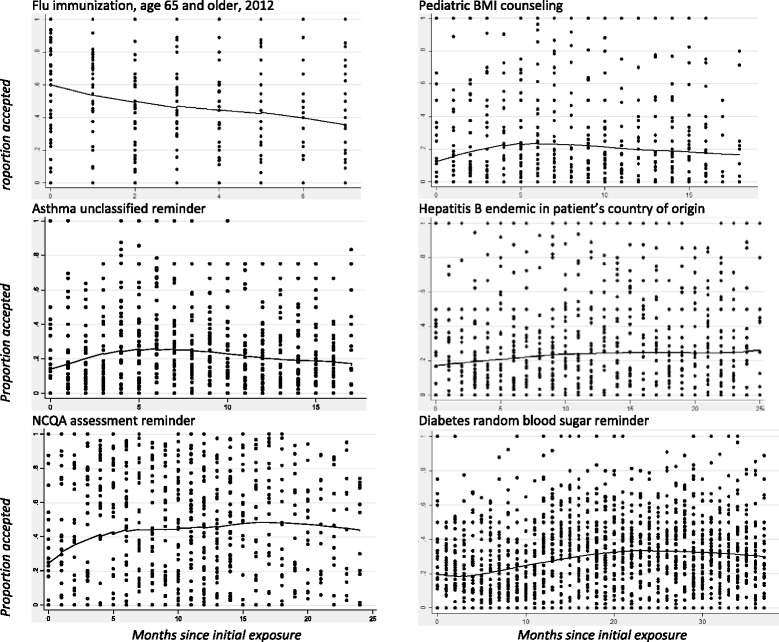
- No desensitization pattern was found: among 6 newly deployed BPAs, only 1 showed an early peak followed by decline (slopes +0.16 to −0.34; p = .03 to .24), likely due to flu seasonality; the others had no clear temporal pattern.
- Nurse practitioners were more than 4 times as likely as physicians to accept drug alerts (multivariable IRR 4.56, p = .002; bivariate IRR 3.97, p = .002). Repeated alerts were highly sticky: if the first BPA was overridden, 87.9% of subsequent instances were overridden; if the first was accepted, 51.9% of subsequent instances were overridden. For drug alerts, the corresponding override rates were 99.9% and 58.4%.
Methods
- Retrospective cohort using EHR data from January 2010 through June 2013 at the Institute for Family Health, including 112 ambulatory primary care clinicians (93 physicians, 19 nurse practitioners), 430,803 encounters, 99,649 patients, 1,266,325 BPAs, and 326,203 drug-drug interaction/drug-allergy interaction alerts.
- Clinician-level negative binomial models with an offset of log(number of alerts fired) and cluster-robust standard errors; predictors included clinician type, meaningful use attestation, sex, patients per year, encounters per year, alerts per encounter, patient comorbidity, percent within-patient repeats, order sets used, and labs ordered.
- Desensitization was tested on 6 newly deployed BPAs available continuously for ≥6 months and presented to ≥10 clinicians ≥5 times each; monthly acceptance rates for 46 clinicians were graphed with lowess smoothing and modeled with Poisson, zero-inflated Poisson, negative binomial, or zero-inflated negative binomial models selected by likelihood ratio and Vuong tests.
Limitations
- The paper states it was observational, used novel metrics because no validated metrics existed, and relied on a single commercial EHR with interruptive alerts, limiting generalizability. It had no DDI/DAI severity information and no manual review to distinguish appropriate from inappropriate overrides; repeats were assumed to be potentially uninformative, though relevance depends on the clinical situation.
- The paper also states that secondary EHR data lacked ambient noise, interruptions, time pressure, quality of patient-clinician interaction, and multitasking, likely biasing findings toward the null; high alert volume may have produced ceiling effects; and desensitization models used robust rather than cluster-robust errors.
- Evident from the text: drug alert acceptance was <1%, creating floor effects that weakened DDI/DAI analyses, and the clinician-level observational design cannot establish causality.
Model-written summary. Check it against the paper before relying on it.
Integrity signals
Registry
Cites
Statistics
Figures
Verification
Claims the paper makes
11 Valid · 0 Not valid · 17 Not checked · 46 Own results and interpretations
Every source the paper cites for this claim was checked and supports it.
In the paper
“In practice, however, 49–96% of alerts are overridden [7], raising questions about the effectiveness of decision support.”
§ Effects of workload, work complexity, and repeated alerts on alert fatigue in a clinical decision support system > Background
What the sources say
- Supportedcites [7] van der Sijs H Aarts J Vulto A Berg M Overriding of drug safety alerts in computerized physician order entry J Am Med Inform Assoc 2006 13 2 138 147 10.1197/jamia.M1809 16357358 PMC1447540 source
The Results section states that drug safety alerts are overridden in 49% to 96% of cases. It notes an exception: serious overdose alerts were overridden in about one fourth of cases. (LLM, conf=0.93)
plain- Asserted: passes — The authors put it forward as true.
- Checkable: passes — It can be checked against evidence.
- Load-bearing: passes — The paper’s conclusions depend on it.
- Based: passes — The paper gives a reason why it holds.
- Supported
The cited sources support only part of this claim — read each source’s verdict below.
In the paper
“This was because a substantial body of work [7, 8, 32, 33] suggests that repeated CDSS alerts are less likely to be informative (that is, they are often equivalent to false alarms).”
§ Effects of workload, work complexity, and repeated alerts on alert fatigue in a clinical decision support system > Methods > Cognitive overload hypotheses
What the sources say
- Partly supportedcites [7] van der Sijs H Aarts J Vulto A Berg M Overriding of drug safety alerts in computerized physician order entry J Am Med Inform Assoc 2006 13 2 138 147 10.1197/jamia.M1809 16357358 PMC1447540 sourceExperimental — accuracy not yet measured
The Results describe many alerts as irrelevant or false positive and recommend preventing some repeat alerts, including interaction alerts previously found not to cause problems for a particular patient. But the paper does not establish that repeated alerts generally become less informative or are often false alarms; it also cautions that an alert a clinician already knows can still flag a potentially unsafe situation. Page numbers were not available in our copy. (LLM, conf=0.82)
- Partly supportedcites [8] Hsieh TC Kuperman GJ Jaggi T Characteristics and consequences of drug allergy alert overrides in a computerized physician order entry system J Am Med Inform Assoc 2004 11 6 482 491 10.1197/jamia.M1556 15298998 PMC524628 sourceExperimental — accuracy not yet measured
The Abstract (page not specified) describes redundant drug-allergy alerts from repeated prescription renewals and alerts with low predictive value. The Discussion (page not specified) says frequent false alerts can obscure important warnings. The paper does not establish that repeated CDSS alerts generally are less informative or that repetition itself makes an alert a false alarm. (LLM, conf=0.84)
- Partly supportedcites [32] Stultz JS Nahata MC Appropriateness of commercially available and partially customized medication dosing alerts among pediatric patients J Am Med Inform Assoc 2014 21 e1 e35 e42 10.1136/amiajnl-2013-001725 23813540 PMC3957387 sourceExperimental — accuracy not yet measured
The Discussion (page unavailable) reports that most pediatric dosing alerts studied were inappropriate and that excessive inappropriate alerting may contribute to alert fatigue. This supports the concern that many alerts are uninformative, but the paper does not establish that an alert becomes less informative when repeated. (LLM, conf=0.83)
- Not checked — no full text of the sourcecites [33] Feldman PH McDonald MV Exploring the utility of automated drug alerts in home health care J Healthc Qual 2006 28 1 29 40 10.1111/j.1945-1474.2006.tb00592.x 16681298 source
hedgedstates an association- Asserted: passes — The authors put it forward as true.
- Checkable: passes — It can be checked against evidence.
- Load-bearing: passes — The paper’s conclusions depend on it.
- Based: passes — The paper gives a reason why it holds.
- Partly supported
The cited sources support only part of this claim — read each source’s verdict below.
In the paper
“One study supporting the desensitization explanation showed that response to clinical trial recruiting alerts in the EHR declined by approximately 2.7% per week, falling from about 50% to about 35% over 36 weeks [19].”
§ Effects of workload, work complexity, and repeated alerts on alert fatigue in a clinical decision support system > Background
What the sources say
- Partly supportedcites [19] Embi PJ Leonard AC Evaluating alert fatigue over time to EHR-based clinical trial alerts: findings from a randomized controlled study J Am Med Inform Assoc 2012 19 e1 e145 e148 10.1136/amiajnl-2011-000743 22534081 PMC3392862 sourceExperimental — accuracy not yet measured
The Results (page not provided) report that responses to EHR-based clinical trial alerts fell from about 50% initially to 35% at week 36. The reported decline was 2.7% per two-week period, not per week as the citing sentence states. (LLM, conf=0.92)
plainstates an association- Asserted: passes — The authors put it forward as true.
- Checkable: passes — It can be checked against evidence.
- Load-bearing: unclear — It is unclear whether the paper’s conclusions depend on it.
- Based: passes — The paper gives a reason why it holds.
- Partly supported
Every source the paper cites for this claim was checked and supports it.
In the paper
“a retrospective chart review in which expert reviewers identified inappropriate DDI overrides found the only factor associated with inappropriate overrides to be number of noncritical alerts received at the same time [23].”
§ Effects of workload, work complexity, and repeated alerts on alert fatigue in a clinical decision support system > Discussion
What the sources say
- Supportedcites [23] Miller AM Boro MS Korman NE Davoren JB Provider and pharmacist responses to warfarin drug–drug interaction alerts: a study of healthcare downstream of CPOE alerts J Am Med Inform Assoc 2011 18 Suppl 1 i45 i50 10.1136/amiajnl-2011-000262 22037888 PMC3241165 source
The Data categorization section says raters classified override responses as appropriate or inappropriate, and the paper describes the study as a retrospective chart review. The Results section reports that the number of simultaneous non-critical alerts was the only factor associated with an inappropriate provider response, including in multivariate analysis. This finding concerns critical DDI alerts involving warfarin. (LLM, conf=0.91)
plainstates an association- Asserted: passes — The authors put it forward as true.
- Checkable: passes — It can be checked against evidence.
- Load-bearing: unclear — It is unclear whether the paper’s conclusions depend on it.
- Based: passes — The paper gives a reason why it holds.
- Supported
A result the paper reports from its own data — it cites no other source for it, so there is none to check. The quote shows it is in the paper.
In the paper
“With every additional BPA per encounter, the likelihood a clinician would accept any BPA dropped by 30% (IRR = 0.70; p < .001; Table 2).”
§ Effects of workload, work complexity, and repeated alerts on alert fatigue in a clinical decision support system > Results > Cognitive overload hypothesis
plainstates a cause- Asserted: passes — The authors put it forward as true.
- Checkable: passes — It can be checked against evidence.
- Load-bearing: passes — The paper’s conclusions depend on it.
- Based: passes — The paper gives a reason why it holds.
29 more claims
Create a free account to see all 74 claims and to verify the 3 references still open.
- Probably not a substantial claim. 27
- It may state two separate claims as one. 14
- The quote only partly states this claim. 2
Claims other papers make about this one
Each is checked against this paper’s own text: does it say what the citing paper says it does?
The source backs part of the claim, not all of it — or backs it for a different population, condition or comparison.
In the citing paper
“Complementary work on alert fatigue and automation bias shows that clinician interaction with decision support systems can recursively influence both inputs and outcomes, creating feedback loops that invalidate original performance assumptions [19,20].”
From Validation is not enough: Longitudinal evidence of post-deployment fragility in clinical AI systems (2026) · cites this paper as [20]
Experimental — accuracy not yet measuredIn the citing paper
“In this framework, environmental factors (interruptions), along with the factors of task demand (task time, task difficulty) [19], technology (system usability) [20] and individual characteristics (professional competency, self-efficacy and mood), are the key variables that influence psychophysiological responses, workload modification and performance in human–machine interaction tasks [21].”
From Workflow interruption and nurses’ mental workload in electronic health record tasks: An observational study (2023) · cites this paper as [19]
Self-check
Percentages, sums and reported differences re-computed from the paper’s own numbers.
Each contradiction between two passages listed here was confirmed by an independent check.
Rated minor: it would not touch a result — a value no result rests on, a p-value that stays on the same side of the significance level, or a conflict that is clerical, resolved elsewhere in the paper, or outside its own findings.
In the paper
“Under time constraints, 8 of 211 alerts (13%) were handled incorrectly because of skill-based errors”
§ Effects of workload, work complexity, and repeated alerts on alert fatigue in a clinical decision support system > Discussion
Reported 13 · recomputed 3.791469
Rated minor: it would not touch a result — a value no result rests on, a p-value that stays on the same side of the significance level, or a conflict that is clerical, resolved elsewhere in the paper, or outside its own findings.
In the paper
§ Effects of workload, work complexity, and repeated alerts on alert fatigue in a clinical decision support system > Abstract > Results
“On average, one-quarter of drug alerts received by a primary care clinician, and one-third of clinical reminders, were repeats for the same patient within the same year.”
§ Effects of workload, work complexity, and repeated alerts on alert fatigue in a clinical decision support system > Results
“More than a quarter of BPAs were repeats for the same clinician for the same patient within the same year (median 26.2% per clinician; interquartile range [IQR] 16.5% to 35.1%). Similarly, of all DDI/DAI received by a clinician, almost 1/3 represented repeats for the same patient within the same year (median 31.8% per clinician; IQR 25.6% to 38.2%).”
Citations
Cites
(1967) · Project Euclid (Cornell University) · Cited by 4,720
Proceedings of the fifth Berkeley symposium on mathematical statistics and probability.
Kojima, K.-I. (1969) · Europe PMC (PubMed Central) · Cited by 3,648
Regression standard errors in clustered samples
Rogers, W. H. (1993) · Stata technical bulletin · Cited by 2,694
Bates, D. W. (1998) · JAMA · doi:10.1001/jama.280.15.1311 · Cited by 2,107
The “Meaningful Use” Regulation for Electronic Health Records
Blumenthal, D., & Tavenner, M. (2010) · New England Journal of Medicine · doi:10.1056/nejmp1006114 · Cited by 2,059 · cited 1×
“As a result of this promising history, as well as the federal EHR incentive program (the “meaningful use” program) [4], contemporary EHR products routinely integrate eprescribing with CDSS.”
BackgroundAmerican Academy of Family Physicians
(1966) · New England Journal of Medicine · doi:10.1056/nejm196611172752014 · Cited by 1,948
Ash, J. S. (2003) · Journal of the American Medical Informatics Association · doi:10.1197/jamia.m1471 · Cited by 1,789
Proceedings of the Human Factors and Ergonomics Society 54th Annual Meeting
Kluge, A., Badura, B., Urbas, L., & Burkolter, D. (2010) · Cited by 1,127
Overriding of Drug Safety Alerts in Computerized Physician Order Entry
van der Sijs, H., Aarts, J., Vulto, A., & Berg, M. (2006) · Journal of the American Medical Informatics Association · doi:10.1197/jamia.m1809 · Cited by 1,117 · cited 5×
“We considered alerts that were repeated the same year as potentially uninformative, following the work of previous researchers who have identified repeated alerts as duplicative and likely to have low relevance [7, 8, 32, 33].”
BackgroundInfluential(2003) · Cited by 969
Cited by
Items 101–200 of 668
Bronsoler, A., Doyle, J. J., & Reenen, J. M. V. (2021) · Annual Review of Economics · doi:10.1146/annurev-economics-080921-101909 · Cited by 42
Biesen, W. V., Cauwenberge, D. V., Decruyenaere, J. M. A., Leune, T., & Sterckx, S. (2022) · BMC Medical Informatics and Decision Making · doi:10.1186/s12911-022-01933-3 · Cited by 26
“The problem of alert fatigue is a well-established downside of interruptive messaging in CDSS [5, 14].”
BackgroundOntoPharma: ontology based clinical decision support system to reduce medication prescribing errors
Calvo-Cidoncha, E., Hernando, C. C., Feu, F., Pastor, X., Codina‐Jané, C., & Lozano-Rubí, R. (2022) · BMC Medical Informatics and Decision Making · doi:10.1186/s12911-022-01979-3 · Cited by 32
Campmans, Z., van Rhijn, A., Dull, R. M., Santen-Reestman, J., Taxis, K., & Borgsteede, S. D. (2018) · PLoS ONE · doi:10.1371/journal.pone.0197469 · Cited by 23
Schinas, G., Dimοpoulos, G., & Akinosoglou, K. (2023) · Microorganisms · doi:10.3390/microorganisms11092214 · Cited by 34
“However, integrating DS into EHR can present several challenges in terms of increased workload and cognitive overload, with “alert fatigue” causing clinicians to ignore electronic prompts [24].”
BackgroundBangash, H., Pencille, L. J., Gundelach, J. H., Makkawy, A., Sutton, J. A., Makkawy, L., Dikilitas, O., Kopecky, S. L., Freimuth, R. R., Caraballo, P. J., et al. (2020) · Journal of Personalized Medicine · doi:10.3390/jpm10030067 · Cited by 28
Hagan, R., Gillan, C. J., Spence, I. T. A., McAuley, D. F., & Shyamsundar, M. (2020) · Computers in Biology and Medicine · doi:10.1016/j.compbiomed.2020.104030 · Cited by 28
“Multiple false alerts could lead to alarm fatigue and clinical inattention [16,32], increased response time [33] and there is evidence that clinicians over ride rate is up to 96% [30].”
Cricelli, I., Marconi, E., & Lapi, F. (2022) · Current Medical Research and Opinion · doi:10.1080/03007995.2022.2052513 · Cited by 29
“Certain phenomena, such as alert fatigue due to too many alerts might impair the GP ’ s interest 6 .”
BackgroundMethodItraconazole Dosing and Drug Monitoring at a Tertiary Children’s Hospital
Leong, Y. H., Boast, A., Cranswick, N., Curtis, N. C., & Gwee, A. (2018) · The Pediatric Infectious Disease Journal · doi:10.1097/inf.0000000000002048 · Cited by 23
Clinical considerations when applying machine learning to decision-support tasks versus automation
Jamieson, T., & Goldfarb, A. (2019) · BMJ Quality & Safety · doi:10.1136/bmjqs-2019-009514 · Cited by 22
“14 Even in binary decisions, there is ample evidence that physicians, even those with dedicated statistical training, have poor comprehension of basic statistical measures relevant to healthcare decisions, 15 and greater computational power opens the door to much more complex non-binary decisions…”
BackgroundHealth System Implementation of a Tobacco Quitline eReferral
Hood-Medland, E. A., STEWART, S. L., Nguyen, H., Avdalovic, M. V., MacDonald, S. T., Zhu, S., Mayoral, A., & Tong, E. K. (2019) · Applied Clinical Informatics · doi:10.1055/s-0039-1697593 · Cited by 24
Lemke, A. A., Thompson, J., Hulick, P. J., Sereika, A. W., Johnson, C., Oshman, L., & Dunnenberger, H. M. (2020) · Journal of Community Genetics · doi:10.1007/s12687-020-00454-8 · Cited by 24
“Alert fatigue is a significant issue with CDS in general and is one of several reasons for low uptake of CDS recommendations (Cash 2009; Ancker et al. 2017).”
BackgroundPletcher, M. J., Flaherman, V. J., Najafi, N., Patel, S., Rushakoff, R. J., Hoffman, A., Robinson, A., Cucina, R. J., McCulloch, C. E., Gonzales, R., et al. (2020) · Annals of Internal Medicine · doi:10.7326/m19-0877 · Cited by 30
Jones, E., Banks, A., Melton, G. B., Porta, C. M., & Tignanelli, C. J. (2022) · JMIR Human Factors · doi:10.2196/29019 · Cited by 31
“Our findings support the current literature that is increasingly recognizing alert fatigue as a negative consequence of CDSSs and a frequently cited reason for poor adherence [42,43].”
ResultSkalafouris, C., Reny, J., Stirnemann, J., Grosgurin, O., Eggimann, F., Grauser, D., Teixeira, D., Jermini, M., Bruggmann, C., Bonnabry, P., et al. (2022) · BMC Medical Informatics and Decision Making · doi:10.1186/s12911-022-01885-8 · Cited by 26
“Several factors may explain a poor adherence rate, especially the cognitive overload that leads to the alert-fatigue phenomenon [14].”
BackgroundHumans in the LoopPreprint
Crootof, R., Kaminski, M. E., & Price, W. N., II (2022) · SSRN Electronic Journal · doi:10.2139/ssrn.4066781 · Cited by 58
Fallon, A., Haralambides, K., Mazzillo, J., & Gleber, C. (2024) · Applied Clinical Informatics · doi:10.1055/a-2226-8144 · Cited by 22
Bai, E., Zhang, Z., Xu, Y., Luo, X., & Adelgais, K. (2025) · BMC Medical Informatics and Decision Making · doi:10.1186/s12911-024-02844-1 · Cited by 35
Roberts, T., Seymour, V., Brooks, K., Thompson, R., Petrokofsky, C., O’Connell, E., & Landeg, O. (2022) · Environmental Science & Policy · doi:10.1016/j.envsci.2022.07.012 · Cited by 21
Optimizing Drug-Drug Interaction Alerts Using a Multidimensional Approach
Daniels, C. C., Burlison, J. D., Baker, D. K., Robertson, J., Sablauer, A., Flynn, P. M., Campbell, P. K., & Hoffman, J. M. (2019) · Pediatrics · doi:10.1542/peds.2017-4111 · Cited by 21
“Alert fatigue can also be affected by inferior interface design and limitations in knowledge bases.(5,6)”
BackgroundShah, A., Polascik, T. J., George, D. J., Anderson, J., Hyslop, T., Ellis, A. M., Armstrong, A. J., Ferrandino, M. N., Preminger, G. M., Gupta, R. T., et al. (2020) · Journal of General Internal Medicine · doi:10.1007/s11606-020-06124-2 · Cited by 25
Alarm fatigue in the Intensive Care Unit: Relevance and response time
Méndez, B. A., Torres, D. O. A., & Gómez-Tovar, L. O. (2020) · Enfermería Intensiva (English ed ) · doi:10.1016/j.enfie.2019.11.001 · Cited by 20
Use of the Electronic Health Record to Optimize Antimicrobial Prescribing
Parzen-Johnson, S., Kronforst, K. D., Shah, R. M., Whitmer, G. R., Scardina, T. L., Chandarraju, M., & Patel, S. J. (2021) · Clinical Therapeutics · doi:10.1016/j.clinthera.2021.09.009 · Cited by 22
Huang, L., & Zhu, Q. (2022) · Computers & Security · doi:10.1016/j.cose.2022.102844 · Cited by 28
“Evidence has shown that the continuous arrival of the alerts can increase the stress level of human operators [33] and 52% of employees attributes their mistakes to stress [3].”
BackgroundGarabedian, P. M., Gannon, M. P., Aaron, S., Wu, E., Burns, Z., & Samal, L. (2022) · BMC Medical Informatics and Decision Making · doi:10.1186/s12911-022-01962-y · Cited by 24
Nandiwada, S., Manca, D. P., Yeung, R. O., & Lau, D. (2023) · Canadian Medical Association Journal · doi:10.1503/cmaj.220673 · Cited by 24
“…barriers including “intervention fatigue” or oversaturation of priority issues, analogous to “alert fatigue” in clinical decision support systems; 44 lack of resources for registry-based care; increasing demands on health care resources; and ongoing challenges with leadership and health systems…”
Scoping review: Positive and negative impact of technology on clinicians
McBride, S. G., Alexander, G. L., Baernholdt, M., Vugrin, M., & Epstein, B. (2023) · Nursing Outlook · doi:10.1016/j.outlook.2023.101918 · Cited by 28
NHS Scotland’s Decision Support Platform: a formative qualitative evaluation
Cresswell, K. M., Callaghan, M., Mozaffar, H., & Sheikh, A. (2019) · BMJ Health & Care Informatics · doi:10.1136/bmjhci-2019-100022 · Cited by 26
Generative Artificial Intelligence in Medicine
Shanmugam, D., Agrawal, M., Movva, R., Chen, I. Y., Ghassemi, M., Jacobs, M. L., & Pierson, E. (2025) · Annual Review of Biomedical Data Science · doi:10.1146/annurev-biodatasci-103123-095332 · Cited by 42
Electronic Health Record Reminders for Chlamydia Screening in an American Indian Population
Hughes, M. S., Apostolou, A., Reilley, B. A., Leston, J. D., McCollum, J. T., & Iralu, J. V. (2020) · Public Health Reports · doi:10.1177/0033354920970947 · Cited by 20
Implementing comprehensive pharmacogenomics in a community hospital–associated primary care setting
Wick, J. A., Schmidlen, T., Grande, K., Moretz, C., Ashcraft, K. C., Green, J., Moyer, N. A., & Blaxall, B. C. (2022) · Journal of the American Pharmacists Association · doi:10.1016/j.japh.2022.09.002 · Cited by 19
Preventative Sensor-Based Remote Monitoring of the Diabetic Foot in Clinical Practice
Minty, E. P., Bray, E., Bachus, C. B., Everett, B., Smith, K. M., Matijevich, E., Hajizadeh, M., Armstrong, D. G., & Liden, B. A. (2023) · Sensors · doi:10.3390/s23156712 · Cited by 27
“While all seek to minimize the former, the pernicious effects of false positive alerts in clinical environments are well documented in the literature surrounding alert fatigue [68,69].”
BackgroundGe, J., Fontil, V., Ackerman, S., Pletcher, M. J., & Lai, J. C. (2023) · Hepatology · doi:10.1097/hep.0000000000000583 · Cited by 21
Wilbanks, B. A., Aroke, E. N., & Dudding, K. M. (2021) · CIN Computers Informatics Nursing · doi:10.1097/cin.0000000000000704 · Cited by 36
Lee, N. S., Anastos-Wallen, R., Chaiyachati, K. H., Reitz, C., Asch, D. A., & Mehta, S. J. (2022) · JAMA Network Open · doi:10.1001/jamanetworkopen.2021.43590 · Cited by 20
Wasylewicz, A. T. M., van de Burgt, B. W. M., Manten, T., Kerskes, M., Compagner, W. N., Korsten, E. H. H. M., Egberts, T. C. G., & Grouls, R. J. E. (2022) · Clinical Pharmacology & Therapeutics · doi:10.1002/cpt.2624 · Cited by 24
“33,43 Overall, these studies showed reductions of 50– 92% of the DDI alert burden.”
BackgroundDonker, E. M., Brinkman, D. J., van Rosse, F., Janssen, B. J., Knol, W., Dumont, G., Jorens, P. G., Dupont, A. G., Christiaens, T., van Smeden, J., et al. (2022) · British Journal of Clinical Pharmacology · doi:10.1111/bcp.15443 · Cited by 18
Tilson, J. K., Martinez, C. A., MacDowell, S. G., D’Silva, L. J., Howard, R., Roth, H., Skop, K. M., Dannenbaum, E., & Farrell, L. (2022) · BMC Health Services Research · doi:10.1186/s12913-022-08796-4 · Cited by 20
Dahmke, H., Fiumefreddo, R., Schüetz, P., Iaco, R. D., & Zaugg, C. (2023) · Swiss Medical Weekly · doi:10.57187/smw.2023.40082 · Cited by 25
“Common reasons for alert fatigue are the reception of high numbers of irrelevant alerts and desensitisation from repeated exposure to the same alert, particularly in a demanding and complex working envi-ronment [11].”
Backgroundwith the HITEC Investigators, Ancker, J. S., Edwards, A. M., Nosal, S. C., Hauser, D., Mauer, E. A., & Kaushal, R. (2019) · BMC Medical Informatics and Decision Making · doi:10.1186/s12911-019-0971-0 · Cited by 20
Self-citationClinician Perceptions of Timing and Presentation of Drug-Drug Interaction Alerts
Humphrey, K. E., Mirica, M., Phansalkar, S., Ozonoff, A., & Harper, M. B. (2020) · Applied Clinical Informatics · doi:10.1055/s-0040-1714276 · Cited by 17
Ancker, J. S., Gossey, J. T., Nosal, S. C., Xu, C., Banerjee, S., Wang, Y., Veras, Y., Mitchell, H., & Bao, Y. (2020) · Journal of General Internal Medicine · doi:10.1007/s11606-020-06276-1 · Cited by 20
Self-citationSchults, J. A., Paterson, R., Kleidon, T. M., Cooke, M. L., Ullman, A. J., McNeil, K., Chopra, V., Charles, K. R., Ray‐Barruel, G., Marsh, N. M., et al. (2021) · Australian Health Review · doi:10.1071/ah21053 · Cited by 16
Better specification of triggers to reduce the number of drug interaction alerts in primary care
Heringa, M., van der Heide, A., Floor‐Schreudering, A., Smet, P. A. G. M. D., & Bouvy, M. L. (2017) · International Journal of Medical Informatics · doi:10.1016/j.ijmedinf.2017.11.005 · Cited by 19
Ronan, C., Crable, E. L., Drainoni, M., & Walkey, A. J. (2022) · Journal of Hospital Medicine · doi:10.1002/jhm.12825 · Cited by 25
Qureshi, F. M., Ramprasad, A., & Derylo, B. (2022) · Cureus · doi:10.7759/cureus.27999 · Cited by 16
“This process of desensitization can make the side effects, though generally known to most of these physicians, less jarring and less of a concern on a day-to-day basis, especially with its repercussions not being seen immediately [19].”
BackgroundOlmos, A. V., Robinowitz, D. L., Feiner, J., Chen, C. L., & Gandhi, S. (2022) · Anesthesia & Analgesia · doi:10.1213/ane.0000000000006242 · Cited by 20
“328 www.anesthesia-analgesia.org aNesthesia & aNalgesia GLOSSARY AIMS = anesthesia information management system; BPA = best practice advisory; CDS = clinical decision support; CI = confidence interval; CRNA = certified registered nurse anesthetist; FGF = fresh gas flow; GHG = greenhouse gas; IRB = institutional revie…”
MethodInfluentialMarcelin, J. R., Brewer, C., Beachy, M. W., Lyden, E. R., Winterboer, T., Murphy, C. N., Fey, P. D., Hood, L., & Schooneveld, T. C. V. (2019) · Infection Control and Hospital Epidemiology · doi:10.1017/ice.2019.78 · Cited by 17
Acute kidney injury risk-based screening in pediatric inpatients: a pragmatic randomized trial
Driest, S. L. V., Wang, L., McLemore, M. F., Bridges, B. C., Fleming, G. M., McGregor, T. L., Jones, D. P., Shirey-Rice, J. K., Gatto, C. L., Gay, J. C., et al. (2019) · Pediatric Research · doi:10.1038/s41390-019-0550-1 · Cited by 18
Bennett, C. C., Stanojević, Č., Šabanović, S., Piatt, J. A., & Kim, S. (2021) · International Conference on Human-Agent Interaction (HAI) · doi:10.1145/3472307.3484670 · Cited by 18
“All participants except one reported a sense of alert fatigue with frequent reminder prompts, similar to that observed in clinicians and patients in other settings [34, 35].”
ResultPhysician Knowledge Base: Clinical Decision Support Systems
Kim, S., Kim, E.-H., & Kim, H. (2021) · Yonsei Medical Journal · doi:10.3349/ymj.2022.63.1.8 · Cited by 22
Schapira, M. M., Barlow, W. E., Conant, E. F., Sprague, B. L., Tosteson, A. N. A., Haas, J. S., Onega, T., Beaber, E. F., Goodrich, M., McCarthy, A. M., et al. (2018) · Academic Radiology · doi:10.1016/j.acra.2017.12.028 · Cited by 18
Huang, J. S., Yueh, R., Wood, K., Ma, S., Cruz, R., Boyd, N., Kruth, R., & Parker, J. (2020) · Journal of Pediatric Gastroenterology and Nutrition - JPGN · doi:10.1097/mpg.0000000000002516 · Cited by 11
“Alerts have also been used to advise providers regarding significant clinical issues requiring attention; however, frequent alerts have poor physician acceptance rates (17).”
BackgroundNg, Y., Hsu, J. T. Y., ́ng, N. V. H., Ong, J. Z. E., Hsu, J. L. J., Sulaimi, F., Tan, H. K., Tang, A. S. P., & Ng, Q. X. (2025) · Age and Ageing · doi:10.1093/ageing/afaf206 · Cited by 20
Zehner, M. E., Kirsch, J. A., Adsit, R. T., Gorrilla, A., Hayden, K., Skora, A. D., Rosenblum, M. S., Baker, T. B., Fiore, M. C., & McCarthy, D. E. (2022) · Implementation Science Communications · doi:10.1186/s43058-022-00357-4 · Cited by 18
“, reducing clicks) to enhance eReferral acceptability and thereby promote its adoption or maintenance and downstream population impact [13, 16, 17].”
BackgroundErickson, J. L., Wu, J., Fertel, B. S., Pallotta, A. M., Englund, K., Shrestha, N. K. M., & Lehman, B. (2022) · Open Forum Infectious Diseases · doi:10.1093/ofid/ofac601 · Cited by 17
“cians perceive alerts in the EMR to be excessive [40] and are less likely to respond to reminders as more are deployed [38].”
BackgroundCai, J., Li, P., Li, W., & Zhu, T. (2024) · International Journal of Surgery · doi:10.1097/js9.0000000000001821 · Cited by 25
“If too many insigni fi cant alarms or CDSS recommendations are imposed on professionals, it may contribute to concealing the real effect of CDSS by human factors and then in fl uence patient prognosis [37] .”
Safe use of hospital information systems: an evaluation model based on a sociotechnical perspective
Salahuddin, L. B., Ismail, Z., Ikram, R. R. R., Hashim, U. R., Idris, A., Ismail, N. H., Hassan, N. H., & Rahim, F. A. (2019) · Behaviour and Information Technology · doi:10.1080/0144929x.2019.1597164 · Cited by 19
“when they were considered to be irrelevant or repeated (Abramson et al. 2012; Ancker et al. 2017).”
BackgroundInformation Management in the Emergency Department
Leventhal, E. L., & Schreyer, K. E. (2020) · Emergency Medicine Clinics of North America · doi:10.1016/j.emc.2020.03.004 · Cited by 20
Gold, R. B., Middendorf, M., Heintzman, J., Nelson, J. C., O’Connor, P. J., Sperl‐Hillen, J. M., Appana, D., Geissal, E. D., Thirumalai, V., Sheppler, C. R., et al. (2020) · Healthcare · doi:10.1016/j.hjdsi.2020.100488 · Cited by 14
“[31] HPI achieved CDS use rates of 70-80% at alerted encounters with a risk threshold set such that the CDS use was recommended at about 20% of all adult patient visits.”
BackgroundPivotal challenges in artificial intelligence and machine learning applications for neonatal care
Jeong, H., & Kamaleswaran, R. (2022) · Seminars in Fetal and Neonatal Medicine · doi:10.1016/j.siny.2022.101393 · Cited by 21
Miller, S. D., Murphy, Z. R., Gray, J., Marsteller, J. A., Oliva‐Hemker, M. M., Maslen, A., Lehmann, H. P., Nagy, P. G., Hutfless, S. M., & Gürses, A. P. (2023) · Applied Clinical Informatics · doi:10.1055/a-2040-0578 · Cited by 18
Designing Interactive Alerts to Improve Recognition of Critical Events in Medical Emergencies
Mastrianni, A., Sarcevic, A., Chung, L., Zakeri, I., Alberto, E. C., Milestone, Z. P., Marsic, I., & Burd, R. S. (2021) · Designing Interactive Systems Conference · doi:10.1145/3461778.3462051 · Cited by 18
Horwood, J. P., Clement, C., Roberts, K., Waldron, C.-A., Irving, W. L., Macleod, J., & Hickman, M. (2020) · British Journal of General Practice · doi:10.3399/bjgp20x708785 · Cited by 16
Strategies for Referring Cancer Patients in a Smoking Cessation Program
Davis, J. M., Thomas, L. C., Dirkes, J., & Swartzwelder, H. S. (2020) · International Journal of Environmental Research and Public Health · doi:10.3390/ijerph17176089 · Cited by 16
“BPA outcomes have often been quite modest, because providers who are busy with other issues routinely ignore these BPA alerts [34].”
BackgroundGibson, R., MacLeod, N., Donaldson, L., Williams, H., Hibbert, P. D., Parry, G. J., Bhatt, J., Sheikh, A., & Carson‐Stevens, A. (2020) · Addiction · doi:10.1111/add.15039 · Cited by 17
Douthit, B. J., Musser, R. C., Lytle, K. S., & Richesson, R. (2020) · Journal of Personalized Medicine · doi:10.3390/jpm10040142 · Cited by 14
Truong, T. M., Apfelbaum, J. L., Danahey, K., Schierer, E., Ludwig, J., George, D., House, L., Karrison, T., Shahul, S., Anitescu, M., et al. (2022) · Anesthesia & Analgesia · doi:10.1213/ane.0000000000005951 · Cited by 16
Patrick, M. T., Bardhi, R., Raja, K., He, K., & Tsoi, L. C. (2020) · Journal of the American Medical Informatics Association · doi:10.1093/jamia/ocaa335 · Cited by 13
“However, there is a danger of DDI alert fatigue, 58 whereby suboptimal decisions may be taken because the provision of too much (seemingly irrelevant) information makes it difficult to identify the potential DDIs on which action should be taken.”
BackgroundRobert, L., Cuvelier, E., Rousselière, C., Gautier, S., Odou, P., Beuscart, J., & Décaudin, B. (2023) · Healthcare · doi:10.3390/healthcare11060827 · Cited by 20
Everything Every Radiologist Always Wanted (and Needs) to Know About Clinical Decision Support
Wintermark, M., Willis, M. H., Hom, J., Franceschi, A. M., Fotos, J. S., Mosher, T. J., Cruciata, G., Reuss, T., Horton, R., Fredericks, N., et al. (2020) · Journal of the American College of Radiology · doi:10.1016/j.jacr.2020.03.016 · Cited by 13
External validation of the Epic sepsis predictive model in 2 county emergency departments.
Ostermayer, D. G., Braunheim, B., Mehta, A. M., Ward, J., Andrabi, S., & Sirajuddin, A. M. (2024) · JAMIA Open · doi:10.1093/jamiaopen/ooae133 · Cited by 13
“18 Although it is unknown if sepsis would have been successfully treated without the alert in 50% of cases, it is unlikely given the distribution, to suggest that those cases would have been completely missed.”
Zapata, L. V., Carhart, B., Horn, J. R., Hansten, P. D., Subbian, V., Gephart, S. M., Tan, M. S., Romero, A. V., & Malone, D. C. (2021) · American Journal of Health-System Pharmacy · doi:10.1093/ajhp/zxab215 · Cited by 14
“should not receive combination therapy, and alert fatigue has been identified as a major limitation of these systems in clinical practice.(3) One strategy for making a CDS system more reliable in the context of RAAS inhibitor use is to explore evidence that could be incorporated into the system so that clinicians are…”
BackgroundBuilding a Targeted Automatic e-Consult (TACo) Program
Judson, T. J., Mourad, M., & Wachter, R. M. (2021) · The Joint Commission Journal on Quality and Patient Safety · doi:10.1016/j.jcjq.2021.10.007 · Cited by 13
Identifying and Reconciling Patients’ Allergy Information Within the Electronic Health Record
Vallamkonda, S., Ortega, C. A., Lo, Y.-C., Blackley, S. V., Wang, L., Seger, D. L., Blumenthal, K. G., Plasek, J. M., Goss, F. R., & Zhou, L. (2022) · Studies in health technology and informatics · doi:10.3233/shti220044 · Cited by 17
“[22] However, only one study, to our knowledge, has investigated comprehensive allergy reconciliation methods, [23] and none have examined the design or implementation of a more expansive automated allergy reconciliation tool.”
A pilot study to investigate real-time digital alerting from wearable sensors in surgical patients
Joshi, M., Ashrafian, H., Arora, S., Sharabiani, M. T. A., McAndrew, K., Khan, S. N., Cooke, G., & Darzi, A. W. (2022) · Pilot and Feasibility Studies · doi:10.1186/s40814-022-01084-2 · Cited by 13
“Clinicians are less likely to accept alerts when a greater number of alerts are received, especially if the alerts are repeated [31].”
BackgroundTransitioning Cognitive Aids into Decision Support Platforms: Requirements and Design Guidelines
Mastrianni, A., Sarcevic, A., Hu, A., Almengor, L., Tempel, P. E., Gao, S., & Burd, R. S. (2023) · ACM Transactions on Computer-Human Interaction · doi:10.1145/3582431 · Cited by 15
“Because extra work is required to distinguish true alerts from false alerts [2], false alerts are detrimental in safety-critical domains, such as clinical [62], driving [53], and rail traffic control [78] settings.”
BackgroundImplementing real-time prescription benefit tools: Early experiences from 5 academic medical centers
Luo, J., Wong, R., Mehta, T., Schwartz, J. I., Epstein, J. A., Smith, E., Kashyap, N., Woreta, F. A., Feterik, K., Fliotsos, M. J., et al. (2023) · Healthcare · doi:10.1016/j.hjdsi.2023.100689 · Cited by 12
Clinical Informatics in Critical Care Medicine
Nadkarni, G. N., & Sakhuja, A. (2023) · The Yale Journal of Biology and Medicine · doi:10.59249/wttu3055 · Cited by 14
Co, Z., Holmgren, A. J., Classen, D. C., Newmark, L. P., Seger, D. L., Cole, J., Pon, B., Zimmer, K. P., & Bates, D. W. (2021) · Applied Clinical Informatics · doi:10.1055/s-0041-1722917 · Cited by 13
Lauffenburger, J. C., Khatib, R., Siddiqi, A., Albert, M. A., Keller, P. A., Samal, L., Glowacki, N., Everett, M. E., Hanken, K. E., Lee, S. G., et al. (2022) · American Heart Journal · doi:10.1016/j.ahj.2022.10.003 · Cited by 13
Jain, R. K., Weiner, M. G., Polley, E. C., Iwamaye, A., Huang, E. S., & Vokes, T. (2023) · Journal of General Internal Medicine · doi:10.1007/s11606-023-08347-5 · Cited by 13
“However, the exact approach would need to be tested, as many EHR alerts are simply ignored due to “alert fatigue,” 21 .”
BackgroundImpact of Electronic Medical Record Alerts on Emergency Physician Workflow and Medical Management
Todd, B. R., Shinthia, N., Nierenberg, L., Mansour, L., Miller, M., & Otero, R. (2020) · Journal of Emergency Medicine · doi:10.1016/j.jemermed.2020.10.017 · Cited by 14
Bosetti, D., Grant, R., & Catho, G. (2025) · Antimicrobial Stewardship & Healthcare Epidemiology · doi:10.1017/ash.2025.10091 · Cited by 19
“39 This is often the main reason for dissatisfaction with current decision support systems.”
Using an electronic health record alert to prompt blood-borne virus testing in primary care
Chadwick, D., Forbes, G., Lawrence, C., Lorrimer, S., & van Schaik, P. (2021) · AIDS · doi:10.1097/qad.0000000000002935 · Cited by 11
Meaningful time-related aspects of alerts in Clinical Decision Support Systems. A unified framework
Cánovas-Segura, B., Morales, A., Juárez, J. M., & Campos, M. (2023) · Journal of Biomedical Informatics · doi:10.1016/j.jbi.2023.104397 · Cited by 13
Domínguez, J., Prociuk, D., Marović, B., Čyras, K., Cocarascu, O., Ruiz, F. J., Mi, E., Mi, E., Ramtale, S. C., Rago, A., et al. (2023) · Learning Health Systems · doi:10.1002/lrh2.10391 · Cited by 16
Leveraging digital technologies to enhance patient safety
Agius, S., Magri, C., Topham, L., Bezzina, F., & Cassar, V. (2025) · Health and Technology · doi:10.1007/s12553-025-01001-6 · Cited by 23
“Poorly designed digital tools may also contribute to cognitive overload and “alert fatigue” among clinicians, particularly in already high-pressure environments [60, 61].”
Proactive integrated virtual healthcare resource use in primary care
Haun, J. N., Cotner, B. A., Melillo, C., Panaite, V., Messina, W., Patel-Teague, S., & Zilka, B. (2021) · BMC Health Services Research · doi:10.1186/s12913-021-06783-9 · Cited by 11
“Workload credit and incentives to proactively integrate VHR into the coordination and delivery of care may provide the necessary motivation for adoption and sustained use over time ([39]; J.”
BackgroundModulators Influencing Medication Alert Acceptance: An Explorative Review
Bittmann, J. A., Haefeli, W. E., & Seidling, H. M. (2022) · Applied Clinical Informatics · doi:10.1055/s-0042-1748146 · Cited by 18
The Implementation of Pharmacogenetics in the United Kingdom
McDermott, J. H., Sharma, V., Keen, J., Newman, W. G., & Pirmohamed, M. (2023) · Handbook of experimental pharmacology · doi:10.1007/164_2023_658 · Cited by 13
Dandachi, D., Dang, B. N., Dib, R. W., et al. (2018) · AIDS Patient Care and STDs · doi:10.1089/apc.2018.0035 · Cited by 11
“Some studies demonstrated improved evidence-based practices, whereas clinicians in other studies described alert fatigue as they became desensitized to and less likely to accept alerts as they received increasing numbers of them.(17) Given the lack of information on HIV testing practices among internal medicine reside…”
Clinical deployment of AI for prostate cancer diagnosis
Janowczyk, A. R., Leo, P., & Rubin, M. A. (2020) · The Lancet Digital Health · doi:10.1016/s2589-7500(20)30163-1 · Cited by 16
“5 Additionally, concerns regarding alert fatigue in the case of poorly performing systems might be warranted 6 and thus require dedicated long-term study.”
BackgroundA Framework to Assist Providers in the Management of Patients with Chronic, Nonhealing Wounds
Howell, R. S., Gorenstein, S. A., Gillette, B. M., DiGregorio, J., Criscitelli, T. M., Davitz, M. S., Woods, J. S., Acerra, M., & Brem, H. (2018) · Advances in Skin & Wound Care · doi:10.1097/01.asw.0000546117.86938.75 · Cited by 13
Reese, T. J., Kawamoto, K., Fiol, G. D., Drews, F. A., Taft, T., Kramer, H., & Weir, C. R. (2018) · Europe PMC (PubMed Central) · Cited by 14
Tai, A. M. Y., Kim, J. J., Schmeckenbecher, J., Kitchin, V., Wang, J., Kazemi, A., Masoudi, R., Fadakar, H., Iorfino, F., & Krausz, R. M. (2024) · Journal of Evaluation in Clinical Practice · doi:10.1111/jep.14069 · Cited by 16
Where's the Remote? Failure to Report Clinical Workflows in Heart Failure Remote Monitoring Studies
Shalowitz, E. L., Jhund, P. S., Psotka, M. A., Sharma, A., Dimond, M. G., Martyn, T., Nkulikiyinka, R., Fiuzat, M., & Kao, D. P. (2024) · Journal of Cardiac Failure · doi:10.1016/j.cardfail.2024.11.012 · Cited by 13
Individualized Dynamic Patient Monitoring Under Alarm Fatigue
Piri, H., Huh, W. T., Shechter, S. M., & Hudson, D. (2022) · Operations Research · doi:10.1287/opre.2022.2300 · Cited by 13
Wong, A., Berenbrok, L. A., Snader, L., Soh, Y. H., Kumar, V. K., Javed, M. A., Bates, D. W., Sorce, L. R., & Kane‐Gill, S. L. (2023) · Critical Care Explorations · doi:10.1097/cce.0000000000000967 · Cited by 18
Scott, K., Faryar, K. A., Patil, N. T., Gripshover, B., Hammond, C., Purohit, M. P., Schmotzer, C. L., Suleman-Civis, L., Niforatos, J. D., Avery, A., et al. (2023) · The American Journal of Emergency Medicine · doi:10.1016/j.ajem.2023.12.029 · Cited by 11
Metadata
- Authors
- with the HITEC Investigators, Ancker, J. S., Edwards, A., Nosal, S., Hauser, D., Mauer, E., & Kaushal, R.
- Affiliations
- Weill Cornell Medicine (US)
- Institute for Family Health (US)
- Corresponding author
- Ancker, Jessica S.
- Venue
- BMC Medical Informatics and Decision Making
- Published
- 2017-04-10
- Volume
- 17
- Issue
- 1
- Pages
- 36-36
- ISSN
- 1472-6947 (ISSN-L)
- PMC
- PMC5387195
- OpenAlex
- W2605753964
- Cited by
- 709
- References
- 43
- Citations by year
- 2026: 160 · 2025: 87 · 2024: 76 · 2023: 82 · 2022: 90 · 2021: 74 · 2020: 73 · 2019: 38 · 2018: 26 · 2017: 2
- FWCI
- 52.24
- Type
- journal article
- Language
- en
- Update notices
- correction (2019-11-18)
- Open access
- gold
- doi.org
- Licence
- cc-by
- creativecommons.org/licenses/by/4.0/ (tdm)
- creativecommons.org/licenses/by/4.0/ (vor)
- Locations
- BMC Medical Informatics and Decision Making (publishedVersion, cc-by)
- PubMed Central (publishedVersion, cc-by)
- PubMed (publishedVersion)
- DOAJ (DOAJ: Directory of Open Access Journals) (submittedVersion, cc-by-sa)
- Funders
- New York State Department of Health (C025877)
- Agency for Healthcare Research and Quality (K01HS021531)
- Topics
- Health Sciences › Health Professions › Health Information Management › Electronic Health Records Systems
- Health Sciences › Medicine › Surgery › Healthcare Technology and Patient Monitoring
- Health Sciences › Medicine › Family Practice › Clinical Reasoning and Diagnostic Skills
- Keywords
- alarm fatigue, clinical decision support, drug alerts, alert override, cognitive overload, workload, job complexity, desensitization, nurse practitioners, primary care providers, electronic health records
- MeSH terms
- Alert Fatigue, Health Personnel, Adult, Humans, Nurse Practitioners, Retrospective Studies, Workload, Decision Support Systems, Clinical, Electronic Health Records, Physicians, Primary Care
About these checks
Registry, retraction, Cites and statistics results are computed, not judged, with one exception: a printed reference that no index lists is read once by a model before it counts as a citation error. Claims are extracted by a model and kept only when their quote appears verbatim in the text; each cited source is then checked, with a model’s help, for whether it says what the claim relies on. Those verdicts can be wrong — read the claim’s quote and the cited source before relying on one.
The claim verdicts this report counts are experimental: their accuracy is not yet measured.
A language model drew the claims from the paper on 2026-10-10, under version 3 of the claim definition (model deepseek-v4.1-flash, prompt extract-v3).
A second model labelled each claim on 2026-10-10 (model jev-1.13-20260917, definition revision gold-guideline-v0.2).
Cited sources are checked with a language model’s help (gpt-6-sol).
Statistics and arithmetic are recomputed, not judged.
Confidence bands are shown only for fields calibrated on our annotated test set. None is calibrated yet, so no band is shown.
What counts as a claim ›How we measure confidence ›How we check this ›
Are you an author, or do you see a problem with this page? Request a review
Data sources
Bibliographic data: Semantic Scholar, OpenAlex, Crossref.
Contains information from the Semantic Scholar Academic Graph Datasets, made available under the ODC Attribution License (ODC-BY 1.0).
Semantic Scholar’s data is described in: Kinney, R., et al. (2023). The Semantic Scholar Open Data Platform. arXiv:2301.10140.
