

Effects of workload, work complexity, and repeated alerts on alert fatigue in a clinical decision support system
Open accessThe DOI matches its Crossref record; 44 of the 45 references it cites were found in a registry or an index; 18 of the 56 sources its claims cite were checked for support.
Abstract
Background: Although alert fatigue is blamed for high override rates in contemporary clinical decision support systems, the concept of alert fatigue is poorly defined. We tested hypotheses arising from two possible alert fatigue mechanisms: (A) cognitive overload associated with amount of work, complexity of work, and effort distinguishing informative from uninformative alerts, and (B) desensitization from repeated exposure to the same alert over time. Methods: Retrospective cohort study using electronic health record data (both drug alerts and clinical practice reminders) from January 2010 through June 2013 from 112 ambulatory primary care clinicians. Results: On average, one-quarter of drug alerts received by a primary care clinician, and one-third of clinical reminders, were repeats for the same patient within the same year. Alert acceptance was associated with work complexity and repeated alerts, but not with the amount of work. Likelihood of reminder acceptance dropped by 30% for each additional reminder received per encounter, and by 10% for each five reminders received per day.
Overview
CoChat Summary
TL;DR
In a retrospective cohort of 112 primary care clinicians, alert acceptance fell with greater work complexity and more repeated alerts, but not with amount of workload or desensitization over time. Reducing within-patient repeat alerts may be a promising target for reducing alert fatigue.
Key findings
- Alert acceptance decreased with repeated alerts and complexity: for best-practice advisories (BPAs), each additional BPA per encounter reduced acceptance by 30% (IRR 0.70, p < .001), and each 5-percentage-point increase in repeated BPAs reduced acceptance by 10% (IRR 0.90, p < .001).
- Workload amount was not associated with acceptance: patients per year and encounters per year were not significant predictors. Patient comorbidity was associated with lower BPA acceptance in bivariate analysis (IRR 0.27, p = .008) but narrowly lost significance in the multivariable model (IRR 0.49, p = .06).
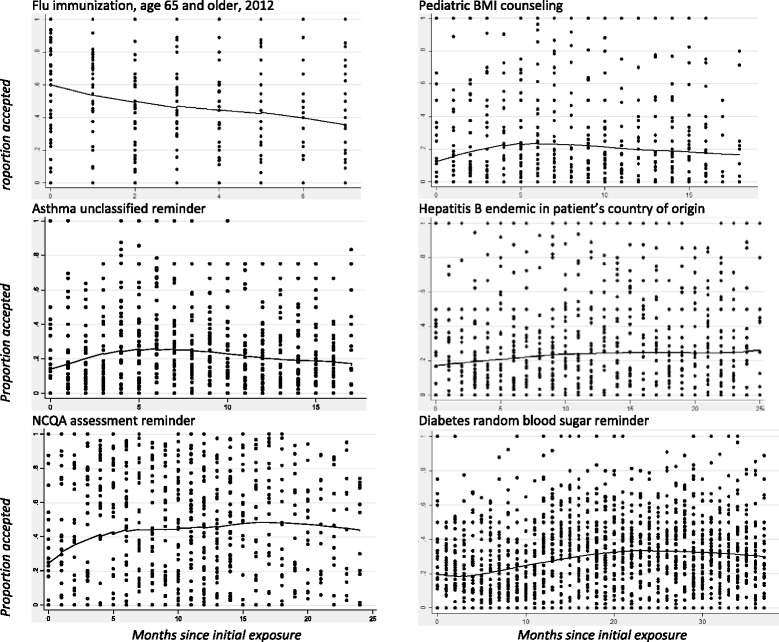
- No desensitization pattern was found: among 6 newly deployed BPAs, only 1 showed an early peak followed by decline (slopes +0.16 to −0.34; p = .03 to .24), likely due to flu seasonality; the others had no clear temporal pattern.
- Nurse practitioners were more than 4 times as likely as physicians to accept drug alerts (multivariable IRR 4.56, p = .002; bivariate IRR 3.97, p = .002). Repeated alerts were highly sticky: if the first BPA was overridden, 87.9% of subsequent instances were overridden; if the first was accepted, 51.9% of subsequent instances were overridden. For drug alerts, the corresponding override rates were 99.9% and 58.4%.
Methods
- Retrospective cohort using EHR data from January 2010 through June 2013 at the Institute for Family Health, including 112 ambulatory primary care clinicians (93 physicians, 19 nurse practitioners), 430,803 encounters, 99,649 patients, 1,266,325 BPAs, and 326,203 drug-drug interaction/drug-allergy interaction alerts.
- Clinician-level negative binomial models with an offset of log(number of alerts fired) and cluster-robust standard errors; predictors included clinician type, meaningful use attestation, sex, patients per year, encounters per year, alerts per encounter, patient comorbidity, percent within-patient repeats, order sets used, and labs ordered.
- Desensitization was tested on 6 newly deployed BPAs available continuously for ≥6 months and presented to ≥10 clinicians ≥5 times each; monthly acceptance rates for 46 clinicians were graphed with lowess smoothing and modeled with Poisson, zero-inflated Poisson, negative binomial, or zero-inflated negative binomial models selected by likelihood ratio and Vuong tests.
Limitations
- The paper states it was observational, used novel metrics because no validated metrics existed, and relied on a single commercial EHR with interruptive alerts, limiting generalizability. It had no DDI/DAI severity information and no manual review to distinguish appropriate from inappropriate overrides; repeats were assumed to be potentially uninformative, though relevance depends on the clinical situation.
- The paper also states that secondary EHR data lacked ambient noise, interruptions, time pressure, quality of patient-clinician interaction, and multitasking, likely biasing findings toward the null; high alert volume may have produced ceiling effects; and desensitization models used robust rather than cluster-robust errors.
- Evident from the text: drug alert acceptance was <1%, creating floor effects that weakened DDI/DAI analyses, and the clinician-level observational design cannot establish causality.
Model-written summary. Check it against the paper before relying on it.
Integrity signals
Registry
Cites
Statistics
Figures
Verification
Claims the paper makes
11 Valid · 0 Not valid · 17 Not checked · 46 Own results and interpretations
Every source the paper cites for this claim was checked and supports it.
In the paper
“In practice, however, 49–96% of alerts are overridden [7], raising questions about the effectiveness of decision support.”
§ Effects of workload, work complexity, and repeated alerts on alert fatigue in a clinical decision support system > Background
What the sources say
- Supportedcites [7] van der Sijs H Aarts J Vulto A Berg M Overriding of drug safety alerts in computerized physician order entry J Am Med Inform Assoc 2006 13 2 138 147 10.1197/jamia.M1809 16357358 PMC1447540 source
The Results section states that drug safety alerts are overridden in 49% to 96% of cases. It notes an exception: serious overdose alerts were overridden in about one fourth of cases. (LLM, conf=0.93)
plain- Asserted: passes — The authors put it forward as true.
- Checkable: passes — It can be checked against evidence.
- Load-bearing: passes — The paper’s conclusions depend on it.
- Based: passes — The paper gives a reason why it holds.
- Supported
The cited sources support only part of this claim — read each source’s verdict below.
In the paper
“This was because a substantial body of work [7, 8, 32, 33] suggests that repeated CDSS alerts are less likely to be informative (that is, they are often equivalent to false alarms).”
§ Effects of workload, work complexity, and repeated alerts on alert fatigue in a clinical decision support system > Methods > Cognitive overload hypotheses
What the sources say
- Partly supportedcites [7] van der Sijs H Aarts J Vulto A Berg M Overriding of drug safety alerts in computerized physician order entry J Am Med Inform Assoc 2006 13 2 138 147 10.1197/jamia.M1809 16357358 PMC1447540 sourceExperimental — accuracy not yet measured
The Results describe many alerts as irrelevant or false positive and recommend preventing some repeat alerts, including interaction alerts previously found not to cause problems for a particular patient. But the paper does not establish that repeated alerts generally become less informative or are often false alarms; it also cautions that an alert a clinician already knows can still flag a potentially unsafe situation. Page numbers were not available in our copy. (LLM, conf=0.82)
- Partly supportedcites [8] Hsieh TC Kuperman GJ Jaggi T Characteristics and consequences of drug allergy alert overrides in a computerized physician order entry system J Am Med Inform Assoc 2004 11 6 482 491 10.1197/jamia.M1556 15298998 PMC524628 sourceExperimental — accuracy not yet measured
The Abstract (page not specified) describes redundant drug-allergy alerts from repeated prescription renewals and alerts with low predictive value. The Discussion (page not specified) says frequent false alerts can obscure important warnings. The paper does not establish that repeated CDSS alerts generally are less informative or that repetition itself makes an alert a false alarm. (LLM, conf=0.84)
- Partly supportedcites [32] Stultz JS Nahata MC Appropriateness of commercially available and partially customized medication dosing alerts among pediatric patients J Am Med Inform Assoc 2014 21 e1 e35 e42 10.1136/amiajnl-2013-001725 23813540 PMC3957387 sourceExperimental — accuracy not yet measured
The Discussion (page unavailable) reports that most pediatric dosing alerts studied were inappropriate and that excessive inappropriate alerting may contribute to alert fatigue. This supports the concern that many alerts are uninformative, but the paper does not establish that an alert becomes less informative when repeated. (LLM, conf=0.83)
- Not checked — no full text of the sourcecites [33] Feldman PH McDonald MV Exploring the utility of automated drug alerts in home health care J Healthc Qual 2006 28 1 29 40 10.1111/j.1945-1474.2006.tb00592.x 16681298 source
hedgedstates an association- Asserted: passes — The authors put it forward as true.
- Checkable: passes — It can be checked against evidence.
- Load-bearing: passes — The paper’s conclusions depend on it.
- Based: passes — The paper gives a reason why it holds.
- Partly supported
The cited sources support only part of this claim — read each source’s verdict below.
In the paper
“One study supporting the desensitization explanation showed that response to clinical trial recruiting alerts in the EHR declined by approximately 2.7% per week, falling from about 50% to about 35% over 36 weeks [19].”
§ Effects of workload, work complexity, and repeated alerts on alert fatigue in a clinical decision support system > Background
What the sources say
- Partly supportedcites [19] Embi PJ Leonard AC Evaluating alert fatigue over time to EHR-based clinical trial alerts: findings from a randomized controlled study J Am Med Inform Assoc 2012 19 e1 e145 e148 10.1136/amiajnl-2011-000743 22534081 PMC3392862 sourceExperimental — accuracy not yet measured
The Results (page not provided) report that responses to EHR-based clinical trial alerts fell from about 50% initially to 35% at week 36. The reported decline was 2.7% per two-week period, not per week as the citing sentence states. (LLM, conf=0.92)
plainstates an association- Asserted: passes — The authors put it forward as true.
- Checkable: passes — It can be checked against evidence.
- Load-bearing: unclear — It is unclear whether the paper’s conclusions depend on it.
- Based: passes — The paper gives a reason why it holds.
- Partly supported
Every source the paper cites for this claim was checked and supports it.
In the paper
“a retrospective chart review in which expert reviewers identified inappropriate DDI overrides found the only factor associated with inappropriate overrides to be number of noncritical alerts received at the same time [23].”
§ Effects of workload, work complexity, and repeated alerts on alert fatigue in a clinical decision support system > Discussion
What the sources say
- Supportedcites [23] Miller AM Boro MS Korman NE Davoren JB Provider and pharmacist responses to warfarin drug–drug interaction alerts: a study of healthcare downstream of CPOE alerts J Am Med Inform Assoc 2011 18 Suppl 1 i45 i50 10.1136/amiajnl-2011-000262 22037888 PMC3241165 source
The Data categorization section says raters classified override responses as appropriate or inappropriate, and the paper describes the study as a retrospective chart review. The Results section reports that the number of simultaneous non-critical alerts was the only factor associated with an inappropriate provider response, including in multivariate analysis. This finding concerns critical DDI alerts involving warfarin. (LLM, conf=0.91)
plainstates an association- Asserted: passes — The authors put it forward as true.
- Checkable: passes — It can be checked against evidence.
- Load-bearing: unclear — It is unclear whether the paper’s conclusions depend on it.
- Based: passes — The paper gives a reason why it holds.
- Supported
A result the paper reports from its own data — it cites no other source for it, so there is none to check. The quote shows it is in the paper.
In the paper
“With every additional BPA per encounter, the likelihood a clinician would accept any BPA dropped by 30% (IRR = 0.70; p < .001; Table 2).”
§ Effects of workload, work complexity, and repeated alerts on alert fatigue in a clinical decision support system > Results > Cognitive overload hypothesis
plainstates a cause- Asserted: passes — The authors put it forward as true.
- Checkable: passes — It can be checked against evidence.
- Load-bearing: passes — The paper’s conclusions depend on it.
- Based: passes — The paper gives a reason why it holds.
29 more claims
Create a free account to see all 74 claims and to verify the 3 references still open.
- Probably not a substantial claim. 27
- It may state two separate claims as one. 14
- The quote only partly states this claim. 2
Claims other papers make about this one
Each is checked against this paper’s own text: does it say what the citing paper says it does?
The source backs part of the claim, not all of it — or backs it for a different population, condition or comparison.
In the citing paper
“Complementary work on alert fatigue and automation bias shows that clinician interaction with decision support systems can recursively influence both inputs and outcomes, creating feedback loops that invalidate original performance assumptions [19,20].”
From Validation is not enough: Longitudinal evidence of post-deployment fragility in clinical AI systems (2026) · cites this paper as [20]
Experimental — accuracy not yet measuredIn the citing paper
“In this framework, environmental factors (interruptions), along with the factors of task demand (task time, task difficulty) [19], technology (system usability) [20] and individual characteristics (professional competency, self-efficacy and mood), are the key variables that influence psychophysiological responses, workload modification and performance in human–machine interaction tasks [21].”
From Workflow interruption and nurses’ mental workload in electronic health record tasks: An observational study (2023) · cites this paper as [19]
Self-check
Percentages, sums and reported differences re-computed from the paper’s own numbers.
Each contradiction between two passages listed here was confirmed by an independent check.
Rated minor: it would not touch a result — a value no result rests on, a p-value that stays on the same side of the significance level, or a conflict that is clerical, resolved elsewhere in the paper, or outside its own findings.
In the paper
“Under time constraints, 8 of 211 alerts (13%) were handled incorrectly because of skill-based errors”
§ Effects of workload, work complexity, and repeated alerts on alert fatigue in a clinical decision support system > Discussion
Reported 13 · recomputed 3.791469
Rated minor: it would not touch a result — a value no result rests on, a p-value that stays on the same side of the significance level, or a conflict that is clerical, resolved elsewhere in the paper, or outside its own findings.
In the paper
§ Effects of workload, work complexity, and repeated alerts on alert fatigue in a clinical decision support system > Abstract > Results
“On average, one-quarter of drug alerts received by a primary care clinician, and one-third of clinical reminders, were repeats for the same patient within the same year.”
§ Effects of workload, work complexity, and repeated alerts on alert fatigue in a clinical decision support system > Results
“More than a quarter of BPAs were repeats for the same clinician for the same patient within the same year (median 26.2% per clinician; interquartile range [IQR] 16.5% to 35.1%). Similarly, of all DDI/DAI received by a clinician, almost 1/3 represented repeats for the same patient within the same year (median 31.8% per clinician; IQR 25.6% to 38.2%).”
Citations
Cites
(1967) · Project Euclid (Cornell University) · Cited by 4,720
Proceedings of the fifth Berkeley symposium on mathematical statistics and probability.
Kojima, K.-I. (1969) · Europe PMC (PubMed Central) · Cited by 3,648
Regression standard errors in clustered samples
Rogers, W. H. (1993) · Stata technical bulletin · Cited by 2,694
Bates, D. W. (1998) · JAMA · doi:10.1001/jama.280.15.1311 · Cited by 2,107
The “Meaningful Use” Regulation for Electronic Health Records
Blumenthal, D., & Tavenner, M. (2010) · New England Journal of Medicine · doi:10.1056/nejmp1006114 · Cited by 2,059 · cited 1×
“As a result of this promising history, as well as the federal EHR incentive program (the “meaningful use” program) [4], contemporary EHR products routinely integrate eprescribing with CDSS.”
BackgroundAmerican Academy of Family Physicians
(1966) · New England Journal of Medicine · doi:10.1056/nejm196611172752014 · Cited by 1,948
Ash, J. S. (2003) · Journal of the American Medical Informatics Association · doi:10.1197/jamia.m1471 · Cited by 1,789
Proceedings of the Human Factors and Ergonomics Society 54th Annual Meeting
Kluge, A., Badura, B., Urbas, L., & Burkolter, D. (2010) · Cited by 1,127
Overriding of Drug Safety Alerts in Computerized Physician Order Entry
van der Sijs, H., Aarts, J., Vulto, A., & Berg, M. (2006) · Journal of the American Medical Informatics Association · doi:10.1197/jamia.m1809 · Cited by 1,117 · cited 5×
“We considered alerts that were repeated the same year as potentially uninformative, following the work of previous researchers who have identified repeated alerts as duplicative and likely to have low relevance [7, 8, 32, 33].”
BackgroundInfluential(2003) · Cited by 969
Cited by
Items 401–500 of 668
How Do Operators Use Network Diagrams? Characterising Visualisation Tasks in an Energy Control Room
Hoang, M. K., Goodwin, S., Dargaville, R., et al. (2026) · CHI Conference on Human Factors in Computing Systems · doi:10.1145/3772318.3791442 · Cited by 2
Who Does What? Archetypes of Roles Assigned to LLMs During Human-AI Decision-Making
Chappidi, S., Singh, J., & Krauze, A. V. (2026) · CHI Conference on Human Factors in Computing Systems · doi:10.1145/3772318.3791428 · Cited by 8
“The appropriateness of cognitive easing vs. forcing functions may vary contextually, with some works finding that cognitive forcing functions may actually exacerbate automation bias [15], including “alert fatigue” amongst physicians [13].”
Clinical Decision Support Tools for Microbiology Laboratory Testing
Jackups, R. (2020) · Clinical Microbiology Newsletter · doi:10.1016/j.clinmicnews.2020.02.001 · Cited by 4
Davies, I., Weber, J. H., & Price, M. (2020) · doi:10.1109/rewbah51211.2020.00015 · Cited by 2
The impact of e-alerts on inpatient diagnosis and management of acute kidney injury
Spencer, S., Dickson, F. J., Sofroniadou, S., Naudeer, S., Bhandari, S., & Hazara, A. M. (2021) · British Journal of Hospital Medicine · doi:10.12968/hmed.2020.0213 · Cited by 2
Bendall, A. C., Tan, S., See, E. J., & Toussaint, N. D. (2021) · The Medical Journal of Australia · doi:10.5694/mja2.51024 · Cited by 2
A Self-Management App for Patients with Schizophrenia: A Pilot Study
Cinemre, B., Gulerce, M., & Gülkesen, K. H. (2022) · Studies in health technology and informatics · doi:10.3233/shti210933 · Cited by 2
“This behavior reminds us of “alert fatigue”, a phenomenon that is discussed for clinical decision support systems [12].”
BackgroundClinical Decision Support: It’s More than Just Alerts
Vijayaraghavan, M., Masson, L. M., & Kannry, J. L. (2022) · Springer eBooks · doi:10.1007/978-3-030-93765-2_7 · Cited by 2
Clinical Decision Support System Braced with Artificial Intelligence: A Review
Prajapati, J. B., & Prajapati, B. G. (2022) · Lecture notes in networks and systems · doi:10.1007/978-3-031-12413-6_42 · Cited by 5
Smit, J. M., Krijthe, J. H., Tintu, A. N., Endeman, H., Ludikhuize, J., van Genderen, M. E., Hassan, S., el Moussaoui, R., Westerweel, P. E., Goekoop, R. J., et al. (2022) · Intensive Care Medicine Experimental · doi:10.1186/s40635-022-00465-4 · Cited by 2
Pseudorandomized Testing of a Discharge Medication Alert to Reduce Free-Text Prescribing
Rabbani, N., Ho, M., Dash, D., Calway, T., Morse, K., & Chadwick, W. A. (2023) · Applied Clinical Informatics · doi:10.1055/a-2068-6940 · Cited by 3
Lacroix, G., Danford, D. A., & Marshall, A. (2023) · Pediatric Critical Care Medicine · doi:10.1097/pcc.0000000000003240 · Cited by 3
Inferring EHR Utilization Workflows through Audit Logs.
Zhang, X., Zhao, Y., Yan, C., Derr, T., & Chen, Y. (2022) · PubMed Central · Cited by 5
Corrente, C., Satkumaran, S., Segal, A., Butters, C. T., Fernandez, C., Babl, F. E., Orme, L. M., Thursky, K., & Haeusler, G. M. (2023) · International Journal of Medical Informatics · doi:10.1016/j.ijmedinf.2023.105205 · Cited by 2
Gorbaty, J. D., Wally, M. K., Odum, S. M., Yu, Z., Hamid, N., Hsu, J. R., Beuhler, M. C., Bosse, M. J., Gibbs, M. A., Griggs, C. A., et al. (2023) · Journal of Opioid Management · doi:10.5055/jom.0834 · Cited by 2
Mullins, J. M., Brandon, R. G., Skourtes, N., et al. (2024) · The Journal of the American Dental Association · doi:10.1016/j.adaj.2024.02.009 · Cited by 2
Esposito, C. P. (2021) · The Journal for Nurse Practitioners · doi:10.1016/j.nurpra.2021.03.012 · Cited by 2
Implementing automated prognostic models to inform palliative care: more than just the algorithm
Bange, E. M., Courtright, K. R., & Parikh, R. B. (2021) · BMJ Quality & Safety · doi:10.1136/bmjqs-2021-013510 · Cited by 2
Jones, A. E., Abedin, Z., Ilkun, O. L., et al. (2020) · medRxiv · doi:10.1101/2020.12.23.20248775 · Cited by 2
Skalafouris, C., Reny, J., Stirnemann, J., et al. (2021) · Research Square · doi:10.21203/rs.3.rs-816129/v1 · Cited by 2
Mulder, S. T., Omidvari, A., Rueten‐Budde, A. J., Huang, P., Kim, K.-H., Bais, B., Rousian, M., Hai, R., Akgün, C., van Lennep, J. E. R., et al. (2021) · doi:10.2196/preprints.35675 · Cited by 2
From Classification to Governance: Ethical Challenges of Adaptive Learning in Medicine
Griffen, Z. W., Rosen, K. L., Horwitz, L. I., & Owens, K. (2024) · The American Journal of Bioethics · doi:10.1080/15265161.2024.2388721 · Cited by 3
“The Rapid RCT team hypothesized that the low action rate was due to alert fatigue causing clinician desensitization, leading to missed alarms and delayed response (Ancker et al. 2017; Hall et al. 2020).”
Action vs. Attention Signals for Human-AI Collaboration: Evidence from ChessPreprint
Poulidis, S., Ge, H., Bastani, H., & Bastani, O. (2025) · SSRN Electronic Journal · doi:10.2139/ssrn.5128584 · Cited by 8
Ariza, L. M., Ochoa, B., Shewade, H. D., et al. (2023) · Revista Panamericana de Salud Pública · doi:10.26633/rpsp.2023.52 · Cited by 1
Sheehan, K. N., Cioci, A., Lucioni, T., & Hernandez, S. (2024) · Applied Clinical Informatics · doi:10.1055/s-0044-1786682 · Cited by 1
Tekin, A., Herasevich, S., Minteer, S. A., Gajic, O., & Barwise, A. K. (2024) · Applied Clinical Informatics · doi:10.1055/a-2451-9046 · Cited by 1
Michel, J. J., Karavite, D., White, D., Mudenge, N. U., Dawson-Hahn, E. E., & Yun, K. (2025) · Applied Clinical Informatics · doi:10.1055/a-2594-3633 · Cited by 1
de Villiers, R. (2025) · Administrative Sciences · doi:10.3390/admsci15070259 · Cited by 2
Improving End-of-Life Care through AI-Based Clinical Decision Support
Saleska, J. L., Moore, N. H., Pitzer, K., Foraker, R. E., & White, P. (2025) · NEJM Catalyst · doi:10.1056/cat.24.0392 · Cited by 4
Disappearing Text as a Clinical Decision Support Layer: A Case Series
Silberlust, J., Small, W. R., Shah, D., Chakravartty, E., Moawad, K., Moawad, A., Testa, P. A., & Feldman, J. (2025) · Applied Clinical Informatics · doi:10.1055/a-2675-3510 · Cited by 1
Assessing the early sepsis warning system in the emergency department
Hsu, S., Hsu, C.-W., Chen, C., Lee, C., Huang, C.-C., Huy, L. Đ., Shih, C., Huang, S. K., & Ou, T.-Y. (2025) · International Journal of Infectious Diseases · doi:10.1016/j.ijid.2025.108083 · Cited by 8
Desai, N. R., Ahmad, T., & Wilson, F. P. (2025) · Heart Failure Reviews · doi:10.1007/s10741-025-10564-5 · Cited by 4
Dutta, S., Sengupta, S., & Arivazhagan, R. (2025) · Academic International Journal of Engineering Science · doi:10.59675/e322 · Cited by 3
“Clinical decision support systems must present behavioral predictions and recommendations at relevant moments in clinical workflow, which does not also create alert fatigue or workflow disturbance [87].”
Patient Participation in Monitoring Potential Adverse Drug Events
Blomgren, K. J., & Fastbom, J. (2025) · Applied Clinical Informatics · doi:10.1055/a-2641-0265 · Cited by 2
Hijjawi, S. B., & Ssentongo, P. (2026) · Frontiers in Medicine · doi:10.3389/fmed.2025.1660390 · Cited by 3
Wearable Biosensors and AI Analytics for Continuous Health Monitoring and Early Disease Detection
Mohmmed, H. A. (2024) · Academic International Journal of Engineering Science · doi:10.59675/e225 · Cited by 1
“False positive rates decreased by half to 23 percent with implementation of machine learning-based alert filtering that took into account patient specific baseline parameters [65].”
A simulation framework for evaluating electronic order workflows in integrated health records
Chen, Y., Niu, H., Omitaomu, O. A., Bhanja, S. N., Laurio, A., Trickey, A. W., Sampath, V., & Nebeker, J. R. (2026) · npj Health Systems · doi:10.1038/s44401-026-00067-2 · Cited by 2
Zhang, X., Bustamante, J., Stefani, H., Lee, H., Xiao, N., Xiao, L., Soni, A., & Danpanichkul, P. (2026) · Leukemia Research · doi:10.1016/j.leukres.2026.108199 · Cited by 2
Damarched, M. K. (2026) · Journal of Drug Delivery and Therapeutics · doi:10.22270/jddt.v16i3.7649 · Cited by 3
Tian, X., Wang, R., & Tian, X. (2026) · Human-Centric Intelligent Systems · doi:10.1007/s44230-026-00138-5 · Cited by 1
Informatics Infrastructure for the Learning Health System
Tenenbaum, J. D., Cimino, J. J., Dorr, D. A., Embí, P. J., Melton, G. B., Ritchie, M. D., Weiner, M. G., & Friedman, C. P. (2026) · Annual Review of Biomedical Data Science · doi:10.1146/annurev-biodatasci-092624-103225 · Cited by 3
Viswanadham, R. V. N., Belli, H. M., Martinez, T. R., Wong, C., Blecker, S., Troxel, A. B., & Mann, D. M. (2026) · Implementation Science Communications · doi:10.1186/s43058-026-00983-2 · Cited by 1
“…rationale: higher co-firing volumes are associated with cognitive overload and lower response rates in CDS studies), the number of unique prior encounters in the patient-provider dyad (to account for relationship and clustering), and encounter type (e.g., ambulatory visit, telemedicine) [35, 36].”
A Safety-Constrained Architecture for Adaptive Clinical Decision Support
Wendakoon, K., & Tripathi, N. (2026) · Communications in computer and information science · doi:10.1007/978-3-032-28819-6_21 · Cited by 1
Non-interruptive decision support to increase appropriate screening for primary hyperparathyroidism
Passman, J. E., Hwang, J., Epps, M., Tang, J., Chambers, C., Peifer, M. K., Flood, J. J., Wachtel, H., Cook, T., Kelz, R. R., et al. (2026) · The American Journal of Surgery · doi:10.1016/j.amjsurg.2026.117104 · Cited by 2
Jiang, X.-Z., Guo, L.-J., Zhang, M.-T., Ji, G.-L., Liu, H.-T., Zheng, Y., & Zhou, J. (2026) · Frontiers in Cardiovascular Medicine · doi:10.3389/fcvm.2026.1846105 · Cited by 3
“Predefined risk thresholds can facilitate timely reassessment or therapeutic modification, whereas adaptive alert strategies and clinically meaningful action thresholds may help minimise unnecessary notifications (78, 79).”
Jenkins, I., Casazza, K., Lernhardt, W., Savich, V., Uffens, J., Narayan, V., & Lakey, J. R. T. (2026) · Pharmaceutics · doi:10.3390/pharmaceutics18081012 · Cited by 1
Applying AI to Manage Acute and Chronic Clinical Condition
Hagan, R., Gillan, C. J., & Shyamsundar, M. (2022) · Springer eBooks · doi:10.1007/978-3-030-78307-5_10 · Cited by 2
Improving the Prescription System to Prevent Adverse Drug Reactions
Kim, H. J., Moon, M., Kim, H. H., Park, S.-B., Kang, R. Y., Park, G.-Y., Kang, H., & Kang, D. Y. (2021) · Journal of Pharmacoepidemiology and Risk Management · doi:10.56142/2021.13.1.24 · Cited by 1
Clinical decision support for intervention reduction in neonatal patients: A usability assessment
Tremoulet, P. D. (2022) · Digital Health · doi:10.1177/20552076221113696 · Cited by 2
“Healthcare providers that are overwhelmed or desensitized may delay their responses to, ignore, or dismiss alarms or alerts that otherwise would have prompted rapid intervention, 13 – 15 leaving patients vulnerable to greater deterioration or more harm than necessary.”
BackgroundNgai, D., Kotamraju, S., Do, P., et al. (2022) · Nutrition in Clinical Practice · doi:10.1002/ncp.10939 · Cited by 1
Barra, M. E., Webb, A. J., Roberts, R. J., Ross, M. H., Hallisey, R. K., Szumita, P. M., & Guidon, A. C. (2023) · Muscle & Nerve · doi:10.1002/mus.27790 · Cited by 3
Núñez, E., Lindenauer, P. K., & Wiener, R. S. (2023) · JCO Clinical Cancer Informatics · doi:10.1200/cci.23.00222 · Cited by 1
Oh, H. (. Y., & Pontis, S. (2023) · Disability and Rehabilitation Assistive Technology · doi:10.1080/17483107.2023.2293876 · Cited by 2
“However, it is important to minimise “alarm fatigue” caused by receiving too many alerts throughout the day and leading to cognitive overload and desen-sitisation to the alerts [43].”
Incidental Findings and Missed Cancers: The Importance of a Total Solution
Newman, E. D., & Skibo, S. (2024) · AI in Precision Oncology · doi:10.1089/aipo.2023.0006 · Cited by 1
Sangillo, E., Jube-Desai, N., El‐Metwally, D., & Driscoll, C. A. H. (2024) · Pediatric Quality and Safety · doi:10.1097/pq9.0000000000000713 · Cited by 1
“19,25,27,30 In our study, the CDS was programmed as a soft stop alert restricted to the first 24 hours of admission, allowing users to bypass recommendations with valid reasoning and limiting undesired disruptions in the clinical workflow.”
MethodChien, S.-C., Chien, C., Chen, C.-Y., Chin, Y.-P., Chien, P.-H., Hsu, C.-K., Yang, H., & Li, Y. (2024) · Health Policy and Technology · doi:10.1016/j.hlpt.2024.100852 · Cited by 1
Ladegaard, T., Frederiksen, L. H., & Skov, M. N. (2024) · Dansk Tidsskrift for Akutmedicin · doi:10.7146/akut.v7i2.139548
“I FAM fik 15 patienter anlagt KAD grundet urinretention uden at alternativer som SIK, var forsøgt. klinikere, og fandt ingen desensibilisering over tid [20].”
BackgroundInfluentialErcole, A., Wung, S., Muzzy, A., & Prim, L. (2025) · Critical Care Nursing Clinics of North America · doi:10.1016/j.cnc.2025.02.007 · Cited by 2
Schnoll, R. A., Blumenthal, D., Wileyto, E. P., Bauer, A., Evers‐Casey, S., Stevens, N., Fisher, T., Ware, S., Jenssen, B. P., Wollack, C., et al. (2025) · Nicotine & Tobacco Research · doi:10.1093/ntr/ntaf129 · Cited by 1
Linfield, R. Y., Moskatel, L. S., Carlton, S., et al. (2025) · Journal of Hospital Medicine · doi:10.1002/jhm.70127 · Cited by 1
Smith, S., & Steckler, L. E. (2025) · Journal of Clinical and Translational Science · doi:10.1017/cts.2025.10110 · Cited by 2
A standard-based taxonomy of features that affect user response to clinical decision support alerts
Liu, S., McCoy, A. B., Sittig, D. F., Peterson, J. F., Lasko, T. A., & Wright, A. T. (2025) · BMC Medical Informatics and Decision Making · doi:10.1186/s12911-025-03231-0 · Cited by 2
“However, acceptance rates of CDS alerts often fall below 10% [3–5].”
Tan, H., Tan, H.-P., & Liang, H. (2018) · Lecture notes in computer science · doi:10.1007/978-3-319-92037-5_11 · Cited by 3
“In addition, the value of Di for each senior Si should be configured appropriately such that the total number of alerts that are received by the caregivers are manageable within their workload; otherwise, this may lead to alert fatigue [21] and potentially poorer health outcomes for the seniors.”
BackgroundLeveraging Blockchain to Improve Clinical Decision Support Systems.
Soundararajan, V., McDaniel, B., Shin, J., Sneha, S., & Soundararajan, V. (2019) · Cited by 1
Creating Microclimates of Change: Transparency in Disseminating Nursing Quality Performance Data
Werlau, T., Soares-Sardinha, S., Overman, A. S., Chutz, J., Emory, J., Jones, C. M., Lee, G., & Smith‐Miller, C. A. (2020) · JONA The Journal of Nursing Administration · doi:10.1097/nna.0000000000000905 · Cited by 2
“Given the significance of NCQD in clinical practice and its impact on nurses' work, it is important the methods that are used to disseminate this information, its influence, and outcomes are critically examined.(17,25,27) Therefore, the study goals were to”
MethodFentanyl Quality Assurance Project Prompted Change in Clinical Workflow and Test Configurations
Tacker, D. H., Adelanwa, A., Pearson, N., Marshalek, P. J., & Berry, J. H. (2020) · The Journal of Applied Laboratory Medicine · doi:10.1093/jalm/jfaa173 · Cited by 1
Cusick (2022) · Journal of clinical outcomes management · doi:10.12788/jcom.0087 · Cited by 1
Martell, J. (2019) · DalSpace (Dalhousie University) · Cited by 1
Improving Resident Satisfaction with Post-Hospitalization Follow-up at Mayo Clinic FloridaPreprint
Melody, M. E., Espinosa, S. M., Mareth, K. F., Gardner, L. B., Heckman, A. J., Mechtler, A. G., Killebrew, S. R., Dudgeon, M., White, R. O., & Speicher, L. L. (2020) · doi:10.22541/au.158921583.30982457 · Cited by 1
Domínguez, J., Prociuk, D., Marović, B., et al. (2022) · medRxiv · doi:10.1101/2022.12.12.22283312 · Cited by 1
“Although studies have shown clinical decision support (CDS) improves clinicians’ adherence to clinical and operational guidelines for medication, prevention, and treatment, problems with ‘alert fatigue’, confusion and contradiction between different CDS alerts can represent a threat to patient safety.(8) Computable Gu…”
BackgroundKhan, N. A. (2024) · JACC Advances · doi:10.1016/j.jacadv.2024.101367 · Cited by 2
Chen, Y., Wilson, M. G., Nagendran, M., Collard, D., Wijayarathne, J., Dilan, M. M. N. S., Wickramaratne, R., Dahele, K., Samways, J., Jani, Y. H., et al. (2024) · medRxiv · doi:10.1101/2024.10.25.24316128 · Cited by 1
“…this, there is significant growth in the number of CDSS trials, particularly those using For example, concerns about alert fatigue have been the subject of previous research(24), however in our search, only 15% of studies reported metrics that could indicate whether such a phenomenon was present.”
BackgroundExperiments on behaviour and decision making in health
Behrendt, H. (2018) · ERA
Shah, S., Rouse, G., McManus, D. S., et al. (2020) · International Journal of Medical Informatics · doi:10.1016/j.ijmedinf.2020.104249
Human Factors and Organizational Issues
Senathirajah, Y., Sylvia Pelayo, A., & Issues, S. E. F. T. I. Y. S. O. H. F. A. O. (2020) · Yearbook of Medical Informatics · doi:10.1055/s-0040-1702012
Quality & Safety in the Literature: January 2021
Gupta, A. B., & Houchens, N. (2020) · BMJ Quality & Safety · doi:10.1136/bmjqs-2020-012602
Autonomy vs. artificial intelligence : studies on healthcare work and analytics
Wang, L. (2021) · DR-NTU (Nanyang Technological University) · doi:10.32657/10356/146910 · Cited by 1
The Present and Future Champions of Patient Safety
Methangkool, E., Harbell, M. W., & Lane-Fall, M. B. (2021) · ASA Monitor · doi:10.1097/01.asm.0000795176.25982.81
Berkovsky, S., & Coiera, E. W. (2021) · ACM SIGWEB Newsletter · doi:10.1145/3473044.3473048
“As such, the service would need to strike the balance between raising potentially overlooked alternatives, and providing consistent and comprehensible support to clinicians [Anckler et al. 2017].”
Background15 小倉新 2 高炉設備概要と操業について(高炉操業・耐火物, 製銑, 日本鉄鋼協会第 89 回(春季)講演大会)
野見山, 寛., 藤原, 利., 望月, 顕., et al. (1975) · 鐵と鋼 : 日本鐡鋼協會々誌
Janssen, A. L., Kay, J., Talic, S., Pusci, M., Birnbaum, R. J., Cavalcanti, R. B., Gašević, D., & Shaw, T. J. (2021) · doi:10.2196/preprints.34713
Merianos, A. L., Fischer, K. A., Mahabee‐Gittens, E. M., Lyons, M. S., Stone, L., & Gordon, J. S. (2021) · Drug and Alcohol Dependence Reports · doi:10.1016/j.dadr.2021.100019
Fischer, H. J., Hahn, E. E., Li, B. H., Munoz‐Plaza, C. E., Luong, T. Q., Harrison, T. N., Slezak, J. M., Sim, J. J., Mittman, B. S., Lee, E. A., et al. (2022) · The Joint Commission Journal on Quality and Patient Safety · doi:10.1016/j.jcjq.2022.01.003
Newell, J., & Averch, T. D. (2020) · Urology · doi:10.1016/j.urology.2020.02.029
Дешко, М. С., Бойко, С. Л., Вячеславовна, У. И., Гриб, С. Н., Шпак, Н. В., & Александрович, С. В. (2021) · Кардиология в Беларуси · doi:10.34883/pi.2021.13.2.013
Individualizing Cardiovascular Evaluation After Acute Cerebrovascular Ischemia
Kerr, W. T. (2022) · Neurology · doi:10.1212/wnl.0000000000200760
Contents IMIA Yearbook of Medical Informatics 2018
(2018) · Yearbook of Medical Informatics · doi:10.1055/s-0038-1667105
Wengryn, D. M., Halstead, N. V., Beebe, S. C., et al. (2022) · Research Square · doi:10.21203/rs.3.rs-1678256/v1
Seeking the Right Time for Venous Thromboembolism Prophylaxis Alerts
Hentzen, S., Hacker, S., Meyer, N., & Kuperman, E. F. (2022) · Journal of Brown Hospital Medicine · doi:10.56305/001c.36786
Visual impairment service review
Wilby, E. (2022) · British Journal of Neuroscience Nursing · doi:10.12968/bjnn.2022.18.4.165
Wengryn, D. M., Halstead, N. V., Beebe, S. C., Sevick, C. J., & Vemulakonda, V. M. (2022) · Pediatric Surgery International · doi:10.1007/s00383-022-05314-9
“Additionally, clinicians become more desensitized to alerts if there are multiple within a single patient encounter, with acceptance of reminders or alerts dropping by 30% for each additional reminder received per encounter [11, 22].”
Kuhn, D. M., & Weiner, M. (2023) · Annals of Emergency Medicine · doi:10.1016/j.annemergmed.2022.10.028
Prevalence, taxonomy, and outcomes of inpatient imaging incidental findings
Nair, P., Madhani, N., Block, B., Ripley, L., Warsi, M., Hegde, A. A., & Chu, E. S. (2023) · Human Factors in Healthcare · doi:10.1016/j.hfh.2023.100037 · Cited by 1
Nandiwada, S., Manca, D. P., Yeung, R. O., & Lau, D. (2023) · Canadian Medical Association Journal · doi:10.1503/cmaj.220673-f · Cited by 1
“Metformine 20 073 (44,7) 278 (37,9) 5475 (49,0) 5459 (47,0) 338 (31,6) 4350 (41,9) 4173 (41,9)”
Alert Fatigue and Alert Override Significance in Relation to CDSS Success
Eagen, A. (2023) · Acta Scientific Medical Sciences · doi:10.31080/asms.2023.07.1559
Sarcevic, A., Riley, C.-M., Gestrich-Thompson, W. V., Marsic, I., O’Connell, K. J., & Burd, R. S. (2023) · Designing Interactive Systems Conference · doi:10.1145/3563703.3596626
Smith, M. W., Kalsy, M., Weir, C. R., Brown, C. R., Virani, S. S., & Garvin, J. H. (2023) · Proceedings of the Human Factors and Ergonomics Society Annual Meeting · doi:10.1177/21695067231192614 · Cited by 1
“The number of alerts and the rate of false alarms are recognized as issues (Ancker 2017).”
BackgroundCalambur, V., Zhang, Z., Huh, J., & Schiaffino, M. K. (2023) · SSRN Electronic Journal · doi:10.2139/ssrn.4624787
Scale, T. (2023) · Cronfa (Swansea University) · doi:10.23889/suthesis.65412
Sabottke, C. F., Lee, J., Chiang, A., Spieler, B. M., & Mushtaq, R. (2024) · Journal of Imaging Informatics in Medicine · doi:10.1007/s10278-023-00927-5 · Cited by 1
“This phenomenon has been previously investigated for electronic health records (EHRs) and involves physicians disregarding automatically generated patient safety alerts when the number of false positive alarms is perceived as high [6].”
Metadata
- Authors
- with the HITEC Investigators, Ancker, J. S., Edwards, A., Nosal, S., Hauser, D., Mauer, E., & Kaushal, R.
- Affiliations
- Weill Cornell Medicine (US)
- Institute for Family Health (US)
- Corresponding author
- Ancker, Jessica S.
- Venue
- BMC Medical Informatics and Decision Making
- Published
- 2017-04-10
- Volume
- 17
- Issue
- 1
- Pages
- 36-36
- ISSN
- 1472-6947 (ISSN-L)
- PMC
- PMC5387195
- OpenAlex
- W2605753964
- Cited by
- 709
- References
- 43
- Citations by year
- 2026: 160 · 2025: 87 · 2024: 76 · 2023: 82 · 2022: 90 · 2021: 74 · 2020: 73 · 2019: 38 · 2018: 26 · 2017: 2
- FWCI
- 52.24
- Type
- journal article
- Language
- en
- Update notices
- correction (2019-11-18)
- Open access
- gold
- doi.org
- Licence
- cc-by
- creativecommons.org/licenses/by/4.0/ (tdm)
- creativecommons.org/licenses/by/4.0/ (vor)
- Locations
- BMC Medical Informatics and Decision Making (publishedVersion, cc-by)
- PubMed Central (publishedVersion, cc-by)
- PubMed (publishedVersion)
- DOAJ (DOAJ: Directory of Open Access Journals) (submittedVersion, cc-by-sa)
- Funders
- New York State Department of Health (C025877)
- Agency for Healthcare Research and Quality (K01HS021531)
- Topics
- Health Sciences › Health Professions › Health Information Management › Electronic Health Records Systems
- Health Sciences › Medicine › Surgery › Healthcare Technology and Patient Monitoring
- Health Sciences › Medicine › Family Practice › Clinical Reasoning and Diagnostic Skills
- Keywords
- alarm fatigue, clinical decision support, drug alerts, alert override, cognitive overload, workload, job complexity, desensitization, nurse practitioners, primary care providers, electronic health records
- MeSH terms
- Alert Fatigue, Health Personnel, Adult, Humans, Nurse Practitioners, Retrospective Studies, Workload, Decision Support Systems, Clinical, Electronic Health Records, Physicians, Primary Care
About these checks
Registry, retraction, Cites and statistics results are computed, not judged, with one exception: a printed reference that no index lists is read once by a model before it counts as a citation error. Claims are extracted by a model and kept only when their quote appears verbatim in the text; each cited source is then checked, with a model’s help, for whether it says what the claim relies on. Those verdicts can be wrong — read the claim’s quote and the cited source before relying on one.
The claim verdicts this report counts are experimental: their accuracy is not yet measured.
A language model drew the claims from the paper on 2026-10-10, under version 3 of the claim definition (model deepseek-v4.1-flash, prompt extract-v3).
A second model labelled each claim on 2026-10-10 (model jev-1.13-20260917, definition revision gold-guideline-v0.2).
Cited sources are checked with a language model’s help (gpt-6-sol).
Statistics and arithmetic are recomputed, not judged.
Confidence bands are shown only for fields calibrated on our annotated test set. None is calibrated yet, so no band is shown.
What counts as a claim ›How we measure confidence ›How we check this ›
Are you an author, or do you see a problem with this page? Request a review
Data sources
Bibliographic data: Semantic Scholar, OpenAlex, Crossref.
Contains information from the Semantic Scholar Academic Graph Datasets, made available under the ODC Attribution License (ODC-BY 1.0).
Semantic Scholar’s data is described in: Kinney, R., et al. (2023). The Semantic Scholar Open Data Platform. arXiv:2301.10140.
