

Benchmark findings from a veteran electronic patient-reported outcomes evaluation from a chronic pain management telehealth program
Open accessThe DOI matches its Crossref record; 56 of the 57 references it cites were found in a registry or an index; 25 of the 33 sources its claims cite were checked for support.
Abstract
Background: Chronic pain is a leading cause of disability and negatively impacts biological/physical, psychological, and social aspects of life resulting in significant pain interference or disability. This project was part of a longitudinal mixed-methods implementation evaluation of the TelePain-Empower Veterans Program (EVP), a non-pharmacological chronic pain intervention. The purpose of this quality management project was to examine electronic patient-reported outcome measures (ePROs) including primary pain-related (intensity, interference, catastrophizing, kinesiophobia) and secondary outcomes (physical, psychological, acceptance, social) to determine TelePain-EVP effectiveness. Secondary purpose was to examine dosing effects to better understand potential dose relationships between EVP use and ePROs. Methods: Standardized ePRO measures were examined at week 1 (baseline), week 10 (post-EVP), and week 26 (follow-up). Qualtrics, a cloud-based platform was used to collect ePRO data at each time point. Veterans that completed at-least one survey at any specified time point were categorized as responders (n = 221). Linear-mixed models (LMMs) were fit to assess changes for each primary and secondary ePRO. Results: Participants ranged from 24 to 81 years old; veterans were typically male (65.16%), black or African American (76.47%), married or partnered (41.63%), attended at-least some college or vocational school (67.87%), and reported low back as their primary pain location (29.41%). There was a significant decrease in pain catastrophizing from baseline to post-TelePain-EVP (p <.001). However, pain catastrophizing improvement from baseline was not present at week 26 (p =.116). Pain interference also decreased from baseline to post-treatment (p =.05), but this improvement did not exceed the adjusted significance threshold. Additional pre-post improvements were also observed for certain secondary ePROs: psychological (anxiety, depression), acceptance (activities engagement). Only the activities engagement effect remained 26 weeks from baseline. Mixed results were observed for EVP dose across primary and secondary outcomes. Conclusions: Evidence from this evaluation indicate that TelePain-EVP has positive outcomes for certain pain (catastrophizing), psychological (anxiety, depression), and acceptance (activities engagement) for veterans with chronic pain. More TelePain related studies and enterprise-wide evaluations are needed along with comparative and cost effectiveness methods to determine patient benefits and the economic value gained of treatment options such as TelePain-EVP. © This is a U.S. Government work and not under copyright protection in the US; foreign copyright protection may apply 2024.
Overview
CoChat Summary
## TL;DR
This quality improvement evaluation found that TelePain-EVP was associated with short-term improvements in some veteran chronic pain outcomes, especially pain catastrophizing, anxiety, depression, and activities engagement, with only activities engagement remaining significant at 26 weeks. Dose-response effects were limited, and post-treatment satisfaction was high.
## Key findings
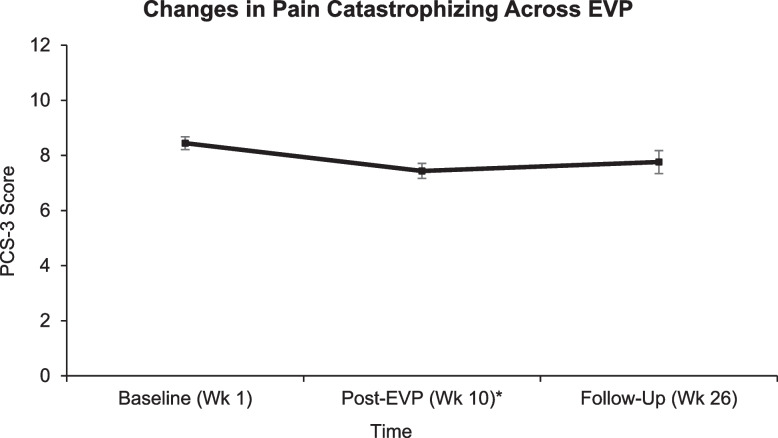
- Among 221 veteran participants, pain catastrophizing improved from baseline to post-treatment with a medium effect size (SMD = -0.345, p < .001), but this improvement was not sustained at week 26 (SMD = -0.204, p = .116).
- Pain interference showed a small pre-post improvement that did not meet the adjusted significance threshold (SMD = -0.256, p = .05), and pain intensity and kinesiophobia did not significantly change post-treatment or at week 26.
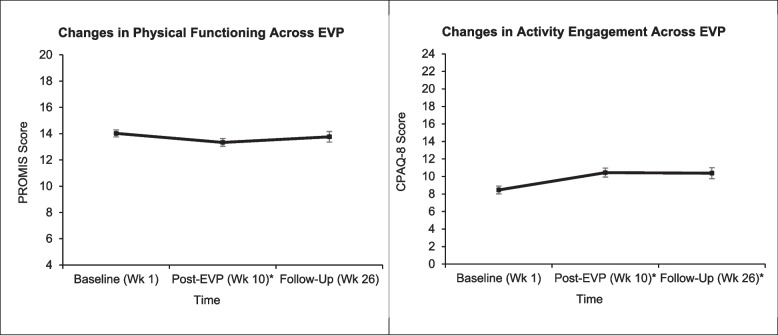
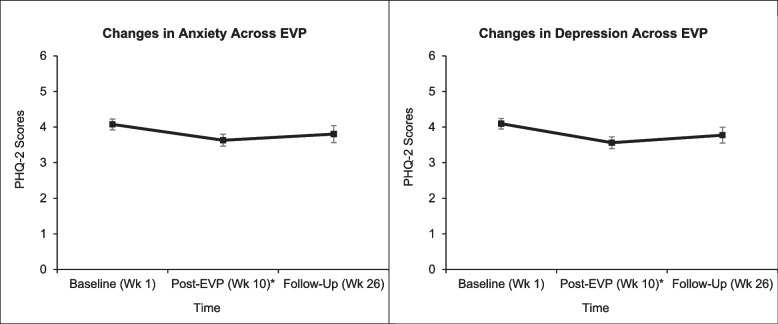
- Secondary outcomes showed pre-post improvements in anxiety (SMD = -0.256, p = .008), depression (SMD = -0.296, p = .002), and activities engagement (SMD = 0.364, p < .001); only activities engagement remained significant at week 26 (SMD = 0.376, p < .001).
- TelePain-EVP satisfaction was high: median satisfaction was 4.00 (IQR = 2.00) on a 5-point scale, and scores were significantly higher than “fair” (2.00; p < .001).
## Methods
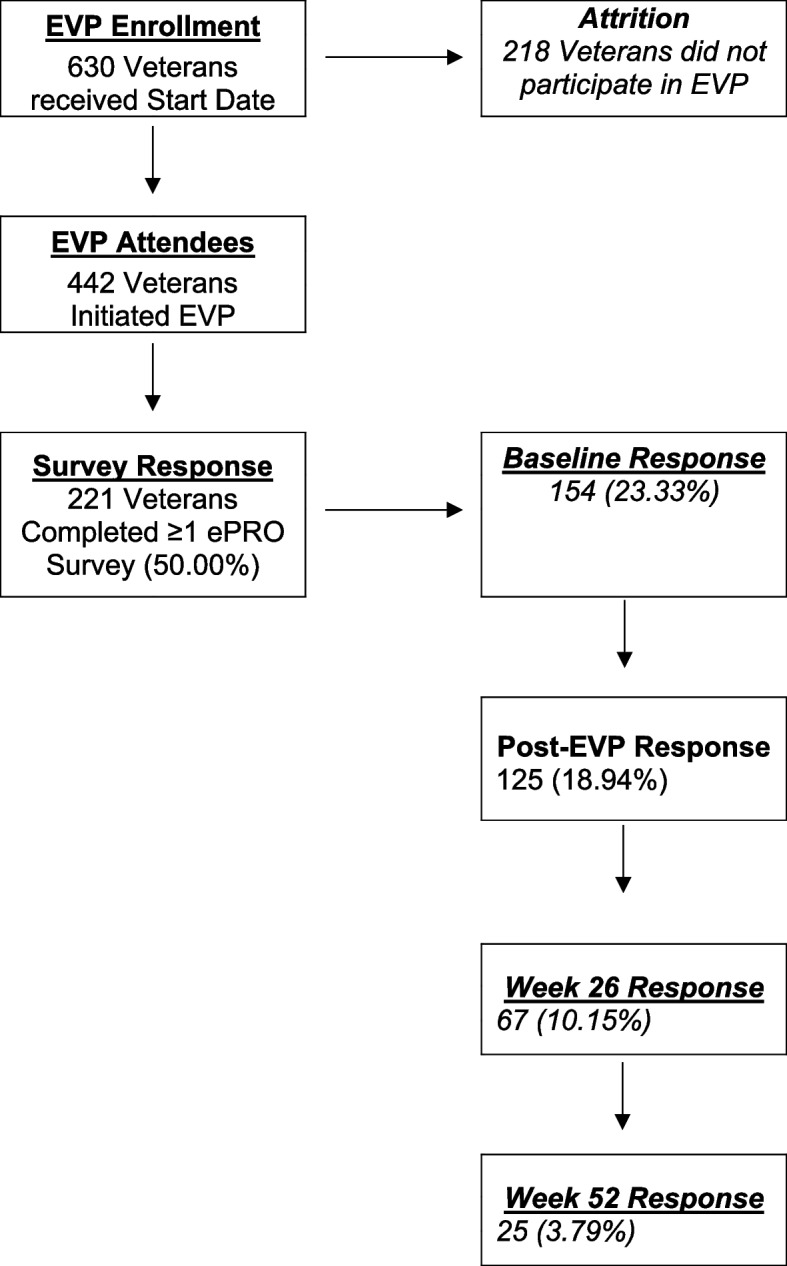
- Within-participants repeated-measures design as part of a larger quality improvement/implementation evaluation, with assessments at week 1 (baseline), week 10 (post-EVP), week 26, and week 52; however, week 52 data were excluded from primary analyses due to low response (n = 25; 3.79%).
- Sample: 221 veterans with chronic pain who completed at least one ePRO survey; 630 were targeted, 442 initiated TelePain-EVP, and 218 did not attend and were excluded.
- Main analysis: linear mixed models with time, dose, and time-by-dose interaction as fixed effects; random intercepts and an autoregressive covariance matrix were used, with significance set at p = .01. Satisfaction was tested with a one-sample Wilcoxon signed-rank test against “fair” satisfaction.
## Limitations
- The paper states this was a pragmatic quality improvement evaluation without randomized and/or blinded controls, leaving results vulnerable to self-selection/referral bias and confounding, and limiting generalizability.
- The paper states the single-site setting at a VA medical center in the southeastern United States may limit generalizability, though it also notes the representation of minority veterans is a strength.
- The paper states the low response rate at week 26 reduced statistical power and may have inflated effect sizes; additionally, the text makes evident that self-reported outcomes are subjective and that exclusion of week 52 data due to low response further limits long-term inference.
Model-written summary. Check it against the paper before relying on it.
Integrity signals
Registry
Cites
Statistics
Figures
Verification
Claims the paper makes
19 Valid · 1 Not valid · 1 Not checked · 52 Own results and interpretations
The cited sources support only part of this claim — read each source’s verdict below.
In the paper
“A pre-post pilot evaluation [40] found medium-to-large effect size improvements in pain intensity, catastrophizing, and health-related quality of life (HRQoL) among veterans that graduated (attended ≥ 8 of 10 sessions) from EVP.”
§ Benchmark findings from a veteran electronic patient-reported outcomes evaluation from a chronic pain management telehealth program > Background
What the sources say
- Partly supportedcites [40] Uche. Evaluation of the Empower Veterans Program for Military Veterans with chronic pain. J Clin Outcomes Manag. 2022;29(2). 10.12788/jcom.0089. sourceExperimental — accuracy not yet measured
The Results and Discussion (page unavailable) report pre–post improvements in pain intensity, catastrophizing, and quality of life among 67 EVP completers, describing the effect sizes overall as moderate to large. The Intervention describes a 10-week program, but the passages do not define completion or graduation as attending at least 8 of 10 sessions. (LLM, conf=0.86)
plainstates an association- Asserted: passes — The authors put it forward as true.
- Checkable: passes — It can be checked against evidence.
- Load-bearing: passes — The paper’s conclusions depend on it.
- Based: passes — The paper gives a reason why it holds.
- Partly supported
Every source the paper cites for this claim was checked and supports it.
In the paper
“However, in the largest EVP evaluation to date, graduation status did not predict pre-post improvements for any primary or secondary outcomes when adjusting for family-wise error rate [36].”
§ Benchmark findings from a veteran electronic patient-reported outcomes evaluation from a chronic pain management telehealth program > Background
What the sources say
- Supportedcites [36] Haun JN Fowler CA Venkatachalam HH Empower Veterans Program (EVP): a chronic pain management program demonstrates positive outcomes among veterans BMC Health Serv Res 2023 23 1 431 10.1186/s12913-023-09327-5 37138319 PMC10155644 source
The Results (Primary analyses; page unavailable) state that none of the patient-reported outcome models showed a significant time-by-graduation interaction after the Bonferroni adjustment. The Methods (Outcome measures; page unavailable) identify the primary and secondary outcomes examined, so this supports the claim that graduation status did not predict their pre-post changes at the adjusted threshold. (LLM, conf=0.91)
plain- Asserted: passes — The authors put it forward as true.
- Checkable: passes — It can be checked against evidence.
- Load-bearing: passes — The paper’s conclusions depend on it.
- Based: passes — The paper gives a reason why it holds.
- Supported
The cited sources support only part of this claim — read each source’s verdict below.
In the paper
“ACT has shown effectiveness for functional and quality of life improvements when interventions directly targeting nociceptive pain achieve limited success [30, 31].”
§ Benchmark findings from a veteran electronic patient-reported outcomes evaluation from a chronic pain management telehealth program > Background
What the sources say
- Partly supportedcites [30] McCracken LM Vowles KE Acceptance and commitment therapy and mindfulness for chronic pain: model, process, and progress Am Psychol 2014 69 2 178 187 10.1037/a0035623 24547803 sourceExperimental — accuracy not yet measured
The “ACT for Chronic Pain: Model, Process, and Evidence” section reports improved physical and social functioning and discusses life satisfaction as an outcome in an ACT trial. “The Success of CBT for Chronic Pain” also says functioning can improve even when pain remains unchanged. The paper does not establish that ACT was effective specifically when interventions targeting nociceptive pain had achieved limited success. (LLM, conf=0.84)
- Partly supportedcites [31] Vowles KE Fink BC Cohen LL Acceptance and commitment therapy for chronic pain: a diary study of treatment process in relation to reliable change in disability J Context Behav Sci 2014 3 2 74 80 10.1016/j.jcbs.2014.04.003 PMC5096642 27818931 sourceExperimental — accuracy not yet measured
The Results report reliable improvement in disability for 10 of 21 patients after ACT, supporting the functional-improvement claim. The Introduction describes ACT as useful when efforts to control or reduce pain have failed, and the Discussion says disability reduction did not require a change in pain intensity. The study does not establish quality-of-life improvement or compare ACT with interventions directly targeting nociceptive pain. (LLM, conf=0.84)
plainstates a cause- Asserted: passes — The authors put it forward as true.
- Checkable: passes — It can be checked against evidence.
- Load-bearing: passes — The paper’s conclusions depend on it.
- Based: passes — The paper gives a reason why it holds.
- Partly supported
The cited sources support only part of this claim — read each source’s verdict below.
In the paper
“The effectiveness of integrated interdisciplinary chronic pain programs on improving multi-dimensional pain outcomes is well-established in VA settings [32–36].”
§ Benchmark findings from a veteran electronic patient-reported outcomes evaluation from a chronic pain management telehealth program > Background
What the sources say
- Supportedcites [32] Murphy JL Palyo SA Schmidt ZS The resurrection of interdisciplinary pain rehabilitation: outcomes across a veterans affairs collaborative Pain Med 2021 22 2 430 443 10.1093/pm/pnaa417 33496787 PMC8599775 source
The Discussion reports statistically significant improvements in nearly all patient-reported outcomes across six VA interdisciplinary pain programs, including pain-related functioning, catastrophizing, and sleep difficulties. It also states that these outcomes support the programs’ effectiveness; the Introduction describes the broader evidence for interdisciplinary pain programs as robust. (LLM, conf=0.91)
- Partly supportedcites [33] Glynn LH Chen JA Dawson TC Gelman H Zeliadt SB Bringing chronic-pain care to rural veterans: a telehealth pilot program description Psychol Serv 2021 18 3 310 318 10.1037/ser0000408 31944817 PMC7927421 sourceExperimental — accuracy not yet measured
The Problem Description and Available Knowledge section says biopsychosocial treatments improve functional status and may be enhanced by a comprehensive interdisciplinary approach. It does not establish that integrated programs improve multidimensional pain outcomes specifically in VA settings. The Limitations section says this VA pilot could not support conclusions about its clinical utility. (LLM, conf=0.85)
- Not checked — no full text of the sourcecites [34] Chen JA DeFaccio RJ Gelman H Telehealth and rural-urban differences in receipt of pain care in the Veterans Health Administration Pain Med 2022 23 3 466 474 10.1093/pm/pnab194 34145892 source
- Not checked — no full text of the sourcecites [35] Murphy JL Clark ME Banou E Opioid cessation and multidimensional outcomes after interdisciplinary chronic pain treatment Clin J Pain 2013 29 2 109 117 10.1097/AJP.0b013e3182579935 22751033 source
- Partly supportedcites [36] Haun JN Fowler CA Venkatachalam HH Empower Veterans Program (EVP): a chronic pain management program demonstrates positive outcomes among veterans BMC Health Serv Res 2023 23 1 431 10.1186/s12913-023-09327-5 37138319 PMC10155644 sourceExperimental — accuracy not yet measured
The Discussion reports improvements across pain, physical, psychological, and quality-of-life measures after EVP and describes similar findings from other VA programs. But the Conclusions call the EVP findings preliminary, and the Discussion notes a single-site sample without randomization or an adequate control group. The source therefore supports reported multidimensional improvements in VA programs, not the stronger claim that their effectiveness is well-established. (LLM, conf=0.85)
boostedstates a cause- Asserted: passes — The authors put it forward as true.
- Checkable: passes — It can be checked against evidence.
- Load-bearing: unclear — It is unclear whether the paper’s conclusions depend on it.
- Based: passes — The paper gives a reason why it holds.
- Supported
Every source the paper cites for this claim was checked and supports it.
In the paper
“A larger pre-post quality management project [36] found clinical small-to-medium effect size improvements in primary outcomes including pain intensity, interference, and catastrophizing.”
§ Benchmark findings from a veteran electronic patient-reported outcomes evaluation from a chronic pain management telehealth program > Background
What the sources say
- Supportedcites [36] Haun JN Fowler CA Venkatachalam HH Empower Veterans Program (EVP): a chronic pain management program demonstrates positive outcomes among veterans BMC Health Serv Res 2023 23 1 431 10.1186/s12913-023-09327-5 37138319 PMC10155644 source
The Results (Primary analyses; page not provided) report baseline-to-post-EVP decreases in all three primary pain outcomes, with small-to-medium effect sizes. The Discussion identifies the work as a clinical quality management effort. (LLM, conf=0.93)
plainstates a cause- Asserted: passes — The authors put it forward as true.
- Checkable: passes — It can be checked against evidence.
- Load-bearing: passes — The paper’s conclusions depend on it.
- Based: passes — The paper gives a reason why it holds.
- Supported
43 more claims · 5 with their cited sources checked
Create a free account to see all 73 claims and every source verdict.
- It may state two separate claims as one. 22
- Probably not a substantial claim. 8
- The quote only partly states this claim. 1
Citations
Cites
Vos, T., Abajobir, A. A., Abate, K. H., Abbafati, C., Abbas, K. M., Abd-Allah, F., Abdulkader, R. S., Abdulle, A. M., Abebo, T. A., Abera, S. F., et al. (2017) · The Lancet · doi:10.1016/s0140-6736(17)32154-2 · Cited by 13,220 · cited 1×
“Chronic pain is a leading cause of disability [1], impacting more the 50 million American adults [2].”
BackgroundLakens, D. (2013) · Frontiers in Psychology · doi:10.3389/fpsyg.2013.00863 · Cited by 10,303 · cited 1×
“Mixed model analyses were conducted using Analyses used Proc Mixed in SAS ® version 9.4 Cary, NC. Standardized mean differences (SMD) effects sizes for correlated samples were calculated to determine changes across time points using a Microsoft Excel macro [60].”
MethodInfluentialThe Pain Catastrophizing Scale: Development and validation.
Sullivan, M. J. L., Bishop, S. R., & Pivik, J. (1995) · Psychological Assessment · doi:10.1037//1040-3590.7.4.524 · Cited by 8,227
Power failure: why small sample size undermines the reliability of neuroscience
Button, K. S., Ioannidis, J. P. A., Mokrysz, C., Nosek, B. A., Flint, J., Robinson, E. S. J., & Munafò, M. R. (2013) · Nature Reviews Neuroscience · doi:10.1038/nrn3475 · Cited by 7,641 · cited 1×
“The lower response rate at week 26 may also result in inflated effects sizes and lower reproducibility of results [63].”
BackgroundThe PHQ-9: A New Depression Diagnostic and Severity Measure
Kroenke, K., & Spitzer, R. L. (2002) · Psychiatric Annals · doi:10.3928/0048-5713-20020901-06 · Cited by 5,898
Cella, D., Riley, W., Stone, A., Rothrock, N., Reeve, B., Yount, S., Amtmann, D., Bode, R., Buysse, D., Choi, S., et al. (2010) · Journal of Clinical Epidemiology · doi:10.1016/j.jclinepi.2010.04.011 · Cited by 5,128
Prevalence of Chronic Pain and High-Impact Chronic Pain Among Adults — United States, 2016
Dahlhamer, J., Lucas, J., Zelaya, Nahin, R., Mackey, S., DeBar, L., Kerns, R., Von Korff, M., Porter, L., & Helmick, C. (2018) · MMWR. Morbidity and Mortality Weekly Report · doi:10.15585/mmwr.mm6736a2 · Cited by 2,598 · cited 3×
“%) chronic pain in the veteran population versus the general public [2, 7].”
BackgroundFlexible Imputation of Missing Data, Second Edition
van Buuren, S. (2018) · doi:10.1201/9780429492259 · Cited by 2,273
Association Between Opioid Prescribing Patterns and Opioid Overdose-Related Deaths
Bohnert, A. S. B. (2011) · JAMA · doi:10.1001/jama.2011.370 · Cited by 1,509
Lew, H. L., Otis, J. D., Tun, C., Kerns, R. D., Clark, M. E., & Cifu, D. X. (2009) · The Journal of Rehabilitation Research and Development · doi:10.1682/jrrd.2009.01.0006 · Cited by 655 · cited 1×
“Incidence of chronic pain may be even higher among combat veterans with estimates of up to 81.5% among Operation Enduring Freedom and Iraqi Freedom veterans [8].”
BackgroundInfluentialAcceptance and commitment therapy and mindfulness for chronic pain: Model, process, and progress.
McCracken, L. M., & Vowles, K. E. (2014) · American Psychologist · doi:10.1037/a0035623 · Cited by 627 · cited 2×
“Hence, ACT may indirectly reduce pain interference [29, 30].”
BackgroundPark, T. W., Saitz, R., Ganoczy, D., Ilgen, M. A., & Bohnert, A. S. B. (2015) · BMJ · doi:10.1136/bmj.h2698 · Cited by 579 · cited 1×
“Of the approximately 2,400 who died from a drug overdose, roughly half ( n = 1,185) were also prescribed benzodiazepines [22].”
BackgroundSeal, K. H., Shi, Y., Cohen, G., Cohen, B. E., Maguen, S., Krebs, E. E., & Neylan, T. C. (2012) · JAMA · doi:10.1001/jama.2012.234 · Cited by 515
Wetherell, J. L., Afari, N., Rutledge, T., Sorrell, J. T., Stoddard, J. A., Petkus, A. J., Solomon, B. C., Lehman, D. H., Liu, L., Lang, A. J., et al. (2011) · PAIN · doi:10.1016/j.pain.2011.05.016 · Cited by 508 · cited 1×
“Consistent with the VA’s mission to address chronic pain as a biopsychosocial condition, contemporary treatment approaches including Acceptance and Commitment Therapy (ACT) expand their focus beyond reducing pain severity alone [14, 27, 28].”
BackgroundPrevalence and Profile of High-Impact Chronic Pain in the United States
Pitcher, M. H., Von Korff, M., Bushnell, M. C., & Porter, L. (2019) · The Journal of Pain · doi:10.1016/j.jpain.2018.07.006 · Cited by 470 · cited 1×
“Chronic pain can negatively impact the biological/physical, psychological, and social areas of an individual’s life resulting in significant pain interference or disability in their functioning and daily lives (high-impact chronic pain) [4, 5].”
BackgroundBohnert, A. S. B., Guy, G. P., & Losby, J. L. (2018) · Annals of Internal Medicine · doi:10.7326/m18-1243 · Cited by 409 · cited 1×
“Such alarming findings and changes in guidelines for prescription opioid use have led to decreases in prescribing trends nationally [17, 23].”
BackgroundEmergency Department Visits and Overdose Deaths From Combined Use of Opioids and Benzodiazepines
Jones, C. M., & McAninch, J. K. (2015) · American Journal of Preventive Medicine · doi:10.1016/j.amepre.2015.03.040 · Cited by 376 · cited 1×
“…Network and the National Vital Statistics System databases from 2004–2011 revealed that concurrent opioid and benzodiazepine use was associated with significant increases in both emergency department visits (from 11.0 to 34.2 per 100,000) and overdose deaths (from 0.6 to 1.7 per 100,000) [21].”
BackgroundInfluentialon behalf of the PROMIS Cooperative Group, Hahn, E. A., DeVellis, R. F., Bode, R. K., Garcia, S. F., Castel, L. D., Eisen, S. V., Bosworth, H. B., Heinemann, A. W., Rothrock, N., et al. (2010) · Quality of Life Research · doi:10.1007/s11136-010-9654-0 · Cited by 372
(2020) · PubMed · Cited by 332
Fish, R. A., McGuire, B., Hogan, M., Morrison, T. G., & Stewart, I. (2010) · Pain · doi:10.1016/j.pain.2009.12.016 · Cited by 306
Severe pain in veterans: the effect of age and sex, and comparisons with the general population
Nahin, R. L. (2017) · The Journal of Pain · doi:10.1016/j.jpain.2016.10.021 · Cited by 293 · cited 1×
“%) chronic pain in the veteran population versus the general public [2, 7].”
BackgroundGraded chronic pain scale revised: mild, bothersome, and high-impact chronic pain
Von Korff, M., DeBar, L. L., Krebs, E. E., Kerns, R. D., Deyo, R. A., & Keefe, F. J. (2020) · Pain · doi:10.1097/j.pain.0000000000001758 · Cited by 276
Development and validation of a daily pain catastrophizing scale
Darnall, B. D., Sturgeon, J. A., Cook, K. F., Taub, C. J., Roy, A., Burns, J. W., Sullivan, M., & Mackey, S. C. (2017) · The Journal of Pain · doi:10.1016/j.jpain.2017.05.003 · Cited by 264
The difference between acute and chronic pain.
Grichnik, K. P., & Ferrante, F. M. (1991) · PubMed · Cited by 246
United States national pain strategy for population research: concepts, definitions, and pilot data.
Von Korff, M., Scher, A. I., Helmick, C., Carter-Pokras, O., Dodick, D. W., Goulet, J., Hamill-Ruth, R., LeResche, L., Porter, L., Tait, R., et al. (2016) · The Journal of Pain · doi:10.1016/j.jpain.2016.06.009 · Cited by 229 · cited 1×
“Chronic pain can negatively impact the biological/physical, psychological, and social areas of an individual’s life resulting in significant pain interference or disability in their functioning and daily lives (high-impact chronic pain) [4, 5].”
BackgroundMultiple Imputation of Missing Data for Multilevel Models: Simulations and Recommendations
Grund, S., Lüdtke, O., & Robitzsch, A. (2018) · Organizational Research Methods · doi:10.1177/1094428117703686 · Cited by 224
Psychological Interventions for the Treatment of Chronic Pain in Adults
Driscoll, M. A., Edwards, R. R., Becker, W. C., Kaptchuk, T. J., & Kerns, R. D. (2021) · Psychological Science in the Public Interest · doi:10.1177/15291006211008157 · Cited by 176 · cited 1×
“Consistent with the VA’s mission to address chronic pain as a biopsychosocial condition, contemporary treatment approaches including Acceptance and Commitment Therapy (ACT) expand their focus beyond reducing pain severity alone [14, 27, 28].”
BackgroundConnolly, S. L., Stolzmann, K. L., Heyworth, L., Weaver, K. R., Bauer, M. S., & Miller, C. J. (2021) · Telemedicine and e-Health · doi:10.1089/tmj.2020.0233 · Cited by 171 · cited 1×
“First, EVP evolved into a telehealth program (TelePain-EVP) in response to the COVID-19 pandemic which aligned VA’s mission to expand veteran access to telehealth services [36, 41, 42].”
BackgroundHiggins, D. M., Kerns, R. D., Brandt, C. A., Haskell, S. G., Bathulapalli, H., Gilliam, W., & Goulet, J. L. (2014) · Pain Medicine · doi:10.1111/pme.12388 · Cited by 168 · cited 1×
“The high prevalence of chronic pain in the veteran population can also contribute to the psychological health (e.g., depression, anxiety, sleep, posttraumatic stress disorder) and substance use disorders burden given that these are common comorbidities among people with chronic pain [9–12].”
BackgroundKrejci, L. P., Carter, K., & Gaudet, T. (2014) · Medical Care · doi:10.1097/mlr.0000000000000226 · Cited by 142 · cited 1×
“WH integrates complimentary and integrative modalities into conventional healthcare approaches to offer a patient-centered, values-driven approach to veteran health [38].”
BackgroundDevelopment and validation of the Pain Outcomes Questionnaire-VA
Clark, M. E., Gironda, R. J., & Young, R. W. (2003) · The Journal of Rehabilitation Research and Development · doi:10.1682/jrrd.2003.09.0381 · Cited by 131
Severe Pain Predicts Greater Likelihood of Subsequent Suicide
Ilgen, M. A., Zivin, K., Austin, K. L., Bohnert, A. S. B., Czyz, E. K., Valenstein, M., & Kilbourne, A. M. (2010) · Suicide and Life-Threatening Behavior · doi:10.1521/suli.2010.40.6.597 · Cited by 125 · cited 1×
“Furthermore, there may also be a dose–response relationship between increased veteran pain severity and completed suicide after accounting for demographic and psychological factors [13].”
BackgroundTurner, B. J., & Liang, Y. (2015) · Journal of General Internal Medicine · doi:10.1007/s11606-015-3199-4 · Cited by 109 · cited 1×
“Over reliance on the use of prescription opioids as a frontline treatment for chronic pain contributed to a national epidemic including increased rates of opioid addiction, accidental overdose, and even mortality [16–20].”
BackgroundChanging Trends in Opioid Overdose Deaths and Prescription Opioid Receipt Among Veterans
Lin, L. (., Peltzman, T., McCarthy, J. F., Oliva, E. M., Trafton, J. A., & Bohnert, A. S. B. (2019) · American Journal of Preventive Medicine · doi:10.1016/j.amepre.2019.01.016 · Cited by 90 · cited 1×
“Such alarming findings and changes in guidelines for prescription opioid use have led to decreases in prescribing trends nationally [17, 23].”
BackgroundChua, K.-P., Brummett, C. M., Conti, R. M., & Bohnert, A. (2020) · JAMA Pediatrics · doi:10.1001/jamapediatrics.2019.4878 · Cited by 90
Hill, M. L., Nichter, B., Na, P. J., Norman, S. B., Morland, L. A., Krystal, J. H., & Pietrzak, R. H. (2021) · Psychological Medicine · doi:10.1017/s0033291721002361 · Cited by 83 · cited 1×
“Furthermore, increased prevalence of psychological disorders (e.g., generalized anxiety) during COVID-19 may have introduced increased complications for veterans served by TelePain-EVP that were less prevalent in previous evaluations [62].”
BackgroundThe Association Between Chronic Pain and Prescription Drug Abuse in Veterans
Becker, W. C., Fiellin, D. A., Gallagher, R. M., Barth, K. S., Ross, J. T., & Oslin, D. W. (2009) · Pain Medicine · doi:10.1111/j.1526-4637.2009.00584.x · Cited by 82
Opioid Cessation and Multidimensional Outcomes After Interdisciplinary Chronic Pain Treatment
Murphy, J. L., Clark, M. E., & Banou, E. (2013) · The Clinical Journal of Pain · doi:10.1097/ajp.0b013e3182579935 · Cited by 81
The Readiness Ruler as a measure of readiness to change poly-drug use in drug abusers
Hesse, M. (2006) · Harm Reduction Journal · doi:10.1186/1477-7517-3-3 · Cited by 76
Acceptance and Commitment Therapy and Traditional Cognitive Behavior Therapy Approaches to Pain
Hayes, S. C., & Duckworth, M. P. (2006) · Cognitive and Behavioral Practice · doi:10.1016/j.cbpra.2006.04.002 · Cited by 68 · cited 1×
“Hence, ACT may indirectly reduce pain interference [29, 30].”
BackgroundChronic pain, posttraumatic stress disorder, and opioid intake: A systematic review
López-Martínez, A. E., Reyes-Pérez, Á., Serrano‐Ibáñez, E. R., Esteve, R., & Ramírez‐Maestre, C. (2019) · World Journal of Clinical Cases · doi:10.12998/wjcc.v7.i24.4254 · Cited by 66 · cited 1×
“The high prevalence of chronic pain in the veteran population can also contribute to the psychological health (e.g., depression, anxiety, sleep, posttraumatic stress disorder) and substance use disorders burden given that these are common comorbidities among people with chronic pain [9–12].”
BackgroundPositive affect and chronic pain: a preregistered systematic review and meta-analysis
Ong, A. D., Thoemmes, F. J., Ratner, K., Ghezzi‐Kopel, K., & Reid, M. C. (2020) · Pain · doi:10.1097/j.pain.0000000000001828 · Cited by 64
Becker, W. C., DeBar, L. L., Heapy, A. A., Higgins, D., Krein, S. L., Lisi, A., Makris, U. E., & Allen, K. D. (2018) · Journal of General Internal Medicine · doi:10.1007/s11606-018-4345-6 · Cited by 59 · cited 1×
“Given the significant burden and risk factor that chronic pain poses for veterans, it has been designated as a high priority area by Department of Veterans Affairs (VA) [14, 15].”
BackgroundVowles, K. E., Fink, B. C., & Cohen, L. L. (2014) · Journal of Contextual Behavioral Science · doi:10.1016/j.jcbs.2014.04.003 · Cited by 55 · cited 1×
“ACT has shown effectiveness for functional and quality of life improvements when interventions directly targeting nociceptive pain achieve limited success [30, 31].”
BackgroundMurphy, J. L., Palyo, S. A., Schmidt, Z. S., Hollrah, L. N., Banou, E., Van Keuren, C. P., & Strigo, I. A. (2021) · Pain Medicine · doi:10.1093/pm/pnaa417 · Cited by 54 · cited 1×
“The effectiveness of integrated interdisciplinary chronic pain programs on improving multi-dimensional pain outcomes is well-established in VA settings [32–36].”
BackgroundArcher, K. R., Phelps, K. D., Seebach, C. L., Song, Y., Riley, L. H., & Wegener, S. T. (2012) · Archives of Physical Medicine and Rehabilitation · doi:10.1016/j.apmr.2012.03.024 · Cited by 43
Bringing chronic-pain care to rural veterans: A telehealth pilot program description.
Glynn, L. H., Chen, J. A., Dawson, T. C., Gelman, H., & Zeliadt, S. B. (2021) · Psychological Services · doi:10.1037/ser0000408 · Cited by 40 · cited 1×
“Future research should focus on identifying patient profiles who will most/least benefit from the TelePain-EVP approach to pain management, compared to other TelePain management programs [33, 34] offered within the VA system.”
ResultPatterson, D. G., Wilson, D. K., Fishman, M. A., Moore, G., Skaribas, I. M., Heros, R. D., Dehghan, S., Ross, E., & Kyani, A. (2023) · npj Digital Medicine · doi:10.1038/s41746-023-00892-x · Cited by 38 · cited 1×
“Future studies should integrate objective outcome measures such as wearable devices to triangulate with subjective data sources [64].”
BackgroundPenney, L. S., & Haro, E. (2019) · Journal of Pain Research · doi:10.2147/jpr.s185652 · Cited by 32 · cited 4×
“Findings from these evaluations suggest that EVP is a workable non-pharmacological interdisciplinary rehabilitation option for veterans with chronic pain [36, 39, 40].”
BackgroundInfluentialTelehealth and Rural-Urban Differences in Receipt of Pain Care in the Veterans Health Administration
Chen, J. A., DeFaccio, R. J., Gelman, H., Thomas, E. R., Indresano, J. A., Dawson, T. C., Glynn, L. H., Sandbrink, F., & Zeliadt, S. B. (2022) · Pain Medicine · doi:10.1093/pm/pnab194 · Cited by 28 · cited 1×
“Future research should focus on identifying patient profiles who will most/least benefit from the TelePain-EVP approach to pain management, compared to other TelePain management programs [33, 34] offered within the VA system.”
ResultHaun, J. N., Alman, A. C., Melillo, C., Standifer, M., McMahon-Grenz, J., Shin, M., Lapcevic, W. A., Patel, N., & Elwy, A. R. (2020) · JMIR Medical Informatics · doi:10.2196/15609 · Cited by 22 · cited 1×
“Qualtrics has demonstrated usability for ePRO data collection within the VA system [57].”
BackgroundSelf-citationHaun, J. N., Fowler, C. A., Venkatachalam, H. H., Saenger, M. S., Alman, A. C., Smith, B. M., Schneider, T., Benzinger, R., Stroupe, K., & French, D. D. (2023) · BMC Health Services Research · doi:10.1186/s12913-023-09327-5 · Cited by 12 · cited 10×
“Veterans also provided high favorability ratings for EVP [36].”
BackgroundInfluentialSelf-citationSullivan, M. B., Hill, K., Ballengee, L. A., Knoblach, D., Fowler, C., Haun, J., & Saenger, M. (2023) · Global Advances in Integrative Medicine and Health · doi:10.1177/27536130231209751 · Cited by 10 · cited 2×
“MM within EVP teaches veterans to observe and accept mind–body experiences while emphasizing an open, nonjudgmental attitude [37].”
BackgroundSelf-citationWard, R., Rauch, S. A. M., Axon, R. N., & Saenger, M. S. (2023) · Health Services Research · doi:10.1111/1475-6773.14062 · Cited by 9 · cited 2×
“TelePain-EVP is an evidence-based program delivered in a weekly format over 10 consecutive weeks [36, 37, 39, 40, 43].”
BackgroundSelf-citationEvaluation of the Empower Veterans Program for Military Veterans With Chronic Pain
Uche (2022) · Journal of Clinical Outcomes Management · doi:10.12788/jcom.0089 · Cited by 8 · cited 8×
“Veterans also reported high program satisfaction [40].”
BackgroundResultInfluentialComplementary and Integrative Health Therapies for Opioid Overuse: An Opportunity for the VA.
Fletcher, C. E., Mitchinson, A., & Hinshaw, D. B. (2018) · Europe PMC (PubMed Central) · Cited by 6
Cited by
Areias, A. C., Doverspike, D., Brostek, D. F., Janela, D., Erwin, M. S., Pinter, J. M., Ficke, J. R., & Costa, F. M. T. A. (2024) · Healthcare · doi:10.3390/healthcare12151518 · Cited by 5
“In another study [21] (N = 221), evaluating a remote interdisciplinary program primarily focused on mental health (video calls conducted by pain physicians, physical therapists, or nurses) for Veterans with chronic MSP, no significant changes in pain were reported following the intervention, not…”
BackgroundResultInfluential
Metadata
- Authors
- Haun, J. N., Fowler, C. A., Smith, B. M., Cao, L., Stroupe, K. T., Lapcevic, W. A., Saenger, M. S., Benzinger, R. C., & French, D. D.
- Affiliations
- University of Utah (US)
- University of South Florida (US)
- Edward Hines, Jr. VA Hospital (US)
- James A. Haley Veterans' Hospital (US)
- Emory University (US)
- Northwestern University (US)
- Corresponding author
- Benzinger, Rachel C.
- ORCID
- Venue
- BMC Health Services Research
- Published
- 2024-03-28
- Volume
- 24
- Issue
- 1
- Pages
- 388-388
- ISSN
- 1472-6963 (ISSN-L)
- PMC
- PMC10976697
- OpenAlex
- W4394750606
- Cited by
- 2
- References
- 57
- Citations by year
- 2026: 1 · 2024: 1
- FWCI
- 0.56
- Type
- journal article
- Language
- en
- Open access
- gold
- dx.doi.org
- Licence
- cc-by
- creativecommons.org/licenses/by/4.0 (tdm)
- creativecommons.org/licenses/by/4.0 (vor)
- Locations
- BMC Health Services Research (publishedVersion, cc-by)
- PubMed Central (publishedVersion, cc-by)
- PubMed (publishedVersion)
- DOAJ (DOAJ: Directory of Open Access Journals) (submittedVersion)
- Funders
- The Department of Veterans Affairs, Veterans Health Administration, Office of Rural Health (OMAT ID# 16403,16404, 16405, 16489, 16490)
- Pain Management, Opioid Safety and Prescription Drug Monitoring Program Office (PMOP ID# SP8E-PMTIA160)
- Topics
- Health Sciences › Health Professions › Physical Therapy, Sports Therapy and Rehabilitation › Musculoskeletal pain and rehabilitation
- Health Sciences › Medicine › Public Health, Environmental and Occupational Health › Telemedicine and Telehealth Implementation
- Health Sciences › Medicine › Anesthesiology and Pain Medicine › Pain Management and Treatment
- Keywords
- chronic pain, veterans, telemedicine, electronic patient-reported outcomes, pain catastrophizing, pain interference, kinesiophobia, anxiety, depression, acceptance, non-pharmacological treatment, dose-response relationship, implementation evaluation, low back pain, quality management, cost-effectiveness
- MeSH terms
- Adult, Aged, Aged, 80 and over, Humans, Male, Middle Aged, Veterans, Telemedicine, Benchmarking, Young Adult, Chronic Pain, Pain Management
About these checks
Registry, retraction, Cites and statistics results are computed, not judged, with one exception: a printed reference that no index lists is read once by a model before it counts as a citation error. Claims are extracted by a model and kept only when their quote appears verbatim in the text; each cited source is then checked, with a model’s help, for whether it says what the claim relies on. Those verdicts can be wrong — read the claim’s quote and the cited source before relying on one.
The claim verdicts this report counts are experimental: their accuracy is not yet measured.
A language model drew the claims from the paper on 2026-10-11, under version 3 of the claim definition (model deepseek-v4.1-flash, prompt extract-v3).
A second model labelled each claim on 2026-10-11 (model jev-1.13-20260917, definition revision gold-guideline-v0.2).
Cited sources are checked with a language model’s help (gpt-6-sol).
Statistics and arithmetic are recomputed, not judged.
Confidence bands are shown only for fields calibrated on our annotated test set. None is calibrated yet, so no band is shown.
What counts as a claim ›How we measure confidence ›How we check this ›
Are you an author, or do you see a problem with this page? Request a review
Data sources
Bibliographic data: Semantic Scholar, OpenAlex, Crossref.
Contains information from the Semantic Scholar Academic Graph Datasets, made available under the ODC Attribution License (ODC-BY 1.0).
Semantic Scholar’s data is described in: Kinney, R., et al. (2023). The Semantic Scholar Open Data Platform. arXiv:2301.10140.
