

Comparison of registered and published outcomes in randomized controlled trials: a systematic review
Open accessThe DOI matches its Crossref record; 43 of the 44 references it cites were found in a registry or an index.
Abstract
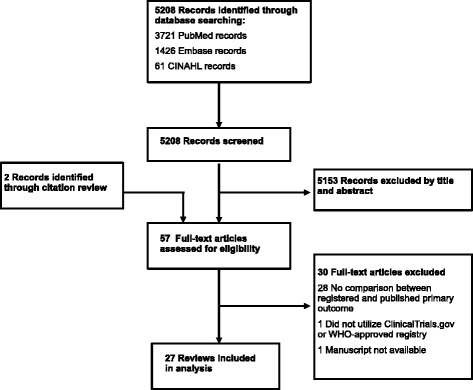
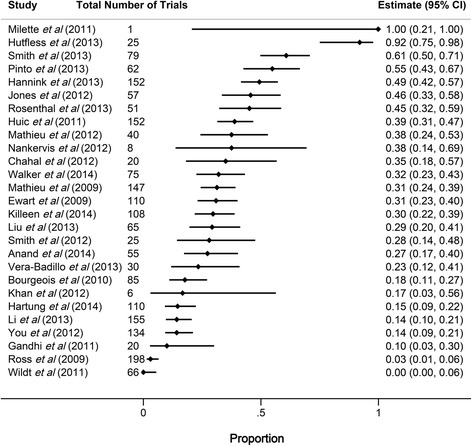
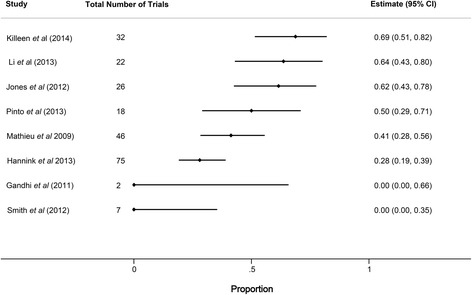
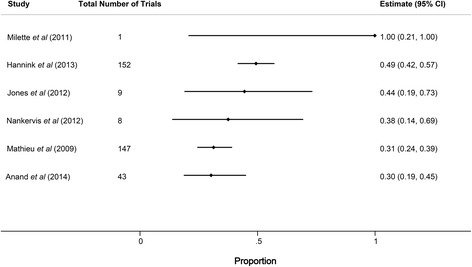
BACKGROUND: Clinical trial registries can improve the validity of trial results by facilitating comparisons between prospectively planned and reported outcomes. Previous reports on the frequency of planned and reported outcome inconsistencies have reported widely discrepant results. It is unknown whether these discrepancies are due to differences between the included trials, or to methodological differences between studies. We aimed to systematically review the prevalence and nature of discrepancies between registered and published outcomes among clinical trials. METHODS: We searched MEDLINE via PubMed, EMBASE, and CINAHL, and checked references of included publications to identify studies that compared trial outcomes as documented in a publicly accessible clinical trials registry with published trial outcomes. Two authors independently selected eligible studies and performed data extraction. We present summary data rather than pooled analyses owing to methodological heterogeneity among the included studies. RESULTS: Twenty-seven studies were eligible for inclusion. The overall risk of bias among included studies was moderate to high. These studies assessed outcome agreement for a median of 65 individual trials (interquartile range [IQR] 25-110). The median proportion of trials with an identified discrepancy between the registered and published primary outcome was 31%; substantial variability in the prevalence of these primary outcome discrepancies was observed among the included studies (range 0% (0/66) to 100% (1/1), IQR 17-45%). We found less variability within the subset of studies that assessed the agreement between prospectively registered outcomes and published outcomes, among which the median observed discrepancy rate was 41% (range 30% (13/43) to 100% (1/1), IQR 33-48%). The nature of observed primary outcome discrepancies also varied substantially between included studies. Among the studies providing detailed descriptions of these outcome discrepancies, a median of 13 % of trials introduced a new, unregistered outcome in the published manuscript (IQR 5-16%). CONCLUSIONS: Discrepancies between registered and published outcomes of clinical trials are common regardless of funding mechanism or the journals in which they are published. Consistent reporting of prospectively defined outcomes and consistent utilization of registry data during the peer review process may improve the validity of clinical trial publications.
Overview
The claims and statistics of this paper haven’t been checked yet.
Free: it reads the open-access text and checks the first 5 claims that cite a source we can check. Create a free account to check every claim.
Integrity signals
Registry
Cites
Statistics
Figures
Verification
Claims the paper makes
The claims and statistics of this paper haven’t been checked yet.
Free: it reads the open-access text and checks the first 5 claims that cite a source we can check. Create a free account to check every claim.
Claims other papers make about this one
Each is checked against this paper’s own text: does it say what the citing paper says it does?
The source backs part of the claim, not all of it — or backs it for a different population, condition or comparison.
In the citing paper
“Eight studies also assessed the impact of outcome switching on the statistical significance of the published outcome and found that outcome switching favoured the reporting of significant outcomes in half the trials.”
From COMPare: a prospective cohort study correcting and monitoring 58 misreported trials in real time (2019) · cites this paper as [1]
Experimental — accuracy not yet measuredThe source backs part of the claim, not all of it — or backs it for a different population, condition or comparison.
In the citing paper
“However, owing to lack of access to all measured outcomes, this biased reporting could not be assessed in many cases and therefore the reviewers concluded that this figure was likely to be an underestimate.”
From COMPare: a prospective cohort study correcting and monitoring 58 misreported trials in real time (2019) · cites this paper as [1]
Experimental — accuracy not yet measuredThe source backs part of the claim, not all of it — or backs it for a different population, condition or comparison.
In the citing paper
“However, despite near universal recognition of the importance of this issue and extensive public commitments to address the problem, trial reports in academic journals routinely fail to report pre-specified outcomes, and add in non-pre-specified outcomes, without disclosing that this has occurred.”
From COMPare: a prospective cohort study correcting and monitoring 58 misreported trials in real time (2019) · cites this paper as [1]
Experimental — accuracy not yet measuredThe source backs part of the claim, not all of it — or backs it for a different population, condition or comparison.
In the citing paper
“Several studies have compared journal article reports of studies with their corresponding protocols 23,24 , trials register entries 25,26 , or documents submitted to regulators 27 , and identified frequent nonreporting of results for outcomes that were prespecified.”
From Investigating and dealing with publication bias and other reporting biases in meta-analyses of health research: a review (2021) · cites this paper as [25]
Experimental — accuracy not yet measuredThe source backs part of the claim, not all of it — or backs it for a different population, condition or comparison.
In the citing paper
“Even when a study report is available, results for some outcomes that were assessed may be missing or incompletely reported because of the P value, or the magnitude or direction of the results (selective nonreporting bias or outcome reporting bias).”
From Investigating and dealing with publication bias and other reporting biases in meta-analyses of health research: a review (2021) · cites this paper as [25]
Experimental — accuracy not yet measured
5 more claims about this paper
Create a free account to see every claim other papers make about this one.
Self-check
Percentages, sums and reported differences re-computed from the paper’s own numbers.
The self-check needs the paper’s full text.
Citations
Cites
Preferred Reporting Items for Systematic Reviews and Meta-Analyses: the PRISMA statement
Moher, D., Liberati, A., Tetzlaff, J., Altman, D. G., & for the PRISMA Group (2009) · BMJ · doi:10.1136/bmj.b2535 · Cited by 83,823
Preferred reporting items for systematic reviews and meta-analyses: the PRISMA Statement.
(2009) · PubMed Central · Cited by 44,859
Preferred Reporting Items for Systematic Reviews and Meta-Analyses: The PRISMA Statement
Moher, D., Liberati, A., Tetzlaff, J., & Altman, D. G. (2009) · Journal of Clinical Epidemiology · doi:10.1016/j.jclinepi.2009.06.005 · Cited by 19,575
(2014) · Medical Entomology and Zoology · Cited by 17,633
CONSORT 2010 Statement: updated guidelines for reporting parallel group randomised trials
the CONSORT Group, Schulz, K. F., Altman, D. G., & Moher, D. (2010) · BMC Medicine · doi:10.1186/1741-7015-8-18 · Cited by 13,371
Moher, D., Hopewell, S., Schulz, K. F., Montori, V., Gotzsche, P. C., Devereaux, P. J., Elbourne, D., Egger, M., & Altman, D. G. (2010) · BMJ · doi:10.1136/bmj.c869 · Cited by 8,883
Two-sided confidence intervals for the single proportion: comparison of seven methods
Newcombe, R. G. (1998) · Statistics in Medicine · doi:10.1002/(sici)1097-0258(19980430)17:8<857::aid-sim777>3.0.co;2-e · Cited by 5,107 · cited 1×
“correction to calculate 95 % confidence intervals [14].”
BackgroundChan, A.-W., Hróbjartsson, A., Haahr, M. T., Gøtzsche, P. C., & Altman, D. G. (2004) · JAMA · doi:10.1001/jama.291.20.2457 · Cited by 1,845 · cited 2×
“were common [10]: for five studies the most common discrepancy was omission of”
BackgroundClinical Trial Registration: A Statement from the International Committee of Medical Journal Editors
De Angelis, C., Drazen, J. M., Frizelle, F. A., Haug, C., Hoey, J., Horton, R., Kotzin, S., Laine, C., Marusic, A., Overbeke, A. J. P. M., et al. (2004) · New England Journal of Medicine · doi:10.1056/nejme048225 · Cited by 1,241
The ClinicalTrials.gov Results Database — Update and Key Issues
Zarin, D. A., Tse, T., Williams, R. J., Califf, R. M., & Ide, N. C. (2011) · New England Journal of Medicine · doi:10.1056/nejmsa1012065 · Cited by 838 · cited 1×
“While utilization of the results database on the part of investigators has been mixed, improved compliance with this feature has the potential to streamline comparisons between planned and completed outcome analyses [41].”
Background
Cited by
Items 201–243 of 243
Assessment of the Risk of Bias
Moon, K., & Rao, S. C. (2021) · Springer eBooks · doi:10.1007/978-3-030-71921-0_4 · Cited by 2
van Dyk, G. (2009) · SMARTech Repository (Georgia Institute of Technology)
Amorim, J. D., & Scareli-Santos, C. (2022) · doi:10.22533/at.ed.50922180310
Helal, L. C. A. S., da Costa, G. G., Alves, C. P. D. L., Luizeti, B. O., Freccia, G. W., Gonçalves, L. S., Nascimento, D. P., Rice, D. B., Mayo‐Wilson, E., & Hoffmann, T. (2020) · MetArXiv (OSF Preprints) · doi:10.31222/osf.io/uegmb
Misleading information generated in medical journals that reaches the citizen electronically
Dal‐Ré, R. (2018) · Medicina Clínica (English Edition) · doi:10.1016/j.medcle.2018.03.029
Almgren, H., Parsons, N., Bossche, S. V. D., & Marinazzo, D. (2020) · MetArXiv (OSF Preprints) · doi:10.31222/osf.io/9hg3j
Vedula, S. S., Hróbjartsson, A., & Page, M. J. (2021) · Springer eBooks · doi:10.1007/978-3-319-52677-5_183-1
Left in the dark: the importance of publicly available clinical trial protocols
Braat, S., & Lee, K. J. (2022) · The Medical Journal of Australia · doi:10.5694/mja2.51773 · Cited by 1
Liu, H., Su, C., Li, Z., Yue, S., Cheng, S., & Peng, D. (2023) · Worldviews on Evidence-Based Nursing · doi:10.1111/wvn.12644 · Cited by 1
Designing and Deciphering Clinical Trials: Methodological Ingredients to Nourish a Healthy Study
Glantz, M., & Mansouri, A. (2023) · doi:10.1093/med/9780197573778.003.0028
Newell, B. R., & Shanks, D. R. (2023) · The MIT Press eBooks · doi:10.7551/mitpress/14922.003.0016
GPT's Performance in Identifying Outcome Changes on ClinicalTrials.govPreprint
Ying, X., Vorland, C. J., Qureshı, R., Brown, A. W., Kilicoglu, H., Saldanha, I. J., DeVito, N., & Mayo‐Wilson, E. (2024) · MetArXiv (OSF Preprints) · doi:10.31222/osf.io/npvwr · Cited by 3
Compton, W., Dennis, B., Clark, P., Smith, C., Nees, D., Hughes, G. K., & Vassar, M. B. (2024) · BJGP Open · doi:10.3399/bjgpo.2023.0183
López‐Alcalde, J., Tietjen, A. K., Yan, Y., Canella, C., Barth, J., Steinemann, N., Hägele-Link, S., Bolt, S., Baum, C., Rettenmund, G., et al. (2025) · BMJ Open · doi:10.1136/bmjopen-2024-095764
Sustainable Practices And Performance Outcomes: A Study Of Circular Economy In Indian Firms
Bandna, B., Shah, M. A., Hussain, I., & Hussain, M. (2025) · International Journal of Environmental Sciences · doi:10.64252/z73vjs60
Smith, H., & Vassar, M. B. (2025) · International Journal of Pediatric Otorhinolaryngology · doi:10.1016/j.ijporl.2025.112600
Lazzarini, S. G., Stella Yousif, M., Bargeri, S., Castellini, G., & Gianola, S. (2024) · Figshare · doi:10.6084/m9.figshare.24417626
Pool, L., Ruiz del Portal Luyten, C., van der Pluijm, R. W., Soentjens, P. H. P., Hänscheid, T., Grobusch, M. P., & Visser, B. J. (2024) · Figshare · doi:10.6084/m9.figshare.27140808
Pool, L., Ruiz del Portal Luyten, C., van der Pluijm, R. W., Soentjens, P. H. P., Hänscheid, T., Grobusch, M. P., & Visser, B. J. (2024) · Figshare · doi:10.6084/m9.figshare.27140811
Stoll, M., Lindner, S., Marquardt, B., Salholz‐Hillel, M., DeVito, N. J., Klemperer, D., & Lieb, K. (2024) · Figshare · doi:10.6084/m9.figshare.26607439
Konno, K., Gibbons, J., Lewis, R., & Pullin, A. S. (2024) · Figshare · doi:10.6084/m9.figshare.26677886
Konno, K., Gibbons, J., Lewis, R., & Pullin, A. S. (2024) · Figshare · doi:10.6084/m9.figshare.26677889
Jones, C. W., Adams, A., Murphy, E., King, R., Saracco, B., Stesis, K., Cavanaugh, S., Roberts, B. W., & Platts-Mills, T. F. (2021) · Figshare · doi:10.6084/m9.figshare.14752319
Self-citationLazzarini, S. G., Stella Yousif, M., Bargeri, S., Castellini, G., & Gianola, S. (2023) · Figshare · doi:10.6084/m9.figshare.24417576
Additional file 1 of Changes to aspects of ongoing randomised controlled trials with fixed designs
Coskinas, X., Simes, J., Schou, I. M., & Martin, A. J. (2020) · Figshare · doi:10.6084/m9.figshare.12421991
Stoll, M., Lindner, S., Marquardt, B., Salholz‐Hillel, M., DeVito, N. J., Klemperer, D., & Lieb, K. (2024) · Figshare · doi:10.6084/m9.figshare.26607442
Additional file 2 of Changes to aspects of ongoing randomised controlled trials with fixed designs
Coskinas, X., Simes, J., Schou, I. M., & Martin, A. J. (2020) · Figshare · doi:10.6084/m9.figshare.12421997
Stoll, M., Lindner, S., Marquardt, B., Salholz‐Hillel, M., DeVito, N. J., Klemperer, D., & Lieb, K. (2024) · Figshare · doi:10.6084/m9.figshare.26607436
Buitrago-Garcia, D., Mehouachi, S., Agoritsas, T., Iudici, M., & Mongin, D. (2026) · Seminars in Arthritis and Rheumatism · doi:10.1016/j.semarthrit.2026.152926
Navigating Analytical Challenges in Clinical Trials Using the Multiverse Approach
Crenshaw, A. O., Pukay-Martin, N. D., Wagner, A. C., Schobitz, R. P., Yarvis, J. S., Young-McCaughan, S., Mintz, J., Straud, C. L., Litz, B. T., Riggs, D., et al. (2026) · Collabra Psychology · doi:10.1525/collabra.155619 · Cited by 1
Šaler, F., Paladin, I., Blažeković, I., Boras, E., Tokalić, R., Viđak, M., & Puljak, L. (2026) · Journal of Clinical Epidemiology · doi:10.1016/j.jclinepi.2026.112227
Poursalehian, M., Sahebi, M., Tajvidi, M., Sabaghian, A., Asgari, A.-M., Tabaie, S. A., & Hoveidaei, A. H. (2026) · Clinical Orthopaedics and Related Research · doi:10.1097/corr.0000000000003910
Le gaspillage évitable de la recherche dans les essais cliniques
Yordanov, Y. (2019) · theses.fr (ABES) · doi:10.70675/130e8831z862fz47f2z8000z2f04c8541788
Martinić-Cezar, I. J., Pranić, S. M., Tavra, A., & Marušić, A. (2026) · Journal of Clinical Medicine · doi:10.3390/jcm15103981
“Such omissions may limit the interpretability, generalizability, and reproducibility of published findings, particularly when outcome definitions or timing are affected [42].”
Study preregistration: an early example and analysis
Wiseman, R. J., & Watt, C. A. (2026) · PeerJ · doi:10.7717/peerj.21360 · Cited by 1
“Within clinical trials (an early adopter of preregistration) around one third of preregistered trials have a discrepancy between the preregistered and the published primary outcome measure ( Jones et al., 2015 ; see also Goldacre et al., 2019 ; Claesen et al., 2021 ).”
Ying, X., Ninan, K., Oberste, J.-P., Vorland, C. J., Li, T., Brown, A. W., Menke, J. D., Qureshi, R., DeVito, N., Page, M. J., et al. (2026) · npj Digital Medicine · doi:10.1038/s41746-026-03045-y · Cited by 2
Shifts in Clinical Practice–Changing Acute Ischemic Stroke Research Over the Past Decade
Khalid, M., Nguyen, C., Li, J., Bala, A., Jovin, T. G., Jadhav, A. P., Le, N. M., Gomez-Farias, J., Kanakhara, F., Lee, E., et al. (2026) · Stroke Vascular and Interventional Neurology · doi:10.1161/svin.126.002479 · Cited by 1
Jain, G. (2026) · Asian Journal of Oral Health and Allied Sciences · doi:10.18231/j.ajohas.92652.1791448949
Narbekovas, K., Kuemmerli, C., Huegli, S., Sijberden, J. P., Widmer, L. W., Strobel, O., Stauffer, M., Ludmir, E. B., & Leonhardt, C.-S. (2026) · BJS Open · doi:10.1093/bjsopen/zrag160
“A systematic review 35 comparing registered and published primary outcomes reported a median discrepancy rate of 31%.”
Metadata
- Authors
- Jones, C. W., Keil, L. G., Holland, W. C., Caughey, M. C., & Platts-Mills, T. F.
- Affiliations
- Cooper Medical School of Rowan University (US)
- University of North Carolina at Chapel Hill (US)
- Corresponding author
- Jones, Christopher W.
- Venue
- BMC Medicine
- Published
- 2015-11-18
- Volume
- 13
- Issue
- 1
- Pages
- 282-282
- ISSN
- 1741-7015 (ISSN-L)
- PMC
- PMC4650202
- OpenAlex
- W2180048566
- Cited by
- 237
- References
- 44
- Citations by year
- 2026: 11 · 2025: 7 · 2024: 20 · 2023: 17 · 2022: 15 · 2021: 30 · 2020: 30 · 2019: 30 · 2018: 32 · 2017: 27 · 2016: 17
- FWCI
- 4.17
- Type
- journal article
- Language
- en
- Open access
- gold
- doi.org
- Licence
- cc-by
- Locations
- BMC Medicine (publishedVersion, cc-by)
- PubMed Central (publishedVersion, cc-by)
- PubMed (publishedVersion)
- Carolina Digital Repository (University of North Carolina at Chapel Hill) (submittedVersion)
- Funders
- National Institute on Aging (K23AG038548)
- Topics
- Social Sciences › Decision Sciences › Statistics, Probability and Uncertainty › Meta-analysis and systematic reviews
- Physical Sciences › Mathematics › Statistics and Probability › Statistical Methods in Clinical Trials
- Health Sciences › Nursing › Issues, ethics and legal aspects › Pharmaceutical industry and healthcare
- Keywords
- clinical trial registries, clinical trial registration, reporting bias, peer review, trial validity
- MeSH terms
- Humans, Peer Review, Publications, Registries, Bias, Randomized Controlled Trials as Topic, Treatment Outcome
About these checks
Registry, retraction, Cites and statistics results are computed, not judged, with one exception: a printed reference that no index lists is read once by a model before it counts as a citation error. Claims are extracted by a model and kept only when their quote appears verbatim in the text; each cited source is then checked, with a model’s help, for whether it says what the claim relies on. Those verdicts can be wrong — read the claim’s quote and the cited source before relying on one.
Statistics and arithmetic are recomputed, not judged.
Confidence bands are shown only for fields calibrated on our annotated test set. None is calibrated yet, so no band is shown.
What counts as a claim ›How we measure confidence ›How we check this ›
Are you an author, or do you see a problem with this page? Request a review
Data sources
Bibliographic data: Semantic Scholar, OpenAlex, Crossref.
Contains information from the Semantic Scholar Academic Graph Datasets, made available under the ODC Attribution License (ODC-BY 1.0).
Semantic Scholar’s data is described in: Kinney, R., et al. (2023). The Semantic Scholar Open Data Platform. arXiv:2301.10140.
