

Gestational weight gain across continents and ethnicity: systematic review and meta-analysis of maternal and infant outcomes in more than one million women
Open accessThe DOI matches its Crossref record; 61 of the 61 references it cites were found in a registry or an index.
Abstract
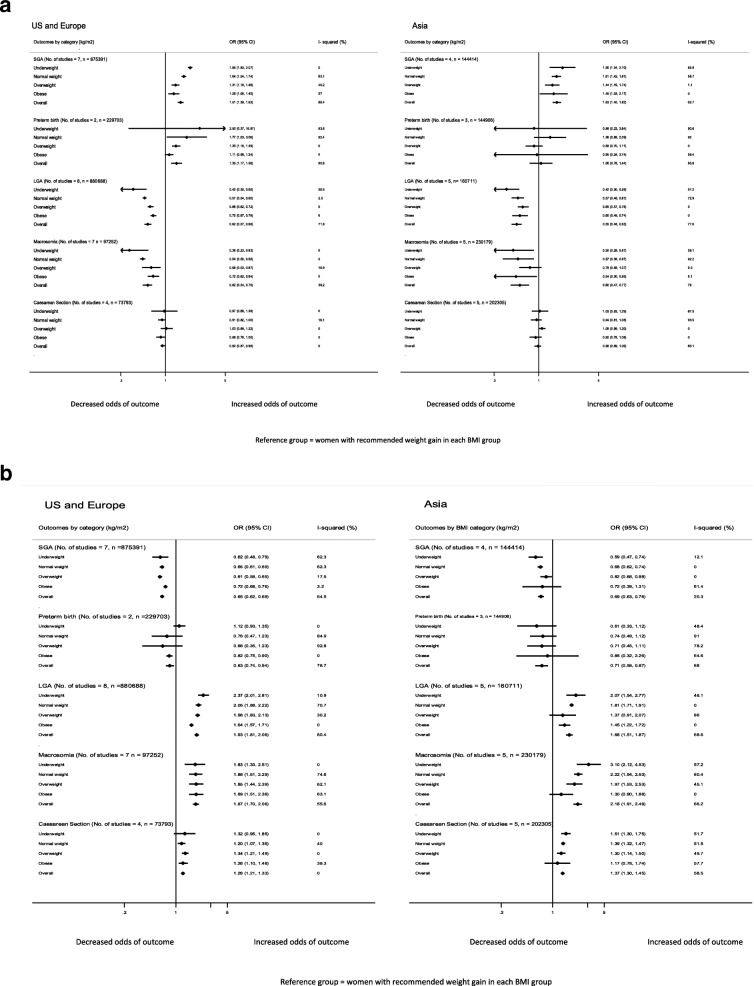
BACKGROUND: The association between Institute of Medicine (IOM) guidelines and pregnancy outcomes across ethnicities is uncertain. We evaluated the associations of gestational weight gain (GWG) outside 2009 IOM guidelines, with maternal and infant outcomes across the USA, western Europe and east Asia, with subgroup analyses in Asia. The aim was to explore ethnic differences in maternal prepregnancy body mass index (BMI), GWG and health outcomes across these regions. METHODS: Systematic review, meta-analysis and meta-regression of observational studies were used for the study. MEDLINE, MEDLINE In-Process, Embase and all Evidence-Based Medicine (EBM) Reviews were searched from 1999 to 2017. Studies were stratified by prepregnancy BMI category and total pregnancy GWG. Odds ratio (ORs) 95% confidence intervals (CI) applied recommended GWG within each BMI category as the reference. Primary outcomes were small for gestational age (SGA), preterm birth and large for gestational age (LGA). Secondary outcomes were macrosomia, caesarean section and gestational diabetes. RESULTS: Overall, 5874 studies were identified and 23 were included (n = 1,309,136). Prepregnancy overweight/obesity in the USA, Europe and Asia was measured at 42%, 30% and 10% respectively, with underweight 5%, 3% and 17%. GWG below guidelines in the USA, Europe and Asia was 21%, 18% and 31%, and above was 51%, 51% and 37% respectively. Applying regional BMI categories in Asia showed GWG above guidelines (51%) was similar to that in the USA and Europe. GWG below guidelines was associated with a higher risk of SGA (USA/Europe [OR 1.51; CI 1.39, 1.63]; Asia [1.63; 1.45, 1.82]) and preterm birth (USA/Europe [1.35; 1.17, 1.56]; Asia [1.06; 0.78, 1.44]) than GWG within guidelines. GWG above guidelines was associated with a higher risk of LGA (USA/Europe [1.93; 1.81, 2.06]; Asia [1.68; 1.51 , 1.87]), macrosomia (USA/Europe [1.87; 1.70, 2.06]; Asia [2.18; 1.91, 2.49]) and caesarean (USA/Europe [1.26; 1.21, 1.33]; Asia [1.37; 1.30, 1.45]). Risks remained elevated when regional BMI categories were applied for GWG recommendations. More women in Asia were categorised as having GWG below guidelines using World Health Organization (WHO) (60%) compared to regional BMI categories (16%), yet WHO BMI was not accompanied by increased risks of adverse outcomes. CONCLUSIONS: Women in the USA and western Europe have higher prepregnancy BMI and higher rates of GWG above guidelines than women in east Asia. However, when using regional BMI categories in east Asia, rates of GWG above guidelines are similar across the three continents. GWG outside guidelines is associated with adverse outcomes across all regions. If regional BMI categories are used in east Asia, IOM guidelines are applicable in the USA, western Europe and east Asia.
Overview
The claims and statistics of this paper haven’t been checked yet.
Free: it reads the open-access text and checks the first 5 claims that cite a source we can check. Create a free account to check every claim.
Integrity signals
Registry
Cites
Statistics
Figures
Verification
Claims the paper makes
The claims and statistics of this paper haven’t been checked yet.
Free: it reads the open-access text and checks the first 5 claims that cite a source we can check. Create a free account to check every claim.
Claims other papers make about this one
Each is checked against this paper’s own text: does it say what the citing paper says it does?
The source backs part of the claim, not all of it — or backs it for a different population, condition or comparison.
In the citing paper
“Excessive GWG is more common in women who are overweight or obese (64%) and is linked to higher risks of delivering large-for-gestational-age (LGA) infants across ethnicities (OR 1.68–1.93) [35].”
From Medical Nutrition Therapy for Women with Gestational Diabetes: Current Practice and Future Perspectives (2025) · cites this paper as [35]
Experimental — accuracy not yet measured
Self-check
Percentages, sums and reported differences re-computed from the paper’s own numbers.
The self-check needs the paper’s full text.
Citations
Cites
Measuring inconsistency in meta-analyses
Higgins, J. P. T., Thompson, S. G., Deeks, J. J., & Altman, D. G. (2003) · BMJ · doi:10.1136/bmj.327.7414.557 · Cited by 63,139
(2004) · The Lancet · doi:10.1016/s0140-6736(03)15268-3 · Cited by 12,717
Trends in Obesity Among Adults in the United States, 2005 to 2014
Flegal, K. M., Kruszon-Moran, D., Carroll, M. D., Fryar, C. D., & Ogden, C. L. (2016) · JAMA · doi:10.1001/jama.2016.6458 · Cited by 2,803 · cited 1×
“Applying WHO prepregnancy BMI categories, the USA had the greatest prevalence of overweight and obesity at 43%, consistent with trends from the 2013– 2014 National Health and Nutrition Examination Survey (NHANES), with 37% of reproductive-aged women obese [43].”
MethodObesity and Kidney Disease: Hidden Consequences of the Epidemic
Kovesdy, C. P., Furth, S. L., Zoccali, C., & on behalf of the World Kidney Day Steering Committee (2017) · American Journal of Nephrology · doi:10.1159/000458467 · Cited by 2,217
New Criteria for `Obesity Disease' in Japan
The Examination Committee of Criter (2002) · Circulation Journal · doi:10.1253/circj.66.987 · Cited by 1,650
Goldstein, R. F., Abell, S. K., Ranasinha, S., Misso, M., Boyle, J. A., Black, M. H., Li, N., Hu, G., Corrado, F., Rode, L., et al. (2017) · JAMA · doi:10.1001/jama.2017.3635 · Cited by 1,636
Self-citationDeurenberg, P., Deurenberg‐Yap, M., & Guricci, S. (2002) · Obesity Reviews · doi:10.1046/j.1467-789x.2002.00065.x · Cited by 1,326
Preconceptional and maternal obesity: epidemiology and health consequences
Poston, L., Caleyachetty, R., Cnattingius, S., Corvalán, C., Uauy, R., Herring, S., & Gillman, M. W. (2016) · The Lancet Diabetes & Endocrinology · doi:10.1016/s2213-8587(16)30217-0 · Cited by 1,111
New Criteria for `Obesity Disease' in Japan
Oda, E. (2006) · Circulation Journal · doi:10.1253/circj.70.150 · Cited by 783
Wang, Y., Mi, J., Shan, X.-Y., Wang, Q. J., & Ge, K.-Y. (2007) · International Journal of Obesity · doi:10.1038/sj.ijo.0803354 · Cited by 779
Research works printed but not linked: 1
- Rasmussen K Yaktine AL Institute of Medicine and National Research Council Committee to reexamine IOM pregnancy weight guidelines. Weight gain during pregnancy: reexamining the guidelines 2009 Washington DC National Academic Press
Cited by
Items 201–300 of 540
Argentato, P. P., Marchesi, J. A. P., Dejani, N. N., Nakandakare, P. Y., Teles, L. D. F. D. S., Batista, L. P. R., Leitão, M. P. C., Luzia, L. A., Ramos, E. S., & Rondó, P. H. D. C. (2023) · Frontiers in Nutrition · doi:10.3389/fnut.2023.1170411 · Cited by 8
Xie, X., Liu, J., García‐Patterson, A., Chico, A. I., Mateu-Salat, M., Amigó, J., Adelantado, J. M., & Corcoy, R. (2023) · HORMONES · doi:10.1007/s42000-023-00497-9 · Cited by 9
“Goldstein et. al observed that average rates of iGWG in singleton pregnancies ranged from 18 to 31% in different settings [23], while in a systematic review addressing twin pregnancies, the rates of iGWG ranged from 15 to 83%, and two-thirds of the studies reported a rate over 30% [24].”
Desmet, C., Reynolds, R., Hollis, J., Licata, M., Daly, J., Doherty, E. L., Tully, B., Lecathelinais, C., Wiggers, J., & Kingsland, M. (2023) · BMC Pregnancy and Childbirth · doi:10.1186/s12884-023-06090-7 · Cited by 9
“Globally, up to 70% of pregnant women gain gestational weight outside of the Institute of Medicine (IOM) Guidelines [10], with 72%, 69% and 68% of pregnant women in the United States of America, Europe and Asia respectively, gaining weight outside of IOM recommendations [11].”
Backgroundde Jersey, S., Keramat, S. A., Chang, A. T., Meloncelli, N. J. L., Guthrie, T. M., Eakin, E., & Comans, T. A. (2024) · Cost Effectiveness and Resource Allocation · doi:10.1186/s12962-024-00520-9 · Cited by 8
“Weight gain above recommendations increases the risk of many adverse health outcomes, particularly gestational diabetes mellitus (GDM), and large-for-gestational-age babies [1].”
BackgroundThe Impact of Lifestyle on the Secondary Sex Ratio: A Review
Dermitzakis, I., Theotokis, P., Axarloglou, E., Delilampou, E., Miliaras, D., Meditskou, S., & Μanthou, M. E. (2024) · Life · doi:10.3390/life14060662 · Cited by 9
“Other than that, gestational weight gain beyond normal limits has been blamed for certain adverse birth outcomes, namely preterm birth and emergency cesarean delivery [46,47].”
BackgroundHuang, X., Fan, D., Li, W., Chen, G., Li, P., Rao, J., Lan, S., Wang, L., & Lin, D. (2024) · American Journal of Clinical Nutrition · doi:10.1016/j.ajcnut.2024.07.008 · Cited by 10
Standard international recommendations for gestational weight gain: suitability for our population
García, M. F., Vila‐Candel, R., & Martín-Moreno, J. M. (2020) · Nutrición Hospitalaria · doi:10.20960/nh.03340 · Cited by 10
Primipaternities and human birthweights
Robillard, P., Dekker, G., Chaouat, G., Scioscia, M., & Boukerrou, M. (2021) · Journal of Reproductive Immunology · doi:10.1016/j.jri.2021.103365 · Cited by 8
Fu, J. M., TOMLINSON, G. A., & Feig, D. S. (2022) · Diabetes Research and Clinical Practice · doi:10.1016/j.diabres.2022.109811 · Cited by 10
Liu, Q., Xia, W., Xiong, X., Li, J., Li, Y., Xu, S., & Li, Y. (2022) · Current Medical Science · doi:10.1007/s11596-022-2547-y · Cited by 9
Comparison of Chinese vs US Gestational Weight Gain Guidelines for Chinese Women
Teede, H. J., Goldstein, R. F., & Harrison, C. L. (2022) · JAMA Network Open · doi:10.1001/jamanetworkopen.2022.33256 · Cited by 10
Self-citationFry, J., Wilkinson, S. A., Willcox, J. C., Henny, M., McGuire, L., Guthrie, T. M., Meloncelli, N. J. L., & de Jersey, S. (2023) · Nutrients · doi:10.3390/nu15081860 · Cited by 8
Pre-pregnancy nutritional status versus maternal weight gain and neonatal size
Wierzejska, R. E., & Wojda, B. K. (2019) · Roczniki Państwowego Zakładu Higieny · doi:10.32394/rpzh.2019.0089 · Cited by 8
“However, literature suggests that the risk of macrosomia is generally two to three times higher in women with excess weight gain [6, 7, 29, 33] and in women with gestational diabetes [10, 32].”
de Souza, É. D. S. S., Saunders, C., do Carmo, C. N., Lacerda, E. M. D. A., Zajdenverg, L., de Castro, M. B. T., de Almeida, N. F. A., & Padilha, P. D. C. (2022) · Clinical Nutrition ESPEN · doi:10.1016/j.clnesp.2022.05.016 · Cited by 8
Balsarkar, G. D. (2022) · The Journal of Obstetrics and Gynecology of India · doi:10.1007/s13224-022-01654-7 · Cited by 9
“1 3 disorders should be informed about the added adverse effects of obesity on pregnancy and their future health [10].”
BackgroundTai, Y. T., Khoo, J. K., Lim, Q. H., Lim, L., Paramasivam, S. S., Ratnasingam, J., Hee, N. K. Y., Sarvanandan, T., Ooi, Y. G., Boey, V. W. F., et al. (2025) · PLoS ONE · doi:10.1371/journal.pone.0316837 · Cited by 9
Wang, D., Partap, U., Liu, E., Costa, J. C., Cliffer, I. R., Wang, M., Nookala, S. K., Subramoney, V., Briggs, B., Ahmed, I., et al. (2025) · PLoS Medicine · doi:10.1371/journal.pmed.1004523 · Cited by 8
The Impact of Nutrient Intake on Pregnancy Outcomes: Narrative Review
Yadak, A., Al-Kuran, O., Allehdan, S., Badran, E., & Tayyem, R. (2025) · Current Research in Nutrition and Food Science Journal · doi:10.12944/crnfsj.13.2.4 · Cited by 7
Gestational Weight Management in Underserved Mothers in the U.S.
Flanagan, E. W., Falkenhain, K., Beyl, R. A., Altazan, A. D., Barlow, S. A., Cabre, H. E., Kracht, C. L., Sparks, J. R., Kebbe, M., Gilmore, L. A., et al. (2026) · American Journal of Preventive Medicine · doi:10.1016/j.amepre.2026.108542 · Cited by 8
Gestational obesity: An unconventional endocrine disruptor for the fetus
Barrea, L., Vetrani, C., Verde, L., Frías-Toral, E., Garcia-Velasquez, E., Ranasinghe, P. D., Méndez, V., Jayawardena, R., Savastano, S., Colao, A., et al. (2022) · Biochemical Pharmacology · doi:10.1016/j.bcp.2022.114974 · Cited by 8
Killeen, S. L., Yelverton, C. A., Geraghty, A. A., Kennelly, M. A., Eakins, S., Farrell, L., Fagan, J. F., Mehegan, J., & McAuliffe, F. M. (2022) · Clinical Obesity · doi:10.1111/cob.12510 · Cited by 7
“The severity of obesity can be described using BMI classes, namely class 1 or low-risk (30–34.9), class 2 or moderate risk (35– 39.9) and class 3 or high-risk obesity (≥40 kg/m2).2 Pre-pregnancy overweight or obesity is common, affecting up to 42% of women in the United States.3 In pregnancy, a raised BMI is associate…”
BackgroundInfluentialChen, W., Li, B., Gan, K., Liu, J., Yang, Y., Lv, X., & Ma, H. (2023) · International Journal of Endocrinology · doi:10.1155/2023/3048171 · Cited by 8
“the greatest prevalence of overweight and obesity [47, 48].”
BackgroundO'Reilly, S. L., Laws, R., Maindal, H. T., Teede, H. J., Harrison, C. L., McAuliffe, F. M., Geraghty, A. A., Campoy, C., García-Bermúdez, M., Pirhonen, L., et al. (2023) · JMIR Research Protocols · doi:10.2196/51431 · Cited by 11
Self-citationAssociation of high pre-pregnancy body mass index with adverse maternal and perinatal outcomes
Liaqat, N., Qazi, Q., Afridi, F., & Khattak, S. (2023) · Pakistan Journal of Medical Sciences · doi:10.12669/pjms.40.3.7317 · Cited by 10
Naja, F., Ismail, L. C., Abbas, N., Saleh, S. T., & Ali, H. I. (2022) · European Journal of Nutrition · doi:10.1007/s00394-022-02835-w · Cited by 7
Tennekoon, V. (2022) · PLOS Global Public Health · doi:10.1371/journal.pgph.0000815 · Cited by 8
Rustogi, D., Synnes, A. R., Alshaikh, B. N., Hasan, S. U., Drolet, C., Massé, É., Murthy, P., Shah, P. S., Yusuf, K., on behalf of the Canadian Neonatal Network and the Canadian Neonatal Follow-Up Program, et al. (2021) · Journal of Perinatology · doi:10.1038/s41372-021-01080-z · Cited by 8
“infants is not confined to any specific region but has been reported from North America, Europe, and Asia [14].”
BackgroundWądołowska, L., Drywień, M. E., Hamułka, J., Socha, P., Borawska, M. H., Friedrich, M. E., & Lange, E. (2021) · Roczniki Państwowego Zakładu Higieny · doi:10.32394/rpzh.2021.0166 · Cited by 14
van Uytsel, H., Ameye, L., Devlieger, R., Bijlholt, M., Jacquemyn, Y., Catry, V., Schreurs, A., & Bogaerts, A. (2022) · Clinical Obesity · doi:10.1111/cob.12550 · Cited by 7
“In Europe, more than one in three women start pregnancy with excessive weight or obesity.(1,2) These women are at increased risk for excessive gestational weight gain (GWG)(3) and therefore postpartum weight retention (PPWR).”
BackgroundSelf-citationLee, F., Horng, H., & Wang, P. (2019) · Taiwanese Journal of Obstetrics and Gynecology · doi:10.1016/j.tjog.2019.03.013 · Cited by 7
Palumbo, A. M., Muraca, G. M., Fuller, A. E., Keown‐Stoneman, C. D. G., Birken, C. S., Maguire, J. L., Anderson, L. N., Allen, C., D’Annunzio, D., Jaleel, M., et al. (2025) · BMC Pregnancy and Childbirth · doi:10.1186/s12884-024-07106-6 · Cited by 6
Xue, Y., Cui, Z., Shu, X., Juan, J., Kang, X., Yao, M., Chen, X., Wei, Z., Kong, L., Chen, H., et al. (2025) · Diabetology & Metabolic Syndrome · doi:10.1186/s13098-025-01782-w · Cited by 6
Er, Y. T., Chan, Y. M., Lim, S. Y., Shariff, Z. M., Daud, Z. A. M., & Hamid, H. A. (2026) · BMC Public Health · doi:10.1186/s12889-025-25973-2 · Cited by 7
Misgina, K. H., Groen, H., Mulugeta, A., Boezen, H. M., & van der Beek, E. M. (2021) · Nutrients · doi:10.3390/nu14010131 · Cited by 7
Tang, W., Cai, Q., Wang, Y., Shao, L., Zhang, X., Li, Z., Tian, H., Liu, T., Chen, Y., & Wang, L. (2024) · International Journal of Gynecology & Obstetrics · doi:10.1002/ijgo.15879 · Cited by 7
“11,12 Many preconception and antenatal care guidelines therefore have included the monitoring and management of GWG as part of routine prenatal care, such as the 2019 SOGC Guidelines for the Management of Obesity in Pregnancy.”
A Bayesian Network model of pregnancy outcomes for England and Wales
McLachlan, S., Daley, B. J., Saidi, S. A., Kyrimi, E., Dube, K., Groşan, C., Neil, M., Rose, L., & Fenton, N. (2025) · Computers in Biology and Medicine · doi:10.1016/j.compbiomed.2025.110026 · Cited by 6
Notario-Barandiarán, L., Signes‐Pastor, A. J., Himes, K. P., & Karagas, M. R. (2025) · Journal of Nutrition · doi:10.1016/j.tjnut.2025.10.011 · Cited by 10
“A systematic review and meta-analysis by Goldstein et al. [33] included 23 observational studies from various continents, derived comparable rates of excessive GWG; prevalences ranged from 51% in the United States and Europe to 37% in Asia, underscoring the global nature of this issue.”
Harrison, C. L., Brammall, B. R., Garad, R. M., & Teede, H. J. (2022) · JMIR Research Protocols · doi:10.2196/33625 · Cited by 6
“During pregnancy, up to 50% of women exceed international gestational weight gain recommendations [6], which increases their risk of complications, such as gestational diabetes, cesarean section delivery, and having a large-for-gestational-age infant, compared with those whose weight gain is within recommendations [6,…”
BackgroundSelf-citationCoutinho, C. M., Warshaw, M. G., Duarte, G. G., Stek, A. M., Violari, A., Hofer, C. B., Deville, J. G., Ngocho, J. S., Pilotto, J. H., Júnior, M. D. C., et al. (2022) · JAIDS Journal of Acquired Immune Deficiency Syndromes · doi:10.1097/qai.0000000000003081 · Cited by 8
Mediterranean Dietary Pattern and Cardiovascular Risk in Pregnant Women
Morales‐Suárez‐Varela, M., Peraita‐Costa, I., Perales, A., Puig, B. M., González, A. L., & Soriano, J. M. (2023) · Life · doi:10.3390/life13010241 · Cited by 8
Williams, C. Y., Wylie, A. C., Ghobrial, V., Coe, C. L., & Short, S. J. (2023) · Frontiers in Endocrinology · doi:10.3389/fendo.2023.1100724 · Cited by 6
Sámano, R., Martínez‐Rojano, H., Ortiz-Hernández, L., Nájera-Medina, O., Chico‐Barba, G., Gamboa, R., & Mendoza-Flores, M. E. (2023) · Nutrients · doi:10.3390/nu15061530 · Cited by 8
Rhodes, A., Pimprikar, A., Baum, A., Smith, A. D., & Llewellyn, C. H. (2023) · JMIR Formative Research · doi:10.2196/44082 · Cited by 6
“Despite these adverse health outcomes, many pregnant women in the United Kingdom and elsewhere fail to adhere to dietary and PA guidelines [12,13], and rates of excessive GWG in many high-income countries are in excess of 50% [14].”
BackgroundWang, K., Shang, B., Ye, P., Wei, Q., Zhang, Y., & Shi, H. (2023) · Nutrients · doi:10.3390/nu15214523 · Cited by 6
“There is no consensus on the results of the time-sensitive period of the effect of GWG on children’s physical development [30–33], with the bulk of data coming from studies conducted in Western nations [8,34].”
BackgroundPredictive modeling of gestational weight gain: a machine learning multiclass classification study
Victor, A., dos Santos, H. G., Silva, G. F. S., Filho, F. B., Cobre, A. D. F., Luzia, L. A., Rondó, P. H. D. C., & Filho, A. D. P. C. (2024) · BMC Pregnancy and Childbirth · doi:10.1186/s12884-024-06952-8 · Cited by 8
Tranidou, A., Tsakiridis, I. G., Magriplis, E., Apostolopoulou, A., Chroni, V., Tsekitsidi, E., Kalaitzopoulou, I., Pazaras, N., Chourdakis, M., & Dagklis, T. (2024) · Biomedicines · doi:10.3390/biomedicines13010057 · Cited by 7
Clarke, G. S., Li, H., Heshmati, E., Nicholas, L. M., Gatford, K. L., & Page, A. J. (2025) · The Journal of Physiology · doi:10.1113/jp286115 · Cited by 6
“In addition, more than 50% of women experience excessive weight gain during pregnancy (Deputy et al., 2015), which is itself associated with increased risks of complications including gestational diabetes, the need for caesarean-section delivery and infant macrosomia (Goldstein et al., 2018).”
Emery, R. L., Benno, M. T., Conlon, R. P. K., Marcus, M. D., & Levine, M. D. (2020) · Journal of Obstetrics and Gynaecology · doi:10.1080/01443615.2020.1803242 · Cited by 6
“Excessive gestational weight gain (GWG) is associated with serious health repercussions for women and children (Margerison Zilko et al. 2010; Goldstein et al. 2017, 2018; Qarmach et al. 2018).”
BackgroundLee, S. J., Hashmi, A. H., Min, A. M., Gilder, M. E., Tun, N. W., Wah, L. L., Wah, M., Win, E., Ner, M., Charunwatthana, P., et al. (2021) · BMJ Global Health · doi:10.1136/bmjgh-2020-004325 · Cited by 6
de Jersey, S., Meloncelli, N. J. L., Guthrie, T. M., Powlesland, H., Callaway, L. K., Chang, A. T., Wilkinson, S. A., Comans, T. A., & Eakin, E. (2021) · JMIR Research Protocols · doi:10.2196/27196 · Cited by 6
“Gaining too much weight in pregnancy is an issue in Australia and occurs more frequently with women who begin their pregnancy above a healthy weight [1,6].”
BackgroundArgentato, P. P., Guerra, J. V. D. S., Luzia, L. A., Ramos, E. S., Maschietto, M. C., & Rondó, P. H. D. C. (2023) · Epigenomes · doi:10.3390/epigenomes7030018 · Cited by 6
“of women in Europe and 10% of women in Asia who become pregnant are overweight or obese [4].”
BackgroundMaeda, Y., Ogawa, K., Morisaki, N., & Sago, H. (2022) · International Journal of Gynecology & Obstetrics · doi:10.1002/ijgo.14122 · Cited by 6
Pre-pregnancy body mass index and outcome of preeclampsia
Lee, W.-L., Lee, F., & Wang, P. (2022) · Taiwanese Journal of Obstetrics and Gynecology · doi:10.1016/j.tjog.2022.05.010 · Cited by 7
Zhang, S., Li, N., Dong, W., Li, W., Cheng, G., Zhu, H., Yang, W., Chang, B., & Leng, J. (2023) · Public Health Nutrition · doi:10.1017/s1368980023001490 · Cited by 5
“A meta-analysis on GWG across continents and ethnicity(7) showed that women in the United States and Europe had higher prepregnancy BMI.”
MethodSelf-citationYovo, E., Accrombessi, M., Briand, V., Agbota, G., Hounkonnou, C., Alao, J. M., Zeitlin, J. A., Traissac, P., & Martin‐Prével, Y. (2024) · PLoS ONE · doi:10.1371/journal.pone.0312840 · Cited by 5
Interpregnancy and pregnancy lifestyle intervention (INTER-ACT): a randomized controlled trial
Bogaerts, A., van Uytsel, H., Ameye, L., Shafran, Y. W., Jacquemyn, Y., Holsbeke, C. V., & Devlieger, R. (2025) · American Journal of Obstetrics and Gynecology · doi:10.1016/j.ajog.2025.05.041 · Cited by 5
Self-citationMaternal Adherence to Healthy Dietary Patterns During Pregnancy and Gestational Weight Gain
Lim, S. X., Wadhawan, S., DeVilbiss, E. A., Clayton, P., Wagner, K. A., Gleason, J. L., Chen, Z., Zhang, C., Grantz, K. L., & Grewal, J. (2025) · Nutrients · doi:10.3390/nu17162707 · Cited by 6
Long-Term Health Associated with Small and Large for Gestational Age Births among Young Thai Adults
Suhag, A., Rerkasem, A., Kulprachakarn, K., Parklak, W., Angkurawaranon, C., Rerkasem, K., & Derraik, J. G. B. (2022) · Children · doi:10.3390/children9060779 · Cited by 5
“However, the geographical, regional, and ethnic variations in maternal and perinatal characteristics may lead to SGA and LGA births [6].”
BackgroundInfluence of Food Security Status and Diet Quality on Maternal Gestational Weight Gain
Sparks, J. R., Myers, C. A., Phelan, S., Newton, R. L., Yang, S., & Redman, L. M. (2024) · Journal of Midwifery & Women s Health · doi:10.1111/jmwh.13622 · Cited by 7
Yan, X., Jia, J., Zheng, W., Yuan, X., Wang, J., Zhang, L., & Li, G. (2024) · Frontiers in Endocrinology · doi:10.3389/fendo.2024.1348382 · Cited by 6
Zheng, X., Lai, K., Liu, C., Chen, Y., Zhang, X., Wu, W., Luo, M., & Gu, C. (2024) · Frontiers in Endocrinology · doi:10.3389/fendo.2024.1297373 · Cited by 5
Zhang, Y., Shao, S., Qin, J., Liu, Z., & Zhang, X. (2024) · Early Human Development · doi:10.1016/j.earlhumdev.2024.106180 · Cited by 5
Labonté, J. M., Clark, E., Dumas, A., Savard, C., Fournier, K., O'Connor, S. E., Morisset, A., & Fontaine‐Bisson, B. (2024) · Peer Community Journal · doi:10.24072/pcjournal.502 · Cited by 5
“%) is notably higher than inadequate GWG (23%), as estimated among pregnant women across the United States, Europe, and Asia (Goldstein et al., 2018).”
Diferentes métodos para avaliação do ganho de peso gestacional e sua associação com o peso ao nascer
Araújo, R. G. P. D. S., da Gama, S. G. N., de Barros, D. C., Saunders, C., & Pereira, A. P. E. (2021) · Epidemiologia e Serviços de Saúde · doi:10.1590/s1679-49742021000100006 · Cited by 9
Comparison between the Brazilian and 3 international gestational weight gain charts
Farias, D. R., Carrilho, T. R. B., Rasmussen, K. M., Hutcheon, J. A., Reichenheim, M. E., de Barros, D. C., da Gama, S. G. N., & Kac, G. (2022) · American Journal of Clinical Nutrition · doi:10.1093/ajcn/nqac164 · Cited by 7
Ornaghi, S., Fumagalli, S., Galimberti, S., Ornago, A. M., Brivio, V., Lambicchi, L., Nespoli, A., & Vergani, P. (2023) · Journal of Women s Health · doi:10.1089/jwh.2022.0278 · Cited by 5
Liu, G., Zhang, J., Zhou, C., Zhang, H., & Shen, H. (2023) · Frontiers in Medicine · doi:10.3389/fmed.2023.1157967 · Cited by 5
Prasad, A., Lin, J., Jelliffe‐Pawlowski, L. L., Coleman-Phox, K., Rand, L., & Wojcicki, J. M. (2023) · Maternal Health Neonatology and Perinatology · doi:10.1186/s40748-023-00167-z · Cited by 5
“In addition to our observations of negative LTL effects from inadequate gestational weight gain, other adverse maternal and neonatal outcomes are related to high and low gestational weight gain [29], and appear to follow a U-shaped curve [67].”
BackgroundGanancia de peso gestacional como predictor de macrosomía y bajo peso al nacer: revisión sistemática
Santos-Antonio, G., Alvis-Chirinos, K., Aguilar-Esenarro, L., Bautista-Olórtegui, W., Velarde-Delgado, P., & Aramburú, A. (2020) · Revista Peruana de Medicina Experimental y Salud Pública · doi:10.17843/rpmesp.2020.373.4919 · Cited by 8
“Alberico, 2014 (11) 7,6 48,5 (45,5-51,6) 72,5 (71,7-73,2) 12,6 (11,6-13,7) 94,5 (94,1-95)”
BackgroundInfluentialPreconceptional and Periconceptional Pathways to Preeclampsia
Conrad, K. P., Bernstein, I. M., & Gernand, A. D. (2022) · Elsevier eBooks · doi:10.1016/b978-0-12-818417-2.00003-8 · Cited by 6
Sun, Y., Zhang, M., Liu, R., Wang, J., Yang, K., Wu, Q., Yue, W., & Yin, C. (2022) · Frontiers in Endocrinology · doi:10.3389/fendo.2022.805636 · Cited by 5
Selvam, N., Jayashree, K., & Mithra, P. (2022) · Korean Journal of Pediatrics · doi:10.3345/cep.2022.00122 · Cited by 5
Gagnon, M., Plante, A.-S., Turcotte, M., Bégin, C., Michaud, A., Provencher, V., & Morisset, A. (2022) · Journal of Gynecology Obstetrics and Human Reproduction · doi:10.1016/j.jogoh.2022.102519 · Cited by 5
Yang, Z., & Lai, J. (2024) · Maternal and Child Nutrition · doi:10.1111/mcn.13597 · Cited by 5
“%) of pregnant women had inadequate gestational weight gain in Europe and the USA (Goldstein et al., 2018).”
BackgroundLapolla, A., Dalfrà, M. G., Marelli, G., Parrillo, M., Sciacca, L., Sculli, M. A., Succurro, E., Torlone, E., & Vitacolonna, E. (2025) · Acta Diabetologica · doi:10.1007/s00592-024-02442-7 · Cited by 6
Park, T., Brickwood, S., Buss, K., Tran, V., Parsons, D., Wisely, K. M., Gillett, K., Lavis, H., & Heaney, S. E. (2025) · Women s Health · doi:10.1177/17455057251336292 · Cited by 5
“7,13 4 Whilst Olson et al. (a) was the only study to find a statistically significant reduction in foetal macrosomia, 38 both Chen et al. and Gonzalez-Plaza et al. found a non-statistically significant correlation between reduced GWG and lower prevalence for multiple maternal and foetal…”
Digital Lifestyle Interventions to Support Healthy Gestational Weight Gain: Scoping Review
Otte, R. A., Duracher, L., Demir, O., & Spelt, H. (2025) · Journal of Medical Internet Research · doi:10.2196/71548 · Cited by 6
Marchant, T., Bottomley, C., Sahota, R., Porwal, A., Wadhwa, N., Chanda, S., Ranjan, R., Santhanam, D., Soni, M., & Das, D. A. (2026) · Nature Health · doi:10.1038/s44360-026-00143-9 · Cited by 4
“This substantial burden is associated with increased risk of morbidity and mortality in early life and childhood 2,3 .”
My Baby, My Move+: feasibility of a community prenatal wellbeing intervention
Leiferman, J. A., Lacy, R., Walls, J., Farewell, C. V., Dinger, M. K., Downs, D. S., Farabi, S. S., Huberty, J., & Paulson, J. F. (2023) · Pilot and Feasibility Studies · doi:10.1186/s40814-023-01368-1 · Cited by 4
“Approximately half of pregnant women in the USA gain more than the recommended weight during pregnancy based on the Institute of Medicine (IOM) guidelines [5].”
BackgroundSöderström, E., Sandborg, J., Nilsson, E., Henström, M., Lemming, E. W., Lindroos, A. K., Rood, J., Sipinen, J. P., & Löf, M. (2024) · Nutrition Journal · doi:10.1186/s12937-024-00987-5 · Cited by 4
“Given the increased prevalence of obesity and excessive GWG in pregnant women in many high-income countries [5– 7], dietary intakes are clearly not optimal.”
BackgroundRoland, C. B., Seyedhosseini, P., Knudsen, S. D. P., Jessen, A. D., Jensen, I. K. B., Bendix, J. M., van Hall, G., Mølsted, S., Alomairah, S. A., Løkkegaard, E., et al. (2024) · PLoS ONE · doi:10.1371/journal.pone.0308214 · Cited by 4
Corrêa, F. F., Bonilha, E. D. A., da Silva, W. P., de Melo, T. C., Quaresma, M. V. L. D. S., & Diniz, C. S. G. (2024) · BMC Pregnancy and Childbirth · doi:10.1186/s12884-024-06955-5 · Cited by 4
Jin, Y., Dai, X., Wang, N., Hu, Y., Quan, L., & Zhu, S. (2021) · Evidence-based Complementary and Alternative Medicine · doi:10.1155/2021/8323189 · Cited by 4
RetractedDNA damage analysis in newborns and their mothers related to pregnancy and delivery characteristics
Correggio, K. S. D., Silveira, S. K., Feuerschuette, O. H. M., Maraslis, F. T., Pinheiro, K., Machado, M. J., Maluf, S. W., & Onofre, A. S. C. (2021) · Placenta · doi:10.1016/j.placenta.2021.09.019 · Cited by 4
Wang, X., Zhu, C., Liu, H., Sun, L., Zhu, W., & Gu, C. (2022) · International Journal of Nursing Studies · doi:10.1016/j.ijnurstu.2022.104387 · Cited by 4
RetractedDamasceno, A. A. D. A., Matijasevich, A., Mosquera, P. S., Malta, M. B., Cardoso, M. A., & for the MINA‐Brazil Study Group (2023) · American Journal of Human Biology · doi:10.1002/ajhb.24026 · Cited by 4
“Several studies have shown that maternal excessive gestational weight gain (GWG) was associated with HDP, with most of the evidence based on the data from high-income countries (Goldstein et al., 2018).”
ResultHu, D., Zhou, Z., Ge, Y., Su, X., & Tan, J. (2024) · Heliyon · doi:10.1016/j.heliyon.2024.e38478 · Cited by 4
“A series of studies have highlighted the importance of considering ethic-specific BMI categories and GWG recommendations [13 – 16].”
BackgroundAssociation of gestational weight gain rate with infant anaemia in China: a birth cohort study
Yin, S., Zhou, Y., Li, H., Cheng, Z., Zhang, Y., Zhang, L., Liu, J., & Liu, J. (2020) · British Journal Of Nutrition · doi:10.1017/s0007114520002354 · Cited by 4
“A recent meta-analysis(7) with a sample of over 1·3 million pregnant women showed that the prevalence of excessive GWG was 51 %, and the prevalence did not materially differ among the USA, Europe and Asia including China(8).”
Traboulsi, M. A., Boussaid, A., & Talibi, Z. E. A. (2021) · International Journal of Biology and Biomedical Engineering · doi:10.46300/91011.2021.15.3 · Cited by 4
Lu, C. H., Blyderveen, S. V., Yu, Z., Vanstone, M. G., Biringer, A. B., Sword, W. A., Schmidt, L. A., & McDonald, S. D. (2021) · The Journal of Maternal-Fetal & Neonatal Medicine · doi:10.1080/14767058.2021.1937988 · Cited by 4
Hardy, I. S., Lloyd, A. J., Morisset, A., Lemyre, F. C., Baillargeon, J., & Fraser, W. D. (2021) · Frontiers in Public Health · doi:10.3389/fpubh.2021.670304 · Cited by 5
Nutrition for a healthy pregnancy and environment
Molina‐Recio, G. (2022) · Elsevier eBooks · doi:10.1016/b978-0-12-818309-0.00019-8 · Cited by 4
Булавенко, О. В., Bodnarchuk, О. V., Honcharenko, O. M., Kosianenko, S. М., & Konkov, D. G. (2022) · Reproductive Endocrinology · doi:10.18370/2309-4117.2022.66.54-60 · Cited by 4
Li, M.-Y., Wang, L., Du, Z., Shen, Q., Jiang, L., Sui, L., Zhang, N., Wang, H., & Li, G. (2023) · BMC Pregnancy and Childbirth · doi:10.1186/s12884-023-05510-y · Cited by 4
Boone‐Heinonen, J., Dinh, D., Springer, R. J., Liu, S., O'Malley, J. P., Rosenquist, N. A., Schmidt, T. D., Snowden, J. M., Tran, S.-T. T., & Vesco, K. K. (2024) · Obesity · doi:10.1002/oby.24071 · Cited by 4
“…research is needed on optimal GWG in other critical sub-groups, including those with comorbidities such as hypertension, or racial and ethnic groups such as disaggregated subgroups of Asian or Asian American individuals, who exhibit different risks at a given BMI compared with majority groups [42].”
Yin, X., Shi, Y., Sheng, T., & Ji, C. (2024) · Nutrition Reviews · doi:10.1093/nutrit/nuae140 · Cited by 4
Shi, X., Yue, J., Lyu, M., Wang, L., Bai, E., & Tie, L.-J. (2019) · PubMed · doi:10.7499/j.issn.1008-8830.2019.08.009 · Cited by 4
Maternal weight trajectories and associations with infant growth in South African women
Madlala, H. P., Bengtson, A. M., Hannan, L., Malaba, T. R., Kalk, E., Nyemba, D. C., Boulle, A., & Myer, L. (2023) · BMC Public Health · doi:10.1186/s12889-023-16963-3 · Cited by 6
“In addition, underweight increases the risk of having preterm and small size for gestational age (SGA) infants [22, 23].”
BackgroundZhu, Y., Wang, L., Qi, Q., Cheng, Y., Zhu, Z., & Zeng, L. (2024) · PLOS Global Public Health · doi:10.1371/journal.pgph.0002691 · Cited by 4
Citro, F., Placenza, N., Aragona, M., Galleano, F., Venturi, C., Battini, L., Marchetti, P., Penno, G., Bianchi, C., & Bertolotto, A. (2025) · Diabetes/Metabolism Research and Reviews · doi:10.1002/dmrr.70107 · Cited by 3
“Indeed, a recent meta‐analysis confirmed that Asian women report higher rates of gestational weight gain below IOM recommendations compared to those from the USA and Europe [22].”
Metadata
- Authors
- Goldstein, R. F., Abell, S. K., Ranasinha, S., Misso, M. L., Boyle, J. A., Harrison, C. L., Black, M. H., Li, N., Hu, G., Corrado, F., Hegaard, H., Kim, Y. J., Haugen, M., Song, W. O., Kim, M. H., Bogaerts, A., Devlieger, R., Chung, J. H., & Teede, H. J.
- Affiliations
- Monash Health (AU)
- Monash University (AU)
- Kaiser Permanente (US)
- Tianjin Women's and Children's Health Center (CN)
- Pennington Biomedical Research Center (US)
- University of Messina (IT)
- Copenhagen University Hospital (DK)
- Ewha Womans University (KR)
- Norwegian Institute of Public Health (NO)
- Michigan State University (US)
- Dankook University (KR)
- University of Antwerp (BE)
- GZA Ziekenhuizen Campus Sint-Augustinus (BE)
- Monash Medical Centre (AU)
- Corresponding author
- Teede, Helena J.
- ORCID
- Venue
- BMC Medicine
- Published
- 2018-08-31
- Volume
- 16
- Issue
- 1
- Pages
- 153-153
- ISSN
- 1741-7015 (ISSN-L)
- PMC
- PMC6117916
- OpenAlex
- W2888709256
- Cited by
- 515
- References
- 61
- Citations by year
- 2026: 45 · 2025: 65 · 2024: 61 · 2023: 78 · 2022: 108 · 2021: 63 · 2020: 67 · 2019: 27
- FWCI
- 6.41
- Type
- journal article
- Language
- en
- Open access
- gold
- doi.org
- Licence
- cc-by
- creativecommons.org/licenses/by/4.0/ (tdm)
- Locations
- BMC Medicine (publishedVersion, cc-by)
- Europe PMC (PubMed Central) (publishedVersion, other-oa)
- PubMed Central (publishedVersion, cc-by)
- PubMed (publishedVersion)
- Research at the University of Copenhagen (University of Copenhagen) (publishedVersion, cc-by)
- Adelaide Research & Scholarship (AR&S) (University of Adelaide) (submittedVersion, cc-by)
- Monash University Research Portal (Monash University) (submittedVersion, other-oa)
- Lirias (submittedVersion, other-oa)
- DOAJ (DOAJ: Directory of Open Access Journals) (submittedVersion, cc-by-sa)
- eScholarship (California Digital Library) (submittedVersion, cc-by)
- NORA - Norwegian Open Research Archives (submittedVersion, other-oa)
- Funders
- Gentofte Hospital
- Centers for Disease Control and Prevention
- University of Illinois at Urbana-Champaign
- Medical Research Council
- National Health and Medical Research Council
- National Institute of General Medical Sciences (U54GM104940)
- National Center for Chronic Disease Prevention and Health Promotion
- Topics
- Health Sciences › Medicine › Obstetrics and Gynecology › Gestational Diabetes Research and Management
- Health Sciences › Medicine › Pediatrics, Perinatology and Child Health › Birth, Development, and Health
- Health Sciences › Medicine › Pediatrics, Perinatology and Child Health › Maternal and Neonatal Healthcare
- Keywords
- gestational weight gain, IOM weight gain guidelines, pre-pregnancy body mass index, maternal obesity, ethnic differences, small for gestational age, preterm birth, large for gestational age, macrosomia, cesarean section, gestational diabetes mellitus, Asian women, regional comparison, maternal outcomes, infant outcomes, underweight pregnancy, overweight in pregnancy
- MeSH terms
- Adult, Female, Humans, Infant, Newborn, Pregnancy, Pregnancy Complications, Pregnancy Outcome, Weight Gain, Fetal Weight
About these checks
Registry, retraction, Cites and statistics results are computed, not judged, with one exception: a printed reference that no index lists is read once by a model before it counts as a citation error. Claims are extracted by a model and kept only when their quote appears verbatim in the text; each cited source is then checked, with a model’s help, for whether it says what the claim relies on. Those verdicts can be wrong — read the claim’s quote and the cited source before relying on one.
Statistics and arithmetic are recomputed, not judged.
Confidence bands are shown only for fields calibrated on our annotated test set. None is calibrated yet, so no band is shown.
What counts as a claim ›How we measure confidence ›How we check this ›
Are you an author, or do you see a problem with this page? Request a review
Data sources
Bibliographic data: Semantic Scholar, OpenAlex, Crossref.
Contains information from the Semantic Scholar Academic Graph Datasets, made available under the ODC Attribution License (ODC-BY 1.0).
Semantic Scholar’s data is described in: Kinney, R., et al. (2023). The Semantic Scholar Open Data Platform. arXiv:2301.10140.
