

Gestational weight gain across continents and ethnicity: systematic review and meta-analysis of maternal and infant outcomes in more than one million women
Open accessThe DOI matches its Crossref record; 61 of the 61 references it cites were found in a registry or an index.
Abstract
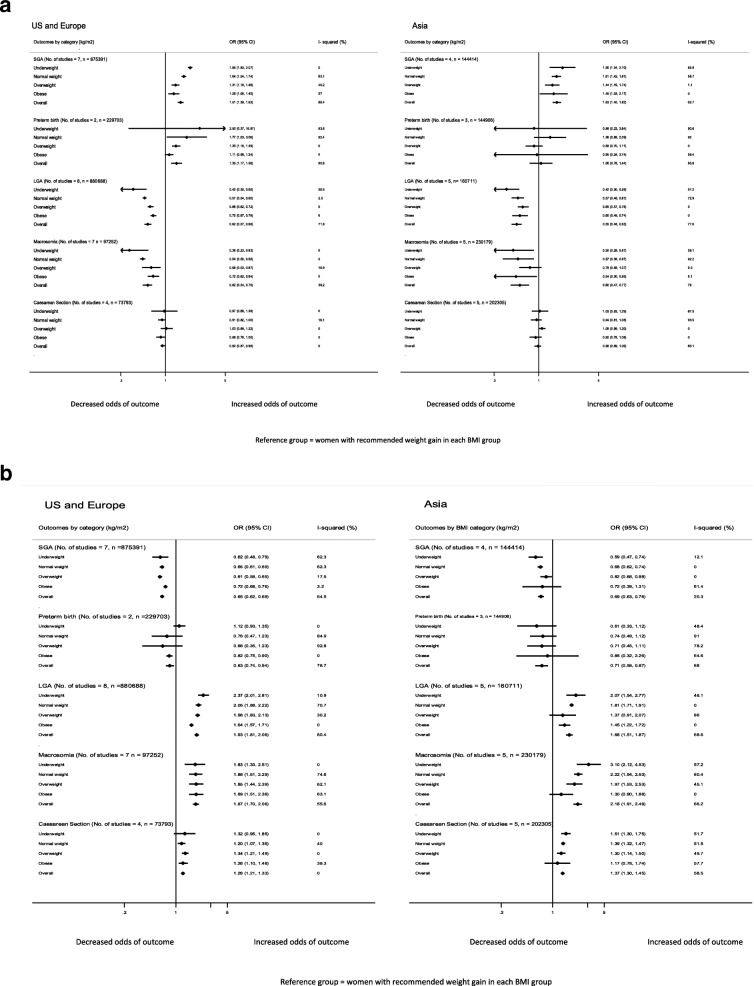
BACKGROUND: The association between Institute of Medicine (IOM) guidelines and pregnancy outcomes across ethnicities is uncertain. We evaluated the associations of gestational weight gain (GWG) outside 2009 IOM guidelines, with maternal and infant outcomes across the USA, western Europe and east Asia, with subgroup analyses in Asia. The aim was to explore ethnic differences in maternal prepregnancy body mass index (BMI), GWG and health outcomes across these regions. METHODS: Systematic review, meta-analysis and meta-regression of observational studies were used for the study. MEDLINE, MEDLINE In-Process, Embase and all Evidence-Based Medicine (EBM) Reviews were searched from 1999 to 2017. Studies were stratified by prepregnancy BMI category and total pregnancy GWG. Odds ratio (ORs) 95% confidence intervals (CI) applied recommended GWG within each BMI category as the reference. Primary outcomes were small for gestational age (SGA), preterm birth and large for gestational age (LGA). Secondary outcomes were macrosomia, caesarean section and gestational diabetes. RESULTS: Overall, 5874 studies were identified and 23 were included (n = 1,309,136). Prepregnancy overweight/obesity in the USA, Europe and Asia was measured at 42%, 30% and 10% respectively, with underweight 5%, 3% and 17%. GWG below guidelines in the USA, Europe and Asia was 21%, 18% and 31%, and above was 51%, 51% and 37% respectively. Applying regional BMI categories in Asia showed GWG above guidelines (51%) was similar to that in the USA and Europe. GWG below guidelines was associated with a higher risk of SGA (USA/Europe [OR 1.51; CI 1.39, 1.63]; Asia [1.63; 1.45, 1.82]) and preterm birth (USA/Europe [1.35; 1.17, 1.56]; Asia [1.06; 0.78, 1.44]) than GWG within guidelines. GWG above guidelines was associated with a higher risk of LGA (USA/Europe [1.93; 1.81, 2.06]; Asia [1.68; 1.51 , 1.87]), macrosomia (USA/Europe [1.87; 1.70, 2.06]; Asia [2.18; 1.91, 2.49]) and caesarean (USA/Europe [1.26; 1.21, 1.33]; Asia [1.37; 1.30, 1.45]). Risks remained elevated when regional BMI categories were applied for GWG recommendations. More women in Asia were categorised as having GWG below guidelines using World Health Organization (WHO) (60%) compared to regional BMI categories (16%), yet WHO BMI was not accompanied by increased risks of adverse outcomes. CONCLUSIONS: Women in the USA and western Europe have higher prepregnancy BMI and higher rates of GWG above guidelines than women in east Asia. However, when using regional BMI categories in east Asia, rates of GWG above guidelines are similar across the three continents. GWG outside guidelines is associated with adverse outcomes across all regions. If regional BMI categories are used in east Asia, IOM guidelines are applicable in the USA, western Europe and east Asia.
Overview
The claims and statistics of this paper haven’t been checked yet.
Free: it reads the open-access text and checks the first 5 claims that cite a source we can check. Create a free account to check every claim.
Integrity signals
Registry
Cites
Statistics
Figures
Verification
Claims the paper makes
The claims and statistics of this paper haven’t been checked yet.
Free: it reads the open-access text and checks the first 5 claims that cite a source we can check. Create a free account to check every claim.
Claims other papers make about this one
Each is checked against this paper’s own text: does it say what the citing paper says it does?
The source backs part of the claim, not all of it — or backs it for a different population, condition or comparison.
In the citing paper
“Excessive GWG is more common in women who are overweight or obese (64%) and is linked to higher risks of delivering large-for-gestational-age (LGA) infants across ethnicities (OR 1.68–1.93) [35].”
From Medical Nutrition Therapy for Women with Gestational Diabetes: Current Practice and Future Perspectives (2025) · cites this paper as [35]
Experimental — accuracy not yet measured
Self-check
Percentages, sums and reported differences re-computed from the paper’s own numbers.
The self-check needs the paper’s full text.
Citations
Cites
Measuring inconsistency in meta-analyses
Higgins, J. P. T., Thompson, S. G., Deeks, J. J., & Altman, D. G. (2003) · BMJ · doi:10.1136/bmj.327.7414.557 · Cited by 63,139
(2004) · The Lancet · doi:10.1016/s0140-6736(03)15268-3 · Cited by 12,717
Trends in Obesity Among Adults in the United States, 2005 to 2014
Flegal, K. M., Kruszon-Moran, D., Carroll, M. D., Fryar, C. D., & Ogden, C. L. (2016) · JAMA · doi:10.1001/jama.2016.6458 · Cited by 2,803 · cited 1×
“Applying WHO prepregnancy BMI categories, the USA had the greatest prevalence of overweight and obesity at 43%, consistent with trends from the 2013– 2014 National Health and Nutrition Examination Survey (NHANES), with 37% of reproductive-aged women obese [43].”
MethodObesity and Kidney Disease: Hidden Consequences of the Epidemic
Kovesdy, C. P., Furth, S. L., Zoccali, C., & on behalf of the World Kidney Day Steering Committee (2017) · American Journal of Nephrology · doi:10.1159/000458467 · Cited by 2,217
New Criteria for `Obesity Disease' in Japan
The Examination Committee of Criter (2002) · Circulation Journal · doi:10.1253/circj.66.987 · Cited by 1,650
Goldstein, R. F., Abell, S. K., Ranasinha, S., Misso, M., Boyle, J. A., Black, M. H., Li, N., Hu, G., Corrado, F., Rode, L., et al. (2017) · JAMA · doi:10.1001/jama.2017.3635 · Cited by 1,636
Self-citationDeurenberg, P., Deurenberg‐Yap, M., & Guricci, S. (2002) · Obesity Reviews · doi:10.1046/j.1467-789x.2002.00065.x · Cited by 1,326
Preconceptional and maternal obesity: epidemiology and health consequences
Poston, L., Caleyachetty, R., Cnattingius, S., Corvalán, C., Uauy, R., Herring, S., & Gillman, M. W. (2016) · The Lancet Diabetes & Endocrinology · doi:10.1016/s2213-8587(16)30217-0 · Cited by 1,111
New Criteria for `Obesity Disease' in Japan
Oda, E. (2006) · Circulation Journal · doi:10.1253/circj.70.150 · Cited by 783
Wang, Y., Mi, J., Shan, X.-Y., Wang, Q. J., & Ge, K.-Y. (2007) · International Journal of Obesity · doi:10.1038/sj.ijo.0803354 · Cited by 779
Research works printed but not linked: 1
- Rasmussen K Yaktine AL Institute of Medicine and National Research Council Committee to reexamine IOM pregnancy weight guidelines. Weight gain during pregnancy: reexamining the guidelines 2009 Washington DC National Academic Press
Cited by
Items 501–540 of 540
Factors Associated with Inadequate Gestational Weight Gain
Lin, C.-X. (2023) · eScholarship (California Digital Library)
Xie, X. (2020) · Dipòsit Digital de Documents de la UAB (Universitat Autònoma de Barcelona)
An exploration of a weight management programme for pregnant women living with obesity
Ellis, S. (2023) · Nottingham ePrints (University of Nottingham)
Rhodes, A. (2024) · UCL Discovery (University College London)
Optimizing Gestational Weight Gain in Twin Pregnancies
Lipworth, H. (2021) · TSpace (University of Toronto)
Janssen, E. (2023) · UWM Digital Commons (University of Wisconsin–Milwaukee)
Palumbo, A. M. (2023) · MacSphere (McMaster University) · doi:10.71548/21089
BsmI and TaqI single nucleotide polymorphisms in the VDR gene and gestational overweight
Fernandes, K. G. S. (2023) · LA Referencia (Red Federada de Repositorios Institucionales de Publicaciones Científicas)
Shaikh, S., Chowdhury, R., Dhabhai, N., Taneja, S., & Bhandari, N. (2026) · PLOS Global Public Health · doi:10.1371/journal.pgph.0005932 · Cited by 1
Goedeke, S. M. (2024) · Tuwhera (Auckland University of Technology)
Pathirathna, M. L., HARUNA, M., Nandasena, H. M. R. K. G., Atapattu, A. M. M. P., & Ganegoda, U. D. (2026) · International Journal of Gynecology & Obstetrics · doi:10.1002/ijgo.70891
Associations Between Gestational Weight Gain and Children's Neurodevelopment at 3 Years of Age
Xiong, Y., Jiang, Y., Chang, W., Liao, G., Qin, R., Lv, H., Liu, C., Xu, X., You, L., Sun, T., et al. (2026) · Obesity · doi:10.1002/oby.70192
赵, 俊. (2026) · Journal of Clinical Personalized Medicine · doi:10.12677/jcpm.2026.52131
Kasahara, K., Tsuji, S., Kawasaki, T., & Murakami, T. (2026) · Journal of Bone and Mineral Metabolism · doi:10.1007/s00774-026-01720-4
Luo, W., Wei, H., Zhang, K., Wang, D., Lu, H., Hu, Y., Li, C., Zhang, J., & Zhu, X. (2026) · Healthcare · doi:10.3390/healthcare14081035
He, L., Zhou, X., Shen, Y., Zhou, B., Wu, J., & Liu, J. (2026) · Frontiers in Public Health · doi:10.3389/fpubh.2026.1779962
Abayomi, J. C. (2026) · Wiley eBooks · doi:10.1002/9781394206148.mdp0025
An Evaluation of the Relationship Between Obesity and Sexual Quality of Life in Married Women
Şahin, S., DÜZGÜN, A. A., Karagöl, B., Bilmez, G., Aydın, E. İ., Dikmen, R., & Ünsal, A. (2026) · Bandırma Onyedi Eylül Üniversitesi Sağlık Bilimleri ve Araştırmaları Dergisi · doi:10.46413/boneyusbad.1667223
Ye, X., Li, P., & Shi, C. (2026) · Frontiers in Global Women s Health · doi:10.3389/fgwh.2026.1777069
Shin, J., Kim, T., Park, S. H., & Park, H. W. (2026) · Scientific Reports · doi:10.1038/s41598-026-51035-7
“When employing region-specific BMI classifications, the relationship between maternal pre-pregnancy BMI and fetal health outcomes may differ across various continents 35 .”
Minjuurdorj, N.-E., Jamsranjav, E., Zorigtbaatar, O., Lkhagvasuren, N., Byambasukh, O., & Khasag, A. (2026) · Journal of Clinical Medicine · doi:10.3390/jcm15103638
“Compared with global trends reported by Gold-stein et al. (2018, 2025) [12,16], the prevalence of inadequate GWG among underweight women in our study was higher than the 2025 estimate (27%), but similar to the 2018 estimate (43%).”
InfluentialPatel, N., Sagili, H., Sahoo, J., Vairappan, B., Kulkarni, B., Locks, L. M., & Lakshminarayanan, S. (2026) · The Indian Journal of Medical Research · doi:10.25259/ijmr_2230_2025
“Data collection : Data were collected using a pre-tested, structured questionnaire administered by trained staff, with translation into Tamil and back-translation to ensure language validity ( Supplementary Material 3 ).”
InfluentialMihiret, G. T., Melesse, Y. D., Mulueh, A. A., Abneh, A. A., Ewunetie, A. A., Amha, H., Lamesgen, A., Gedif, G., Getnet, A., Alamneh, A. A., et al. (2026) · Maternal Health Neonatology and Perinatology · doi:10.1186/s40748-026-00270-x
“In contrast, studies from Europe, North America, and China report excessive GWG prevalence exceeding 40% [37, 38].”
Gao, S., Su, S., Zhang, E., Zhang, Y., Liu, J., Xie, S., Cui, Y., Li, S., Yue, W., Liu, R., et al. (2026) · The Journal of Maternal-Fetal & Neonatal Medicine · doi:10.1080/14767058.2026.2682080
Ma, J., Cheng, D., Zhu, M., & Zhou, D. (2026) · International Journal of Women s Health · doi:10.2147/ijwh.s609513
Victor, A., Luzia, L. A., Silva, T. R., Lopes, A. P., Penzias, R. E., Aires, I. O., Rondó, P. H. D. C., & Ohuma, E. O. (2026) · The Lancet Regional Health - Americas · doi:10.1016/j.lana.2026.101561
Qian, S., Yang, J., Tian, Y., Zhao, Q., Wang, R., Yang, J., Shu, L., Zhu, X., & He, J. (2026) · BMC Pregnancy and Childbirth · doi:10.1186/s12884-026-09694-x
“Asian populations, in particular, experience higher metabolic risk at lower BMI thresholds than Western populations, raising concerns about the generalizability of existing recommendations [10–12].”
Xuto, P., Bressington, D. T., Khiaokham, L., Khaw-on, P., Matayaboon, N., Sangsawang, S., Janta, N., Sungplipan, P., Wiangsuwan, S., Chaiwatthanakorn, S., et al. (2026) · Nursing Reports · doi:10.3390/nursrep16080274
Hu, Y., Hou, L., Yu, M., Zhang, R., Wu, X., Wang, B., Wu, J., & Li, Z. (2026) · European Journal of Nutrition · doi:10.1007/s00394-026-04065-w
“Existing research consistently demonstrates that pre-pregnancy obesity and excessive GWG are associated with increased birth weight and a heightened risk of macrosomia and large for gestational age (LGA) infants [ 5, 6 ].”
POLA MAKAN DAN KENAIKAN BERAT BADAN GESTASIONAL BERLEBIH PADA KEHAMILAN ATERM DI PONOROGO
Nikma, A. A., Susilo, H. M., & Hidayati, N. (2026) · HEALTHY Jurnal Inovasi Riset Ilmu Kesehatan · doi:10.51878/healthy.v5i4.14741
Xu, L., Sun, P., Li, J., Wan, Y., Kang, S., Wang, Z., Wu, M., & Song, J. (2026) · BMC Pregnancy and Childbirth · doi:10.1186/s12884-026-09974-6
Yang, C.-Y., Hsu, C.-Y., Wu, J. C., Wu, L. S., Hsieh, M.-H., Tsai, M., Liu, X., Chen, P.-C., Liu, T., Tsai, H.-J., et al. (2026) · Nutrition Research · doi:10.1016/j.nutres.2026.09.005
Zhang, S., Li, W., Li, N., Guo, J., Tan, L., & Liu, H. (2026) · Journal of Diabetes Investigation · doi:10.1111/jdi.70439
Self-citationบทบาทพยาบาลในการจัดการน้ำหนักตัวของหญิงตั้งครรภ์
Chairat, T., Traetulakarn, W., Jittavisuttiwong, R., & Sirabarameesith, N. (2023) · BCNNON Health Science Research Journal
Ashrita, C., Bhaskar, D., & Kumar, V. (2026) · Student s Journal of Health Research Africa · doi:10.51168/vg66je76
Zhao, Y., Li, Q., Zhu, H., Zheng, W., Ni, Y., Wu, A., Ye, K., Jiang, X., Liu, G., Bao, Y., et al. (2026) · Frontiers in Endocrinology · doi:10.3389/fendo.2026.1936050
Obesity and gestational weight gain
Corbett, G. A., & McAuliffe, F. M. (2026) · Elsevier eBooks · doi:10.1016/b978-0-443-13265-0.00011-2
Guivarch, C., & Zhang, C. (2026) · Elsevier eBooks · doi:10.1016/b978-0-443-13265-0.00016-1
Hsu, T.-J., Chen, T., & Yu, T. (2026) · International Journal of Gynecology & Obstetrics · doi:10.1002/ijgo.71447
Gibadullina, Y. E., Abakumova, K. B., Vakhrushina, A. S., & Николаевна, П. В. (2026) · Кубанский научный медицинский вестник · doi:10.25207/1608-6228-2026-33-5-15-26
Metadata
- Authors
- Goldstein, R. F., Abell, S. K., Ranasinha, S., Misso, M. L., Boyle, J. A., Harrison, C. L., Black, M. H., Li, N., Hu, G., Corrado, F., Hegaard, H., Kim, Y. J., Haugen, M., Song, W. O., Kim, M. H., Bogaerts, A., Devlieger, R., Chung, J. H., & Teede, H. J.
- Affiliations
- Monash Health (AU)
- Monash University (AU)
- Kaiser Permanente (US)
- Tianjin Women's and Children's Health Center (CN)
- Pennington Biomedical Research Center (US)
- University of Messina (IT)
- Copenhagen University Hospital (DK)
- Ewha Womans University (KR)
- Norwegian Institute of Public Health (NO)
- Michigan State University (US)
- Dankook University (KR)
- University of Antwerp (BE)
- GZA Ziekenhuizen Campus Sint-Augustinus (BE)
- Monash Medical Centre (AU)
- Corresponding author
- Teede, Helena J.
- ORCID
- Venue
- BMC Medicine
- Published
- 2018-08-31
- Volume
- 16
- Issue
- 1
- Pages
- 153-153
- ISSN
- 1741-7015 (ISSN-L)
- PMC
- PMC6117916
- OpenAlex
- W2888709256
- Cited by
- 515
- References
- 61
- Citations by year
- 2026: 45 · 2025: 65 · 2024: 61 · 2023: 78 · 2022: 108 · 2021: 63 · 2020: 67 · 2019: 27
- FWCI
- 6.41
- Type
- journal article
- Language
- en
- Open access
- gold
- doi.org
- Licence
- cc-by
- creativecommons.org/licenses/by/4.0/ (tdm)
- Locations
- BMC Medicine (publishedVersion, cc-by)
- Europe PMC (PubMed Central) (publishedVersion, other-oa)
- PubMed Central (publishedVersion, cc-by)
- PubMed (publishedVersion)
- Research at the University of Copenhagen (University of Copenhagen) (publishedVersion, cc-by)
- Adelaide Research & Scholarship (AR&S) (University of Adelaide) (submittedVersion, cc-by)
- Monash University Research Portal (Monash University) (submittedVersion, other-oa)
- Lirias (submittedVersion, other-oa)
- DOAJ (DOAJ: Directory of Open Access Journals) (submittedVersion, cc-by-sa)
- eScholarship (California Digital Library) (submittedVersion, cc-by)
- NORA - Norwegian Open Research Archives (submittedVersion, other-oa)
- Funders
- Gentofte Hospital
- Centers for Disease Control and Prevention
- University of Illinois at Urbana-Champaign
- Medical Research Council
- National Health and Medical Research Council
- National Institute of General Medical Sciences (U54GM104940)
- National Center for Chronic Disease Prevention and Health Promotion
- Topics
- Health Sciences › Medicine › Obstetrics and Gynecology › Gestational Diabetes Research and Management
- Health Sciences › Medicine › Pediatrics, Perinatology and Child Health › Birth, Development, and Health
- Health Sciences › Medicine › Pediatrics, Perinatology and Child Health › Maternal and Neonatal Healthcare
- Keywords
- gestational weight gain, IOM weight gain guidelines, pre-pregnancy body mass index, maternal obesity, ethnic differences, small for gestational age, preterm birth, large for gestational age, macrosomia, cesarean section, gestational diabetes mellitus, Asian women, regional comparison, maternal outcomes, infant outcomes, underweight pregnancy, overweight in pregnancy
- MeSH terms
- Adult, Female, Humans, Infant, Newborn, Pregnancy, Pregnancy Complications, Pregnancy Outcome, Weight Gain, Fetal Weight
About these checks
Registry, retraction, Cites and statistics results are computed, not judged, with one exception: a printed reference that no index lists is read once by a model before it counts as a citation error. Claims are extracted by a model and kept only when their quote appears verbatim in the text; each cited source is then checked, with a model’s help, for whether it says what the claim relies on. Those verdicts can be wrong — read the claim’s quote and the cited source before relying on one.
Statistics and arithmetic are recomputed, not judged.
Confidence bands are shown only for fields calibrated on our annotated test set. None is calibrated yet, so no band is shown.
What counts as a claim ›How we measure confidence ›How we check this ›
Are you an author, or do you see a problem with this page? Request a review
Data sources
Bibliographic data: Semantic Scholar, OpenAlex, Crossref.
Contains information from the Semantic Scholar Academic Graph Datasets, made available under the ODC Attribution License (ODC-BY 1.0).
Semantic Scholar’s data is described in: Kinney, R., et al. (2023). The Semantic Scholar Open Data Platform. arXiv:2301.10140.
