

The DOI matches its Crossref record; 53 of the 53 references it cites were found in a registry or an index.
Prospective association between ultra-processed food consumption and incident depressive symptoms in the French NutriNet-Santé cohort
Open accessAbstract
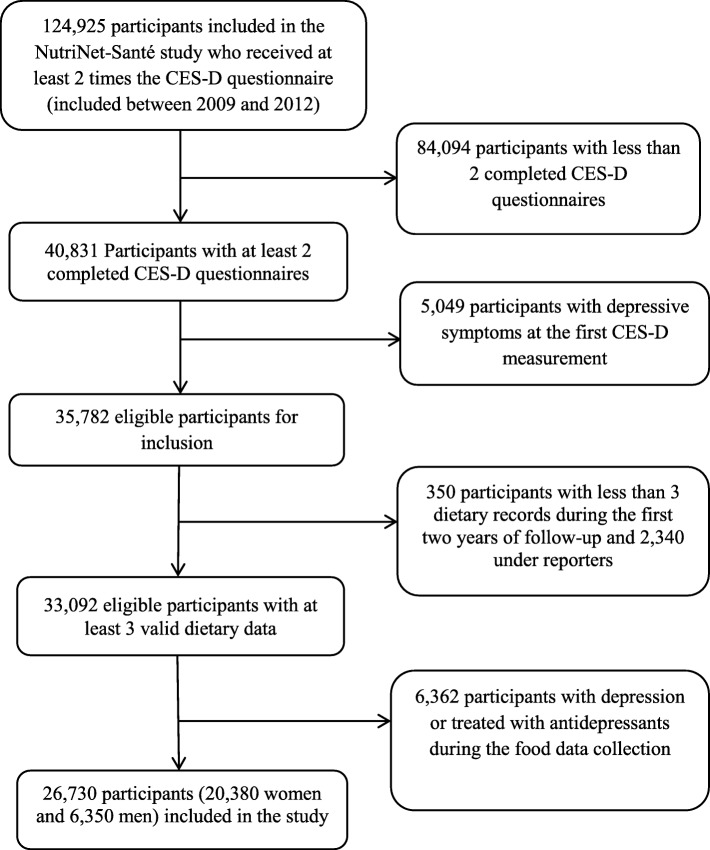
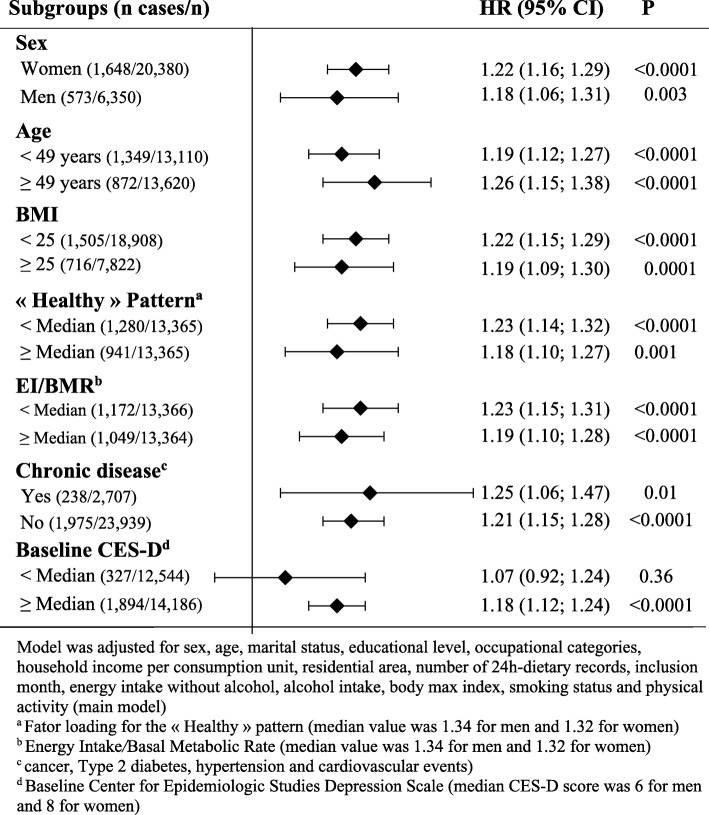
BACKGROUND: Ultra-processed food (UPF) consumption has increased over the last decades in Westernized countries. Our objective was to investigate for the first time the association between the proportion of UPF (%UPF) in the diet and incident depressive symptoms in the NutriNet-Santé cohort. METHODS: The sample included 20,380 women and 6350 men (aged 18-86 years) without depressive symptoms at the first Center for Epidemiologic Studies Depression Scale (CES-D) measurement, using validated cut-offs (CES-D score ≥ 17 for men and ≥ 23 for women). The proportion of UPF in the diet was computed for each subject using the NOVA classification applied to dietary intakes collected by repeated 24-h records (mean = 8; SD = 2.3). The association between UPF and depressive symptoms was evaluated using multivariable Cox proportional hazards models. RESULTS: Over a mean follow-up of 5.4 years, 2221 incident cases of depressive symptoms were identified. After accounting for a wide range of potential confounders, an increased risk of depressive symptoms was observed with an increased %UPF in the diet. In the main model adjusted for sociodemographic characteristics, body mass index, and lifestyle factors, the estimated hazard ratio for a 10% increase in UPF was 1.21 (95% confidence interval = 1.15-1.27). Considering %UPF in food groups, the association was significant only for beverages and sauces or added fats. CONCLUSION: Overall, UPF consumption was positively associated with the risk of incident depressive symptoms, suggesting that accounting for this non-nutritional aspect of the diet could be important for mental health promotion.
Overview
The claims and statistics of this paper haven’t been checked yet.
Run the check — free, no account needed. It reads the open-access text and checks the sources it cites.
Integrity signals
Registry
Cites
Statistics
Figures
Verification
Claims the paper makes
The claims and statistics of this paper haven’t been checked yet.
Run the check — free, no account needed. It reads the open-access text and checks the sources it cites.
Claims other papers make about this one
Each is checked against this paper’s own text: does it say what the citing paper says it does?
In the citing paper
“Another large French cohort of adults followed for a mean of 5.4 years demonstrated a positive association between ultra-processed food and the risk of incident depression [156].”
From Separating the Signal from the Noise: How Psychiatric Diagnoses Can Help Discern Food Addiction from Dietary Restraint (2020) · cites this paper as [156]
In the citing paper
“To our knowledge, although UPF consumption was previously found to be associated with increased risks of cancer, 31 cardiovascular diseases, 35 mortality, 32,36 depressive symptoms, 33,37 and metabolic disorders (obesity, 40 hypertension, 41 and dyslipidemia 39 ), no prior prospective epidemiological study had evaluated their association with T2D risk.”
From Ultraprocessed Food Consumption and Risk of Type 2 Diabetes Among Participants of the NutriNet-Santé Prospective Cohort (2020) · cites this paper as [31]
Self-check
Percentages, sums and reported differences re-computed from the paper’s own numbers.
The self-check needs the paper’s full text.
Citations
Cites
Controlling the False Discovery Rate: A Practical and Powerful Approach to Multiple Testing
Benjamini, Y., & Hochberg, Y. (1995) · Journal of the Royal Statistical Society Series B: Statistical Methodology · doi:10.1111/j.2517-6161.1995.tb02031.x · Cited by 109,482
The CES-D Scale: A Self-Report Depression Scale for Research in the General Population
Radloff, L. S. (1977) · Applied Psychological Measurement · doi:10.1177/014662167700100306 · Cited by 53,267
James, S. L., Abate, D., Abate, K. H., Abay, S. M., Abbafati, C., Abbasi, N., Abbastabar, H., Abd-Allah, F., Abdela, J., Abdelalim, A., et al. (2018) · The Lancet · doi:10.1016/s0140-6736(18)32279-7 · Cited by 13,867
Vos, T., Abajobir, A. A., Abate, K. H., Abbafati, C., Abbas, K. M., Abd-Allah, F., Abdulkader, R. S., Abdulle, A. M., Abebo, T. A., Abera, S. F., et al. (2017) · The Lancet · doi:10.1016/s0140-6736(17)32154-2 · Cited by 13,220
Self-citationPredicting basal metabolic rate, new standards and review of previous work.
Wn, S. (1985) · PubMed · Cited by 2,955
The UN Decade of Nutrition, the NOVA food classification and the trouble with ultra-processing
Monteiro, C. A., Cannon, G., Moubarac, J.-C., Levy, R. B., Louzada, M. L. C., & Jaime, P. C. (2018) · Public Health Nutrition · doi:10.1017/s1368980017000234 · Cited by 2,333
Hagströmer, M., Oja, P., & Sjöstróm, M. (2006) · Public Health Nutrition · doi:10.1079/phn2005898 · Cited by 2,078
Ultra‐processed products are becoming dominant in the global food system
Monteiro, C. A., Moubarac, J. ‐., Cannon, G., Ng, S. W., & Popkin, B. (2013) · Obesity Reviews · doi:10.1111/obr.12107 · Cited by 1,827
Willett, W. C. (2012) · Oxford University Press eBooks · doi:10.1093/acprof:oso/9780199754038.001.0001 · Cited by 1,754
Black, A. (2000) · International Journal of Obesity · doi:10.1038/sj.ijo.0801376 · Cited by 1,490
Research works printed but not linked: 2
- Le Moullec N, Deheeger M, Preziosi P, Monteiro P, Valeix P, Rolland-Cachera M, et al. Validation of the photo manual used for the collection of dietary data in the SU.VI.MAX study. Cah Nutr Diététique. 1996;31:158-64.
- NutriNet-Santé coordination. Table de composition des aliments - Etude NutriNet-Santé. Paris: Economica; 2013.
Cited by
Sorted by citations
Items 201–229 of 229
Efeitos gastrointestinais da exposição ao hexaclorociclohexano no organismo humano
Vieira, C. A. M., Moreno, A. M., Tavares, M. S., Benevenuto, B. R., Reis, T. D. S., Orsini, M., & Armada, L. (2024) · Cuadernos de Educación y Desarrollo · doi:10.55905/cuadv16n8-135
Sazali, A., Yusoff, N. A., Azmawi, N. I., Li, N. M., Yahya, H. M., Yaacob, N., & Rivan, N. F. M. (2025) · Jurnal Gizi dan Pangan · doi:10.25182/jgp.2025.20.1.51-60 · Cited by 1
Poor dietary quality is associated with anxious and depressive symptoms in university studentsPreprint
Sabbagh, M. I. R., Meireles, A. L., Chagas, C. M. D. S., Cardoso, C. S., Ferreira, L. G., da Silva, L. S., Vidigal, F. D. C., de Freitas, E. D., de Oliveira, H. N., de Paula, W., et al. (2025) · Research Square · doi:10.21203/rs.3.rs-6185181/v1
Alışır, G., & Çetin, S. (2025) · İzmir Katip Çelebi Üniversitesi Sağlık Bilimleri Fakültesi Dergisi · doi:10.61399/ikcusbfd.1531030
Jiang, X., Li, Z., Wen, P., Ling, Y., Li, H., & Huang, J. (2025) · BMC Public Health · doi:10.1186/s12889-025-25976-z
Ashour, L., Karkar, R., Zenha, K. A., Shdaifat, A. A., Louzi, A., Sirhan, L. A. A., Hamad, T. A., Okasha, A., Alfawadleh, M., Heramas, R., et al. (2025) · Alcoholism Treatment Quarterly · doi:10.1080/07347324.2025.2602762
Egnell, M., Galan, P., Fialon, M., Touvier, M., Péneau, S., Kesse‐Guyot, E., Herçberg, S., & Julia, C. (2021) · Figshare · doi:10.6084/m9.figshare.14234598
Self-citationEgnell, M., Galan, P., Fialon, M., Touvier, M., Péneau, S., Kesse‐Guyot, E., Herçberg, S., & Julia, C. (2021) · Figshare · doi:10.6084/m9.figshare.14234601
Self-citationJoo, M. J., Kim, D. B., Ko, J., Lim, J. H., Park, E.-C., & Shin, J. (2024) · Figshare · doi:10.6084/m9.figshare.25971659
Joo, M. J., Kim, D. B., Ko, J., Lim, J. H., Park, E.-C., & Shin, J. (2024) · Figshare · doi:10.6084/m9.figshare.25971776
Eroğlu, F. E., Açıkalın, B., Arslan, N., & Kılıç, F. (2026) · BMC Women s Health · doi:10.1186/s12905-026-04267-8
Impacto de la calidad de la dieta en la prevalencia de sintomatología ansiosa y depresiva
Córdova, V. M. Á. (2026) · Arandu-UTIC. · doi:10.69639/arandu.v12i4.1852
Irgat, S. İ., & Bakırhan, H. (2026) · Healthcare · doi:10.3390/healthcare14050575 · Cited by 1
Adjibade, M. (2018) · theses.fr (ABES) · doi:10.70675/d32a6681zbcaaz4de2za44dzef2dda82e783
Self-citationFood processing and risk of non-communicable diseases : findings from the NutriNet-Santé cohort
Srour, B. (2019) · theses.fr (ABES) · doi:10.70675/a836731az0f9cz4c79zb114z5fe899d59164
Self-citationdos Santos, B. S. M., Malinovski, J., & Barreto, K. A. C. (2026) · RCMOS - Revista Científica Multidisciplinar O Saber · doi:10.51473/rcmos.v1i1.2026.2539
Al-Amoudi, A. A., & Almoraie, N. M. (2026) · Frontiers in Sustainable Food Systems · doi:10.3389/fsufs.2026.1862373
Kurebayashi, Y. (2026) · Archives of Psychiatric Nursing · doi:10.1016/j.apnu.2026.152186
Ghosh, A., Muley, A., Verma, R., Zunjur, A. C., Borse, S., & Adhikari, S. (2026) · Frontiers in Nutrition · doi:10.3389/fnut.2026.1889456
Ивановна, Р. С., Bolatova, Z., Nukeshtayeva, K., Zhamantayev, O., Kayupova, G., GALAYEVA, A., Shintayeva, N. U., Plotnikova, O. V., & Турчанинов, Д. В. (2026) · Nutrients · doi:10.3390/nu18172774
da Silva, L. P., Steele, E. M., Leite, M. A., Marques, T. D. S., da Silva, E. O., Louzada, M. L. D. C., & Levy, R. B. (2026) · Journal of the Academy of Nutrition and Dietetics · doi:10.1016/j.jand.2026.156837
Mechlińska, A., Sudoł, N., Pazda-Juda, D., & Cubała, W. J. (2026) · Frontiers in Nutrition · doi:10.3389/fnut.2026.1961751
Taylor, E. L., Lugon, G., Gallo, E., Awad, C., Llauradó-Pont, J., Ayala, N., Bustamante, M., Contreras‐Rodríguez, O., Ferrer, M., Foraster, M., et al. (2026) · Research Square · doi:10.21203/rs.3.rs-10956084/v1
Self-citationJomaa, L., Chokor, F. A. Z., Hwalla, N. C., & Nasreddine, L. (2026) · Journal of Nutritional Science · doi:10.1017/jns.2026.10145
Hockin, J. D., Millar, S., Perry, I. J., & Phillips, C. M. (2026) · Psychiatry Research · doi:10.1016/j.psychres.2026.117513
Shin, S., & Park, C. Y. (2026) · Nutrients · doi:10.3390/nu18213479
Metadata
- Authors
- Adjibade, M., Julia, C., Allès, B., Touvier, M., Lemogne, C., Srour, B., Hercberg, S., Galan, P., Assmann, K. E., & Kesse-Guyot, E.
- Affiliations
- Inserm (FR)
- Corresponding author
- Adjibade, Moufidath
- ORCID
- Venue
- BMC Medicine
- Published
- 2019-04-15
- Volume
- 17
- Issue
- 1
- Pages
- 78-78
- ISSN
- 1741-7015 (ISSN-L)
- PMC
- PMC6463641
- OpenAlex
- W2935870862
- Cited by
- 227
- References
- 53
- Citations by year
- 2026: 22 · 2025: 34 · 2024: 32 · 2023: 43 · 2022: 26 · 2021: 40 · 2020: 22 · 2019: 6
- FWCI
- 21.63
- Type
- journal article
- Language
- en
- Open access
- gold
- doi.org
- Licence
- Locations
- BMC Medicine (publishedVersion, cc-by)
- Europe PMC (PubMed Central) (publishedVersion, cc-by)
- PubMed Central (publishedVersion, cc-by)
- PubMed (publishedVersion)
- HAL (submittedVersion, cc-by)
- DOAJ (DOAJ: Directory of Open Access Journals) (submittedVersion, cc-by-sa)
- Funders
- Fondation pour la Recherche Médicale
- Fondation ARC pour la Recherche sur le Cancer
- Topics
- Health Sciences › Medicine › Public Health, Environmental and Occupational Health › Consumer Attitudes and Food Labeling
- Health Sciences › Medicine › Public Health, Environmental and Occupational Health › Nutritional Studies and Diet
- Health Sciences › Nursing › Nutrition and Dietetics › Nutrition, Health and Food Behavior
- Keywords
- ultra-processed foods, depressive symptoms, incident depression, NOVA classification, diet and mental health, NutriNet-Santé cohort, beverages, dietary intake
- MeSH terms
- Adolescent, Adult, Aged, Aged, 80 and over, Depression, Diet, Female, France, Humans, Male, Middle Aged, Prospective Studies, Cohort Studies, Young Adult, Fast Foods
About these checks
Registry, retraction, Cites and statistics results are computed, not judged, with one exception: a printed reference that no index lists is read once by a model before it counts as a citation error. Claims are extracted by a model and kept only when their quote appears verbatim in the text; each cited source is then checked, with a model’s help, for whether it says what the claim relies on. Those verdicts can be wrong — read the claim’s quote and the cited source before relying on one.
Statistics and arithmetic are recomputed, not judged.
Confidence bands are shown only for fields calibrated on our annotated test set. None is calibrated yet, so no band is shown.
What counts as a claim ›How we measure confidence ›How we check this ›
Are you an author, or do you see a problem with this page? Request a review
