

Neutrophil to lymphocyte ratio and cancer prognosis: an umbrella review of systematic reviews and meta-analyses of observational studies
Open accessPublished version of a preprint
The DOI matches its Crossref record; 159 of the 159 references it cites were found in a registry or an index.
Abstract
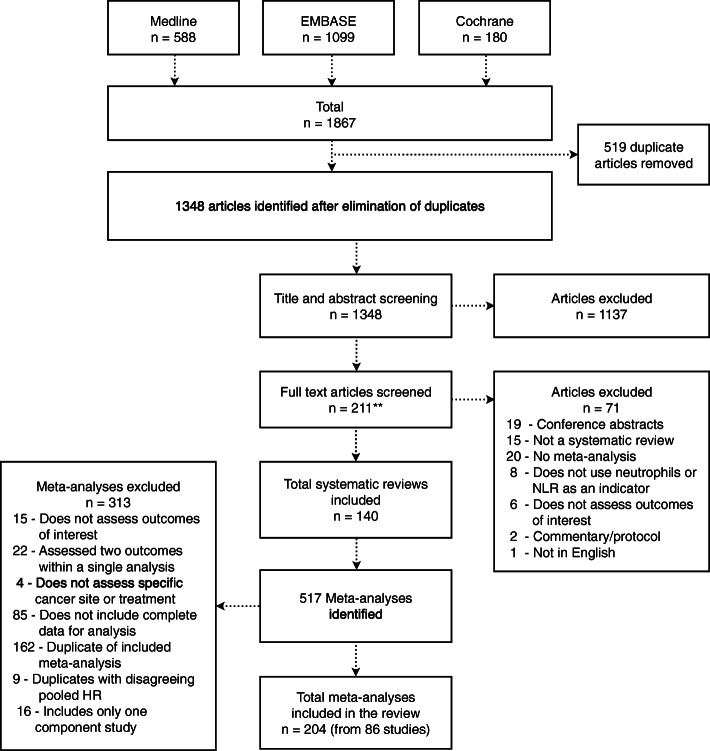
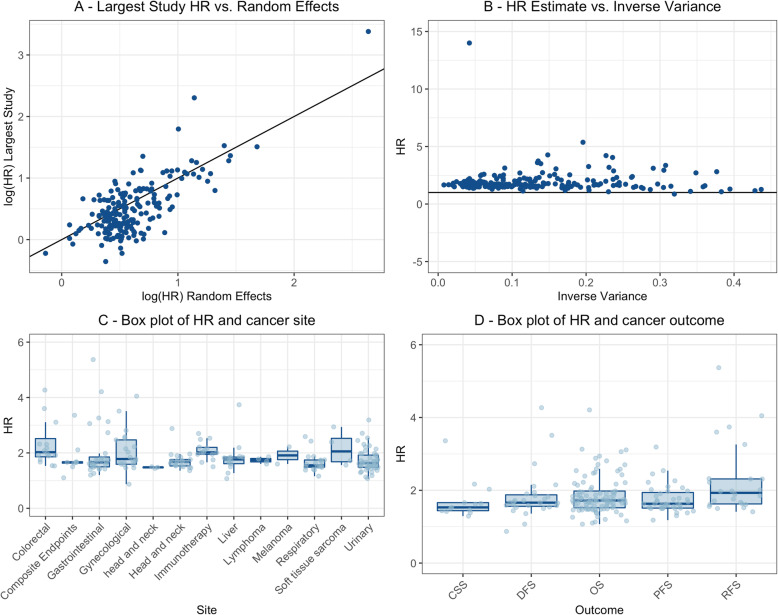
Background: Although neutrophils have been linked to the progression of cancer, uncertainty exists around their association with cancer outcomes, depending on the site, outcome and treatments considered. We aimed to evaluate the strength and validity of evidence on the association between either the neutrophil to lymphocyte ratio (NLR) or tumour-associated neutrophils (TAN) and cancer prognosis. Methods: We searched MEDLINE, Embase and Cochrane Database of Systematic Reviews from inception to 29 May 2020 for systematic reviews and meta-analyses of observational studies on neutrophil counts (here NLR or TAN) and specific cancer outcomes related to disease progression or survival. The available evidence was graded as strong, highly suggestive, suggestive, weak or uncertain through the application of pre-set GRADE criteria. Results: A total of 204 meta-analyses from 86 studies investigating the association between either NLR or TAN and cancer outcomes met the criteria for inclusion. All but one meta-analyses found a hazard ratio (HR) which increased risk (HR > 1). We did not find sufficient meta-analyses to evaluate TAN and cancer outcomes ( N = 9). When assessed for magnitude of effect, significance and bias related to heterogeneity and small study effects, 18 (9%) associations between NLR and outcomes in composite cancer endpoints (combined analysis), cancers treated with immunotherapy and some site specific cancers (urinary, nasopharyngeal, gastric, breast, endometrial, soft tissue sarcoma and hepatocellular cancers) were supported by strong evidence. Conclusion: In total, 60 (29%) meta-analyses presented strong or highly suggestive evidence. Although the NLR and TAN hold clinical promise in their association with poor cancer prognosis, further research is required to provide robust evidence, assess causality and test clinical utility. Trial registration: PROSPERO CRD42017069131 .
Overview
The claims and statistics of this paper haven’t been checked yet.
Free: it reads the open-access text and checks the first 5 claims that cite a source we can check. Create a free account to check every claim.
Integrity signals
Registry
Cites
Statistics
Figures
Verification
Claims the paper makes
The claims and statistics of this paper haven’t been checked yet.
Free: it reads the open-access text and checks the first 5 claims that cite a source we can check. Create a free account to check every claim.
Claims other papers make about this one
Each is checked against this paper’s own text: does it say what the citing paper says it does?
In the citing paper
“both responses to inflammation shown to be strongly prognostic across cancer types and treatment settings 27,28 .”
From A gut microbial signature for combination immune checkpoint blockade across cancer types (2024) · cites this paper as [28]
Self-check
Percentages, sums and reported differences re-computed from the paper’s own numbers.
The self-check needs the paper’s full text.
Citations
Cites
Hallmarks of Cancer: The Next Generation
Hanahan, D., & Weinberg, R. A. (2011) · Cell · doi:10.1016/j.cell.2011.02.013 · Cited by 66,590
Measuring inconsistency in meta-analyses
Higgins, J. P. T., Thompson, S. G., Deeks, J. J., & Altman, D. G. (2003) · BMJ · doi:10.1136/bmj.327.7414.557 · Cited by 63,139 · cited 4×
“We further assessed heterogeneity with Cochran’s Q test and quantified using the I(2) statistic [22].”
InfluentialBias in meta-analysis detected by a simple, graphical test
Egger, M., Smith, G. D., Schneider, M., & Minder, C. (1997) · BMJ · doi:10.1136/bmj.315.7109.629 · Cited by 56,722
Wickham, H. (2016) · Use R! · doi:10.1007/978-3-319-24277-4 · Cited by 33,115
GRADE: an emerging consensus on rating quality of evidence and strength of recommendations
Guyatt, G. H., Oxman, A. D., Vist, G. E., Kunz, R., Falck-Ytter, Y., Alonso-Coello, P., & Schünemann, H. J. (2008) · BMJ · doi:10.1136/bmj.39489.470347.ad · Cited by 23,305
Coussens, L. M., & Werb, Z. (2002) · Nature · doi:10.1038/nature01322 · Cited by 15,111 · cited 1×
“The biological mechanisms behind inflammation and cancer progression could suggest temporality, as elevated NLR and TAN are proposed to promote increased cell proliferation, angiogenesis and risk of metastasis as contributors to poor prognosis [5, 13, 135].”
Siegel, R. L., Miller, K. D., & Jemal, A. (2017) · CA: A Cancer Journal for Clinicians · doi:10.3322/caac.21387 · Cited by 14,712
Immunity, Inflammation, and Cancer
Grivennikov, S. I., Greten, F. R., & Karin, M. (2010) · Cell · doi:10.1016/j.cell.2010.01.025 · Cited by 10,755
Shea, B. J., Reeves, B. C., Wells, G., Thuku, M., Hamel, C., Moran, J., Moher, D., Tugwell, P., Welch, V., Kristjansson, E., et al. (2017) · BMJ · doi:10.1136/bmj.j4008 · Cited by 10,636
Sterne, J. A. C., Sutton, A. J., Ioannidis, J. P. A., Terrin, N., Jones, D. R., Lau, J., Carpenter, J., Rucker, G., Harbord, R. M., Schmid, C. H., et al. (2011) · BMJ · doi:10.1136/bmj.d4002 · Cited by 7,709
Research works printed but not linked: 6
- 16. Reichardt C. RefWorks: http://www.refworks.com. Public Services Quarterly. 2010;6(4):366 -7.
- 17. Schwarzer G. meta: An R package for meta-analysis. R news. 2007;7(3): 40 -5.
- 31. StataCorp. Stata statistical software: release 14. College Station: StataCorp LP; 2015.
- 52. Zheng DC, Zheng C, Wu J, et al. Neutrophil-lymphocyte ratio predicts the prognosis of patients with colorectal cancer: a meta-analysis. Int J Clin Exp Med. 2015;9(1):78 -90.
- 77. Dolan RD, McSorley ST, Horgan PG, et al. The role of the systemic inflammatory response in predicting outcomes in patients with operable cancer: systematic review and meta-analysis. Sci Rep. 2017;116(1):134 -46.
- 108. Zhou Y, Cheng S, Fathy AH, et al. Prognostic value of platelet-tolymphocyte ratio in pancreatic cancer: A comprehensive meta-analysis of 17 cohort studies. Onco Targets Ther. 2018;11:1899 -908. · DOI
Cited by
Items 101–200 of 699
Kuwayama, N., Hoshino, I., Mori, Y., Yokota, H., Iwatate, Y., & Uno, T. (2023) · Oncology Letters · doi:10.3892/ol.2023.14087 · Cited by 17
Lu, T., Lu, M., Liu, H., Song, D., Wang, Z., Guo, Y., Yu, F., Chen, Q., & Li, T. (2024) · Frontiers in Oncology · doi:10.3389/fonc.2023.1282042 · Cited by 17
Zhuang, Q., Zhang, A. Y., Cong, R. S. T. Y., Yang, G. M., Neo, P. S. H., Tan, D. S. W., Chua, M. L. K., Tan, I. B., Wong, F. Y., Ong, M. E. H., et al. (2024) · BMC Palliative Care · doi:10.1186/s12904-024-01457-9 · Cited by 23
“Another example is where we incorporated strong literature evidence that elevated Neutrophil-Lymphocyte ratio (NLR) is associated with poor prognosis, and engineered features around NLR instead of providing raw neutrophil and lymphocyte data to the model [52].”
BackgroundLi, D., Li, J., Zhao, C., Liao, X., Liu, L., Xie, L., & Shang, W. (2022) · Clinical Chemistry and Laboratory Medicine (CCLM) · doi:10.1515/cclm-2022-0801 · Cited by 21
Performance of the neutrophil-to-lymphocyte ratio as a prognostic tool for survival in solid cancers
Carrión-Barberà, I., & Lood, C. (2025) · Frontiers in Oncology · doi:10.3389/fonc.2025.1616477 · Cited by 18
Schröder, S., Heck, J., Groh, A., Frieling, H., Bleich, S., Kahl, K. G., Bosch, J. J., Krichevsky, B., & Westhoff, M. S. (2022) · Brain Sciences · doi:10.3390/brainsci12111424 · Cited by 16
“Assessments comprised neuropsychological testing via Mini-Mental Status Examination (MMSE) [21], neuroimaging (either as cranial magnetic resonance imaging (cMRI) or cranial computed tomography (cCT)), and clinical behavioral observation.”
BackgroundMethodInfluentialLin, G., Lü, J., Lin, J. L., Zheng, H., Xu, B., Xue, Z., Wu, D., Shen, L., Zheng, C., Li, P., et al. (2022) · Annals of Surgical Oncology · doi:10.1245/s10434-022-12625-7 · Cited by 16
Zhou, Q., Jia, R., & Dang, J. (2022) · Neurology Research International · doi:10.1155/2022/3265029 · Cited by 20
Liu, J., Wu, P., Lai, S., Wang, J., Hou, H., & Zhang, Y. (2023) · BMC Cancer · doi:10.1186/s12885-023-11058-z · Cited by 18
“Collected clinical and pathological parameters included agender, age, symptoms, type of operation preoperative, NLR, MLR, PLR, SII, SIRI, tumor location, tumor side, tumor size, presence of preoperative hydronephrosis and hematuria, pT and pN stage, grade, lympho-vascular invasion (LVI), multifocality, the presence of…”
BackgroundInfluentialOruz, O., Dervişoğulları, M. S., Öktem, M. E., & İncekaş, C. (2024) · Graefe s Archive for Clinical and Experimental Ophthalmology · doi:10.1007/s00417-024-06493-y · Cited by 16
“…platelet-lymphocyte ratio (PLR), lymphocyte monocyte ratio (LMR), and systemic immune-inflammation index (SII) have been investigated as potential biomarkers of inflammation in terms of diagnosis and prognosis of many diseases such as cancers, cardiovascular and rheumatological diseases [9–11].”
BackgroundXu, X., Tian, M., Ding, C. C., Xu, H., Wang, H., & Jin, X. (2024) · Nutrition Reviews · doi:10.1093/nutrit/nuae094 · Cited by 19
Stephenson, S. S., Kravchenko, G., Korycka-Błoch, R., Kostka, T., & Sołtysik, B. K. (2024) · Nutrients · doi:10.3390/nu16152464 · Cited by 18
Huang, J.-B., Zhou, Z.-Y., Lü, J., Zhu, J., Lai, B., Mao, S.-X., & Cao, J. (2025) · Frontiers in Immunology · doi:10.3389/fimmu.2024.1471399 · Cited by 16
Meng, L., Tang, Q., Zhao, J., Wang, Z., Wei, L., Wei, Q., Yin, L., Luo, S., & Song, J. (2021) · Frontiers in Oncology · doi:10.3389/fonc.2021.691705 · Cited by 18
“Pre-existing studies of TMEassociated plasma cells have identified the peripheral blood neutrophil (N) to lymphocyte (L) ratio (NLR) as a strong indicator for a poor prognosis (2).”
BackgroundToward prediction of abscopal effect in radioimmunotherapy: Pre-clinical investigation
Mihaylov, I., Totiger, T. M., Giret, T. M., Wang, D., Spieler, B. O., & Welford, S. M. (2021) · PLoS ONE · doi:10.1371/journal.pone.0255923 · Cited by 16
“Therefore, fewer neutrophils and more lymphocytes in the pretreatment state would seem to correlate with better treatment response (lower NLR) as indicated by several studies [19,20].”
ResultZhou, Z., Zhang, Y., Pan, Y., Yang, X., Li, L., Gao, C., & He, C. (2022) · Frontiers in Medicine · doi:10.3389/fmed.2022.872831 · Cited by 15
Xiong, L., Fan, C., Song, J., Wan, Y., Lin, X., Su, Z., Qiu, J., Wu, W., He, Z., Wu, Y., et al. (2022) · Chemosphere · doi:10.1016/j.chemosphere.2022.135946 · Cited by 19
Prognostic value of serum α-HBDH levels in patients with lung cancer
Yuan, Z.-M., Wang, L., & Chen, C. (2023) · World Journal of Surgical Oncology · doi:10.1186/s12957-023-02965-3 · Cited by 14
“It is also a putative measure of the balance between neutrophil-associated tumor-pro-inflammatory response and lymphocytedependent antitumor immune function and has been proposed as a prognostic factor in a variety of cancers [25, 26].”
BackgroundPlaja, A., Teruel, I., Ochoa-de-Olza, M., Cucurull, M., Arroyo, Á. J., Pardo, B., Ortiz, I., Gil-Martín, M., Piulats, J. M., Pla, H., et al. (2023) · International Journal of Molecular Sciences · doi:10.3390/ijms241411420 · Cited by 15
Prognostic utility of neutrophil‐to‐albumin ratio in surgically treated oral squamous cell carcinoma
Yu, Y., Lin, Y., Chuang, H., Chien, C., Huang, T., Fang, F., Tsai, Y., Lu, H., & Tsai, M. (2023) · Head & Neck · doi:10.1002/hed.27511 · Cited by 17
Gawiński, C., Mróz, A., Roszkowska‐Purska, K., Sosnowska, I., Derezińska‐Wołek, E., Michalski, W., & Wyrwicz, L. S. (2023) · Biomedicines · doi:10.3390/biomedicines11113048 · Cited by 22
Becerra‐Tomás, N., Markozannes, G., Cariolou, M., Balducci, K., Vieira, R. D. C. P. A., Kiss, S., Aune, D., Greenwood, D. C., Dossus, L., Copson, E., et al. (2024) · International Journal of Cancer · doi:10.1002/ijc.34905 · Cited by 16
“319 In fact, inflammatory parameters such as high neutrophil-lymphocyte ratio 320,321 and platelet-lymphocyte ratio 322 have been associated with poor clinical outcomes in colorectal cancer survivors.”
BackgroundSelf-citationHsiang, C., Huang, W., Yang, J.-F., Shen, P., Dai, Y.-H., Wang, Y.-F., Lin, C., Chang, W., & Lo, C. (2021) · Journal of Hepatocellular Carcinoma · doi:10.2147/jhc.s334933 · Cited by 14
Gawiński, C., Michalski, W., & Wyrwicz, L. S. (2022) · Research Square · doi:10.21203/rs.3.rs-1243808/v1 · Cited by 16
Sex differences in neutrophil biology
Richter, M., Begandt, D., Jabłońska, J., & Silvestre-Roig, C. (2025) · Journal of Leukocyte Biology · doi:10.1093/jleuko/qiaf161 · Cited by 17
HSUEH, W. H., Hsueh, S., Yeh, K., Hung, Y., Ho, M.-M., Lin, S.-Y., Tseng, C., Hung, C., & Chou, W. (2022) · In Vivo · doi:10.21873/invivo.12973 · Cited by 16
Zhang, X., Chen, H., Wang, H., Sun, X., Dou, X., He, X., Wu, D., Shen, S., Zhu, D., Zhang, X., et al. (2022) · Endocrine Connections · doi:10.1530/ec-22-0260 · Cited by 13
“NLR has been reported to be associated with clinical prognosis in multiple disease contexts, including thyroid diseases (8, 9).”
Afşar, S., Turan, G., Güney, G., SAHIN, G., Talmaç, M. A., & Afşar, Ç. U. (2023) · Cancers · doi:10.3390/cancers15194878 · Cited by 18
“Even if the role of neutrophils in cancer is ambiguous, a high neutrophil-to-lymphocyte ratio (NLR) is related to a poorer prognosis for various cancers, such as breast cancer, colorectal cancer, malignant melanoma, and gynecological cancer [16,17].”
BackgroundWang, G., Zhao, Y., Li, Z., Li, D., Zhao, F., Hao, J., Yang, C., Song, J., Gu, X., & Huang, R. (2023) · European Journal of Gastroenterology & Hepatology · doi:10.1097/meg.0000000000002686 · Cited by 17
Qu, C., Yang, S., Shen, T., Peng, Q., Sun, X., & Lin, Y. (2024) · Frontiers in Oncology · doi:10.3389/fonc.2024.1457886 · Cited by 14
Multifaceted roles of neutrophils in tumor microenvironment
Pan, X., Wang, Q., & Sun, B. (2024) · Biochimica et Biophysica Acta (BBA) - Reviews on Cancer · doi:10.1016/j.bbcan.2024.189231 · Cited by 15
Zhuang, X., Li, Y., Zheng, H., & Fu, L. (2024) · Frontiers in Oncology · doi:10.3389/fonc.2024.1461175 · Cited by 14
Neutrophil-to-Lymphocyte Ratio in the Alzheimer’s Disease Continuum
Aprile, D., Marchi, F. D., Menegon, F., Comi, C., & Tondo, G. (2025) · International Journal of Molecular Sciences · doi:10.3390/ijms26115157 · Cited by 18
“NLR has proven to be a reliable prognostic index in various conditions, such as cancer [55], and in neurological disorders, including stroke [110,111].”
Kim, J. H., Lee, J., Lee, H. S., Shin, S., Park, E. J., Cho, E., Baik, S. H., Lee, K. Y., & Kang, J. (2021) · Journal of Inflammation Research · doi:10.2147/jir.s327443 · Cited by 14
Chen, L., Zhao, R., Sun, H., Huang, R., Pan, H., Zuo, Y., Zhang, L., Xue, Y., Li, X., & Song, H. (2022) · Frontiers in Pharmacology · doi:10.3389/fphar.2022.833584 · Cited by 15
“Novel potential biomarkers, such as neutrophil to lymphocyte ratio, derived neutrophil to lymphocyte ratio [dNLR, absolute neutrophil count/(white blood cell countabsolute neutrophil count)], monocyte to lymphocyte ratio, and platelet to lymphocyte ratio, have been investigated to reflect patients’ immune and inflamma…”
BackgroundKwak, J. S., Kim, S. G., Lee, S. E., Choi, W. J., Yoon, D. S., Choi, I. S., Moon, J. I., Sung, N. S., Kwon, S. U., Bae, I. E., et al. (2022) · Annals of Surgical Treatment and Research · doi:10.4174/astr.2022.103.3.153 · Cited by 13
“Therefore, many studies have been conducted to predict postoperative complications and prognosis using the perioperative NLR [17,22,25,26].”
BackgroundYou, J., Hsu, Y., Chern, Y., Cheng, C.-C., Jong, B., Liao, C., Hsieh, P., Hsu, H., & Tsai, W. (2022) · Cancers · doi:10.3390/cancers14246232 · Cited by 17
“Studies evaluating the relationship between NLR and various cancers have shown that it was a strong prognostic factor [51,52].”
BackgroundRădulescu, P. M., Căluianu, E. I., Traşcă, E. T., Mercuţ, D., Georgescu, I., Georgescu, E. F., Ciupeanu-Călugăru, E. D., Mercuț, M. F., Mercuţ, R., Pădureanu, V., et al. (2023) · Diagnostics · doi:10.3390/diagnostics13142446 · Cited by 14
Progress in the application of the neutrophil-to-lymphocyte ratio in dialysis-related complications
Yang, N., Yang, K., Pan, S., He, Q., & Jin, J. (2023) · Renal Failure · doi:10.1080/0886022x.2023.2259996 · Cited by 15
“Owing to the simple acquisition method, low cost, and widespread acceptance of the NlR, researchers have begun to explore its potential applications in various diseases, such as cardiovascular disease [6], tumors [7], and kidney disease [8].”
MethodVadillo, E., Mantilla, A., Aguilar-Flores, C., León-Rodríguez, S. G. D., Vela-Patiño, S., Badillo, J., Taniguchi‐Ponciano, K., Marrero–Rodríguez, D., Ramírez, L., León-Vega, I. I., et al. (2023) · Journal of Leukocyte Biology · doi:10.1093/jleuko/qiad123 · Cited by 13
Li, F., He, Q., Peng, H. Y., Zhou, J., Zhong, C., Liang, G., Li, W., & Xu, D. (2024) · Burns · doi:10.1016/j.burns.2024.01.020 · Cited by 13
Sang, B., Fan, Y., Wang, X., Dong, L., Gong, Y., Zou, W., Zhao, G., & He, J. (2024) · Frontiers in Oncology · doi:10.3389/fonc.2024.1360975 · Cited by 19
Granulocytes and mast cells in AllergoOncology—Bridging allergy to cancer: An EAACI position paper
Pascal, M., Bax, H. J., Bergmann, C., Bianchini, R., Castells, M., Chauhan, J., Vecillas, L. D. L., Hartmann, K., Izquierdo, E., Jappe, U., et al. (2024) · Allergy · doi:10.1111/all.16246 · Cited by 15
Koc, D. C., Mănescu, I. B., Mănescu, M., & Dobreanu, M. (2024) · Diagnostics · doi:10.3390/diagnostics14182057 · Cited by 20
“To summarize, as highlighted by both Templeton et al. and Cupp et al., the considerable heterogeneity among studies on this topic poses a significant challenge to drawing definitive conclusions from the literature [7,9].”
BackgroundInfluentialZhang, Y.-Y., Liu, F.-H., Wang, Y., Liu, J., Wu, L., Qin, Y., Zheng, W.-R., Xing, W.-Y., Xu, J., Chen, X., et al. (2024) · Critical Reviews in Oncology/Hematology · doi:10.1016/j.critrevonc.2024.104525 · Cited by 16
Miyamoto, H., Toyokawa, T., Ishidate, T., Kuroda, K., Miki, Y., Yoshii, M., Tamura, T., Lee, S., & Maeda, K. (2024) · BMC Cancer · doi:10.1186/s12885-024-13158-w · Cited by 13
“The neutrophil–lymphocyte ratio (NLR) is a simple inflammation maker, readily measured in daily clinical practice, and it has been reported to correlate with prognosis in various types of cancer [13–15].”
Chmielewski, P. P., Strzelec, B., Mozdziak, P. E., & Kempisty, B. (2025) · Journal of Clinical Medicine · doi:10.3390/jcm14072509 · Cited by 20
“…the context of CVD, for Oncological research further supports the negative prognostic implications of elevated NLR, as higher NLR has been consistently associated with poorer overall survival across various solid tumors, as demonstrated by numerous studies, including several meta-analyses [73,74].”
Grandis, J. R., Skorupski, K. A., Cheng, N., Cui, Z., Li, H., Woerner, L. C., Gencel‐Augusto, J., Zeng, Y., Shiah, J. V., Bhola, N. E., et al. (2025) · Cancer Cell · doi:10.1016/j.ccell.2025.07.015 · Cited by 15
Uzun, H., Fenercioğlu, A. K., Şenyiğit, A., & Can, G. (2025) · Nutrients · doi:10.3390/nu17233799 · Cited by 12
Babă, D.-F., Suciu, H., Avram, C., Gyorgy, M. D., Danilesco, A., Huma, L., & Sin, I. A. (2023) · Journal of Cardiovascular Development and Disease · doi:10.3390/jcdd10020081 · Cited by 12
Leung, K. K., Wong, Y. C., Shea, K. S. C., Chan, S. C., Chang, W. C., Mo, Y. M. F., & Chan, S. S. M. (2023) · Scientific Reports · doi:10.1038/s41598-023-37846-y · Cited by 18
Tung, H.-T., Liu, C.-M., Huang, H., Liu, C.-J., & Liu, C.-J. (2023) · Scientific Reports · doi:10.1038/s41598-023-45034-1 · Cited by 12
“NLR not only could predict the prognosis of many cancers 8 , but is also associated with the risk of proteinuria, CKD, and ESKD 9–11 .”
BackgroundZhang, Z., & Lang, J. (2023) · Journal of Medical Biochemistry · doi:10.5937/jomb0-46035 · Cited by 13
“The inflammatory response, signaled by a high NLR, can contribute to an environment that is conducive to tumor growth, progression, and metastasis by promoting cellular proliferation, angiogenesis, and inhibiting programmed cell death or apoptosis (8).”
BackgroundNeutrophils in Ocular Diseases
Bammidi, S., Koontz, V., Gautam, P., Hose, S., Sinha, D., & Ghosh, S. (2024) · International Journal of Molecular Sciences · doi:10.3390/ijms25147736 · Cited by 13
Ronsini, C., Iavarone, I., Braca, E., Vastarella, M. G., Corte, L. D., Vitale, C., Andreoli, G., Mantia, E. L., Cobellis, L., & FRANCISCIS, P. D. (2024) · Seminars in Oncology · doi:10.1053/j.seminoncol.2024.10.002 · Cited by 15
Dong, H., Feng, J., Chang, X., Wu, S., Tang, G., Liang, F., Tang, H., Dong, Y., Fang, W., Hu, J., et al. (2024) · Medicine · doi:10.1097/md.0000000000040349 · Cited by 15
“[14] Both NEU and LYM are involved in immune defense mechanisms, and NLR is more stable in disease evaluation compared to single parameters.”
BackgroundLiu, Y., Ni, J., Xiong, Y., Wu, C., & He, F. (2022) · BMC Infectious Diseases · doi:10.1186/s12879-022-07206-8 · Cited by 12
“The NLR is a widely used biomarker of cellular immune activation for the assessment of severity and prognosis in various infectious and non-infectious diseases [5, 6, 10].”
BackgroundImmunological Insights into Opioid-Free Anaesthesia in Oncological Surgery: A Scoping Review
Smith, L., Cata, J. P., & Forget, P. (2022) · Current Oncology Reports · doi:10.1007/s11912-022-01300-5 · Cited by 12
Zhao, J., Wang, M., Huang, R., Xu, J., Chen, G., Yu, S., Tang, L., Yao, S., Li, W., & Cheng, H. (2023) · Supportive Care in Cancer · doi:10.1007/s00520-023-07929-7 · Cited by 15
Wang, J., Li-juan, H., Li, B., Xu, M.-C., Yang, L., Deng, X., & Li, X. (2023) · PLoS ONE · doi:10.1371/journal.pone.0287696 · Cited by 12
Torralba, E. G., Pérez‐Ramos, M., Rubio, A. I., Manzano, E. N., Boluda, N. B., Gil, M. L., Aller, A., Barrio, P. D. L. M., Garre, E. G., Díaz, F. M., et al. (2024) · Breast Cancer Research and Treatment · doi:10.1007/s10549-024-07286-x · Cited by 18
Sarculator: how to improve further prognostication of all sarcomas
Borghi, A., & Gronchi, A. (2024) · Current Opinion in Oncology · doi:10.1097/cco.0000000000001051 · Cited by 11
Hirasawa, Y., Kubota, Y., Mura, E., Suzuki, R., Tsurui, T., Iriguchi, N., Ishiguro, T., Ohkuma, R., Shimokawa, M., Ariizumi, H., et al. (2024) · Anticancer Research · doi:10.21873/anticanres.17160 · Cited by 15
Cristescu, L., Ţilea, I., Iancu, D.-G., Stoica, F., Moldovan, D.-A., Capriglione, V., & Varga, A. (2024) · Diagnostics · doi:10.3390/diagnostics14182102 · Cited by 15
“The NLR has been identified as a predictive marker in patients infected with COVID-19, and elevated values have been shown to influence clinical outcomes in individuals with bacterial pneumonia and malignancies [24–26].”
BackgroundLi, W., Wang, Z., Gao, M., Wang, Y., & Ke, Y. (2024) · BMC Neurology · doi:10.1186/s12883-024-03986-5 · Cited by 13
He, J., & Yang, Y. (2025) · Frontiers in Endocrinology · doi:10.3389/fendo.2025.1512621 · Cited by 13
Biswas, T., Gawdi, R., Jindal, C., Iyer, S., Kang, K. H., Bajor, D. J., Machtay, M. X., Choi, Y. M., & Efird, J. T. (2021) · Journal of Thoracic Disease · doi:10.21037/jtd-21-1018 · Cited by 14
“Although NLR has been well-studied previously, in both NSCLC as well as other malignancies, this marker remains to be independently validated in the context of a large clinical trial with systematic data collection (29).”
BackgroundLi, L., Wang, Y., He, X., Li, Z., Lu, M., Gong, T., Chang, Q., Lin, J., Liu, C., Luo, Y., et al. (2022) · Frontiers in Immunology · doi:10.3389/fimmu.2022.879560 · Cited by 11
Zhao, J., Dai, T., Ding, L., Liang, Y., Yuan, W., Jiang, Y., & Zheng, Y. (2023) · Medicine · doi:10.1097/md.0000000000033233 · Cited by 11
“For the characters of convenient detection, simple operation and low cost, they have been widely used in the early diagnosis and prognosis assessment of many diseases.[5,6] Perioperative systemic inflammatory response promoted the rapid production of neutrophils, and accelerated the apoptosis of lymphocytes, resulting…”
MethodLuo, H., Yan, J., Zhang, D., & Zhou, X. (2023) · Frontiers in Immunology · doi:10.3389/fimmu.2023.1152223 · Cited by 12
Predictors of early mortality risk in patients with epithelial ovarian cancer
Okunade, K. S., John‐Olabode, S., Ohazurike, E. O., Soibi-Harry, A. P., Osunwusi, B. O., & Anorlu, R. I. (2022) · Health Science Reports · doi:10.1002/hsr2.717 · Cited by 11
Chen, F., Chen, D., Jin, L., Xu, C., Zhao, W., & Hu, W. (2022) · Frontiers in Oncology · doi:10.3389/fonc.2022.845935 · Cited by 10
Kang, L., Liu, X., Ji, W., Zheng, K., Li, Y., Song, Y., He, H., Wang, X., Yang, T., Guan, M., et al. (2023) · Journal of Inflammation Research · doi:10.2147/jir.s401189 · Cited by 11
“Increasing evidence has indicated that the NLR, a useful marker of systemic inflammation with the advantage of wide availability, reproducible and inexpensive, would also be an effective indicator of nutrition-related status and prognosis in various types of tumors.(26,27) This study also revealed that higher NLR sign…”
BackgroundWang, J., Tan, S., Xu, J., Li, S., Yan, M., Yang, F., Huang, Q., Zhang, Z., Zhang, Y., Han, J. S., et al. (2023) · Nutrition · doi:10.1016/j.nut.2023.112114 · Cited by 9
Iwata, K., Suzawa, K., Hashimoto, K., Tanaka, S., Shien, K., Miyoshi, K., Yamamoto, H., Okazaki, M., Sugimoto, S., & Toyooka, S. (2024) · Japanese Journal of Clinical Oncology · doi:10.1093/jjco/hyae058 · Cited by 14
Budin, C. E., Cocuz, I. G., Enache, L. S., Rența, I. A., Cazacu, C., Pătrîntașu, D. E., Olteanu, M., Râjnoveanu, R., Ianoși, E. S., Râjnoveanu, A. G., et al. (2024) · Cancers · doi:10.3390/cancers16162903 · Cited by 12
Deng, J., Hua, J., Zeng, T., Que, H., Zhang, Q., Li, Q., Xie, J., & Ouyang, J. (2024) · World Journal of Urology · doi:10.1007/s00345-024-05241-5 · Cited by 14
“Serum inflammatory biomarkers, including neutrophils, lymphocytes, neutrophil to lympho - cyte ratio (NLR), could serve as accurate indicators of the systemic inflammatory condition in patients with cancer [14].”
Wan, J., Zhao, J., & Fang, X. (2024) · Frontiers in Immunology · doi:10.3389/fimmu.2024.1502257 · Cited by 15
Chen, H., Yang, Q., Zheng, H., Tan, J., Xie, J., Xu, M. J., Ouyang, X., Li, Z., & Chen, Y. (2025) · Nutrition Journal · doi:10.1186/s12937-025-01097-6 · Cited by 11
“SII = (neutrophils × platelets)/ lymphocytes [18], NLR = neutrophils/lymphocytes [21].”
Wang, M., Wang, S., Hu, J., Wang, X.-X., Pang, Y., & Sun, X.-N. (2025) · Frontiers in Nutrition · doi:10.3389/fnut.2025.1541609 · Cited by 10
Wang, Q., Jiang, Y., Jin, F., Gan, L., Li, R., Sun, D., Zhang, M., Pei, Z., Zhang, J., Ye, J., et al. (2025) · Frontiers in Cellular and Infection Microbiology · doi:10.3389/fcimb.2025.1529532 · Cited by 13
Prognostic significance of nutritional and inflammatory markers in colorectal cancer
Andreescu, J., Ocanto, A., & Couñago, F. (2025) · World Journal of Clinical Oncology · doi:10.5306/wjco.v16.i6.104958 · Cited by 10
Hu, Z., Zhou, J., Li, Y., Luan, Y., Li, H., Jia, B., Xie, Z., Cheng, B., & Wu, T. (2022) · Frontiers in Immunology · doi:10.3389/fimmu.2022.915207 · Cited by 13
Chen, X., Li, Z., Zhou, J., Wei, Q., Wang, X., & Jiang, R. (2022) · PeerJ · doi:10.7717/peerj.14566 · Cited by 11
“Numerous researches have described some hematologic indicators such as NLR, MLR and PLR as independent prognostic factors for various cancer types (Zhang et al., 2021; Song et al., 2021; Jin et al., 2021; Cupp et al., 2020; Ethier et al., 2017; Liu et al., 2021; Gao et al., 2020).”
BackgroundStangl‐Kremser, J., Sun, M., Ho, B., Thomas, J. M., Nauseef, J. T., Osborne, J. R., Molina, A. M., Sternberg, C. N., Nanus, D. M., Bander, N. H., et al. (2023) · The Prostate · doi:10.1002/pros.24597 · Cited by 10
Lue, K., Huang, C.-H., Hsieh, T., Liu, S., Wu, Y., & Chen, Y. (2022) · Cancers · doi:10.3390/cancers14020309 · Cited by 10
Spieler, B. O., Giret, T. M., Welford, S. M., Totiger, T. M., & Mihaylov, I. (2022) · Biomedicines · doi:10.3390/biomedicines10051173 · Cited by 10
“An elevated neutrophil count is known to stimulate tumor angiogenesis and contribute to disease progression or resistance to therapy, while fewer neutrophils and more lymphocytes (lower NLR) in the pretreatment state correlate with better treatment response [47,48].”
BackgroundMireștean, C. C., Stan, M. C., Schenker, M., Volovat, C. D., Volovăț, S. R., Iancu, D. T., Iancu, R. I., & Bădulescu, F. (2023) · Diagnostics · doi:10.3390/diagnostics13162620 · Cited by 11
“However, certain aspects and relationships were still lacking in evidence, including causality and clinical utility, calling for further research [27].”
BackgroundPrognostic value of neutrophil-to-lymphocyte ratio in end-stage liver disease: A meta-analysis
Cai, X., Tang, Y.-M., Chen, S., Pang, J., Chong, Y., Cao, H., & Li, X. (2024) · World Journal of Hepatology · doi:10.4254/wjh.v16.i3.477 · Cited by 11
Shen, P., Xu, Y., Zhu, J., Qian, D., Yang, B. K., Mao, Y., Ji, S., Gu, K., & Zhao, Y. (2024) · Biomolecules and Biomedicine · doi:10.17305/bb.2024.10658 · Cited by 9
“The link between systemic inflammation and cancer prognosis has been extensively studied [5–7].”
Tao, B.-F., Zhu, H., Qi, L., Zhong, J., Mai, R., & Ma, L. (2024) · BMC Cancer · doi:10.1186/s12885-024-12929-9 · Cited by 13
“The compromised immune system, resulting from low levels of lymphocytes, may hinder the body’s ability to fight against tumor growth and metastasis [28].”
BackgroundPeripheral immune profiling of soft tissue sarcoma: perspectives for disease monitoring
Almeida, J. S., Sousa, L. M., Couceiro, P., Andrade, T. F., Alves, V., Martinho, A., Rodrigues, J. M., Fonseca, R. L., Freitas-Tavares, P., Santos-Rosa, M., et al. (2024) · Frontiers in Immunology · doi:10.3389/fimmu.2024.1391840 · Cited by 9
Ruan, Y., Cao, W., Han, J., Yang, A., Xu, J., & Zhang, T. (2025) · Frontiers in Oncology · doi:10.3389/fonc.2025.1489068 · Cited by 12
“Consequently, calculating PLR and LMR values in surgical patients with LC upon admission Peripheral blood in fl ammatory markers, including neutrophils, lymphocytes, macrophages, platelets, and natural killer cells, re fl ect systemic in fl ammation and have multiple roles in cancer (21, 22).”
Li, J., Tao, M., Liu, L., Liu, C., Ma, M., Liu, D., Zhang, P., Zhang, M., Xue, R., Gong, J., et al. (2025) · British Journal of Cancer · doi:10.1038/s41416-025-03015-3 · Cited by 12
Wei, W., Yang, B., Zhu, Y., Liu, C., Huang, Y., Yang, L., Li, J. H., Ren, J., Ma, L., Zhang, L., et al. (2025) · Clinical and Experimental Medicine · doi:10.1007/s10238-025-01746-4 · Cited by 12
“Similarly, the neutrophil-to-lymphocyte ratio (NLR), a readily accessible and cost-effective marker of inflammation, has garnered attention as a potential predictive and prognostic biomarker across various diseases, including sepsis [5], cancer [6], acute appendicitis [7], and AKI [8].”
Li, W., Zhao, D., & Li, W. (2025) · Scientific Reports · doi:10.1038/s41598-025-09574-y · Cited by 9
Cerrito, L., Ainora, M. E., Mosoni, C., Borriello, R., Gasbarrini, A., & Zocco, M. A. (2022) · Cancers · doi:10.3390/cancers14194647 · Cited by 14
“It has been used as a prognostic marker in several cancers [82].”
Short-Term Prognostic Role of Peripheral Lymphocyte Subsets in Patients with Gastric Cancer
Gao, C., Tong, Y. X., Zhu, L., Zeng, C. D. D., & Zhang, S. (2022) · International Immunopharmacology · doi:10.1016/j.intimp.2022.109641 · Cited by 10
“…status, tumor deposit, neural or vessel invasion [10-15]; systemic inflammation markers such as C-reactive protein (CRP) and neutrophil-to-lymphocyte ratio (NLR) [16-18]; nutritional markers such as serum albumin, pre-albumin, skeletal muscle mass, and prognostic nutritional index (PNI) [19-22].”
The predictive value of serum inflammatory markers for the severity of cervical lesions
Qin, L., & Zhang, L. (2024) · BMC Cancer · doi:10.1186/s12885-024-12561-7 · Cited by 14
“Neutrophil/lymphocyte ratio (NLR), lymphocyte/monocyte ratio (LMR), and platelet/lymphocyte ratio (PLR) were three non-specific indicators of systemic inflammation [7, 8], which had been proven to predict the prognosis of multiple malignant tumors [9–11].”
Background
Metadata
- Authors
- Cupp, M. A., Cariolou, M., Tzoulaki, I., Aune, D., Evangelou, E., & Berlanga-Taylor, A. J.
- Affiliations
- MRC Centre for Environment and Health (GB)
- University of Ioannina (GR)
- Oslo University Hospital (NO)
- Venue
- BMC Medicine
- Published
- 2020-11-20
- Volume
- 18
- Issue
- 1
- Pages
- 360-360
- ISSN
- 1741-7015 (ISSN-L)
- PMC
- PMC7678319
- OpenAlex
- W3104254817
- Semantic Scholar
- dbd1398d909a25bb623a84e5aae3a5b5136ef5bd
- Cited by
- 697
- References
- 157
- Citations by year
- 2026: 110 · 2025: 166 · 2024: 184 · 2023: 111 · 2022: 95 · 2021: 30
- FWCI
- 6.34
- Type
- journal article
- Language
- en
- Open access
- gold
- doi.org
- Licence
- cc-by
- creativecommons.org/licenses/by/4.0/ (tdm)
- creativecommons.org/licenses/by/4.0/ (vor)
- Locations
- BMC Medicine (publishedVersion, cc-by)
- bioRxiv (Cold Spring Harbor Laboratory) (acceptedVersion, cc-by)
- PubMed Central (publishedVersion, cc-by)
- PubMed (publishedVersion)
- DOAJ (DOAJ: Directory of Open Access Journals) (submittedVersion, cc-by-sa)
- Spiral (Imperial College London) (submittedVersion, cc-by)
- Funders
- Medical Research Council (MR/L01632X/1)
- Topics
- Health Sciences › Medicine › Oncology › Inflammatory Biomarkers in Disease Prognosis
- Life Sciences › Biochemistry, Genetics and Molecular Biology › Cancer Research › Cancer, Stress, Anesthesia, and Immune Response
- Life Sciences › Immunology and Microbiology › Immunology › Immune cells in cancer
- Keywords
- neutrophil-to-lymphocyte ratio, tumor-associated neutrophils, cancer prognosis, neutrophils, immunotherapy, cancer survival, disease progression
- MeSH terms
- Female, Humans, Lymphocytes, Male, Neoplasms, Neutrophils, Prognosis, Survival Analysis
About these checks
Registry, retraction, Cites and statistics results are computed, not judged, with one exception: a printed reference that no index lists is read once by a model before it counts as a citation error. Claims are extracted by a model and kept only when their quote appears verbatim in the text; each cited source is then checked, with a model’s help, for whether it says what the claim relies on. Those verdicts can be wrong — read the claim’s quote and the cited source before relying on one.
Statistics and arithmetic are recomputed, not judged.
Confidence bands are shown only for fields calibrated on our annotated test set. None is calibrated yet, so no band is shown.
What counts as a claim ›How we measure confidence ›How we check this ›
Are you an author, or do you see a problem with this page? Request a review
Data sources
Bibliographic data: Semantic Scholar, OpenAlex, Crossref.
Contains information from the Semantic Scholar Academic Graph Datasets, made available under the ODC Attribution License (ODC-BY 1.0).
Semantic Scholar’s data is described in: Kinney, R., et al. (2023). The Semantic Scholar Open Data Platform. arXiv:2301.10140.
