

Neutrophil to lymphocyte ratio and cancer prognosis: an umbrella review of systematic reviews and meta-analyses of observational studies
Open accessPublished version of a preprint
The DOI matches its Crossref record; 159 of the 159 references it cites were found in a registry or an index.
Abstract
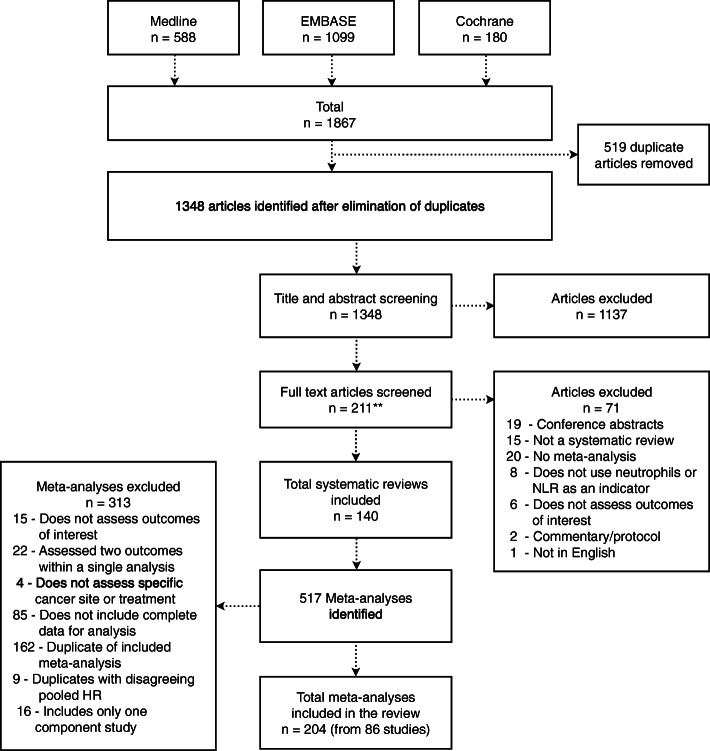
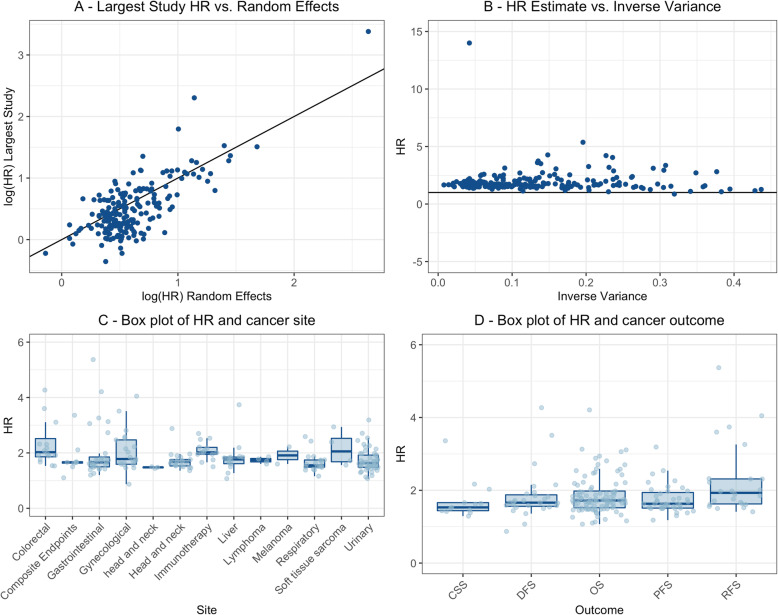
Background: Although neutrophils have been linked to the progression of cancer, uncertainty exists around their association with cancer outcomes, depending on the site, outcome and treatments considered. We aimed to evaluate the strength and validity of evidence on the association between either the neutrophil to lymphocyte ratio (NLR) or tumour-associated neutrophils (TAN) and cancer prognosis. Methods: We searched MEDLINE, Embase and Cochrane Database of Systematic Reviews from inception to 29 May 2020 for systematic reviews and meta-analyses of observational studies on neutrophil counts (here NLR or TAN) and specific cancer outcomes related to disease progression or survival. The available evidence was graded as strong, highly suggestive, suggestive, weak or uncertain through the application of pre-set GRADE criteria. Results: A total of 204 meta-analyses from 86 studies investigating the association between either NLR or TAN and cancer outcomes met the criteria for inclusion. All but one meta-analyses found a hazard ratio (HR) which increased risk (HR > 1). We did not find sufficient meta-analyses to evaluate TAN and cancer outcomes ( N = 9). When assessed for magnitude of effect, significance and bias related to heterogeneity and small study effects, 18 (9%) associations between NLR and outcomes in composite cancer endpoints (combined analysis), cancers treated with immunotherapy and some site specific cancers (urinary, nasopharyngeal, gastric, breast, endometrial, soft tissue sarcoma and hepatocellular cancers) were supported by strong evidence. Conclusion: In total, 60 (29%) meta-analyses presented strong or highly suggestive evidence. Although the NLR and TAN hold clinical promise in their association with poor cancer prognosis, further research is required to provide robust evidence, assess causality and test clinical utility. Trial registration: PROSPERO CRD42017069131 .
Overview
The claims and statistics of this paper haven’t been checked yet.
Free: it reads the open-access text and checks the first 5 claims that cite a source we can check. Create a free account to check every claim.
Integrity signals
Registry
Cites
Statistics
Figures
Verification
Claims the paper makes
The claims and statistics of this paper haven’t been checked yet.
Free: it reads the open-access text and checks the first 5 claims that cite a source we can check. Create a free account to check every claim.
Claims other papers make about this one
Each is checked against this paper’s own text: does it say what the citing paper says it does?
In the citing paper
“both responses to inflammation shown to be strongly prognostic across cancer types and treatment settings 27,28 .”
From A gut microbial signature for combination immune checkpoint blockade across cancer types (2024) · cites this paper as [28]
Self-check
Percentages, sums and reported differences re-computed from the paper’s own numbers.
The self-check needs the paper’s full text.
Citations
Cites
Hallmarks of Cancer: The Next Generation
Hanahan, D., & Weinberg, R. A. (2011) · Cell · doi:10.1016/j.cell.2011.02.013 · Cited by 66,590
Measuring inconsistency in meta-analyses
Higgins, J. P. T., Thompson, S. G., Deeks, J. J., & Altman, D. G. (2003) · BMJ · doi:10.1136/bmj.327.7414.557 · Cited by 63,139 · cited 4×
“We further assessed heterogeneity with Cochran’s Q test and quantified using the I(2) statistic [22].”
InfluentialBias in meta-analysis detected by a simple, graphical test
Egger, M., Smith, G. D., Schneider, M., & Minder, C. (1997) · BMJ · doi:10.1136/bmj.315.7109.629 · Cited by 56,722
Wickham, H. (2016) · Use R! · doi:10.1007/978-3-319-24277-4 · Cited by 33,115
GRADE: an emerging consensus on rating quality of evidence and strength of recommendations
Guyatt, G. H., Oxman, A. D., Vist, G. E., Kunz, R., Falck-Ytter, Y., Alonso-Coello, P., & Schünemann, H. J. (2008) · BMJ · doi:10.1136/bmj.39489.470347.ad · Cited by 23,305
Coussens, L. M., & Werb, Z. (2002) · Nature · doi:10.1038/nature01322 · Cited by 15,111 · cited 1×
“The biological mechanisms behind inflammation and cancer progression could suggest temporality, as elevated NLR and TAN are proposed to promote increased cell proliferation, angiogenesis and risk of metastasis as contributors to poor prognosis [5, 13, 135].”
Siegel, R. L., Miller, K. D., & Jemal, A. (2017) · CA: A Cancer Journal for Clinicians · doi:10.3322/caac.21387 · Cited by 14,712
Immunity, Inflammation, and Cancer
Grivennikov, S. I., Greten, F. R., & Karin, M. (2010) · Cell · doi:10.1016/j.cell.2010.01.025 · Cited by 10,755
Shea, B. J., Reeves, B. C., Wells, G., Thuku, M., Hamel, C., Moran, J., Moher, D., Tugwell, P., Welch, V., Kristjansson, E., et al. (2017) · BMJ · doi:10.1136/bmj.j4008 · Cited by 10,636
Sterne, J. A. C., Sutton, A. J., Ioannidis, J. P. A., Terrin, N., Jones, D. R., Lau, J., Carpenter, J., Rucker, G., Harbord, R. M., Schmid, C. H., et al. (2011) · BMJ · doi:10.1136/bmj.d4002 · Cited by 7,709
Research works printed but not linked: 6
- 16. Reichardt C. RefWorks: http://www.refworks.com. Public Services Quarterly. 2010;6(4):366 -7.
- 17. Schwarzer G. meta: An R package for meta-analysis. R news. 2007;7(3): 40 -5.
- 31. StataCorp. Stata statistical software: release 14. College Station: StataCorp LP; 2015.
- 52. Zheng DC, Zheng C, Wu J, et al. Neutrophil-lymphocyte ratio predicts the prognosis of patients with colorectal cancer: a meta-analysis. Int J Clin Exp Med. 2015;9(1):78 -90.
- 77. Dolan RD, McSorley ST, Horgan PG, et al. The role of the systemic inflammatory response in predicting outcomes in patients with operable cancer: systematic review and meta-analysis. Sci Rep. 2017;116(1):134 -46.
- 108. Zhou Y, Cheng S, Fathy AH, et al. Prognostic value of platelet-tolymphocyte ratio in pancreatic cancer: A comprehensive meta-analysis of 17 cohort studies. Onco Targets Ther. 2018;11:1899 -908. · DOI
Cited by
Items 301–400 of 699
Xu, J., Wu, F., Jiang, Y., Han, C., Xing, X., Zhu, H., Chen, Y., & Li, Q. (2026) · BMC Oral Health · doi:10.1186/s12903-026-08098-9 · Cited by 4
“Comprehensive umbrella reviews and meta-analyses have consistently demonstrated that dysregulated inflammatory biomarkers, particularly NLR, are associated with poor survival outcomes across various solid tumors [13, 14].”
Zhang, F., Hu, K., Sun, C., Chen, R., Ni, G., Liu, X., Wei, L., & Su, R. (2026) · Gut Microbes · doi:10.1080/19490976.2026.2662690 · Cited by 4
“…studies observed that a low blood albumin and high neutrophil-to-lymphocyte ratio (NLR) are associated with clinical progressive disease (cPD), 33,34 these commonly measured clinical factors provide limited information for distinguishing treatment responders from non-responders and are useful…”
Hsiao, P., Wang, Y., Wu, S., Chen, W., Wu, C., Chiu, T., Yang, Y., & Luo, S. (2024) · Cancers · doi:10.3390/cancers16051037 · Cited by 4
“For those at a high risk, nutritional interventions or adjustments in therapy strategies may be necessary.”
BackgroundSaboorifar, H., Zafarani, Y., Gholampour, G., Roghani, A., Qiu, F. X., Dequaniter, D., & Yu, Q. (2024) · European Archives of Oto-Rhino-Laryngology · doi:10.1007/s00405-024-08649-2 · Cited by 4
“Many previous studies suggested the association between higher NLR and lower survival of cancer patients [27, 28].”
Jo, Y., Puri, S., Haaland, B. A., Coletta, A. M., Chipman, J., Embrey, K., Kerrigan, K. C., Patel, S. B., Moynahan, K., Gumbleton, M., et al. (2024) · Clinical Lung Cancer · doi:10.1016/j.cllc.2024.10.001 · Cited by 5
Neutrophil to lymphocyte ratio in urolithiasis: a systematic review
Khanzadeh, S., Zarimeidani, F., Kashani, E., Babadi, S., Rahmati, R., Lucke-Wold, B. P., Cerillo, J., & Ghaedi, A. (2025) · BMC Urology · doi:10.1186/s12894-025-01720-y · Cited by 7
“As an instance, there are studies available on internal [70, 71], autoimmune [72, 73], infectious [74–76], neurological [77, 78], cancers [79–81], urological [82, 83], orthopedics [84, 85], surgery [86–88], gynecology/obstetrics [89, 90], psychiatry [91, 92], oto-laryngology [93–95], ophthalmology…”
Chi, X., Bi, Q., You, L., Zhou, Y., & Zhao, C. (2025) · Biomarkers in Medicine · doi:10.1080/17520363.2025.2542111 · Cited by 7
Yoon, L. I., & Li, R. H. L. (2025) · Journal of Feline Medicine and Surgery · doi:10.1177/1098612x251376773 · Cited by 4
Bristow, C. L., Reeves, M. A. B., & Winston, R. (2021) · Frontiers in Oncology · doi:10.3389/fonc.2021.739080 · Cited by 4
Masuda, T., Ueo, H., Okumura, Y., Kai, Y., ANDO, Y., Masuguchi, K., KITAGAWA, M., Kitagawa, A., Hayashi, N., Tsuruda, Y., et al. (2023) · Cancer Genomics & Proteomics · doi:10.21873/cgp.20373 · Cited by 6
Zhen, L., Chen, X., Fan, J., Wang, X., Ai, H., Que, B., Gong, W., & Nie, S. (2024) · Cardiovascular Innovations and Applications · doi:10.15212/cvia.2024.0016 · Cited by 6
“The NLR is increasingly being used as a biomarker for managing various inflammation-associated diseases, such as CVD, cancer, and autoimmune diseases [33–36].”
MethodHu, X., Wang, N., Gao, F., Ge, S., Mei, L., Zhang, X., Li, T., Li, T., Xu, C., Huang, C., et al. (2024) · Heliyon · doi:10.1016/j.heliyon.2024.e32393 · Cited by 4
Zhang, C., Huo, Y., Shang, X., Zhang, T., Tang, N., & Wang, H. (2024) · Respiratory Research · doi:10.1186/s12931-024-02885-0 · Cited by 5
“Thus, there is a desperate need for exploration of more reliable biomarkers to help guide immunotherapeutic treatment in SCLC. Neutrophil to lymphocyte ratio (NLR), an inflammatory parameter, has been adopted to predict survival and response to cancer treatments [8, 9].”
BackgroundLi, J., Wang, N., Mao, G., Wang, J., Xiang, M., Zhang, H., Zeng, D., Ma, H., & Jiang, J. (2024) · Journal of Cellular and Molecular Medicine · doi:10.1111/jcmm.70059 · Cited by 4
“29 32 This correlation may be attributed to various factors, including the immunosuppres - sive properties of neutrophils, their ability to promote tumour growth and their facilitation of tumour cell migration and invasion through the release of hepatocyte growth factor (HGF) and other molecules.”
Li, X., Dong, J., Li, B., Aimei, O., Sun, Y., Wu, X., Liu, W., Li, R., Li, Z., & Yu, Y. (2024) · Dose-Response · doi:10.1177/15593258241301525 · Cited by 4
Zhang, Z., Zhao, W., Lv, C., Wu, Z., Liu, W., Chang, X., Yu, Y., Xiao, Z., He, Y., & Zhang, H. (2024) · Frontiers in Immunology · doi:10.3389/fimmu.2024.1456150 · Cited by 4
Sun, H., Liang, J., Xue, S., Zhang, X., Ding, M., Zhu, J., Nanding, A., Liu, T., Lou, G., Gao, Y., et al. (2024) · BMC Cancer · doi:10.1186/s12885-024-13354-8 · Cited by 7
Wang, W., Chen, Y., Chen, Q., Sun, H.-W., Niu, N.-X., Li, H.-H., Cao, Y., Bai, Y., & Li, X. (2025) · Frontiers in Immunology · doi:10.3389/fimmu.2024.1500525 · Cited by 5
Li, L., Yang, X., Zou, J., Zhang, J., Xie, X.-H., Liu, J.-H., & Chen, B.-Z. (2025) · BMC Anesthesiology · doi:10.1186/s12871-025-02972-9 · Cited by 4
“As a highly sensitive inflammatory marker, NLR is of great value in the diagnosis and prognosis of various diseases [16, 17].”
Wu, Y., Hu, J., Zhao, Y., Ju, D., Cao, S., Guo, J., Song, W., Mo, R., Lei, S., Wu, Y., et al. (2025) · Journal of Stroke and Cerebrovascular Diseases · doi:10.1016/j.jstrokecerebrovasdis.2025.108341 · Cited by 5
Assessing inflammatory status in COVID-19: a role in the pandemic?
Corica, B., & Romiti, G. F. (2021) · Internal and Emergency Medicine · doi:10.1007/s11739-021-02706-y · Cited by 4
“These results are consistent with findings already reported in the literature: NLR, which may reflect the balance between systemic inflammation and immunity, has been already described as a prognostic biomarker in other scenarios, including cardiovascular disease and cancer [12, 13].”
ResultTian, K., Li, P.-J., & Zhang, Y. (2022) · Cancer Management and Research · doi:10.2147/cmar.s340723 · Cited by 4
Aziz, M. H., van der Meulen, J., Mustafa, D. A. M., & van Eijck, C. H. J. (2022) · Pancreas · doi:10.1097/mpa.0000000000002128 · Cited by 5
“Reduced retinol-binding protein levels have also been linked to an elevated neutrophil-to-lymphocyte ratio,(35) a potent inflammatory biomarker used in pancreatic as well as other cancer prognostic studies.(36,37) Decrease in retinol-binding protein results in an increase of unbound retinol, which is excreted in the u…”
BackgroundXiao, X., Huang, S., Gan, C., Quan, X., Xiang, Y., & Zheng, B. (2023) · Nutrition and Cancer · doi:10.1080/01635581.2023.2186265 · Cited by 4
“The presence of a high NLR has been associated with increased mortality in several malignancies (26).”
BackgroundTorralba, E. G., Manzano, E. N., Luengo‐Gil, G., Barrio, P. D. L. M., Benito, A. C., Pérez‐Ramos, M., Álvarez-Abril, B., Rubio, A. I., García-Garré, E., de la Peña, F. A., et al. (2023) · Frontiers in Oncology · doi:10.3389/fonc.2023.1182725 · Cited by 4
Dirican, A., Uncu, D., Sekacheva, M. I., Artaç, M., Aladashvil, A., Erdoğan, A. P., Ma, K., Alacacıoğlu, A., Boukovinas, I., & Turhal, N. S. (2023) · Eastern Mediterranean Health Journal · doi:10.26719/emhj.23.087 · Cited by 4
“Higher levels of NLR are an indication of poor survival for patients with HCC and NLR can be considered a biomarker in making clinical decisions about HCC treatment (14).”
BackgroundJasti, N., Lakshmikanth Reddy, M. N., Pothireddy, N. K., Sankepalli, M. R., Jagathkar, G. M., & Singh, U. P. (2023) · Cureus · doi:10.7759/cureus.41774 · Cited by 4
“They are used as a predictor of prognosis in patients with cardiovascular disease [10,11], cancers [12,13], sepsis [14,15], bacteremia [16], viral infection [16], and psychiatry disorders [17,18].”
BackgroundWang, Z., Qin, Y., Chai, X., Lu, L., Xue, P., Lu, R., Miao, C., Ma, H.-M., Hu, X., & Yao, J. (2023) · Cancer Control · doi:10.1177/10732748231197511 · Cited by 5
“Specifically, the neutrophil to lymphocyte ratio (NLR) and monocyte to lymphocyte ratio (MLR) are easy-to-determine, cost-effective, and reliable systemic inflammatory biomarkers that are related to the prognosis of different cancer types.(7-9) The NLR has been identified as an independent prognostic variable for gast…”
BackgroundTakeda, K., Umezawa, R., Yamamoto, T., Takahashi, N., Suzuki, Y., Kishida, K., Omata, S., & Jingu, K. (2023) · Reports of Practical Oncology & Radiotherapy · doi:10.5603/rpor.97512 · Cited by 4
Kubo, S., Kobayashi, N., Matsumoto, H., Somekawa, K., Kaneko, A., Hashimoto, H., Teranishi, S., Watanabe, K., Horita, N., Hara, Y., et al. (2023) · Journal of Cancer Research and Clinical Oncology · doi:10.1007/s00432-023-05457-9 · Cited by 4
“The elevated NLR, a poor prognostic factor in diverse cancers, is thought to reflect an increased neutrophil or decreased lymphocyte presence within the tumor milieu (Katayama et al. 2020; Cupp et al. 2020; Kutlu et al. 2023).”
BackgroundHirasawa, Y., Kubota, Y., Mura, E., Suzuki, R., Tsurui, T., Iriguchi, N., Ishiguro, T., Ohkuma, R., Shimokawa, M., Ariizumi, H., et al. (2024) · Frontiers in Oncology · doi:10.3389/fonc.2024.1449941 · Cited by 3
Ronsini, C., Iavarone, I., Corte, L. D., Carotenuto, R. M., Andreoli, G., Mantia, E. L., FRANCISCIS, P. D., Bifulco, G., & Cobellis, L. (2025) · Clinical and Experimental Obstetrics & Gynecology · doi:10.31083/ceog25917 · Cited by 3
“This progression can also be reflected in the immune response of the individual, leading to alterations in inflammatory indices, such as the neutrophil-lymphocyte ratio (NLR), monocyte-lymphocyte ratio (MLR), and platelet-lymphocyte ratio (PLR) [6,7].”
Wang, J., Wu, H., Wang, F., Wang, Y., & Gu, J. H. (2025) · Journal of Inflammation Research · doi:10.2147/jir.s530974 · Cited by 3
“34 Lymphocytes and Monocytes play a crucial role in tumor-specific immune responses by inducing cytotoxic cell death and inhibiting tumor cell proliferation and migration.”
Peng, Y., Chen, Y., Ye, F., Chen, W., Zhou, Z., Ye, R., Jia, H., Zheng, T., & Zheng, C. (2025) · Digestive and Liver Disease · doi:10.1016/j.dld.2025.08.011 · Cited by 4
Kirsch-Mangu, A. T., Țîpcu, A., Gâta, V. A., Pop, D. C., Fekete, Z., Irimie, A., & Kubelac, P. M. (2025) · Diagnostics · doi:10.3390/diagnostics15172172 · Cited by 3
Shen, J., Zhou, J., Xue, F., Shen, W., Geng, L., & Zhang, H. (2025) · Scientific Reports · doi:10.1038/s41598-025-14465-3 · Cited by 5
Takamori, S., Shimokawa, M., Yamaguchi, M., Mori, M., Kuyama, S., Oki, M., Nishimura, Y., Nakatomi, K., Yanai, H., Sukoh, N., et al. (2025) · International Journal of Cancer · doi:10.1002/ijc.70170 · Cited by 3
“20 Further research is warranted to elucidate the mechanisms driving NLR changes and to validate its prognostic significance across diverse cancer types and treatment modalities.”
Wang, Y., Liang, J.-N., Liu, D.-C., Zhao, B.-C., Zhang, H., & Zhang, H. (2025) · Journal of Orthopaedic Surgery and Research · doi:10.1186/s13018-025-06339-1 · Cited by 10
“As a reliable and readily available marker of immune response to various infectious and non-infectious stimuli, NLR is widely used across various medical disciplines, such as cancer, atherosclerosis, inflammation, and stress [23–26].”
Lee, Y., Hsu, C., Wang, M., Kuo, W., Lien, H., Lee, Y., Lo, C., & Huang, C. (2025) · Taiwanese Journal of Obstetrics and Gynecology · doi:10.1016/j.tjog.2025.04.019 · Cited by 4
Ma, G., Ma, L., Zhang, Y., Chen, Y., Zhang, Y., Guo, W., Yao, Z., & Ji, G. (2025) · Frontiers in Oncology · doi:10.3389/fonc.2025.1712779 · Cited by 4
Imam, M. S., Abdel‐Sattar, R. M., Aldekhail, N. M., Humaish, N. K. A., Gary, S. A. G., Alkhulaifi, M. A. M., Alqahtani, M. A. M., Aldajani, M. L. Z., Altuwayhir, H. M. J., Alnaim, W. I. A., et al. (2025) · Clinical and Experimental Medicine · doi:10.1007/s10238-025-01903-9 · Cited by 4
“Impact on Immune Response: In addition, COVID-19 and the upregulation of cuproptosis-related genes are linked to immune dysregulation [111].”
Shirasaki, K., Minai, K., Ogawa, K., Nagoshi, T., Ogawa, T., Kawai, M. J., Tokuda, M., & Yoshimura, M. (2025) · Medicine · doi:10.1097/md.0000000000046725 · Cited by 3
“Its clinical utility has been demonstrated across various diseases, including cancer, [4,5] infectious diseases, [6,7] cerebrovascular disorders, [8,9] and cardiovascular diseases.”
Topuz, B. B., Tufekci, A., Cangi, S., Yıldırım, Ö. A., & Yıldırım, M. (2026) · Journal of Clinical Medicine · doi:10.3390/jcm15041475 · Cited by 3
García, M. E. G., Rodríguez, P. M., de Lema, C. M. S. P., Boluda, N. B., Henaréjos, P. S., Hernandez, M. A. M., Pérez, A. G., Hernández, C. M., Barrio, P. D. L. M., Garre, E. G., et al. (2026) · Breast Cancer Research and Treatment · doi:10.1007/s10549-026-07928-2 · Cited by 3
“While previous studies associate high NLR values with increased BC related mortality and shorter DFS as an independent prognostic factor [8–19], others have failed to confirm these associations for either DFS [20, 21] or OS [12, 18] in contemporary cohorts.”
Zhang, L.-K., Shang‐Guan, Z., Zheng, H.-L., Zheng, H.-H., Zheng, C.-Y., Chen, W.-F., & Xie, J.-W. (2026) · ESMO Open · doi:10.1016/j.esmoop.2026.106922 · Cited by 3
Adachi, Y., Hayashi, H., Tajiri, T., Kanemitsu, K., Ofuchi, T., Ogawa, D., Yumoto, S., Kitano, Y., Okabe, H., & Iwatsuki, M. (2026) · Pancreatology · doi:10.1016/j.pan.2026.04.008 · Cited by 3
Liu, J., Lai, S., Wu, P., Wang, J., Wang, J., Wang, J., & Zhang, Y. (2023) · Journal of Cancer Research and Clinical Oncology · doi:10.1007/s00432-023-04977-8 · Cited by 3
“1 3 different types of cancers, such as neutrophil-to-lymphocyte ratio, platelet-to-lymphocyte ratio, monocyte-to-lymphocyte ratio, systemic inflammation response index, systemic inflammation scores, systemic immune-inflammation index (Mori et al. 2021; Starzer et al. 2021; Katayama et al. 2021; Jomrich et al. 2021; C…”
BackgroundNasr, A. J., Kowalske, A., Wang, J., Jain, N. B., & Khazzam, M. S. (2024) · Seminars in Arthroplasty JSES · doi:10.1053/j.sart.2023.12.005 · Cited by 3
Ye, J., Zheng, L., Chen, Z., Wang, Q., Liao, X., Wang, X., Wei, Q., & Bao, Y. (2024) · BMC Urology · doi:10.1186/s12894-024-01439-2 · Cited by 3
Martínez, C., Asso, R. N., Rastogi, N., Freeman, C. R., & Cury, F. (2024) · Radiotherapy and Oncology · doi:10.1016/j.radonc.2024.110239 · Cited by 3
Clinical Implications of Neutrophil-to-Lymphocyte Ratio in Sickle Cell Disease
Obeagu, E. I. (2024) · Haematology International Journal · doi:10.23880/hij-16000242 · Cited by 2
Zhang, S., Xu, H., Li, W., Cui, J., Zhao, Q., Guo, Z., Chen, J., Yao, Q., Li, S., He, Y., et al. (2024) · BMC Cancer · doi:10.1186/s12885-024-12483-4 · Cited by 3
The Prognostic Implications of Neutrophil‐to‐Lymphocyte Ratio in Olfactory Neuroblastoma
Mocharnuk, J. W., Daniels, K. E., Filimonov, A., North, L. M., Gardner, P. A., Wang, E. W., & Snyderman, C. H. (2024) · Otolaryngology · doi:10.1002/ohn.826 · Cited by 4
“9 This has been shown in colorectal cancer, non ‐ small cell lung cancer, pancreatic cancer, glioblastoma, among many other malignancies.”
The effect of long-standing lymphopenia after radiation therapy on survival in rectal cancer
Soyfer, V., Lugovoy, E., Nikolaevski‐Berlin, A., Korzets, Y., Schlocker, A. J., Gutfeld, O., Ospovat, I., Amit, U., Rabin, T., Oz, Y. N., et al. (2024) · Surgical Oncology · doi:10.1016/j.suronc.2024.102119 · Cited by 3
Kim, G., Kim, E. Y., Lee, H., Shin, S., Lee, S. H., Sohn, K., Kim, J. W., & Lee, J. S. (2024) · Biomedicine & Pharmacotherapy · doi:10.1016/j.biopha.2024.117269 · Cited by 3
Dong, W., Li, J., & Zhuang, Z. (2024) · Biochemical Genetics · doi:10.1007/s10528-024-10940-0 · Cited by 7
“Neutrophils have been recognized as critical mediators of cancer progression, and our study reinforces this by demonstrating that high NRG scores correlate with poor prognosis in IBC patients, corroborating existing literature (Cupp et al. 2020; Zheng et al. 2023).”
Liu, Q., Jia, W., Zhang, Y., Lu, J. L., Luo, Q., Yang, L., & Wan, D. (2025) · Medicine · doi:10.1097/md.0000000000041545 · Cited by 4
Zhang, Y., Qu, Z., Xuan, H., Lu, L., Ding, C., He, Z., Gu, K., & Zhang, Y. (2025) · Journal of Inflammation Research · doi:10.2147/jir.s509928 · Cited by 5
Wang, Y. N., Chen, S. Q., Tang, Y. J., Chen, Q. Z., Wang, J. H., Bai, Y. F., Zhou, Y. L., Xu, H. H., Li, W. L., Chen, J., et al. (2025) · Journal of Dairy Science · doi:10.3168/jds.2024-25842 · Cited by 3
Yanxia, C., Yongqiang, X., Fu, M., & Xiaoyun, K. (2025) · Clinical and Experimental Optometry · doi:10.1080/08164622.2025.2493387 · Cited by 3
“11,12 Notably, indices such as the neutrophil-to-lymphocyte ratio (NLR) and the systemic immune-inflammation index (SII) have been reported to correlate with DME.”
Ho, Y.-T., Perera, O. M., Ayeni, F. E., Gregory, H., McMahon, H., Amarasekera, P. M. S., Chan, Y., Chang, J. H., Chuang, T., & Coverdale, P. (2025) · ANZ Journal of Surgery · doi:10.1111/ans.70220 · Cited by 3
“The effectiveness of NLR has been acknowledged across various conditions, both benign and malignant [5–7].”
Xiong, J., Zhang, D., Wu, J., Yang, P., Shi, D., Zhou, X., Yuan, Y., Quan, C., & Xie, N. (2025) · Frontiers in Oncology · doi:10.3389/fonc.2025.1564238 · Cited by 3
Ucgul, A. N., Sert, I. K., & Bora, H. (2025) · Cancer Control · doi:10.1177/10732748251361684 · Cited by 3
Cazacu, S. M., Alexandru, D. O., Popescu, A. V., Popa, P., Rogoveanu, I., & Iovănescu, V. F. (2025) · Diseases · doi:10.3390/diseases13080265 · Cited by 3
“…severe burns, ischemic and hemorrhagic stroke, myocardial infarction, venous thromboembolism, sepsis, COVID-19 pneumonia, and cancer [16,19–31], in addition to the risk of metabolic syndrome and MAFLD [32,33], cardiac surgery complications [34], encephalopathy [35], TIPS and virus…”
Saputra, P. B. T., Kurniawan, R. B., Siahaan, P. P., Arnindita, J. N., Putra, R. M., D’Oria, M., Faizah, N. N., & Alkaff, F. F. (2025) · Journal of Surgical Research · doi:10.1016/j.jss.2025.09.066 · Cited by 3
Zhang, B., Yao, Z., Zhou, Z., & Zhang, Y. (2025) · Scientific Reports · doi:10.1038/s41598-025-23334-y · Cited by 3
Lymphocyte Subsets in Defense Against New Pathogens in Patients with Cancer
Arango-Prado, M. D. C., Valverde, C. A. V., López, G. T., Pardeiro, P. S., Suárez-Reyes, A., Faxas-García, M. E., Diéguez-Rodríguez, V., Gracia, E., Noa, R. E., Bahí, R. D. C., et al. (2022) · MEDICC Review · doi:10.37757/mr2022.v24.n2.5 · Cited by 3
“NLR is an important biomarker for prognosis of these patients, since its increase is associated with poor outcomes.[40] This correlates with the literature, since patients undergoing treatment with chemo- and radiotherapy generally have lymphopenia and a low NLR, sometimes requiring treatment with granulocyte colony s…”
ResultA vérképből meghatározott neutrophil-lymphocyta arány prognosztikai értéke daganatos betegségekben
Deme, D. (2022) · Orvosi Hetilap · doi:10.1556/650.2022.32507 · Cited by 3
Pergialiotis, V., Papalios, T., Haidopoulos, D. A., Papapanagiotou, A., Vlachos, A., Rodolakis, A., & Thomakos, N. (2023) · Surgical Infections · doi:10.1089/sur.2022.381 · Cited by 3
Hashemi, S. J., Tosi, M. S., Hajiani, E., Parsi, A., & Alavinejad, P. (2023) · Shiraz E-Medical Journal · doi:10.5812/semj-138859 · Cited by 3
“Previous studies have shown that NLR is a useful inflammatory marker in various clinical fields, with the ability to predict the prognosis of diseases such as cancer, cardiovascular disease, and type 2 diabetes (19-21).”
He, X., Lin, Y., Qiu, H., Wang, X., & Zhu, B. (2023) · PubMed Central · Cited by 6
Serum globulin in children with myasthenia gravis: predicting relapse and prognosis
Jiang, Z. D., Hu, W., Ning, Z., Wu, L., Yang, L. M., Liao, H., Chen, B., Tang, J., Xu, R., Guo, F., et al. (2024) · Neurological Research · doi:10.1080/01616412.2024.2340883 · Cited by 3
“We found that globulin is slightly positively correlated with NLR, which is an inflammatory indicator that is significantly elevated in tumors, infections and immune diseases [16].”
BackgroundHeterogeneous characterization of neutrophilic cells in head and neck cancers
Fay, M., Clavijo, P. E., & Allen, C. T. (2024) · Head & Neck · doi:10.1002/hed.27774 · Cited by 3
“37 A pan-cancer analysis of (cid”
Chen, Q., Bao, J., Chen, F., Ding, J., Zhu, T., & Chen, L. (2024) · European Journal of Inflammation · doi:10.1177/1721727x241260224 · Cited by 3
Chen, J., Wang, L., Xu, L., Qian, X., & Chen, X. (2024) · The Journal of Maternal-Fetal & Neonatal Medicine · doi:10.1080/14767058.2024.2376657 · Cited by 3
“Elevated NLR serves as an indicator of systemic inflammation [12].”
Huang, D., Zhang, J., Zheng, X., & Gao, M. (2024) · Langenbeck s Archives of Surgery · doi:10.1007/s00423-024-03431-8 · Cited by 3
Adiposity assessed close to diagnosis and prostate cancer prognosis in the EPIC study
Cariolou, M., Christakoudi, S., Gunter, M. J., Key, T., Perez‐Cornago, A., Travis, R. C., Zamora‐Ros, R., Petersen, K. E. N., Tjønneland, A. M., Weiderpass, E., et al. (2024) · JNCI Cancer Spectrum · doi:10.1093/jncics/pkae070 · Cited by 5
“Obesity has been positively associated with higher neutrophil to lymphocyte ratio (62,63), and strong or highly suggestive evidence supports that high neutrophil to lymphocyte ratio is associated with worse survival outcomes in patients with prostate cancer (64).”
BackgroundSelf-citationPark, J. S., Yu, J. I., Lim, D. H., Nam, H., Kim, Y. I., Lee, J., Kang, W. K., Park, S. H., Kim, S. T., Hong, J. Y., et al. (2022) · Biomedicines · doi:10.3390/biomedicines10071565 · Cited by 4
Li, G., Fu, Y., & Zhang, D. (2025) · Frontiers in Oncology · doi:10.3389/fonc.2025.1521099 · Cited by 3
Guo, Q., Wang, B., Gao, X., Zhao, P., & Lv, S. (2025) · Oncology Letters · doi:10.3892/ol.2025.14998 · Cited by 4
“A meta‑analysis by Cupp et al (10), which integrated all studies on NLR up to May 29, 2020, reported that NLR is a notable prognostic factor for multiple high‑risk cancers.”
The role and application of Coronin family in human tumorigenesis and immunomodulation
Gao, H., Sun, F., Zhang, X., Qiao, X., & Guo, Y. (2025) · Biochimica et Biophysica Acta (BBA) - Reviews on Cancer · doi:10.1016/j.bbcan.2025.189304 · Cited by 4
Miao, Y., Yang, R., Zhang, B., Yang, J. H., Yao, L., Wang, W., Liu, X., Guo, X., & Jia, H. (2025) · Breast Cancer Targets and Therapy · doi:10.2147/bctt.s519742 · Cited by 3
“33,34 In our study, patients with low level of NLR or high level of LMR had survived longer than those with high level of NLR or low level of LMR, respectively.”
Ramly, M. S., Ionescu, D. C., & Buggy, D. J. (2025) · Best practice & research. Clinical anaesthesiology · doi:10.1016/j.bpa.2025.05.001 · Cited by 2
Chowdhury, R., Botros, K., Richardson, K., Mlynarek, A., Sadeghi, N., Hier, M., Wurzba, S., Esfahani, K., Bouganim, N., Sultanem, K., et al. (2025) · Head & Neck · doi:10.1002/hed.28212 · Cited by 3
Tang, J., Jiang, Y. Z., Wang, H., Huang, Q., Yang, W., Tian, Q., Liu, A., Zhang, H., & Wu, C. (2025) · Frontiers in Public Health · doi:10.3389/fpubh.2025.1572558 · Cited by 2
Qiu, Y., Liu, J., Chai, S., Liu, L., Li, L., & Zhang, Y. (2025) · Frontiers in Oncology · doi:10.3389/fonc.2025.1505485 · Cited by 2
“This understanding has catalyzed the emergence of prognostic biomarkers, including the neutrophil-to-lymphocyte ratio (NLR), platelet-to-lymphocyte ratio (PLR), prognostic nutritional index (PNI), and Controlling Nutritional Status Score (CONUT) (12 – 15).”
Neutrophil Lymphocyte Ratio for Assessing Severity of Acute Pancreatitis
Shabbir, U., Ali, R., Bashir, Z., Kumar, A., Abid, A., Amanzai, A., Tariq, M. T., Rajput, I. A., Anees, M. M., Anees, S., et al. (2025) · F1000Research · doi:10.12688/f1000research.170009.1 · Cited by 2
Choi, M., Lee, S.-W., Park, W., Lee, Y. S., Lee, S. H., Lee, J. H., Permata, T. B. M., & Yim, K. (2025) · Frontiers in Immunology · doi:10.3389/fimmu.2025.1676838 · Cited by 8
Cao, J., Pang, J., Li, Y., Wang, S., Xiao, Z., & Ding, N. (2025) · Scientific Reports · doi:10.1038/s41598-025-22559-1 · Cited by 3
“Lymphocytes play a crucial role in recognizing and eliminating tumour cells, particularly when activated by agents such as trastuzumab 22 .”
Wijaya, W., Khattak, M. A., Abed, A., Meniawy, T. M., Millward, M., Gray, E. S., & Oey, O. (2025) · Cancer Investigation · doi:10.1080/07357907.2025.2586257 · Cited by 2
“In the context of cancer, NLR reflects the balance between pro-tumour inflammation and anti-tumour immune activity (31).”
Zhu, Y., Xiang, D., Xing, H., Li, Y., Xie, H., & Jiang, L. (2025) · Frontiers in Nutrition · doi:10.3389/fnut.2025.1644157 · Cited by 2
“Elevated NLR, an easily obtainable marker reflecting systemic inflammation and immune imbalance, has been linked to poor outcomes in various surgical and oncological settings (20), including POD (21).”
Chiang, Y., Tsai, Y., Wang, C.-C., Hsueh, F.-J., Huang, C., Chen, C.-H., Pu, Y.-S., Chueh, S.-C. J., Tsai, X. C.-H., & Cheng, J. C. (2026) · Journal of Biomedical Science · doi:10.1186/s12929-025-01201-2 · Cited by 3
“In addition, the NLR, a recognized marker of systemic inflammation, is a well-established index for predicting poor tumor prognosis [35] as well as the risk of lymph node and distant metastasis [36, 37]; however, the underlying mechanisms remain under investigation.”
Zheng, Y., Zhang, H., Su, Y., Zhang, J., Xu, W., Pan, W., & Li, Z. (2026) · Frontiers in Oncology · doi:10.3389/fonc.2025.1714984 · Cited by 2
Liu, G., Zhao, S., Xia, M., Zheng, K., Lu, D., Zhu, H., & Wang, D. (2026) · Surgical Endoscopy · doi:10.1007/s00464-026-12665-0 · Cited by 2
“…derived from routine blood examinations, such as the modified Glasgow prognostic score (mGPS) [9], prognostic nutritional index (PNI) [10], neutrophil-to-lymphocyte ratio (NLR) [11], and platelet-to-lymphocyte ratio (PLR) [12], have been reported as independent predictors of prognosis in GC.”
Su, X., Tong, X., Li, N., Wang, B., Gao, W., & Wang, Y. (2026) · Intensive Care Medicine Experimental · doi:10.1186/s40635-026-00878-5 · Cited by 3
“For instance, NLR and PLR focus on single proportional relationships, while SIRI incorporates neutrophils and monocytes but omits platelets, an essential contributor to thrombosis and post-stroke inflammation [15, 16].”
Zhang, W., Wang, W., Wu, J., Tian, J., Yan, W., Yuan, Y., Yao, Y., Shang, A., & Quan, W. (2022) · Frontiers in Oncology · doi:10.3389/fonc.2022.942964 · Cited by 2
Ren, W., Xu, Y., Yang, C., Cheng, L., Peng, Y., Fu, S., Han, J., & Dong, Z. (2022) · Frontiers in Oncology · doi:10.3389/fonc.2022.1038177 · Cited by 2
“Neutrophils are associated with the prognosis of many separate cancers (30) and are involved in almost all phases of tumor progression (31).”
BackgroundLiu, H.-L., Weng, S., Chou, C.-C., You, H., Wang, M., Ma, M., & Huang, W.-T. (2023) · Journal of Clinical Pathology · doi:10.1136/jcp-2023-208932 · Cited by 2
Simiraș, C., Morărașu, Ș., Simiras, D.-M., Iacob, Ș., Ong, W. L., Muşină, A. M., Velenciuc, N., Roată, C. E., Luncă, S., & Dimofte, G. (2023) · Chirurgia · doi:10.21614/chirurgia.2023.v.118.i.4.p.399 · Cited by 2
“More so, a recent umbrella review of 204 meta-analyses on NLR and cancer prognosis showed that only 29% of current data has strong evidence favoring NLR (10).”
Yeh, T., Wang, H., Cho, S., Wu, C., Hsieh, T.-Y., Huang, C.-T., Wang, M., Chuang, B. T.-M., Gau, Y., Du, J., et al. (2023) · Biomedicines · doi:10.3390/biomedicines11123113 · Cited by 2
“Two meta-analyses [25,26] and various studies have demonstrated that the NLR is a prognostic Two meta-analyses [25,26] and various studies have demonstrated that the NLR is a prognostic factor in di ff erent solid tumors, including esophageal cancer [40], gastric cancer [41,42], pancreatic cancer…”
Background
Metadata
- Authors
- Cupp, M. A., Cariolou, M., Tzoulaki, I., Aune, D., Evangelou, E., & Berlanga-Taylor, A. J.
- Affiliations
- MRC Centre for Environment and Health (GB)
- University of Ioannina (GR)
- Oslo University Hospital (NO)
- Venue
- BMC Medicine
- Published
- 2020-11-20
- Volume
- 18
- Issue
- 1
- Pages
- 360-360
- ISSN
- 1741-7015 (ISSN-L)
- PMC
- PMC7678319
- OpenAlex
- W3104254817
- Semantic Scholar
- dbd1398d909a25bb623a84e5aae3a5b5136ef5bd
- Cited by
- 697
- References
- 157
- Citations by year
- 2026: 110 · 2025: 166 · 2024: 184 · 2023: 111 · 2022: 95 · 2021: 30
- FWCI
- 6.34
- Type
- journal article
- Language
- en
- Open access
- gold
- doi.org
- Licence
- cc-by
- creativecommons.org/licenses/by/4.0/ (tdm)
- creativecommons.org/licenses/by/4.0/ (vor)
- Locations
- BMC Medicine (publishedVersion, cc-by)
- bioRxiv (Cold Spring Harbor Laboratory) (acceptedVersion, cc-by)
- PubMed Central (publishedVersion, cc-by)
- PubMed (publishedVersion)
- DOAJ (DOAJ: Directory of Open Access Journals) (submittedVersion, cc-by-sa)
- Spiral (Imperial College London) (submittedVersion, cc-by)
- Funders
- Medical Research Council (MR/L01632X/1)
- Topics
- Health Sciences › Medicine › Oncology › Inflammatory Biomarkers in Disease Prognosis
- Life Sciences › Biochemistry, Genetics and Molecular Biology › Cancer Research › Cancer, Stress, Anesthesia, and Immune Response
- Life Sciences › Immunology and Microbiology › Immunology › Immune cells in cancer
- Keywords
- neutrophil-to-lymphocyte ratio, tumor-associated neutrophils, cancer prognosis, neutrophils, immunotherapy, cancer survival, disease progression
- MeSH terms
- Female, Humans, Lymphocytes, Male, Neoplasms, Neutrophils, Prognosis, Survival Analysis
About these checks
Registry, retraction, Cites and statistics results are computed, not judged, with one exception: a printed reference that no index lists is read once by a model before it counts as a citation error. Claims are extracted by a model and kept only when their quote appears verbatim in the text; each cited source is then checked, with a model’s help, for whether it says what the claim relies on. Those verdicts can be wrong — read the claim’s quote and the cited source before relying on one.
Statistics and arithmetic are recomputed, not judged.
Confidence bands are shown only for fields calibrated on our annotated test set. None is calibrated yet, so no band is shown.
What counts as a claim ›How we measure confidence ›How we check this ›
Are you an author, or do you see a problem with this page? Request a review
Data sources
Bibliographic data: Semantic Scholar, OpenAlex, Crossref.
Contains information from the Semantic Scholar Academic Graph Datasets, made available under the ODC Attribution License (ODC-BY 1.0).
Semantic Scholar’s data is described in: Kinney, R., et al. (2023). The Semantic Scholar Open Data Platform. arXiv:2301.10140.
