

Neutrophil to lymphocyte ratio and cancer prognosis: an umbrella review of systematic reviews and meta-analyses of observational studies
Open accessPublished version of a preprint
The DOI matches its Crossref record; 159 of the 159 references it cites were found in a registry or an index.
Abstract
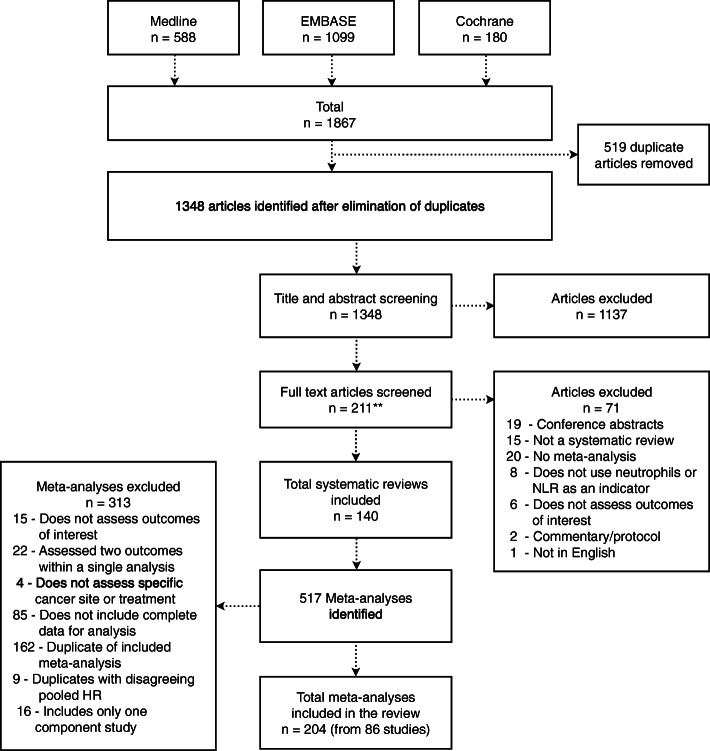
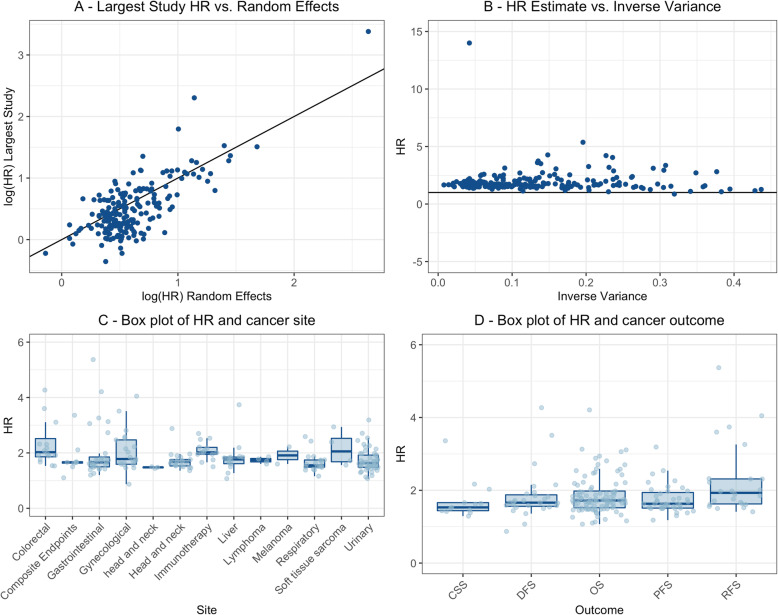
Background: Although neutrophils have been linked to the progression of cancer, uncertainty exists around their association with cancer outcomes, depending on the site, outcome and treatments considered. We aimed to evaluate the strength and validity of evidence on the association between either the neutrophil to lymphocyte ratio (NLR) or tumour-associated neutrophils (TAN) and cancer prognosis. Methods: We searched MEDLINE, Embase and Cochrane Database of Systematic Reviews from inception to 29 May 2020 for systematic reviews and meta-analyses of observational studies on neutrophil counts (here NLR or TAN) and specific cancer outcomes related to disease progression or survival. The available evidence was graded as strong, highly suggestive, suggestive, weak or uncertain through the application of pre-set GRADE criteria. Results: A total of 204 meta-analyses from 86 studies investigating the association between either NLR or TAN and cancer outcomes met the criteria for inclusion. All but one meta-analyses found a hazard ratio (HR) which increased risk (HR > 1). We did not find sufficient meta-analyses to evaluate TAN and cancer outcomes ( N = 9). When assessed for magnitude of effect, significance and bias related to heterogeneity and small study effects, 18 (9%) associations between NLR and outcomes in composite cancer endpoints (combined analysis), cancers treated with immunotherapy and some site specific cancers (urinary, nasopharyngeal, gastric, breast, endometrial, soft tissue sarcoma and hepatocellular cancers) were supported by strong evidence. Conclusion: In total, 60 (29%) meta-analyses presented strong or highly suggestive evidence. Although the NLR and TAN hold clinical promise in their association with poor cancer prognosis, further research is required to provide robust evidence, assess causality and test clinical utility. Trial registration: PROSPERO CRD42017069131 .
Overview
The claims and statistics of this paper haven’t been checked yet.
Free: it reads the open-access text and checks the first 5 claims that cite a source we can check. Create a free account to check every claim.
Integrity signals
Registry
Cites
Statistics
Figures
Verification
Claims the paper makes
The claims and statistics of this paper haven’t been checked yet.
Free: it reads the open-access text and checks the first 5 claims that cite a source we can check. Create a free account to check every claim.
Claims other papers make about this one
Each is checked against this paper’s own text: does it say what the citing paper says it does?
In the citing paper
“both responses to inflammation shown to be strongly prognostic across cancer types and treatment settings 27,28 .”
From A gut microbial signature for combination immune checkpoint blockade across cancer types (2024) · cites this paper as [28]
Self-check
Percentages, sums and reported differences re-computed from the paper’s own numbers.
The self-check needs the paper’s full text.
Citations
Cites
Hallmarks of Cancer: The Next Generation
Hanahan, D., & Weinberg, R. A. (2011) · Cell · doi:10.1016/j.cell.2011.02.013 · Cited by 66,590
Measuring inconsistency in meta-analyses
Higgins, J. P. T., Thompson, S. G., Deeks, J. J., & Altman, D. G. (2003) · BMJ · doi:10.1136/bmj.327.7414.557 · Cited by 63,139 · cited 4×
“We further assessed heterogeneity with Cochran’s Q test and quantified using the I(2) statistic [22].”
InfluentialBias in meta-analysis detected by a simple, graphical test
Egger, M., Smith, G. D., Schneider, M., & Minder, C. (1997) · BMJ · doi:10.1136/bmj.315.7109.629 · Cited by 56,722
Wickham, H. (2016) · Use R! · doi:10.1007/978-3-319-24277-4 · Cited by 33,115
GRADE: an emerging consensus on rating quality of evidence and strength of recommendations
Guyatt, G. H., Oxman, A. D., Vist, G. E., Kunz, R., Falck-Ytter, Y., Alonso-Coello, P., & Schünemann, H. J. (2008) · BMJ · doi:10.1136/bmj.39489.470347.ad · Cited by 23,305
Coussens, L. M., & Werb, Z. (2002) · Nature · doi:10.1038/nature01322 · Cited by 15,111 · cited 1×
“The biological mechanisms behind inflammation and cancer progression could suggest temporality, as elevated NLR and TAN are proposed to promote increased cell proliferation, angiogenesis and risk of metastasis as contributors to poor prognosis [5, 13, 135].”
Siegel, R. L., Miller, K. D., & Jemal, A. (2017) · CA: A Cancer Journal for Clinicians · doi:10.3322/caac.21387 · Cited by 14,712
Immunity, Inflammation, and Cancer
Grivennikov, S. I., Greten, F. R., & Karin, M. (2010) · Cell · doi:10.1016/j.cell.2010.01.025 · Cited by 10,755
Shea, B. J., Reeves, B. C., Wells, G., Thuku, M., Hamel, C., Moran, J., Moher, D., Tugwell, P., Welch, V., Kristjansson, E., et al. (2017) · BMJ · doi:10.1136/bmj.j4008 · Cited by 10,636
Sterne, J. A. C., Sutton, A. J., Ioannidis, J. P. A., Terrin, N., Jones, D. R., Lau, J., Carpenter, J., Rucker, G., Harbord, R. M., Schmid, C. H., et al. (2011) · BMJ · doi:10.1136/bmj.d4002 · Cited by 7,709
Research works printed but not linked: 6
- 16. Reichardt C. RefWorks: http://www.refworks.com. Public Services Quarterly. 2010;6(4):366 -7.
- 17. Schwarzer G. meta: An R package for meta-analysis. R news. 2007;7(3): 40 -5.
- 31. StataCorp. Stata statistical software: release 14. College Station: StataCorp LP; 2015.
- 52. Zheng DC, Zheng C, Wu J, et al. Neutrophil-lymphocyte ratio predicts the prognosis of patients with colorectal cancer: a meta-analysis. Int J Clin Exp Med. 2015;9(1):78 -90.
- 77. Dolan RD, McSorley ST, Horgan PG, et al. The role of the systemic inflammatory response in predicting outcomes in patients with operable cancer: systematic review and meta-analysis. Sci Rep. 2017;116(1):134 -46.
- 108. Zhou Y, Cheng S, Fathy AH, et al. Prognostic value of platelet-tolymphocyte ratio in pancreatic cancer: A comprehensive meta-analysis of 17 cohort studies. Onco Targets Ther. 2018;11:1899 -908. · DOI
Cited by
Items 401–500 of 699
Altınbaş, A., Keleş, B. O., Yılmaz, E. T., & COBAN, S. (2024) · Bratislavské lekárske listy/Bratislava medical journal · doi:10.4149/bll_2024_56 · Cited by 3
Li, X., Ou, C., & He, A. (2024) · Medicine · doi:10.1097/md.0000000000037680 · Cited by 2
“[19] Because of its convenient availability, it has high clinical significance.”
BackgroundDominoni, M., Barcellini, A., Pasquali, M. F., SILVESTRI, A. D., Ferretti, V. V., Cesari, S., Fiandrino, G., Orlandi, E. M., & Gardella, B. (2024) · Gynecologic and Obstetric Investigation · doi:10.1159/000534790 · Cited by 3
“Particularly, HPV types 31, 33, 45, 52, and 58 are responsible for around 20% of all cervical malignancies globally, while genotypes 16 and 18 account for over 70% of all high-grade cervical intra-epithelial neoplasia (CIN2+) and cervical cancers worldwide [2].”
Role of neutrophil–lymphocyte ratio as a prognostic marker in SJS/TEN patients
Rayi, M. K. M., Monteiro, R. C., Martis, J., Bhat, R. M., Fernandes, M. S., Jayaraman, J., D’Souza, M. J., Shetty, P., & Fernandes, S. (2024) · Archives of Dermatological Research · doi:10.1007/s00403-024-03327-z · Cited by 2
“The role of NLR as a prognosticator index has been studied in various systemic conditions like cardiovascular disease [11], stroke [13], diabetes [14], cancer [15], sepsis [16] and also in a few dermatological conditions such as uUrticaria [17], psoriasis [18] and vitiligo [19].”
Blood-, Tissue- and Urine-Based Prognostic Biomarkers of Upper Tract Urothelial Carcinoma
Łaszkiewicz, J., Krajewski, W. R., Sójka, A., Nowak, Ł., Chorbińska, J., Subiela, J. D., Tomczak, W. A., Giudice, F. D., Małkiewicz, B., & Szydełko, T. (2024) · Diagnostics · doi:10.3390/diagnostics14171927 · Cited by 2
“The NLR has been reported to be an important prognostic indicator of cancer progression due to the increase in tumor-associated neutrophils, which directly promote tumor development and low lymphocyte levels, suggesting a weakened immune response against the tumor [55,56].”
BackgroundDu, R., Liu, J., Tang, X., Chen, Z., Guan, L., Gao, W., & Huang, W. J. (2024) · Preventive Medicine Reports · doi:10.1016/j.pmedr.2024.102877 · Cited by 3
“Elevated NLR and PLR have been associated with poorer outcomes in cardiovascular diseases (CVD) (Garcia-Escobar et al., 2023), chronic kidney disease (CKD) (Yuan et al., 2019), cancers (Cupp et al., 2020; Nost et al., 2021), and other inflammatory conditions.”
BackgroundNaulleau, G., Monnet, I., Rousseau-Bussac, G., Vinas, F., Mangiapan, G., Jabot, L., Boudjemaa, A., CHOUAID, C., Auliac, J. B., & Assié, J. (2024) · Translational Lung Cancer Research · doi:10.21037/tlcr-24-382 · Cited by 2
Real-world experience of lenvatinib-based therapy in patients with advanced hepatocellular carcinoma
Wang, H., Lai, H., Su, W., Kao, J., Hsu, W., Chen, H., Chang, C.-W., Huang, G., & Peng, C. (2024) · Journal of Gastrointestinal Oncology · doi:10.21037/jgo-24-351 · Cited by 2
“Furthermore, NLR has prognostic value in various cancer types (40).”
Şahin, T. K., Güven, D. C., Durukan, M., Baş, O., Kaygusuz, Y., Arık, Z., Dızdar, Ö., Erman, M., Yalçın, Ş., & Aksoy, S. (2025) · Expert Review of Anticancer Therapy · doi:10.1080/14737140.2025.2451079 · Cited by 3
“Several clinical biomarkers like neutrophil–lymphocyte ratio (NLR), pan-immune-inflammation-value (PIV), and platelet–lymphocyte ratio (PLR) developed as denominators of immune-inflammatory status and demonstrated significant prognostic value across several tumors treated with ICIs [11–14].”
Harada, H., Hachisuga, T., Harada, Y., Shibahara, M., Murakami, M., Nuratdinova, F., Higami, S., Tohyama, A., Kinjo, Y., Ueda, T., et al. (2025) · Diagnostics · doi:10.3390/diagnostics15040422 · Cited by 2
“In other cancers, the treatment of cachexia with ghrelin-like agonists and the relationship between blood neutrophil to lymphocyte ratio and treatment prognosis have already been investigated [28,36].”
Threading the Needle: Navigating Novel Immunotherapeutics in Pancreatic Ductal Adenocarcinoma
Demir, T., Moloney, C., & Mahalingam, D. (2025) · Cancers · doi:10.3390/cancers17050715 · Cited by 4
“This classification includes the pure basal-like, stroma-activated, desmoplastic, pure classical, and immune classical subtypes.”
Tian, Q., Ma, J., Wu, Y., Wang, L., & Yang, W. (2025) · Open Medicine · doi:10.1515/med-2024-1101 · Cited by 2
“Neutrophil-to-lymphocyte ratio (NLR) and platelet-to-lym-phocyte ratio (PLR) are associated with the diagnosis and prognosis of solid tumors, such as gastric cancer, hepatocellular carcinoma, and colorectal cancer, in some studies [7 – 10].”
CD44 is a nexus between prognosis and therapeutics for brain cancer management
Cai, L., Lv, X., Chen, Y., & Dai, X. (2025) · Computers in Biology and Medicine · doi:10.1016/j.compbiomed.2025.109869 · Cited by 3
Wang, X., Zhang, Y., Ye, Y., Wang, L., Xu, Y., Ren, S., Wang, L., & Wu, G. (2025) · Mediators of Inflammation · doi:10.1155/mi/2247724 · Cited by 2
Neutrophil Prealbumin Ratio as a Potential Predictive Marker for Severe Burn Patients’ Prognosis
Namdaroğlu, O. B., Yazıcı, H., Esmer, A. C., Ugur, M., Erdogan, A. E., Ozturk, A. M., Uçar, A. D., & Yıldırım, M. (2025) · Journal of Burn Care & Research · doi:10.1093/jbcr/iraf096 · Cited by 2
Lu, J., Zhang, Z., Zhong, S., Deng, D., Yang, W., Wu, S., Cheng, Y., Bai, Y., & Mou, Y. (2025) · Journal of Inflammation Research · doi:10.2147/jir.s521075 · Cited by 2
Zhāng, T., & Lu, X. (2025) · Medicine · doi:10.1097/md.0000000000042208 · Cited by 3
Wan, H., Lu, S., Xu, L., Yuan, K., Xiao, Y., Xie, K., & Wu, H. G. (2022) · Frontiers in Oncology · doi:10.3389/fonc.2022.925362 · Cited by 2
Brkic, F. F., Stoiber, S., Al-Gboore, S., Quint, C., Schnoell, J., Scheiflinger, A., Heiduschka, G., Brunner, M., & Kadletz‐Wanke, L. (2022) · Nutrients · doi:10.3390/nu14204337 · Cited by 2
“Nowadays, the role of inflammation in cancer promotion and development is well-known, and inflammation is recognized as one of the hallmarks of cancer [18].”
BackgroundBraga, A., Canelas, A. C., Torres, B., Maestá, I., Pedrotti, L. G., Bessel, M., Esteves, A. P. V. D. S., Amim, J., Filho, J. R., Elias, K. M., et al. (2022) · PLoS ONE · doi:10.1371/journal.pone.0277892 · Cited by 2
“Furthermore, that paper also drew attention to the great heterogeneity of the studies evaluated, many with small sample sizes, generating small study effect biases, which need to be considered [32].”
BackgroundTumor Associated Neutrophils (TANs) and Cancer Metastasis
Khanmohammadi, S., & Rezaei, N. (2023) · Springer eBooks · doi:10.1007/978-3-030-80962-1_67-1 · Cited by 2
Cong, R., Li, M., Xu, W., Ma, X., & Wang, S. (2023) · BMC Cancer · doi:10.1186/s12885-023-11497-8 · Cited by 2
Ríos, C. P. S., Cabrera, O. G. J., Whaley, J. J. J., Sosa, M. D., Palacios, V. H., Hernández-González, G. L., & López, J. C. (2022) · Biomarkers in Medicine · doi:10.2217/bmm-2022-0056 · Cited by 2
Mireștean, C. C., Stan, M. C., Schenker, M., Volovat, C. D., Volovăț, S. R., Iancu, D. P. T., Iancu, R. I., & Bădulescu, F. (2023) · Preprints.org · doi:10.20944/preprints202305.0561.v1 · Cited by 2
Reassessing the role of the neutrophil-to-lymphocyte ratio in chronic kidney disease patients
Lee, Y. H. (2023) · The Korean Journal of Internal Medicine · doi:10.3904/kjim.2023.328 · Cited by 2
“Recently, the neutrophil-to-lymphocyte ratio (NLR) in peripheral blood has emerged as a promising prognostic indicator for various medical conditions, including infection, cardiovascular diseases, and malignancy [3-5].”
Nakamura, T., Asanuma, K., Hagi, T., & Sudo, A. (2023) · Journal of Orthopaedic Science · doi:10.1016/j.jos.2023.07.016 · Cited by 1
Prognostic value of neutrophil-to-lymphocyte ratio and fibrinogen levels in ovarian cancer
Rosaudyn, R., Mutiani, F., Yuliati, I., & Indraprasta, B. R. (2023) · Medical Journal of Indonesia · doi:10.13181/mji.oa.236880 · Cited by 1
Relation of NLR, PLR, LMR and RDW with Mortality and Type of Surgery
Özgüner, Y., & Altınsoy, S. (2023) · Bakirkoy Tip Dergisi / Medical Journal of Bakirkoy · doi:10.4274/bmj.galenos.2023.2023.8-16 · Cited by 2
“Cupp et al. (22) reported that there is a relationship between NLR value and mortality in cases of immunotherapy-treated urinary system cancers.”
Huang, R., Lü, X., Sun, X., & Wu, H. (2024) · Translational Cancer Research · doi:10.21037/tcr-23-2271 · Cited by 1
“Multiple traditional inflammatory markers, such as neutrophil-to-lymphocyte ratio (NLR), lymphocyte-Huang to-monocyte ratio (LMR), and platelet-to-lymphocyte ratio (PLR), are known potential prognostic biomarkers for various tumours (27).”
BackgroundChoi, H., Baek, J. H., Seo, A. N., Park, S. Y., Kim, H. J., Park, J. S., Choi, G., Kim, J. G., & Kang, B. W. (2024) · Chonnam Medical Journal · doi:10.4068/cmj.2024.60.2.105 · Cited by 1
“20,21 In various types of malignancies, a high NLR and PLR resulted in worse OS and DFS. 22,23 Furthermore, our previous study has reported that a high PLR change was a significant independent predictive marker of good responses to CRT in LARC.”
BackgroundShen, H., Gu, Y., Fang, Y., Xu, T., Xu, Y., Wu, X., Shu, Y., & Ma, P. (2024) · Journal of Gastrointestinal Oncology · doi:10.21037/jgo-24-64 · Cited by 1
“The combination of these factors, as captured by NLR, offers a holistic view of the host’s immune status and tumor microenvironment.”
InfluentialCooper, R., Ramaswami, D., Thomas, J. S., Nieva, J. J., & Hsu, R. C. (2024) · Discover Oncology · doi:10.1007/s12672-024-01606-9 · Cited by 2
Ling, Y., Miao, X., Zhou, X., Ma, J., Lin, Z., Li, Q., Zhang, M., Ma, Y., & Chen, B. (2025) · Journal of Inflammation Research · doi:10.2147/jir.s498121 · Cited by 1
“25–28 A retrospective analysis revealed that NLR was associated with PFS and OS in patients with multiple myeloma (MM) who received transplant therapy.”
Prenatt, Z., Patel, H. D., Reddy‐Patel, N., Bahirwani, J. T., Kaur, P., & Schneider, Y. (2025) · JGH Open · doi:10.1002/jgh3.70115 · Cited by 1
“Another meta-analysis examining the NLR in relation to cancer in general concluded that an elevated NLR was associated with an overall poor prognosis but lacked specific predictive value [36].”
Xiang, R., Hu, P., Xiao, X., Li, W., Liao, X., Li, J., Zhu, W., Liu, X., & Li, Q. (2025) · Frontiers in Immunology · doi:10.3389/fimmu.2025.1566195 · Cited by 1
Zhao, Q., Cui, S., Hu, B., & Chen, S. (2025) · Frontiers in Genetics · doi:10.3389/fgene.2025.1549602 · Cited by 1
Li, F., Fu, X., Ruan, Y., Yu, J., Chen, J., Xu, L., & Xiao, J. (2025) · Journal of Orthopaedics · doi:10.1016/j.jor.2025.06.025 · Cited by 2
“25,26 During the immediate postoperative period, a reduction in the levels and function of lymphocytes and NK cells may compromise cellular immunity, thereby escalating the risk of post-operative pneumonia and other inflammatory conditions.”
Liu, A.-X., Miao, Y., Zhang, M., Liu, X., Deng, Y.-L., Zeng, J.-Y., Li, Y.-J., Lu, W., Liu, C., & Zeng, Q. (2025) · Environmental Pollution · doi:10.1016/j.envpol.2025.126799 · Cited by 1
Tsai, S.-M., Chiang, T., Tseng, W., Huang, S. K., & Chiu, A. W. (2025) · Urological Science · doi:10.1097/us9.0000000000000095 · Cited by 1
Zheng, J., Wang, S., Zheng, G.-H., Zhang, J., Hou, S., Li, Y.-N., Li, T., Yuan, L., Yin, D.-Y., Chen, H., et al. (2025) · Clinical Nutrition · doi:10.1016/j.clnu.2025.07.028 · Cited by 2
Wang, Y., Ding, L., Ji, L., & Zhao, Y. (2025) · BMC Gastroenterology · doi:10.1186/s12876-025-04186-2 · Cited by 1
“Lymphocytes are important anti-tumor cells in the body, and a decrease in their quantity can reduce immune surveillance and defense capabilities, promote cancer cell immune escape, and facilitate tumor invasion and growth [24].”
Jaffer, A. A., Cullinane, C. M., Davey, M. G., Jalali, A., Buckley, J., Baban, C. K., Merrigan, B. A., & Tormey, S. M. (2025) · Clinical Breast Cancer · doi:10.1016/j.clbc.2025.08.015 · Cited by 2
Prognostic value of platelet volume indices in heart failure: a systematic review and meta-analysis
Abhari, A. P. (2025) · American Journal of Blood Research · doi:10.62347/xuxb3631 · Cited by 1
Liu, T., Gao, X., Geng, C., Yao, Y., & Zhang, G.-M. (2025) · World Journal of Surgical Oncology · doi:10.1186/s12957-025-03981-1 · Cited by 1
Korobkin, J.-J. D., Adamanskaya, E.-I. A., Ивановна, П. Н., Galkina, S. V., Kadyrov, T. I., Gorbunov, N., Av, S., Zhukova, L., & Sveshnikova, A. N. (2025) · Medical academic journal · doi:10.17816/maj641688 · Cited by 1
Association of leukocyte composition ratios from blood methylation with cancer mortality outcomes
Fan, Z., Edelmann, D., Zhao, Z., Köhler, B. C., Hoffmeister, M., & Brenner, H. (2025) · Communications Medicine · doi:10.1038/s43856-025-01132-x · Cited by 1
“Previous systematic reviews and meta-analyses have highlighted that both higher cytological NLR and lower cytological LMR, with a cut-off value ranging from two to fi ve, are associated with increased overall mortality in patients with various solid tumors 4,5,36 – 38 .”
Revolutionizing cervical cancer care: the synergistic effects of hyperthermia and machine learning
Feng, S., Wang, H., Duan, X., Chen, S., Guo, Y., Qu, B., & Cai, H. (2025) · International Journal of Hyperthermia · doi:10.1080/02656736.2025.2564343 · Cited by 1
“Measuring peripheral neutrophils alone, or as part of the NLR, can predict the outcomes of various cancer treatments [14].”
Song, M., Liu, Y., Dong, J., Xu, J., Yang, M., Hu, Q., Yin, S., & Bi, X. (2025) · Discover Oncology · doi:10.1007/s12672-025-03794-4 · Cited by 1
“For instance, observational studies have explored the relationships between neutrophils [7– 10], neutrophil-to-lymphocyte ratio [11–14], lymphocyte subsets [15–17], and platelet parameters [18–20]and breast cancer.”
Sidam, S., Sahoo, A. K., Chavan, A. G., & Bharti, V. K. (2025) · Cureus · doi:10.7759/cureus.96526 · Cited by 1
“NLR has gained prominence as a prognostic tool for assessing the severity of various critical conditions, including infections, malignancies, cardiovascular diseases, and respiratory failure [17-22].”
Luo, S., Lu, X., Fan, X., Duan, Y., Yu, B., & Shangguan, H. (2025) · ONCOLOGIE · doi:10.1515/oncologie-2025-0416 · Cited by 1
Hou, S., Gu, Q., Yang, T., Hou, Y.-W., Wang, M., Pan, Y., Jin, C., & Lin, N. (2025) · Mediators of Inflammation · doi:10.1155/mi/5588098 · Cited by 1
“According to a meta-analysis, almost 30 % of the studies have demonstrated a strong correlation between the NLR and cancer patients ’ OS [30].”
Nanomedicines targeting myeloid cells for breast cancer therapy
Deng, X., Liang, Y., Xu, X., & Saw, P. E. (2025) · Precision medicine and engineering. · doi:10.1016/j.preme.2025.100038 · Cited by 1
Mahdavi, H., Kaveh, V., Nasrabadi, M. I., Karimi, M. A., & Looha, M. A. (2025) · Health Science Reports · doi:10.1002/hsr2.71619 · Cited by 1
“…administered in this population, further introduces confounding effects that complicate the interpretation of NLR. Importantly, chemotherapy itself induces bone marrow suppression and lymphopenia, which may obscure the prognostic relevance of NLR by artificially altering leukocyte counts [53, 54].”
Tian, Y., Wang, F., Zhang, M., Ding, R., & wang, Y. (2025) · Mediators of Inflammation · doi:10.1155/mi/8701105 · Cited by 1
“NLR and PLR are markers that re fl ect systemic in fl am-mation and have been shown to predict outcomes in various conditions, including malignancies, chronic obstructive pulmonary disease, and sepsis [18 – 20].”
Lu, C. N., Sun, J., Zhang, Y., & Zhao, X. (2025) · Reviews in Cardiovascular Medicine · doi:10.31083/rcm44058 · Cited by 2
“The inflammatory scores were calculated using the following formulas: neutrophil-to-lymphocyte ratio (NLR) [22] = neutrophil count ( × 10 9 /L)/lymphocyte count ( × 10 9 /L); systemic immune-inflammation index (SII) [23] = platelet count ( × 10 9 /L) × neutrophil count ( × 10 9 /L)/lymphocyte count…”
Özkerim, U., Kınıkoğlu, O., Öksüz, S., Işık, D., Altıntaş, Y. E., Yıldırım, S., Akdağ, G., Sürmeli, H., Odabaş, H., Başoğlu, T., et al. (2026) · Medicina · doi:10.3390/medicina62010099 · Cited by 1
Liu, Y., Wu, B., Peng, G., Liang, J., & Liu, X. (2026) · Scientific Reports · doi:10.1038/s41598-025-34721-w · Cited by 2
“Previously, scholars have focused on the role of NLR in predicting cancer prognosis 34 .”
Zhao, S., Fu, P., Lin, L., Zhou, H., Huang, Y., Li, Y., & Tang, C. (2026) · Medicine · doi:10.1097/md.0000000000046941 · Cited by 1
Diagnostic value of pediatric appendicitis score for complicated appendicitis in preschool children
Ding, Z., Shi, X., Sun, H., Chen, H., Cheng, J., & Zhuang, W. (2026) · BMC Pediatrics · doi:10.1186/s12887-026-06535-w · Cited by 1
“A meta-analysis by Meghan et al. found that an elevated NLR was associated with poor cancer prognosis by investigating a total of 204 meta-analyses from 86 studies [31].”
Zhu, S., Li, W., Zhang, H., Lin, Y. E., & Chen, Z. (2026) · Biomarkers in Medicine · doi:10.1080/17520363.2026.2625220 · Cited by 2
Wang, J., Hu, T., & Yu, N. (2026) · Journal of Inflammation Research · doi:10.2147/jir.s556408 · Cited by 1
Zouaki, A., Abidi, K., Seffar, M., Abouqal, R., Masrar, A., Atouf, O., Mamad, H., Abercha, Y., Amin, G. E., Zeggwagh, A. A., et al. (2026) · Diagnostic Microbiology and Infectious Disease · doi:10.1016/j.diagmicrobio.2026.117334 · Cited by 1
Xu, P., Huang, C., Liu, Y., Ji, K., Dai, W., Liu, Y., Yan, Z. L., Zhang, H.-X., Chen, C., Cao, J., et al. (2026) · Frontiers in Immunology · doi:10.3389/fimmu.2026.1752235 · Cited by 1
Aal, M., Lakshman, V. B., Sivaguru, P., & Chandramathy, V. A. (2026) · Indian Journal of Gynecologic Oncology · doi:10.1007/s40944-026-01097-2 · Cited by 1
“Inflammatory biomarkers such as C-reactive pro - tein (CRP), neutrophil-to-lymphocyte ratio (NLR), plate - let-to-lymphocyte ratio (PLR), and the modified Glasgow Prognostic Score (mGPS) have been studied for their prog - nostic utility in cervical cancer [5–7].”
Lyu, Z., Xiao, Y., Wang, J., Wu, R., Yoo, K. H., Wei, W., Zhang, Q., Xie, Y., & Feng, D. (2026) · Frontiers in Immunology · doi:10.3389/fimmu.2026.1806105 · Cited by 1
Xie, H., Xu, N., Wei, L., Tang, S., & Gan, J. (2026) · Frontiers in Oncology · doi:10.3389/fonc.2026.1668103 · Cited by 1
Li, Y., Liu, Y., Zhang, D., Sun, Z., Zhang, H., Xie, L., Chen, H., Cai, C., Li, Y., Jia, J., et al. (2026) · Frontiers in Immunology · doi:10.3389/fimmu.2026.1780204 · Cited by 1
Liu, M., Shi, Y., Chen, A., & Hu, X. (2026) · Frontiers in Oncology · doi:10.3389/fonc.2026.1804811 · Cited by 1
“This may stem from the role of NLR as a dynamic indicator that continuously re fl ects tumor-induced systemic in fl ammation (39).”
Li, X., Peng, K., & Li, Q. (2026) · Clinical and Experimental Medicine · doi:10.1007/s10238-026-02162-y · Cited by 1
“It is an important component of tumor microenvironment and can affect the proliferation, invasion, and metastasis of tumor cells [ 35].”
Du, Z., Jiang, J., Lv, X., Hou, Y., & Li, D. (2026) · Medicine · doi:10.1097/md.0000000000048962 · Cited by 1
Wei, L., Yang, J. G., Wang, S., Xu, N., Chen, Y., Pei, Z., Lin, S., Shi, H., Chen, J. Q., & Xie, H. (2026) · Supportive Care in Cancer · doi:10.1007/s00520-026-10965-8 · Cited by 1
“…status: BMI and serum albumin are direct and classic markers of nutritional reserve and visceral protein status [1, 31], while the neutrophil-to-lymphocyte ratio derived from the denominator is a well-validated indicator of systemic inflammatory response and immune dysfunction in cancer [13, 32].”
Sequero, S., Castillo-Barnés, D., Gálvez, L., Carrión, N. P., Martinez-Murcia, F. J., de la Cruz‐Merino, L., Muñoz‐Couselo, E., Provencio, M., Ortíz, A., Górriz, J. M., et al. (2026) · Frontiers in Immunology · doi:10.3389/fimmu.2026.1854351 · Cited by 1
“Additionally, systemic in fl ammatory markers such as the neutro-phil-to-lymphocyte ratio (NLR) and lactate dehydrogenase (LDH) have been associated with poor prognosis (29, 30).”
Uygun, A., Dağdemir, A., Kartal, İ., Dinçer, O. S., Şimşek, H. K., Colak, M., & Yalcinkaya, G. (2026) · BMC Pediatrics · doi:10.1186/s12887-026-07367-4 · Cited by 1
“The prognostic significance of the NLR has been robustly confirmed across many adult solid tumors [4, 5, 17].”
Zhu, X., Long, C., Zhu, X., Xu, S., & Shao, W. (2026) · Frontiers in Surgery · doi:10.3389/fsurg.2026.1853516 · Cited by 1
“NLR and SII may better capture the combined imbalance between innate inflammatory activation and relative suppression of adaptive immune competence, which may help explain why these indices showed more consistent adverse signals than some of the other markers (27, 28).”
Liu, L., Wang, B., Lin, L.-L., & Da, M. (2021) · Asian Journal of Surgery · doi:10.1016/j.asjsur.2021.08.034 · Cited by 1
(2022) · European Journal of Gynaecological Oncology · doi:10.22514/ejgo.2022.014 · Cited by 1
“Neutrophil-lymphocyte ratio (NLR) has been shown to be a promising prognostic factor for many cancers [5, 6].”
BackgroundHost-related indexes in head and neck cancer
Valero, C., León, X., & Quer, M. (2023) · Current Opinion in Otolaryngology & Head & Neck Surgery · doi:10.1097/moo.0000000000000954 · Cited by 1
“…absolute count of lymphocytes, has been the most widely used, as it is an easy calculation and almost all standard lab tests will have neutrophil and lymphocyte counts [4–6,31 ,43, 44 & & , ]. lymphocytes (i.e. the platelet-to-lymphocyte ratio, PLR), has also been analyzed, with different results.”
ResultDziedzic, K., Pruc, M., Kilic, M., Ah, R., Yıldırım, M., Szarpak, Ł., Safiejko, K., Khamisy‐Farah, R., Chirico, F., & Bragazzi, N. L. (2023) · Disaster and Emergency Medicine Journal · doi:10.5603/demj.98191 · Cited by 1
Ciumanghel, I., Buzincu, I., Ciumanghel, A.-I., Bărbuță, E. I., & Cimpoesu, D. C. (2024) · Vascular · doi:10.1177/17085381241236932 · Cited by 1
Pujatti, P. B., VIEIRA, A. V., OLIVEIRA, C. G., ALMAS, T. M. M., & LOPES, T. F. R. (2024) · Revista Brasileira de Farmácia Hospitalar e Serviços de Saúde · doi:10.30968/rbfhss.2024.152.1127
Rong, Z.-X., Wei, W., Zeng, Q., Cai, X.-T., Wang, Y., Wang, J., Luo, H.-S., Xiao, L., Lin, J.-R., Bai, X., et al. (2024) · BMC Medicine · doi:10.1186/s12916-024-03676-6 · Cited by 4
“Previous studies have indicated the unfavorable role of NLR on cancer incidence risk [27] and prognosis [28].”
BackgroundZeng, C., Ji, J., Huang, Y., Peng, Y., Zhang, X., Yang, Z., & Guo, Z. (2024) · International Journal of General Medicine · doi:10.2147/ijgm.s485087 · Cited by 5
Zhao, Y., Ma, Y., Zhang, W., Jiao, B., Chen, Y., Gao, L., & Zhang, X. (2024) · Journal of Inflammation Research · doi:10.2147/jir.s483242 · Cited by 1
Çavdar, Ü., Kalender, D. S. Y., Yüksel, B. D., Pamuk, B. Ö., Çömlekçi, A., Ertürk, M. S., Gür, E. Ö., Kahraman, A., Yörükoğlu, K., & Yener, S. (2024) · Clinical Endocrinology · doi:10.1111/cen.15192 · Cited by 2
Liang, T., Jiang, J., Li, X., Ma, H., Zhang, X., Deng, G., Deng, W., Guan, L., Zhang, K., Jiang, L., et al. (2025) · BMJ Open · doi:10.1136/bmjopen-2024-086432 · Cited by 1
Chen, L. (2025) · American Journal of Cancer Research · doi:10.62347/ubdr6353 · Cited by 1
Chimeric Antigen Receptor T-Cell Therapy (Car T-Cells) in Solid Tumors, Resistance and Success
Elshimali, Y. (2022) · Bioequivalence & Bioavailability International Journal · doi:10.23880/beba-16000163
Targain, E. S., Chauhan, A., Paul, D., Sehgal, S. A., Soni, A., & Kaur, P. (2022) · Forum of Clinical Oncology · doi:10.2478/fco-2023-0004 · Cited by 1
Sadoyu, S., Tanni, K. A., Punrum, N., Paengtrai, S., Lai, N. M., Thakkinstian, A., Ngorsuraches, S., Bangpan, M., & Chaiyakunapruk, N. (2021) · Research Square · doi:10.21203/rs.3.rs-543971/v1 · Cited by 1
Meluch, M., Kowalska, M. M., Jagiełło-Gruszfeld, A., Fuksiewicz, M., Jodkiewicz, M., & Kotowicz, B. U. (2023) · Qeios · doi:10.32388/uspj73 · Cited by 1
Comino, M. R. S., Youseff, P., Heinzelmann, A., Bernhardt, F., Seifert, C., & Tewes, M. (2023) · Preprints.org · doi:10.20944/preprints202311.0042.v1 · Cited by 1
Wladis, E. J., Bohnak, C. E., Law, J. J., Adam, A. P., Rothschild, M. I., & Pauze, D. R. (2024) · Ophthalmic Plastic and Reconstructive Surgery · doi:10.1097/iop.0000000000002728 · Cited by 1
Azhary, A., Hajhamed, N. M., Mohammed, S. I., Bakheit, A. M., Hamida, M. E., Ahmed, A. E., Ebrahim, R. M. A., Balla, M. A. M., Hassan, A. B., Yassin, S., et al. (2025) · Research Square · doi:10.21203/rs.3.rs-6503959/v1 · Cited by 1
US Navy incurs ongoing asbestos removal costs
Barber, J. A. (1983) · Energy User News; (United States)
Combination of CD47 Expression and SIRI as a Prognostic Factor in Nasopharyngeal Carcinoma PatientsPreprint
Deng, C., Feng, Y., Wang, H., Zhang, H., Ma, J., Fan, S., Hu, C., Liu, X., & Hou, T. (2021) · Research Square · doi:10.21203/rs.3.rs-1122833/v1
Comparison of Neutrophil Lymphocyte Ratio in Benign, Premalignant and Malignant Laryngeal Lesions
ÇOLAK, M., Yağmur, A. R., Çufalı, Ş. A., Yaşar, N. G., İkincioğulları, A., & Dere, H. H. (2022) · kulak burun boğaz ve baş boyun cerrahisi dergisi · doi:10.24179/kbbbbc.2021-84615
Tamura, K., Miyato, H., Kanamaru, R., Sadatomo, A., Takahashi, K., Ohzawa, H., Koyanagi, T., Saga, Y., Takei, Y., Fujiwara, H., et al. (2022) · SSRN Electronic Journal · doi:10.2139/ssrn.4048120
Zhang, X., Wang, D., Sun, T., Li, W., & Dang, C. (2022) · Research Square · doi:10.21203/rs.3.rs-1482073/v1
Silva, W. D. N. (2022) · Digital Library of Theses and Dissertations (Universidade de São Paulo) · doi:10.11606/t.5.2022.tde-18072022-155001 · Cited by 1
Prognostic Value of Albumin Levels before Therapy on Survival Of Nasopharyngeal Carcinoma Patients
Selvyana, D. R., Hutajulu, S. H., Kurnianda, J., & Hidayah, F. N. (2022) · Mutiara Medika: Jurnal Kedokteran dan Kesehatan · doi:10.18196/mmjkk.v22i2.13893
Metadata
- Authors
- Cupp, M. A., Cariolou, M., Tzoulaki, I., Aune, D., Evangelou, E., & Berlanga-Taylor, A. J.
- Affiliations
- MRC Centre for Environment and Health (GB)
- University of Ioannina (GR)
- Oslo University Hospital (NO)
- Venue
- BMC Medicine
- Published
- 2020-11-20
- Volume
- 18
- Issue
- 1
- Pages
- 360-360
- ISSN
- 1741-7015 (ISSN-L)
- PMC
- PMC7678319
- OpenAlex
- W3104254817
- Cited by
- 697
- References
- 157
- Citations by year
- 2026: 110 · 2025: 166 · 2024: 184 · 2023: 111 · 2022: 95 · 2021: 30
- FWCI
- 6.34
- Type
- journal article
- Language
- en
- Open access
- gold
- doi.org
- Licence
- cc-by
- creativecommons.org/licenses/by/4.0/ (tdm)
- creativecommons.org/licenses/by/4.0/ (vor)
- Locations
- BMC Medicine (publishedVersion, cc-by)
- bioRxiv (Cold Spring Harbor Laboratory) (acceptedVersion, cc-by)
- PubMed Central (publishedVersion, cc-by)
- PubMed (publishedVersion)
- DOAJ (DOAJ: Directory of Open Access Journals) (submittedVersion, cc-by-sa)
- Spiral (Imperial College London) (submittedVersion, cc-by)
- Funders
- Medical Research Council (MR/L01632X/1)
- Topics
- Health Sciences › Medicine › Oncology › Inflammatory Biomarkers in Disease Prognosis
- Life Sciences › Biochemistry, Genetics and Molecular Biology › Cancer Research › Cancer, Stress, Anesthesia, and Immune Response
- Life Sciences › Immunology and Microbiology › Immunology › Immune cells in cancer
- Keywords
- neutrophil-to-lymphocyte ratio, tumor-associated neutrophils, cancer prognosis, neutrophils, immunotherapy, cancer survival, disease progression
- MeSH terms
- Female, Humans, Lymphocytes, Male, Neoplasms, Neutrophils, Prognosis, Survival Analysis
About these checks
Registry, retraction, Cites and statistics results are computed, not judged, with one exception: a printed reference that no index lists is read once by a model before it counts as a citation error. Claims are extracted by a model and kept only when their quote appears verbatim in the text; each cited source is then checked, with a model’s help, for whether it says what the claim relies on. Those verdicts can be wrong — read the claim’s quote and the cited source before relying on one.
Statistics and arithmetic are recomputed, not judged.
Confidence bands are shown only for fields calibrated on our annotated test set. None is calibrated yet, so no band is shown.
What counts as a claim ›How we measure confidence ›How we check this ›
Are you an author, or do you see a problem with this page? Request a review
Data sources
Bibliographic data: Semantic Scholar, OpenAlex, Crossref.
Contains information from the Semantic Scholar Academic Graph Datasets, made available under the ODC Attribution License (ODC-BY 1.0).
Semantic Scholar’s data is described in: Kinney, R., et al. (2023). The Semantic Scholar Open Data Platform. arXiv:2301.10140.
