

Neutrophil to lymphocyte ratio and cancer prognosis: an umbrella review of systematic reviews and meta-analyses of observational studies
Open accessPublished version of a preprint
The DOI matches its Crossref record; 159 of the 159 references it cites were found in a registry or an index.
Abstract
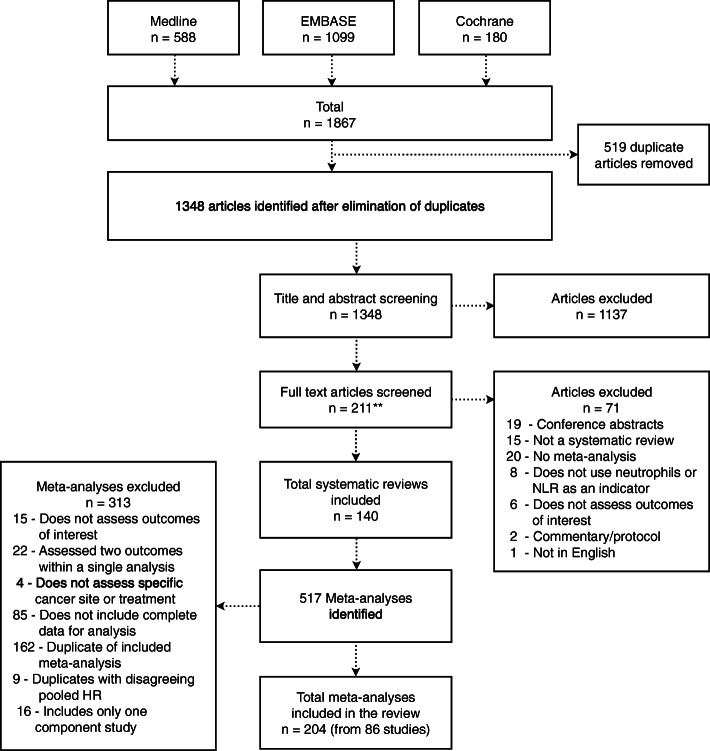
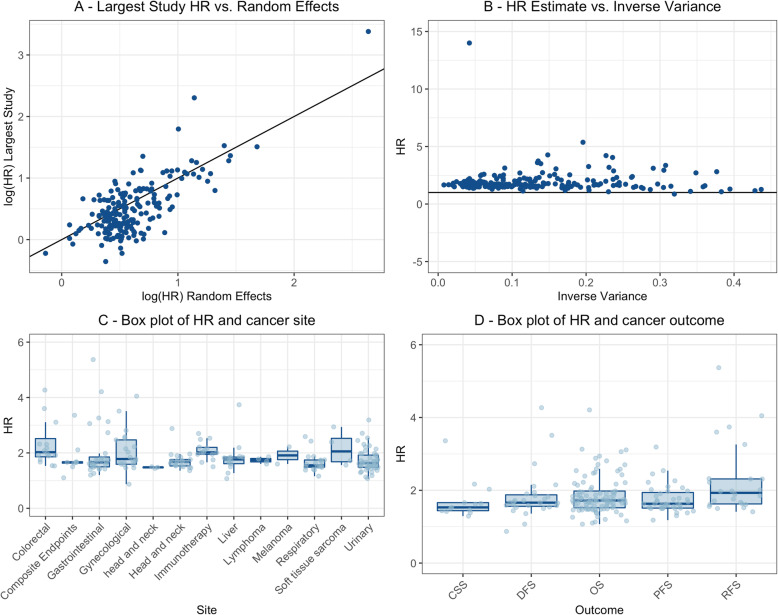
Background: Although neutrophils have been linked to the progression of cancer, uncertainty exists around their association with cancer outcomes, depending on the site, outcome and treatments considered. We aimed to evaluate the strength and validity of evidence on the association between either the neutrophil to lymphocyte ratio (NLR) or tumour-associated neutrophils (TAN) and cancer prognosis. Methods: We searched MEDLINE, Embase and Cochrane Database of Systematic Reviews from inception to 29 May 2020 for systematic reviews and meta-analyses of observational studies on neutrophil counts (here NLR or TAN) and specific cancer outcomes related to disease progression or survival. The available evidence was graded as strong, highly suggestive, suggestive, weak or uncertain through the application of pre-set GRADE criteria. Results: A total of 204 meta-analyses from 86 studies investigating the association between either NLR or TAN and cancer outcomes met the criteria for inclusion. All but one meta-analyses found a hazard ratio (HR) which increased risk (HR > 1). We did not find sufficient meta-analyses to evaluate TAN and cancer outcomes ( N = 9). When assessed for magnitude of effect, significance and bias related to heterogeneity and small study effects, 18 (9%) associations between NLR and outcomes in composite cancer endpoints (combined analysis), cancers treated with immunotherapy and some site specific cancers (urinary, nasopharyngeal, gastric, breast, endometrial, soft tissue sarcoma and hepatocellular cancers) were supported by strong evidence. Conclusion: In total, 60 (29%) meta-analyses presented strong or highly suggestive evidence. Although the NLR and TAN hold clinical promise in their association with poor cancer prognosis, further research is required to provide robust evidence, assess causality and test clinical utility. Trial registration: PROSPERO CRD42017069131 .
Overview
The claims and statistics of this paper haven’t been checked yet.
Free: it reads the open-access text and checks the first 5 claims that cite a source we can check. Create a free account to check every claim.
Integrity signals
Registry
Cites
Statistics
Figures
Verification
Claims the paper makes
The claims and statistics of this paper haven’t been checked yet.
Free: it reads the open-access text and checks the first 5 claims that cite a source we can check. Create a free account to check every claim.
Claims other papers make about this one
Each is checked against this paper’s own text: does it say what the citing paper says it does?
In the citing paper
“both responses to inflammation shown to be strongly prognostic across cancer types and treatment settings 27,28 .”
From A gut microbial signature for combination immune checkpoint blockade across cancer types (2024) · cites this paper as [28]
Self-check
Percentages, sums and reported differences re-computed from the paper’s own numbers.
The self-check needs the paper’s full text.
Citations
Cites
Hallmarks of Cancer: The Next Generation
Hanahan, D., & Weinberg, R. A. (2011) · Cell · doi:10.1016/j.cell.2011.02.013 · Cited by 66,590
Measuring inconsistency in meta-analyses
Higgins, J. P. T., Thompson, S. G., Deeks, J. J., & Altman, D. G. (2003) · BMJ · doi:10.1136/bmj.327.7414.557 · Cited by 63,139 · cited 4×
“We further assessed heterogeneity with Cochran’s Q test and quantified using the I(2) statistic [22].”
InfluentialBias in meta-analysis detected by a simple, graphical test
Egger, M., Smith, G. D., Schneider, M., & Minder, C. (1997) · BMJ · doi:10.1136/bmj.315.7109.629 · Cited by 56,722
Wickham, H. (2016) · Use R! · doi:10.1007/978-3-319-24277-4 · Cited by 33,115
GRADE: an emerging consensus on rating quality of evidence and strength of recommendations
Guyatt, G. H., Oxman, A. D., Vist, G. E., Kunz, R., Falck-Ytter, Y., Alonso-Coello, P., & Schünemann, H. J. (2008) · BMJ · doi:10.1136/bmj.39489.470347.ad · Cited by 23,305
Coussens, L. M., & Werb, Z. (2002) · Nature · doi:10.1038/nature01322 · Cited by 15,111 · cited 1×
“The biological mechanisms behind inflammation and cancer progression could suggest temporality, as elevated NLR and TAN are proposed to promote increased cell proliferation, angiogenesis and risk of metastasis as contributors to poor prognosis [5, 13, 135].”
Siegel, R. L., Miller, K. D., & Jemal, A. (2017) · CA: A Cancer Journal for Clinicians · doi:10.3322/caac.21387 · Cited by 14,712
Immunity, Inflammation, and Cancer
Grivennikov, S. I., Greten, F. R., & Karin, M. (2010) · Cell · doi:10.1016/j.cell.2010.01.025 · Cited by 10,755
Shea, B. J., Reeves, B. C., Wells, G., Thuku, M., Hamel, C., Moran, J., Moher, D., Tugwell, P., Welch, V., Kristjansson, E., et al. (2017) · BMJ · doi:10.1136/bmj.j4008 · Cited by 10,636
Sterne, J. A. C., Sutton, A. J., Ioannidis, J. P. A., Terrin, N., Jones, D. R., Lau, J., Carpenter, J., Rucker, G., Harbord, R. M., Schmid, C. H., et al. (2011) · BMJ · doi:10.1136/bmj.d4002 · Cited by 7,709
Research works printed but not linked: 6
- 16. Reichardt C. RefWorks: http://www.refworks.com. Public Services Quarterly. 2010;6(4):366 -7.
- 17. Schwarzer G. meta: An R package for meta-analysis. R news. 2007;7(3): 40 -5.
- 31. StataCorp. Stata statistical software: release 14. College Station: StataCorp LP; 2015.
- 52. Zheng DC, Zheng C, Wu J, et al. Neutrophil-lymphocyte ratio predicts the prognosis of patients with colorectal cancer: a meta-analysis. Int J Clin Exp Med. 2015;9(1):78 -90.
- 77. Dolan RD, McSorley ST, Horgan PG, et al. The role of the systemic inflammatory response in predicting outcomes in patients with operable cancer: systematic review and meta-analysis. Sci Rep. 2017;116(1):134 -46.
- 108. Zhou Y, Cheng S, Fathy AH, et al. Prognostic value of platelet-tolymphocyte ratio in pancreatic cancer: A comprehensive meta-analysis of 17 cohort studies. Onco Targets Ther. 2018;11:1899 -908. · DOI
Cited by
Items 201–300 of 699
Huang, S., Fan, H., Shi, Y., Hu, Y., Gu, Z., & Chen, Y. (2022) · Journal of Clinical Neuroscience · doi:10.1016/j.jocn.2022.05.020 · Cited by 10
Yılmaz, H., Niğdelioğlu, B., AYTAÇ, A., Turan, M., Oktay, E., Yersal, Ö., & Barutça, S. (2022) · Future Oncology · doi:10.2217/fon-2022-0464 · Cited by 9
Morita, Y., Kitazawa, M., Yagi, C., Takahashi, K., Ohshima, S., Yamagishi, T., Izumi, S., & Horii, A. (2022) · Otology & Neurotology · doi:10.1097/mao.0000000000003610 · Cited by 8
Matsuda, N., Yamamoto, H., Habu, T., Iwata, K., Matsubara, K., Tanaka, S., Hashimoto, K., Shien, K., Suzawa, K., Miyoshi, K., et al. (2023) · Annals of Surgical Oncology · doi:10.1245/s10434-023-14176-x · Cited by 8
“22 We previously reported the NLR immediately before the most recent PM could be a novel independent prognostic factor for patients who underwent surgical resection for pulmonary metastases from various sarcomas.”
BackgroundInfluentialKitthanyateerakul, P., Tankumpuan, T., & Davidson, P. M. (2024) · Nursing Open · doi:10.1002/nop2.70023 · Cited by 8
“Biomarkers are novel inflammatory indicators that have been used more frequently in recent years for the quick identification, early diagnosis and prognosis evaluation of various diseases (Cupp et al., 2020).”
BackgroundPrognostic value of combined nutritional and inflammatory markers in NSCLC patients receiving ICIs
Liu, J., Liu, J., Chen, H., Zhang, Q., Zhang, P., Chen, Z., Lu, X., & Xu, Y. (2025) · Discover Oncology · doi:10.1007/s12672-025-02391-9 · Cited by 8
Ni, T., & Zhao, F. (2025) · BMC Infectious Diseases · doi:10.1186/s12879-025-11132-w · Cited by 8
“NLR has now been used to predict poor prognosis in diseases such as sepsis, neoplasms, and cardiovascular diseases [9–11].”
Monteleone, G., Passantino, L., Simonetti, J., Iovene, B., Varone, F., Cameli, P., Sgalla, G., & Richeldi, L. (2025) · Journal of Clinical Medicine · doi:10.3390/jcm14145100 · Cited by 9
“…events, elevated NLR values may represent a useful tool for risk stratification even in the presence of a normal WBC count, and may be a predictor of mortality for all causes and cardiovascular events in chronic kidney disease patients and poor clinical outcomes in cancer patients [71–73].”
Xie, H., Wang, S., Wei, L., Lin, S., Shi, H., & Chen, J. (2025) · Frontiers in Nutrition · doi:10.3389/fnut.2025.1631483 · Cited by 8
“Composite scores, such as the neutrophil-to-lymphocyte ratio (NLR) and platelet-to-lymphocyte ratio (PLR), have shown promise in improving prognostic accuracy but lack standardization and fail to integrate key inflammatory mediators (11–13).”
Beltran, H., Calais, J., Emmett, L., Kuo, P. H., & Logothetis, C. J. (2025) · Frontiers in Oncology · doi:10.3389/fonc.2025.1583168 · Cited by 9
Li, C., Wan, S., Li, W., Wang, Y., Li, B., Chen, Y., Sun, P., & Lyu, J. (2022) · Neuropsychiatric Disease and Treatment · doi:10.2147/ndt.s387582 · Cited by 9
Li, Q.-M., Sun, Q., Jian, Y., He, J., Zhu, H.-B., Hong, C., Zeng, L., Li, R.-N., Wang, J.-R., Li, Y., et al. (2023) · Discover Oncology · doi:10.1007/s12672-023-00708-0 · Cited by 9
“A meta-analysis provided strong or highly suggestive evidence that NLR is associated with cancer prognosis [47].”
BackgroundTan, Y., Liu, W., Chen, Y., Zhou, Y., Song, K., Cao, S., Zhang, Y., Song, Y., Deng, H., Yang, R., et al. (2023) · Microbiology Spectrum · doi:10.1128/spectrum.00460-23 · Cited by 8
“Principal-component analysis (PCA) (29, 30) was performed, and heatmaps of correlation coefficients (31) were drawn using R software (version 4.2.1) (32) for the data from the three replicates from the different groups (Fig.”
MethodInfluentialXing, D. M., Lv, Y., Sun, B., Chu, T., Bao, Q., & Zhang, H. (2024) · Academic Radiology · doi:10.1016/j.acra.2024.03.035 · Cited by 8
Kadantseva, K., В., С. В., Akchulpanov, R., Бондоевич, Б. Л., Yadgarov, M. Y., Zhukova, L., Kvetenadze, G., Свитич, О. А., Kukina, P. I., Kuznetsov, I. V., et al. (2024) · Frontiers in Oncology · doi:10.3389/fonc.2024.1401910 · Cited by 11
Făgărăşan, V., Bintintan, V. V., Seicean, R., Caziuc, A., Ailioaie, R.-C., Fagarasan, G., Ilie-Ene, A., Dindelegan, G., & Cainap, C. I. (2024) · Surgical Oncology · doi:10.1016/j.suronc.2024.102126 · Cited by 8
Hedbrant, A., Eklund, D., Andersson, L., Bryngelsson, I.-L., Persson, A., Westberg, H., & Särndahl, E. (2021) · Biomarkers · doi:10.1080/1354750x.2021.2013538 · Cited by 9
“Elevated NLR is generally associated with worse outcomes when used as a prognostic tool for e.g. cancer and CVD (Angkananard et al. 2018, Cupp et al. 2020).”
MethodPapadopoulos, E., Helal, A. A., Berger, A. S., Jin, R., Romanovsky, L., Monginot, S., & Alibhai, S. M. H. (2022) · Journal of Geriatric Oncology · doi:10.1016/j.jgo.2022.07.007 · Cited by 9
Natsuki, S., Yoshii, M., Tanaka, H., Mori, T., Deguchi, S., Miki, Y., Tamura, T., Toyokawa, T., Lee, S., & Maeda, K. (2024) · World Journal of Surgical Oncology · doi:10.1186/s12957-024-03353-1 · Cited by 9
“The NLR is reportedly an indicator of tumor-associated neutrophils, thereby linking to the association with poor prognosis [18].”
BackgroundHuo, C., Wu, J., Ye, D., Xu, M., Ma, S., Cheng, A., Liu, Y., Huang, C., Zhang, Y., Lin, Z., et al. (2024) · BMC Cancer · doi:10.1186/s12885-024-13324-0 · Cited by 8
Ding, J., Teng, Y., Cui, R., Liu, J., Ke, X., Dong, Z., Zhang, Y., & Xu, X. (2025) · Frontiers in Immunology · doi:10.3389/fimmu.2025.1533111 · Cited by 7
Zhou, H.-J., Mu, B.-X., Wen, M.-C., Zhao, Q., Li, Y., Zhao, W.-X., Yin, H.-Y., Ren, S., Zhou, J., & Chen, M. (2025) · Frontiers in Immunology · doi:10.3389/fimmu.2025.1530053 · Cited by 7
Yang, Y., Shen, S., Luo, X., Liu, Y., Wang, Z., Li, Y., Zhang, X., & Zhang, Z. (2025) · Maturitas · doi:10.1016/j.maturitas.2025.108233 · Cited by 7
Xu, S., Wang, M.-N., Wang, M., Yao, Y.-S., Lin, M.-Y., & Li, B. (2025) · BMC Pregnancy and Childbirth · doi:10.1186/s12884-025-07520-4 · Cited by 9
“These markers are also utilized as prognostic indicators for various malignant tumors [18–23].”
Noormohammadpour, P., Hueniken, K., Pienkowski, M., Huang, S. H., Yuan, B., Grant, B., Yao, C. M. K. L., Hope, A., Tsai, J., McPartlin, A. J., et al. (2025) · Neoplasia · doi:10.1016/j.neo.2025.101178 · Cited by 8
“…examined the levels of SIR markers and their correlations with the survival [15] of patients with head and neck squamous cell carcinoma (HNSCC) [3,10 – 12,14 – 16] have identified This study aims to bridge these informational gaps and analyze the association of seven SIR markers and their…”
Probiotics supplements for the prevention of atopic dermatitis in children: an umbrella review
Zhong, L., Su, J., Zhou, X., & Wan, H. (2025) · Frontiers in Nutrition · doi:10.3389/fnut.2025.1587348 · Cited by 7
Sun, M., Huang, Y., Luo, N., Qiu, J., Lin, Y., Huang, Y., Zheng, X., Qiu, W., Du, S., Ye, W., et al. (2025) · Nutrients · doi:10.3390/nu17172859 · Cited by 11
“Its diagnostic and prognostic utility extends across diverse clinical conditions, including oncological disorders, inflammatory diseases, metabolic syndrome, psychiatric illnesses, and neurodegenerative conditions [24–28].”
Hapinat, H. L. (2023) · International Journal of ADVANCED AND APPLIED SCIENCES · doi:10.21833/ijaas.2023.03.021 · Cited by 18
Zhang, L., Zhang, X., Wu, B., Han, X. N., Guo, C., Li, B., Jing, H., & Cheng, W. M. (2023) · Pathology & Oncology Research · doi:10.3389/pore.2023.1611175 · Cited by 6
Routine perioperative blood tests predict survival of resectable lung cancer
Morelli, D., Cantarutti, A., Valsecchi, C., Sabia, F., Rolli, L., Leuzzi, G., Bogani, G., & Pastorino, U. (2023) · Scientific Reports · doi:10.1038/s41598-023-44308-y · Cited by 9
Luo, Z., Yan, Y., Jiao, B., Huang, T., Liu, Y., Chen, H., Guan, Y., Ding, Z., & Zhang, G. (2023) · World Journal of Surgical Oncology · doi:10.1186/s12957-023-03225-0 · Cited by 9
“Inflammation-related indicators including SII, NLR, PLR, and LMR can reflect the situation of systemic inflammatory response and have been demonstrated to show prognostic value in in various malignancies [23–26].”
BackgroundChen, X., Zhang, Y., Liu, Z., Song, J., & Li, J. (2024) · Journal of Robotic Surgery · doi:10.1007/s11701-024-01840-x · Cited by 8
“These factors include neutrophil-to-lymphocyte ratio (NLR) [9, 10], platelet-to-lymphocyte ratio (PLR) [11], lymphocyte-to-monocyte ratio (LMR) [12, 13], systemic immune inflammation index (SII) [14, 15], and prognostic nutritional index (PNI) [16, 17].”
Nicolò, E., Gandini, S., Giugliano, F., Uliano, J., D’Ecclesiis, O., Morganti, S., Ferraro, E., Trapani, D., Tarantino, P., Zagami, P., et al. (2024) · European Journal of Cancer · doi:10.1016/j.ejca.2024.114181 · Cited by 7
Kotsifa, E., Machairas, N., Angelis, A., Nikiteas, N. I., Dimitroulis, D., & Sotiropoulos, G. C. (2024) · Cancers · doi:10.3390/cancers16142549 · Cited by 9
“Lymphocyte count, a significant component of the immune system, has been used over the past years as a parameter of inflammatory status, which affects prognosis in cancer patients [69].”
BackgroundZhu, L., Liu, Y., Zheng, B., Dong, D., Xie, X., & Hu, L. (2024) · International Journal of Endocrinology · doi:10.1155/2024/7044644 · Cited by 10
Huang, Y., Ao, T., Peng, Z., & Hu, M. (2024) · Frontiers in Nutrition · doi:10.3389/fnut.2024.1467824 · Cited by 7
Wind, K. L., Steffensen, J. H., Jakobsen, A. V., Kronborg, C. J. S., & Spindler, K. G. (2025) · International Journal of Cancer · doi:10.1002/ijc.35404 · Cited by 9
“6,7 Existing literature on the prognostic value of pre-treatment inflammatory markers, such as NLR in AC, is emerging but not yet conclusive.”
Arulananda, S., & Segelov, E. (2022) · Annals of Oncology · doi:10.1016/j.annonc.2022.04.008 · Cited by 7
Zhang, K.-P., Zhang, X., Zhang, Q., Ruan, G., Song, M., Xie, H., Zhang, H.-Y., Li, X., Yang, M., Liu, Y., et al. (2022) · The journal of nutrition health & aging · doi:10.1007/s12603-022-1835-3 · Cited by 9
“This study, for the first time, comprehensively investigated the prognostic value of 10 inflammatory markers LCR, ALI, NLR, PNI, mGPS, SII, AGR, LCS, GLR, and PLR from a large cohort of patients with CAM diagnosed by GLIM criteria.”
InfluentialКryvoruchko, І. А., Staikov, P., Boyko, V. V., Sartelli, M., Ivanova, Y. V., Honcharov, A., Gramatiuk, S. M., & Sargsyan, K. (2023) · BMC Surgery · doi:10.1186/s12893-023-02062-y · Cited by 7
Che, J., Song, J., Long, Y., Wang, C., Zheng, C., Zhou, R., & Liu, Z. (2023) · Angiology · doi:10.1177/00033197231196174 · Cited by 8
Kast, R. E. (2023) · International Journal of Molecular Sciences · doi:10.3390/ijms242015474 · Cited by 7
Laganà, A., Passucci, M., Pepe, S., Scalzulli, E., Carmosino, I., Costa, A. N., Bisegna, M. L., Ielo, C., Martelli, M., & Breccia, M. (2024) · European Journal Of Haematology · doi:10.1111/ejh.14188 · Cited by 7
Ryu, W. K., Moon, Y., Park, M. H., Lim, J. H., Kim, Y. S., Lee, K.-H., Kwak, S. M., Kim, C., & Nam, H.-S. (2021) · Diagnostics · doi:10.3390/diagnostics11122201 · Cited by 7
Inflammatory and nutritional markers in colorectal cancer: Implications for prognosis and treatment
Tez, M. (2024) · World Journal of Clinical Oncology · doi:10.5306/wjco.v15.i10.1264 · Cited by 7
Tian, Z., Li, C., Wang, X., Sun, H., Zhang, P., & Yu, Z. (2023) · Frontiers in Oncology · doi:10.3389/fonc.2023.1136198 · Cited by 7
Karamchandani, S., Sahovaler, A., Crosbie-Jones, E., McGurk, M., Thavaraj, S., Alibhai, M., Wan, S., Forster, M. D., Sassoon, I. K., & Schilling, C. (2024) · Oral Oncology · doi:10.1016/j.oraloncology.2024.107081 · Cited by 6
The association of metabolic disorders and prognosis in cancer patients
Li, Y., Liu, C., Shi, J., Zheng, X. M., Chen, Y., Liu, X., Bu, Z., Zhao, H., Xu, C., Yin, B., et al. (2025) · BMC Cancer · doi:10.1186/s12885-025-13707-x · Cited by 7
Ronsini, C., Iavarone, I., Vastarella, M. G., Corte, L. D., Andreoli, G., Bifulco, G., Cobellis, L., & FRANCISCIS, P. D. (2025) · Indian Journal of Surgical Oncology · doi:10.1007/s13193-025-02228-5 · Cited by 8
“In numerous solid tumors, this response has been shown to correlate with diagnostic and prognostic factors [4–6].”
Purwati, D. D., Utami, M. D. T., Kurniawan, R. B., Wungu, C. D. K., & Amin, I. M. (2025) · Postgraduate Medicine · doi:10.1080/00325481.2025.2537619 · Cited by 9
“The LAR, a measure combining LDH and albumin levels, can offer a holistic insight into the condition and disease progression of patients with cancer [65–68].”
Shirley, S., Maerivoet, A., Wright, H. L., Field, M., & Madine, J. (2025) · Aorta · doi:10.1055/a-2693-4070 · Cited by 6
Buonpane, A., Romagnoli, E., Bianchini, F., Bianchini, E., Marchetta, M., Aurigemma, C., Bruno, P., Nesta, M., Lunardi, M., Leone, A. M., et al. (2025) · Minerva Cardiology and Angiology · doi:10.23736/s2724-5683.25.06956-x · Cited by 6
C‑reactive protein and related predictors in soft tissue sarcoma (Review)
Nakamura, T., Asanuma, K., Hagi, T., & Sudo, A. (2023) · Molecular and Clinical Oncology · doi:10.3892/mco.2023.2704 · Cited by 6
“Therefore, NLR has also been reported to be a prognostic factor for predicting survival in cancer patients, including STS (55,71,72).”
BackgroundZhang, K., Zhou, M., Wang, K., Weng, M., Zhou, F.-X., Cui, J., Li, W., Ma, H., Guo, Z., Li, S., et al. (2024) · Nutrition · doi:10.1016/j.nut.2024.112399 · Cited by 10
Development and validation of a prognostic immunoinflammatory index for patients with gastric cancer
Ba, Z., Zhu, X.-Q., Li, Z., & Li, Y.-Z. (2024) · World Journal of Gastroenterology · doi:10.3748/wjg.v30.i24.3059 · Cited by 8
Yao, Y., Zhang, M., Liu, D., Liu, X., Li, Q., & Wang, X. (2024) · Clinical & Translational Oncology · doi:10.1007/s12094-024-03596-0 · Cited by 7
“Many studies in hematological markers have shown that NLR can reflect inflammation and host immune response, and high NLR level before treatment is a poor prognostic factor for patients with a variety of malignant tumors receiving immunotherapy [26–28] (27–29 ).”
Kinget, L., Bechter, O. E., Punie, K., Debruyne, P. R., Brems, H., Clement, P., Roussel, E., Herck, Y. V., Albersen, M., Baldewijns, M. M. L. L., et al. (2021) · Current Oncology · doi:10.3390/curroncol28050280 · Cited by 8
Katzke, V. A., Cornet, C. L., Mahfouz, R., Brauer, B., Johnson, T., Canzian, F., Rebours, V., Boutron‐Ruault, M., Severi, G., Schulze, M. B., et al. (2021) · Cancer Epidemiology Biomarkers & Prevention · doi:10.1158/1055-9965.epi-21-0169 · Cited by 5
“In blood, patients with various types of solid tumors, including pancreatic cancer (10, 33, 34), often show increased neutrophil counts compared with cancer-free control subjects, and higher ratios of circulating NLR have been associated with more advanced disease stage and poorer cancer-specific survival rates (35, 3…”
BackgroundKaulanjan, K., Dahan, J., Charrois-Durand, C., Fred Saad, C., Brureau, L., Delouya, G., Taussky, D., & Auclin, É. (2022) · Cancers · doi:10.3390/cancers14194606 · Cited by 6
“The NLR, a simple measure of the absolute neutrophil count (ANC) divided by the absolute lymphocyte count (ALC) has been shown to be such a prognostic factor in many cancers as well as in urological cancers including prostate cancer [5,6].”
BackgroundSystematic review of the diagnostic role of neutrophil to lymphocyte ratio in sarcoidosis.
Alamdari, M. G., Kalami, N., Shojaan, H., Aminizadeh, S., Ghaedi, A., Bazrgar, A., & Khanzadeh, S. (2023) · Sarcoidosis vasculitis and diffuse lung diseases · doi:10.36141/svdld.v40i1.13824 · Cited by 14
Cho, O. (2023) · International Journal of Molecular Sciences · doi:10.3390/ijms25010126 · Cited by 6
The role of neutrophil to lymphocyte ratio in patients with COPD-OSA overlap syndrome
Xia, Y., Han, X., Liang, M., Wang, Y., Zhang, J., & Cao, J. (2024) · Sleep And Breathing · doi:10.1007/s11325-024-03013-4 · Cited by 6
“It has gained attention in recent years and has been utilized in the study of various diseases including cancer and acute coronary syndrome [2, 19].”
Hoppe, M., Gersey, Z. C., Muthiah, N., Abdallah, H. M., Plute, T. J., Abou‐Al‐Shaar, H., Wang, E. W., Snyderman, C. H., Zenonos, G. A., & Gardner, P. A. (2024) · Neurosurgical FOCUS · doi:10.3171/2024.2.focus2421 · Cited by 6
Wu, X., Liu, S., Li, F. X., & Chen, Y. (2024) · Frontiers in Oncology · doi:10.3389/fonc.2024.1404711 · Cited by 6
“Emerging studies on in fl ammatory complex indexes, such as the neutrophil-to-lymphocyte ratio (NLR), are shedding light on their correlation with tumor occurrence, proliferation, invasion, and prognosis as research progresses (15 – 17).”
BackgroundSarkarova, M. R., & Maevskaya, M. V. (2022) · Meditsinskiy sovet = Medical Council · doi:10.21518/2079-701x-2022-16-7-60-68 · Cited by 7
Meunier, S., Frontczak, A., Balssa, L., Blanc, J., Benhmida, S., Pernot, M., Quivrin, M., Martin, E., Hammoud, Y., Créhange, G., et al. (2023) · Cancers · doi:10.3390/cancers15061886 · Cited by 8
Bian, Z., Xu, L., Wang, Y., Tsai, M., Chu, D. T., Tu, H., Wen, C.-P., & Wu, X. (2024) · Frontiers in Oncology · doi:10.3389/fonc.2024.1400893 · Cited by 5
Wang, F., Jiang, C., He, W., Li, H., Guo, G., & Xu, L. (2024) · ImmunoTargets and Therapy · doi:10.2147/itt.s471502 · Cited by 8
Jiang, M., Yang, Y., & Wang, H. (2024) · International Journal of COPD · doi:10.2147/copd.s487063 · Cited by 6
“…more easily obtainable and interpretable inflammatory markers, such as the NLR derived from routine blood tests, have gained widespread use in the prognostic assessment of various diseases, including cardiovascular diseases, 16 infectious diseases, 17 malignancies, 18 and chronic kidney diseases.”
Sun, S., Li, W., Guo, X., & Chen, J. (2024) · Human Vaccines & Immunotherapeutics · doi:10.1080/21645515.2024.2394268 · Cited by 5
Marques, A. M., Petrucci, G. N., Gregório, H., Lobo, L., Henriques, J. J. G. P., Figueira, A. C., Vilhena, H., Marrinhas, C., & QUEIROGA, F. L. (2025) · Veterinary Sciences · doi:10.3390/vetsci12040346 · Cited by 5
Tong, Y., & Lou, X. (2025) · BMC Gastroenterology · doi:10.1186/s12876-025-03860-9 · Cited by 5
“Several studies have demonstrated the clinical relevance of inflammation-based indices such as the neutrophil-to-lymphocyte ratio (NLR) and platelet-to-lymphocyte ratio (PLR) in predicting cancer risk and prognosis [16, 17].”
Mariean, C. R., Tiucă, O. M., Mariean, A., Szekely, T.-B., Niculescu, R., Sabău, A.-H., Al-Akel, C. F., & Cotoi, O. S. (2025) · Journal of Clinical Medicine · doi:10.3390/jcm14093038 · Cited by 6
Kazlow, E., Rinawi, E., Gerszman, E., Mattar, S., Essami, N., Nasir, M., Shtaya, A. A., Assaf, W., Haddad, R., & Mahamid, A. (2025) · Journal of Clinical Medicine · doi:10.3390/jcm14113762 · Cited by 9
“Most studies found that elevated NLR was linked to worse cancer prognosis, with 18 associations showing strong evidence across various cancer types, particularly urinary, nasopharyngeal, and gastric cancers [36].”
The heterogeneous roles of neutrophils in gastric cancer: scaffold or target?
Qin, Y., Liu, Y., Dong, P., Zou, W., Li, Z., & Huang, L. (2025) · Cellular & Molecular Biology Letters · doi:10.1186/s11658-025-00744-4 · Cited by 9
“Neutrophil-to-lymphocyte ratio (NLR) has emerged as a prominent biomarker for GC, offering insights into the balance between TAN-mediated pro-tumor effects and lymphocyte-mediated anti-tumor effects [24].”
InfluentialHematologic and Oncologic Aspects of Sarcoidosis
Lower, E. E., & Baughman, R. P. (2023) · Clinics in Chest Medicine · doi:10.1016/j.ccm.2023.08.008 · Cited by 5
Papantoniou, D., Fröss‐Baron, K., Garske‐Román, U., Sundin, A., Thiis‐Evensen, E., Grönberg, M., Welin, S., & Janson, E. T. (2024) · Journal of Neuroendocrinology · doi:10.1111/jne.13379 · Cited by 5
“12 Unexpectedly, dNLR and OS were unrelated in the present study.”
Takeda, K., Umezawa, R., Yamamoto, T., Takahashi, N., & Jingu, K. (2024) · Journal of Radiation Research · doi:10.1093/jrr/rrae059 · Cited by 5
Luo, H., Yang, C., Vozenin, M., Mao, R., Ma, L., Lei, H., & Ge, H. (2025) · Medical Physics · doi:10.1002/mp.70054 · Cited by 5
“32 Pro-inflammatory cytokine secretion was believed to play an essential role in triggering systemic inflammation.”
Missale, F., Bugatti, M., Mattavelli, D., Lonardi, S., Lombardi, D., Nicolai, P., Piazza, C., Battocchio, S., Bozzola, A. M., Calza, S., et al. (2021) · Cells · doi:10.3390/cells10092203 · Cited by 5
Mullally, W. J., Greene, J. P., Jordan, E., Horgan, A. M., O’Connor, M., & Calvert, P. M. (2022) · Irish Journal of Medical Science (1971 -) · doi:10.1007/s11845-022-02982-3 · Cited by 7
“A recent extensive umbrella study including 204 meta-analyses from eighty-six studies identified 29% of these meta-analyses offered strong (or highly suggestive) evidence that NLR impacts cancer prognosis [15].”
BackgroundGu, M., Han, X., Liu, X., Sui, F., Zhang, Q., & Pan, S. (2023) · Diagnostics · doi:10.3390/diagnostics13030396 · Cited by 5
“NLR is a convenient, readily determined biomarker that is used to assess mortality risk and predict prognosis in patients with tumors [25] and inflammation [26].”
BackgroundHao, S., Yuan, Y., Ye, W., & Fang, X. (2023) · Medical Science Monitor · doi:10.12659/msm.938554 · Cited by 5
“Over the last 10 years, more studies have reported that NLR may be a new marker of systemic inflammation to assess the prognosis of many diseases, including acute coronary syndrome [15], stroke [16], inflammatory bowel disease [17], sepsis [18], and neoplastic disease [19].”
BackgroundHe, L., Li, J., Li, X., Wang, X., & Yan, Q. (2024) · Oncology Letters · doi:10.3892/ol.2024.14488 · Cited by 5
Chatziioannou, E., Serna-Higuita, L. M., Kreft, S., Sekulović, L. K., Dujovic, B., Reinhardt, L., Tamara, E., Márquez‐Rodas, I., Fortuna, A. R. F. P., Nuebling, A., et al. (2024) · ESMO Open · doi:10.1016/j.esmoop.2024.103661 · Cited by 7
Zhang, J., Gong, J., Liu, H., Zhou, W., Cai, M., & Zhang, C. (2024) · BMC Cancer · doi:10.1186/s12885-024-12801-w · Cited by 5
Kuan, T., Liang, W.-Y., Lin, C.-C., Lin, H.-H., Huang, S.-C., Cheng, H.-S., Chang, S.-C., Jiang, J.-K., & Lan, Y.-T. (2022) · Journal of the Chinese Medical Association · doi:10.1097/jcma.0000000000000730 · Cited by 5
Li, L., Li, Z., He, X., Wang, Y., Lu, M., Gong, T., Chang, Q., Lin, J., Luo, Y., Min, L., et al. (2022) · Frontiers in Nutrition · doi:10.3389/fnut.2022.883308 · Cited by 5
Zhang, X., Zhang, Q., Tang, M., Zhang, K., Zhang, X., Song, M., Ruan, G., Sun, Q., Li, W., Xu, H., et al. (2022) · Journal of Parenteral and Enteral Nutrition · doi:10.1002/jpen.2407 · Cited by 7
Barcellini, A., Fontana, G., Filippini, D. M., Ronchi, S., Bonora, M., Vischioni, B., Ingargiola, R., Camarda, A. M., Loap, P., Facchinetti, N., et al. (2022) · Radiotherapy and Oncology · doi:10.1016/j.radonc.2022.10.027 · Cited by 5
Al-Ramahi, J. S., Shahzad, M., Li, K., DeJarnette, S., Chaudhary, S. G., Lutfi, F. U., Ahmed, N., Balusu, R., Bansal, R., Abdelhakim, H., et al. (2023) · Leukemia & lymphoma/Leukemia and lymphoma · doi:10.1080/10428194.2023.2243355 · Cited by 5
“The high neutrophil-to-lymphocyte ratio is a marker that reflects an inflamed micro-environment in cancer that indicates poor prognosis [43], which has not shown worse outcomes in our study.”
Xu, F., Cheng, S., Shu, P., Liang, Y., Wang, X., & Bai, H. (2025) · BMC Nephrology · doi:10.1186/s12882-025-04273-2 · Cited by 5
“Similarly, high NLR has also been considered an important adverse prognostic factor in both oncology [10] and cardiovascular diseases [11].”
Dai, H., Zhao, Q., Ren, W., Chen, Q., Pei, B., Wang, W., Liu, Z., Liu, Z., Guo, J., Shao, Y., et al. (2025) · Frontiers in Immunology · doi:10.3389/fimmu.2025.1620085 · Cited by 4
Predictors of Mortality in Surgical Patients Admitted to a Tertiary Intensive Care Unit
Girgin, T., Sayur, V., Güler, E., Uç, C., Göktepe, B., Ersin, M. S., Uyar, M., & Sezer, T. Ö. (2025) · Journal of Clinical Medicine · doi:10.3390/jcm14186369 · Cited by 5
“Within this subgroup, average NLR was 12.64 ± 8.34 in non-survivors compared to 6.5 ± 4.15 in survivors, consistent with other studies [20].”
InfluentialZou, F., Deng, S., Liu, B., Chen, M., Chen, D., Wang, J., Gu, J., Mao, F., Cao, Y., & Cai, K. (2025) · BMC Cancer · doi:10.1186/s12885-025-14852-z · Cited by 6
Qian, M., Ma, P., Zhao, Y., Jiang, H., Gao, L., Lin, G., Duan, D., & Guo, J. (2025) · Frontiers in Immunology · doi:10.3389/fimmu.2025.1662333 · Cited by 6
Liu, Z., Zhang, S., Wang, Y., Zong, Y., Zhou, T. G., Wu, D., Wang, G., He, L., Huang, K., Xu, Y., et al. (2025) · Frontiers in Immunology · doi:10.3389/fimmu.2025.1662605 · Cited by 6
Zhang, L., Liu, T., Wang, G., Liu, B.-H., Shen, H., Mei, Y., Liu, Y., Cao, G., & Yu, S. (2026) · Scientific Reports · doi:10.1038/s41598-026-35005-7 · Cited by 4
“Meanwhile, isolated inflammatory markers like neutrophil-to-lymphocyte ratio (NLR) offer snapshot assessments but lack nutritional context and longitudinal stability 14–16 , decaying to AUC 0.55 beyond 30 days 17 .”
InfluentialHuang, Y., Zhang, J., Ge, Y., Wang, C., Wang, X. H., & Zuo, J. (2026) · Frontiers in Nutrition · doi:10.3389/fnut.2026.1737375 · Cited by 8
Kim, J. C., Lee, H.-J., Kang, M. K., Park, K., Kim, S.-H., Kim, J., Kim, S. M., Cho, Y.-S., Han, D., Ahn, H. S., et al. (2026) · Annals of Surgical Oncology · doi:10.1245/s10434-026-19241-9 · Cited by 4
“25 Neutrophils in the tumor microenvironment release pro-tumorigenic factors such as vascular endothelial growth factor (VEGF), matrix metalloproteinase-9 (MMP-9), and fibroblast growth factor-2 (FGF-2), whereas lymphocytes exert anti-tumor effects through cytotoxic activity.”
Metadata
- Authors
- Cupp, M. A., Cariolou, M., Tzoulaki, I., Aune, D., Evangelou, E., & Berlanga-Taylor, A. J.
- Affiliations
- MRC Centre for Environment and Health (GB)
- University of Ioannina (GR)
- Oslo University Hospital (NO)
- Venue
- BMC Medicine
- Published
- 2020-11-20
- Volume
- 18
- Issue
- 1
- Pages
- 360-360
- ISSN
- 1741-7015 (ISSN-L)
- PMC
- PMC7678319
- OpenAlex
- W3104254817
- Semantic Scholar
- dbd1398d909a25bb623a84e5aae3a5b5136ef5bd
- Cited by
- 697
- References
- 157
- Citations by year
- 2026: 110 · 2025: 166 · 2024: 184 · 2023: 111 · 2022: 95 · 2021: 30
- FWCI
- 6.34
- Type
- journal article
- Language
- en
- Open access
- gold
- doi.org
- Licence
- cc-by
- creativecommons.org/licenses/by/4.0/ (tdm)
- creativecommons.org/licenses/by/4.0/ (vor)
- Locations
- BMC Medicine (publishedVersion, cc-by)
- bioRxiv (Cold Spring Harbor Laboratory) (acceptedVersion, cc-by)
- PubMed Central (publishedVersion, cc-by)
- PubMed (publishedVersion)
- DOAJ (DOAJ: Directory of Open Access Journals) (submittedVersion, cc-by-sa)
- Spiral (Imperial College London) (submittedVersion, cc-by)
- Funders
- Medical Research Council (MR/L01632X/1)
- Topics
- Health Sciences › Medicine › Oncology › Inflammatory Biomarkers in Disease Prognosis
- Life Sciences › Biochemistry, Genetics and Molecular Biology › Cancer Research › Cancer, Stress, Anesthesia, and Immune Response
- Life Sciences › Immunology and Microbiology › Immunology › Immune cells in cancer
- Keywords
- neutrophil-to-lymphocyte ratio, tumor-associated neutrophils, cancer prognosis, neutrophils, immunotherapy, cancer survival, disease progression
- MeSH terms
- Female, Humans, Lymphocytes, Male, Neoplasms, Neutrophils, Prognosis, Survival Analysis
About these checks
Registry, retraction, Cites and statistics results are computed, not judged, with one exception: a printed reference that no index lists is read once by a model before it counts as a citation error. Claims are extracted by a model and kept only when their quote appears verbatim in the text; each cited source is then checked, with a model’s help, for whether it says what the claim relies on. Those verdicts can be wrong — read the claim’s quote and the cited source before relying on one.
Statistics and arithmetic are recomputed, not judged.
Confidence bands are shown only for fields calibrated on our annotated test set. None is calibrated yet, so no band is shown.
What counts as a claim ›How we measure confidence ›How we check this ›
Are you an author, or do you see a problem with this page? Request a review
Data sources
Bibliographic data: Semantic Scholar, OpenAlex, Crossref.
Contains information from the Semantic Scholar Academic Graph Datasets, made available under the ODC Attribution License (ODC-BY 1.0).
Semantic Scholar’s data is described in: Kinney, R., et al. (2023). The Semantic Scholar Open Data Platform. arXiv:2301.10140.
