

Neutrophil to lymphocyte ratio and cancer prognosis: an umbrella review of systematic reviews and meta-analyses of observational studies
Open accessPublished version of a preprint
The DOI matches its Crossref record; 159 of the 159 references it cites were found in a registry or an index.
Abstract
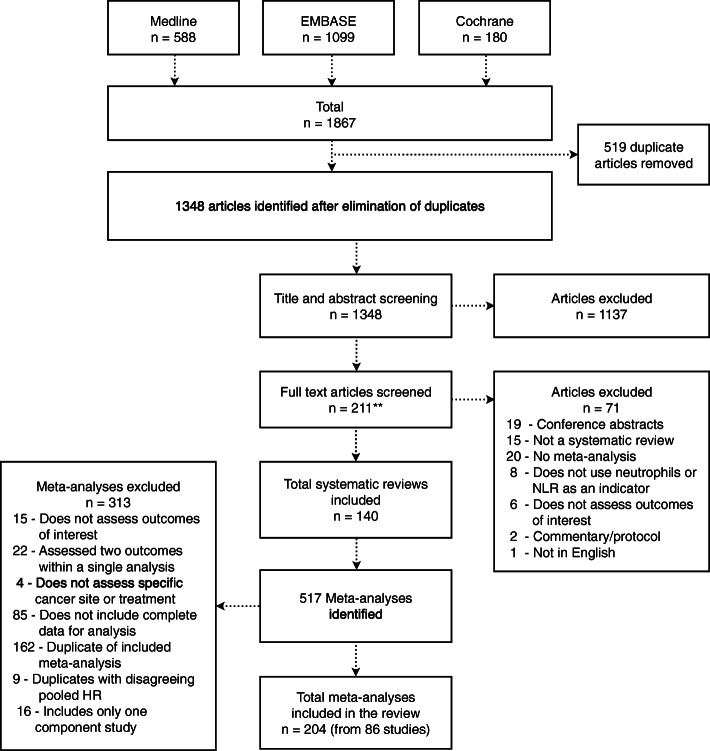
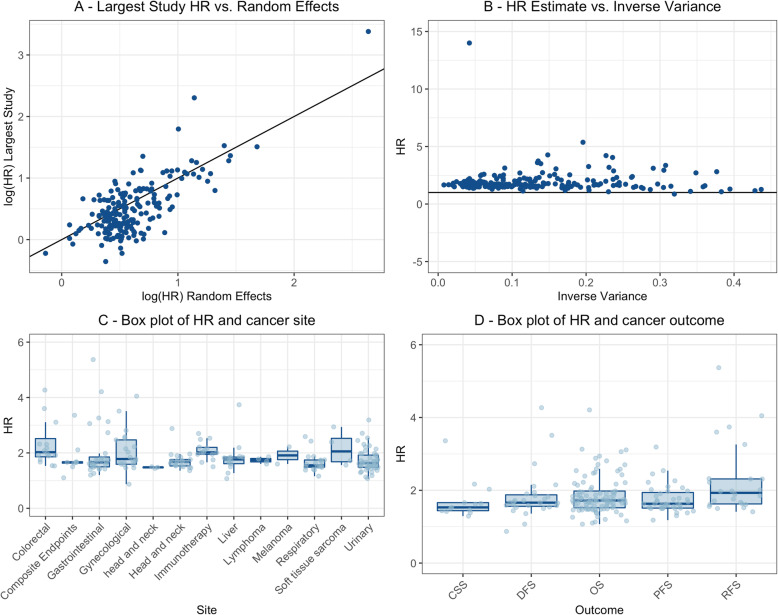
Background: Although neutrophils have been linked to the progression of cancer, uncertainty exists around their association with cancer outcomes, depending on the site, outcome and treatments considered. We aimed to evaluate the strength and validity of evidence on the association between either the neutrophil to lymphocyte ratio (NLR) or tumour-associated neutrophils (TAN) and cancer prognosis. Methods: We searched MEDLINE, Embase and Cochrane Database of Systematic Reviews from inception to 29 May 2020 for systematic reviews and meta-analyses of observational studies on neutrophil counts (here NLR or TAN) and specific cancer outcomes related to disease progression or survival. The available evidence was graded as strong, highly suggestive, suggestive, weak or uncertain through the application of pre-set GRADE criteria. Results: A total of 204 meta-analyses from 86 studies investigating the association between either NLR or TAN and cancer outcomes met the criteria for inclusion. All but one meta-analyses found a hazard ratio (HR) which increased risk (HR > 1). We did not find sufficient meta-analyses to evaluate TAN and cancer outcomes ( N = 9). When assessed for magnitude of effect, significance and bias related to heterogeneity and small study effects, 18 (9%) associations between NLR and outcomes in composite cancer endpoints (combined analysis), cancers treated with immunotherapy and some site specific cancers (urinary, nasopharyngeal, gastric, breast, endometrial, soft tissue sarcoma and hepatocellular cancers) were supported by strong evidence. Conclusion: In total, 60 (29%) meta-analyses presented strong or highly suggestive evidence. Although the NLR and TAN hold clinical promise in their association with poor cancer prognosis, further research is required to provide robust evidence, assess causality and test clinical utility. Trial registration: PROSPERO CRD42017069131 .
Overview
The claims and statistics of this paper haven’t been checked yet.
Free: it reads the open-access text and checks the first 5 claims that cite a source we can check. Create a free account to check every claim.
Integrity signals
Registry
Cites
Statistics
Figures
Verification
Claims the paper makes
The claims and statistics of this paper haven’t been checked yet.
Free: it reads the open-access text and checks the first 5 claims that cite a source we can check. Create a free account to check every claim.
Claims other papers make about this one
Each is checked against this paper’s own text: does it say what the citing paper says it does?
In the citing paper
“both responses to inflammation shown to be strongly prognostic across cancer types and treatment settings 27,28 .”
From A gut microbial signature for combination immune checkpoint blockade across cancer types (2024) · cites this paper as [28]
Self-check
Percentages, sums and reported differences re-computed from the paper’s own numbers.
The self-check needs the paper’s full text.
Citations
Cites
Hallmarks of Cancer: The Next Generation
Hanahan, D., & Weinberg, R. A. (2011) · Cell · doi:10.1016/j.cell.2011.02.013 · Cited by 66,590
Measuring inconsistency in meta-analyses
Higgins, J. P. T., Thompson, S. G., Deeks, J. J., & Altman, D. G. (2003) · BMJ · doi:10.1136/bmj.327.7414.557 · Cited by 63,139 · cited 4×
“We further assessed heterogeneity with Cochran’s Q test and quantified using the I(2) statistic [22].”
InfluentialBias in meta-analysis detected by a simple, graphical test
Egger, M., Smith, G. D., Schneider, M., & Minder, C. (1997) · BMJ · doi:10.1136/bmj.315.7109.629 · Cited by 56,722
Wickham, H. (2016) · Use R! · doi:10.1007/978-3-319-24277-4 · Cited by 33,115
GRADE: an emerging consensus on rating quality of evidence and strength of recommendations
Guyatt, G. H., Oxman, A. D., Vist, G. E., Kunz, R., Falck-Ytter, Y., Alonso-Coello, P., & Schünemann, H. J. (2008) · BMJ · doi:10.1136/bmj.39489.470347.ad · Cited by 23,305
Coussens, L. M., & Werb, Z. (2002) · Nature · doi:10.1038/nature01322 · Cited by 15,111 · cited 1×
“The biological mechanisms behind inflammation and cancer progression could suggest temporality, as elevated NLR and TAN are proposed to promote increased cell proliferation, angiogenesis and risk of metastasis as contributors to poor prognosis [5, 13, 135].”
Siegel, R. L., Miller, K. D., & Jemal, A. (2017) · CA: A Cancer Journal for Clinicians · doi:10.3322/caac.21387 · Cited by 14,712
Immunity, Inflammation, and Cancer
Grivennikov, S. I., Greten, F. R., & Karin, M. (2010) · Cell · doi:10.1016/j.cell.2010.01.025 · Cited by 10,755
Shea, B. J., Reeves, B. C., Wells, G., Thuku, M., Hamel, C., Moran, J., Moher, D., Tugwell, P., Welch, V., Kristjansson, E., et al. (2017) · BMJ · doi:10.1136/bmj.j4008 · Cited by 10,636
Sterne, J. A. C., Sutton, A. J., Ioannidis, J. P. A., Terrin, N., Jones, D. R., Lau, J., Carpenter, J., Rucker, G., Harbord, R. M., Schmid, C. H., et al. (2011) · BMJ · doi:10.1136/bmj.d4002 · Cited by 7,709
Research works printed but not linked: 6
- 16. Reichardt C. RefWorks: http://www.refworks.com. Public Services Quarterly. 2010;6(4):366 -7.
- 17. Schwarzer G. meta: An R package for meta-analysis. R news. 2007;7(3): 40 -5.
- 31. StataCorp. Stata statistical software: release 14. College Station: StataCorp LP; 2015.
- 52. Zheng DC, Zheng C, Wu J, et al. Neutrophil-lymphocyte ratio predicts the prognosis of patients with colorectal cancer: a meta-analysis. Int J Clin Exp Med. 2015;9(1):78 -90.
- 77. Dolan RD, McSorley ST, Horgan PG, et al. The role of the systemic inflammatory response in predicting outcomes in patients with operable cancer: systematic review and meta-analysis. Sci Rep. 2017;116(1):134 -46.
- 108. Zhou Y, Cheng S, Fathy AH, et al. Prognostic value of platelet-tolymphocyte ratio in pancreatic cancer: A comprehensive meta-analysis of 17 cohort studies. Onco Targets Ther. 2018;11:1899 -908. · DOI
Cited by
Items 601–699 of 699
Luo, H., Ikenaga, N., Nakata, K., Higashijima, N., Zhong, P., Kubo, A., Wu, C., Tsutsumi, C., Shimada, Y., Hayashi, M., et al. (2024) · Figshare · doi:10.6084/m9.figshare.27000654
Chaoqun, L., Zhang, C., Song, J., Yan, L., Xiao, Y. H., Cheng, N., Wu, H., Chen, X., & Yang, J. (2024) · Figshare · doi:10.6084/m9.figshare.25989357
Cong, R., Li, M., Xu, W., Ma, X., & Wang, S. (2024) · Figshare · doi:10.6084/m9.figshare.26647131
Luo, H., Ikenaga, N., Nakata, K., Higashijima, N., Zhong, P., Kubo, A., Wu, C., Tsutsumi, C., Shimada, Y., Hayashi, M., et al. (2024) · Figshare · doi:10.6084/m9.figshare.27000663
Matsunaga, T., Saito, H., Osaki, T., Takahashi, S., Iwamoto, A., Fukuda, K., Taniguchi, K., Kuroda, H., Takeuchi, T., Sugamura, K., et al. (2022) · Figshare · doi:10.6084/m9.figshare.19759955
Luo, Z., Yan, Y., Jiao, B., Huang, T., Liu, Y., Chen, H., Guan, Y., Ding, Z., & Zhang, G. (2024) · Figshare · doi:10.6084/m9.figshare.26632366
Natsuki, S., Yoshii, M., Tanaka, H., Mori, T., Deguchi, S., Miki, Y., Tamura, T., Toyokawa, T., Lee, S., & Maeda, K. (2024) · Figshare · doi:10.6084/m9.figshare.25333376
Zhang, X., Wei, R., Wang, X., Zhang, W., Li, M., Ni, T., Weng, W., & Li, Q. (2024) · Figshare · doi:10.6084/m9.figshare.25530213
Zhang, S., HongXia, X. U., Li, W., Cui, J., Zhao, Q., Guo, Z., Chen, J., Yao, Q., Li, S., He, Y., et al. (2024) · Figshare · doi:10.6084/m9.figshare.26011742
Ye, J., Zheng, L., Chen, Z., Wang, Q., Liao, X., Wang, X., Wei, Q., & Bao, Y. (2024) · Figshare · doi:10.6084/m9.figshare.25449057
Luo, H., Ikenaga, N., Nakata, K., Higashijima, N., Zhong, P., Kubo, A., Wu, C., Tsutsumi, C., Shimada, Y., Hayashi, M., et al. (2024) · Figshare · doi:10.6084/m9.figshare.27000645
Luo, H., Ikenaga, N., Nakata, K., Higashijima, N., Zhong, P., Kubo, A., Wu, C., Tsutsumi, C., Shimada, Y., Hayashi, M., et al. (2024) · Figshare · doi:10.6084/m9.figshare.27000657
Liu, Y., Ni, J., Xiong, Y., Wu, C., & He, F. (2022) · Figshare · doi:10.6084/m9.figshare.19314709
Luo, H., Ikenaga, N., Nakata, K., Higashijima, N., Zhong, P., Kubo, A., Wu, C., Tsutsumi, C., Shimada, Y., Hayashi, M., et al. (2024) · Figshare · doi:10.6084/m9.figshare.27000630
Zhang, X., Wang, D., Sun, T., Li, W., & Dang, C. (2022) · Figshare · doi:10.6084/m9.figshare.20115752
Luo, Z., Yan, Y., Jiao, B., Huang, T., Liu, Y., Chen, H., Guan, Y., Ding, Z., & Zhang, G. (2024) · Figshare · doi:10.6084/m9.figshare.26632378
Luo, Z., Yan, Y., Jiao, B., Huang, T., Liu, Y., Chen, H., Guan, Y., Ding, Z., & Zhang, G. (2024) · Figshare · doi:10.6084/m9.figshare.26632375
Cong, R., Li, M., Xu, W., Ma, X., & Wang, S. (2024) · Figshare · doi:10.6084/m9.figshare.26647143
Cong, R., Li, M., Xu, W., Ma, X., & Wang, S. (2024) · Figshare · doi:10.6084/m9.figshare.26647140
Tu, H., Feng, S., Chen, L., Huang, Y., Zhang, J., Peng, S., Lin, D., & Ye, X. (2025) · Scientific Reports · doi:10.1038/s41598-025-27931-9 · Cited by 1
“…NLR and treatment efficacy is further substantiated by the observation of heterogeneity in response across different studies, which underscores the importance of adjusting for prognostic factors and suggests a complex interaction between systemic inflammatory markers and cancer prognosis 16 .”
Vancea, T. M., Țăpîrdea, A. O., Zait, M. G., Sur, D. G., Cainap, C. I., & Burz, C. C. (2025) · Journal of Personalized Medicine · doi:10.3390/jpm16010009 · Cited by 2
“A high NLR is indicative of predominant pro-tumoral inflammation [21].”
Liang, H., Pan, K., Liang, X., Wang, J., Xie, X., Wan, N., & Lin, J. (2026) · Journal of Inflammation Research · doi:10.2147/jir.s573858
Xu, C., Liu, L., Tian, Y., Zhang, H., Wang, M., & Lin, Y. (2026) · PLoS ONE · doi:10.1371/journal.pone.0338129
Search for prognostic markers of mortality in inpatients receiving palliative chemotherapy
Díaz-López, S., Miguel, C. A.-D., Fernández-Pérez, E. M., Guerra, I. B., Bachurin, L., García-González, G., Jiménez-Castro, J., & Chaves-Conde, M. (2026) · Clinical & Translational Oncology · doi:10.1007/s12094-025-04206-3
“NLR is widely used and accepted for the assessment of ongoing systemic inflammation during the progression, severity stratification, and prognosis of neoplastic diseases [13, 16–23].”
Xie, H., Chen, T., Lan, B., Zhou, Q., Gan, J., & Tang, S. (2026) · BMC Cancer · doi:10.1186/s12885-026-15679-y
“Dysregulation of these blood cell ratios not only reflects the extent of impairment to the body’s anti-tumor immune function but also has been repeatedly confirmed as an independent adverse prognostic factor in various malignancies, including lung, breast, and liver cancer [10, 11].”
Buldukoğlu, O. Ç., Öcal, S., Kaya, B., Atar, G. E., Akça, S., Harmandar, F. A., & Çekın, A. H. (2025) · DergiPark (Istanbul University)
Tałasiewicz, K., Czachowska, A., Folwarski, M., Ługowska, I., Jaxa-Larecka, D., & Kapała, A. (2026) · Cancers · doi:10.3390/cancers18040565
“In healthy individuals, the normal range for the neutrophil-lymphocyte ratio (NLR) is typically between 0.78 and 3.53 [48,49].”
InfluentialAssociation between inflammation‑based index and acute deep vein thrombosis and thrombus burden
Bai, Y., Li, D., Huang, X., Wang, K. Y., Jia, Z., Qin, H., & Lu, A. (2026) · Heart & Lung · doi:10.1016/j.hrtlng.2026.102737 · Cited by 2
Khaksar, M. A., Hosseinpour, M., Bastani, M., Fard, R. M., Zahedian, M., Mahdizade, A. H., & Bahreiny, S. S. (2026) · Archives of Gynecology and Obstetrics · doi:10.1007/s00404-026-08350-1
“CBC and parameters derived from it, neutrophil-to-lymphocyte ratio (NLR), platelet-to-lymphocyte ratio (PLR), and lymphocyte-to-monocyte ratio (LMR), can be a valuable indicator of inflammation and potential in predicting disease status and clinical prognosis [9, 10].”
Shiratori, F., Yajima, S., Suzuki, T., Oshima, Y., Yamakawa, T., Ohtsuka, Y., & Shimada, H. (2026) · Annals of Thoracic and Cardiovascular Surgery · doi:10.5761/atcs.oa.26-00001
Crosstalk of cancer stemness-neutrophils in outcome of intracranial germ cell tumors
Zhang, B., Ji, Q., Lin, Y., & Li, W. (2026) · Frontiers in Immunology · doi:10.3389/fimmu.2026.1571513
“Additionally, the NLR is a prognostic marker for various solid tumors (47, 48), requiring validation with comprehensive survival data.”
Evrard, C., Vauchel, B., Boyer, C., Ferru, A., Olivier, R., & Tougeron, D. (2026) · Therapeutic Advances in Gastroenterology · doi:10.1177/17562848261428776
“19 Furthermore, our study revealed that the longer delay from the first symptom-to-treatment initiation did not significantly impact OS or PFS.”
Wang, T., Liu, C., & Jiang, J. (2026) · World Journal of Gastrointestinal Oncology · doi:10.4251/wjgo.v18.i4.115687
Trifunović, N., Mitrović, N., Trifunović, J., Nikolić, M., & Filipović, S. (2026) · The American Surgeon · doi:10.1177/00031348261441671 · Cited by 1
Wang, M., Bao, R., Yang, Z., Chen, Z., Gu, S., Kong, L., Gong, W., Gu, J., Wu, X., & Zhu, Y. (2026) · Research Square · doi:10.21203/rs.3.rs-9222230/v1
Feng, W., Xu, Z., Yan, Z., Wu, H., Guo, H., Luo, Y., & Liu, W. T. (2026) · Journal of bone oncology · doi:10.1016/j.jbo.2026.100764
“A systematic review and meta -analyses further confirms the widespread functional heterogeneity of neutrophils across distinct cancer types [39].”
Determining acceptable duration for chemoradiation of esophageal squamous cell carcinoma
Kam, K.-H., Lee, C., Chang, J.-M., Yang, H., Chang, C.-C., Tsang, Y., Wang, Y., Wang, W.-Y., Kuo, C., Lee, M., et al. (2026) · Journal of the Chinese Medical Association · doi:10.1097/jcma.0000000000001383
“17 Increased NLR might reflect increased activation of neutrophils by inflammatory mediators such as interleukin-6.”
Yates, C. F., Roeland, D., & Coulthard, L. G. (2026) · Journal of Clinical Neuroscience · doi:10.1016/j.jocn.2026.112079
Jiang, S., Zheng, X., Qiu, H., Tao, N., & An, H. (2026) · BMC Urology · doi:10.1186/s12894-026-02078-5
“…biomarkers such as neutrophils, lymphocytes, and NLR have been shown to have prognostic value for survival in a variety of cancers, including PCa [36–38], there is still a gap in the studies that systematically compare the performance of different hematologic biomarkers in predicting mortality…”
Chen, H., Lei, J., Zhang, W., Wang, Z., Liu, R., & Chen, L. (2026) · Frontiers in Oncology · doi:10.3389/fonc.2026.1830463
“Growing evidence indicates that composite in fl ammatory indices are associated not only with cancer incidence but also with tumor progression, survival outcomes, and treatment responses (15 – 18).”
Ding, Y., Lu, S., Kan, H., & Zhang, Z. (2026) · Indian Journal of Orthopaedics · doi:10.1007/s43465-026-01792-4
“NLR, reflecting the balance between neutrophil-mediated innate immunity and lymphocyte-mediated adaptive immunity, has been increasingly recognized as a stable marker of systemic inflammation [11–14].”
Inflammatory and Metabolic Markers in Stroke: Diagnostic and Prognostic Associations of NLR and GPR
Kenan, N. K., Doğan, E., Çap, A. M., Kadıoğlu, E., Yılmaz, Y., & Açar, D. (2026) · OSMANGAZİ JOURNAL OF MEDICINE · doi:10.20515/otd.1798641
Neutrophil-lymphocyte ratio as prognostic factor in metastatic breast cancer
dos Santos, G. M. C., Lima, N. K. D. C., Tiezzi, I. D. M., Pavão, G. K., Silva, I. G., Maia, P. M., Carrara, H. H. A., & Tiezzi, D. G. (2026) · Revista Brasileira Ginecologia e Obstetrícia · doi:10.61622/rbgo/2026rbgo10
Yang, N., Gong, J., Ge, C., Wu, G., Chen, G., Li, J., Tang, W., Wang, B., Li, X., Sheung, L., et al. (2026) · Cellular Oncology · doi:10.1007/s13402-026-01178-6 · Cited by 1
“Elevated NLR is consistently linked to tumor progression, higher metastatic risk, and shorter survival, and recent evidence syntheses in the immunotherapy era similarly associate high pretreatment NLR with poorer outcomes and reduced benefit from immune checkpoint inhibitors [276, 280].”
InfluentialGovaerts, C. W., van Dijk, J. M. C., van der Hoorn, A., & Kruyt, F. A. E. (2026) · Acta Neuropathologica · doi:10.1007/s00401-026-03011-8 · Cited by 2
“It is, however, unlikely that the NLR reflects a CNS-specific tumour-promoting mechanism, as similar correlations have been made in extracranial cancers [34].”
Bivolarski, I., Dimitrov, M., & Yordanova, T. (2026) · Cureus · doi:10.7759/cureus.109495
“Systemic inflammatory markers, including NLR, have been associated with prognosis and disease progression in several malignancies, including prostate cancer [12].”
Kırkgeçit, M., Türkoğlu, H., Yuzbasi, M. F., Kesılmez, E. C., Yıldız, F., Aslan, Y., Kırmızıgöz, Ş., & Yüksel, K. Z. (2026) · Medicina · doi:10.3390/medicina62050950
“Most studies focus on a single marker or on a single tumor type, and cross-histology comparisons remain scarce; subgroup-level interpretation is correspondingly difficult [1,2].”
Bilgetekin, İ., Demir, N., Eraslan, E., Akdağcık, Z., Onur, İ. D., Ateş, Ö., & Demırcı, U. (2026) · Medicina · doi:10.3390/medicina62061027
Cho, J.-K., Lee, K., Shin, D., Nguyen, T. D. T., Park, W., Im, S. J., & Jeong, H. (2026) · Cancer Immunology Immunotherapy · doi:10.1007/s00262-026-04436-6
Prognostic value of inflammation-immunity-nutrition score in patients with cancers
Zhang, S., Zhang, G., Zhang, C. Y., Liu, R., Li, L., Li, X., & Yu, J. (2026) · Discover Oncology · doi:10.1007/s12672-026-05301-9
“Compared with other inflammation indices, such as prognostic nutritional index (PNI), neutrophil-to-lymphocyte ratio (NLR), platelet-to-lymphocyte ratio (PLR), controlling nutritional status score (CONUT) and systemic immune-inflammation index (SII), IINS offers several advantages [9–12].”
İlgen, O., Yozgat, S. T., Aras, G., Tekgündüz, S. E., Çelebioğlu, N. O., & Kadıoğlu, B. G. (2026) · Journal of Basic and Clinical Health Sciences · doi:10.30621/jbachs.1918061
Aymerich, C., Pedruzo, B., Acasuso, G., Ibarretxe, O., Alconada, D. A., Labad, J., Algora, M. J., Cabezas, Á., de Pablo, G. S., Gonzalez-Torres, M. A., et al. (2026) · Frontiers in Psychiatry · doi:10.3389/fpsyt.2026.1838805
Çaltek, N. Ç., Yassa, M., Bacaksiz, A., Çaltek, H. Ö., Aras, D., Aksoy, Y., & Yüksel, İ. T. (2026) · Discover Oncology · doi:10.1007/s12672-026-05318-0
“Systemic inflammation has been linked to the initiation and progression of various malignancies [14, 15].”
Bényei, E., Huszty, G., Laki, A., Jakab, Z., Kiss, G., Kovács, K. A., Borka, K., Uhlyarik, A., Eitler, K., Igaz, P., et al. (2026) · Frontiers in Endocrinology · doi:10.3389/fendo.2026.1733138
“In particular, a substantial number of studies have reported associations between NLR (38), PLR (39) and patient survival outcomes.”
New Insights Into the Role of Neutrophils in Lymphoma
Gu, L. (2026) · Cancer Medicine · doi:10.1002/cam4.72036
“An elevated NLR is a well-validated poor prognostic factor across diverse solid tumors, including carcinomas of the pancreas, col-orectum, urothelium, nasopharynx, stomach, breast, endometrium, and liver, as well as soft tissue sarcomas [110].”
Wang, W., Chen, X., Zhou, Y. F., & Guo, W. (2026) · Clinical & Translational Oncology · doi:10.1007/s12094-026-04457-8
Bülbül, O., Aydin, E., Nak, D., Bülbül, H. M., & Alyildiz, N. (2026) · Clinical and Translational Imaging · doi:10.1007/s40336-026-00784-6
“In many types of cancer, NLR, a marker of systemic inflammation, is known to be associated with poor prognosis [25].”
Huo, C., Zhao, X., Ye, D., Lin, S., Xu, D., Pang, S. W., Xu, M., Chen, J., Huang, C., Liu, Y., et al. (2026) · Cancer Immunology Research · doi:10.1158/2326-6066.cir-25-1118
“Previous studies have identified the NLR as a clinically relevant inflammatory marker associated with chemoresistance and adverse outcomes across multiple cancer types (6, 20, 21).”
The peripheral immune landscape of human breast cancer
Torralba, E. G., Buqué, A., & Galluzzi, L. (2026) · OncoImmunology · doi:10.1080/2162402x.2026.2696059
“52,90 In the metastatic setting, an elevated NLR has also been associated with poor disease outcome, although its prognostic impact may be influenced by clinical variables such as tumor burden and treatment response.”
Yang, J., Pan, Y. L., Ma, Y., Cui, H., Li, D., 张鑫圣, Liu, Z. F., Ma, Y., & Liu, Y. (2026) · European journal of medical research · doi:10.1186/s40001-026-04827-6
Yao, Q., Zhang, H., Jiang, J., & Yuan, F. (2026) · Annals of Human Biology · doi:10.1080/03014460.2026.2669070
Kreiberg, K. B., Qvortrup, C., Winther, S. B., Zitnjak, D., Poulsen, L. Ø., Yilmaz, M. N., Brink, C., Tarpgaard, L. S., & Pfeiffer, P. (2026) · ESMO Gastrointestinal Oncology · doi:10.1016/j.esmogo.2026.100370
“Supporting the latter interpretation, a low baseline NLR is an established prognostic factor across cancers and treatments, 38 and a low NLR may simultaneously increase the probability of CIN.”
Li, H., 田梦醒, Wang, W., Han, Q., Xv, J., & Xu, X. H. (2026) · Frontiers in Nutrition · doi:10.3389/fnut.2026.1810531
Yang, Y., Ainiwaer, K., Gao, Y., Li, A., Kamili, A., & Luo, D. (2026) · Frontiers in Oncology · doi:10.3389/fonc.2026.1877476
Wang, J., Xu, L., Cao, X., Liu, L. Y., Tian, X., Fu, Y., Qiang, Q., & Ling, B. (2026) · Frontiers in Oncology · doi:10.3389/fonc.2026.1747849
“Findings over the past decade have linked elevated NLR and PLR with poor prognosis across various types of malignant tumors (52).”
Roque, K., Ruiz, R., Gálvez-Niño, M., Castro-Mollo, M. W., Vallejos, H. D., Otoya, I., Ferreyra, Y., Coanqui, O., Olivera, M., Valdiviezo, N., et al. (2026) · International Journal of Gynecological Cancer · doi:10.1016/j.ijgc.2026.104885
Jiang, H., Wang, J., Zhang, Z., & Sun, J. (2026) · Research Square · doi:10.21203/rs.3.rs-10218912/v1 · Cited by 1
Kárpáti, C., Tóth, R., Sebők, B., Sebok, P., Keszthelyi, A., Merkely, P., Lintner, B., Lőczi, L., Ács, N., Keszthelyi, M., et al. (2026) · Cancers · doi:10.3390/cancers18162575
“Among complete blood count-derived inflammatory markers, NLR has gained particular attention because it is one of the most extensively studied inflammatory indices and has been associated with cancer outcomes across several malignancies [25].”
López-Basave, H. N., Ruiz, G. C., Morales-Vásquez, F., Miranda-Dévora, G., Tlelo-Amastal, D., Alavez-Ortega, L. M., & Munoz-Moñtano, W. (2026) · Annals of Coloproctology · doi:10.3393/ac.2025.01347.0192
“Studies examining the relationship between NLR, overall survival (OS), and disease-free survival (DFS) in colon cancer have demonstrated that higher NLR at diagnosis is associated with reduced survival rates [10].”
Zhang, X., Wang, Y., Guan, Y., & Qu, R. (2026) · Clinical & Translational Oncology · doi:10.1007/s12094-026-04535-x
Prognostic significance of the C-reactive protein-to-lymphocyte ratio in patients with cancers
Liu, X., Zhang, S., & Liu, Y. (2026) · Frontiers in Oncology · doi:10.3389/fonc.2026.1932997 · Cited by 1
“In recent years, a variety of in fl ammation-based biomarkers have been investigated as prognostic indicators in malignancies (8 – 10).”
Cao, H., Tao, M., Qin, X., & Guo, H. (2026) · Frontiers in Immunology · doi:10.3389/fimmu.2026.1887760
“In TNBC, increased TAN in fi ltration and elevated neutrophil-to-lymphocyte ratios (NLRs) are frequently associated with poor prognosis and reduced therapeutic responses (70 – 72).”
Acet, A., Kilit, T. P., Erarslan, S., YALÇIN, C., Özlü, C., & Özdemir, Ç. (2026) · OSMANGAZİ JOURNAL OF MEDICINE · doi:10.20515/otd.1862199
Cai, S., Chen, Q., Su, J., Li, Y., Cai, S., Huang, Z., & Cai, Q. (2026) · Frontiers in Immunology · doi:10.3389/fimmu.2026.1909926
“Consequently, lymphocytopenia is frequently associated with diminished therapeutic ef fi cacy and inferior clinical prognosis (31, 32).”
Rao, Y., Gong, Q., Li, J., Liu, N., Miao, H., Huang, J., & Xu, S. (2026) · Frontiers in Immunology · doi:10.3389/fimmu.2026.1920402
“These variables are not speci fi c markers of lung cancer, although NLR, MLR, SII, albumin-related measures, and composite nutritional-in fl ammatory indices have been widely studied as nonspeci fi c systemic readouts in cancer and lung-cancer cohorts (6 – 12).”
Feng, R., Chen, C., & Hua, Q. (2026) · The International Journal of Lower Extremity Wounds · doi:10.1177/15347346261483973
Yang, Y., Deng, Y., Liu, C., Yu, M., & Wang, H. (2026) · Cancer Treatment and Research Communications · doi:10.1016/j.ctarc.2026.101370
Xie, J., Che, B., Zhang, W., Gao, C., Yang, Z., & Zhang, W. (2026) · Research Square · doi:10.21203/rs.3.rs-10376688/v1
Sancho, M. J. M., Agüero, J., Humano, M. E., Mizrahi, G. E., Carelli, D. N., & Sero, O. A. (2026) · Oncología Clínica · doi:10.56969/oc.v31i2.243
Yang, F., Wang, X., Wei, L., Wen, H., Chen, P., Chen, J., Zhang, Y., Xu, N., Chen, Y., Shi, H., et al. (2026) · Frontiers in Nutrition · doi:10.3389/fnut.2026.1906113
“…and a major contributor to poor prognosis in GC. Elevated systemic inflammation, characterized by increased CRP levels and dysregulated immune cell ratios, promotes tumor proliferation, invasion, and immunosuppression while exacerbating nutritional depletion and muscle wasting (12, 20, 21).”
Xu, S., Guo, J., Zhao, Z., Zhai, Y., Liu, Y., & Li, H. (2026) · Current Oncology · doi:10.3390/curroncol33090551
“Greater tumor burden and more pronounced metabolic and inflammatory changes in advanced disease may partly contribute to the higher diagnostic performance [11,14].”
Giunta, E. F., Marini, I., Grassi, I., Nicolini, S., Foca, F., Celli, M., Caroli, P., Sarnelli, A., Brighi, N., Schepisi, G., et al. (2026) · European Journal of Nuclear Medicine and Molecular Imaging · doi:10.1007/s00259-026-08173-x
“From CBC, we obtained two ratios that have been extensively tested in PC and in other cancer types: the aforementioned NLR [29, 30], calculated as absolute neutrophil count (ANC) / absolute lymphocyte count (ALC) ratio. and the platelet-to-lymphocyte ratio (PLR) [ 31], calculated as absolute…”
Mavropoulos, P., Konstantis, G., Tsaousi, G., Baka, S., Ziaka, V., Tseriotis, V., Tsimtsiou, Z., & Pourzitaki, C. (2026) · Clinical Breast Cancer · doi:10.1016/j.clbc.2026.09.002
Ülger, G., Akay, K., Yıldız, H., Aytan, P., Gökulu, Ş. G., & İlhan, T. T. (2026) · Medicina · doi:10.3390/medicina62091767
Miguel, A. F. P., Lonni, N., Rosa, T. S., Vieira, D. S. C., Modolo, F., & Rivero, E. R. C. (2026) · Applied immunohistochemistry & molecular morphology · doi:10.1097/pai.0000000000001357
Juoairia, A., Akter, A., Nima, R. J., & Haque, M. A. (2026) · bioRxiv (Cold Spring Harbor Laboratory) · doi:10.64898/2026.09.13.751329
“Neutrophil infiltration has been associated with shorter DFS, DSS, and OS, as well as an increased risk of mortality [64].”
Chatterjee, P., Insagaray, B., Ferraz, T., González, M., Muñoz, G., Pombo, V., Barrios, R., & Cuello, M. (2026) · Frontiers in Oncology · doi:10.3389/fonc.2026.1930031
“The neutrophil-to-lymphocyte ratio (NLR), calculated from a routine complete blood count, has emerged as an attractive candidate marker of systemic in fl ammation and host immune competence (5).”
Herbel, N., Helal, C., Ouali, K., Danlos, F., Goldschmidt, V., Michot, J., Laparra, A., Géraud, A., Martín-Romano, P., Vuagnat, P., et al. (2026) · Cancer Research Communications · doi:10.1158/2767-9764.crc-26-0171
“It was widely demonstrated that a high NLR is an independent prognostic factor associated with poor short-and long-term outcomes in both solid and hematologic malignancies (27).”
Machado, C. D. C., López, B. F., Rodriguez-Conde, S., Mena-Rodríguez, M. D. L. D., Gómez-Frías, C., & Cañueto, J. (2026) · Journal of the American Academy of Dermatology · doi:10.1016/j.jaad.2026.09.097
Xu, T., Wu, Z., Li, J., Wang, L., Weng, B., Chen, L., Chen, X., Zhu, Q., Liu, P., He, F., et al. (2026) · Frontiers in Oncology · doi:10.3389/fonc.2026.1934583
Ali, S. R., & Ghafoor, D. D. (2026) · Cancer Treatment and Research Communications · doi:10.1016/j.ctarc.2026.101460
Reséndiz-Castillo, L. J., Martínez-Barajas, M. G., Carranza-Aranda, A. S., García-Bernal, J. R., Díaz-Palomera, C. D., Ramírez-de-Arellano, A., Ramos‐Solano, M., Vega‐Magaña, N., Villegas‐Pineda, J. C., & Pereira-Suárez, A. L. (2026) · Frontiers in Immunology · doi:10.3389/fimmu.2026.1900567
Kashyap, N., Fletcher, L., & Gombolay, G. Y. (2026) · Journal of Child Neurology · doi:10.1177/08830738261491959
Серозный рак яичников высокой степени злокачественности: диагностика, лечение, прогноз
Чекнизов, Ф. В., Sannikova, M. V., & Леонидович, О. Д. (2026) · Medical Opponent · doi:10.64831/2619-0001.2026.2.343639
Liu, J.-B., Tang, C., Yang, M., Li, Y.-X., Kong, R., Guo, Q., Lyu, Z.-N., Liu, Y., & Peng, P. (2026) · Cancer Treatment and Research Communications · doi:10.1016/j.ctarc.2026.101487
Wang, Q.-Q. (2026) · Advances in Clinical Medicine · doi:10.12677/acm.2026.16103409
Hatta, M., Watanabe, R., Shiomi, M., Masuda, Y., Okazaki, A., Matsuda, S., Kotani, T., Taniguchi, T., Iwasaka, S., Kadoba, K., et al. (2026) · Frontiers in Immunology · doi:10.3389/fimmu.2026.1948318
“It has been associated with disease severity and prognosis in various in fl ammatory (7 – 9), cardiovascular (10, 11), and malignant diseases (12, 13).”
Gök, Z. E., Melekoğlu, N. A., & Yaşar, Ş. (2026) · BMC Pediatrics · doi:10.1186/s12887-026-07786-3
Wang, F., Yang, L., Bai, W., Zhao, C., Miao, Y., Yang, W., & Liu, Y. (2026) · Frontiers in Endocrinology · doi:10.3389/fendo.2026.1921109
Metadata
- Authors
- Cupp, M. A., Cariolou, M., Tzoulaki, I., Aune, D., Evangelou, E., & Berlanga-Taylor, A. J.
- Affiliations
- MRC Centre for Environment and Health (GB)
- University of Ioannina (GR)
- Oslo University Hospital (NO)
- Venue
- BMC Medicine
- Published
- 2020-11-20
- Volume
- 18
- Issue
- 1
- Pages
- 360-360
- ISSN
- 1741-7015 (ISSN-L)
- PMC
- PMC7678319
- OpenAlex
- W3104254817
- Semantic Scholar
- dbd1398d909a25bb623a84e5aae3a5b5136ef5bd
- Cited by
- 697
- References
- 157
- Citations by year
- 2026: 110 · 2025: 166 · 2024: 184 · 2023: 111 · 2022: 95 · 2021: 30
- FWCI
- 6.34
- Type
- journal article
- Language
- en
- Open access
- gold
- doi.org
- Licence
- cc-by
- creativecommons.org/licenses/by/4.0/ (tdm)
- creativecommons.org/licenses/by/4.0/ (vor)
- Locations
- BMC Medicine (publishedVersion, cc-by)
- bioRxiv (Cold Spring Harbor Laboratory) (acceptedVersion, cc-by)
- PubMed Central (publishedVersion, cc-by)
- PubMed (publishedVersion)
- DOAJ (DOAJ: Directory of Open Access Journals) (submittedVersion, cc-by-sa)
- Spiral (Imperial College London) (submittedVersion, cc-by)
- Funders
- Medical Research Council (MR/L01632X/1)
- Topics
- Health Sciences › Medicine › Oncology › Inflammatory Biomarkers in Disease Prognosis
- Life Sciences › Biochemistry, Genetics and Molecular Biology › Cancer Research › Cancer, Stress, Anesthesia, and Immune Response
- Life Sciences › Immunology and Microbiology › Immunology › Immune cells in cancer
- Keywords
- neutrophil-to-lymphocyte ratio, tumor-associated neutrophils, cancer prognosis, neutrophils, immunotherapy, cancer survival, disease progression
- MeSH terms
- Female, Humans, Lymphocytes, Male, Neoplasms, Neutrophils, Prognosis, Survival Analysis
About these checks
Registry, retraction, Cites and statistics results are computed, not judged, with one exception: a printed reference that no index lists is read once by a model before it counts as a citation error. Claims are extracted by a model and kept only when their quote appears verbatim in the text; each cited source is then checked, with a model’s help, for whether it says what the claim relies on. Those verdicts can be wrong — read the claim’s quote and the cited source before relying on one.
Statistics and arithmetic are recomputed, not judged.
Confidence bands are shown only for fields calibrated on our annotated test set. None is calibrated yet, so no band is shown.
What counts as a claim ›How we measure confidence ›How we check this ›
Are you an author, or do you see a problem with this page? Request a review
Data sources
Bibliographic data: Semantic Scholar, OpenAlex, Crossref.
Contains information from the Semantic Scholar Academic Graph Datasets, made available under the ODC Attribution License (ODC-BY 1.0).
Semantic Scholar’s data is described in: Kinney, R., et al. (2023). The Semantic Scholar Open Data Platform. arXiv:2301.10140.
