

Associations of circulating plasma microRNAs with age, body mass index and sex in a population-based study
Open accessThe DOI matches its Crossref record; 40 of the 40 references it cites were found in a registry or an index.
Abstract
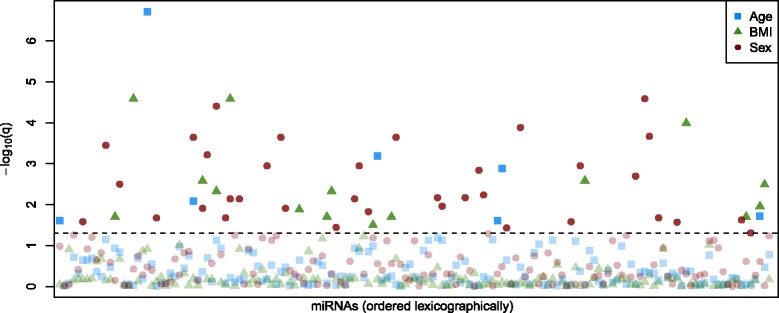
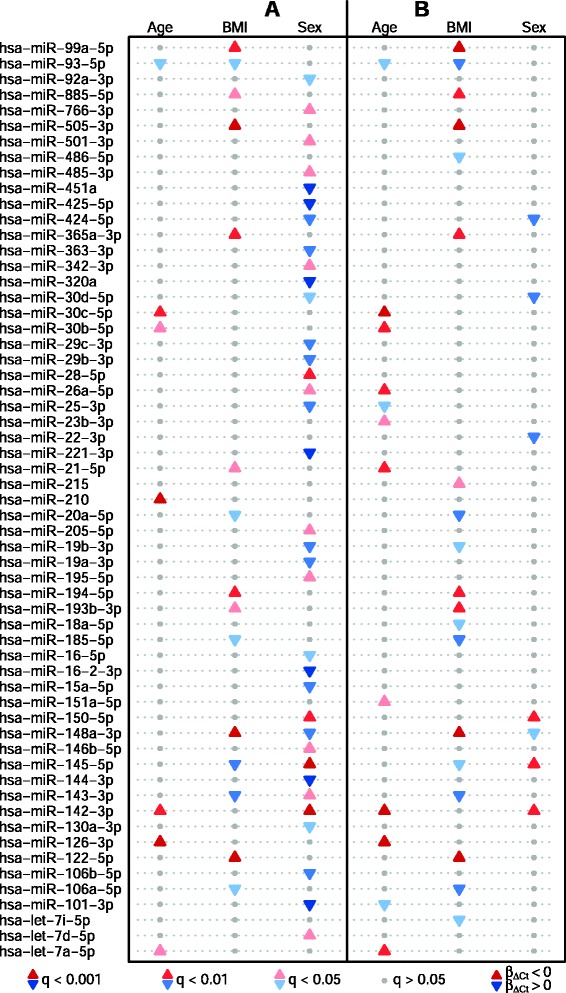
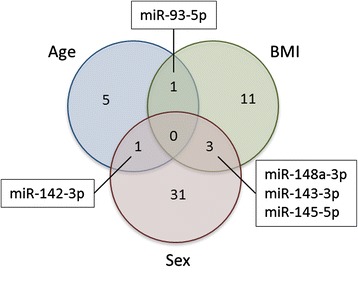
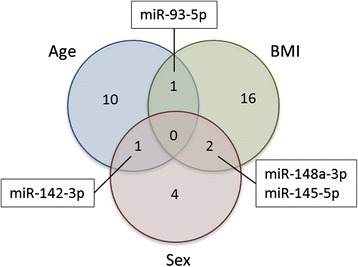
BACKGROUND: Non-cellular blood circulating microRNAs (plasma miRNAs) represent a promising source for the development of prognostic and diagnostic tools owing to their minimally invasive sampling, high stability, and simple quantification by standard techniques such as RT-qPCR. So far, the majority of association studies involving plasma miRNAs were disease-specific case-control analyses. In contrast, in the present study, plasma miRNAs were analysed in a sample of 372 individuals from a population-based cohort study, the Study of Health in Pomerania (SHIP). METHODS: Quantification of miRNA levels was performed by RT-qPCR using the Exiqon Serum/Plasma Focus microRNA PCR Panel V3.M covering 179 different miRNAs. Of these, 155 were included in our analyses after quality-control. Associations between plasma miRNAs and the phenotypes age, body mass index (BMI), and sex were assessed via a two-step linear regression approach per miRNA. The first step regressed out the technical parameters and the second step determined the remaining associations between the respective plasma miRNA and the phenotypes of interest. RESULTS: After regressing out technical parameters and adjusting for the respective other two phenotypes, 7, 15, and 35 plasma miRNAs were significantly (q < 0.05) associated with age, BMI, and sex, respectively. Additional adjustment for the blood cell parameters identified 12 and 19 miRNAs to be significantly associated with age and BMI, respectively. Most of the BMI-associated miRNAs likely originate from liver. Sex-associated differences in miRNA levels were largely determined by differences in blood cell parameters. Thus, only 7 as compared to originally 35 sex-associated miRNAs displayed sex-specific differences after adjustment for blood cell parameters. CONCLUSIONS: These findings emphasize that circulating miRNAs are strongly impacted by age, BMI, and sex. Hence, these parameters should be considered as covariates in association studies based on plasma miRNA levels. The established experimental and computational workflow can now be used in future screening studies to determine associations of plasma miRNAs with defined disease phenotypes.
Overview
The claims and statistics of this paper haven’t been checked yet.
Free: it reads the open-access text and checks the first 5 claims that cite a source we can check. Create a free account to check every claim.
Integrity signals
Registry
Cites
Statistics
Figures
Verification
Claims the paper makes
The claims and statistics of this paper haven’t been checked yet.
Free: it reads the open-access text and checks the first 5 claims that cite a source we can check. Create a free account to check every claim.
Claims other papers make about this one
Each is checked against this paper’s own text: does it say what the citing paper says it does?
The source backs part of the claim, not all of it — or backs it for a different population, condition or comparison.
In the citing paper
“Studies have shown age-related differences in the abundance of specific miRNAs in circulating cells, plasma, and whole blood from older compared with younger individuals42–48.”
From Inflammageing: chronic inflammation in ageing, cardiovascular disease, and frailty (2018) · cites this paper as [47]
Experimental — accuracy not yet measuredThe source backs part of the claim, not all of it — or backs it for a different population, condition or comparison.
In the citing paper
“Nonetheless, miR-25–3p, miR-92a-3p, miR-93–5p, miR-101–3p, miR-106b-5p, miR-142–5p, miR-151a-3p, and miR-181a-5p tend to be under-represented, whereas miR-21–5p and miR-126–3p are over-represented at older ages47,49,50.”
From Inflammageing: chronic inflammation in ageing, cardiovascular disease, and frailty (2018) · cites this paper as [47]
Experimental — accuracy not yet measured
Self-check
Percentages, sums and reported differences re-computed from the paper’s own numbers.
The self-check needs the paper’s full text.
Citations
Cites
Bartel (2004) · doi:10.1016/s0092-8674(04)00045-5 · Cited by 34,714
Regularization and Variable Selection Via the Elastic Net
Zou, H., & Hastie, T. (2005) · Journal of the Royal Statistical Society Series B: Statistical Methodology · doi:10.1111/j.1467-9868.2005.00503.x · Cited by 20,957
Regularization Paths for Generalized Linear Models via Coordinate Descent
Friedman, J., Hastie, T., & Tibshirani, R. (2010) · Journal of Statistical Software · doi:10.18637/jss.v033.i01 · Cited by 19,927
A Mammalian microRNA Expression Atlas Based on Small RNA Library Sequencing
Landgraf, P., Rusu, M., Sheridan, R., Sewer, A., Iovino, N., Aravin, A., Pfeffer, S., Rice, A., Kamphorst, A. O., Landthaler, M., et al. (2007) · Cell · doi:10.1016/j.cell.2007.04.040 · Cited by 3,626 · cited 1×
“As potential sources of such miRNAs, lymphoid cells such as T cells, B cells (hsa-miR-150, hsa-miR-142), platelets (hsa-miR-142) and monocytes (hsa-miR-145) have been mentioned [24, 40].”
MicroRNAs are transported in plasma and delivered to recipient cells by high-density lipoproteins
Vickers, K. C., Palmisano, B. T., Shoucri, B. M., Shamburek, R. D., & Remaley, A. T. (2011) · Nature Cell Biology · doi:10.1038/ncb2210 · Cited by 2,741 · cited 1×
“Recent studies have proposed a hormone-like role for circulating miRNAs in intercellular communication [3, 4].”
Cohort Profile: The Study of Health in Pomerania
Volzke, H., Alte, D., Schmidt, C. O., Radke, D., Lorbeer, R., Friedrich, N., Aumann, N., Lau, K., Piontek, M., Born, G., et al. (2011) · International Journal of Epidemiology · doi:10.1093/ije/dyp394 · Cited by 1,000
Self-citationRole of microRNAs in vascular diseases, inflammation, and angiogenesis
Urbich, C., Kuehbacher, A., & Dimmeler, S. (2008) · Cardiovascular Research · doi:10.1093/cvr/cvn156 · Cited by 880 · cited 1×
“Thus, they affect a wide range of physiological and pathophysiological processes including cell differentiation, proliferation, apoptosis, angiogenesis or inflammation [1, 2].”
Blood Cell Origin of Circulating MicroRNAs: A Cautionary Note for Cancer Biomarker Studies
Pritchard, C. C., Kroh, E., Wood, B., Arroyo, J. D., Dougherty, K. J., Miyaji, M. M., Tait, J. F., & Tewari, M. (2012) · Cancer Prevention Research · doi:10.1158/1940-6207.capr-11-0370 · Cited by 879 · cited 4×
“Without appropriate adjustment, plasma miRNA profiles will always partially reflect the individual blood composition at the sampling time [23, 24].”
InfluentialSecreted microRNAs: a new form of intercellular communication
Chen, X., Liang, H., Zhang, J., Zen, K., & Zhang, C.-Y. (2012) · Trends in Cell Biology · doi:10.1016/j.tcb.2011.12.001 · Cited by 690
Evaluation of quantitative miRNA expression platforms in the microRNA quality control (miRQC) study
Mestdagh, P., Hartmann, N., Baeriswyl, L., Andreasen, D., Bernard, N., Chen, C., Cheo, D., D'Andrade, P., DeMayo, M., Dennis, L., et al. (2014) · Nature Methods · doi:10.1038/nmeth.3014 · Cited by 660
miR-122 – A key factor and therapeutic target in liver disease
Bandiera, S., Pfeffer, S., Baumert, T. F., & Zeisel, M. B. (2015) · Journal of Hepatology · doi:10.1016/j.jhep.2014.10.004 · Cited by 629
Circulating microRNAs as potential markers of human drug-induced liver injury
Starkey Lewis, P. J., Dear, J., Platt, V., Simpson, K. J., Craig, D. G. N., Antoine, D. J., French, N. S., Dhaun, N., Webb, D. J., Costello, E. M., et al. (2011) · Hepatology · doi:10.1002/hep.24538 · Cited by 515
Prospective Study on Circulating MicroRNAs and Risk of Myocardial Infarction
Zampetaki, A., Willeit, P., Tilling, L., Drozdov, I., Prokopi, M., Renard, J.-M., Mayr, A., Weger, S., Schett, G., Shah, A., et al. (2012) · Journal of the American College of Cardiology · doi:10.1016/j.jacc.2012.03.056 · Cited by 464
The sex difference in haemoglobin levels in adults—mechanisms, causes, and consequences
Murphy, W. G. (2014) · Blood Reviews · doi:10.1016/j.blre.2013.12.003 · Cited by 463 · cited 1×
“This was confirmed for multiethnic populations [37] and is reflected in a 12 % lower mean haemoglobin level in female venous blood compared to men [38] as well as in lower haematocrit values.”
miR-122, a paradigm for the role of microRNAs in the liver
Girard, M., Jacquemin, E., Munnich, A., Lyonnet, S., & Henrion-Caude, A. (2008) · Journal of Hepatology · doi:10.1016/j.jhep.2008.01.019 · Cited by 375
miR‐17, miR‐19b, miR‐20a, and miR‐106a are down‐regulated in human aging
Hackl, M., Brunner, S., Fortschegger, K., Schreiner, C., Micutkova, L., Mück, C., Laschober, G. T., Lepperdinger, G., Sampson, N., Berger, P., et al. (2010) · Aging Cell · doi:10.1111/j.1474-9726.2010.00549.x · Cited by 355
Toward the blood-borne miRNome of human diseases
Keller, A., Leidinger, P., Bauer, A., ElSharawy, A., Haas, J., Backes, C., Wendschlag, A., Giese, N., Tjaden, C., Ott, K., et al. (2011) · Nature Methods · doi:10.1038/nmeth.1682 · Cited by 355 · cited 1×
“The putative value of plasma miRNAs as predictive and diagnostic biomarkers motivated the recent large-scale profiling of these molecules in the context of many diseases, such as cancer, diabetes, multiple sclerosis, coronary artery disease or myocardial infarction [6–8].”
Age-related changes in microRNA levels in serum
Hooten, N. N., Fitzpatrick, M., Wood, W. H., De, S., Ejiogu, N., Zhang, Y., Mattison, J. A., Becker, K. G., Zonderman, A. B., & Evans, M. K. (2013) · Aging · doi:10.18632/aging.100603 · Cited by 329
Plasma processing conditions substantially influence circulating microRNA biomarker levels
Cheng, H. H., Yi, H. S., Kim, Y., Kroh, E. M., Chien, J. W., Eaton, K. D., Goodman, M. T., Tait, J. F., Tewari, M., & Pritchard, C. C. (2013) · PLoS ONE · doi:10.1371/journal.pone.0064795 · Cited by 317 · cited 1×
“Without appropriate adjustment, plasma miRNA profiles will always partially reflect the individual blood composition at the sampling time [23, 24].”
Pescador, N., Pérez-Barba, M., Ibarra, J. M., Corbatón, A., Martínez-Larrad, M. T., & Serrano-Ríos, M. (2013) · PLoS ONE · doi:10.1371/journal.pone.0077251 · Cited by 258
Olivieri, F., Spazzafumo, L., Santini, G., Lazzarini, R., Albertini, M. C., Rippo, M. R., Galeazzi, R., Abbatecola, A. M., Marcheselli, F., Monti, D., et al. (2012) · Mechanisms of Ageing and Development · doi:10.1016/j.mad.2012.09.004 · Cited by 248 · cited 1×
“For instance, studies on miRNA levels detected in human plasma samples provided evidence for age-associated miRNA levels in blood [12, 13].”
De Guire, V., Robitaille, R., Tétreault, N., Guérin, R., Ménard, C., Bambace, N., & Sapieha, P. (2013) · Clinical Biochemistry · doi:10.1016/j.clinbiochem.2013.03.015 · Cited by 221
MicroRNAs, cancer and cancer stem cells
Zimmerman, A. L., & Wu, S. (2011) · Cancer Letters · doi:10.1016/j.canlet.2010.09.019 · Cited by 173
Tan, Y., Ge, G., Pan, T., Wen, D., & Gan, J. (2014) · PLoS ONE · doi:10.1371/journal.pone.0105192 · Cited by 169
RDML: structured language and reporting guidelines for real-time quantitative PCR data
Lefever, S., Hellemans, J., Pattyn, F., Przybylski, D. R., Taylor, C., Geurts, R., Untergasser, A., Vandesompele, J., & on behalf of the RDML consortium (2009) · Nucleic Acids Research · doi:10.1093/nar/gkp056 · Cited by 165
Signature of circulating microRNAs in osteoarthritis
Beyer, C., Zampetaki, A., Lin, N.-Y., Kleyer, A., Perricone, C., Iagnocco, A., Distler, A., Langley, S. R., Gelse, K., Sesselmann, S., et al. (2015) · Annals of the Rheumatic Diseases · doi:10.1136/annrheumdis-2013-204698 · Cited by 159
MicroRNAs: Emerging roles in adipogenesis and obesity
Peng, Y., Yu, S., Li, H., Xiang, H., Peng, J., & Jiang, S. (2014) · Cellular Signalling · doi:10.1016/j.cellsig.2014.05.006 · Cited by 148
Diagnostic value of a plasma microRNA signature in gastric cancer: a microRNA expression analysis
Zhou, X., Zhu, W., Li, H., Wen, W., Cheng, W., Wang, F., Wu, Y., Qi, L., Fan, Y., Chen, Y., et al. (2015) · Scientific Reports · doi:10.1038/srep11251 · Cited by 135
Serum microRNA‐122 levels in different groups of patients with chronic hepatitis B virus infection
Waidmann, O., Bihrer, V., Pleli, T., Farnik, H., Berger, A., Zeuzem, S., Kronenberger, B., & Piiper, A. (2011) · Journal of Viral Hepatitis · doi:10.1111/j.1365-2893.2011.01536.x · Cited by 132
Age- and glycemia-related miR-126-3p levels in plasma and endothelial cells
Olivieri, F., Bonafè, M., Spazzafumo, L., Gobbi, M., Prattichizzo, F., Recchioni, R., Marcheselli, F., Sala, L. L., Galeazzi, R., Rippo, M. R., et al. (2014) · Aging · doi:10.18632/aging.100693 · Cited by 118 · cited 1×
“A positive age-correlation was found for hsa-miR-126-3p, thereby confirming a recently published study [25].”
Ahmed, A., & Dai, R. (2014) · Therapeutics and Clinical Risk Management · doi:10.2147/tcrm.s33517 · Cited by 113
Influence of the Confounding Factors Age and Sex on MicroRNA Profiles from Peripheral Blood
Meder, B., Backes, C., Haas, J., Leidinger, P., Stähler, C., Großmann, T., Vogel, B., Frese, K., Giannitsis, E., Katus, H. A., et al. (2014) · Clinical Chemistry · doi:10.1373/clinchem.2014.224238 · Cited by 112 · cited 4×
“This study highlighted the importance of age matching case-control studies whereas sex seemed to have a less pronounced effect on the miRNA levels [14].”
Influentialvan der Meer, A. J., Farid, W. R. R., Sonneveld, M. J., de Ruiter, P. E., Boonstra, A., van Vuuren, A. J., Verheij, J., Hansen, B. E., de Knegt, R. J., van der Laan, L. J. W., et al. (2012) · Journal of Viral Hepatitis · doi:10.1111/jvh.12001 · Cited by 96
Teruel-Montoya, R., Kong, X., Abraham, S., Ma, L., Kunapuli, S. P., Holinstat, M., Shaw, C. A., McKenzie, S. E., Edelstein, L. C., & Bray, P. F. (2014) · PLoS ONE · doi:10.1371/journal.pone.0102259 · Cited by 90
miRNAs can be generally associated with human pathologies as exemplified for miR-144*
Keller, A., Leidinger, P., Vogel, B., Backes, C., ElSharawy, A., Galata, V., Mueller, S. C., Marquart, S., Schrauder, M. G., Strick, R., et al. (2014) · BMC Medicine · doi:10.1186/s12916-014-0224-0 · Cited by 86
Haematological Reference Intervals in a Multiethnic Population
Ambayya, A., Su, A. T., Osman, N. H., Nik, R. N.-S., Khalid, K., Chang, K. M., Sathar, J., Rajasuriar, J. S., & Yegappan, S. (2014) · PLoS ONE · doi:10.1371/journal.pone.0091968 · Cited by 81
Starikova, I., Jamaly, S., Sorrentino, A., Blöndal, T., Latysheva, N., Sovershaev, M. A., & Hansen, J. (2015) · Thrombosis Research · doi:10.1016/j.thromres.2015.07.005 · Cited by 75
Hatse, S., Brouwers, B., Dalmasso, B., Laenen, A., Kenis, C., Schöffski, P., & Wildiers, H. (2014) · PLoS ONE · doi:10.1371/journal.pone.0110644 · Cited by 67
Design and Analysis for Studying microRNAs in Human Disease: A Primer on -Omic Technologies
Nair, V. S., Pritchard, C. C., Tewari, M., & Ioannidis, J. P. A. (2014) · American Journal of Epidemiology · doi:10.1093/aje/kwu135 · Cited by 60
Age-Associated Changes in MicroRNA Expression in Bone Marrow Derived Dendritic Cells
Park, S., Kang, S., Min, K. H., Woo Hwang, K., & Min, H. (2013) · Immunological Investigations · doi:10.3109/08820139.2012.717328 · Cited by 39
Cited by
Inflammageing: chronic inflammation in ageing, cardiovascular disease, and frailty
Ferrucci, L., & Fabbri, E. (2018) · Nature Reviews Cardiology · doi:10.1038/s41569-018-0064-2 · Cited by 3,690
Franceschi, C., Garagnani, P., Vitale, G., Capri, M., & Salvioli, S. (2017) · Trends in Endocrinology & Metabolism · doi:10.1016/j.tem.2016.09.005 · Cited by 997
Extracellular miRNAs: From Biomarkers to Mediators of Physiology and Disease
Mori, M. A., Ludwig, R. G., Garcia-Martin, R., Brandão, B. B., & Kahn, C. R. (2019) · Cell Metabolism · doi:10.1016/j.cmet.2019.07.011 · Cited by 961
Biological embedding of experience: a primer on epigenetics
Aristizabal, M. J., Anreiter, I., Halldorsdottir, T., Odgers, C. L., McDade, T. W., Goldenberg, A., Mostafavi, S., Kobor, M. S., Binder, E. B., Sokolowski, M. B., et al. (2020) · Proceedings of the National Academy of Sciences · doi:10.1073/pnas.1820838116 · Cited by 268
MicroRNAs as Peripheral Biomarkers in Aging and Age-Related Diseases
Kumar, S., Vijayan, M., Bhatti, J. S., & Reddy, P. H. (2017) · Progress in Molecular Biology and Translational Science · doi:10.1016/bs.pmbts.2016.12.013 · Cited by 216
Metadata
- Authors
- Ameling, S., Kacprowski, T., Chilukoti, R. K., Malsch, C., Liebscher, V., Suhre, K., Pietzner, M., Friedrich, N., Homuth, G., Hammer, E., & Völker, U.
- Affiliations
- Universitätsmedizin Greifswald (DE)
- Universität Greifswald (DE)
- Helmholtz Munich (DE)
- Corresponding author
- Völker, Uwe
- ORCID
- Venue
- BMC Medical Genomics
- Published
- 2015-10-14
- Volume
- 8
- Issue
- 1
- Pages
- 61-61
- ISSN
- 1755-8794 (ISSN-L)
- PMC
- PMC4604724
- OpenAlex
- W2172631994
- Cited by
- 181
- References
- 40
- Citations by year
- 2026: 3 · 2025: 16 · 2024: 14 · 2023: 12 · 2022: 22 · 2021: 21 · 2020: 22 · 2019: 23 · 2018: 25 · 2017: 12 · 2016: 11
- FWCI
- 5.29
- Type
- journal article
- Language
- en
- Open access
- gold
- doi.org
- Licence
- cc-by
- Locations
- BMC Medical Genomics (publishedVersion, cc-by)
- Europe PMC (PubMed Central) (publishedVersion, cc-by)
- PubMed Central (publishedVersion, cc-by)
- PubMed (publishedVersion)
- PuSH - Publication Server of Helmholtz Zentrum München (submittedVersion, cc-by)
- Site cant be reached (submittedVersion, cc-by)
- Funders
- Bundesministerium für Bildung und Forschung (01ZZ9603, 01ZZ0103, and 01ZZ0403, 03IS2061A, 01ZZ0403, and 01ZZ0403, 01ZZ0103, 01ZZ9603)
- Universität Greifswald
- Ministry of Cultural Affairs
- Topics
- Life Sciences › Biochemistry, Genetics and Molecular Biology › Cancer Research › MicroRNA in disease regulation
- Life Sciences › Biochemistry, Genetics and Molecular Biology › Molecular Biology › Extracellular vesicles in disease
- Health Sciences › Medicine › Endocrinology, Diabetes and Metabolism › Adipokines, Inflammation, and Metabolic Diseases
- Keywords
- circulating microRNAs, plasma microRNA, age, body mass index, sex differences, hematological parameters, Study of Health in Pomerania, non-invasive biomarkers
- MeSH terms
- Adult, Aged, Aging, Blood Cells, Female, Humans, Male, Middle Aged, Phenotype, Sex Characteristics, Cohort Studies, Body Mass Index, MicroRNAs, Young Adult
About these checks
Registry, retraction, Cites and statistics results are computed, not judged, with one exception: a printed reference that no index lists is read once by a model before it counts as a citation error. Claims are extracted by a model and kept only when their quote appears verbatim in the text; each cited source is then checked, with a model’s help, for whether it says what the claim relies on. Those verdicts can be wrong — read the claim’s quote and the cited source before relying on one.
Statistics and arithmetic are recomputed, not judged.
Confidence bands are shown only for fields calibrated on our annotated test set. None is calibrated yet, so no band is shown.
What counts as a claim ›How we measure confidence ›How we check this ›
Are you an author, or do you see a problem with this page? Request a review
Data sources
Bibliographic data: Semantic Scholar, OpenAlex, Crossref.
Contains information from the Semantic Scholar Academic Graph Datasets, made available under the ODC Attribution License (ODC-BY 1.0).
Semantic Scholar’s data is described in: Kinney, R., et al. (2023). The Semantic Scholar Open Data Platform. arXiv:2301.10140.
