

Glycemic variability in continuous glucose monitoring is inversely associated with baroreflex sensitivity in type 2 diabetes: a preliminary report
Open accessThe DOI matches its Crossref record; 47 of the 47 references it cites were found in a registry or an index.
Abstract
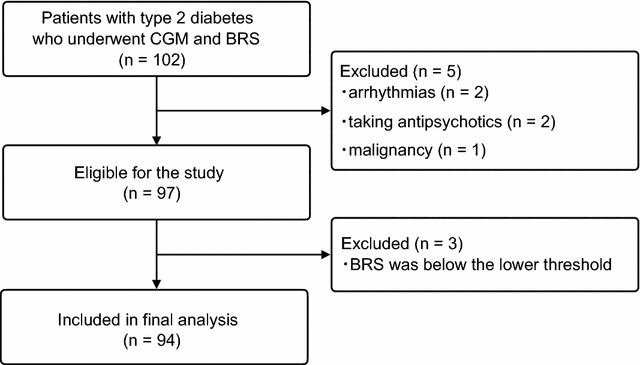
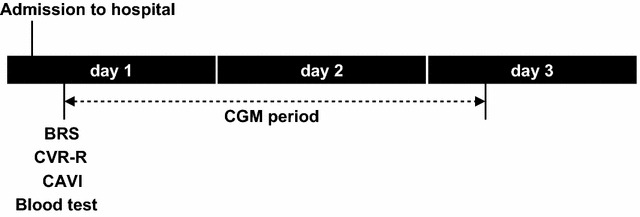
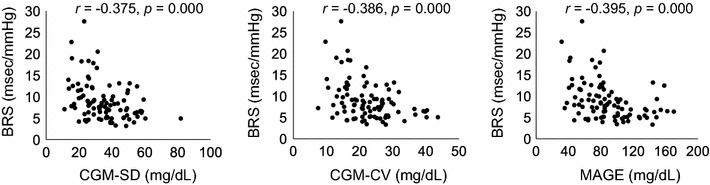
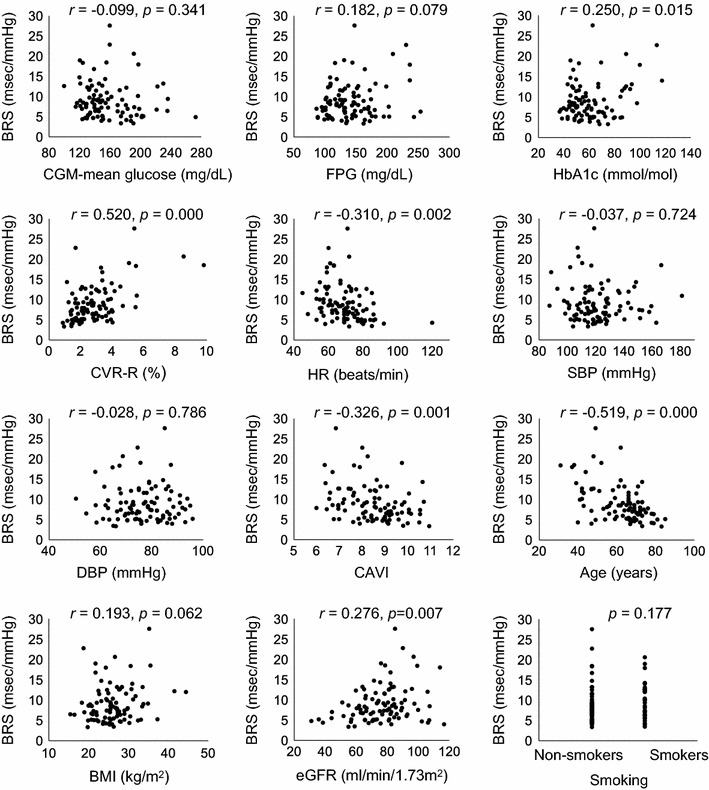
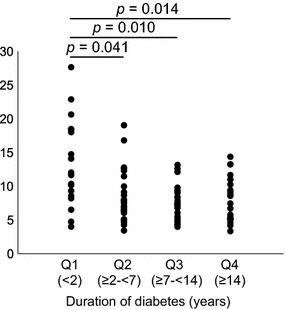
Background: It is presently unclear whether glycemic variability (GV) is associated with baroreflex sensitivity (BRS), which is an early indicator of cardiovascular autonomic neuropathy. The present study is the first to examine the relationships between BRS and GV measured using continuous glucose monitoring (CGM). Methods: This was a multicenter, prospective, open-label clinical trial. A total of 102 patients with type 2 diabetes were consecutively recruited for this study. GV was assessed by measuring the standard deviation (SD), glucose coefficient of variation (CV), and the mean amplitude of glycemic excursions (MAGE) during CGM. The BRS was analyzed from electrocardiogram and blood pressure recordings using the sequence method on the first day of hospitalization. Results: A total of 94 patients (mean diabetes duration 9.7 ± 9.6 years, mean HbA1c 61.0 ± 16.8 mmol/mol [7.7 ± 1.5%]) were analyzed. In the univariate analysis, CGM-SD (r = − 0.375, p = 0.000), CGM-CV (r = − 0.386, p = 0.000), and MAGE (r = − 0.395, p = 0.000) were inversely related to BRS. In addition to GV, the level of BRS correlated with the coefficient of variation in the R–R intervals (CVR-R) (r = 0.520, p = 0.000), heart rate (HR) (r = − 0.310, p = 0.002), cardio-ankle vascular index (CAVI) (r = − 0.326, p = 0.001), age (r = − 0.519, p = 0.000), and estimated glomerular filtration rate (eGFR) (r = 0.276, p = 0.007). Multiple regression analysis showed that CGM-CV and MAGE were significantly related to a decrease in BRS. These findings remained after adjusting the BRS for age, sex, hypertension, dyslipidemia, HR, eGFR, CAVI, and CGM-mean glucose. Additionally, BRS was divided according to quartiles of the duration of diabetes (Q1–4). BRS decreased after a 2-year duration of diabetes independently of age and sex. Conclusions: GV was inversely related to BRS independently of blood glucose levels in type 2 diabetic patients. Measurement of BRS may have the potential to predict CV events in consideration of GV. Trial registration UMIN Clinical Trials Registry UMIN000025964, 28/02/2017
Overview
The claims and statistics of this paper haven’t been checked yet.
Free: it reads the open-access text and checks the first 5 claims that cite a source we can check. Create a free account to check every claim.
Integrity signals
Registry
Cites
Statistics
Figures
Verification
Claims the paper makes
The claims and statistics of this paper haven’t been checked yet.
Free: it reads the open-access text and checks the first 5 claims that cite a source we can check. Create a free account to check every claim.
Claims other papers make about this one
Each is checked against this paper’s own text: does it say what the citing paper says it does?
The source backs part of the claim, not all of it — or backs it for a different population, condition or comparison.
In the citing paper
“Timely detection of CAN may help implementation of tailored interventions to prevent its progression and mitigate the risk of associated complications, including CVD, cardiac arrhythmias, myocardial dysfunction leading to congestive heart failure (CHF), CKD, and all-cause mortality.547,614,617–625”
From American Association of Clinical Endocrinology Clinical Practice Guideline: Developing a Diabetes Mellitus Comprehensive Care Plan-2022 Update. (2022) · cites this paper as [620]
Experimental — accuracy not yet measured
Self-check
Percentages, sums and reported differences re-computed from the paper’s own numbers.
The self-check needs the paper’s full text.
Citations
Cites
Glucose control and vascular complications in veterans with type 2 diabetes
Duckworth, W., Abraira, C., Moritz, T., Reda, D., Emanuele, N., Reaven, P. D., Zieve, F. J., Marks, J., Davis, S. N., Hayward, R., et al. (2009) · New England Journal of Medicine · doi:10.1056/nejmoa0808431 · Cited by 4,762 · cited 1×
“Among risk factors, although chronic hyperglycemia is an important pathophysiological factor in reduced BRS, improved chronic hyperglycemia alone was not shown to improve CAN in type 2 diabetes [13, 14].”
BackgroundMonnier, L., Mas, E., Ginet, C., Michel, F., Villon, L., Cristol, J.-P., & Colette, C. (2006) · JAMA · doi:10.1001/jama.295.14.1681 · Cited by 2,444
Monnier, L., Lapinski, H., & Colette, C. (2003) · Diabetes Care · doi:10.2337/diacare.26.3.881 · Cited by 1,461 · cited 1×
“In patients with type 2 diabetes of a short duration, increased GV caused by postprandial hyperglycemia is the predominant pathophysiological feature [46, 47].”
BackgroundOxidative Stress in the Pathogenesis of Diabetic Neuropathy
Vincent, A. M., Russell, J. W., Low, P., & Feldman, E. L. (2004) · Endocrine Reviews · doi:10.1210/er.2003-0019 · Cited by 982
Spallone, V., Ziegler, D., Freeman, R., Bernardi, L., Frontoni, S., Pop‐Busui, R., Stevens, M., Kempler, P., Hilsted, J., Tesfaye, S., et al. (2011) · Diabetes/Metabolism Research and Reviews · doi:10.1002/dmrr.1239 · Cited by 957
Tabák, A. G., Jokela, M., Akbaraly, T. N., Brunner, E. J., Kivimäki, M., & Witte, D. R. (2009) · The Lancet · doi:10.1016/s0140-6736(09)60619-x · Cited by 898 · cited 1×
“In patients with type 2 diabetes of a short duration, increased GV caused by postprandial hyperglycemia is the predominant pathophysiological feature [46, 47].”
BackgroundLa Rovere, M. T., Pinna, G. D., Hohnloser, S. H., Marcus, F. I., Mortara, A., Nohara, R., Bigger, J. T., Camm, A. J., & Schwartz, P. J. (2001) · Circulation · doi:10.1161/01.cir.103.16.2072 · Cited by 697
Baroreflex Sensitivity: Measurement and Clinical Implications
La Rovere, M. T., Pinna, G. D., & Raczak, G. (2008) · Annals of Noninvasive Electrocardiology · doi:10.1111/j.1542-474x.2008.00219.x · Cited by 659
La Rovere, M. T., Specchia, G., Mortara, A., & Schwartz, P. J. (1988) · Circulation · doi:10.1161/01.cir.78.4.816 · Cited by 631
Shirai, K., Hiruta, N., Song, M., Kurosu, T., Suzuki, J., Tomaru, T., Miyashita, Y., Saiki, A., Takahashi, M., Suzuki, K., et al. (2011) · Journal of Atherosclerosis and Thrombosis · doi:10.5551/jat.7716 · Cited by 458 · cited 1×
“The principle of the CAVI formula and its calculation were described previously [24].”
MethodSpontaneous Cardiac Baroreflex in Humans: Comparison With Drug-Induced Responses
Parlow, J., Viale, J.-P., Annat, G., Hughson, R., & Quintin, L. (1995) · Hypertension · doi:10.1161/01.hyp.25.5.1058 · Cited by 392
Su, G., Mi, S., Tao, H., Li, Z., Yang, H., Zheng, H., Zhou, Y., & Ma, C. (2011) · Cardiovascular Diabetology · doi:10.1186/1475-2840-10-19 · Cited by 257
Oxidative stress and diabetic neuropathy: a new understanding of an old problem
Feldman, E. L. (2003) · Journal of Clinical Investigation · doi:10.1172/jci17862 · Cited by 244
Frattola, A., Parati, G., Gamba, P., Paleari, F., Mauri, G., Di Rienzo, M., Castiglioni, P., & Mancia, G. (1997) · Diabetologia · doi:10.1007/s001250050851 · Cited by 213
Determinants of Spontaneous Baroreflex Sensitivity in a Healthy Working Population
Kardos, A., Watterich, G., de Menezes, R., Csanády, M., Casadei, B., & Rudas, L. (2001) · Hypertension · doi:10.1161/01.hyp.37.3.911 · Cited by 186
Costantino, S., Paneni, F., Battista, R., Castello, L., Capretti, G., Chiandotto, S., Tanese, L., Russo, G., Pitocco, D., Lanza, G. A., et al. (2017) · Diabetes · doi:10.2337/db17-0294 · Cited by 186
Postprandial Hyperglycemia and Glycemic Variability
Standl, E., Schnell, O., & Ceriello, A. (2011) · Diabetes Care · doi:10.2337/dc11-s206 · Cited by 183
Azad, N., Emanuele, N., Abraira, C., Henderson, W. G., Colwell, J. A., Levin, S. R., Nuttall, F. Q., Comstock, J. P., Sawin, C. T., Silbert, C. K., et al. (1999) · Journal of Diabetes and its Complications · doi:10.1016/s1056-8727(99)00062-8 · Cited by 151
Glucose “peak” and glucose “spike”: Impact on endothelial function and oxidative stress
Ceriello, A., Esposito, K., Piconi, L., Ihnat, M. A., Thorpe, J. E., Testa, R., Bonfigli, A. R., & Giugliano, D. (2008) · Diabetes Research and Clinical Practice · doi:10.1016/j.diabres.2008.07.015 · Cited by 138
Glucose tolerance and other determinants of cardiovascular autonomic function: the Hoorn Study
Gerritsen, J., Dekker, J. M., TenVoorde, B. J., Bertelsmann, F. W., Kostense, P. J., Stehouwer, C. D. A., Heine, R. J., Nijpels, G., Heethaar, R. M., & Bouter, L. M. (2000) · Diabetologia · doi:10.1007/s001250051344 · Cited by 121 · cited 1×
“Although it was previously reported that BRS was decreased in type 2 diabetic patients [6, 30], the detailed mechanism has not been elucidated.”
BackgroundJun, J. E., Jin, S.-M., Baek, J., Oh, S., Hur, K. Y., Lee, M.-S., Lee, M.-K., & Kim, J. H. (2015) · Cardiovascular Diabetology · doi:10.1186/s12933-015-0233-0 · Cited by 110
Time- and frequency-domain estimation of early diabetic cardiovascular autonomic neuropathy
Ziegler, D., Laude, D., Akila, F., & Elghozi, J. (2001) · Clinical Autonomic Research · doi:10.1007/bf02292769 · Cited by 104
Spontaneous baroreflex sensitivity: toward an ideal index of cardiovascular risk in hypertension?
Lantelme, P., Khettab, F., Custaud, M.-A., Rial, M.-O., Joanny, C., Gharib, C., & Milon, H. (2002) · Journal of Hypertension · doi:10.1097/00004872-200205000-00029 · Cited by 93
Greater intima-media thickness in the carotid bulb is associated with reduced baroreflex sensitivity
Gianaros, P. J., Jennings, J. R., Olafsson, G. B., Steptoe, A., Sutton-Tyrrell, K., Muldoon, M. F., & Manuck, S. B. (2002) · American Journal of Hypertension · doi:10.1016/s0895-7061(02)02923-0 · Cited by 79
Mo, Y., Zhou, J., Li, M., Wang, Y., Bao, Y., Ma, X., Ding, L., Lu, W., Hu, C., Li, M., et al. (2013) · Cardiovascular Diabetology · doi:10.1186/1475-2840-12-15 · Cited by 67
Ruiz, J., Monbaron, D., Parati, G., Perret, S., Haesler, E., Danzeisen, C., & Hayoz, D. (2005) · Hypertension · doi:10.1161/01.hyp.0000169053.14440.7d · Cited by 61
Xu, W., Zhu, Y., Yang, X., Deng, H., Yan, J., Lin, S., Yang, H.-Z., Chen, H., & Weng, J. (2016) · International Journal of Cardiology · doi:10.1016/j.ijcard.2016.04.078 · Cited by 57
Is there a glycemic threshold for impaired autonomic control?
Watkins, L. L., Surwit, R. S., Grossman, P., & Sherwood, A. (2000) · Diabetes Care · doi:10.2337/diacare.23.6.826 · Cited by 55
Hansen, C. S., Vistisen, D., Jørgensen, M. E., Witte, D. R., Brunner, E. J., Tabák, Á. G., Mika Kivimaki, B., Roden, M., Malík, M., & Herder, C. (2017) · Cardiovascular Diabetology · doi:10.1186/s12933-017-0634-3 · Cited by 53
Su, G., Mi, S.-H., Li, Z., Tao, H., Yang, H.-X., & Zheng, H. (2013) · Cardiovascular Diabetology · doi:10.1186/1475-2840-12-33 · Cited by 49
Kuroda, M., Shinke, T., Sakaguchi, K., Otake, H., Takaya, T., Hirota, Y., Osue, T., Kinutani, H., Konishi, A., Takahashi, H., et al. (2015) · Cardiovascular Diabetology · doi:10.1186/s12933-015-0236-x · Cited by 48
Pozza, R. D., Bechtold, S. M., Bonfig, W., Putzker, S., Kozlik-Feldmann, R. G., Schwarz, H., & Netz, H. (2007) · Diabetologia · doi:10.1007/s00125-007-0823-9 · Cited by 44
Pierce, G. L., Harris, S. A., Seals, D. R., Casey, D. P., Barlow, P. B., & Stauss, H. M. (2016) · Journal of Human Hypertension · doi:10.1038/jhh.2016.3 · Cited by 44
Kuroda, M., Shinke, T., Otake, H., Sugiyama, D., Takaya, T., Takahashi, H., Terashita, D., Uzu, K., Tahara, N., Kashiwagi, D., et al. (2016) · Cardiovascular Diabetology · doi:10.1186/s12933-016-0395-4 · Cited by 43
Baroreceptor sensitivity and diabetes mellitus
Rowaiye, O. O., Jankowska, E. A., & Ponikowska, B. (2013) · Cardiology Journal · doi:10.5603/cj.2013.0130 · Cited by 41
Ziegler, D., Strom, A., Kupriyanova, Y., Bierwagen, A., Bönhof, G. J., Bódis, K. B., Müssig, K., Szendroedi, J., Bobrov, P., Markgraf, D. F., et al. (2017) · The Journal of Clinical Endocrinology & Metabolism · doi:10.1210/jc.2017-02294 · Cited by 41
Shimabukuro, M., Tanaka, A., Sata, M., Dai, K., Shibata, Y., Inoue, Y., Ikenaga, H., Kishimoto, S., Ogasawara, K., Takashima, A., et al. (2017) · Cardiovascular Diabetology · doi:10.1186/s12933-017-0571-1 · Cited by 38
A critical level of diabetic autonomic neuropathy.
Kageyama, S., TANIGUCHI, I., Tanaka, S., Tajima, N., SAITO, N., Ikeda, Y., & Abé, M. (1983) · The Tohoku Journal of Experimental Medicine · doi:10.1620/tjem.141.suppl_479 · Cited by 37
Baroreflex dysfunction in chronic kidney disease
Kaur, M., Chandran, D. S., Jaryal, A. K., Bhowmik, D., Agarwal, S. K., & Deepak, K. K. (2016) · World Journal of Nephrology · doi:10.5527/wjn.v5.i1.53 · Cited by 36
Tiftikçioğlu, B. İ., Bilgin, Ş., Duksal, T., Köse, Ş., & Zorlu, Y. (2016) · Medicine · doi:10.1097/md.0000000000003340 · Cited by 34
Takahashi, N., Anan, F., Nakagawa, M., Yufu, K., Shinohara, T., Tsubone, T., Goto, K., Masaki, T., Katsuragi, I., Tanaka, K., et al. (2007) · Metabolism · doi:10.1016/j.metabol.2007.02.005 · Cited by 31
Emanuel, A. L., Nieuwenhoff, M. D., Klaassen, E. S., Verma, A., Kramer, M. H. H., STRIJERS, R. L. M., Vrancken, A. F. J. E., Eringa, E. C., Groeneveld, G. J., & Serné, E. H. (2017) · Diabetes Care · doi:10.2337/dc16-1690 · Cited by 27
Jun, J. E., Lee, S., Lee, Y., Ahn, J. Y., Kim, G., Jin, S., Hur, K. Y., Lee, M., & Kim, J. H. (2017) · Cardiovascular Diabetology · doi:10.1186/s12933-017-0619-2 · Cited by 27
Pathophysiological Contribution of Vascular Function to Baroreflex Regulation in Hypertension
Tomiyama, H., Matsumoto, C., Kimura, K., Odaira, M., Shiina, K., & Yamashina, A. (2014) · Circulation Journal · doi:10.1253/circj.cj-14-0064 · Cited by 25
Wu, J., Lu, F., Yang, Y., Chang, S.-H., Huang, Y., Chen, J. J., & Chang, C. (2014) · Acta Diabetologica · doi:10.1007/s00592-013-0548-9 · Cited by 21
Reimann, M., Rüdiger, H., Weiss, N., & Ziemssen, T. (2015) · Atherosclerosis Supplements · doi:10.1016/j.atherosclerosissup.2015.02.004 · Cited by 14
How Can We Easily Measure Glycemic Variability in Diabetes Mellitus?
Chon, S. (2015) · Diabetes & Metabolism Journal · doi:10.4093/dmj.2015.39.2.114 · Cited by 4
Cited by
Lu, J., Ma, X., Zhou, J., Zhang, L., Mo, Y., Ying, L., Lu, W., Zhu, W., Bao, Y., Vigersky, R. A., et al. (2018) · Diabetes Care · doi:10.2337/dc18-1131 · Cited by 517
Blonde, L., Umpierrez, G. E., Reddy, S. S., McGill, J. B., Berga, S. L., Bush, M., Chandrasekaran, S., DeFronzo, R. A., Einhorn, D., Galindo, R. J., et al. (2022) · Endocrine Practice · doi:10.1016/j.eprac.2022.08.002 · Cited by 507
Shimizu, W., Kubota, Y., Hoshika, Y., Mozawa, K., Tara, S., Tokita, Y., Yodogawa, K., Iwasaki, Y.-K., Yamamoto, T., Takano, H., et al. (2020) · Cardiovascular Diabetology · doi:10.1186/s12933-020-01127-z · Cited by 228
Time in Range from Continuous Glucose Monitoring: A Novel Metric for Glycemic Control
Yoo, J. H., & Kim, J. H. (2020) · Diabetes & Metabolism Journal · doi:10.4093/dmj.2020.0257 · Cited by 108
Guo, Q., Zang, P., Xu, S., Song, W., Zhang, Z., Liu, C., Guo, Z., Chen, J., Lu, B., Gu, P., et al. (2020) · Journal of Diabetes Research · doi:10.1155/2020/5817074 · Cited by 74
Metadata
- Authors
- Matsutani, D., Sakamoto, M., Iuchi, H., Minato, S., Suzuki, H., Kayama, Y., Takeda, N., Horiuchi, R., & Utsunomiya, K.
- Corresponding author
- Sakamoto, Masaya
- Venue
- Cardiovascular Diabetology
- Published
- 2018-03-07
- Volume
- 17
- Issue
- 1
- Pages
- 36-36
- ISSN
- 1475-2840 (ISSN-L)
- PMC
- PMC5840775
- OpenAlex
- W2791384939
- Cited by
- 52
- References
- 47
- Citations by year
- 2026: 2 · 2025: 4 · 2024: 3 · 2023: 4 · 2022: 8 · 2021: 5 · 2020: 12 · 2019: 8 · 2018: 6
- FWCI
- 6.16
- Type
- journal article
- Language
- en
- Open access
- gold
- doi.org
- Licence
- cc-by
- creativecommons.org/licenses/by/4.0 (tdm)
- creativecommons.org/licenses/by/4.0 (vor)
- Locations
- Cardiovascular Diabetology (publishedVersion, cc-by)
- Europe PMC (PubMed Central) (publishedVersion, cc-by)
- PubMed Central (publishedVersion, cc-by)
- PubMed (publishedVersion)
- DOAJ (DOAJ: Directory of Open Access Journals) (submittedVersion, cc-by-sa)
- Funders
- Japan Society for the Promotion of Science (26111003)
- Topics
- Health Sciences › Medicine › Endocrinology, Diabetes and Metabolism › Diabetes Management and Research
- Health Sciences › Medicine › Cardiology and Cardiovascular Medicine › Heart Rate Variability and Autonomic Control
- Health Sciences › Medicine › Endocrinology, Diabetes and Metabolism › Diabetes Treatment and Management
- Keywords
- glycemic variability, baroreflex sensitivity, type 2 diabetes, cardiac autonomic neuropathy, continuous glucose monitoring, mean amplitude of glycemic excursions, autonomic dysfunction, cardiovascular risk, cardio-ankle vascular index, estimated glomerular filtration rate, heart rate variability, diabetes duration, cardiovascular mortality risk
- MeSH terms
- Preliminary Data, Aged, Blood Glucose, Cardiovascular Diseases, Cross-Sectional Studies, Diabetes Mellitus, Type 2, Diabetic Neuropathies, Female, Glycated Hemoglobin, Hospitalization, Humans, Hypoglycemic Agents, Japan, Male, Middle Aged, Predictive Value of Tests, Prospective Studies, Risk Factors, Time Factors, Blood Glucose Self-Monitoring, Biomarkers, Baroreflex
About these checks
Registry, retraction, Cites and statistics results are computed, not judged, with one exception: a printed reference that no index lists is read once by a model before it counts as a citation error. Claims are extracted by a model and kept only when their quote appears verbatim in the text; each cited source is then checked, with a model’s help, for whether it says what the claim relies on. Those verdicts can be wrong — read the claim’s quote and the cited source before relying on one.
Statistics and arithmetic are recomputed, not judged.
Confidence bands are shown only for fields calibrated on our annotated test set. None is calibrated yet, so no band is shown.
What counts as a claim ›How we measure confidence ›How we check this ›
Are you an author, or do you see a problem with this page? Request a review
Data sources
Bibliographic data: Semantic Scholar, OpenAlex, Crossref.
Contains information from the Semantic Scholar Academic Graph Datasets, made available under the ODC Attribution License (ODC-BY 1.0).
Semantic Scholar’s data is described in: Kinney, R., et al. (2023). The Semantic Scholar Open Data Platform. arXiv:2301.10140.
