

The DOI matches its Crossref record; 38 of the 38 references it cites were found in a registry or an index.
CRISPR/Cas9 mediated targeted mutagenesis of the fast growing cyanobacterium Synechococcus elongatus UTEX 2973
Open accessAbstract
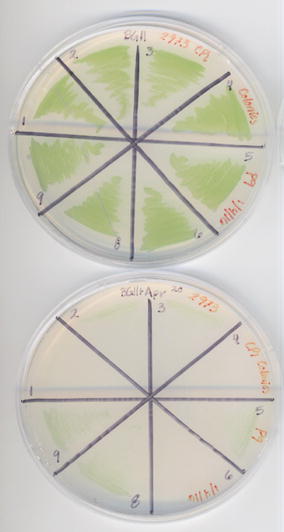
BACKGROUND: As autotrophic prokaryotes, cyanobacteria are ideal chassis organisms for sustainable production of various useful compounds. The newly characterized cyanobacterium Synechococcus elongatus UTEX 2973 is a promising candidate for serving as a microbial cell factory because of its unusually rapid growth rate. Here, we seek to develop a genetic toolkit that enables extensive genomic engineering of Synechococcus 2973 by implementing a CRISPR/Cas9 editing system. We targeted the nblA gene because of its important role in biological response to nitrogen deprivation conditions. RESULTS: First, we determined that the Streptococcus pyogenes Cas9 enzyme is toxic in cyanobacteria, and conjugational transfer of stable, replicating constructs containing the cas9 gene resulted in lethality. However, after switching to a vector that permitted transient expression of the cas9 gene, we achieved markerless editing in 100 % of cyanobacterial exconjugants after the first patch. Moreover, we could readily cure the organisms of antibiotic resistance, resulting in a markerless deletion strain. CONCLUSIONS: High expression levels of the Cas9 protein in Synechococcus 2973 appear to be toxic and result in cell death. However, introduction of a CRISPR/Cas9 genome editing system on a plasmid backbone that leads to transient cas9 expression allowed for efficient markerless genome editing in a wild type genetic background.
Overview
The claims and statistics of this paper haven’t been checked yet.
Run the check — free, no account needed. It reads the open-access text and checks the sources it cites.
Integrity signals
Registry
Cites
Statistics
Figures
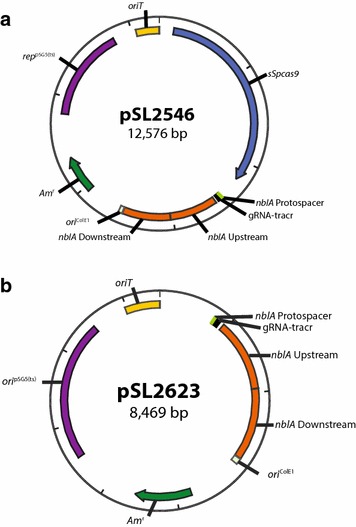
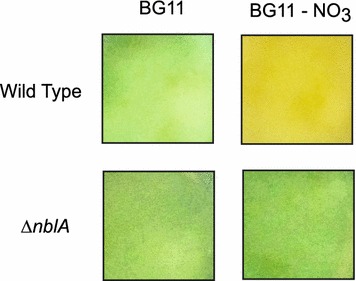
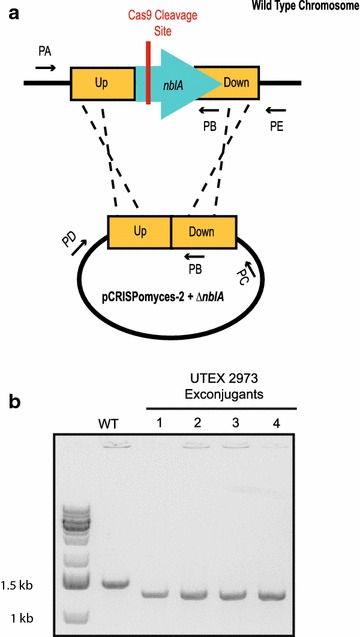
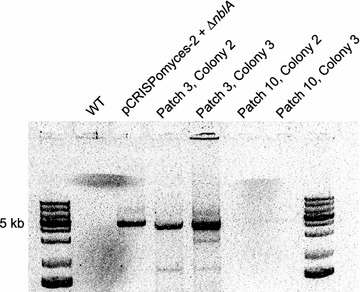
Verification
Claims the paper makes
The claims and statistics of this paper haven’t been checked yet.
Run the check — free, no account needed. It reads the open-access text and checks the sources it cites.
Claims other papers make about this one
Each is checked against this paper’s own text: does it say what the citing paper says it does?
The cited source says what the claim attributes to it.
In the citing paper
“Over the past decade, significant progress has been achieved in the development of genetic tools for cyanobacterial metabolic engineering, including improved transformation methods, modular DNA assembly systems, synthetic promoters, and CRISPR-based genome editing technologies [10,16,17].”
From Cyanobacteria as a Photosynthetic Chassis for Metabolic Pathway Engineering with Heterologous Gene Expression (2026) · cites this paper as [17]
Self-check
Percentages, sums and reported differences re-computed from the paper’s own numbers.
The self-check needs the paper’s full text.
Citations
Cites
Multiplex Genome Engineering Using CRISPR/Cas Systems
Cong, L., Ran, F. A., Cox, D., Lin, S., Barretto, R., Habib, N., Hsu, P. D., Wu, X., Jiang, W., Marraffini, L. A., et al. (2013) · Science · doi:10.1126/science.1231143 · Cited by 15,339
Friedberg, E. C., Walker, G. C., Siede, W., Wood, R. D., Schultz, R. A., & Ellenberger, T. (2005) · doi:10.1128/9781555816704 · Cited by 5,683
CRISPR-Cas systems for editing, regulating and targeting genomes
Sander, J. D., & Joung, J. K. (2014) · Nature Biotechnology · doi:10.1038/nbt.2842 · Cited by 3,153
CRISPR RNA Maturation by Trans-Encoded Small RNA and Host Factor RNase III
Deltcheva, E., Chylinski, K., Sharma, C. M., Gonzales, K., Chao, Y., Pirzada, Z. A., Eckert, M. R., Vogel, J., & Charpentier, E. (2011) · Nature · doi:10.1038/nature09886 · Cited by 2,563
CRISPR/Cas, the Immune System of Bacteria and Archaea
Horvath, P., & Barrangou, R. (2010) · Science · doi:10.1126/science.1179555 · Cited by 2,471
RNA-guided editing of bacterial genomes using CRISPR-Cas systems
Jiang, W., Bikard, D., Cox, D., Zhang, F., & Marraffini, L. A. (2013) · Nature Biotechnology · doi:10.1038/nbt.2508 · Cited by 2,429
RNA-guided genetic silencing systems in bacteria and archaea
Wiedenheft, B., Sternberg, S. H., & Doudna, J. A. (2012) · Nature · doi:10.1038/nature10886 · Cited by 1,851
CRISPR-Cas Systems in Bacteria and Archaea: Versatile Small RNAs for Adaptive Defense and Regulation
Bhaya, D., Davison, M., & Barrangou, R. (2011) · Annual Review of Genetics · doi:10.1146/annurev-genet-110410-132430 · Cited by 914
Recombinational Repair of DNA Damage in Escherichia coli and Bacteriophage λ
Kuzminov, A. (1999) · Microbiology and Molecular Biology Reviews · doi:10.1128/mmbr.63.4.751-813.1999 · Cited by 897
Lindberg, P., Park, S., & Melis, A. (2010) · Metabolic Engineering · doi:10.1016/j.ymben.2009.10.001 · Cited by 596
Cited by
Sorted by citations
Items 201–232 of 232
Shaberi, H. S. A., Bunawan, H., Craig, S., Bryan, S. J., & Ramzi, A. B. (2024) · Algal Research · doi:10.1016/j.algal.2024.103755 · Cited by 1
INSIGHT INTO CRISPR SYSTEM IN EUKARYOTIC MICROALGAE, A REVIEW
Bilal, I., Butnariu, M., & Bilal, E. (2019) · EurasianUnionofScientists · doi:10.31618/esu.2413-9335.2019.3.59.37-48 · Cited by 1
Öncel, S. Ş., & Köse, A. (2018) · Springer eBooks · doi:10.1007/978-1-4939-7789-5_951 · Cited by 2
Current Advances in Biotechnology of Marine Microalgae
Wan, C., Chen, B., Zhao, X., & Bai, F. (2020) · Wiley eBooks · doi:10.1002/9781119143802.ch77 · Cited by 1
Design Principles for Engineering Metabolic Pathways in Cyanobacteria
Ku, J. T., & Lan, E. I. (2021) · Wiley eBooks · doi:10.1002/9783527824908.ch7 · Cited by 1
A “CRISPY” tale on microalgal genome editing: featuring Nannochloropsis oceanica IMET1
Naduthodi, M. I. S. (2021) · doi:10.18174/555308 · Cited by 1
Öncel, S. Ş., & Köse, A. (2017) · Springer eBooks · doi:10.1007/978-1-4939-2493-6_951-1 · Cited by 1
Feel the burn: a collection of stories on hot’n’sharp DNA engineering
Mougiakos, I. (2019) · doi:10.18174/468570
Metabolic Network Analysis of Filamentous Cyanobacteria
Noreña-Caro, D. (2020) · Louisiana State University · doi:10.31390/gradschool_dissertations.5293
CRISPRi in Deinococcus radioduransPreprint
Misra, C. S., Pandey, N., Appukuttan, D., & Rath, D. (2022) · bioRxiv (Cold Spring Harbor Laboratory) · doi:10.1101/2022.11.23.517625
Microalgae as biofuel: current perspectives and technological progress
Gupta, S., & Ahirwar, S. (2023) · Elsevier eBooks · doi:10.1016/b978-0-323-95332-0.00011-9
Genome Editing in Medicinal Plants for Abiotic Stress Tolerance
Zafar, Z., Ahmad, F., Rehman, S. U., Karimi, S., Akram, U., Ali, Z., & Khan, Z. (2023) · BENTHAM SCIENCE PUBLISHERS eBooks · doi:10.2174/9789815136838123010013
CRISPR driven Cyanobacterial Metabolic Engineering and its role in metabolite production
Chakraborty, S., Mukhopadhyay, R., Dutta, R., Samanta, S., Bagchi, A., Mitra, O., & Majumder, R. (2024) · Journal of Experimental Biology and Agricultural Sciences · doi:10.18006/2024.12(3).446.456
Pioneering precision in markerless strain development for Synechococcus sp. PCC 7002
Tsuji, A., Inabe, K., Hidese, R., Kato, Y., Domingues, L., Kondo, A., & Hasunuma, T. (2024) · Microbial Cell Factories · doi:10.1186/s12934-024-02543-6
Nares-Rodriguez, M. I., & Karunakaran, E. (2025) · SynBio · doi:10.3390/synbio3010003
Delzenne, T. O., & Claessen, D. (2025) · HardwareX · doi:10.1016/j.ohx.2025.e00649
What would a hypothetical supercyanobacterium look like?
Pěnčík, O., Koláčková, M., Molnárová, K., & Húska, D. (2025) · Trends in biotechnology · doi:10.1016/j.tibtech.2025.04.006
Engineering Algal Strains for Enhanced Performance
Kumari, R., Patel, V., Kumari, P., & Kajla, S. (2025) · Springer eBooks · doi:10.1007/978-981-96-8054-2_3
Effective Strategies for Translating CRISPR-dCas Systems to Diverse Microbes
Gervais, N. C., Hendriks, A., & Shapiro, R. S. (2025) · ACS Synthetic Biology · doi:10.1021/acssynbio.5c00537
Additional file 3 of SEVA-Cpf1, a CRISPR-Cas12a vector for genome editing in cyanobacteria
Baldanta, S., Guevara, G., & Navarro-Llorens, J. M. (2022) · Figshare · doi:10.6084/m9.figshare.19921035
Semary, N. A. H. E., Fadiel, A., Eichenbaum, K. D., & Alhusayni, S. (2026) · Current Issues in Molecular Biology · doi:10.3390/cimb48010105
Progresses of engineering microbial chassis for one-carbon biotransformation
Shen, Y., Cai, P., & Zhou, Y. J. (2025) · Chinese Science Bulletin (Chinese Version) · doi:10.1360/tb-2025-0119 · Cited by 1
Targeted genome editing of the non-model cyanobacterium Cyanothece PCC 7425 via CRISPR/Cas12aPreprint
Khan, M. A., Durand, A., Skouri‐Panet, F., Benzerara, K., Cassier‐Chauvat, C., Chauvat, F., & Ouchane, S. (2026) · bioRxiv (Cold Spring Harbor Laboratory) · doi:10.64898/2026.05.09.723881
Li, S., Sun, T., Liu, D., Zhang, T. A., Chen, L., & Zhang, W. (2026) · Plant Biotechnology Journal · doi:10.1111/pbi.70702 · Cited by 1
Bridging Sustainable OMEGAs Production in Algae by Crafting Omics Blocks
Mariam, I., Rova, U., Christakopoulos, P., Μάτσακας, Λ., & Patel, A. (2026) · Reference series in phytochemistry · doi:10.1007/978-3-031-80866-1_45-1
Craig, S., Green, D., Martin, C. A., Spence, E. M., Barajas-Solano, A. F., & Bryan, S. J. (2026) · SynBio · doi:10.3390/synbio4030016
Microalgal proteins as sustainable alternatives: CRISPR opportunities and challenges
Wang, F., Liu, X., Gu, W., Xie, X., Wu, S., Gao, S., Srimongkol, P., Srinuanpan, S., Karnchanatat, A., & Gu, W. (2026) · Bioresource Technology · doi:10.1016/j.biortech.2026.135918
Cyanobacteria: A sustainable platform for high-value biopharmaceutical protein production
Majhi, B. K. (2026) · Journal of Pharmaceutical Analysis · doi:10.1016/j.jpha.2026.101807
Metadata
- Authors
- Wendt, K. E., Ungerer, J., Cobb, R. E., Zhao, H., & Pakrasi, H. B.
- Affiliations
- Washington University in St. Louis (US)
- University of Illinois Urbana-Champaign (US)
- Corresponding author
- Pakrasi, Himadri B.
- Venue
- Microbial Cell Factories
- Published
- 2016-06-23
- Volume
- 15
- Issue
- 1
- Pages
- 115-115
- ISSN
- 1475-2859 (ISSN-L)
- PMC
- PMC4917971
- OpenAlex
- W2470889463
- Cited by
- 232
- References
- 38
- Citations by year
- 2026: 15 · 2025: 15 · 2024: 24 · 2023: 17 · 2022: 29 · 2021: 23 · 2020: 22 · 2019: 34 · 2018: 31 · 2017: 16 · 2016: 6
- FWCI
- 15.07
- Type
- journal article
- Language
- en
- Open access
- gold
- doi.org
- Locations
- Microbial Cell Factories (publishedVersion, cc-by)
- Europe PMC (PubMed Central) (publishedVersion, cc-by)
- PubMed Central (publishedVersion, cc-by)
- PubMed (publishedVersion)
- OSTI OAI (U.S. Department of Energy Office of Scientific and Technical Information) (submittedVersion)
- Funders
- Office of Science
- National Institute of General Medical Sciences (GM077596)
- Topics
- Life Sciences › Biochemistry, Genetics and Molecular Biology › Molecular Biology › CRISPR and Genetic Engineering
- Life Sciences › Biochemistry, Genetics and Molecular Biology › Molecular Biology › Microbial Metabolic Engineering and Bioproduction
- Life Sciences › Biochemistry, Genetics and Molecular Biology › Genetics › Bacterial Genetics and Biotechnology
- Keywords
- CRISPR/Cas9, cyanobacteria, genome editing, conjugative transfer
- MeSH terms
- Endonucleases, Genetic Techniques, Mutagenesis, Synechococcus, Clustered Regularly Interspaced Short Palindromic Repeats
About these checks
Registry, retraction, Cites and statistics results are computed, not judged, with one exception: a printed reference that no index lists is read once by a model before it counts as a citation error. Claims are extracted by a model and kept only when their quote appears verbatim in the text; each cited source is then checked, with a model’s help, for whether it says what the claim relies on. Those verdicts can be wrong — read the claim’s quote and the cited source before relying on one.
Statistics and arithmetic are recomputed, not judged.
Confidence bands are shown only for fields calibrated on our annotated test set. None is calibrated yet, so no band is shown.
What counts as a claim ›How we measure confidence ›How we check this ›
Are you an author, or do you see a problem with this page? Request a review
