

Eave tubes for malaria control in Africa: initial development and semi-field evaluations in Tanzania
Open accessThe DOI matches its Crossref record; 21 of the 21 references it cites were found in a registry or an index.
Abstract
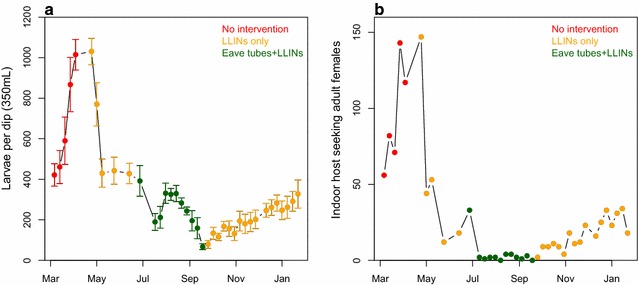
BACKGROUND: Presented here are a series of preliminary experiments evaluating "eave tubes"-a technology that combines house screening with a novel method of delivering insecticides for control of malaria mosquitoes. METHODS: Eave tubes were first evaluated with overnight release and recapture of mosquitoes in a screened compartment containing a hut and human sleeper. Recapture numbers were used as a proxy for overnight survival. These trials tested physical characteristics of the eave tubes (height, diameter, angle), and different active ingredients (bendiocarb, LLIN material, fungus). Eave tubes in a hut with closed eaves were also compared to an LLIN protecting a sleeper in a hut with open eaves. Eave tubes were then evaluated in a larger compartment containing a self-replicating mosquito population, vegetation, and multiple houses and cattle sheds. In this "model village", LLINs were introduced first, followed by eave tubes and associated house modifications. RESULTS: Initial testing suggested that tubes placed horizontally and at eave height had the biggest impact on mosquito recapture relative to respective controls. Comparison of active ingredients suggested roughly equivalent effects from bendiocarb, LLIN material, and fungal spores (although speed of kill was slower for fungus). The impact of treated netting on recapture rates ranged from 50 to 70 % reduction relative to controls. In subsequent experiments comparing bendiocarb-treated netting in eave tubes against a standard LLIN, the effect size was smaller but the eave tubes with closed eaves performed at least as well as the LLIN with open eaves. In the model village, introducing LLINs led to an approximate 60 % reduction in larval densities and 85 % reduction in indoor catches of host-seeking mosquitoes relative to pre-intervention values. Installing eave tubes and screening further reduced larval density (93 % relative to pre intervention values) and virtually eliminated indoor host-seeking mosquitoes. When the eave tubes and screening were removed, larval and adult catches recovered to pre-eave tube levels. CONCLUSIONS: These trials suggest that the "eave tube" package can impact overnight survival of host-seeking mosquitoes and can suppress mosquito populations, even in a complex environment. Further testing is now required to evaluate the robustness of these findings and demonstrate impact under field conditions.
Overview
The claims and statistics of this paper haven’t been checked yet.
Free: it reads the open-access text and checks the first 5 claims that cite a source we can check. Create a free account to check every claim.
Integrity signals
Registry
Cites
Statistics
Figures
Verification
Claims the paper makes
The claims and statistics of this paper haven’t been checked yet.
Free: it reads the open-access text and checks the first 5 claims that cite a source we can check. Create a free account to check every claim.
Claims other papers make about this one
Each is checked against this paper’s own text: does it say what the citing paper says it does?
The source backs part of the claim, not all of it — or backs it for a different population, condition or comparison.
In the citing paper
“When combined with screening of doors and windows, preliminary evidence suggests that eave tubes reduce entry of mosquitoes and increase overnight mortality rate, leading to reduced transmission risk at both household and community levels [4–7].”
From Semi-field studies to better understand the impact of eave tubes on mosquito mortality and behaviour (2018) · cites this paper as [6]
Experimental — accuracy not yet measuredThe source backs part of the claim, not all of it — or backs it for a different population, condition or comparison.
In the citing paper
“preliminary evidence suggests insecticide-treated tubes, combined with screening of doors and windows to make the house more ‘mosquito proof’, reduces entry of mosquitoes and increases overnight mortality rate, leading to reduced transmission risk at both household and community levels [14–17].”
From Semi-field evaluation of the cumulative effects of a "Lethal House Lure" on malaria mosquito mortality (2019) · cites this paper as [15]
Experimental — accuracy not yet measured
5 more claims about this paper
Create a free account to see every claim other papers make about this one.
Self-check
Percentages, sums and reported differences re-computed from the paper’s own numbers.
The self-check needs the paper’s full text.
Citations
Cites
The effect of malaria control on Plasmodium falciparum in Africa between 2000 and 2015
Bhatt, S., Weiss, D. J., Cameron, E., Bisanzio, D., Mappin, B., Dalrymple, U., Battle, K. E., Moyes, C. L., Henry, A., Eckhoff, P. A., et al. (2015) · Nature · doi:10.1038/nature15535 · Cited by 3,225
Insecticide-treated bed nets and curtains for preventing malaria
Lengeler, C. (2004) · Cochrane Database of Systematic Reviews · doi:10.1002/14651858.cd000363.pub2 · Cited by 1,700
The evidence for improving housing to reduce malaria: a systematic review and meta-analysis
Tusting, L. S., Ippolito, M. M., Willey, B. A., Kleinschmidt, I., Dorsey, G., Gosling, R. D., & Lindsay, S. W. (2015) · Malaria Journal · doi:10.1186/s12936-015-0724-1 · Cited by 355 · cited 1×
“Closing off the eaves of houses (together with additional screening of windows) provides a physical barrier that protects inhabitants from malaria [8–11].”
BackgroundTHE IMPORTANCE OF MOSQUITO BEHAVIOURAL ADAPTATIONS TO MALARIA CONTROL IN AFRICA
Gatton, M. L., Chitnis, N., Churcher, T., Donnelly, M. J., Ghani, A. C., Godfray, H. C. J., Gould, F., Hastings, I., Marshall, J., Ranson, H., et al. (2013) · Evolution · doi:10.1111/evo.12063 · Cited by 336
Kirby, M. J., Ameh, D., Bottomley, C., Green, C., Jawara, M., Milligan, P. J., Snell, P. C., Conway, D. J., & Lindsay, S. W. (2009) · The Lancet · doi:10.1016/s0140-6736(09)60871-0 · Cited by 293
Russell, T. L., Beebe, N. W., Cooper, R. D., Lobo, N. F., & Burkot, T. R. (2013) · Malaria Journal · doi:10.1186/1475-2875-12-56 · Cited by 198
Govella, N. J., & Ferguson, H. (2012) · Frontiers in Physiology · doi:10.3389/fphys.2012.00199 · Cited by 172
Killeen, G. F., Govella, N. J., Lwetoijera, D. W., & Okumu, F. O. (2016) · Malaria Journal · doi:10.1186/s12936-016-1280-z · Cited by 166
Ferguson, H. M., Ng’habi, K. R., Walder, T., Kadungula, D., Moore, S., Lyimo, I. N., Russell, T. L., Urassa, H., Mshinda, H., Killeen, G. F., et al. (2008) · Malaria Journal · doi:10.1186/1475-2875-7-158 · Cited by 147
Self-citationMind the Gap: House Structure and the Risk of Malaria in Uganda
Wanzirah, H., Tusting, L. S., Arinaitwe, E., Katureebe, A., Maxwell, K., Rek, J., Bottomley, C., Staedke, S. G., Kamya, M., Dorsey, G., et al. (2015) · PLOS ONE · doi:10.1371/journal.pone.0117396 · Cited by 140
Research works printed but not linked: 2
- WHO Guidelines for laboratory and field testing of long-lasting insecticidal nets 2013 Geneva World Health Organization
- WHO Mosquito adulticides for indoor residual spraying and treatment of mosquito nets 2006 Geneva World Health Organization
Cited by
Current vector control challenges in the fight against malaria
Benelli, G., & Beier, J. C. (2017) · Acta Tropica · doi:10.1016/j.actatropica.2017.06.028 · Cited by 313
Onen, H., Luzala, M. M., Kigozi, S., Sikumbili, R. M., Muanga, C.-J. K., Zola, E. N., Wendji, S. N., Buya, A. B., Balčiūnaitienė, A., Viškelis, J., et al. (2023) · Insects · doi:10.3390/insects14030221 · Cited by 213
Developing an expanded vector control toolbox for malaria elimination
Killeen, G. F., Tatarsky, A., Diabate, A., Chaccour, C. J., Marshall, J. M., Okumu, F. O., Brunner, S., Newby, G., Williams, Y. A., Malone, D., et al. (2017) · BMJ Global Health · doi:10.1136/bmjgh-2016-000211 · Cited by 149
Biological control of human disease vectors: a perspective on challenges and opportunities
Thomas, M. B. (2017) · BioControl · doi:10.1007/s10526-017-9815-y · Cited by 133
Self-citationImplicating Cryptic and Novel Anophelines as Malaria Vectors in Africa
Stevenson, J. C., & Norris, D. E. (2016) · Insects · doi:10.3390/insects8010001 · Cited by 126
Slater, H. C., Foy, B. D., Kobylinski, K. C., Chaccour, C., Watson, O. J., Hellewell, J., Aljayyoussi, G., Bousema, T., Burrows, J. N., D’Alessandro, U., et al. (2020) · The Lancet Infectious Diseases · doi:10.1016/s1473-3099(19)30633-4 · Cited by 93
Mmbando, A. S., Ngowo, H., Limwagu, A., Kilalangongono, M., Kifungo, K., & Okumu, F. O. (2018) · Malaria Journal · doi:10.1186/s12936-018-2520-1 · Cited by 90
Killeen, G. F., Marshall, J. M., Kiware, S. S., South, A. B., Tusting, L. S., Chaki, P. P., & Govella, N. J. (2017) · BMJ Global Health · doi:10.1136/bmjgh-2016-000212 · Cited by 81
Nalinya, S., Musoke, D., & Deane, K. D. (2022) · Malaria Journal · doi:10.1186/s12936-022-04052-6 · Cited by 78
Implications of Insecticide Resistance Consortium (2018) · Parasites & Vectors · doi:10.1186/s13071-018-3101-4 · Cited by 69
Priorities for Broadening the Malaria Vector Control Tool Kit
Barreaux, P., Barreaux, A. M. G., Sternberg, E. D., Suh, E., Waite, J. L., Whitehead, S. A., & Thomas, M. B. (2017) · Trends in Parasitology · doi:10.1016/j.pt.2017.06.003 · Cited by 67
“The eave tubes contain an insert comprising insecticide-treated netting that kills mosquitoes as they attempt to enter the house through the tubes [62,63].”
BackgroundSelf-citationInsights from agriculture for the management of insecticide resistance in disease vectors
Sternberg, E. D., & Thomas, M. B. (2018) · Evolutionary Applications · doi:10.1111/eva.12501 · Cited by 64
Self-citationIntegrated malaria prevention in low- and middle-income countries: a systematic review
Musoke, D., Atusingwize, E., Namata, C., Ndejjo, R., Wanyenze, R. K., & Kamya, M. R. (2023) · Malaria Journal · doi:10.1186/s12936-023-04500-x · Cited by 60
Lindsay, S. W., Davies, M., Alabaster, G., Altamirano, H., Jatta, E., Jawara, M., Carrasco-Tenezaca, M., von Seidlein, L., Shenton, F. C., Tusting, L. S., et al. (2020) · Philosophical Transactions of the Royal Society B Biological Sciences · doi:10.1098/rstb.2019.0814 · Cited by 59
Killeen, G. F., Masalu, J. P., Chinula, D., Fotakis, E. A., Kavishe, D. R., Malone, D., & Okumu, F. (2017) · Emerging Infectious Diseases · doi:10.3201/eid2305.160662 · Cited by 58
Sternberg, E. D., Cook, J., Alou, L. P. A., Assi, S. B., Koffi, A. A., Doudou, D. T., Aoura, C. J., Wolie, R. Z., Oumbouke, W. A., Worrall, E., et al. (2021) · The Lancet · doi:10.1016/s0140-6736(21)00250-6 · Cited by 57
Self-citationGene drives: an alternative approach to malaria control?
Naidoo, K., & Oliver, S. V. (2024) · Gene Therapy · doi:10.1038/s41434-024-00468-8 · Cited by 50
Managing mosquitoes and ticks in a rapidly changing world – Facts and trends
Benelli, G. (2018) · Saudi Journal of Biological Sciences · doi:10.1016/j.sjbs.2018.06.007 · Cited by 48
Malaria vector abundance is associated with house structures in Baringo County, Kenya
Ondiba, I. M., Oyieke, F. A., Ong’amo, G. O., Olumula, M. M., Nyamongo, I. K., & Estambale, B. B. A. (2018) · PLoS ONE · doi:10.1371/journal.pone.0198970 · Cited by 46
House modifications for preventing malaria
Furnival-Adams, J., Olanga, E. A., Napier, M., & Garner, P. (2021) · Cochrane Database of Systematic Reviews · doi:10.1002/14651858.cd013398.pub3 · Cited by 46
House modifications for preventing malaria
Furnival-Adams, J., Olanga, E. A., Napier, M., & Garner, P. (2020) · Cochrane Database of Systematic Reviews · doi:10.1002/14651858.cd013398.pub2 · Cited by 45
Rhodes, V. L. M., Thomas, M. B., & Michel, K. (2018) · Developmental & Comparative Immunology · doi:10.1016/j.dci.2018.04.008 · Cited by 45
Self-citationSnetselaar, J., Njiru, B. N., Gachie, B., Owigo, P., Andriessen, R., Glunt, K., Osinga, A. J., Mutunga, J., Farenhorst, M., & Knols, B. G. J. (2017) · Malaria Journal · doi:10.1186/s12936-017-1926-5 · Cited by 43
“Differences in recapture numbers served as an indicator for the potential vector control impact of eave tubes achieved within a single night [27].”
BackgroundMethodResultInfluentialSelf-citationSmith, R. A., Kim, Y., Zhu, X., Doudou, D. T., Sternberg, E. D., & Thomas, M. B. (2018) · Journal of Health Communication · doi:10.1080/10810730.2018.1434259 · Cited by 43
Self-citationEntomological Surveillance as a Cornerstone of Malaria Elimination: A Critical Appraisal
Killeen, G. F., Chaki, P., Reed, T. E., Moyes, C. L., & Govella, N. J. (2018) · InTech eBooks · doi:10.5772/intechopen.78007 · Cited by 37
Insecticide-treated eave ribbons for malaria vector control in low-income communities
Kaindoa, E. W., Mmbando, A. S., Shirima, R. S., Hape, E. E., & Okumu, F. O. (2021) · Malaria Journal · doi:10.1186/s12936-021-03945-2 · Cited by 34
Gul, D., Rodríguez-Rodríguez, D., Nate, E., Auwan, A., Salib, M., Lorry, L., Keven, J. B., Katusele, M., Rosado, J., Hofmann, N., et al. (2021) · Scientific Reports · doi:10.1038/s41598-021-95959-8 · Cited by 34
Sternberg, E. D., Cook, J., Ahoua Alou, L. P., Aoura, C. J., Assi, S. B., Doudou, D. T., Koffi, A. A., N’Guessan, R., Oumbouke, W. A., Smith, R. A., et al. (2018) · BMC Public Health · doi:10.1186/s12889-018-5746-5 · Cited by 31
“Pilot studies in semi-field systems in Tanzania and Kenya suggest an up to 80% reduction in mosquito entry into houses with eave tubes and screening [20, 21]; a more conservative 50% reduction was used for these sample size calculations.”
MethodSelf-citationNewer Approaches for Malaria Vector Control and Challenges of Outdoor Transmission
Beier, J. C., Wilke, A. B. B., & Benelli, G. (2018) · InTech eBooks · doi:10.5772/intechopen.75513 · Cited by 30
Eave tubes for malaria control in Africa: a modelling assessment of potential impact on transmission
Waite, J. L., Lynch, P. A., & Thomas, M. B. (2016) · Malaria Journal · doi:10.1186/s12936-016-1505-1 · Cited by 25
Self-citationBiting patterns of malaria vectors of the lower Shire valley, southern Malawi
Mburu, M. M., Mzilahowa, T., Amoah, B., Chifundo, D., Phiri, K. S., van den Berg, H., Takken, W., & McCann, R. S. (2019) · Acta Tropica · doi:10.1016/j.actatropica.2019.105059 · Cited by 22
Semi-field studies to better understand the impact of eave tubes on mosquito mortality and behaviour
Barreaux, A. M. G., Brou, N., Koffi, A. A., N’Guessan, R., Oumbouke, W. A., Tia, I. Z., & Thomas, M. B. (2018) · Malaria Journal · doi:10.1186/s12936-018-2457-4 · Cited by 19
Self-citationOkumu, F. O. (2017) · Malaria Journal · doi:10.1186/s12936-017-1859-z · Cited by 19
Housing interventions for preventing malaria
Furnival-Adams, J., Olanga, E. A., Napier, M., & Garner, P. (2019) · Cochrane Database of Systematic Reviews · doi:10.1002/14651858.cd013398 · Cited by 19
Oumbouke, W. A., Tia, I. Z., Barreaux, A. M. G., Koffi, A. A., Sternberg, E. D., Thomas, M. B., & N’Guessan, R. (2018) · Malaria Journal · doi:10.1186/s12936-018-2517-9 · Cited by 17
Self-citationThe role of human and mosquito behaviour in the efficacy of a house-based intervention
Barreaux, A. M. G., Oumbouke, W. A., Brou, N., Tia, I. Z., Alou, L. P. A., Doudou, D. T., Koffi, A. A., N’Guessan, R., Sternberg, E. D., & Thomas, M. B. (2020) · Philosophical Transactions of the Royal Society B Biological Sciences · doi:10.1098/rstb.2019.0815 · Cited by 16
Self-citationAnaele, B. I., Varshney, K., Ugwu, F. S. O., & Frasso, R. (2021) · Malaria Journal · doi:10.1186/s12936-021-03920-x · Cited by 14
Francisco, M. E., & Watanabe, K. (2024) · Frontiers in Public Health · doi:10.3389/fpubh.2024.1404493 · Cited by 14
Madumla, E. P., Moore, S., Moore, J., Mbuba, E., Mbeyela, E., Kibondo, U. A., Selemani, C. M., Mmbaga, Kobe, D., Baraka, J., et al. (2022) · Malaria Journal · doi:10.1186/s12936-022-04126-5 · Cited by 12
Sperling, S., Cordel, M., Gordon, S. W., Knols, B. G., & Rose, A. (2017) · MalariaWorld journal · doi:10.5281/zenodo.10776625 · Cited by 11
Self-citationKataki, A. S., Baldini, F., & Naorem, A. S. (2024) · PLoS ONE · doi:10.1371/journal.pone.0308707 · Cited by 11
Barreaux, A. M. G., Oumbouke, W. A., Tia, I. Z., Brou, N., Koffi, A. A., N’guessan, R., & Thomas, M. B. (2019) · Malaria Journal · doi:10.1186/s12936-019-2936-2 · Cited by 10
Self-citationObonyo, E., Pareek, S., & Woldu, D. O. (2018) · Buildings · doi:10.3390/buildings9010002 · Cited by 10
New directions for malaria vector control using geography and geospatial analysis
Hardy, A. (2024) · Advances in Parasitology/Advances in parasitology · doi:10.1016/bs.apar.2024.06.001 · Cited by 6
Muyaga, L. L., Meza, F. C., Kahamba, N. F., Njalambaha, R. M., Msugupakulya, B. J., Kaindoa, E. W., Ngowo, H. S., & Okumu, F. O. (2023) · Malaria Journal · doi:10.1186/s12936-023-04625-z · Cited by 5
Obembe, A., Oduola, A. O., Oyeniyi, T. A., Olakiigbe, A. K., & Awolola, S. (2022) · The Journal of Infection in Developing Countries · doi:10.3855/jidc.13429 · Cited by 4
Oumbouke, W. A., Barreaux, A. M. G., Tia, I. Z., Koffi, A. A., N'Guessan, Y. T., Alou, L. P. A., Wolie, R. Z., Cook, J. A., Sternberg, E. D., Thomas, M. B., et al. (2023) · Scientific Reports · doi:10.1038/s41598-023-31116-7 · Cited by 3
Self-citationN’Guessan, R., Assi, S.-B., Koffi, A. A., Alou, P. L. A., Mian, A., Achee, N. L., Fustec, B., Grieco, J. P., Liu, F., Kumar, S., et al. (2023) · Trials · doi:10.1186/s13063-023-07639-9 · Cited by 3
Self-citationCook, J. A., Sternberg, E. D., Aoura, C. J., N’Guessan, R., Kleinschmidt, I., Koffi, A. A., Thomas, M. B., & Assi, S.-B. (2023) · BMC Medicine · doi:10.1186/s12916-023-02871-1 · Cited by 3
Self-citationAbong’o, B., Agumba, S., Moshi, V., Simwero, J., Otima, J., & Ochomo, E. (2024) · MalariaWorld journal · doi:10.5281/zenodo.10567424 · Cited by 3
Shirima, R. S., Katusi, G. C., Mmbando, A. S., Fanuel, G., Aslanis, D., Kadam, S., Lonji, C. T., Sylvester, H. A., Lluberas, M., Okumu, F. O., et al. (2024) · Parasites & Vectors · doi:10.1186/s13071-024-06407-1 · Cited by 2
Self-citationStrong, M., & Silva, J. A. (2021) · World Development Perspectives · doi:10.1016/j.wdp.2021.100371 · Cited by 2
Efficacy of a ‘lethal house lure’ against Culex quinquefasciatus from Bouaké city, Côte d’Ivoire
Tia, I. Z., Barreaux, A. M. G., Oumbouke, W. A., Koffi, A. A., Alou, L. P. A., Camara, S., Wolie, R. Z., Sternberg, E. D., Dahounto, A., Yapi, G. Y., et al. (2023) · Parasites & Vectors · doi:10.1186/s13071-023-05883-1 · Cited by 1
Self-citationMaximising the impact of house modification with eave tubes for malaria control in Africa
Knols, B. G., & Okumu, F. O. (2021) · MalariaWorld journal · doi:10.5281/zenodo.8205365 · Cited by 1
Self-citationA “lethal house lure” approach for the control of insecticide resistant African malaria vectors
Oumbouke, W. (2021) · LSHTM Research Online (London School of Hygiene and Tropical Medicine) · doi:10.17037/pubs.04663976 · Cited by 1
Aka, K. G. (2021) · theses.fr (ABES) · doi:10.70675/1d19dd13z40dez4890zaec5zef1e870a1199 · Cited by 1
Zoh, M. G., Barreaux, A. M. G., Dangbénon, E., Koffi, A. A., Alou, L. P. A., Camara, S., Brou, N., Koffi, S. Y., Thomas, M. B., & N’Guessan, R. (2025) · Parasites & Vectors · doi:10.1186/s13071-025-07194-z
Self-citationHouse Modification for Malaria Control
Charlwood, J. D. (2024) · CABI eBooks · doi:10.1079/9781789248845.0008
Mosquitoes, Plasmodium Parasites, and Cancer: Where from, Where to?
Ward, M., & Benelli, G. (2018) · Parasitology research monographs · doi:10.1007/978-3-319-94075-5_14
Odufuwa, O. G., Sheppard, R. J., Ngonyani, S., Mpelepele, A. B., Kobe, D., Njohole, A., Moore, J., Lusoli, J. L., Muganga, J. B., Bosselmann, R., et al. (2026) · BMC Public Health · doi:10.1186/s12889-026-28554-z
N’Guessan, R., Assi, S.-B., Koffi, A. A., Ahoua Alou, P. L., Mian, A., Achee, N. L., Fustec, B., Grieco, J. P., Liu, F., Kumar, S., et al. (2023) · Figshare · doi:10.6084/m9.figshare.24494124
Self-citationMuyaga, L. L., Meza, F. C., Kahamba, N. F., Njalambaha, R. M., Msugupakulya, B. J., Kaindoa, E. W., Ngowo, H. S., & Okumu, F. O. (2023) · Figshare · doi:10.6084/m9.figshare.23557856
Abong’o, B., Agumba, S., Moshi, V., Simwero, J., Otima, J., & Ochomo, E. (2023) · bioRxiv (Cold Spring Harbor Laboratory) · doi:10.1101/2023.07.05.547882
Toll signaling immune function and evolution in Anopheline mosquitoes
Rhodes, V. L. M. (2018) · K-State Research Exchange (Kansas State University)
Ayesha Sadiqa, F. A., Anwar, F., Mahmood, S., Afzal, N., Shahzadi, Z., Zafar, A., & Aslam, B. (2026) · Policy Research Journal · doi:10.5281/zenodo.20503397
Metadata
- Authors
- Sternberg, E. D., Ng’habi, K. R., Lyimo, I. N., Kessy, S. T., Farenhorst, M., Thomas, M. B., Knols, B. G. J., & Mnyone, L. L.
- Affiliations
- Pennsylvania State University (US)
- Ifakara Health Institute (TZ)
- Corresponding author
- Sternberg, Eleanore D.
- ORCID
- Venue
- Malaria Journal
- Published
- 2016-09-01
- Volume
- 15
- Issue
- 1
- Pages
- 447-447
- ISSN
- 1475-2875 (ISSN-L)
- PMC
- PMC5009540
- OpenAlex
- W2513616427
- Cited by
- 63
- References
- 21
- Citations by year
- 2026: 1 · 2025: 1 · 2024: 7 · 2023: 10 · 2022: 3 · 2021: 6 · 2020: 4 · 2019: 6 · 2018: 13 · 2017: 10 · 2016: 2
- FWCI
- 8.82
- Type
- journal article
- Language
- en
- Open access
- gold
- doi.org
- Licence
- cc-by
- Locations
- Malaria Journal (publishedVersion, cc-by)
- PubMed Central (publishedVersion, cc-by)
- PubMed (publishedVersion)
- White Rose Research Online (University of Leeds, The University of Sheffield, University of York) (acceptedVersion)
- Funders
- Seventh Framework Programme (306105)
- Topics
- Health Sciences › Medicine › Public Health, Environmental and Occupational Health › Malaria Research and Control
- Life Sciences › Agricultural and Biological Sciences › Plant Science › Insect Pest Control Strategies
- Health Sciences › Medicine › Public Health, Environmental and Occupational Health › Mosquito-borne diseases and control
- Keywords
- malaria vector control, insecticide-treated nets, bendiocarb, long-lasting insecticidal nets, fungal spores, mosquito larval density, mosquito survival, house screening, model villages
- MeSH terms
- Animals, Female, Humans, Malaria, Mosquito Control, Tanzania, Disease Transmission, Infectious, Healthy Volunteers
About these checks
Registry, retraction, Cites and statistics results are computed, not judged, with one exception: a printed reference that no index lists is read once by a model before it counts as a citation error. Claims are extracted by a model and kept only when their quote appears verbatim in the text; each cited source is then checked, with a model’s help, for whether it says what the claim relies on. Those verdicts can be wrong — read the claim’s quote and the cited source before relying on one.
Statistics and arithmetic are recomputed, not judged.
Confidence bands are shown only for fields calibrated on our annotated test set. None is calibrated yet, so no band is shown.
What counts as a claim ›How we measure confidence ›How we check this ›
Are you an author, or do you see a problem with this page? Request a review
Data sources
Bibliographic data: Semantic Scholar, OpenAlex, Crossref.
Contains information from the Semantic Scholar Academic Graph Datasets, made available under the ODC Attribution License (ODC-BY 1.0).
Semantic Scholar’s data is described in: Kinney, R., et al. (2023). The Semantic Scholar Open Data Platform. arXiv:2301.10140.
