

Eave tubes for malaria control in Africa: initial development and semi-field evaluations in Tanzania
Open accessThe DOI matches its Crossref record; 21 of the 21 references it cites were found in a registry or an index.
Abstract
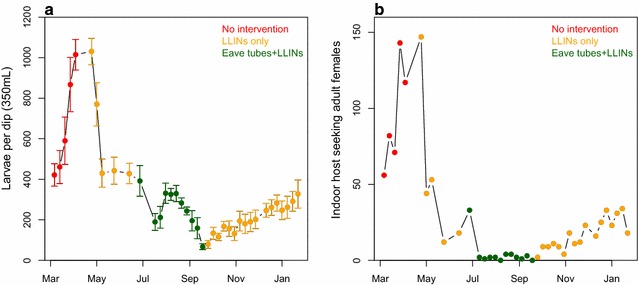
BACKGROUND: Presented here are a series of preliminary experiments evaluating "eave tubes"-a technology that combines house screening with a novel method of delivering insecticides for control of malaria mosquitoes. METHODS: Eave tubes were first evaluated with overnight release and recapture of mosquitoes in a screened compartment containing a hut and human sleeper. Recapture numbers were used as a proxy for overnight survival. These trials tested physical characteristics of the eave tubes (height, diameter, angle), and different active ingredients (bendiocarb, LLIN material, fungus). Eave tubes in a hut with closed eaves were also compared to an LLIN protecting a sleeper in a hut with open eaves. Eave tubes were then evaluated in a larger compartment containing a self-replicating mosquito population, vegetation, and multiple houses and cattle sheds. In this "model village", LLINs were introduced first, followed by eave tubes and associated house modifications. RESULTS: Initial testing suggested that tubes placed horizontally and at eave height had the biggest impact on mosquito recapture relative to respective controls. Comparison of active ingredients suggested roughly equivalent effects from bendiocarb, LLIN material, and fungal spores (although speed of kill was slower for fungus). The impact of treated netting on recapture rates ranged from 50 to 70 % reduction relative to controls. In subsequent experiments comparing bendiocarb-treated netting in eave tubes against a standard LLIN, the effect size was smaller but the eave tubes with closed eaves performed at least as well as the LLIN with open eaves. In the model village, introducing LLINs led to an approximate 60 % reduction in larval densities and 85 % reduction in indoor catches of host-seeking mosquitoes relative to pre-intervention values. Installing eave tubes and screening further reduced larval density (93 % relative to pre intervention values) and virtually eliminated indoor host-seeking mosquitoes. When the eave tubes and screening were removed, larval and adult catches recovered to pre-eave tube levels. CONCLUSIONS: These trials suggest that the "eave tube" package can impact overnight survival of host-seeking mosquitoes and can suppress mosquito populations, even in a complex environment. Further testing is now required to evaluate the robustness of these findings and demonstrate impact under field conditions.
Overview
The claims and statistics of this paper haven’t been checked yet.
Free: it reads the open-access text and checks the first 5 claims that cite a source we can check. Create a free account to check every claim.
Integrity signals
Registry
Cites
Statistics
Figures
Verification
Claims the paper makes
The claims and statistics of this paper haven’t been checked yet.
Free: it reads the open-access text and checks the first 5 claims that cite a source we can check. Create a free account to check every claim.
Claims other papers make about this one
Each is checked against this paper’s own text: does it say what the citing paper says it does?
The source backs part of the claim, not all of it — or backs it for a different population, condition or comparison.
In the citing paper
“When combined with screening of doors and windows, preliminary evidence suggests that eave tubes reduce entry of mosquitoes and increase overnight mortality rate, leading to reduced transmission risk at both household and community levels [4–7].”
From Semi-field studies to better understand the impact of eave tubes on mosquito mortality and behaviour (2018) · cites this paper as [6]
Experimental — accuracy not yet measuredThe source backs part of the claim, not all of it — or backs it for a different population, condition or comparison.
In the citing paper
“preliminary evidence suggests insecticide-treated tubes, combined with screening of doors and windows to make the house more ‘mosquito proof’, reduces entry of mosquitoes and increases overnight mortality rate, leading to reduced transmission risk at both household and community levels [14–17].”
From Semi-field evaluation of the cumulative effects of a "Lethal House Lure" on malaria mosquito mortality (2019) · cites this paper as [15]
Experimental — accuracy not yet measured
5 more claims about this paper
Create a free account to see every claim other papers make about this one.
Self-check
Percentages, sums and reported differences re-computed from the paper’s own numbers.
The self-check needs the paper’s full text.
Citations
Cites
The effect of malaria control on Plasmodium falciparum in Africa between 2000 and 2015
Bhatt, S., Weiss, D. J., Cameron, E., Bisanzio, D., Mappin, B., Dalrymple, U., Battle, K. E., Moyes, C. L., Henry, A., Eckhoff, P. A., et al. (2015) · Nature · doi:10.1038/nature15535 · Cited by 3,225
Insecticide-treated bed nets and curtains for preventing malaria
Lengeler, C. (2004) · Cochrane Database of Systematic Reviews · doi:10.1002/14651858.cd000363.pub2 · Cited by 1,700
The evidence for improving housing to reduce malaria: a systematic review and meta-analysis
Tusting, L. S., Ippolito, M. M., Willey, B. A., Kleinschmidt, I., Dorsey, G., Gosling, R. D., & Lindsay, S. W. (2015) · Malaria Journal · doi:10.1186/s12936-015-0724-1 · Cited by 355 · cited 1×
“Closing off the eaves of houses (together with additional screening of windows) provides a physical barrier that protects inhabitants from malaria [8–11].”
BackgroundTHE IMPORTANCE OF MOSQUITO BEHAVIOURAL ADAPTATIONS TO MALARIA CONTROL IN AFRICA
Gatton, M. L., Chitnis, N., Churcher, T., Donnelly, M. J., Ghani, A. C., Godfray, H. C. J., Gould, F., Hastings, I., Marshall, J., Ranson, H., et al. (2013) · Evolution · doi:10.1111/evo.12063 · Cited by 336
Kirby, M. J., Ameh, D., Bottomley, C., Green, C., Jawara, M., Milligan, P. J., Snell, P. C., Conway, D. J., & Lindsay, S. W. (2009) · The Lancet · doi:10.1016/s0140-6736(09)60871-0 · Cited by 293
Russell, T. L., Beebe, N. W., Cooper, R. D., Lobo, N. F., & Burkot, T. R. (2013) · Malaria Journal · doi:10.1186/1475-2875-12-56 · Cited by 198
Govella, N. J., & Ferguson, H. (2012) · Frontiers in Physiology · doi:10.3389/fphys.2012.00199 · Cited by 172
Killeen, G. F., Govella, N. J., Lwetoijera, D. W., & Okumu, F. O. (2016) · Malaria Journal · doi:10.1186/s12936-016-1280-z · Cited by 166
Ferguson, H. M., Ng’habi, K. R., Walder, T., Kadungula, D., Moore, S., Lyimo, I. N., Russell, T. L., Urassa, H., Mshinda, H., Killeen, G. F., et al. (2008) · Malaria Journal · doi:10.1186/1475-2875-7-158 · Cited by 147
Self-citationMind the Gap: House Structure and the Risk of Malaria in Uganda
Wanzirah, H., Tusting, L. S., Arinaitwe, E., Katureebe, A., Maxwell, K., Rek, J., Bottomley, C., Staedke, S. G., Kamya, M., Dorsey, G., et al. (2015) · PLOS ONE · doi:10.1371/journal.pone.0117396 · Cited by 140
Importance of Eaves to House Entry by Anopheline, But Not Culicine, Mosquitoes
Njie, M., Dilger, E., Lindsay, S. W., & Kirby, M. J. (2009) · Journal of Medical Entomology · doi:10.1603/033.046.0314 · Cited by 139 · cited 2×
“Discussion The concept of eave tubes emerged out of an existing body of knowledge implicating the open eaves of African houses as a primary entry point for malaria mosquitoes [3, 7–9].”
BackgroundThe trouble with eaves; house entry by vectors of malaria
Lindsay, S. W., & Snow, R. W. (1988) · Transactions of the Royal Society of Tropical Medicine and Hygiene · doi:10.1016/0035-9203(88)90546-9 · Cited by 119
Lwetoijera, D. W., Kiware, S. S., Mageni, Z. D., Dongus, S., Harris, C., Devine, G. J., & Majambere, S. (2013) · Parasites & Vectors · doi:10.1186/1756-3305-6-57 · Cited by 110
Andriessen, R., Snetselaar, J., Suer, R. A., Osinga, A. J., Deschietere, J., Lyimo, I. N., Mnyone, L. L., Brooke, B. D., Ranson, H., Knols, B. G. J., et al. (2015) · Proceedings of the National Academy of Sciences · doi:10.1073/pnas.1510801112 · Cited by 86 · cited 2×
“0) and compared to eave tubes with bendiocarb-treated electrostatically-charged netting (a recently developed technology for improving insecticide bioavailability [16]), together with an untreated control.”
BackgroundSelf-citationBradley, J., Rehman, A. M., Schwabe, C., Vargas, D., Monti, F., Ela, C., Riloha, M., & Kleinschmidt, I. (2013) · PLoS ONE · doi:10.1371/journal.pone.0080626 · Cited by 81
Eave tubes for malaria control in Africa: an introduction
Knols, B. G. J., Farenhorst, M., Andriessen, R., Snetselaar, J., Suer, R. A., Osinga, A. J., Knols, J. M. H., Deschietere, J., Ng’habi, K. R., Lyimo, I. N., et al. (2016) · Malaria Journal · doi:10.1186/s12936-016-1452-x · Cited by 81 · cited 2×
“The eave tube technology (which is introduced in [3]) exploits the natural behavioural ecology of the mosquitoes that transmit malaria in sub-Saharan Africa.”
BackgroundSelf-citationNg’habi, K. R., Mwasheshi, D. D., Knols, B. G., & Ferguson, H. M. (2010) · Malaria Journal · doi:10.1186/1475-2875-9-356 · Cited by 38
Self-citationSternberg, E. D., Waite, J. L., & Thomas, M. B. (2014) · Malaria Journal · doi:10.1186/1475-2875-13-499 · Cited by 34 · cited 1×
“Prior to the overnight trials, insecticidal activity was confirmed using the MCD bottle bioassay (bioassay method is described in [17]).”
MethodSelf-citationThe impact of host species and vector control measures on the fitness of African malaria vectors
Lyimo, I. N., Haydon, D. T., Russell, T. L., Mbina, K. F., Daraja, A. A., Mbehela, E. M., Reeve, R. E., & Ferguson, H. M. (2013) · Proceedings of the Royal Society B Biological Sciences · doi:10.1098/rspb.2012.2823 · Cited by 33
Self-citationNg’habi, K. R., Lee, Y., Knols, B. G., Mwasheshi, D. D., Lanzaro, G. C., & Ferguson, H. M. (2015) · Malaria Journal · doi:10.1186/s12936-014-0523-0 · Cited by 30
Self-citationLyimo, I. N., Ng’habi, K. R., Mpingwa, M. W., Daraja, A. A., Mwasheshe, D. D., Nchimbi, N., Lwetoijera, D. W., & Mnyone, L. L. (2012) · Journal of Parasitology Research · doi:10.1155/2012/280583 · Cited by 10
Self-citation
Research works printed but not linked: 2
- WHO Guidelines for laboratory and field testing of long-lasting insecticidal nets 2013 Geneva World Health Organization
- WHO Mosquito adulticides for indoor residual spraying and treatment of mosquito nets 2006 Geneva World Health Organization
Cited by
Current vector control challenges in the fight against malaria
Benelli, G., & Beier, J. C. (2017) · Acta Tropica · doi:10.1016/j.actatropica.2017.06.028 · Cited by 313
Onen, H., Luzala, M. M., Kigozi, S., Sikumbili, R. M., Muanga, C.-J. K., Zola, E. N., Wendji, S. N., Buya, A. B., Balčiūnaitienė, A., Viškelis, J., et al. (2023) · Insects · doi:10.3390/insects14030221 · Cited by 213
Developing an expanded vector control toolbox for malaria elimination
Killeen, G. F., Tatarsky, A., Diabate, A., Chaccour, C. J., Marshall, J. M., Okumu, F. O., Brunner, S., Newby, G., Williams, Y. A., Malone, D., et al. (2017) · BMJ Global Health · doi:10.1136/bmjgh-2016-000211 · Cited by 149
Biological control of human disease vectors: a perspective on challenges and opportunities
Thomas, M. B. (2017) · BioControl · doi:10.1007/s10526-017-9815-y · Cited by 133
Self-citationImplicating Cryptic and Novel Anophelines as Malaria Vectors in Africa
Stevenson, J. C., & Norris, D. E. (2016) · Insects · doi:10.3390/insects8010001 · Cited by 126
Metadata
- Authors
- Sternberg, E. D., Ng’habi, K. R., Lyimo, I. N., Kessy, S. T., Farenhorst, M., Thomas, M. B., Knols, B. G. J., & Mnyone, L. L.
- Affiliations
- Pennsylvania State University (US)
- Ifakara Health Institute (TZ)
- Corresponding author
- Sternberg, Eleanore D.
- ORCID
- Venue
- Malaria Journal
- Published
- 2016-09-01
- Volume
- 15
- Issue
- 1
- Pages
- 447-447
- ISSN
- 1475-2875 (ISSN-L)
- PMC
- PMC5009540
- OpenAlex
- W2513616427
- Cited by
- 63
- References
- 21
- Citations by year
- 2026: 1 · 2025: 1 · 2024: 7 · 2023: 10 · 2022: 3 · 2021: 6 · 2020: 4 · 2019: 6 · 2018: 13 · 2017: 10 · 2016: 2
- FWCI
- 8.82
- Type
- journal article
- Language
- en
- Open access
- gold
- doi.org
- Licence
- cc-by
- Locations
- Malaria Journal (publishedVersion, cc-by)
- PubMed Central (publishedVersion, cc-by)
- PubMed (publishedVersion)
- White Rose Research Online (University of Leeds, The University of Sheffield, University of York) (acceptedVersion)
- Funders
- Seventh Framework Programme (306105)
- Topics
- Health Sciences › Medicine › Public Health, Environmental and Occupational Health › Malaria Research and Control
- Life Sciences › Agricultural and Biological Sciences › Plant Science › Insect Pest Control Strategies
- Health Sciences › Medicine › Public Health, Environmental and Occupational Health › Mosquito-borne diseases and control
- Keywords
- malaria vector control, insecticide-treated nets, bendiocarb, long-lasting insecticidal nets, fungal spores, mosquito larval density, mosquito survival, house screening, model villages
- MeSH terms
- Animals, Female, Humans, Malaria, Mosquito Control, Tanzania, Disease Transmission, Infectious, Healthy Volunteers
About these checks
Registry, retraction, Cites and statistics results are computed, not judged, with one exception: a printed reference that no index lists is read once by a model before it counts as a citation error. Claims are extracted by a model and kept only when their quote appears verbatim in the text; each cited source is then checked, with a model’s help, for whether it says what the claim relies on. Those verdicts can be wrong — read the claim’s quote and the cited source before relying on one.
Statistics and arithmetic are recomputed, not judged.
Confidence bands are shown only for fields calibrated on our annotated test set. None is calibrated yet, so no band is shown.
What counts as a claim ›How we measure confidence ›How we check this ›
Are you an author, or do you see a problem with this page? Request a review
Data sources
Bibliographic data: Semantic Scholar, OpenAlex, Crossref.
Contains information from the Semantic Scholar Academic Graph Datasets, made available under the ODC Attribution License (ODC-BY 1.0).
Semantic Scholar’s data is described in: Kinney, R., et al. (2023). The Semantic Scholar Open Data Platform. arXiv:2301.10140.
