

An evaluation of health systems equity in Indonesia: study protocol
Open accessThe DOI matches its Crossref record; 63 of the 65 references it cites were found in a registry or an index.
Abstract
BACKGROUND: Many low and middle income countries are implementing reforms to support Universal Health Coverage (UHC). Perhaps one of the most ambitious examples of this is Indonesia's national health scheme known as the JKN which is designed to make health care available to its entire population of 255 million by end of 2019. If successful, the JKN will be the biggest single payer system in the world. While Indonesia has made steady progress, around a third of its population remains without cover and out of pocket payments for health are widespread even among JKN members. To help close these gaps, especially among the poor, the Indonesian government is currently implementing a set of UHC policy reforms that include the integration of remaining government insurance schemes into the JKN, expansion of provider networks, restructuring of provider payments systems, accreditation of all contracted health facilities and a range of demand side initiatives to increase insurance uptake, especially in the informal sector. This study evaluates the equity impact of this latest set of UHC reforms. METHODS: Using a before and after design, we will evaluate the combined effects of the national UHC reforms at baseline (early 2018) and target of JKN full implementation (end 2019) on: progressivity of the health care financing system; pro-poorness of the health care delivery system; levels of catastrophic and impoverishing health expenditure; and self-reported health outcomes. In-depth interviews with stakeholders to document the context and the process of implementing these reforms, will also be undertaken. DISCUSSION: As countries like Indonesia focus on increasing coverage, it is critically important to ensure that the poor and vulnerable - who are often the most difficult to reach - are not excluded. The results of this study will not only help track Indonesia's progress to universalism but also reveal what the UHC-reforms mean to the poor.
Overview
The claims and statistics of this paper haven’t been checked yet.
Free: it reads the open-access text and checks the first 5 claims that cite a source we can check. Create a free account to check every claim.
Integrity signals
Registry
Cites
Statistics
Figures
Verification
Claims the paper makes
The claims and statistics of this paper haven’t been checked yet.
Free: it reads the open-access text and checks the first 5 claims that cite a source we can check. Create a free account to check every claim.
Claims other papers make about this one
Each is checked against this paper’s own text: does it say what the citing paper says it does?
The source backs part of the claim, not all of it — or backs it for a different population, condition or comparison.
In the citing paper
“Many scholars highlighted difficulties to properly evaluate health inequalities reduction and much more the reduction of the social gradient (20,15,27,75,59).”
From Theoretical and practical challenges of proportionate universalism: a review (2020) · cites this paper as [75]
Experimental — accuracy not yet measured
Self-check
Percentages, sums and reported differences re-computed from the paper’s own numbers.
The self-check needs the paper’s full text.
Citations
Cites
Document Analysis as a Qualitative Research Method
Bowen, G. A. (2009) · Qualitative Research Journal · doi:10.3316/qrj0902027 · Cited by 13,013
Self-rated health and mortality: a review of twenty-seven community studies.
Idler, E. L., & Benyamini, Y. (1997) · Journal of Health and Social Behavior · doi:10.2307/2955359 · Cited by 8,598
Donabedian, A. (1988) · JAMA · doi:10.1001/jama.260.12.1743 · Cited by 5,895
Filmer, D., & Pritchett, L. H. (2001) · Demography · doi:10.1353/dem.2001.0003 · Cited by 5,238
Filmer, D., & Pritchett, L. H. (2001) · Demography · doi:10.2307/3088292 · Cited by 2,972
(2017) · The SHAFR Guide Online · doi:10.1163/2468-1733_shafr_sim010030025 · Cited by 2,300
Stowman, K. (1949) · The Milbank Memorial Fund Quarterly · doi:10.2307/3348165 · Cited by 2,096
Every Newborn: progress, priorities, and potential beyond survival
Lawn, J. E., Blencowe, H., Oza, S., You, D., Lee, A. C., Waiswa, P., Lalli, M., Bhutta, Z., Barros, A. J., Christian, P., et al. (2014) · The Lancet · doi:10.1016/s0140-6736(14)60496-7 · Cited by 1,929
(2016) · Human Rights Documents online · doi:10.1163/2210-7975_hrd-9841-2014001 · Cited by 1,546
Analyzing Health Equity Using Household Survey Data: A Guide to Techniques and their Implementation
O'Donnell, O., van Doorslaer, E., Wagstaff, A., & Lindelow, M. (2007) · doi:10.1596/978-0-8213-6933-3 · Cited by 1,156 · cited 7×
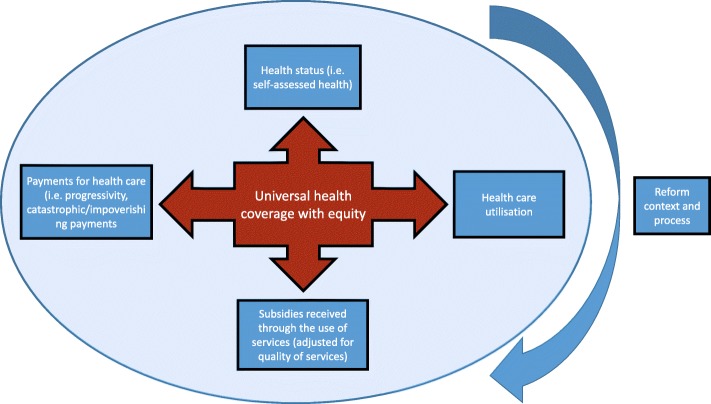
“Health equity research is typically concerned with four broad sets of outcomes: health care utilisation; subsidies received through the use of services; payments people make for health care (through for example, out-of-pocket payments, insurance premiums and direct and indirect taxes) [35, 36] and health status.”
BackgroundMethodInfluentialMeasurement of Tax Progressivity: An International Comparison
Kakwani, N. C. (1977) · The Economic Journal · doi:10.2307/2231833 · Cited by 1,093
Protecting Households From Catastrophic Health Spending
Xu, K., Evans, D. B., Carrin, G., Aguilar-Rivera, A. M., Musgrove, P., & Evans, T. (2007) · Health Affairs · doi:10.1377/hlthaff.26.4.972 · Cited by 1,071
Progress on catastrophic health spending in 133 countries: a retrospective observational study
Wagstaff, A., Flores, G., Hsu, J., Smitz, M.-F., Chepynoga, K., Buisman, L. R., van Wilgenburg, K., & Eozenou, P. (2018) · The Lancet Global Health · doi:10.1016/s2214-109x(17)30429-1 · Cited by 1,019 · cited 1×
“Assuming that 12% of households [40] will exceed the threshold of 25% of total consumption expenditure on health (a commonly used indicator of payments for health that may have a catastrophic effect on household wellbeing [41]), we will be able to detect differences of 5% in characteristics between households that exc…”
BackgroundGuidelines for Constructing Consumption Aggregates for Welfare Analysis
Deaton, A., & Zaidi, S. (2002) · doi:10.1596/0-8213-4990-2 · Cited by 873
World Development Indicators 2015
Bank, W. (2015) · World Bank, Washington, DC eBooks · doi:10.1596/978-1-4648-0440-3 · Cited by 715
Self-Reported vs. Objective Measures of Health in Retirement Models
Bound, J. (1989) · National Bureau of Economic Research · doi:10.3386/w2997 · Cited by 653
Self-Reported Versus Objective Measures of Health in Retirement Models
Bound, J. (1991) · The Journal of Human Resources · doi:10.2307/145718 · Cited by 636
Medicare: A Strategy for Quality Assurance
Lohr, K. N. (1991) · Journal For Healthcare Quality · doi:10.1111/j.1945-1474.1991.tb00115.x · Cited by 629
Howe, L. D., Galobardes, B., Matijasevich, A., Gordon, D., Johnston, D., Onwujekwe, O., Patel, R., Webb, E. A., Lawlor, D. A., & Hargreaves, J. R. (2012) · International Journal of Epidemiology · doi:10.1093/ije/dys037 · Cited by 611 · cited 1×
“Consumption expenditure is generally considered a better measure of ability to pay than income in LMICs with a large informal sector, as consumption expenditure is smoothed over time and so better reflects long-term average well-being [50, 51].”
BackgroundKutzin, J. (2013) · Bulletin of the World Health Organization · doi:10.2471/blt.12.113985 · Cited by 573
Jacobs, B., Ir, P., Bigdeli, M., Annear, P. L., & Van Damme, W. (2012) · Health Policy and Planning · doi:10.1093/heapol/czr038 · Cited by 548
The reliability of self-assessed health status
Crossley, T. F., & Kennedy, S. (2002) · Journal of Health Economics · doi:10.1016/s0167-6296(02)00007-3 · Cited by 439
Progress on impoverishing health spending in 122 countries: a retrospective observational study
Wagstaff, A., Flores, G., Smitz, M.-F., Hsu, J., Chepynoga, K., & Eozenou, P. (2018) · The Lancet Global Health · doi:10.1016/s2214-109x(17)30486-2 · Cited by 421 · cited 1×
“catastrophic health spending and medical impoverishment [6, 7].”
Gwatkin, D. R., Rutstein, S., Johnson, K., Suliman, E. A., Wagstaff, A. R., & Amouzou, A. (2007) · PubMed · Cited by 408
Indonesia Demographic and Health Survey 2002-2003
Macro, O. (2003) · Cited by 377
Victora, C. G. (2007) · JAMA · doi:10.1001/jama.298.16.1943 · Cited by 361
Self-rated health and survival: a 7-year follow-up study of Australian elderly.
McCallum, J., Shadbolt, B., & Wang, D. (1994) · American Journal of Public Health · doi:10.2105/ajph.84.7.1100 · Cited by 322
Mills, A., Ataguba, J. E., Akazili, J., Borghi, J., Garshong, B., Makawia, S., Mtei, G., Harris, B., Macha, J., Meheus, F., et al. (2012) · The Lancet · doi:10.1016/s0140-6736(12)60357-2 · Cited by 312
Self-citationIndonesia demographic and health survey
Indonesien, Statistik, B. P., & Statistik, B. P. (1989) · Cited by 281
van Doorslaer, E., & Gerdtham, U.-G. (2003) · Social Science & Medicine · doi:10.1016/s0277-9536(02)00559-2 · Cited by 267
Indonesia's road to universal health coverage: a political journey
Pisani, E., Kok, M. O., & Nugroho, K. P. (2016) · Health Policy and Planning · doi:10.1093/heapol/czw120 · Cited by 243 · cited 1×
“A key response by the Government has been the development of a compulsory national health insurance scheme designed to pave the way for the achievement of universal coverage [29].”
Dual practice in the health sector: review of the evidence
Ferrinho, P., Van Lerberghe, W., Fronteira, I., Hipólito, F., & Biscaia, A. (2004) · Human Resources for Health · doi:10.1186/1478-4491-2-14 · Cited by 227
The Incidence of Public Spending on Healthcare: Comparative Evidence from Asia
O'Donnell, O., van Doorslaer, E., Rannan-Eliya, R. P., Somanathan, A., Adhikari, S. R., Harbianto, D., Garg, C. C., Hanvoravongchai, P., Huq, M. N., Karan, A., et al. (2007) · The World Bank Economic Review · doi:10.1093/wber/lhl009 · Cited by 208
Leslie, H. H., Sun, Z., & Kruk, M. E. (2017) · PLOS Medicine · doi:10.1371/journal.pmed.1002464 · Cited by 201
Asante, A., Price, J., Hayen, A., Jan, S., & Wiseman, V. (2016) · PLOS ONE · doi:10.1371/journal.pone.0152866 · Cited by 199
Self-citationMedicare: a strategy for quality assurance
(1990) · Choice Reviews Online · doi:10.5860/choice.28-1584 · Cited by 190
O’Neill, K., Takane, M., Sheffel, A., Abou-Zahr, C., & Boerma, T. (2013) · Bulletin of the World Health Organization · doi:10.2471/blt.12.116798 · Cited by 182
Ekman, B. (2007) · Health Policy · doi:10.1016/j.healthpol.2007.02.004 · Cited by 178
Hu, Y., van Lenthe, F. J., Borsboom, G. J., Looman, C. W. N., Bopp, M., Burström, B., Dzúrová, D., Ekholm, O., Klumbiene, J., Lahelma, E., et al. (2016) · Journal of Epidemiology and Community Health · doi:10.1136/jech-2015-206780 · Cited by 160
Indonesia: On the Way to Universal Health Care
Mboi, N. (2015) · Health Systems & Reform · doi:10.1080/23288604.2015.1020642 · Cited by 154
Women as Family Caregivers: Why Do They Care?
Guberman, N., Maheu, P., & Maille, C. (1992) · The Gerontologist · doi:10.1093/geront/32.5.607 · Cited by 146 · cited 1×
“The gender dimension of benefit from health spending is particularly important given the role of women as primary caregivers in times of illness or disability [44].”
BackgroundPoor Quality for Poor Women? Inequities in the Quality of Antenatal and Delivery Care in Kenya
Sharma, J., Leslie, H. H., Kundu, F., & Kruk, M. E. (2017) · PLOS ONE · doi:10.1371/journal.pone.0171236 · Cited by 140
How to do (or not to do) … a benefit incidence analysis
McIntyre, D., & Ataguba, J. E.-O. (2010) · Health Policy and Planning · doi:10.1093/heapol/czq031 · Cited by 132
Health system performance at the district level in Indonesia after decentralization
Heywood, P., & Choi, Y. (2010) · BMC International Health and Human Rights · doi:10.1186/1472-698x-10-3 · Cited by 131 · cited 1×
“of health financing and more than half of all health services in private hands [74].”
BackgroundGilson, L., Erasmus, E., Borghi, J., Macha, J., Kamuzora, P., & Mtei, G. (2012) · Health Policy and Planning · doi:10.1093/heapol/czs007 · Cited by 118 · cited 8×
“Specifically, we will develop a chronology of key events in the reform process and assess stakeholder support and political feasibility of the UHC-reforms [71, 72].”
BackgroundMethodInfluentialSelf-citationMtei, G., Makawia, S., Ally, M., Kuwawenaruwa, A., Meheus, F., & Borghi, J. (2012) · Health Policy and Planning · doi:10.1093/heapol/czs018 · Cited by 112
Impoverishing effects of catastrophic health expenditures in Malawi
Mchenga, M., Chirwa, G. C., & Chiwaula, L. S. (2017) · International Journal for Equity in Health · doi:10.1186/s12939-017-0515-0 · Cited by 110 · cited 3×
“In line with other equity analyses [17, 53], households in this study will be considered to have incurred catastrophic health expenditure if the share of health expenditure in the household’s non-food expenditure is greater than a given threshold often around 25% [4] or within a range of 10 and 40% [54– 56].”
BackgroundMethodInfluentialRodney, A. M., & Hill, P. S. (2014) · International Journal for Equity in Health · doi:10.1186/s12939-014-0072-8 · Cited by 109
Meessen, B., Bigdeli, M., Chheng, K., Decoster, K., Ir, P., Men, C., & Van Damme, W. (2011) · Health Policy and Planning · doi:10.1093/heapol/czr026 · Cited by 95
Kim, T. J., Vonneilich, N., Lüdecke, D., & Knesebeck, O. V. D. (2017) · Social Science & Medicine · doi:10.1016/j.socscimed.2017.01.044 · Cited by 94
Reassessing catastrophic health-care payments with a Nigerian case study
Ataguba, J. E.-O. (2011) · Health Economics Policy and Law · doi:10.1017/s1744133110000356 · Cited by 88
Catastrophic Health Expenditure among Developing Countries
Ezat Wan Puteh, S., & Almualm, Y. (2017) · Health Systems and Policy Research · doi:10.21767/2254-9137.100069 · Cited by 64
Reflections on and alternatives to WHO's fairness of financial contribution index
Wagstaff, A. R. (2002) · Health Economics · doi:10.1002/hec.685 · Cited by 59
Benefit‐incidence analysis: are government health expenditures more pro‐rich than we think?
Wagstaff, A. R. (2011) · Health Economics · doi:10.1002/hec.1727 · Cited by 59
Gergen, J., Josephson, E., Coe, M., Ski, S., Madhavan, S., & Bauhoff, S. (2017) · Global Health Science and Practice · doi:10.9745/ghsp-d-16-00239 · Cited by 52 · cited 1×
“A recent review of 8500 quality indicators used to assess performance-based financing programmes showed that over 90% measured structural aspects of quality [70].”
BackgroundThe double burden of malnutrition in Indonesia
Shrimpton, R., & Rokx, C. (2013) · Cited by 45
How to do (or not to do) … a health financing incidence analysis
Ataguba, J. E.-O., Asante, A. D., Limwattananon, S., & Wiseman, V. L. (2018) · Health Policy and Planning · doi:10.1093/heapol/czx188 · Cited by 35
Self-citationUniversal health coverage: progressive taxes are key
Yates, R. (2015) · The Lancet · doi:10.1016/s0140-6736(15)60868-6 · Cited by 27
Ensor, T., Hafidz, F., Dunlop, D. D., Manu, A. A., Mukti, A. G., Puspandari, D. A., von Roenne, F., Indradjaya, S., Suseno, U., & Vaughan, P. J. (2012) · Cost Effectiveness and Resource Allocation · doi:10.1186/1478-7547-10-11 · Cited by 27
Assessment of equity in healthcare financing in Fiji and Timor-Leste: a study protocol
Asante, A. D., Price, J. A. D., Hayen, A. D., Irava, W. J., Martins, J. S., Guinness, L., Ataguba, J. E.-O., Limwattananon, S., MILLS, A. J., Jan, S., et al. (2014) · BMJ Open · doi:10.1136/bmjopen-2014-006806 · Cited by 20 · cited 2×
“Such direct payments affect the poor more than the rich and tax financed health-care may protect the most vulnerable against the risk of financial catastrophe in times of illness [14, 15].”
BackgroundSelf-citationAji, B., Mohammed, S., Haque, M. A., & Allegri, M. D. (2017) · Asia Pacific Journal of Public Health · doi:10.1177/1010539517729778 · Cited by 18
Ten best resources for conducting financing and benefit incidence analysis in resource-poor settings
Wiseman, V. L., Asante, A. D., Price, J. A. D., Hayen, A. D., Irava, W. J., Martins, J. S., Guinness, L., & Jan, S. (2014) · Health Policy and Planning · doi:10.1093/heapol/czu108 · Cited by 11
Self-citationIndonesia Health Financing System Assessment
Pinto, R., Masaki, E., & Harimurti, P. (2016) · World Bank, Washington, DC eBooks · doi:10.1596/26311 · Cited by 7
Research works printed but not linked: 13
- 1. WHO, World Health Report 2000. Health Systems: Improving Performance. Geneva: World Health Organization; 2000.
- 18. WHO. The World Health Report 2010 -financing for universal coverage. Geneva: World Health Organization; 2010.
- Ministry of Health - Indonesia. National report on basic health research, RISKESDAS, 2013. Jakarta: Ministry of Health and National Institute of Health Research and Development; 2014.
- 29. Ministry of Health-Indonesia. Health financing and universal health coverage: policy Briefs. Indonesia: Australia Indonesia Partnership for Health Systems Strengthening; 2015.
- 30. WHO Indonesia. Universal health coverage and health care financing Indonesia. Indonesia: WHO Indonesia; 2016.
- 32. GIZ. Out-of-Pocket Payments in the National Health Insurance of Indonesia: A First Year Review. Jakarta: Ministry for National Development Planning and GIZ; 2015.
- 33. National Team for the Acceleration of Poverty Reduction. The Road to National Health Insurance (JKN). Jakarta, Indonesia: Office of the President; 2015.
- 34. Wagstaff A, van Doorslaer E. Equity in Health Care Finance and Delivery. In: Culyer A, Newhouse J, editors. North Holland Handbook in Health Economics. Amsterdam, Netherlands: North Holland; 2000. p. 1804-62.
- 38. Statistics Indonesia (Badan Pusat Statistik-BPS). Indonesia -Survei Sosial Ekonomi Nasional 2013 Kor Gabungan. Jakarta: Badan Pusat Statistik-BPS; 2014.
- 40. Wagstaff A et al. Progress on catastrophic health spending in 133 countries: a retrospective observational study. Lancet Glob Health 2018, 6(2), e169-e179. · DOI · Paper page
- 51. Deaton A, Zaidi S. Guidelines for constructing consumption aggregates. Washington, DC: The World Bank; 2002.
- 53. Xu K, Evans DB, Carrin G, Aguilar-Rivera AM, Musgrove P, Evans T. Protecting households from catastrophic health spending. Health Aff. 2007;26:972-83. · DOI · Paper page
- 67. The World Bank. New insights into the provision of health Services in Indonesia. Washington D.C: The World Bank; 2010.
Cited by
Theoretical and practical challenges of proportionate universalism: a review
Francis-Oliviero, F., Cambon, L., Wittwer, J., Marmot, M., & Alla, F. (2020) · Revista Panamericana de Salud Pública · doi:10.26633/rpsp.2020.110 · Cited by 136
Maulana, N., Soewondo, P., Adani, N., Limasalle, P., & Pattnaik, A. (2022) · PLOS Global Public Health · doi:10.1371/journal.pgph.0000203 · Cited by 140
Wenang, S., Schaefers, J., Afdal, A., Gufron, A., Geyer, S., Dewanto, I., & Haier, J. (2021) · Frontiers in Public Health · doi:10.3389/fpubh.2021.721886 · Cited by 122
“Perhaps one of the most ambitious examples for this is the national health scheme being implemented in Indonesia [Jaminan Kesehatan Nasional (JKN)], which made healthcare available to its 255 million population, subsequently becoming the largest single healthcare system worldwide (2).”
BackgroundAnindya, K., Lee, J. T., McPake, B., Wilopo, S. A., Millett, C. J., & Carvalho, N. (2020) · Journal of Global Health · doi:10.7189/jogh.10.010429 · Cited by 93
Febriyanti, R. M., Saefullah, K., Susanti, R. D., & Lestari, K. (2024) · BMC Complementary Medicine and Therapies · doi:10.1186/s12906-024-04368-7 · Cited by 85
“Enabling factors can be measured by family resources such as socio-economic status (SES), health insurance, family income, costs, free health care, and health insurance [21–23].”
Background
Metadata
- Authors
- Wiseman, V., Thabrany, H., Asante, A., Haemmerli, M., Kosen, S., Gilson, L., Mills, A., Hayen, A., Tangcharoensathien, V., & Patcharanarumol, W.
- Affiliations
- UNSW Sydney (AU)
- University of Indonesia (ID)
- University of Cape Town (ZA)
- London School of Hygiene & Tropical Medicine (GB)
- University of Technology Sydney (AU)
- Ministry of Public Health (TH)
- Corresponding author
- Wiseman, Virginia
- ORCID
- Venue
- International Journal for Equity in Health
- Published
- 2018-09-12
- Volume
- 17
- Issue
- 1
- Pages
- 138-138
- ISSN
- 1475-9276 (ISSN-L)
- PMC
- PMC6134712
- OpenAlex
- W2890595120
- Cited by
- 94
- References
- 65
- Citations by year
- 2026: 7 · 2025: 8 · 2024: 10 · 2023: 22 · 2022: 17 · 2021: 13 · 2020: 14 · 2019: 3
- FWCI
- 9.91
- Type
- journal article
- Language
- en
- Open access
- gold
- doi.org
- Licence
- cc-by
- creativecommons.org/licenses/by/4.0/ (tdm)
- Locations
- International Journal for Equity in Health (publishedVersion, cc-by)
- Europe PMC (PubMed Central) (publishedVersion, other-oa)
- PubMed Central (publishedVersion, cc-by)
- PubMed (publishedVersion)
- LSHTM Research Online (London School of Hygiene and Tropical Medicine) (acceptedVersion)
- UNSWorks (University of New South Wales, Sydney, Australia) (submittedVersion, cc-by-nc-nd)
- DOAJ (DOAJ: Directory of Open Access Journals) (submittedVersion)
- Open University of Cape Town (University of Cape Town) (submittedVersion)
- UTS ePRESS (University of Technology Sydney) (submittedVersion)
- Greater South Information System
- Funders
- Department of International Development, the Economic and Social Research Council, the Medical Research Council and the Wellcome Trust (MR/P013996/1)
- Topics
- Health Sciences › Medicine › Public Health, Environmental and Occupational Health › Healthcare Systems and Reforms
- Social Sciences › Economics, Econometrics and Finance › Economics and Econometrics › Healthcare Policy and Management
- Health Sciences › Medicine › Public Health, Environmental and Occupational Health › Healthcare Systems and Practices
- Keywords
- universal health coverage, impoverishing health expenditure, catastrophic health expenditure, out-of-pocket costs, health insurance uptake, informal economy, provider payment reform, health facility accreditation
- MeSH terms
- Health Equity, Health Expenditures, Health Policy, Humans, Indonesia, Universal Health Insurance, Healthcare Financing
About these checks
Registry, retraction, Cites and statistics results are computed, not judged, with one exception: a printed reference that no index lists is read once by a model before it counts as a citation error. Claims are extracted by a model and kept only when their quote appears verbatim in the text; each cited source is then checked, with a model’s help, for whether it says what the claim relies on. Those verdicts can be wrong — read the claim’s quote and the cited source before relying on one.
Statistics and arithmetic are recomputed, not judged.
Confidence bands are shown only for fields calibrated on our annotated test set. None is calibrated yet, so no band is shown.
What counts as a claim ›How we measure confidence ›How we check this ›
Are you an author, or do you see a problem with this page? Request a review
Data sources
Bibliographic data: Semantic Scholar, OpenAlex, Crossref.
Contains information from the Semantic Scholar Academic Graph Datasets, made available under the ODC Attribution License (ODC-BY 1.0).
Semantic Scholar’s data is described in: Kinney, R., et al. (2023). The Semantic Scholar Open Data Platform. arXiv:2301.10140.
