

Targeting tumour microenvironment by tyrosine kinase inhibitor
Open accessThe DOI matches its Crossref record; 167 of the 167 references it cites were found in a registry or an index.
Abstract
Tumour microenvironment (TME) is a key determinant of tumour growth and metastasis. TME could be very different for each type and location of tumour and TME may change constantly during tumour growth. Multiple counterparts in surrounding microenvironment including mesenchymal-, hematopoietic-originated cells as well as non-cellular components affect TME. Thus, therapeutics that can disrupt the tumour-favouring microenvironment should be further explored for cancer therapy. Previous efforts in unravelling the dysregulated mechanisms of TME components has identified numerous protein tyrosine kinases, while its corresponding inhibitors have demonstrated potent modulatory effect on TME. Recent works have demonstrated that beyond the direct action on cancer cells, tyrosine kinase inhibitors (TKIs) have been implicated in inactivation or normalization of dysregulated TME components leading to cancer regression. Either through re-sensitizing the tumour cells or reversing the immunological tolerance microenvironment, the emergence of these TME modulatory mechanism of TKIs supports the combinatory use of TKIs with current chemotherapy or immunotherapy for cancer therapy. Therefore, an appropriate understanding on TME modulation by TKIs may offer another mode of action of TKIs for cancer treatment. This review highlights mode of kinase activation or paracrine ligand production from TME components and summarises the findings on the potential use of various TKIs on regulating TME components. At last, the combination use of current TKIs with immunotherapy in the perspectives of efficacy and safety are discussed.
Overview
The claims and statistics of this paper haven’t been checked yet.
Free: it reads the open-access text and checks the first 5 claims that cite a source we can check. Create a free account to check every claim.
Integrity signals
Registry
Cites
Statistics
Figures
Verification
Claims the paper makes
The claims and statistics of this paper haven’t been checked yet.
Free: it reads the open-access text and checks the first 5 claims that cite a source we can check. Create a free account to check every claim.
Claims other papers make about this one
Each is checked against this paper’s own text: does it say what the citing paper says it does?
The source backs part of the claim, not all of it — or backs it for a different population, condition or comparison.
In the citing paper
“Furthermore, while many cancers are driven by aberrant kinase activity, it is thought that targeting the PPIs that regulate the activity of a specific kinase is a more viable approach to develop selective kinase inhibitors than targeting the conserved ATP binding site of kinases directly [4, 102, 103].”
From The design and development of covalent protein-protein interaction inhibitors for cancer treatment (2020) · cites this paper as [102]
Experimental — accuracy not yet measured
Self-check
Percentages, sums and reported differences re-computed from the paper’s own numbers.
The self-check needs the paper’s full text.
Citations
Cites
The protein kinase complement of the human genome
Manning, G., Whyte, D. B., Martinez, R., Hunter, T., & Sudarsanam, S. (2002) · Science · doi:10.1126/science.1075762 · Cited by 8,145 · cited 1×
“To our knowledge, there are in total 518 kinases in human genome [2], while 90 of them are classified in the category of tyrosine kinases (58 of them are receptor tyrosine kinase RTK; the remaining are non-receptor tyrosine kinase) [3].”
BackgroundKalluri, R., & Zeisberg, M. (2006) · Nature Reviews Cancer · doi:10.1038/nrc1877 · Cited by 4,538
Stromal fibroblasts in cancer initiation and progression
Bhowmick, N. A., Neilson, E. G., & Moses, H. L. (2004) · Nature · doi:10.1038/nature03096 · Cited by 2,302 · cited 1×
“Cancer associated stromal cell, comprised of approximately 40% of total tumour volume [36], plays a pivotal role in carcinogenesis, in which its role involves promoting cancer cell initiation [37], extracellular matrix remodelling [38], and even preserving stem/progenitor cells [39].”
BackgroundEpidermal growth factor receptor (EGFR) signaling in cancer
Normanno, N., De Luca, A., Bianco, C., Strizzi, L., Mancino, M., Maiello, M. R., Carotenuto, A., De Feo, G., Caponigro, F., & Salomon, D. S. (2006) · Gene · doi:10.1016/j.gene.2005.10.018 · Cited by 2,038 · cited 1×
“For instances, overexpression of epidermal growth factor receptor (EGFR) and platelet derived growth factor receptor α/β (PDGFR) have been well implicated in supporting various malignancy growth and progression [6, 7].”
BackgroundTumour micro-environment elicits innate resistance to RAF inhibitors through HGF secretion
Straussman, R., Morikawa, T., Shee, K., Barzily-Rokni, M., Qian, Z. R., Du, J., Davis, A., Mongare, M. M., Gould, J., Frederick, D. T., et al. (2012) · Nature · doi:10.1038/nature11183 · Cited by 1,771 · cited 1×
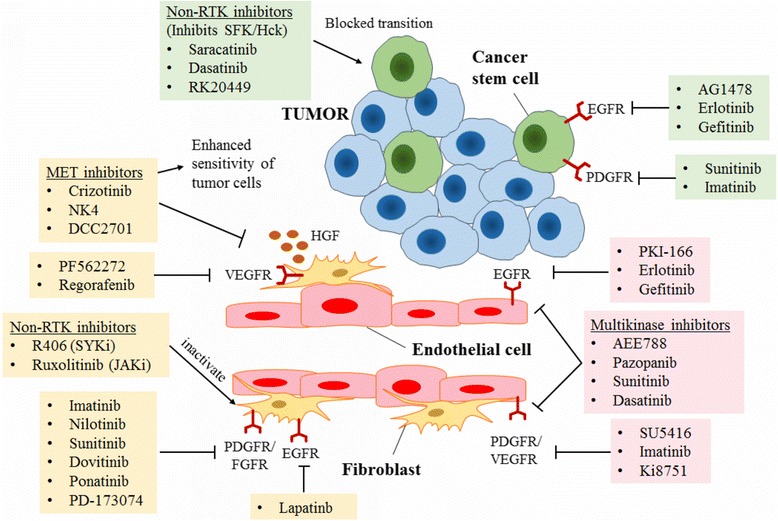
“While co-treatment with another c-MET TKIs, crizotinib [58, 59] or NK4 [60] reversed the drug resistance.”
BackgroundShibuya, M. (2011) · Genes & Cancer · doi:10.1177/1947601911423031 · Cited by 1,748
DeNardo, D. G., Brennan, D. J., Rexhepaj, E., Ruffell, B., Shiao, S. L., Madden, S. F., Gallagher, W. M., Wadhwani, N., Keil, S. D., Junaid, S. A., et al. (2011) · Cancer Discovery · doi:10.1158/2159-8274.cd-10-0028 · Cited by 1,715 · cited 1×
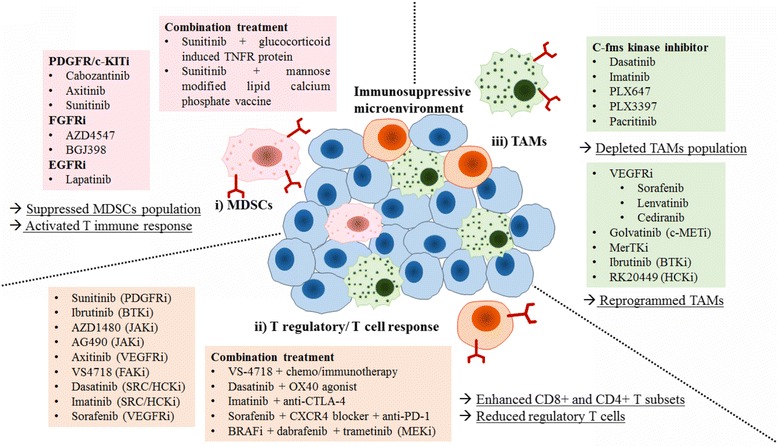
“The same also observed on its counterpart compound PLX3397, in which it enhanced the sensitivity of cancer cells towards chemotherapeutic treatment through declining TAMs infiltration to tumor microenvironment [120].”
BackgroundDe Palma, M., Venneri, M. A., Galli, R., Sergi, L. S., Politi, L. S., Sampaolesi, M., & Naldini, L. (2005) · Cancer Cell · doi:10.1016/j.ccr.2005.08.002 · Cited by 1,311 · cited 1×
“Tie2 receptor has been shown to highly express on monocytes/macrophages and its paracrine secretion supports tumour neovascularization [123].”
BackgroundLong-Term Outcomes of Imatinib Treatment for Chronic Myeloid Leukemia
Hochhaus, A., Larson, R. A., Guilhot, F., Radich, J. P., Branford, S., Hughes, T. P., Baccarani, M., Deininger, M. W., Cervantes, F., Fujihara, S., et al. (2017) · New England Journal of Medicine · doi:10.1056/nejmoa1609324 · Cited by 1,285 · cited 1×
“gastrointestinal stromal patients [10, 11]; sorafenib which multi-targeted VEGFR, PDGFR and Raf, is uti-”
BackgroundGainor, J. F., Shaw, A. T., Sequist, L. V., Fu, X., Azzoli, C. G., Piotrowska, Z., Huynh, T. G., Zhao, L., Fulton, L., Schultz, K. R., et al. (2016) · Clinical Cancer Research · doi:10.1158/1078-0432.ccr-15-3101 · Cited by 1,250 · cited 1×
“treatment efficacy of TKIs to cancer patients [160].”
Background
Cited by
Deepak, K. G. K., Vempati, R., Nagaraju, G. P., Dasari, V. R., S., N., Rao, D. N., & Malla, R. R. (2020) · Pharmacological Research · doi:10.1016/j.phrs.2020.104683 · Cited by 614
Fibroblasts as immune regulators in infection, inflammation and cancer
Davidson, S., Coles, M., Thomas, T., Kollias, G., Ludewig, B., Turley, S., Brenner, M., & Buckley, C. D. (2021) · Nature Reviews Immunology · doi:10.1038/s41577-021-00540-z · Cited by 605
Tyrosine Kinase Inhibitors in Cancer: Breakthrough and Challenges of Targeted Therapy
Pottier, C., Fresnais, M., Gilon, M., Jérusalem, G., Longuespée, R., & Sounni, N. E. (2020) · Cancers · doi:10.3390/cancers12030731 · Cited by 515
Adaptive Mechanisms of Tumor Therapy Resistance Driven by Tumor Microenvironment
Wu, P., Gao, W., Su, M., Nice, E. C., Zhang, W., Lin, J., & Xie, N. (2021) · Frontiers in Cell and Developmental Biology · doi:10.3389/fcell.2021.641469 · Cited by 209
Lin, Y.-H., Chen, Y.-H., Chang, H.-Y., Au, H.-K., Tzeng, C.-R., & Huang, Y.-H. (2018) · International Journal of Molecular Sciences · doi:10.3390/ijms19082385 · Cited by 186
Metadata
- Authors
- Tan, H.-Y., Wang, N., Lam, W., Guo, W., Feng, Y., & Cheng, Y.-C.
- Affiliations
- University of Hong Kong (HK)
- Yale University (US)
- Corresponding author
- Feng, Yibin
- Cheng, Yung-Chi
- Venue
- Molecular Cancer
- Published
- 2018-02-19
- Volume
- 17
- Issue
- 1
- Pages
- 43-43
- ISSN
- 1476-4598 (ISSN-L)
- PMC
- PMC5817793
- OpenAlex
- W2794836336
- Cited by
- 107
- References
- 167
- Citations by year
- 2026: 4 · 2025: 8 · 2024: 16 · 2023: 14 · 2022: 8 · 2021: 26 · 2020: 19 · 2019: 9 · 2018: 3
- FWCI
- 1.49
- Type
- journal article
- Language
- en
- Open access
- gold
- doi.org
- Licence
- cc-by
- creativecommons.org/licenses/by/4.0/ (tdm)
- creativecommons.org/licenses/by/4.0/ (vor)
- Locations
- Molecular Cancer (publishedVersion, cc-by)
- PubMed Central (publishedVersion, cc-by)
- PubMed (publishedVersion)
- DOAJ (DOAJ: Directory of Open Access Journals) (submittedVersion, cc-by-sa)
- Funders
- research council of the University of Hong Kong (104003422, 104004092)
- the Research Grants Committee (RGC) of Hong Kong (106160190)
- Wong’s Donation on Modern Oncology of Chinese Medicine (200006276)
- Gala Family Trust (200007008)
- Government-Matching Grant Scheme (207060411)
- HKU Overseas Fellowship Awards (102009600)
- National Cancer Institute (PO1CA154295-01A1)
- Topics
- Health Sciences › Medicine › Oncology › Cancer Cells and Metastasis
- Life Sciences › Biochemistry, Genetics and Molecular Biology › Cancer Research › Cancer Mechanisms and Therapy
- Life Sciences › Biochemistry, Genetics and Molecular Biology › Molecular Biology › Angiogenesis and VEGF in Cancer
- Keywords
- tumor microenvironment, tyrosine kinase inhibitors, tyrosine kinase, tumor immunosuppression, combination immunotherapy, paracrine signaling, cancer therapy
- MeSH terms
- Animals, Humans, Immunotherapy, Neoplasms, Protein Kinase Inhibitors, Tumor Microenvironment
About these checks
Registry, retraction, Cites and statistics results are computed, not judged, with one exception: a printed reference that no index lists is read once by a model before it counts as a citation error. Claims are extracted by a model and kept only when their quote appears verbatim in the text; each cited source is then checked, with a model’s help, for whether it says what the claim relies on. Those verdicts can be wrong — read the claim’s quote and the cited source before relying on one.
Statistics and arithmetic are recomputed, not judged.
Confidence bands are shown only for fields calibrated on our annotated test set. None is calibrated yet, so no band is shown.
What counts as a claim ›How we measure confidence ›How we check this ›
Are you an author, or do you see a problem with this page? Request a review
Data sources
Bibliographic data: Semantic Scholar, OpenAlex, Crossref.
Contains information from the Semantic Scholar Academic Graph Datasets, made available under the ODC Attribution License (ODC-BY 1.0).
Semantic Scholar’s data is described in: Kinney, R., et al. (2023). The Semantic Scholar Open Data Platform. arXiv:2301.10140.
