

The DOI matches its Crossref record; 129 of the 133 references it cites were found in a registry or an index.
Antioxidant properties of Milk and dairy products: a comprehensive review of the current knowledge
Open accessAbstract
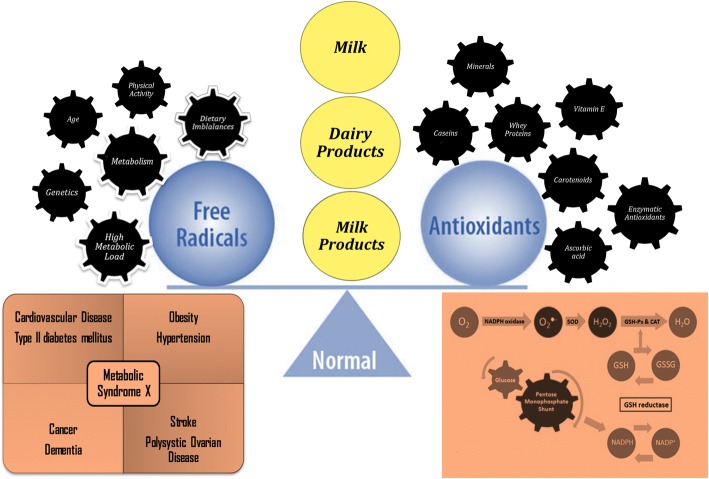
Milk and dairy products are integral part of human nutrition and they are considered as the carriers of higher biological value proteins, calcium, essential fatty acids, amino acids, fat, water soluble vitamins and several bioactive compounds that are highly significant for several biochemical and physiological functions. In recent years, foods containing natural antioxidants are becoming popular all over the world as antioxidants can neutralize and scavenge the free radicals and their harmful effects, which are continuously produced in the biological body. Uncontrolled free radicals activity can lead to oxidative stresses, which have been implicated in breakdown of vital biochemical compounds such as lipids, protein, DNA which may lead to diabetes, accelerated ageing, carcinogenesis and cardiovascular diseases. Antioxidant capacity of milk and milk products is mainly due to sulfur containing amino acids, such as cysteine, phosphate, vitamins A, E, carotenoids, zinc, selenium, enzyme systems, superoxide dismutase, catalase, glutathione peroxidase, milk oligosaccharides and peptides that are produced during fermentation and cheese ripening. Antioxidant activity of milk and dairy products can be enhanced by phytochemicals supplementation while fermented dairy products have been reported contained higher antioxidant capacity as compared to the non-fermented dairy products. Literature review has shown that milk and dairy products have antioxidant capacity, however, information regarding the antioxidant capacity of milk and dairy products has not been previously compiled. This review briefly describes the nutritional and antioxidant capacity of milk and dairy products.
Overview
The claims and statistics of this paper haven’t been checked yet.
Run the check — free, no account needed. It reads the open-access text and checks the sources it cites.
Integrity signals
Registry
Cites
Statistics
Figures
Verification
Claims the paper makes
The claims and statistics of this paper haven’t been checked yet.
Run the check — free, no account needed. It reads the open-access text and checks the sources it cites.
Claims other papers make about this one
Each is checked against this paper’s own text: does it say what the citing paper says it does?
The check wasn’t confident either way, so it gives no verdict — never disputed.
In the citing paper
“During ripening, lipolytic enzymes present in lactic acid bacteria (LAB) can hydrolyze a substrate to generate free fatty acid esters, triacylglycerides, diacylglycerides, and monoacylglycerides (Khan et al., 2019, Xiaochun et al., 2021).”
From Antioxidant and antihypertensive activity of Gouda cheese at different stages of ripening (2022) · cites this paper as Khan et al., 2019
Experimental — accuracy not yet measured
Self-check
Percentages, sums and reported differences re-computed from the paper’s own numbers.
The self-check needs the paper’s full text.
Citations
Cites
The Chemistry behind Antioxidant Capacity Assays
Huang, D., Ou, B., & Prior, R. L. (2005) · Journal of Agricultural and Food Chemistry · doi:10.1021/jf030723c · Cited by 6,162
Pathophysiology of acute wound healing
Li, J., Chen, J., & Kirsner, R. S. (2007) · Clinics in Dermatology · doi:10.1016/j.clindermatol.2006.09.007 · Cited by 4,042
Erel, Ö. (2004) · Clinical Biochemistry · doi:10.1016/j.clinbiochem.2003.11.015 · Cited by 2,940
Free radicals, antioxidants, and nutrition
Fang, Y.-Z., Yang, S., & Wu, G. (2002) · Nutrition · doi:10.1016/s0899-9007(02)00916-4 · Cited by 2,607
Bioactive compounds in foods: their role in the prevention of cardiovascular disease and cancer
Kris‐Etherton, P. M., Hecker, K. D., Bonanome, A., Coval, S. M., Binkoski, A. E., Hilpert, K. F., Griel, A. E., & Etherton, T. D. (2002) · The American Journal of Medicine · doi:10.1016/s0002-9343(01)00995-0 · Cited by 2,573
Antioxidant enzymes and human diseases
MatÉs, J. M., Pérez-Gómez, C., & De Castro, I. N. (1999) · Clinical Biochemistry · doi:10.1016/s0009-9120(99)00075-2 · Cited by 2,099
Antioxidants in Human Health and Disease
Halliwell, B. B. (1996) · Annual Review of Nutrition · doi:10.1146/annurev.nu.16.070196.000341 · Cited by 1,852
Antioxidant activity of carotenoids
Stahl, W., & Sies, H. (2003) · Molecular Aspects of Medicine · doi:10.1016/s0098-2997(03)00030-x · Cited by 1,415
Antioxidant and Prooxidant Properties of Carotenoids
Young, A. J., & Lowe, G. M. (2001) · Archives of Biochemistry and Biophysics · doi:10.1006/abbi.2000.2149 · Cited by 822
Mechanisms of Antioxidants in the Oxidation of Foods
Choe, E., & MIN, D. B. S. (2009) · Comprehensive Reviews in Food Science and Food Safety · doi:10.1111/j.1541-4337.2009.00085.x · Cited by 728
Research works printed but not linked: 13
- Clouatre D. The whey to health. Total Health. 1999;2:65–6.
- Kim HJ, Min DB. Chemistry and reactions of singlet and triplet oxygen in lipid oxidation. In: Kamal-Eldin A and Min DB. Lipid Oxidation Pathways. Urbana, IL: AOCS Press. 2003;1–30.
- Khan GA, Nadeem M, Abdullah M, Ilyas M. Effect of vitamin E on storage stability of sour cream butter made from sheep milk. Carpathian J Food Sci Tech. 2011;3:21–5.
- Fox PF, McSweeney PLH. Dairy Chemistry and Biochemistry. First edition. Blackie Academic and Professional, Thomson Science, London. 1998;1:265–340.
- Lim CW, Norziah MH, Lu HFS. Effect of flaxseed oil towards physicochemical and sensory characteristic of reduced fat ice creams and its stability in ice creams upon storage. Food Res Int. 2010;17:393–403.
- Srivastava P, Prasad SGM, Ali MN, Prasad M. Analysis of antioxidant activity of herbal yoghurt prepared from different milk. The Pharma Innovation J. 2015;4:18–20.
- Matter AA, Mahmoud EAM, Zidan NS. Fruit flavored yoghurt: chemical, functional and rheological properties. Inter J Enviro Agric Res. 2016;2:57–66.
- Aleksandrova V, Chikov G, Velikova G, Dimitrov M, Dimov SG. In vivo antioxidant activity evaluation of peptides produced during the fermentation of yoghourt-like dairy products. Bulg J Agri Sci. 2013;19:97–100.
- Abdel M. Present status of the world goat populations and their productivity. King Faisal University, Al-Ahsa. Saudi Arabia Lohmann information. 2010;42:160–95.
- Ruiz de Gordoa JC, Bustamante M, Arranz J, Virto M, Barrón LJR, Beltrán de Heredia I, Amores G, Abilleira E, Nájera AI, Ruiz R, Albisu M, Pérez-Elortondo FJ, Mandaluniz N. Increase in water-soluble total antioxidant capacity of sheep's milk as a result of increased grazing time. Options Méditerranéennes. 2011;99:267–271.
- Balakrishnan G, Agrawal R. 2012. Antioxidant activity and fatty acid profile of fermented milk prepared by Pediococcus pentosaceus. J Food Sci Technol. 2012;51:4138–42. · DOI
- Vankudre M, Balpande A, Athale M. Comparative analysis of α-amylase inhibition and antioxidant activity of whey from cow and buffalo milk fermented with lactobacillus species. Biosci Biotech Res Comm. 2015;8:25–8.
- Nadeem M, Ullah R, Ullah A. Improvement of the physical and oxidative stability characteristics of ice cream through interesterified Moringa oleifera oil. Pakistan J Sci Indust res. Ser B: biol sci. 2016;59:38–43.
Cited by
Sorted by citations
Ponnampalam, E. N., Kiani, A., Santhiravel, S., Holman, B. W. B., Lauridsen, C., & Dunshea, F. R. (2022) · Animals · doi:10.3390/ani12233279 · Cited by 325
Oxidative Stress and Antioxidants—A Critical Review on In Vitro Antioxidant Assays
Kotha, R. R., Tareq, F. S., Yıldız, E., & Luthria, D. L. (2022) · Antioxidants · doi:10.3390/antiox11122388 · Cited by 281
Grosso, G., Laudisio, D., Frias-Toral, E., Barrea, L., Muscogiuri, G., Savastano, S., & Colao, A. (2022) · Nutrients · doi:10.3390/nu14061137 · Cited by 255
Carrillo-López, L. M., Garcia-Galicia, I. A., Tirado‐Gallegos, J. M., Sánchez‐Vega, R., Huerta‐Jimenez, M., Ashokkumar, M., & Alarcon-Rojo, A. D. (2021) · Ultrasonics Sonochemistry · doi:10.1016/j.ultsonch.2021.105467 · Cited by 235
Bovine Colostrum and Its Potential for Human Health and Nutrition
Arslan, A., Kaplan, M., Duman, H., Bayraktar, A., Ertürk, M., Henrick, B. M., Frese, S. A., & Karav, S. (2021) · Frontiers in Nutrition · doi:10.3389/fnut.2021.651721 · Cited by 147
Metadata
- Authors
- Khan, I. T., Nadeem, M., Imran, M., Ullah, R., Ajmal, M., & Jaspal, M. H.
- Affiliations
- University of Veterinary and Animal Sciences (PK)
- Government College University, Faisalabad (PK)
- Corresponding author
- Nadeem, Muhammad
- Venue
- Lipids in Health and Disease
- Published
- 2019-02-04
- Volume
- 18
- Issue
- 1
- Pages
- 41-41
- ISSN
- 1476-511X (ISSN-L)
- PMC
- PMC6362592
- OpenAlex
- W2922199485
- Cited by
- 374
- References
- 133
- Citations by year
- 2026: 33 · 2025: 51 · 2024: 57 · 2023: 52 · 2022: 79 · 2021: 58 · 2020: 35 · 2019: 9
- FWCI
- 4.00
- Type
- journal article
- Language
- en
- Open access
- gold
- doi.org
- Licence
- Locations
- Lipids in Health and Disease (publishedVersion, cc-by)
- Europe PMC (PubMed Central) (publishedVersion, other-oa)
- PubMed Central (publishedVersion, cc-by)
- PubMed (publishedVersion)
- DOAJ (DOAJ: Directory of Open Access Journals) (submittedVersion)
- Funders
- Government College University, Lahore
- University of Veterinary and Animal Sciences
- Topics
- Life Sciences › Agricultural and Biological Sciences › Food Science › Protein Hydrolysis and Bioactive Peptides
- Life Sciences › Agricultural and Biological Sciences › Food Science › Food Nutrient Composition and Product Development
- Health Sciences › Medicine › Biochemistry (medical) › Phytochemicals and Antioxidant Activities
- Keywords
- milk, dairy products, antioxidant capacity, free radicals, oxidative stress, bioactive compounds, sulfur-containing amino acids, cysteine, milk oligosaccharides, fermented dairy products, cheese ripening, superoxide dismutase, catalase, glutathione peroxidase, carotenoids, selenium, zinc, vitamins
- MeSH terms
- Whey Proteins, Amino Acids, Animals, Antioxidants, Buffaloes, Caseins, Cattle, Dairy Products, Goats, Humans, Milk, Nutritive Value, Sheep
About these checks
Registry, retraction, Cites and statistics results are computed, not judged, with one exception: a printed reference that no index lists is read once by a model before it counts as a citation error. Claims are extracted by a model and kept only when their quote appears verbatim in the text; each cited source is then checked, with a model’s help, for whether it says what the claim relies on. Those verdicts can be wrong — read the claim’s quote and the cited source before relying on one.
Statistics and arithmetic are recomputed, not judged.
Confidence bands are shown only for fields calibrated on our annotated test set. None is calibrated yet, so no band is shown.
What counts as a claim ›How we measure confidence ›How we check this ›
Are you an author, or do you see a problem with this page? Request a review
