

Associations between psychological factors and health-related quality of life and global quality of life in patients with ALS: a systematic review
Open accessThe DOI matches its Crossref record; 91 of the 91 references it cites were found in a registry or an index; none of the 40 sources its claims cite is checked for support yet.
Abstract
OBJECTIVE: To systematically identify and appraise evidence on associations between psychological factors (moods, beliefs, personality) and Health-related QoL (HRQoL) and/or global QoL in patients with Amyotrophic Lateral Sclerosis (ALS). METHODS: A systematic review was conducted in several online databases (PsycINFO, EMBASE, PubMed and CINAHL) up to October 2015. Articles were included if they reported associations between psychological factors (moods, beliefs and personality) and HRQoL and/or global QoL in an ALS population. The search was limited to empirical studies, published in English, which provided quantitative data. The methodological quality of the included articles was assessed. RESULTS: In total, 22 studies were included. Mood was investigated in 14 studies, beliefs in 11 studies and personality in one study. Fifteen different psychological factors were extracted and assessed using 24 different measures. Twelve different QoL measures were used in the selected studies, subdivided into seven different HRQoL measures and five different global QoL measures. Higher levels of anxiety and depression appeared to be related to a poorer HRQoL, whereas a higher level of religiosity seemed to be associated with better global QoL. No conclusive associations were found for confusion-bewilderment (mood), spirituality, mindfulness, coping styles, hopelessness, perception of burden, cognitive appraisal (beliefs), neuroticism, extraversion, openness, agreeableness and conscientiousness (personality), due to insufficient or inconsistent evidence. Religiosity and spirituality appeared to become more positively associated over time. CONCLUSIONS: Our results suggest that higher levels of anxiety and depression are related to a poorer HRQoL, whereas higher levels of religiosity appeared to be related to better global QoL. Associations might change during the disease course. This review supports the importance of psychological factors with regard to ALS care. Further research is needed to supplement the available evidence and to investigate how psychological factors can be modified to improve QoL. REVIEW REGISTRATION NUMBER: PROSPERO 2015:CRD42015027303.
Overview
CoChat Summary
## TL;DR
This systematic review found that higher anxiety and depression were generally associated with poorer health-related quality of life (HRQoL) in ALS, while higher religiosity was more consistently associated with better global quality of life (QoL). Evidence was too sparse, inconsistent, or heterogeneous to draw firm conclusions for most other psychological factors.
## Key findings
- The review included 22 studies; 14 examined mood, 11 beliefs, and 1 personality, with 15 psychological factors assessed using 24 measures and 12 QoL measures overall.
- Anxiety: 2 of 3 studies found significant negative associations with HRQoL, and 1 of 3 found significant negative associations with global QoL; one HRQoL study reported a strong negative correlation (−0.53).
- Depression: 7 of 8 studies found significant negative associations with HRQoL, with reported moderate-to-strong correlations of −0.430, −0.60, and −0.617; 4 of 8 studies found significant negative associations with global QoL, including a moderate correlation (−0.36).
- Religiosity/spirituality: 3 of 4 studies found higher religiosity was significantly related to higher global QoL; one study reported religiosity/personal religiosity became more positively associated over time, with an increase in explained variance of 16% at 12 months. One study found religious well-being strongly associated with higher HRQoL (−0.99), and spirituality was strongly associated with higher global QoL (0.54) at long-term follow-up.
## Methods
- Systematic review conducted according to PRISMA and registered in PROSPERO 2015:CRD42015027303.
- Searched EMBASE, PsycINFO, PubMed, and CINAHL up to October 2015; limited to English-language, peer-reviewed, empirical quantitative studies in ALS.
- Two reviewers independently screened studies and assessed methodological quality with an 8-point checklist; associations were summarized using reported correlations, standardized betas, and explained variance, and no meta-analysis was done because of heterogeneity.
## Limitations
- The paper states that only a small number of psychological factors could be compared because most associations were reported only once, and that the review may have missed relevant non-English journals; it also notes potential publication bias.
- The literature was highly heterogeneous: psychological factors were measured with 24 different instruments and QoL with 12 different measures; the paper says this prevented meta-analysis.
- Evidence was limited by cross-sectional designs, small samples, and insufficient stratification by disease stage; this is stated in the paper’s “Limitations of the literature” section and is also evident from the reported study mix.
Model-written summary. Check it against the paper before relying on it.
Integrity signals
Registry
Cites
Statistics
Figures
Verification
Claims the paper makes
0 Valid · 1 Not valid · 26 Not checked · 26 Own results and interpretations
A result the paper states — it cites no source for it, so there is none to check. The quote shows it is in the paper.
In the paper
“Mood appeared to be related to HRQoL but not to global QoL.”
§ Associations between psychological factors and health-related quality of life and global quality of life in patients with ALS: a systematic review > Discussion > Mood
hedged- Asserted: passes — The authors put it forward as true.
- Checkable: passes — It can be checked against evidence.
- Load-bearing: passes — The paper’s conclusions depend on it.
- Based: passes — The paper gives a reason why it holds.
In the paper
“high mindfulness at baseline predicted significantly higher global QoL scores after four months [29].”
§ Associations between psychological factors and health-related quality of life and global quality of life in patients with ALS: a systematic review > Results > Mindfulness
What the sources say
- Not checked yetcites [29] Pagnini F Phillips D Bosma CM Reece A Langer E Mindfulness, physical impairment and psychological well-being in people with amyotrophic lateral sclerosis Psychol Health 2015 30 503 17 10.1080/08870446.2014.982652 25361013 source
plainstates a cause- Asserted: passes — The authors put it forward as true.
- Checkable: passes — It can be checked against evidence.
- Load-bearing: passes — The paper’s conclusions depend on it.
- Based: passes — The paper gives a reason why it holds.
In the paper
“Having the belief of being a burden to others was moderately associated with lower global QoL (0.45).”
§ Associations between psychological factors and health-related quality of life and global quality of life in patients with ALS: a systematic review > Results > Mindfulness
What the sources say
- Not checked yetcites [45] Ganzini L Johnston WS Hoffman WF Correlates of suffering in amyotrophic lateral sclerosis Neurology 1999 52 1434 40 10.1212/WNL.52.7.1434 10227631 source
plainstates an association- Asserted: passes — The authors put it forward as true.
- Checkable: passes — It can be checked against evidence.
- Load-bearing: unclear — It is unclear whether the paper’s conclusions depend on it.
- Based: passes — The paper gives a reason why it holds.
A result the paper reports from its own data — it cites no other source for it, so there is none to check. The quote shows it is in the paper.
In the paper
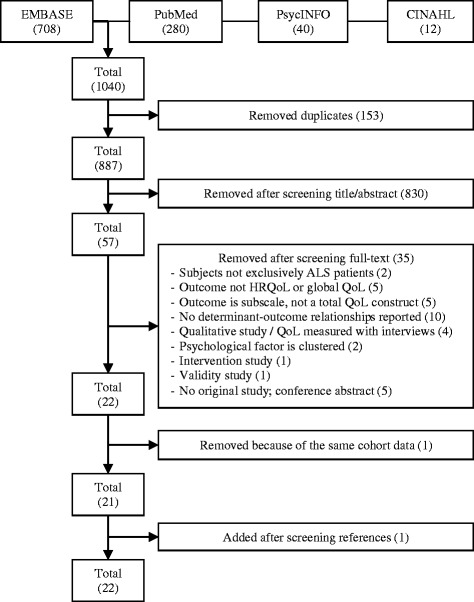
“A total of 57 articles remained for full-text screening; 22 articles met all inclusion criteria.”
§ Associations between psychological factors and health-related quality of life and global quality of life in patients with ALS: a systematic review > Results > Description of studies included
plain- Asserted: passes — The authors put it forward as true.
- Checkable: passes — It can be checked against evidence.
- Load-bearing: unclear — It is unclear whether the paper’s conclusions depend on it.
- Based: passes — The paper gives a reason why it holds.
In the paper
“Religiosity and spirituality appeared to become more positively associated over time.”
- Also stated in: § Associations throughout the disease course · hedged
“religiosity and spirituality appeared to become more positively associated with global QoL over time.”
§ Associations between psychological factors and health-related quality of life and global quality of life in patients with ALS: a systematic review > Abstract > Results
What the sources say
- Not checked yetcites [16] Bremer BA Simone AL Walsh S Simmons Z Felgoise SH Factors supporting quality of life over time for individuals with amyotrophic lateral sclerosis: the role of positive self-perception and religiosity Ann Behav Med 2004 28 119 25 10.1207/s15324796abm2802_7 15454359 source
hedgedstates an association- Asserted: passes — The authors put it forward as true.
- Checkable: passes — It can be checked against evidence.
- Load-bearing: passes — The paper’s conclusions depend on it.
- Based: passes — The paper gives a reason why it holds.
- Also stated in: § Associations throughout the disease course · hedged
26 more claims
Create a free account to see all 53 claims and to verify the 40 references still open.
- It may state two separate claims as one. 9
- Probably not a substantial claim. 18
Claims other papers make about this one
Each is checked against this paper’s own text: does it say what the citing paper says it does?
The source backs part of the claim, not all of it — or backs it for a different population, condition or comparison.
In the citing paper
“poor quality of life and psychological distress are associated with negative outcomes, including shorter survival time and increased risk of suicide. 4-6”
From Acceptance and Commitment Therapy plus usual care for improving quality of life in people with motor neuron disease (COMMEND): a multicentre, parallel, randomised controlled trial in the UK (2024) · cites this paper as [5]
Experimental — accuracy not yet measuredThe source backs part of the claim, not all of it — or backs it for a different population, condition or comparison.
In the citing paper
“Although shorter survival times, poorer quality of life and increased risks of suicide and mortality have been reported in those experiencing psychological distress [8–12]”
From A randomised controlled trial of acceptance and commitment therapy plus usual care compared to usual care alone for improving psychological health in people with motor neuron disease (COMMEND): study protocol. (2022) · cites this paper as [12]
Experimental — accuracy not yet measuredThe cited source says what the claim attributes to it.
In the citing paper
“No curative treatment is currently available, so the paramount clinical consideration is symptom relief to improve quality of life (QoL) [1].”
Citations
Cites
Diagnostic and Statistical Manual of Mental Disorders
Williams, J. B. W., & First, M. (2013) · Encyclopedia of Social Work · doi:10.1093/acrefore/9780199975839.013.104 · Cited by 109,519
The Hospital Anxiety and Depression Scale
Zigmond, A. S., & Snaith, R. P. (1983) · Acta Psychiatrica Scandinavica · doi:10.1111/j.1600-0447.1983.tb09716.x · Cited by 47,139
An inventory for measuring depression
BECK, A. T. (1961) · Archives of General Psychiatry · doi:10.1001/archpsyc.1961.01710120031004 · Cited by 38,032 · cited 3×
“Depression Beck Depression Inventory (BDI) Beck (1961) [53] 21 To assess severity of depressive symptoms.”
BackgroundMethodInfluentialHamilton, M. (1960) · Journal of Neurology, Neurosurgery & Psychiatry · doi:10.1136/jnnp.23.1.56 · Cited by 32,817 · cited 1×
“Hospital Anxiety and Depression Scale subscale depression (HADS-d) Zigmond (1983) [65] 7 To assess psychological distress in medically ill patients.”
BackgroundDiagnostic and Statistical Manual of Mental Disorders.
Widiger, T. A. (2000) · Encyclopedia of Psychology, Vol. 3. · doi:10.1037/10518-009 · Cited by 19,744
Depression and quality of life in older persons: A review
Sivertsen, H., Bjørkløf, G. H., Engedal, K., Selbæk, G., & Helvik, A.-S. (2015) · Dementia and Geriatric Cognitive Disorders · doi:10.1159/000437299 · Cited by 14,152
The assessment of anxiety states by rating
HAMILTON, M. (1959) · British Journal of Medical Psychology · doi:10.1111/j.2044-8341.1959.tb00467.x · Cited by 11,455 · cited 2×
“Anxiety Hamilton rating scale for anxiety (HAM-A) Hamilton (1959) [63] 14 To assess the severity of symptoms of anxiety.”
MethodSF-36 health survey: Manual and interpretation guide
Ware, J. (2003) · Medical Entomology and Zoology · Cited by 11,424
A self-rating depression scale
ZUNG, W. W. K. (1965) · Archives of General Psychiatry · doi:10.1001/archpsyc.1965.01720310065008 · Cited by 9,813 · cited 1×
“Zung Depression Scale (ZDS); Zung (1965) [68] also called Zung Self-Rating Depression Scale (SDS) (1965) 20 To assess depression 4-point scale.”
MethodScoville, W. B. (1949) · Journal of neurosurgery · doi:10.3171/jns.1949.6.1.0065 · Cited by 7,381
You want to measure coping but your protocol’ too long: Consider the brief cope
Carver, C. S. (1997) · International Journal of Behavioral Medicine · doi:10.1207/s15327558ijbm0401_6 · Cited by 7,361 · cited 1×
“The Brief COPE Carver (1997) [77] 28 Measures 14 dimensions of coping: distraction; active coping; denial; emotional support; instrumental support; disengagement; venting; positive reframing; planning; acceptance; humour; religion; self-blame; substance use.”
Relatives of the Impaired Elderly: Correlates of Feelings of Burden
Zarit, S. H., Reever, K. E., & Bach-Peterson, J. (1980) · The Gerontologist · doi:10.1093/geront/20.6.649 · Cited by 5,810 · cited 1×
“Perception of burden to others Zarit Burden Inventory (ZBI) – revised Zarit (1980) [75] 3 Three items of the original ZBI were revised to measure patient beliefs that their medical condition stressed, burdened, or caused financial hardship to their family.”
BackgroundThe measurement of pessimism: the hopelessness scale
Beck, A. T., Weissman, A., Lester, D., & Trexler, L. (1974) · Journal of Consulting and Clinical Psychology · doi:10.1037/h0037562 · Cited by 5,494 · cited 1×
“Hopelessness Becks Hopelessness Scale (BHS) Beck (1974) [74] 20 To assess three major aspects of hopelessness: feelings about the future, loss of motivation, and expectations.”
MethodSkevington, S. M., Lotfy, M., & O'Connell, K. A. (2004) · Quality of Life Research · doi:10.1023/b:qure.0000018486.91360.00 · Cited by 4,686 · cited 1×
“World Health Organization Quality of Life brief questionnaire (WHOQoL-BREF) Skevington (2004) [87] 26 WHOQoL-BREF assesses quality of life within the context of an individual’s culture, value systems, personal goals, standards and concerns.”
BackgroundThe Sickness Impact Profile: Development and Final Revision of a Health Status Measure
Bergner, M., Bobbitt, R. A., Carter, W. B., & Gilson, B. S. (1981) · Medical Care · doi:10.1097/00005650-198108000-00001 · Cited by 4,619
International Classification of Functioning Disability and Health (ICF)
Battistella, L. R., & Brito, C. M. M. D. (2002) · Acta Fisiátrica · doi:10.5935/0104-7795.20020003 · Cited by 4,446
International Classification of Functioning, Disability and Health (ICF) 2001
Jiménez Buñuales, M. ª. T., González Diego, P., & Martín Moreno, J. M. ª. (2002) · Revista Española de Salud Pública · doi:10.1590/s1135-57272002000400002 · Cited by 3,254
Integrating response shift into health-related quality of life research: a theoretical model
Sprangers, M. A. G., & Schwartz, C. E. (1999) · Social Science & Medicine · doi:10.1016/s0277-9536(99)00045-3 · Cited by 2,228 · cited 1×
“Psychological processes like coping, reframing expectations and spiritual practice might contribute to a change in internal standards and values of QoL, ultimately resulting in unexpectedly high QoL, even in later disease stages [11, 12].”
BackgroundMeasuring the quality of life of cancer patients
Spitzer, W. O., Dobson, A. J., Hall, J., Chesterman, E., Levi, J., Shepherd, R., Battista, R. N., & Catchlove, B. R. (1981) · Journal of Chronic Diseases · doi:10.1016/0021-9681(81)90058-8 · Cited by 1,528
Spiritual Well-Being: Conceptualization and Measurement
Ellison, C. W. (1983) · Journal of Psychology and Theology · doi:10.1177/009164718301100406 · Cited by 1,480 · cited 1×
“Spiritual Well-being Scale (SWBS) (2) Ellison (1983) [72] 20 The scale consists of 10 religious well-being items (RWB) and 10 existential well-being items (EWB); spiritual well-being.”
MethodAppraisal components, core relational themes, and the emotions
Smith, C. A., & Lazarus, R. S. (1993) · Cognition & Emotion · doi:10.1080/02699939308409189 · Cited by 1,302 · cited 1×
“Cognitive appraisal Appraisal scale Smith (1993) [76] 4 To assess patients’ primary (motivational relevance, motivational congruence) and secondary appraisal (problem-focused and emotion-focused coping potential) 9-point scale.”
BackgroundMolecular biology of amyotrophic lateral sclerosis: insights from genetics
Pasinelli, P., & Brown, R. H. (2006) · Nature Reviews Neuroscience · doi:10.1038/nrn1971 · Cited by 1,107 · cited 2×
“Patients eventually die due to respiratory failure within three to five years after symptom onset [1].”
BackgroundLanger, E. J., & Moldoveanu, M. (2000) · Journal of Social Issues · doi:10.1111/0022-4537.00148 · Cited by 1,048 · cited 1×
“One recent high quality study found a positive association between mindfulness ‘the process of actively making new distinctions about a situation and its environment, or its current context, rather than relying on previous categorizations from the past’ [48] and global QoL [29].”
BackgroundIncidence of amyotrophic lateral sclerosis in Europe
Logroscino, G., Traynor, B. J., Hardiman, O., Chio, A., Mitchell, D., Swingler, R. J., Millul, A., Benn, E., Beghi, E., & EURALS, F. (2010) · Journal of Neurology, Neurosurgery & Psychiatry · doi:10.1136/jnnp.2009.183525 · Cited by 772
Cohen, S. R., Mount, B. M., Strobel, M. G., & Bui, F. (1995) · Palliative Medicine · doi:10.1177/026921639500900306 · Cited by 738 · cited 1×
“The McGill Quality of Life Questionnaire (MQOL) Cohen SR (1995/1996) [82, 83] 17 MQOL assesses overall subjective QoL as judged by the patient.”
MethodTesting the validity of the Euroqol and comparing it with the SF-36 health survey questionnaire
Brazier, J., Jones, N., & Kind, P. (1993) · Quality of Life Research · doi:10.1007/bf00435221 · Cited by 704 · cited 1×
“EuroQoL-5D Brazier (1993) [85] 5 EuroQoL-5D assess health-related QoL.”
Religious Involvement and the Health of the Elderly: Some Hypotheses and an Initial Test
Idler, E. L. (1987) · Social Forces · doi:10.1093/sf/66.1.226 · Cited by 486 · cited 1×
“Religiosity Idler Index of Religiosity (IRR) Idler (1987) [70] 4 To assess the level of religiosity.”
BackgroundSpirituality and well‐being in terminally ill hospitalized adults
Reed, P. G. (1987) · Research in Nursing & Health · doi:10.1002/nur.4770100507 · Cited by 484 · cited 1×
“Spirituality Spiritual Well-being Scale (SWBS) (1) Reed (1987) [71] 10 To assess the level of spiritual well-being.”
BackgroundIndividual quality of life in patients undergoing hip replacement
O'Boyle, C. A., McGee, H., Hickey, A., O'Malley, K., & Joyce, C. R. B. (1992) · The Lancet · doi:10.1016/0140-6736(92)90673-q · Cited by 440 · cited 1×
“The Schedule for the Evaluation of Quality of Life (SEIQoL) McGee (1991) [79] O’Boyle (1992) [80] 46 SEIQoL assesses overall subjective QoL as judged by the patient in healthy or ill individuals.”
MethodHickey, A. M., Bury, G., O'Boyle, C. A., Bradley, F., O'Kelly, F. D., & Shannon, W. (1996) · BMJ · doi:10.1136/bmj.313.7048.29 · Cited by 421 · cited 1×
“The Schedule for the evaluation of Quality of Life-Direct Weighting (SEIQoL-DW) Hickey (1996) [81] 15 SEIQoL-DW is a shorter, direct-weight (DW) version of the SEIQoL, employs an alternative method of deriving cue weights using a colored disk.”
MethodCohen, S. R., Mount, B. M., Tomas, J. J. N., & Mount, L. F. (1996) · Cancer · doi:10.1002/(sici)1097-0142(19960201)77:3<576::aid-cncr22>3.0.co;2-0 · Cited by 410
Development and Validation of an International English Big-Five Mini-Markers
Thompson, E. R. (2008) · Personality and Individual Differences · doi:10.1016/j.paid.2008.06.013 · Cited by 352 · cited 1×
“Agreeableness refers to ‘a personality trait manifesting itself in individual behavioral characteristics that are perceived as kind, sympathetic, cooperative, warm and considerate’ [49].”
BackgroundMcGee, H. M., O'Boyle, C. A., Hickey, A., O'Malley, K., & Joyce, C. R. B. (1991) · Psychological Medicine · doi:10.1017/s0033291700022388 · Cited by 321 · cited 1×
“The Schedule for the Evaluation of Quality of Life (SEIQoL) McGee (1991) [79] O’Boyle (1992) [80] 46 SEIQoL assesses overall subjective QoL as judged by the patient in healthy or ill individuals.”
MethodAndersen, P. M., Borasio, G. D., Dengler, R., Hardiman, O., Kollewe, K., Leigh, P. N., Pradat, P. ‐., Silani, V., & Tomik, B. (2005) · European Journal of Neurology · doi:10.1111/j.1468-1331.2005.01351.x · Cited by 289 · cited 1×
“Patients suffer progressive wasting and weakness of limb, bulbar and respiratory muscles, leading to inability to speak and swallow, respiratory failure and complete paralysis [1, 2].”
BackgroundQuality of life in ALS depends on factors other than strength and physical function
Simmons, Z., Bremer, B. A., Robbins, R. A., Walsh, S. M., & Fischer, S. (2000) · Neurology · doi:10.1212/wnl.55.3.388 · Cited by 279 · cited 4×
“Five studies assessed the relationship between religiosity and QoL [13, 14, 16, 31, 46]: three of these reported HRQoL, four global QoL and two studies both HRQoL and global QoL outcomes.”
BackgroundMethodInfluentialThe epidemiology of motor neuron diseases: a review of recent studies
Worms, P. M. (2001) · Journal of the Neurological Sciences · doi:10.1016/s0022-510x(01)00630-x · Cited by 278 · cited 1×
“7 per 100,000 person-years, [5] with an estimated lifetime risk of 1 in 400 [6].”
BackgroundBeyond new age : exploring alternative spirituality
Sutcliffe, S. J., & Bowman, M. (2000) · Edinburgh University Press eBooks · Cited by 264
Relation between cognitive dysfunction and pseudobulbar palsy in amyotrophic lateral sclerosis.
Abrahams, S., Goldstein, L. H., Al-Chalabi, A., Pickering, A., Morris, R. G., Passingham, R. E., Brooks, D. J., & Leigh, P. N. (1997) · Journal of Neurology, Neurosurgery & Psychiatry · doi:10.1136/jnnp.62.5.464 · Cited by 254 · cited 1×
“Hospital Anxiety and Depression Scale subscale depression (HADS-d) - modified version 2 Abrahams (1997) [66] 6 To assess psychological distress in medically ill patients.”
BackgroundCorrelates of suffering in amyotrophic lateral sclerosis
Ganzini, L., Johnston, W. S., & Hoffman, W. F. (1999) · Neurology · doi:10.1212/wnl.52.7.1434 · Cited by 250 · cited 5×
“One study tested the association of hopelessness and global QoL [45].”
BackgroundMethodInfluentialA prospective study of cognitive impairment in ALS
Strong, M. J., Grace, G. M., Orange, J. B., Leeper, H. A., Menon, R. S., & Aere, C. (1999) · Neurology · doi:10.1212/wnl.53.8.1665 · Cited by 246
Quality of life in ALS is maintained as physical function declines
Robbins, R. A., Simmons, Z., Bremer, B. A., Walsh, S. M., & Fischer, S. (2001) · Neurology · doi:10.1212/wnl.56.4.442 · Cited by 245
Amyotrophic lateral sclerosis in an urban setting: A population based study of inner city London
Johnston, C. A., Stanton, B. R., Turner, M. R., Gray, R., Blunt, A. H.-M., Butt, D., Ampong, M.-A., Shaw, C. E., Leigh, P. N., & Al-Chalabi, A. (2006) · Journal of Neurology · doi:10.1007/s00415-006-0195-y · Cited by 215
Quality-of-Life Measurement in Advanced Cancer: Assessing the Individual
Waldron, D., O'Boyle, C. A., Kearney, M., Moriarty, M., & Carney, D. (1999) · Journal of Clinical Oncology · doi:10.1200/jco.1999.17.11.3603 · Cited by 209 · cited 1×
“This is in accordance with the theory of Waldron [61] who suggested that psychological adaptation to terminal illness may involve a shift in focus of determinants of QoL; in the initial stages of a progressive illness, patients may focus on physical functioning and on decreasing disability, but as the illness progress…”
ResultPretreatment factors predicting quality of life after treatment for head and neck cancer
de Graeff, A., de Leeuw, J. R. J., Ros, W. J. G., Hordijk, G.-J., Blijham, G. H., & Winnubst, J. A. M. (2000) · Head & Neck · doi:10.1002/1097-0347(200007)22:4<398::aid-hed14>3.0.co;2-v · Cited by 206 · cited 1×
“This is in concurrence with cancer studies [9, 50], which also revealed that depression explained a large amount of variation in HRQoL, but not global QoL.”
ResultPirson, M. A., Langer, E. J., Bodner, T., & Zilcha, S. (2012) · SSRN Electronic Journal · doi:10.2139/ssrn.2158921 · Cited by 197 · cited 1×
“Mindfulness Langer mindfulness scale (LMS) Pirson (2012) [73] 14 Three domains associated with mindful thinking: novelty seeking, engagement and novelty producing.”
BackgroundA cross sectional study on determinants of quality of life in ALS
Chio, A. (2004) · Journal of Neurology, Neurosurgery & Psychiatry · doi:10.1136/jnnp.2003.033100 · Cited by 190 · cited 6×
“ZDS SEIQoL-DW index score nr s*/nr [13] 5.”
BackgroundInfluentialvan Leeuwen, C. M. C., Kraaijeveld, S., Lindeman, E., & Post, M. W. M. (2012) · Spinal Cord · doi:10.1038/sc.2011.120 · Cited by 169
Severity of Depressive Symptoms and Quality of Life in Patients with Amyotrophic Lateral Sclerosis
Kübler, A., Winter, S., Ludolph, A. C., Hautzinger, M., & Birbaumer, N. (2005) · Neurorehabilitation and Neural Repair · doi:10.1177/1545968305276583 · Cited by 163 · cited 3×
“Two ALS-specific questionnaires, the ALS Depression Inventory (ADI-12) [34] and the Motor Neuron Disease Coping Scale (MNDCS) [35] were applied in one [28] and three [30, 36, 37] studies, respectively.”
MethodInfluentialSurvival of 793 patients with amyotrophic lateral sclerosis diagnosed over a 28-year period
Testa, D., Lovati, R., Ferrarini, M., Salmoiraghi, F., & Filippini, G. (2004) · Amyotrophic Lateral Sclerosis and Other Motor Neuron Disorders · doi:10.1080/14660820410021311 · Cited by 150
Spielberger State-Trait Anxiety Inventory
Skapinakis, P. (2014) · Springer eBooks · doi:10.1007/978-94-007-0753-5_2825 · Cited by 143
Predictors of quality of life among multiple sclerosis patients: a comprehensive analysis
Yamout, B., Issa, Z., Herlopian, A., El Bejjani, M., Khalifa, A., Ghadieh, A. S., & Habib, R. H. (2013) · European Journal of Neurology · doi:10.1111/ene.12046 · Cited by 137 · cited 1×
“These findings are mirrored in other diseases such as Multiple Sclerosis [57] and advanced cancer [58].”
ResultA review of psychosocial aspects of motor neurone disease
McLeod, J. E., & Clarke, D. M. (2007) · Journal of the Neurological Sciences · doi:10.1016/j.jns.2007.03.001 · Cited by 135 · cited 1×
“The authors summarized associations between QoL and depression [20, 21], anxiety [20], spiritual and existential issues [20–22], sense of burden [22] and hope/hopelessness [20, 22] in patients with ALS, but as they did not quantify or appraise them, the relationships remain unclear.”
BackgroundQuality of life and measures of quality of life in patients with neuromuscular disorders
Burns, T. M., Graham, C. D., Rose, M. R., & Simmons, Z. (2012) · Muscle & Nerve · doi:10.1002/mus.23245 · Cited by 132 · cited 3×
“Global QoL reflects overall QoL as judged by the patient and takes into account other, non-medical concepts, such as family, support system and friends [8].”
BackgroundInfluentialRasch analysis of the Hospital Anxiety and Depression Scale (HADS) for use in motor neurone disease
Gibbons, C. J., Mills, R. J., Thornton, E. W., Ealing, J., Mitchell, J. D., Shaw, P. J., Talbot, K., Tennant, A., & Young, C. A. (2011) · Health and Quality of Life Outcomes · doi:10.1186/1477-7525-9-82 · Cited by 130 · cited 3×
“Hospital Anxiety and Depression Scale subscale anxiety (HADS-a)— modified version 1 Gibbons (2011) [56] 6 To assess psychological distress in medically ill patients.”
BackgroundCorrelates of Quality of Life in people with motor neuron disease (MND)
Goldstein, L., Atkins, L., & Leigh, P. (2002) · Amyotrophic Lateral Sclerosis and Other Motor Neuron Disorders · doi:10.1080/146608202760834120 · Cited by 126 · cited 7×
“In four other studies, however, including 2 which used ALSspecific questionnaires, no significant correlations between depression and global QoL were demonstrated [15, 38, 42, 45].”
BackgroundMethodInfluentialAssessing individual quality of life in amyotrophic lateral sclerosis
Clarke, S., Hickey, A., O’Boyle, C. A., & Hardiman, O. M. (2001) · Quality of Life Research · doi:10.1023/a:1016704906100 · Cited by 125 · cited 8×
“HADS-d SEIQoL index score ns/nr [15] 5.”
BackgroundInfluentialJohnston, M., Dixon, D., Hart, J., Glidewell, L., Schröder, C., & Pollard, B. (2014) · British Journal of Health Psychology · doi:10.1111/bjhp.12095 · Cited by 124 · cited 3×
“Significance levels: *p < 0.1; **p < 0.01; ***p < 0.001 Abbreviations: ns not significant, nr not reported, r correlation, β standardized regression coefficient, R2 explained variance of the determinant, D diagnosis, A obtained from the author, F.U. follow-up, 1 modified version 1, 2 modified version 2, 3 self-develop…”
BackgroundMethodInfluentialSelf-citationA SURVEY OF MEASURES OF TRANSPERSONAL CONSTRUCTS
MacDonald, D. A., LeClair, L., Holland, C. J., Alter, A., & Friedman, H. L. (1995) · Cited by 124
König, H. H., Bernert, S., & Angermeyer, M. C. (2005) · Das Gesundheitswesen · doi:10.1055/s-2005-857991 · Cited by 121
Psychological wellbeing and quality of life in amyotrophic lateral sclerosis: A review
Pagnini, F. (2013) · International Journal of Psychology · doi:10.1080/00207594.2012.691977 · Cited by 116 · cited 1×
“The authors summarized associations between QoL and depression [20, 21], anxiety [20], spiritual and existential issues [20–22], sense of burden [22] and hope/hopelessness [20, 22] in patients with ALS, but as they did not quantify or appraise them, the relationships remain unclear.”
BackgroundDepression and Quality of Life in Patients With Amyotrophic Lateral Sclerosis
Lulé, D., Häcker, S., Ludolph, A., Birbaumer, N., & Kübler, A. (2008) · Deutsches Ärzteblatt international · doi:10.3238/arztebl.2008.0397 · Cited by 112 · cited 5×
“36) [28] negatively associated with global QoL.”
BackgroundMethodInfluentialvan Mierlo, M. L., Schröder, C., van Heugten, C. M., Post, M. W. M., de Kort, P. L. M., & Visser-Meily, J. M. A. (2014) · International Journal of Stroke · doi:10.1111/ijs.12149 · Cited by 97 · cited 1×
“The impact of psychological factors such as neuroticism, coping, cognitive appraisals and mood on QoL has already been demonstrated in other chronic diseases [17, 18] and in other progressive neurological illnesses, such as Huntington’s disease, Parkinson’s disease and multiple sclerosis [19].”
BackgroundSelf-citationAnxiety undermines quality of life in ALS patients and caregivers
Vignola, A., Guzzo, A., Calvo, A., Moglia, C., Pessia, A., Cavallo, E., Cammarosano, S., Giacone, S., Ghiglione, P., & Chiò, A. (2008) · European Journal of Neurology · doi:10.1111/j.1468-1331.2008.02303.x · Cited by 89 · cited 8×
“Vignola (2008) [41] Italy 29 (20) Cross sectional 63.”
BackgroundInfluentialCoping with amyotrophic lateral sclerosis: an integrative view
Matuz, T., Birbaumer, N., Hautzinger, M., & Kubler, A. (2010) · Journal of Neurology, Neurosurgery & Psychiatry · doi:10.1136/jnnp.2009.201285 · Cited by 87 · cited 7×
“The first study [36] with a cross-sectional design, using multivariate regression analysis, revealed positive associations between the coping strategy ‘problem management’ and ‘emotional avoidance’ and global QoL at baseline [30].”
BackgroundMethodInfluentialHealth-related quality of life in ALS, myasthenia gravis and facioscapulohumeral muscular dystrophy
Winter, Y., Schepelmann, K., Spottke, A. E., Claus, D., Grothe, C., Schröder, R., Heuss, D., Vielhaber, S., Tackenberg, B., Mylius, V., et al. (2010) · Journal of Neurology · doi:10.1007/s00415-010-5549-9 · Cited by 86 · cited 5×
“Generic instrument, measures QoL of life across 4 domains: physical health (7 items), psychological health (6 items), social relationships (3 items) and environment (8 items).”
BackgroundMethodInfluentialvan den Berg, J., de Groot, I., Joha, B., van Haelst, J., van Gorcom, P., & Kalmijn, S. (2004) · Amyotrophic Lateral Sclerosis and Other Motor Neuron Disorders · doi:10.1080/14660820410021258 · Cited by 83 · cited 1×
“Second, in order to detect which psychological factors affect HRQoL and global QoL over the course of the disease, it is essential to cluster the data of patients according to the same disease stage (diagnostic stage, rehabilitation stage and terminal stage [62]).”
BackgroundPizzimenti, A. (2013) · Functional Neurology · doi:10.11138/fneur/2013.28.2.115 · Cited by 80 · cited 3×
“Pizzimenti [43] 2013 1 1 1 1 1 1 1 1 8.”
BackgroundMethodMcCabe, M. P., Firth, L., & O’Connor, E. (2009) · Journal of Clinical Psychology in Medical Settings · doi:10.1007/s10880-009-9168-5 · Cited by 76 · cited 7×
“The contribution of depressive symptoms to HRQoL was also endorsed in regression analysis [19, 27, 37, 43, 44].”
BackgroundMethodInfluentialTheories of personality, 7th ed.
Ryckman, R. M. (2000) · Cited by 64
Pagnini, F., Phillips, D., Bosma, C. M., Reece, A., & Langer, E. (2015) · Psychology & Health · doi:10.1080/08870446.2014.982652 · Cited by 62 · cited 4×
“One recent high quality study found a positive association between mindfulness ‘the process of actively making new distinctions about a situation and its environment, or its current context, rather than relying on previous categorizations from the past’ [48] and global QoL [29].”
BackgroundResultInfluentialBremer, B. A., Simone, A.-L., Walsh, S., Simmons, Z., & Felgoise, S. H. (2004) · Annals of Behavioral Medicine · doi:10.1207/s15324796abm2802_7 · Cited by 58 · cited 8×
“Two studies tested the correlation between spirituality and QoL [16, 47].”
BackgroundMethodInfluentialAmyotrophic Lateral Sclerosis–Plus Syndrome With TAR DNA-Binding Protein-43 Pathology
McCluskey, L. F., Elman, L. B., Martinez-Lage, M., Van Deerlin, V., Yuan, W., Clay, D., Siderowf, A., & Trojanowski, J. Q. (2009) · Archives of Neurology · doi:10.1001/archneur.66.1.121 · Cited by 58 · cited 1×
“Currently, there is increasing awareness that ALS is also associated with non-motor findings, including behavioral and cognitive deficits [3, 4].”
BackgroundLlewellyn, C. D., McGurk, M., & Weinman, J. (2006) · British Journal of Oral and Maxillofacial Surgery · doi:10.1016/j.bjoms.2005.06.033 · Cited by 57 · cited 3×
“Assessing global QoL generally provides a broader picture of the impact of disease on an individual’s life [9].”
BackgroundResultReligiousness is related to quality of life in patients with ALS
Walsh, S. M., Bremer, B. A., Felgoise, S. H., & Simmons, Z. (2003) · Neurology · doi:10.1212/01.wnl.0000058767.05265.f3 · Cited by 54 · cited 1×
“In two studies [16, 26], the same cohort data was used; we included the study by Bremer because of a higher quality assessment.”
MethodLee, J. N., Rigby, S., Burchardt, F., Thornton, E. W., Dougan, C. F., & Young, C. A. (2001) · Journal of the Neurological Sciences · doi:10.1016/s0022-510x(01)00619-0 · Cited by 53 · cited 4×
“Motor Neuron Disease Coping Scale (MNDCS/Cope-MND)—adapted version 2 Lee (2001) [35] 9 To assess extent to which patients relied on the coping strategies.”
BackgroundMethodInfluentialMcGuire, D., Garrison, L. P., Armon, C., Barohn, R. J., Bryan, W. W., Miller, R. G., Parry, G. J., Petajan, J. H., & Ross, M. A. (1997) · Journal of the Neurological Sciences · doi:10.1016/s0022-510x(97)00239-6 · Cited by 52 · cited 2×
“One ALS-specific HRQoL questionnaire, the Sickness Impact Profile ALS (SIP/ALS-19) [39], was used in two studies [14, 31].”
BackgroundMethodHenderson, Y. C., Breau, R. L., Liu, T.-J., & Clayman, G. L. (2000) · Head & Neck · doi:10.1002/1097-0347(200007)22:4<336::aid-hed4>3.0.co;2-t · Cited by 52
Psychosocial adjustment to ALS: a longitudinal study
Matuz, T., Birbaumer, N., Hautzinger, M., & Kübler, A. (2015) · Frontiers in Psychology · doi:10.3389/fpsyg.2015.01197 · Cited by 49 · cited 6×
“The first study [36] with a cross-sectional design, using multivariate regression analysis, revealed positive associations between the coping strategy ‘problem management’ and ‘emotional avoidance’ and global QoL at baseline [30].”
BackgroundMethodInfluentialQuality of life of patients with amyotrophic lateral sclerosis
Tramonti, F., Bongioanni, P., Di Bernardo, C., Davitti, S., & Rossi, B. (2012) · Psychology, Health & Medicine · doi:10.1080/13548506.2011.651149 · Cited by 47
Psychological health in patients with ALS is maintained as physical function declines
Cupp, J., Simmons, Z., Berg, A., Felgoise, S. H., Walsh, S. M., & Stephens, H. E. (2011) · Amyotrophic Lateral Sclerosis · doi:10.3109/17482968.2011.554555 · Cited by 43 · cited 1×
“Psychological processes like coping, reframing expectations and spiritual practice might contribute to a change in internal standards and values of QoL, ultimately resulting in unexpectedly high QoL, even in later disease stages [11, 12].”
BackgroundGibbons, C., Thornton, E., Ealing, J., Shaw, P., Talbot, K., Tennant, A., & Young, C. (2013) · Amyotrophic Lateral Sclerosis and Frontotemporal Degeneration · doi:10.3109/21678421.2013.799700 · Cited by 41 · cited 8×
“The contribution of depressive symptoms to HRQoL was also endorsed in regression analysis [19, 27, 37, 43, 44].”
BackgroundMethodInfluentialPagnini, F., Manzoni, G. M., Tagliaferri, A., & Gibbons, C. J. (2015) · Journal of Health Psychology · doi:10.1177/1359105314530453 · Cited by 39 · cited 2×
“In current (western) culture, people are more interested in spirituality [60] and mindfulness [55] and are searching for a connection with the divine within themselves, instead of a connection with an external almighty power [60].”
BackgroundSpiritual well-being of the individual with amyotrophic lateral sclerosis
Bello-Haas, V. D., Andrews-Hinders, D., Bocian, J., Mascha, E., Wheeler, T., & Mitsumoto, H. (2000) · Amyotrophic Lateral Sclerosis and Other Motor Neuron Disorders · doi:10.1080/146608200750139413 · Cited by 36 · cited 5×
“Religiosity might be important for the individual’s global QoL because it may create meaning and coherence when an individual’s world is devastated by a distressing and progressive disease [47].”
BackgroundMethodInfluentialPerić, S., Rakočević-Stojanović, V., Stević, Z., Basta, I. Z., Pavlovic, S., Vujanac, V., Marjanovic, L., & Lavrnić, D. (2010) · PubMed · Cited by 35
Krampe, H., Bartels, C., Victorson, D., Enders, C. K., Beaumont, J., Cella, D., & Ehrenreich, H. (2008) · Amyotrophic Lateral Sclerosis · doi:10.1080/17482960701875805 · Cited by 31 · cited 9×
“Generic instrument, measures QoL of life across 4 domains: physical health (7 items), psychological health (6 items), social relationships (3 items) and environment (8 items).”
BackgroundMethodResultInfluentialPaiva, C. E., Paiva, B. S. R., de Castro, R. A., Souza, C. D. P., Maia, Y. C. D. P., Ayres, J. A., & Michelin, O. C. (2011) · Journal of Religion and Health · doi:10.1007/s10943-011-9468-6 · Cited by 27 · cited 1×
“These findings are mirrored in other diseases such as Multiple Sclerosis [57] and advanced cancer [58].”
ResultAssessing Quality of Life in ALS
Bromberg, M. B. (2007) · Journal of Clinical Neuromuscular Disease · doi:10.1097/cnd.0b013e31815af9b7 · Cited by 27 · cited 1×
“The authors summarized associations between QoL and depression [20, 21], anxiety [20], spiritual and existential issues [20–22], sense of burden [22] and hope/hopelessness [20, 22] in patients with ALS, but as they did not quantify or appraise them, the relationships remain unclear.”
BackgroundCoping strategies in relation to quality of life in amyotrophic lateral sclerosis
Montel, S., Albertini, L., & Spitz, É. (2011) · Muscle & Nerve · doi:10.1002/mus.22270 · Cited by 25
Ilse, B., Prell, T., Walther, M., Hartung, V., Penzlin, S., Tietz, F., Witte, O.-W., Strauss, B., & Grosskreutz, J. (2015) · Social Indicators Research · doi:10.1007/s11205-014-0621-y · Cited by 23 · cited 6×
“Generic instrument, measures QoL of life across 4 domains: physical health (7 items), psychological health (6 items), social relationships (3 items) and environment (8 items).”
BackgroundInfluentialSpielberger State-Trait Anxiety Inventory
(2009) · Springer eBooks · doi:10.1007/978-0-387-78665-0_6696 · Cited by 19 · cited 1×
“State and Trait Anxiety Inventory (STAI) Spielberger (1968) [64] 40 To assess trait and state anxiety.”
BackgroundHeelas, P. (2021) · Edinburgh University Press eBooks · doi:10.1515/9781474497015-015 · Cited by 14
Research works printed but not linked: 5
- World Health Organization WHOQOL: measuring quality of life 1997 Geneva World Health Organization
- Cohen J Statistical power analysis for the behavioural sciences 1988 2 UK Lawrence Erlbaum Associates
- Ryckman R Theories of Personality 2000 7 Thomson/Wadsworth Belmont
- McNair DM Lorr M Droppleman LF Profile of mood state manual 1992 Educational and Industrial Testing Service San Diego
- Costa P McCrae R Revised NEO Personality Inventory (NEO PI-R) and NEO Five Factor Inventory. Professional Manual 1992 Odessa Psychological Assessment Resources
Cited by
Caregiver burden in amyotrophic lateral sclerosis: A systematic review
de Wit, J., Bakker, L. A., van Groenestijn, A. C., van den Berg, L. H., Schröder, C. D., Visser-Meily, J. M., & Beelen, A. (2018) · Palliative Medicine · doi:10.1177/0269216317709965 · Cited by 163
Self-citationAbu, H. O., Ulbricht, C. M., Ding, E., Allison, J. J., Salmoirago‐Blotcher, E., Goldberg, R. J., & Kiefe, C. I. (2018) · Quality of Life Research · doi:10.1007/s11136-018-1906-4 · Cited by 160
Linse, K., Aust, E., Joos, M., & Hermann, A. (2018) · Frontiers in Neurology · doi:10.3389/fneur.2018.00603 · Cited by 84
“However, there has been reported a “response shift” in the evaluation of their QoL by patients toward a higher value of social activities and a lower value of financial aspects, mobility and leisure activities (47, 60, 61); a shift that patients’ next of kin are apparently not aware of (44), maybe because it does not…”
An, T., He, Z.-C., Zhang, X.-Q., Li, J., Chen, A.-L., Tan, F., Chen, H.-D., Lv, B.-H., Lian, J., Gao, S.-H., et al. (2019) · Chinese Medicine · doi:10.1186/s13020-019-0225-1 · Cited by 63
Multidisciplinary care in Amyotrophic Lateral Sclerosis: a systematic review and meta-analysis
de Almeida, F. E. O., Santana, A. K. D. C., & de Carvalho, F. O. (2021) · Neurological Sciences · doi:10.1007/s10072-020-05011-2 · Cited by 68
“Lack of optimal HRQoL assessment tools for ALS has been already reported as a problem to accurately measure QoL of these patients, leading to high study heterogeneity and making transition of results for clinical practice even more difficult [49].”
BackgroundResult
Metadata
- Authors
- van Groenestijn, A. C., Kruitwagen-van Reenen, E. T., Visser-Meily, J. M. A., van den Berg, L. H., & Schröder, C. D.
- Affiliations
- University Medical Center Utrecht (NL)
- Corresponding author
- Schröder, Carin D.
- ORCID
- Schröder, Carin D.
- Venue
- Health and Quality of Life Outcomes
- Published
- 2016-07-20
- Volume
- 14
- Issue
- 1
- Pages
- 107-107
- ISSN
- 1477-7525 (ISSN-L)
- PMC
- PMC4955215
- OpenAlex
- W2475928909
- Semantic Scholar
- 5598f61f8b6b17c14cabe1e61a2cc7f14bba65b2
- Cited by
- 92
- References
- 91
- Citations by year
- 2026: 9 · 2025: 4 · 2024: 12 · 2023: 16 · 2022: 8 · 2021: 8 · 2020: 8 · 2019: 12 · 2018: 8 · 2017: 7
- FWCI
- 1.25
- Type
- journal article
- Language
- en
- Open access
- gold
- doi.org
- Licence
- cc-by
- Locations
- Health and Quality of Life Outcomes (publishedVersion, cc-by)
- PubMed Central (publishedVersion, cc-by)
- PubMed (publishedVersion)
- Pure Amsterdam UMC (publishedVersion, cc-by)
- Utrecht University Repository (Utrecht University) (publishedVersion, other-oa)
- Utrecht University Repository (Utrecht University) (submittedVersion, other-oa)
- Funders
- The Netherlands Organization for Health Research and Development (ZonMw) and the Prinses Beatrix Fonds (ID: ZonMW 89000003)
- Topics
- Health Sciences › Medicine › Clinical Neurology › Amyotrophic Lateral Sclerosis Research
- Health Sciences › Medicine › Oncology › Cancer survivorship and care
- Social Sciences › Health › Religion, Spirituality, and Psychology
- Keywords
- amyotrophic lateral sclerosis, health-related quality of life, global quality of life, psychological factors, mood, anxiety, depression, religiosity, spirituality, belief, personality, coping styles, hopelessness
- MeSH terms
- Adaptation, Psychological, Affect, Amyotrophic Lateral Sclerosis, Anxiety, Depression, Humans, Personality, Quality of Life, Spirituality
About these checks
Registry, retraction, Cites and statistics results are computed, not judged, with one exception: a printed reference that no index lists is read once by a model before it counts as a citation error. Claims are extracted by a model and kept only when their quote appears verbatim in the text; each cited source is then checked, with a model’s help, for whether it says what the claim relies on. Those verdicts can be wrong — read the claim’s quote and the cited source before relying on one.
A language model drew the claims from the paper on 2026-10-11, under version 3 of the claim definition (model deepseek-v4.1-flash, prompt extract-v3).
A second model labelled each claim on 2026-10-11 (model jev-1.13-20260917, definition revision gold-guideline-v0.2).
Statistics and arithmetic are recomputed, not judged.
Confidence bands are shown only for fields calibrated on our annotated test set. None is calibrated yet, so no band is shown.
What counts as a claim ›How we measure confidence ›How we check this ›
Are you an author, or do you see a problem with this page? Request a review
Data sources
Bibliographic data: Semantic Scholar, OpenAlex, Crossref.
Contains information from the Semantic Scholar Academic Graph Datasets, made available under the ODC Attribution License (ODC-BY 1.0).
Semantic Scholar’s data is described in: Kinney, R., et al. (2023). The Semantic Scholar Open Data Platform. arXiv:2301.10140.
