

Doctor retention and distribution in post-apartheid South Africa: tracking medical graduates (2007–2011) from one university
Open accessThe DOI matches its Crossref record; 37 of the 40 references it cites were found in a registry or an index; 1 of the 5 sources its claims cite were checked for support.
Abstract
BACKGROUND: Doctor emigration from low- and middle-income countries represents a financial loss and threatens the equitable delivery of healthcare. In response to government imperatives to produce more health professionals to meet the country's needs, South African medical schools increased their student intake and changed their selection criteria, but little is known about the impact of these changes. This paper reports on the retention and distribution of doctors who graduated from the University of the Witwatersrand, South Africa (SA), between 2007 and 2011. METHODS: Data on 988 graduates were accessed from university databases. A cross-sectional descriptive email survey was used to gather information about graduates' demographics, work histories, and current work settings. Frequency and proportion counts and multiple logistic regressions of predictors of working in a rural area were conducted. Open-ended data were analysed using content analysis. RESULTS: The survey response rate was 51.8%. Foreign nationals were excluded from the analysis because of restrictions on them working in SA. Of 497 South African respondents, 60% had completed their vocational training in underserved areas. At the time of the study, 89% (444) worked as doctors in SA, 6.8% (34) practised medicine outside the country, and 3.8% (19) no longer practised medicine. Eighty percent of the 444 doctors still in SA worked in the public sector. Only 33 respondents (6.6%) worked in rural areas, of which 20 (60.6%) were Black. Almost half (47.7%) of the 497 doctors still in SA were in specialist training appointments. CONCLUSIONS: Most of the graduates were still in the country, with an overwhelmingly urban and public sector bias to their distribution. Most doctors in the public sector were still in specialist training at the time of the study and may move to the private sector or leave the country. Black graduates, who were preferentially selected in this graduate cohort, constituted the majority of the doctors practising in rural areas. The study confirms the importance of selecting students with rural backgrounds to provide doctors for underserved areas. The study provides a baseline for future tracking studies to inform the training of doctors for underserved areas.
Overview
CoChat Summary
## TL;DR
This cross-sectional email survey tracked 988 Wits University medical graduates from 2007–2011 to assess retention and work distribution. Most respondents were still in South Africa, but their work was heavily urban and public-sector concentrated, and rural practice was strongly associated with rural background and rural training exposure.
## Key findings
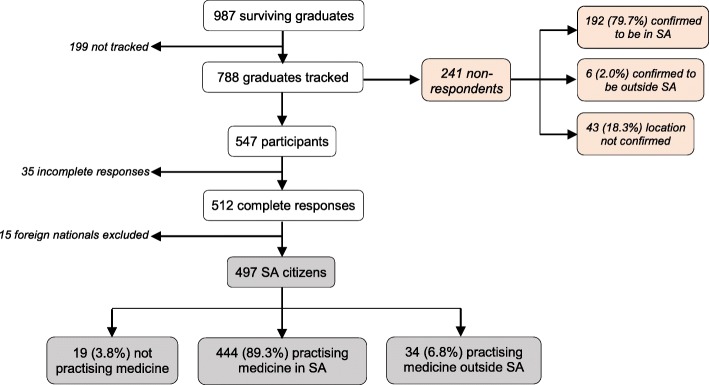
- Of the 988 graduates, 788 were tracked and 547 responded; 512/987 completed the survey, and 497 South African citizens were analyzed after excluding 15 foreign nationals.
- At the time of the study, 89% (444/497) of respondents worked as doctors in South Africa, 6.8% (34/497) practised outside the country, and 3.8% (19/497) no longer practised medicine.
- Among doctors still in South Africa, 80% (330/444) worked in the public sector, and 92% (384/417) worked in urban areas versus 6.6% (33/497) in rural areas.
- Rural practice was associated with rural exposure: a rural background was the strongest predictor, and a rural background, rural internship, and rural community service each independently increased the probability of currently working in a rural area; the paper reports a rural-background odds ratio of 4.998.
## Methods
- Cross-sectional descriptive email survey of all 988 medical graduates from the University of the Witwatersrand between 2007 and 2011; university databases and alumni records were used to track graduates.
- The online questionnaire (SurveyMonkey) covered demographics, work history/current work settings, and student experiences; this paper reports the first two sections.
- Analysis used frequency/proportion counts and multiple logistic regression for predictors of working in a rural area; open-ended responses were analyzed using inductive content analysis.
## Limitations
- The paper states a possible selection bias toward graduates who remained in South Africa and were easier to locate, though it says this was mitigated by estimating non-respondents’ locations.
- The paper states that analysis was limited by small numbers of graduates from rural backgrounds.
- Evident from the text: the study is cross-sectional and therefore may not reflect final career destinations, especially because many respondents were still specializing and could later move or emigrate.
Model-written summary. Check it against the paper before relying on it.
Integrity signals
Registry
Cites
Statistics
Figures
Verification
Claims the paper makes
1 Valid · 0 Not valid · 3 Not checked · 57 Own results and interpretations
Every source the paper cites for this claim was checked and supports it.
In the paper
“The redistribution of respondents to underserved areas from internship to community service mirrors the findings of a longitudinal study reviewing the first 15 years of community service nationally, which found that more doctors were being allocated to rural areas and district hospitals [30].”
§ Doctor retention and distribution in post-apartheid South Africa: tracking medical graduates (2007–2011) from one university > Discussion
What the sources say
- Supportedcites [30] Reid SJ Peacocke J Kornik S Wolvaardt G Compulsory community service for doctors in South Africa: A 15-year review South African Med J 2018 108 741 747 10.7196/SAMJ.2018.v108i9.13070 30182899 source
Split into 2 atoms — 2 confirmed, 0 partially supported, 0 disputed, 0 misattributed, 0 unverifiable. Expand the claim to see per-atom verdicts.
plainstates an association- Asserted: passes — The authors put it forward as true.
- Checkable: passes — It can be checked against evidence.
- Load-bearing: unclear — It is unclear whether the paper’s conclusions depend on it.
- Based: passes — The paper gives a reason why it holds.
- Supported
A result the paper reports from its own data — it cites no other source for it, so there is none to check. The quote shows it is in the paper.
In the paper
“Only 33 respondents (6.6%) worked in rural areas”
§ Doctor retention and distribution in post-apartheid South Africa: tracking medical graduates (2007–2011) from one university > Abstract > Results
plainn = 33- Asserted: passes — The authors put it forward as true.
- Checkable: passes — It can be checked against evidence.
- Load-bearing: passes — The paper’s conclusions depend on it.
- Based: passes — The paper gives a reason why it holds.
A result the paper reports from its own data — it cites no other source for it, so there is none to check. The quote shows it is in the paper.
In the paper
“and 33 (6.6%) in rural areas (self-reported data).”
§ Doctor retention and distribution in post-apartheid South Africa: tracking medical graduates (2007–2011) from one university > Results > Current work settings
plainn = 4,174- Asserted: passes — The authors put it forward as true.
- Checkable: passes — It can be checked against evidence.
- Load-bearing: passes — The paper’s conclusions depend on it.
- Based: passes — The paper gives a reason why it holds.
A result the paper reports from its own data — it cites no other source for it, so there is none to check. The quote shows it is in the paper.
In the paper
“At the time of the study, 89% (444) worked as doctors in SA”
§ Doctor retention and distribution in post-apartheid South Africa: tracking medical graduates (2007–2011) from one university > Abstract > Results
plainn = 497- Asserted: passes — The authors put it forward as true.
- Checkable: passes — It can be checked against evidence.
- Load-bearing: passes — The paper’s conclusions depend on it.
- Based: passes — The paper gives a reason why it holds.
A result the paper reports from its own data — it cites no other source for it, so there is none to check. The quote shows it is in the paper.
In the paper
“Of 4152 doctors working in South Africa, 28% (116) were generalists”
§ Doctor retention and distribution in post-apartheid South Africa: tracking medical graduates (2007–2011) from one university > Results > Current work settings
plain- Asserted: passes — The authors put it forward as true.
- Checkable: passes — It can be checked against evidence.
- Load-bearing: unclear — It is unclear whether the paper’s conclusions depend on it.
- Based: passes — The paper gives a reason why it holds.
44 more claims
Create a free account to see all 61 claims and to verify the 1 reference still open.
- It may state two separate claims as one. 10
- Probably not a substantial claim. 3
Citations
Cites
Weber, R. (1990) · doi:10.4135/9781412983488 · Cited by 7,750
Frenk, J., Chen, L., Bhutta, Z. A., Cohen, J., Crisp, N., Evans, T., Fineberg, H., Garcia, P., Ke, Y., Kelley, P., et al. (2010) · The Lancet · doi:10.1016/s0140-6736(10)61854-5 · Cited by 5,960
The World Health report 2006 1 : Working together for health 2
Guilbert, J.-J. (2006) · Education for Health: Change in Learning & Practice · doi:10.1080/13576280600937911 · Cited by 2,654
Human resources for health: overcoming the crisis
Chen, L., Evans, T., Anand, S., Boufford, J. I., Brown, H., Chowdhury, M., Cueto, M., Dare, L., Dussault, G., Elzinga, G., et al. (2004) · The Lancet · doi:10.1016/s0140-6736(04)17482-5 · Cited by 1,552
The health and health system of South Africa: Historical roots of current public health challenges
Coovadia, H., Jewkes, R., Barron, P., Sanders, D., & McIntyre, D. (2009) · The Lancet · doi:10.1016/s0140-6736(09)60951-x · Cited by 1,413
Health and Health Care in South Africa — 20 Years after Mandela
Mayosi, B. M., & Benatar, S. R. (2014) · New England Journal of Medicine · doi:10.1056/nejmsr1405012 · Cited by 533
Wilson, N., Couper, I., de Vries, E., Reid, S., Fish, T., & Marais, B. (2009) · Rural and Remote Health · doi:10.22605/rrh1060 · Cited by 518 · cited 1×
“Like other countries, the rural areas in SA are historically under-served [20, 21].”
BackgroundTowards an understanding of resilience and its relevance to medical training
Howe, A., Smajdor, A., & Stöckl, A. (2012) · Medical Education · doi:10.1111/j.1365-2923.2011.04188.x · Cited by 441
Hagopian, A., Thompson, M. J., Fordyce, M., Johnson, K. E., & Hart, L. G. (2004) · Human Resources for Health · doi:10.1186/1478-4491-2-17 · Cited by 425
Davies, B. S., Rafique, J., Vincent, T. R., Fairclough, J., Packer, M. H., Vincent, R., & Haq, I. (2012) · BMC Medical Education · doi:10.1186/1472-6920-12-1 · Cited by 307
New data on African health professionals abroad
Clemens, M. A., & Pettersson, G. (2008) · Human Resources for Health · doi:10.1186/1478-4491-6-1 · Cited by 303
Wakeford, R., Denney, M., Ludka-Stempien, K., Dacre, J., & McManus, I. C. (2015) · BMC Medical Education · doi:10.1186/s12909-014-0281-2 · Cited by 281
Asp, G., Pettersson, K. O., Sandberg, J., Kabakyenga, J., & Agardh, A. (2014) · Global Health Action · doi:10.3402/gha.v7.22904 · Cited by 255
The financial cost of doctors emigrating from sub-Saharan Africa: human capital analysis
Mills, E. J., Kanters, S., Hagopian, A., Bansback, N., Nachega, J., Alberton, M., Au-Yeung, C. G., Mtambo, A., Bourgeault, I. L., Luboga, S., et al. (2011) · BMJ · doi:10.1136/bmj.d7031 · Cited by 251
Why do medical graduates choose rural careers?
Henry, J., Edwards, B., & Crotty, B. (2009) · Rural and Remote Health · doi:10.22605/rrh1083 · Cited by 169
Bossyns, P., & Van Lerberghe, W. (2004) · Human Resources for Health · doi:10.1186/1478-4491-2-1 · Cited by 154
Social accountability: The extra leap to excellence for educational institutions
Boelen, C., & Woollard, R. (2011) · Medical Teacher · doi:10.3109/0142159x.2011.590248 · Cited by 151
Modeling the effects of physician emigration on human development
Bhargava, A., B, F. D. A., & Moullan, Y. (2011) · Economics & Human Biology · doi:10.1016/j.ehb.2010.12.004 · Cited by 142
Do South African medical students of rural origin return to rural practice?
Vries, E. D., & Reid, S. (2003) · PubMed · Cited by 126
Health worker migration from South Africa: causes, consequences and policy responses
Labonté, R., Sanders, D., Mathole, T., Crush, J., Chikanda, A., Dambisya, Y., Runnels, V., Packer, C., MacKenzie, A., Murphy, G. T., et al. (2015) · Human Resources for Health · doi:10.1186/s12960-015-0093-4 · Cited by 122
Human Resources for Health for South Africa : HRH Strategy for the Health Sector 2012/13 - 2016/17
Matsoso, M. P., & Strachan, B. (2011) · South African Health Review · Cited by 119
Chan, B. T. B., Degani, N., Crichton, T., Pong, R., Rourke, J. T. B., Goertzen, J., & McCready, B. (2005) · PubMed Central · Cited by 113
Reasons for doctor migration from South Africa
Bezuidenhout, M., Joubert, G., Hiemstra, L., & Struwig, M. (2009) · South African Family Practice · doi:10.1080/20786204.2009.10873850 · Cited by 99
Brain drain of doctors from southern Africa: brain gain for Australia
Oberoi, S. S., & Lin, V. (2006) · Australian Health Review · doi:10.1071/ah060025 · Cited by 85
Campbell, J. L., Roberts, M., Wright, C., Hill, J., Greco, M., Taylor, M., & Richards, S. (2011) · BMJ · doi:10.1136/bmj.d6212 · Cited by 69
Security and skills: the two key issues in health worker migration
Bidwell, P., Laxmikanth, P., Blacklock, C., Hayward, G., Willcox, M., Peersman, W., Moosa, S., & Mant, D. (2014) · Global Health Action · doi:10.3402/gha.v7.24194 · Cited by 64
Towards an understanding of medical student resilience in longitudinal integrated clerkships
Greenhill, J., Fielke, K. R., Richards, J. N., Walker, L., & Walters, L. (2015) · BMC Medical Education · doi:10.1186/s12909-015-0404-4 · Cited by 60
van der Merwe, L. J., Zyl, G. J. V., Gibson, A. S. C., Viljoen, M. F., Iputo, J. E., Mammen, M., Chitha, W. W., Perez, A., Hartman, N., Fonn, S., et al. (2015) · South African Medical Journal · doi:10.7196/samj.2016.v106i1.9913 · Cited by 59
Self-citationCompulsory community service for doctors in South Africa: A 15-year review
Reid, S. J., Peacocke, J., Kornik, S., & Wolvaardt, G. (2018) · South African Medical Journal · doi:10.7196/samj.2018.v108i9.13070 · Cited by 46
More doctors and dentists are needed in South Africa.
Strachan, B., Zabow, T., & van der Spuy, Z. M. (2011) · PubMed · Cited by 38
Green-Thompson, L. P., McInerney, P. A., Manning, D. M., Mapukata, N. O., Chipamaunga, S. R., & Maswanganyi, T. (2012) · BMC Medical Education · doi:10.1186/1472-6920-12-49 · Cited by 38
Self-citationLarkins, S., Johnston, K., Hogenbirk, J. C., Willems, S., Elsanousi, S., Mammen, M., Van Roy, K., Iputo, J., Cristobal, F. L., Greenhill, J., et al. (2018) · BMC Medical Education · doi:10.1186/s12909-018-1360-6 · Cited by 27
(2005) · PubMed · Cited by 27
Motives for migration of South African doctors to Australia since 1948
Arnold, P. C., & Lewinsohn, D. E. (2010) · The Medical Journal of Australia · doi:10.5694/j.1326-5377.2010.tb03511.x · Cited by 23
Practising medicine in two countries: South African physicians in Canada
Joudrey, R., & Robson, K. (2010) · Sociology of Health & Illness · doi:10.1111/j.1467-9566.2009.01231.x · Cited by 23
Grobler, L. M., Marindi, P., Mabunda, S. A., et al. (2005) · Cochrane Database of Systematic Reviews · doi:10.1002/14651858.cd005314 · Cited by 16
Research works printed but not linked: 11
- World Health Organization. Transforming and scaling up health professionals’ education and training: World Health Organization guidelines 2013. Geneva: World Health Organization; 2013. 26042324
- Academy of Science of South Africa. Reconceptualising Health Professions Education in South Africa: Consensus Study Report. Vol. 91. Pretoria: Academy of Science of South Africa (ASSAf); 2018.
- The World Bank Group Physicians (per 1,000 people): World Health Organization’s Global Health Workforce Statistics, OECD, supplemented by country data 2019
- Lloyd B Sanders D Lehmann U Padarath A Fonn S Human resource requirements for National Health Insurance South African Heal Rev 2010 2010 Durban Health Systems Trust 171 178
- Organisation for Economic Co-operation and Development (OECD) The international mobility of health professionals: an evaluation and analysis based on the case of South Africa. Trends Int Migr Contin Report Syst Migr 2003 Paris Organisation for Economic Co-operation and Development (OECD) 115 151
- Mahlathi P Dlamini J From brain drain to brain gain: understanding and managing the movement of medical doctors in the South African Health System 2017
- World Health Organization Increasing access to health workers in remote and rural areas through improved retention World Heal Organ 2009 1 2 4 23741785
- Reid S Rispel L Padarath A 20 years of community service in South Africa: what have we learnt? South African Heal Rev 2018 2018 Durban Health Systems Trust 41 50
- Foreign Workforce Management Programme National Department of Health Recruitment and employment of foreign health professionals in the Republic of South Africa 2006 Pretoria National Department of Health, Republic of South Africa 1 8
- Department of Health National Health Act, 2003: regulations relating to categories of hospitals 2012 Pretoria South African Government Publishers 1 26
- Weiner R Mitchell G Price M Wits medical graduates: where are they now? S Afr J Sci 1998 94 59 63
Cited by
Toyin-Thomas, P., Ikhurionan, P., Omoyibo, E. E., Iwegim, C., Ukueku, A. O., Okpere, J., Nnawuihe, U. C., Atat, J., Otakhoigbogie, U., Orikpete, E. V., et al. (2023) · BMJ Global Health · doi:10.1136/bmjgh-2023-012338 · Cited by 160
Sancak, B., Selek, S. N., & Sarı, E. (2023) · The International Journal of Health Planning and Management · doi:10.1002/hpm.3646 · Cited by 38
Larkins, S., Johnston, K., Hogenbirk, J. C., Willems, S., Elsanousi, S., Mammen, M., Van Roy, K., Iputo, J., Cristobal, F. L., Greenhill, J., et al. (2018) · BMC Medical Education · doi:10.1186/s12909-018-1360-6 · Cited by 27
Matseke, M. G. (2023) · Africa Journal of Public Sector Development and Governance · doi:10.55390/ajpsdg.2023.6.1.5 · Cited by 23
Medical education, reflections and perspectives from South Africa: a review
Sims, D., Zingela, Z., Mokhachane, M., Botha, G., Mawela, D., Singaram, V. S., Baatjes, K., Green-Thompson, L. P., & Begg, K. (2025) · BMC Medical Education · doi:10.1186/s12909-025-06910-8 · Cited by 39
Self-citation
Metadata
- Authors
- George, A., Blaauw, D., Thompson, J., & Green-Thompson, L.
- Affiliations
- University of the Witwatersrand (ZA)
- Sefako Makgatho Health Sciences University (ZA)
- Corresponding author
- George, Ann
- Venue
- Human Resources for Health
- Published
- 2019-12
- Volume
- 17
- Issue
- 1
- Pages
- 100-100
- ISSN
- 1478-4491 (ISSN-L)
- PMC
- PMC6916458
- OpenAlex
- W2995965294
- Semantic Scholar
- d4488184e80168cacdc11ec73905a33076e456b2
- Cited by
- 23
- References
- 40
- Citations by year
- 2026: 5 · 2025: 3 · 2024: 4 · 2023: 4 · 2022: 4 · 2021: 1 · 2020: 1
- FWCI
- 2.20
- Type
- journal article
- Language
- en
- Open access
- gold
- doi.org
- Licence
- cc-by
- creativecommons.org/licenses/by/4.0/ (tdm)
- creativecommons.org/licenses/by/4.0/ (vor, 15 d)
- Locations
- Human Resources for Health (publishedVersion, cc-by)
- Europe PMC (PubMed Central) (publishedVersion, cc-by)
- PubMed Central (publishedVersion, cc-by)
- PubMed (publishedVersion)
- DOAJ (DOAJ: Directory of Open Access Journals) (submittedVersion)
- Funders
- National Research Foundation (107106)
- Topics
- Health Sciences › Medicine › Public Health, Environmental and Occupational Health › Global Health Workforce Issues
- Social Sciences › Gender Studies › Diversity and Career in Medicine
- Health Sciences › Health Professions › General Health Professions › Healthcare Systems and Challenges
- Keywords
- physician retention, medical graduates, rural health workforce, post-apartheid South Africa, public sector employees, specialist training, student selection criteria, health workforce planning, University of the Witwatersrand
- MeSH terms
- Cross-Sectional Studies, Developing Countries, Emigration and Immigration, Female, Humans, Male, Physicians, Professional Practice Location, South Africa, Developed Countries, Healthcare Disparities
About these checks
Registry, retraction, Cites and statistics results are computed, not judged, with one exception: a printed reference that no index lists is read once by a model before it counts as a citation error. Claims are extracted by a model and kept only when their quote appears verbatim in the text; each cited source is then checked, with a model’s help, for whether it says what the claim relies on. Those verdicts can be wrong — read the claim’s quote and the cited source before relying on one.
A language model drew the claims from the paper on 2026-10-10, under version 3 of the claim definition (model deepseek-v4.1-flash, prompt extract-v3).
A second model labelled each claim on 2026-10-10 (model jev-1.13-20260917, definition revision gold-guideline-v0.2).
Cited sources are checked with a language model’s help (gpt-6-sol).
Statistics and arithmetic are recomputed, not judged.
Confidence bands are shown only for fields calibrated on our annotated test set. None is calibrated yet, so no band is shown.
What counts as a claim ›How we measure confidence ›How we check this ›
Are you an author, or do you see a problem with this page? Request a review
Data sources
Bibliographic data: Semantic Scholar, OpenAlex, Crossref.
Contains information from the Semantic Scholar Academic Graph Datasets, made available under the ODC Attribution License (ODC-BY 1.0).
Semantic Scholar’s data is described in: Kinney, R., et al. (2023). The Semantic Scholar Open Data Platform. arXiv:2301.10140.
