

Interventions for health workforce retention in rural and remote areas: a systematic review
Open accessThe DOI matches its Crossref record; 64 of the 66 references it cites were found in a registry or an index.
Abstract
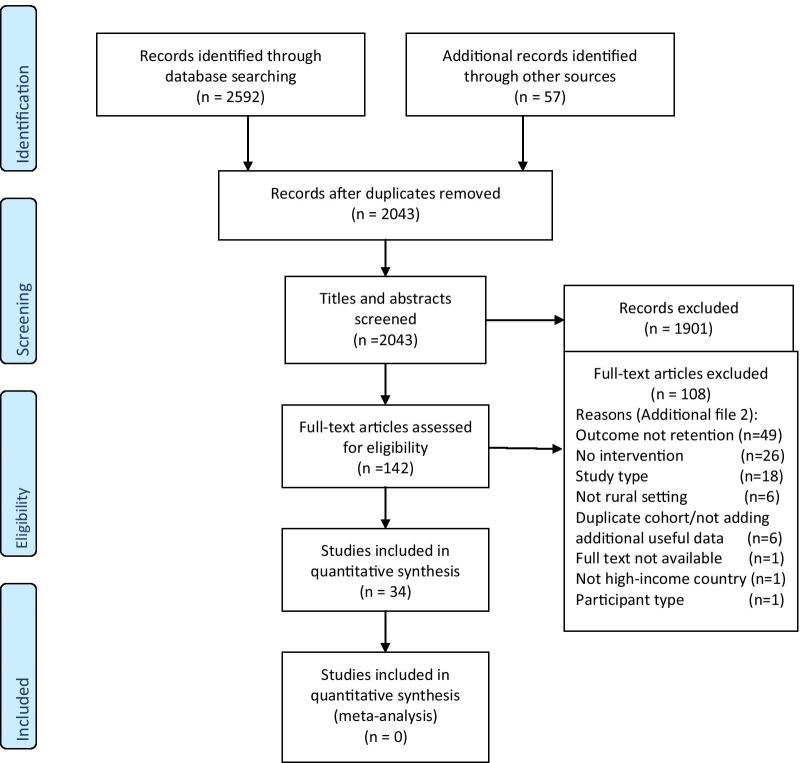
Background: Attracting and retaining sufficient health workers to provide adequate services for residents of rural and remote areas has global significance. High income countries (HICs) face challenges in staffing rural areas, which are often perceived by health workers as less attractive workplaces. The objective of this review was to examine the quantifiable associations between interventions to retain health workers in rural and remote areas of HICs, and workforce retention. Methods: The review considers studies of rural or remote health workers in HICs where participants have experienced interventions, support measures or incentive programs intended to increase retention. Experimental, quasi-experimental and observational study designs including cohort, case–control, cross-sectional and case series studies published since 2010 were eligible for inclusion. The Joanna Briggs Institute methodology for reviews of risk and aetiology was used. Databases searched included MEDLINE (OVID), CINAHL (EBSCO), Embase, Web of Science and Informit. Results: Of 2649 identified articles, 34 were included, with a total of 58,188 participants. All study designs were observational, limiting certainty of findings. Evidence relating to the retention of non-medical health professionals was scant. There is growing evidence that preferential selection of students who grew up in a rural area is associated with increased rural retention. Undertaking substantial lengths of rural training during basic university training or during post-graduate training were each associated with higher rural retention, as was supporting existing rural health professionals to extend their skills or upgrade their qualifications. Regulatory interventions requiring return-of-service (ROS) in a rural area in exchange for visa waivers, access to professional licenses or provider numbers were associated with comparatively low rural retention, especially once the ROS period was complete. Rural retention was higher if ROS was in exchange for loan repayments. Conclusion: Educational interventions such as preferential selection of rural students and distributed training in rural areas are associated with increased rural retention of health professionals. Strongly coercive interventions are associated with comparatively lower rural retention than interventions that involve less coercion. Policy makers seeking rural retention in the medium and longer term would be prudent to strengthen rural training pathways and limit the use of strongly coercive interventions.
Overview
The claims and statistics of this paper haven’t been checked yet.
Free: it reads the open-access text and checks the first 5 claims that cite a source we can check. Create a free account to check every claim.
Integrity signals
Registry
Cites
Statistics
Figures
Verification
Claims the paper makes
The claims and statistics of this paper haven’t been checked yet.
Free: it reads the open-access text and checks the first 5 claims that cite a source we can check. Create a free account to check every claim.
Claims other papers make about this one
Each is checked against this paper’s own text: does it say what the citing paper says it does?
The cited source says what the claim attributes to it.
In the citing paper
“A search for systematic reviews published in the last 10 years examining turnover intention among HCWs on PubMed, PROSPERO and Google Scholar produced nine relevant systematic reviews [11–19]”
From A global overview of healthcare workers’ turnover intention amid COVID-19 pandemic: a systematic review with future directions (2022) · cites this paper as [17]
The cited source says what the claim attributes to it.
In the citing paper
“and many of which were known factors prior to the pandemic [11–19].”
From A global overview of healthcare workers’ turnover intention amid COVID-19 pandemic: a systematic review with future directions (2022) · cites this paper as [17]
In the citing paper
“several systematic reviews highlighted an insufficient number of HWs to enable the provision of quality care, affecting health systems before and during the pandemic, with considerable inequities across countries worldwide [56–60].”
From Health workers’ perspectives on the quality of maternal and newborn health care around the time of childbirth: Results of the Improving MAternal Newborn carE in the EURO Region (IMAgiNE EURO) project in 12 countries of the World Health Organization European Region (2024) · cites this paper as [58]
Self-check
Percentages, sums and reported differences re-computed from the paper’s own numbers.
The self-check needs the paper’s full text.
Citations
Cites
Preferred Reporting Items for Systematic Reviews and Meta-Analyses: the PRISMA statement
Moher, D., Liberati, A., Tetzlaff, J., Altman, D. G., & for the PRISMA Group (2009) · BMJ · doi:10.1136/bmj.b2535 · Cited by 83,823
Preferred reporting items for systematic reviews and meta-analyses: the PRISMA Statement.
(2009) · PubMed Central · Cited by 44,859
Preferred Reporting Items for Systematic Reviews and Meta-Analyses: The PRISMA Statement
Moher, D., Liberati, A., Tetzlaff, J., & Altman, D. G. (2009) · Journal of Clinical Epidemiology · doi:10.1016/j.jclinepi.2009.06.005 · Cited by 19,575
Chapter 7: Systematic reviews of etiology and risk
Moola, S., Munn, Z., Tufanaru, C., Aromataris, E., Sears, K., Sfetic, R., Currie, M., Lisy, K., Qureshi, R., Mattis, P., et al. (2019) · JBI Reviewer's Manual · doi:10.46658/jbirm-17-06 · Cited by 2,114
Chapter 7: Systematic reviews of etiology and risk
(2020) · JBI Manual for Evidence Synthesis · doi:10.46658/jbimes-20-08 · Cited by 1,268 · cited 1×
“This systematic review accords with the Joanna Briggs Institute (JBI) methods for systematic reviews of aetiology and risk evidence [20] and followed an a priori published protocol which more fully describes methods and definitions [21].”
MethodHoltom, B. C., Mitchell, T. R., Lee, T. W.-H., & Eberly, M. B. (2008) · Academy of Management Annals · doi:10.1080/19416520802211552 · Cited by 1,042 · cited 1×
“However, studies reporting job satisfaction without direct turnover or retention outcomes were excluded [22], and we did not use the Grading of Recommendations, Assessment, Development and Evaluation (GRADE) approach for grading the certainty of evidence.”
MethodAnderson, I., Robson, B., Connolly, M., Al-Yaman, F., Bjertness, E., King, A., Tynan, M., Madden, R., Bang, A., Coimbra, C. E. A., et al. (2016) · The Lancet · doi:10.1016/s0140-6736(16)00345-7 · Cited by 990 · cited 1×
“A high proportion of Indigenous peoples live in remote and rural areas, and they experience considerably poorer health outcomes than non-Indigenous citizens [8].”
BackgroundPereira Gray, D. J., Sidaway-Lee, K., White, E., Thorne, A., & Evans, P. H. (2018) · BMJ Open · doi:10.1136/bmjopen-2017-021161 · Cited by 759 · cited 1×
“Hum Resour Health (2021) 19:103 the development of strong professional relationships between health providers and patients which are vital for improving health outcomes of vulnerable populations [2, 3].”
BackgroundWilson, N., Couper, I., de Vries, E., Reid, S., Fish, T., & Marais, B. (2009) · Rural and Remote Health · doi:10.22605/rrh1060 · Cited by 518
Grobler, L., Marais, B. J., & Mabunda, S. (2015) · Cochrane Database of Systematic Reviews · doi:10.1002/14651858.cd005314.pub3 · Cited by 359
Research works printed but not linked: 8
- Dolea C Increasing access to health workers in remote and rural areas through improved retention: global policy recommendations 2010 Geneva World Health Organization 23741785
- Tuttle C Rural-urban differences among older adults 2020 Minneapolis University of Minnesota Rural Health Research Center
- Humphreys JS Improving primary health care workforce retention in small rural and remote communities: how important is ongoing education and training? 2007 Canberra Australian Primary Health Care Research Institute (APHCRI)
- Aromataris E Munn Z Joanna Briggs Institute reviewer's manual 2017 Adelaide The Joanna Briggs Institute
- World Health Organization Increasing access to health workers in remote and rural areas through improved retention—global policy recommendations 2010 Geneva WHO 23741785
- Fleming P Mathews M Retention of specialist physicians in Newfoundland and Labrador Open Med 2012 6 1 e1 9 22567077 PMC3329069
- Patterson DG Family medicine rural training track residencies: 2008–2015 graduate outcomes 2016 Seattle WWAMI Rural Health Research Center, University of Washington
- Russell DJ, et al. Health workforce turnover, stability and employment survival in remote NT health centres 2004–15. In: Proceedings of the 15th national rural health conference, 24–27 March, 2019. Hobart, Tasmania: National Rural Health Alliance.
Cited by
Items 101–200 of 355
Roby, E., Mills-Koonce, R., & Mendelsohn, A. L. (2025) · Academic Pediatrics · doi:10.1016/j.acap.2025.103192 · Cited by 4
Contribution of a bonded scholarship scheme to staffing rural health facilities
MacGregor, R. G., & Ross, A. J. (2024) · South African Medical Journal · doi:10.7196/samj.2024.v114i3.1608 · Cited by 4
Towards a home‐grown rural health workforce: Evidence from Tasmania, Australia
Jessup, B., Tran, N., Stevens, T., Allen, P., & Barnett, T. (2024) · Australian Journal of Rural Health · doi:10.1111/ajr.13169 · Cited by 4
Jessup, B., Proudfoot, F., Cross, M., & Barnett, T. (2024) · BMC Health Services Research · doi:10.1186/s12913-024-11087-9 · Cited by 4
“…origin students into health courses given these students are more likely to remain in the state and work in rural areas post-qualifying [17, 21, 23, 54, 55]; and building high-quality placement capacity across the state, especially for allied health professions and those without local training…”
BackgroundInfluentialRamanathan, S. A., Ling, R., Tattersall, A., Ingold, N., Silva, M. S. D., Close, S., & Searles, A. (2022) · Human Resources for Health · doi:10.1186/s12960-022-00781-6 · Cited by 4
“In addition to existing strategies like recruiting more overseas trained doctors, and training more local doctors [13, 30], the MPA Program value adds to such initiatives through utilising an existing, non-scarce medical administration workforce to allows PNs and GPs to work at the top of their scope, relieve workload…”
BackgroundEdwards, D. J., Csontos, J. K., Gillen, E., Carrier, J., Lewis, R., Cooper, A., Gal, M., Law, R., Greenwell, J., & Edwards, A. (2022) · medRxiv · doi:10.1101/2022.05.11.22274903 · Cited by 4
Mature‐Aged People in the Rural Health Workforce System: A Systems Modelling Approach
Quilliam, C., Thompson, J., Crawford, N., McKinstry, C., Chambers, A., Bhat, R. S., & Stanbrook, L. (2025) · Australian Journal of Rural Health · doi:10.1111/ajr.13222 · Cited by 3
Seaman, C. E., Green, E., Barry, R. J., & Skipworth, A. (2025) · Journal of Advanced Nursing · doi:10.1111/jan.16878 · Cited by 3
“This has been demonstrated in research that has found retention interventions that use extrinsic rewards are less effective than those using intrinsic rewards (Manganelli et al. 2018; Niskala et al. 2020; Russell et al. 2021).”
An integrative review of new nurse practitioners’ experiences in rural healthcare practice
Stidolph, C., Kawi, J., Dingley, C., Hart, A. M., Giger, J. T., Benfield, R. D., & Reyes, A. T. (2025) · Rural and Remote Health · doi:10.22605/rrh9626 · Cited by 3
Espinoza-Castro, B., Encina, V., Garrido, M. A., Vinueza, F. I., Piedra, J. P. B., Garzón-Villalba, X. P., & Radon, K. (2025) · BMC Medical Education · doi:10.1186/s12909-025-07661-2 · Cited by 3
“Ecuador was selected as a case study due to its persistently high rates of COVID-19 infections among HWs [23], as well as the significant challenges in providing timely and accessible training, particularly in rural areas [24].”
Jones, D., & Allin, S. M. (2025) · Human Resources for Health · doi:10.1186/s12960-025-01028-w · Cited by 3
“Russel et al.’s (2021) systematic review of health workforce retention initiatives in rural and remote areas concludes that policymakers should seek to prioritise rural training pathways and educational interventions in order to increase retention of health professionals in rural areas [15].”
McIlveen, P., Beccaria, L., Luke, J., Bartlett, C., & Couch, D. (2025) · Journal of Higher Education Policy and Management · doi:10.1080/1360080x.2025.2593846 · Cited by 4
“…to healthcare practitioners’ attraction to and retention in rural practice (Beccaria et al., 2021; Butterworth et al., 2024; Cosgrave, 2020; Gillespie et al., 2022), such as recruiting graduates who were raised in rural communities (Ray et al., 2015; Russell et al., 2021; Skinner et al., 2022).”
Area remoteness and the distribution and attrition of the rural health workforce in Australia
Bakar, K. S., Radchenko, P., Ho-Nguyen, N., McDonald, E., & Bailie, R. (2026) · Human Resources for Health · doi:10.1186/s12960-026-01050-6 · Cited by 3
“The health workforce (HW) in Australia has been facing significant challenges over the past decades [1–3], particularly in rural and remote areas, where health inequities exist [4–6].”
Zerden, L. D. S., Arendt, V., Vakalahi, H. F. O., Lombardi, B. M., & Denby, R. W. (2026) · Social Work · doi:10.1093/sw/swag015 · Cited by 3
Ayalew, B. D., Khan, S. M., Teklehaimanot, H. K., Gorfu, Z. T., Batu, B. J., Alemayehu, Z. G., Sime, B. L., Zewde, E. K., Sharew, T. M., Hundisa, M. I., et al. (2026) · iRadiology · doi:10.1002/ird3.70054 · Cited by 3
Zakumumpa, H., Rujumba, J., Kyomuhendo, M., Stempler, L., & Amde, W. K. (2023) · Human Resources for Health · doi:10.1186/s12960-023-00824-6 · Cited by 3
“Retaining skilled and experienced HWs is critical in sustaining gains in HIV epidemic control [14].”
BackgroundPerceived Well-Being among Adults with Diabetes and Hypertension: A National Study
Leung, L. Y. L., Tam, H. L., Leung, I. S. H., Chan, A. S. W., Yin, Y., Zhang, X., Mao, A., & Cheong, P. L. (2024) · Healthcare · doi:10.3390/healthcare12080844 · Cited by 3
“However, the government should develop strategies to reduce the difference of uneven distribution of primary care workforces between states, and increased training and payment of locum relief may help in this regard [34].”
BackgroundHealth Professional Shortage Area Bonus Payments and Access to Care Under Medicare
Brunt, C. S. (2024) · Health Economics · doi:10.1002/hec.4924 · Cited by 3
Chan, M. K., Donnelly, P., Sullivan, F., Pope, L. M., & Gambhir, N. (2025) · BJGP Open · doi:10.3399/bjgpo.2024.0289 · Cited by 3
Yara, M., Kakazu, R., Hiyajo, Y., Machida, H., Kinjo, K., & Ohta, R. (2025) · Cureus · doi:10.7759/cureus.95688 · Cited by 3
Vélez, J. C. C., Garcia, T. N. F., Flores, M. A. D., & Robles, M. D. C. A. (2025) · Polo del Conocimiento · doi:10.23857/pc.v10i8.10332 · Cited by 3
Sağlık Çalışanlarında İşten Ayrılma Niyeti: Bibliyometrik Bir Analiz
Buse, M. E. T. E. (2023) · MEYAD Akademi · doi:10.59007/meyadakademi.1272021 · Cited by 3
Nursing Engagement with a Distant, Rural, Underserved Community
Solari-Twadell, P. A., Deichstetter, N. R., Delaney, M., Dunderdale, J., Barajas, J., & Marco, D. G. D. (2023) · Online Journal of Rural Nursing and Health Care · doi:10.14574/ojrnhc.v23i2.744 · Cited by 3
Hamby, C., & Smock, C. (2024) · Leadership in health services · doi:10.1108/lhs-06-2024-0054 · Cited by 3
Latham, H. A., Maclaren, A. S., Kock, J. H. D., Locock, L., Murchie, P., & Skea, Z. C. (2025) · British Journal of General Practice · doi:10.3399/bjgp.2024.0494 · Cited by 3
Experiences of Migrants and Refugees Accessing Healthcare Services in Regional Australia
Mude, W. (2025) · Sustainable development goals series · doi:10.1007/978-981-95-1987-3_9 · Cited by 3
Li, A., Toy, J., Purdy, K. S., Kirshen, C., & Liu, C. (2023) · Journal of Cutaneous Medicine and Surgery · doi:10.1177/12034754221149653 · Cited by 3
Karnik, H., Oldfield-Tabbert, K., Schulman, R., Brueshoff, B. L., Kirkland, C., & Orr, J. M. (2023) · Health Promotion Practice · doi:10.1177/15248399231217484 · Cited by 3
What have the Romans ever done for us?
Skinner, T. C. (2023) · Australian Journal of Rural Health · doi:10.1111/ajr.12990 · Cited by 3
Kapheak, K., Theerawasttanasiri, N., Khumphoo, P., Sriwongphan, R., Ritthimon, W., Chayaseng, C., Bokeo Provincial Health Office, B. P., Bounmaseng, P., Bokeo Provincial Health Office, B. P., Pangsri, N., et al. (2024) · Journal of Population and Social Studies · doi:10.25133/jpssv322024.038 · Cited by 2
Mabunda, S. A., Durbach, A., Chitha, W. W., Phiri, H., Phalane, M., Nomatshila, S. C., Joshi, R., & Angell, B. J. (2024) · BMJ Global Health · doi:10.1136/bmjgh-2023-013740 · Cited by 2
Doghman, J. H., Saba, S. C., & Bakhach, J. Y. (2025) · BMC Health Services Research · doi:10.1186/s12913-024-12198-z · Cited by 2
“The World Health Organization (WHO) suggests providing housing support and transportation assistance to physicians in this scope [14].”
Nurse workforce change and metropolitan medically underserved areas in the United States
H, D. B. M. P., Mauricio, K., & Ruscitti, B. (2025) · BMC Health Services Research · doi:10.1186/s12913-025-12228-4 · Cited by 2
Enhancing rural healthcare infrastructure of Bangladesh
Zhang, M., & Sajal, A. (2025) · World Journal of Biology Pharmacy and Health Sciences · doi:10.30574/wjbphs.2025.22.1.0441 · Cited by 2
“Here, we reveal programs that are trying to train medical personnel to work in rural areas by providing them with the information and training they need (Russell et al., 2021).”
Peng, W., McKinnon-Crowley, J., Han, J., & Bryant, J. (2025) · Family & Community Health · doi:10.1097/fch.0000000000000437 · Cited by 2
Jiang, X., Xu, J., Cheng, F., Zuo, X., Wang, D., Yin, W., Cui, L., Xie, F., Wang, L., Bobkov, A., et al. (2025) · BMC Public Health · doi:10.1186/s12889-025-23217-x · Cited by 2
“Secondly, in terms of medical professionals, Daniel and other scholars have found that high population density provides people with more employment opportunities and career development space and is more likely to attract high-level medical professionals [31–33].”
Huixian, Z., Haoqing, T., Li, M., Yiran, T., Leyang, H., Ren, L., & Xiao-yun, L. (2025) · Chinese general practice journal. · doi:10.1016/j.cgpj.2025.100063 · Cited by 2
Montesanti, S. R., Fleming, E., Furlano, J. A., Sjoblom, E., Oster, R. T., Roach, P., Roy, A., & Crowshoe, L. L. (2025) · SSM - Health Systems · doi:10.1016/j.ssmhs.2025.100109 · Cited by 2
Yasmin, Y., Moons, Phiri, Appelbaum, Nserebo-Banda, ger, K. ⁄., Weigel, & Chimalizeni (2025) · Rural and Remote Health · doi:10.22605/rrh9644 · Cited by 2
Lindsay, S., & Phonepraseuth, J. (2025) · Disability and Rehabilitation · doi:10.1080/09638288.2025.2548986 · Cited by 2
“Some evidence shows that rural ties help to retain health care providers in rural areas [81].”
The Australian oral health practitioner workforce: A scoping review
Carlson‐Jones, W., Pritchard, L., Do, L., Gray, J., & Stormon, N. (2025) · Community Dental Health · doi:10.1177/0265539x251381204 · Cited by 2
“…such as relocation assistance, rural loadings and housing support should be in place to attract and retain OHPs in underserved regions, especially with the imminent departure of DTs concentrated in public dental services and outer regional areas (Buykx et al., 2010; Russell et al., 2021).”
Sesay, M. A., Purwono, R., & Sukartini, N. M. (2025) · Jurnal Ekonomi Kuantitatif Terapan · doi:10.24843/jekt.2025.v18.i02.p01 · Cited by 2
Efendi, F., Has, E. M. M., Pradipta, R. O., Chong, M. C., & Ismawiningsih, I. (2025) · Journal of Transcultural Nursing · doi:10.1177/10436596251377894 · Cited by 2
“A more even distribution does not guarantee retention, as rural and remote areas often faced unique challenges such as isolation, security issues, limited resources, and fewer career opportunities (Russell et al., 2021).”
Hamby, C., & McNack, L. (2025) · Leadership in health services · doi:10.1108/lhs-04-2025-0068 · Cited by 2
Nooney, J. G., Kreiger, N., Bailey, N., Hesgrove, B., Donelan, K., Ziomek, S. B., Liu, H., Daley, K. N., Kirchner, J., & Kepley, H. O. (2025) · Nursing Outlook · doi:10.1016/j.outlook.2025.102578 · Cited by 2
Longacre, M. R., Kinney, L., Carluzzo, K. L., Watts, B. V., & Schifferdecker, K. E. (2026) · The Journal of Rural Health · doi:10.1111/jrh.70115 · Cited by 2
“23,43 One initiative, the Rural Interprofessional Faculty Development Initiative, provides training for residency proc-tors to train and mentor residents serving in rural areas.”
Godrich, S. L., Chiera, I., Stoneham, M. J., Doe, J., Devine, A., & Humphreys, E. (2026) · Health Promotion Journal of Australia · doi:10.1002/hpja.70150 · Cited by 2
“Supporting hub actors is important, especially in regional areas where staff recruitment and retention are challengingi [33].”
van Rooyen, & Larsen (2026) · Wound Practice and Research · doi:10.33235/wpr.34.1.42-48 · Cited by 2
Fletcher, M. C., Fitzgerald, K. W., Hamiduzzaman, M., Mander, G., Dettwiller, P. Y., & Dalton, L. (2026) · Australian Journal of Rural Health · doi:10.1111/ajr.70182 · Cited by 2
Predictors of Community-based Physical and Occupational Therapy Use After Stroke
Freburger, J. K., Mormer, E. R., Zhang, S., Ressel, K., Johnson, A. M., Pastva, A. M., Duncan, P. W., Bushnell, C., Patterson, C. G., Trogdon, J. G., et al. (2026) · Archives of Physical Medicine and Rehabilitation · doi:10.1016/j.apmr.2026.04.002 · Cited by 2
Powell, M., Halbleib, M. L., Rothwell, D., & Reznicek, C. (2026) · Health Affairs · doi:10.1377/hlthaff.2025.01726 · Cited by 2
Australian Rural Surgical Workforce: A Policy Analysis
Carmichael, G. J., Tranquille, T., Tano, V. D., Al‐Sharea, A., Kovoor, J. G., & Jacob, M. O. (2026) · Australian Journal of Rural Health · doi:10.1111/ajr.70208 · Cited by 2
Kensit, P., Islam, M. I., Ramsden, R., Geddes, L., Guisard, Y., Russell, C., & Martiniuk, A. L. C. (2024) · BMC Medical Education · doi:10.1186/s12909-024-05737-z · Cited by 2
“Comprehensive rural health workforce solutions to help address ongoing health workforce shortages in rural and remote settings are needed [2, 11].”
BackgroundAustralian medical practitioners: trends in demographics and regions of work 2013–2022
Cortie, C. H., Garne, D., Parker-Newlyn, L. A., Ivers, R. G., Mullan, J., Mansfield, K. J., & Bonney, A. D. (2024) · Australian Health Review · doi:10.1071/ah24101 · Cited by 2
Factors Influencing Health Career Choices During Clinicians’ First Three Years in Practice
Darlow, B. J. S., Brown, M., McKinlay, E. M., Gray, L., & Pullon, S. (2023) · Journal of Research in Interprofessional Practice and Education · doi:10.22230/jripe.2022v12n2a347 · Cited by 2
Valente, E. P., Mariani, I., Bomben, A., Morano, S., Gemperle, M., Otelea, M. R., Miani, C., Elden, H., Sarantaki, A., Costa, R., et al. (2024) · Journal of Global Health · doi:10.7189/jogh.14.04164 · Cited by 2
Optimising remote health workforce retention: protocol for a program of research
Veginadu, P., Russell, D., Mathew, S., Robinson, A., DeMasi, K., Zhao, Y., Ramjan, M., Jones, M. P., Boffa, J. D., Williams, R., et al. (2024) · BMC Health Services Research · doi:10.1186/s12913-024-11629-1 · Cited by 2
“In Australia, implementation of retention strategies which have been trialed either at the health service level or more broadly at the state/ jurisdictional level, are often based on limited empirical evidence [14], without insight into their effectiveness nor explicit description of how they work.”
BackgroundSelf-citationPerspective Chapter: Strategies for Enhancing Healthcare Access
Senbato, F. R., Wolde, D., Bifa, K. T., & Bikila, T. G. (2025) · IntechOpen eBooks · doi:10.5772/intechopen.1007530 · Cited by 2
Fox, J., Ballantyne, J., Drews, S., Tatangelo, K., & Pozzobon, L. D. (2025) · doi:10.1136/bmjoq-2025-qshu.242 · Cited by 2
Woods, J. A., Valentine, J., Gusterson, K., Fitzgerald, K. W., Fyfe, K. P., Fletcher, M. C., Hamiduzzaman, M., Dettwiller, P. Y., Fallon, T., Bon, C. D., et al. (2025) · BMC Geriatrics · doi:10.1186/s12877-025-06078-2 · Cited by 2
“Crucially in this regard, there is evidence that access to ongoing professional development, training and upskilling of this workforce promotes recruitment and retention [44], and thereby “can be key in breaking this cycle” [45] (p693).”
Supply-Side Impact of Supporting Obstetrically Underserved Areas: A Nationwide Cross-Sectional Study
Ko, H., Ock, M., Lee, S. W., Park, J. W., Kwak, M. Y., & Jang, W. M. (2025) · Journal of Korean Medical Science · doi:10.3346/jkms.2025.40.e186 · Cited by 2
“11 12 Several financial interventions have been employed to serve the underserved areas, such as paid locums guarantee, school subsidies, loan repayments, various allowances, reducing malpractice insurance costs, and adjusted reimbursement fees.”
Elliott, J., O’Malley, L., Walker, C., Erp, A. V., Martin, P., Chong, H. S., Sangelaji, B., & Fallon, T. (2025) · BMC Nursing · doi:10.1186/s12912-025-03324-1 · Cited by 2
Podubinski, T., Glenister, K., & Ferdous, H. S. (2024) · Australian Conference on Human-Computer Interaction (OzCHI) · doi:10.1145/3726986.3727900 · Cited by 2
“To address the maldistribution of the Australian rural health work-force, several strategies have been implemented, focusing on both educational and policy-based interventions [42, 44, 51].”
Pagotto, D. D. P., Marques, W. D. S., de Aquino, É. C., Guimarães, R. A., Júnior, C. V. B., & Isidro-Filho, A. (2025) · Saúde em Debate · doi:10.1590/2358-28982025e19797i · Cited by 2
Mabunda, S. A., Durbach, A., Chitha, W. W., Phiri, H., Phalane, M., Moaletsane, O., Angell, B. J., & Joshi, R. (2023) · BMJ Global Health · doi:10.1136/bmjgh-2023-013687 · Cited by 2
Pipkin, A., & Forero, L. H. R. (2024) · Qualitative Research Journal · doi:10.1108/qrj-12-2023-0195 · Cited by 2
Rosenbaum, D., More, E. A., & Orr, M. (2023) · Leadership in health services · doi:10.1108/lhs-02-2023-101 · Cited by 2
Hongkan, W., Muenpa, R., & Chamnan, P. (2024) · Education for Health · doi:10.62694/efh.2024.8 · Cited by 1
How team-based are rural or underserved clinics where AHEC scholars train?
Taylor, C., Carney, P. A., Stilp, C. C., & Wiser, E. M. (2024) · Journal of Interprofessional Education & Practice · doi:10.1016/j.xjep.2024.100723 · Cited by 1
Shiikha, Y., Ford, T. J., & Wright, H. (2024) · Journal of Paediatrics and Child Health · doi:10.1111/jpc.16625 · Cited by 1
“4,8,9 Similarly, fi nancial incentives, while having an important role, have not addressed structural and social factors impacting recruitment and retention, and thus have not been shown to demonstrate sustainable bene fi t. 16 In a review of literature assessing the social determinants impacting the…”
Curley, D., Kinsman, L., Mooney, G., Whiteford, G. E., Lower, T., Hobbs, M. J., Morris, B., Bartlett, K., & Jacob, A. M. (2024) · Australian Journal of Rural Health · doi:10.1111/ajr.13166 · Cited by 1
“Given the relatively high staff turnover reported in many rural health services, 35,36 steps to assess the longevity of the effects of such training and/ or supplementary booster training may be required moving forward.”
Factors Associated With the Recruitment of Primary Care Workforce in Rural Vermont: A Pilot Study
Waeldner, K., Kruglik, C. P., Halvorson-Phelan, J., Lee, J. Y., Taylor-Olson, C., Hammond, M., Fung, M. K. Y., & Carney, J. K. (2024) · Cureus · doi:10.7759/cureus.71941 · Cited by 1
Steel, B. S., Lovrich, N. P., & Pierce, J. C. (2024) · Rural and regional development · doi:10.70322/rrd.2024.10021 · Cited by 1
Connelly, D. M., Hay, M. E., Smith-Carrier, T. A., Guitar, N. A., & Prentice, K. (2024) · BMC Nursing · doi:10.1186/s12912-024-02524-5 · Cited by 2
“With a return-of-service model, BEGIN recipients must commit to working full-time hours for one year for each academic year of tuition they receive [49], which may increase the employment and retention of nurses in the LTC and HCC sectors [50].”
Well-being in Rural New Graduate Nurses Transitioning to Practice. A Pilot Study.
Urban, R. W., Porter, M., Jennings, L. A., & Mester, J. S. (2024) · Online Journal of Rural Nursing and Health Care · doi:10.14574/ojrnhc.v24i2.769 · Cited by 1
Cowes, V. L. G., & Landini, F. (2025) · Sexuality Research and Social Policy · doi:10.1007/s13178-025-01094-8 · Cited by 1
“Permanence stimulates continuity of care and the development of strong professional relationships between health workers and patients and improves health outcomes for vulnerable populations (López Palma et al., 2018; Russell et al., 2021).”
Zaytseva, A., Verger, P., & Ventelou, B. (2025) · Health Services Insights · doi:10.1177/11786329251331128 · Cited by 1
Pediatrician Characteristics Associated With Rural Practice and Retention: 2012–2023
Gottschlich, E. A., Frintner, M. P., Ray, K. N., Leslie, L. K., & Olson, L. M. (2025) · PEDIATRICS · doi:10.1542/peds.2025-070705 · Cited by 1
Zhou, Y., Long, R., & Liu, X. (2025) · Frontiers in Public Health · doi:10.3389/fpubh.2025.1527676 · Cited by 1
The Big Five Personality Traits of Medical Students Who Choose a Community-Oriented Medicine Career
Kanazawa, H., Yoshizawa, T., & Shimizu, I. (2025) · Cureus · doi:10.7759/cureus.88056 · Cited by 1
“…retention rate than less mandatory interventions such as the selection of university students with rural backgrounds and providing rural training during university and postgraduate education [44], and as a result, the number of health professionals working in community health may not increase.”
Ladjiru, E. F., Rianse, U., Nurwati, N., & Mahrani, S. W. (2025) · International Journal of Accounting and Economics Studies · doi:10.14419/xhvz0z92 · Cited by 1
Bakker, J. M., Nyaguthii, D. W., Andrews, B. C., Pratt, P., Mulbah, J., van Duinen, A. J., & Bolkan, H. A. (2026) · Human Resources for Health · doi:10.1186/s12960-026-01081-z · Cited by 1
“Training health workers locally has the added advantage of higher retention rate, in addition to better preparing them for the health system and context, where they will work [27, 33].”
McNeil, R., McGrath, R. L., Ackland, K., Oates, R.-K., Woodhart, L., & Wright, K. (2025) · BMJ Open · doi:10.1136/bmjopen-2025-105353 · Cited by 1
Current Challenges in Healthcare Delivery
Pamu, S., Sharma, A. M., -, S., Verma, A., Sharma, S., & Sharma, A. (2025) · BENTHAM SCIENCE PUBLISHERS eBooks · doi:10.2174/9798898811563125010005 · Cited by 1
Medicaid Expansion and Patient Safety Culture in USA Hospitals
Forbes, J., & Arrieta, A. (2025) · International Journal of Environmental Research and Public Health · doi:10.3390/ijerph22121795 · Cited by 1
“Policymakers should consider targeted workforce incentives, such as educational interventions, loan forgiveness programs for rural providers and financial grants to support hiring and retention in smaller hospitals [30].”
Error Traps in Global Anesthesia
Kabwe, J. C., Mwiga, F., Albert, R., Rai, E., Tumukunde, J. T., & Bould, M. D. (2025) · Pediatric Anesthesia · doi:10.1111/pan.70086 · Cited by 1
“…in enhanced working conditions, enabling the specialist to effectively apply the new skills they have acquired, or offering better salaries, such as bo-nuses for working in remote and rural areas, along with chances for continuous professional development, training, and collaboration [16, 17].”
Teilhabe von Pflegekräften mit Migrationsgeschichte
Weidinger, T., Bendel, P., Kordel, S., Bekyol, Y., & Wagner, T. A. (2025) · doi:10.25593/978-3-96147-859-0 · Cited by 1
Медицинская миграция Республики Казахстан: Внутренние и внешние тенденции, факторы и пути решения
Kulkaeva, G., Demushkan, O., Gheorghita, S., Karzhaubayeva, S., Касымова, А. М., Сатбекова, Н. Н., & Т., Б. А. (2025) · Journal of Health Development · doi:10.32921/2663-1776-2025-60-6-jhd033 · Cited by 1
Huang, X., Deng, X., Liu, E., Zhang, C., Tang, M., Lei, X., & Deng, H. (2026) · Frontiers in Public Health · doi:10.3389/fpubh.2026.1743744 · Cited by 1
Krauthausen, M., Wingender, L., Deyerl, V. M., Hagen, P. E., Leutritz, T., & Simmenroth, A. (2026) · BMC Medical Education · doi:10.1186/s12909-026-08776-w · Cited by 1
“This stands in contrast with study results showing that financial support measures within programme design is crucial for equity and for achieving long-term retention in rural practice [39].”
Narang, J., Ratcliff, C., & Kanth, V. (2026) · Frontiers in Health Services · doi:10.3389/frhs.2026.1695441 · Cited by 1
What Should Be Done Right Now for Better Health System in 10 Years?: Health System Reform Tasks
Oh, J., Lee, S.-I., Park, K., Oh, S.-W., Ahn, J., RyuOk, H., Ha, E. J., Cho, S.-Y., Kim, S.-J., Cho, E., et al. (2026) · Korean Journal of Family Practice · doi:10.21215/kjfp.2026.16.1.1 · Cited by 1
Budhathoki, N. K., Humphreys, J. S., Mathew, S., Menezes, L., Ramjan, M., Stephens, D.-M., DeMasi, K., Zhao, Y., Lawrence, K., & Russell, D. (2026) · Australian Journal of Rural Health · doi:10.1111/ajr.70170 · Cited by 1
“One recent systematic review synthesised quantitative studies of the effectiveness of rural and remote retention interventions [13].”
Self-citationBridging the gap by improving access to psychological services in low resource settings
Reddy, C., Godinho, J. D., & Kumar, A. R. P. (2026) · Discover Public Health · doi:10.1186/s12982-026-01835-z · Cited by 1
Barriers to Surgical Colorectal Cancer Care in the Rural United States: A Scoping Review
Murthy, J. J., Hernandez, E., Groves, E., Train, K., Hendren, S., Hernandez, J. A., Suwanabol, P. A., & Mullens, C. L. (2026) · Diseases of the Colon & Rectum · doi:10.1097/dcr.0000000000004217 · Cited by 1
Harvey, P., Debenham, J. R., Hutchinson, J., & Brown, L. (2026) · Australian Journal of Rural Health · doi:10.1111/ajr.70209 · Cited by 1
Short‐Term Fixes, Long‐Term Gaps: Addressing Rural Health Workforce Challenges in Queensland
Nguyen, T., Elliott, L. M., Johnston, K. A., & Topp, S. M. (2026) · Australian Journal of Rural Health · doi:10.1111/ajr.70214 · Cited by 1
Park, S., & Yang, E. B. (2026) · BMC Medical Education · doi:10.1186/s12909-026-09681-y · Cited by 1
“Two primary strategies—recruiting students who may pursue a career as rural physicians and providing educational programs that encourage such career choices—have been recognized as crucial [5, 6].”
Exploring Competencies and Skills of Australian Rural Psychologists
Moody, M. P., Loi, N. M., Rock, A. J., Usher, K. J., & Rice, K. (2026) · Australian Journal of Rural Health · doi:10.1111/ajr.70228 · Cited by 1
“Participation in rural training has been associated with higher retention rates in rural communities, as it prepares clinicians for rural practice [15].”
Metadata
- Authors
- Russell, D., Mathew, S., Fitts, M., Liddle, Z., Murakami-Gold, L., Campbell, N., Ramjan, M., Zhao, Y., Hines, S., Humphreys, J. S., & Wakerman, J.
- Affiliations
- Charles Darwin University (AU)
- Flinders University (AU)
- Government of the Northern Territory (AU)
- Monash University (AU)
- Corresponding author
- Russell, Deborah
- ORCID
- Venue
- Human Resources for Health
- Published
- 2021-08-26
- Volume
- 19
- Issue
- 1
- Pages
- 103-103
- ISSN
- 1478-4491 (ISSN-L)
- PMC
- PMC8393462
- OpenAlex
- W3193525039
- Cited by
- 268
- References
- 66
- Citations by year
- 2026: 53 · 2025: 85 · 2024: 66 · 2023: 49 · 2022: 15
- FWCI
- 7.99
- Type
- journal article
- Language
- en
- Open access
- gold
- doi.org
- Licence
- cc-by
- creativecommons.org/licenses/by/4.0 (tdm)
- creativecommons.org/licenses/by/4.0 (vor)
- Locations
- Human Resources for Health (publishedVersion, cc-by)
- PubMed Central (publishedVersion, cc-by)
- PubMed (publishedVersion)
- DOAJ (DOAJ: Directory of Open Access Journals) (submittedVersion, cc-by-sa)
- Funders
- australian research council (DP190100328)
- australian government medical research future fund
- Topics
- Health Sciences › Medicine › Public Health, Environmental and Occupational Health › Global Health Workforce Issues
- Social Sciences › Education › Education in Rural Contexts
- Health Sciences › Health Professions › General Health Professions › Healthcare Systems and Challenges
- Keywords
- health workforce retention, rural health workers, remote areas, rural health workforce shortage, loan repayment, visa waiver, professional licensing, coercive measures, non-medical health professionals, high-income countries
- MeSH terms
- Workforce, Cross-Sectional Studies, Health Workforce, Humans, Medically Underserved Area, Rural Health Services, Observational Studies as Topic
About these checks
Registry, retraction, Cites and statistics results are computed, not judged, with one exception: a printed reference that no index lists is read once by a model before it counts as a citation error. Claims are extracted by a model and kept only when their quote appears verbatim in the text; each cited source is then checked, with a model’s help, for whether it says what the claim relies on. Those verdicts can be wrong — read the claim’s quote and the cited source before relying on one.
Statistics and arithmetic are recomputed, not judged.
Confidence bands are shown only for fields calibrated on our annotated test set. None is calibrated yet, so no band is shown.
What counts as a claim ›How we measure confidence ›How we check this ›
Are you an author, or do you see a problem with this page? Request a review
Data sources
Bibliographic data: Semantic Scholar, OpenAlex, Crossref.
Contains information from the Semantic Scholar Academic Graph Datasets, made available under the ODC Attribution License (ODC-BY 1.0).
Semantic Scholar’s data is described in: Kinney, R., et al. (2023). The Semantic Scholar Open Data Platform. arXiv:2301.10140.
